June 19, 2009

Don't be a shankapottamus, Barack


It occurred to me the other day, as I remarked to a contemporary of mine, that this is the first time in my life that I am older than the President. Came close a couple of times - Bill and George - but they had me by a couple of years. A bunch of you reading this, I know, can say the same. Feels a little weird, doesn't it? It might be more important than it appears at first glance, too.


I'm beginning to think that Barack's basic problem is a lack of experience. While all those jaded solons over at Congress give him his props as a talented wunderkind, they're not in the least afraid of him. The stuff they're pulling is really outrageous now, on both sides of the aisle. Completely out of control. 75% of the American people want a public option as part of an overall health insurance reform act. The outline coming out of the Senate committees working on the matter simply omits the public option, in favor of a lot of health-industry-written nonsense about "savings" through things like standardization of claim forms. Yeah, that'll do it.

They're telling him what to do on defense, too. The defense budget is increasing again. How many times can we recite the same statistics that, for one example, the U.S. defense budget is ten times larger than the country in second place, China, or that American spending accounts for over half of all defense spending in the world? Are we afraid of a superior military force attacking us from another solar system?

The regulatory reform Geithner is proposing is a sick joke. When banks, investment banks, hedge funds, your Uncle Carl decide to go into the mortgage securitization business and create a bunch of Triple A bonds out of tranched and smooshed garbage loans, and then sell them to the Norwegian Teachers Pension Fund or something, they now have to hold on to 5% of the loans. They can only sell 95% of the derivatives into the secondary market. Yep, that 5% equity stake will keep 'em honest!

And Barry, your Justice Department is still carrying all that Bush Administration water. Why are you and Eric Holder so committed to the coverup of Bush & Cheney's crimes and misprisions of office? Huh? The latest is your opposition to the release of the FBI's notes of the Cheney interview regarding Valerie Plame, the 67 pages which CREW (the Washington watchdog agency) is seeking through a FOIA action. (And why must every disclosure be the result of a long, painful, expensive FOIA action where your administration fights tooth and nail to prevent the public from seeing public documents paid for by public money? Where's this frigging transparency you were talking about?)

Dude, you gotta do what the E-Trade Baby would tell you to do. Rise up! Grab the reins! They're rolling you, I really believe it. Unless, of course, despite my seniority it is I who is being naive. It is very easy to see what is going on in the Senate. The corruption is so patent, so palpable, so self-admitted (Durbin: "The banks frankly own the place.") that it's no longer possible to give them any benefit of any doubt about their motives. It is now so obvious that it is becoming ridiculous. Tom Daschle, a healthcare industry mouthpiece that you tried to install as your Health & Human Services Secretary (but couldn't because his corruption was too brazen even for Senate confirmation), comes out and urges you to "drop" the public option because it's "unworkable." It's unworkable for his clients, is what he means.

So whose side are you on? Was that stuff during the campaign about working for the people a bunch of happy horseshit? Now that you're in Washington, D.C., it's just more fun to ride in the Gulfstream and be with the other big players and not mess the game up that serves the insiders so well?

We're going to find out over the next couple of months. If you roll over for this neutered healthcare bill, written and purchased by the health insurance industry, and you don't raise ever lovin' Hell on behalf of the 75% of Americans who are demanding a real change in the most basic of human needs, health, you're done. Even if you don't necessarily win this battle, you better try really hard to do the people's work. Can you get angry? Can you read the riot act to these crooks, then leave the room slamming the door behind you so they start to realize you mean it? You think they're going to give up the millions contributed to their campaign funds because you call them up and sweetly ask for their "help?"

Your acquiescence in a sell-out will deprive you of your real constituency, average American citizens. And from then on, you'll be utterly powerless.

June 17, 2009

What would Niccolo say about Obama?


It's been a lot of years since I read Il Principe, Machiavelli's masterwork on political science (incorrectly translated as "The Prince"). Nick's basic thesis is that wielding power is not for the faint of heart; if you go about it timidly, you're certain to be deposed. Thus, an effective and durable leader must be ruthless from the beginning. Especially at the beginning, in fact, because that's when the leader is most vulnerable to overthrow. Machiavelli espoused a lot of actions which don't really fly in modern democracies with functioning judicial systems; he advocated, for example, that the New Prince, if he's interested in fundamental change, should act immediately to neutralize not only his political opponents but also his political allies who might rise up as rivals. And when he said "neutralize," you know, he didn't mean reduce their salaries. Stalin was said to be a great student of Machiavelli's work, which is why his inner circle came to appreciate that it was only a matter of time before Joe turned on them too.


Well, we don't do things that way anymore. Still, the underlying idea is still sound. A new leader needs to move decisively and boldly at the outset before his political opponents have a chance to organize their resistance. You can't actually kill them anymore, but you can still neutralize them in legal and institutional ways. Obama did campaign on promises of Big Change, so he does not have the argument that his adherence to Bushian policies, for example, or his Full Employment Act for Clintonista Wall Street gorgons like Robert Rubin and Larry Summers, are what he said he was going to do. In fact, a lot of what he has done is exactly what he said he was not going to do; a prime example is his principle of "preventive detention" for Guanatanamo inmates (and elsewhere) who can't be tried and can't be released (according to him), or his denial of habeas corpus for prisoners in places like Bagram in Afghanistan on the specious theory that the Supreme Court's ruling in Boumeddiene didn't specifically say it applied to inmates in places other than Guantanamo. Even if the circumstances of their capture and detention were exactly the same. Even if they wound up in Bagram because they were transferred from Guantanamo. Well, Boumeddiene didn't say specifically that it applied to inmates born on Wednesday, either.

The positions Obama's Administration has taken on state secrets, illegal wiretapping, telecom immunity and investigations of war crimes have been godawful. His Justice Department keeps shocking even conservative federal trial and appellate judges. Obama promised transparency but he never, ever delivers. Where the hell did all that money go that Congress doled out under the TARP? Well, it's better if you don't know, he says. There are just a lot of things the American people shouldn't be told, and it's for their own good.

On more substantive, crucial issues, like global warming and healthcare reform, his positions have been tepid, seemingly more designed to placate the "Left" than to lead. Bill Maher, who's a pretty good weathervane for moderate, liberal sentiment, took Obama to task last Friday night on "Real Time," and I thought rightfully so. Obama's defense spending is the same as Bush's (and Reagan's, in constant dollars). He's talking Social Security "reform" instead of blowing the whistle on the thievery from the "trust fund" which put us in this mess.

Look, the economy's not going anywhere anyway. The last 30 years were built on the unsustainable accumulation of debt. There are no bubbles left to inflate. As Nouriel Roubini says, the economy might stop bottoming out by the end of the year, but it's not going to grow because there are no engines to drive it. It's going to wallow in dangerous high seas, while the international community (such as those Brats at BRIC), start organizing an alternative currency system to replace the fiat dollar. Man, Barry, you think you got problems now...

Reading The Fifties by David Halberstam (and to repeat: what a shame this great man is gone), I was struck by this historical fact. Before 1949, the United States derived 2/3 of its energy from coal. Between 1949 and 1972 a basic shift occurred in which the U.S. derived 2/3 of its energy from petroleum. What made the United States great, along with its creativity and huge advantage in being the only intact manufacturing country to emerge from World War II, was that its economy became dominant during the Age of Oil, a resource which the USA had in abundance for a long time and which was amazingly cheap. Cars, freeways, suburbia, chain motels, fast food, the "Green Revolution" in food production-- all either invented here or brought to their highest expression, and all related to cheap oil. The energy regime built on oil has become a massive liability, both in terms of carbon emissions and balance of payments. Without a fundamental shift in energy paradigms, we're toast, literally and figuratively.

So, Barack -- stop screwing around with Gulfstream flights to New York and trips to the burger joints. This is not a public relations job you were hired to fill. The technology for a new energy regime, solar, wind, geothermal, is here. Read Harvey Wasserman's Solartopia - by 2030, zero emissions. It's doable and it's the only way out. You can't run an economy without energy or without jobs, and jobs depend on energy. Focus here. Tell Afghanistan and Iraq to go to hell. Stop promising aid every time Air Force One touches down in some foreign airport. Stop talking about how you're going to fix every country's problems but our own.

Niccolo would tell you that you've only got a brief window to establish your dominance. After that, your main constituency, the People, will begin to lose interest in you, and then your political opponents at Fox News and in the Republican Party will realize you can be rolled and contained. And then you're going to become like Clinton, looking for other things to do to pass the days in the Oval Office.

June 16, 2009

My lonely quest to revisit the rationale for the Afghan invasion


So now Khalid Sheikh Mohammed has stated in a "court" document (in a kangaroo forum, no doubt delivered by diplomatic "pouch") that he lied while under torture about a lot of things, including his knowledge as to the exact whereabouts of Osama bin Laden. This one should probably go in the "Duh" file, but while we're thinking about it: didn't we just find out that the Bush Administration was waterboarding detainees in order to establish a link between 9-11 and Iraq? Thus, how major a leap of deduction is it to wonder whether the Bush Administration, having already invaded Afghanistan in late 2001, was looking for additional support for its contention that Afghanistan was essential to the planning and training of the 9-11 hijackers, and tortured KSM and others to get it?


Probably no leap at all. Someone, someday is going to sift through the Report of the 9-11 Commission and note again all that evidence that was derived from KSM, the Gurgling Confessor, about bin Laden's role in the plot, such as those riveting passages where the "muscle hijackers" (the 15 non-pilots who were almost all from Saudi Arabia) trained on the high-tech jungle gyms of Kandahar and were personally selected by Osama bin Laden as he watched them go hand-over-hand on the bars and dive cunningly through the barrels. Osama sounds a little like Rosa Klebb from "From Russia With Love." Can't you just see her (to help, that's her up above) walking up to a hijacker, slipping on her brass knuckles and giving the ol' abs a wallop? KSM could picture it, even while the water filled his lungs, and he told the interrogators so. Yep, all that Kandahar training was certainly critical to overpowering unarmed female flight attendants on commercial aircraft and opening an unlocked cockpit door.

So KSM now says he's not sure where Osama was at the time he was "testifying." It's a little unclear, because the Obama Administration is being very difficult (as is becoming always the case) about releasing documents, and when they do release them, they've had the hell redacted out of them. But suppose that Dore Gold, in writing "Hatred's Kingdom" (about the essential role of Saudi Arabia in international Wahhabist terrorism), was right when he claimed that no credible evidence existed that any of the 19 hijackers had ever been to Afghanistan. If this is actually the case, then the argument for invading Afghanistan is reduced to the presence of Osama bin Laden in that country on or about 9-11, and the "harboring" of OBL by the Taliban. Yet if OBL's role was essentially logistical and financial, and the training camps were not involved in the plot, what is the actual rationale for the military invasion of this specific country? Couldn't these planning/paymaster roles be conducted from any country with enough caves?

I kinda wonder what's in the redacted parts of the KSM affidavit - how far he went in recanting his testimony, how much he claimed to know that he didn't, how much he said just to please the guys with the towels and hoses. And I wonder why the Obama Administration, which has become so zealous about focusing us now on this war as the war of "necessity," is being so secretive about the redactions. KSM's original testimony was cited at great length in the 9-11 Report. Why would his recantation suddenly become a matter of national security?

June 15, 2009

It takes two parties to tango


Having become semi-addicted to reading David Halberstam's histories of the recent American past, I'm now deep into his fascinating The Fifties, which just happens to be the decade that my consciousness was formed. It's still early in the decade, as far as my bookmark is concerned, because those years between 1950 and 1954 were chockablock with tidal changes in the American political landscape as the United States assumed its role as the only real economic superpower in the world, and, for a while at least, the only nation with the H-Bomb. The Republicans were able at last to throw off about 20 years or so of complete electoral frustration, the two decades between the first election of FDR in 1932 and Ike's election in 1952.


What's striking are the historical parallels between our present time and the early Fifties. I think the French do have it right when they say the more things change, the more they remain the same. The early Fifties, between 1950 and 1954, were marked by McCarthyism, a symptom of the extreme anti-Communist feelings of the era. Anyone and everyone could be labeled a traitor, even native American scientists such as J. Robert Oppenheimer who ran what was probably the single-most successful technological enterprise in American history, the Manhattan Project. He was sold out by the rabid anti-Communist Edward Teller, a Hungarian refugee with personal axes to grind against the Soviets, because of Oppenheimer's misgivings about building the "Super," or hydrogen bomb. Oppenheimer's attitude was shared by many scientists and politicians, most of whom could hardly be called "fellow travelers." But it made no difference in those hopped-up times of loyalty oaths, blacklisting and paranoia. Richard Nixon made his reputation by his tireless work in persecuting Alger Hiss and his smear campaign against Helen Gahagan Douglas, all on the basis of alleged Communist ties.

McCarthy was an irresponsible alcoholic whose ideas were championed by the owner of the Chicago Tribune; in much the same way, Rush Limbaugh, a confessed prescription narcotic addict who probably long ago burned out his synaptic wiring, is the current voice of the Far Right, combining both mouthpiece and media sponsor. The players have changed but the basic tactics have not. In the Fifties we had the Commies, and the invective of the Right against the Democrats was directed at their "appeasement" of the Soviets, or of themselves adopting "socialist" policies from the New Deal. In our time, the Right attacks the Democrats because they are "soft" on terrorism or Muslim nuclear proliferation, and are imposing a "Socialist" order of public medicine and government ownership. In both historical epochs, the reaction of the Democrats has been the same: to move to the right into their own brand of anti-Communism and latter-day anti-terrorism to avoid the charge of being soft on defense.

The net effect is to homogenize the two parties when it comes to national defense issues and national defense spending. Truman had no choice but to react to the North Korean invasion of the South in the summer of 1950 (which many American isolationists, including Republicans, opposed) because any other approach would have played into the hands of his Congressional political foes. The monolithic view of Communism and the Soviet Union, in which the Cold War was seen as a battle for dominance over the Third World, was applied indiscriminately to every situation by both parties, so that no distinction was made between actual Soviet aggression (as in Hungary in 1956) and regional, nationalistic revolutions as in Vietnam and Yugoslavia. It was all just "Communism."

Thinkers who took a more particularist, nuanced view, such as the great Kremlinologist George Kennan, were of course shouted down in the general frenzy. The question always remained whether the Soviets ever had any intention of extending their hegemony beyond the Eastern bloc of satellite countries which they conquered at the end of World War II. They "earned" these countries by dint of their staggering losses in opposing the full brunt of the Wehrmacht, over 20 million dead, which dwarf the casualties sustained by the United States. Josef Stalin could not be dislodged without yet another global war, and no one wanted that in 1945.

Islamic terrorism has picked up where Communism left off. The important thing is always to have an enemy which poses an existential threat so the American populace is held in a constant state of dread. As a kid in the Fifties, we periodically crawled under our desks and clasped our hands behind our necks. As long as we weren't too near the windows, I guess that would do the trick for a 10-megaton H-bomb exploding over San Francisco 18 miles away. Or probably not.

I think it's realistic to worry about Islamic terrorists acquiring an operable nuclear bomb. I guess in that sense I agree with Dick Cheney. (Write a blog, amaze yourself with what you say.) I don't see how fighting wars in Iraq and Afghanistan in any sense lessen the odds of such a thing happening. International protocols on the security and protection of all fissile material and nuclear bombs, rigorously enforced, are probably the only real defense. No matter how long we go on fighting in Afghanistan and Iraq, the fact remains that we will never reach the point where we can say that every single terrorist capable of wreaking destruction on the U.S. with a weapon of mass destruction has been killed, captured or neutralized. Such common sense, however, runs counter to the natural inclination to use our huge military resources to deal with any situation which arises, because (a) those are what we have, and (b) nothing looks tougher than aircraft carriers and smart bombs, no matter how inappropriate to the problem at hand.

I guess that's why the Obama Administration's approach to the Great War on Terror seems roughly comparable to the Bush/Cheney years. You simply can't afford to make too much sense in the American political arena, not with the other party always ready to leap onto any show of "rationality" as a fatal sign of weakness in the face of the Enemy. So Obama fires up the war in Afghanistan, decelerates in Iraq, and the band plays on.

June 12, 2009

Keeping bad company


Naturally, one problem with trying to be "objective" about President Obama is that you realize, over time, that you're in league with some truly awful people: racists, lunatics, Right Wing "patriots" verging on a form of Fascism. Increasingly, this "objective center" in American life is a mirage - no one really lives there. Charles Krauthammer, one of the Washington Post's big name columnists, writes this today:


"Not that Obama considers himself divine. (He sees himself as merely messianic, or, at worst, apostolic.) But he does position himself as hovering above mere mortals, mere country, to gaze benignly upon the darkling plain beneath him where ignorant armies clash by night, blind to the common humanity that only he can see."

That's how Krauthammer responds to Obama's Cairo speech, and in particular to the President's reference to the CIA coup in Iran in 1953. This piece of historical honesty enraged Krauthammer, predictably enough, and it sent him into a tirade about "false equivalencies" in the Obama speech. Everything which has ever occurred in the Muslim world has been horrific whereas any mistakes ever made by the United States have been trivial and the result of good intentions with unfortunate outcomes. In essence, that's his argument, proof that the Right's ideas of American Exceptionalism have not changed at all since the days of Mario Savio. We're good, they're bad.

Krauthammer goes so far as to suggest that Obama's speech raises a question about Obama's "ambivalence" about his own country. You see, you can't be an effective leader unless you're as jingoist as Charles Krauthammer. But even more, look at the language in the quote: isn't this simply the fancy-pants (and sort of indirect) way of calling Barack Obama an uppity Negro?

Of course it is. And this is the problem with objectivity in America. Barack tried it in Cairo and this is the reception he gets. If I had one moment of Barack's time, I think what I would tell him to do is to simply and absolutely forget any kind of overture toward the Right. Don't even try it anymore.

More than any other writer I know, Glenn Greenwald has demonstrated over and over again that the American public is more "progressive" and liberal than the Beltway conventional wisdom. The Washington insiders repeated over and over again, for example, that the public would never stand still for defunding the war in Iraq, even while rigorous poll after poll demonstrated the exact opposite to be the case - the American people were way ahead of the Washinton establishment on this issue. I think sometimes that Barack's focus on the equally absurd war in Afghanistan results from a similar Beltway calculation, that the "American people" favor this endless overreaction to 9-11, and even if it's been going on for 8 years and shows no sign of abating, nor shows any sign of progress, the American people just won't abide a cessation of this battle. And it makes Barack look like a "war President."

I actually think what goes on is that Obama and Rahm and the other White House thinkers believe that they won't be able to withstand the withering attacks from the Right, from Fox News and the Washington Times, et cetera ad nauseum, if they were to take the commonsense measure of ceasing hostilities that do us no good. Yet what is the relevance of the "Right" or of Republicans generally if they have lapsed, as they have, into inchoherent lunacy and extremism? Who cares? Why is Obama kowtowing to people who cannot be reasoned with and who consider him "messianic" for trying?

Obama won a HUGE victory in November, and he won it because he seemed so different from what the American people had grown sick of. I wish he would take the obvious lesson from that message. It literally doesn't matter what Krauthammer, or Bill Kristol or Rush Limabaugh or Newt Gingrich or Sarah Palin or Bill O'Reilly or any of these people think - not at all. The only relevance they have is a gift from the "center:" the extent to which rational people pay any attention to them or make any effort to placate them.

June 11, 2009

Those Kodak Moments from the Bush Era


Although I was asked recently for my opinion on this Big Question of whether the most recent batch of torture photos should be released, or suppressed along the lines demanded by Senators Joe Losingit,man (Idiopathic, CT) and Lindsey Ismybutttoobig Graham (R, Deep Closet), I have demurred from so opining. Until now, I guess. Barack is with the two stalwart Defenders of the Troops on this one, whereas the ACLU is the other way.  The ACLU won their FOIA case so the proposed Congressional intervention, actually, amounts to a kind of bill of attainder of the sort used in the Terry Schiavo case, a special statutory enactment to reverse a result in a specific lawsuit.  What the hell - it's not as if the Constitution matters anymore.


The court ruled that the FOIA exceptions for national security had not been demonstrated by the Department of Defense.  Obama, Losingit,man and Graham, on the other side, contend that the photos amount to cumulative evidence of things we already know about, and if the photos are released, the troops in harm's way in Iraq and Afghanistan
 will be endangered more than they're endangered already by fighting completely pointless, inflammatory wars in very hostile territory.  

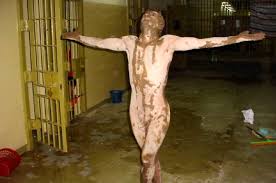
Obama's position represents a reversal of his earlier decision in favor of disclosure.  That's okay with me.  Changing his mind, I mean.  His predecessor prided himself on often being in error but always resolute.  Bush never changed his mind simply because all of the facts and the rationale for his earlier decision had vanished.  W just wasn't that wishy-washy.  But Barack says, on further review, that we don't really need to disclose another photo album full of naked Arabs being humiliated, led around on leashes, piled up in pyramids, and probably much worse.  If these photos get out, then we can expect more roadside explosions, more random attacks on U.S. soldiers, and increased overall murder & mayhem.

I think that's probably right.  I doubt that we'd learn anything materially new.  The sado-homoerotic excesses of the Bush/Cheney/Rumsfeld years have been well documented already. They messed with these Arabs not to "break" them or to elicit valuable information, but because they got off on it.  Of course, that's the whole problem.  It's why these photos would be so inflammatory - those subjected to this sort of humiliation and their countrymen are going to explode if this documentary evidence sees the light of day because they know how pointless, gratuitous and frigging sick all of that stuff was, and they're under no illusions it was the work of a few bad apples.

The White House, in league with Senators Losingit,man and Graham, have the advantage of arguing now that these photographs are of historical interest only because the Obama Administration doesn't do that sort of thing.  They abide by the Geneva Conventions and the Army Field Manual in handling detainees, with the small possible glitch of detaining people for life without charges and without even necessarily believing that any case could be proved. Nobody's perfect.  Still, point for their side.  The ACLU's argument is simpler: we won our FOIA case and the Administration is stonewalling.

The morality of the situation is somewhat ambiguous.  The Administration's argument amounts to a claim that these photographs are the best proof of abuse and provide clear, graphic evidence of what we did to detainees.  Providing this clear proof to the Arab world will make them angry about things we actually did, as demonstrated by the photos.  So we must not provide this evidence to the world at large, because then all U.S. soldiers, even that great majority who have had no part in the abuse, will be at greater risk.

I guess where I come out on this is that there just doesn't seem to be a heroic stand to take.  I think both wars are pointless in the first place, and the invasions have been accompanied by hideous, flagrant and unnecessary human rights violations, which we would like to cover up to the extent still possible.  That's our moral position.  It seems like a long way from Nuremburg. Still, what good does it do to get more U.S. soldiers killed in an effort to make a "clean breast" of something which cannot be exorcised?  More guys come home in coffins, more Arabs die in the gunfights and explosions which follow, and all to prove what we already know.  

I suppose that's the intellectual and emotional journey that Barack Obama followed in arriving where he did.  Nothing very uplifting about it.  Interference with the processes of law, a coverup and suppressed evidence.  Yippee.


June 10, 2009

Single Payer for the Single Citizenship Citizen


A college buddy of mine just left for an extended visit to Europe, including a stay in his new country of citizenship, Ireland.  He's become a dual, courtesy of the ancestor-based invitations from such countries as Ireland, Italy and Greece, which recognize lineage as a basis for naturalization. Probably part of a family feel in those places, plus Italy and Ireland, at least, suffer from chronic depopulation problems and brain drains, so recruitment of those nostalgic about the Old Sod (and who might have some money to spend during their legally-unlimited stays) is not a bad investment. The dual citizen gets an EU passport, recognized in 27 countries as a basis for residence and employment.  So maybe the new Irishman will stay indefinitely if he finds work. The odds over there can't be a lot worse than here.


Meanwhile, back on the New Sod, I was listening yesterday to the Big Ed Shultz Show on "progressive" radio.  Big Eddie's been whipping his listeners into a frenzy about the Single Payer issue that may or not be on the table for discussion by Congress.  Ed used to host a fishing and hunting TV show in the Midwest somewhere, sort of a Marlin Perkins in a motor boat thing, I guess, with lots of closeups of Ed netting a bass.  I don't really know.  Big Eddie doesn't know much about health insurance, or national politics for that matter, but he has very strong opinions.  He's one of those guys whose career in opinion-flogging was given a huge boost by George W. Bush.  That, at least, must be said for W - he was so outrageously bad and incompetent, so disgraceful, that millions of Americans had their consciousnesses raised politically, and half-assed bloviators like Big Ed rushed in to fill the vacuum.

Yesterday Ed let a guy rant and rave for about ten minutes on the failure of Congress ever, ever to do anything for the "little guy," by which I think he meant (in the midst of his hyperventilating) a middle class American, that vanishing species.  This is true, of course.  If you're in your prime working years, earn any kind of living, are not a government employee or in the military, you will essentially receive nothing from the government other than the basic services (roads, infrastructure, public education) received by everyone else.  I am personally a piece of evidence for this truth.  I'll receive Social Security someday (a vestige of the Roosevelt Administration) and qualify for Medicare (from Johnson's Great Society), and that's it.

My medical insurance premiums are $718 per month with a $5,000 deductible.  The premiums have doubled in the last two years, although I have never submitted a claim for medical treatment at any point during the last twenty years or so, and I use twenty because I can't remember back any further than that.  To receive an insurance "benefit" I would have to go out-of-pocket $13,000 during a calendar year.  This is my biggest monthly expense.  

It's the way we do things here in our Darwinist Sparta.  The caller was right, of course, that Congress does not do any thing for the little guy, but it never has. If you're poor or disabled, you can receive benefits under some circumstances.  If you're middle class and get sick, you may go bankrupt whether you have medical insurance or not.  Medical bills are the cause of 62% of all personal bankruptcies in the United States, yet in 75% of those situations, the bankrupt is insured.  I'll do the math for you, since other blogs don't necessarily do so: that means that in about 46.5% of all bankruptcies, medical bills incurred by an insured person cause the b/k.

Thus the clamor for Single Payer, or Socialized Medicine, to call it by its real name.  Naturally, such a program cannot arrive on the scene full-blown; it must be introduced by stealth, in the form of the "public option" which Cigna/Aetna/Blue Cross and Senator Max Boughtman (I hope you're reading this every day) are desperately trying to ward off.  Obviously, a public option could probably match what amounts to a yearly $13,000 deductible, and since most people hate their medical insurers (I know I do - just reading their nauseating, shameless, cloying, disingenuous, dishonest letter explaining the latest rate hike was almost enough to send me to the emergency room, which may actually be covered despite the deductible), insureds would abandon Blue Shield and Aetna in droves at the first opportunity.  Thus, the $20 million annual salary of some of the CEO's at these big companies would endure a kind of "stress test."

The stakes are high and corruption is likely to kick into even higher gear.  I don't think Prez O will succeed in any kind of meaningful reform this time around, and his presidency will begin to fade some time later this year because of this failure.  It's just too easy for the Senate, in particular, to block him, loaded up as it is with pro-insurer Republicans and corrupt Democrats. Johnson was able to get his monumental Great Society through Congress because he played the hardest kind of hardball - famous for saying that a solon's "pecker was in his pocket." That's the only way to get a corrupt politician to move - scare the hell out of him.  This is not Obama's way, and since he actually only spent two years in the Senate (unlike Johnson, who had been the Majority Leader), I don't think he knows how to play the right games or knows enough about where the bodies are buried.

We'll get something, a "public option" that no one, unfortunately, qualifies for, in much the same way that "foreclosure" relief was unavailable to any "little guy" who actually needed the help - that is, if you were behind on your payments, you couldn't get government help, which is to say, you could only get foreclosure relief if you weren't in foreclosure.  This public option will have some devilishly clever small-print detail, rather like the "donut" in the Plan D Medicare benefit, which makes it functionally useless and defangs it as a threat to for-profit medicine.

But at least we're "safe," sort of, or at least we're led to think so. If you die because you can't afford treatment, at least you'll do so behind fortress walls, and not in some place like Ireland or Italy, where they would take care of you but can't protect you from the jihadi.

June 09, 2009

Washington as a company town


Well, O knocked 'em dead over in Egypt and France, so much so that I've been thinking I should go through the archives here at the Pond and purge any negative reference to The One, the better to increase the favorable receipt of my resume at the White House in case I want a job in the West Wing.  I've been thinking maybe I could be Special Assistant to the President in Charge of Funny Names.  I've got a new one, by the way, a moniker for Max Baucus, the Senator from Aetna/Cigna/Blue Cross -  Max Boughtman.  Not bad, huh?  To go with Mr. Mumbles (Harry Reid), La Diva (Nancy Pelosi), Lindsey "Is-My-Butt-Too-Big?" Graham, et alia.  


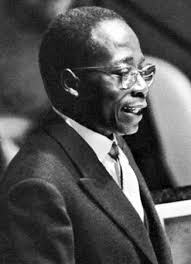
Barack's only serious failing is that he arrived kind of late in history.  I think he means well, and he's a classy guy.  It was good that America finally elected a minority, especially an African-American, to the nation's highest office, even if we waited until what may prove to be the waning days of the Empire.  Naturally, a black man capable of election by the general population in this country is not going to be Street; you know, like Stokeley Carmichael, one of my favorites from the Civil Rights Movement.  Man, that guy could bring it.  Barack reminds me more of Leopold Senghor (pictured above), the poet, academic, and political leader of Senegalese liberation from colonialism.  Cool, sophisticated, kinda French (where he was educated and where one of his wives was from - Normandy, in fact).  Stokeley, on the other hand, was with the Student Nonviolent Coordinating Committee ("Snick"), got involved with the Black Panthers, and was altogether too hot for general acceptance.

It's probably true that Barack did not actually spend enough time in Washington's milieu before he became President.  Realistically, maybe 4 years, and then he started running for President full-time.  He had his eye on the prize.  I think what he's coming up against is the basic reality of Washington, D.C.  The business of the federal government, when you get right down to it, is the care and feeding of the military establishment, or in Eisenhower's phrase, the military-industrial complex.  Here he is now submitting his own "supplemental" for the wars in Afghanistan and Iraq, to the tune of maybe $100 billion when all is said and done.  The Republicans, faithful rubber-stampers when Bush was in office, will fight him on the bill because they've discovered a new, deep belief in fiscal prudence, so the ridiculous spectacle of the "anti-war" Nancy Pelosi marshalling her Demo charges to get "Barack's war budget" through the House will now entertain us.

If this sounds insane, it's because it is.  The Republicans, of course, are not against the war, are not for fiscal prudence, and actually want to do everything they can to keep the money flowing to the Pentagon, to defense contractors and to their lobbyist friends.  But they can safely fight Obama's war budget because the Democrats can't afford to have Barack defeated on the funding necessary to "wind down" the war in Iraq and rev up the war in Afghanistan, which he calls a war of necessity.  Or did in Cairo, anyway.  So the Democrats now have their war, but the main thing, probably, is that whichever party is in power, some war or other is going to be "necessary."

Wars are good for a major American industry, that industry being war itself.  The United States is on a permanent war footing, and the MIC spending necessary to support it sops up most of what the federal government calls its discretionary budget.  About half the money Congress "spends" each year, after all, is simply the in-and-out of the entitlement programs, which have their own dedicated tax systems and have been self-supporting.  These programs are of no real interest to Congress.  The discretionary half is where the action is, and about 64% of this goes to the MIC.  So peacenik Senators like Barbara Boxer are nevertheless thrilled that the Pentagon is moving ahead with plans to build a redundant aircraft like the C-17, which is built, coincidentally, in California, and the equally useless and unnecessary B-22 is built in Georgia, so Saxby Chambliss will champion that one.

Useful programs like socialized medicine for the public at large do not have a constituency large enough to change this inertial force, so they're doomed to failure.  This is the essential difference between the U.S. and countries such as France and Germany, which have broad social safety nets but without the concomitant burden of a huge military establishment.  Trying to "Europeanize" the U.S. is doubtless beyond even the rhetorical skills of Barack Obama, and even Leopold or Stokeley would struggle with that one.  Wars R Us.  Constant war keeps all that military spending credible (it flagged under Clinton because he just didn't have anyone he could rationally engage in a large land war), it keeps army recruitments up in a time of general unemployment, it enables lots of medal ceremonies and promotions, gives a raison d'etre to West Point and Annapolis, to use a phrase Monsieur Senghor might have employed. Selling weapons remains one of our better export businesses, after all, and it doesn't have much company.  So that in the same sense that New York is the financial capital of the U.S., and Los Angeles the movie industry's center, Washington is war headquarters central.  It's what they do there, one way or another.  We've been fighting wars so long no one can even remember why we're doing it anymore.

My guess is we'll keep it up till it breaks us, which, actually, might not be that far off.

June 04, 2009

From Sproul Steps to Cairo University


Very interesting, Mr. Obama.  The buzz is just starting up, but in time Prez O's admission yesterday in his speech at Cairo University that the CIA engineered the overthrow of Mohammed Mossaddeq (pictured here) will be seen as a major turning point in U.S. foreign policy.


The Right Wing is already getting hysterical.  Mitt Romney, of the immovable hair and room temp IQ, is crying foul.  This sort of thing just isn't done.  How dare Obama admit the truth in such an unflattering way, and in front of a foreign audience!  That latter point, wait and see, will be emphasized increasingly over the next few days, because the first part of the criticism is a little disingenuous, after all.  The CIA did engineer the overthrow of the democratically-elected Prime Minister of Iran in 1953, and we had help from the British, and we did it because the anti-imperialist, highly-educated (a Master's in Law from the Sorbonne, a PhD in Philosophy from the University of Lausanne) Mossaddeq decided to nationalize the Iranian oil industry, which at the time was known as the Anglo-Iranian Oil Company (the forerunner to British Petroleum).

A Persian friend of mine, born in Tehran, told me a number of years back that it was this coup that did more to sour U.S. - Iran relations than any other historical event.  And what really bugged the Iranians is that the whole operation only cost about $300,000.  That's bang for the buck, I have to say. But I don't recall any other American President ever openly admitting the numerous roles the U.S. has played in overthrowing inconvenient heads of state.  George W. Bush sort of hinted at it as part of his justification for toppling Saddam; in effect, Bush said that for too long the U.S. had aligned itself with repressive dictators and that it was time to change course.  That was the funny part about our former Prez and his drug-ravaged brain: occasionally he just blurted out the embarassing truth, such as his admission that the country was "addicted" to oil.

America was addicted to oil back in 1953, of course, and the last thing the Eisenhower Administration wanted to see was a movement in the Middle East toward nationalization of the oil industries.  We more or less owned the (royal) family-run filling station known as Saudi Arabia, we had big stakes in Kuwait and Iraq, and Mossaddeq was setting a dangerous trend.  If these sovereign countries started claiming the oil under their land was theirs, where might that lead?  Mexico had already nationalized its oil industry, with the able assistance (as an ideologist) of none other than Leon Trotsky.

Which brings up a salient point.  The cover story for our deposition of Mossaddeq was that he was "leftist" and pro-Soviet, and in 1953 you can imagine that such a rationale had huge selling power.  Which Mitt Romney, his diminutive brain working fast under that hat of high-tensile- strength hair is bound to mention, once his handlers mention it to him.  Ditto Rush Limbaugh and the Dittoheads, and Michael Medved and Pat Buchanan and on and on.  Obama is taking things out of context.

Not really.  He's setting the record straight.  Mossaddeq was a nationalist and an anti-imperialist, and that's why the Iranian Majlis (Parliament) overwhelmingly elected him in 1951.  He had no intention of freeing his country from foreign domination in order to become a Soviet satellite, any more than Ho Chi Minh intended to become a Communist satellite in throwing off the French in Indo-China.

Attending that bastion of non-Mainstream Thought, the University of California at Berkeley in the late Sixties, I of course had become quite familiar with the Mossaddeq story in history and political science classes.  It was so radical to talk about the CIA's role in overthrowing a foreign head of state.  I frankly considered it another elaborate conspiracy theory that one heard daily from the Sproul Hall Steps.  Now we have the President of the United States openly acknowledging it as the truth.

He's a smart guy, that O, and he knows that the story doesn't stop there.  Pick up any tome of Noam Chomsky and you can read the extensive list of similar covert coups: Guatemala, Honduras, the Dominican Republic, Cuba, Chile, Greece, Iraq (not Saddam, the other one) and numerous others.  All essentially for the same reason: we wanted a reliable, Right Wing, business-friendly thug to oversee the safety and profitability of our business interests in these places.  You see, we didn't really build this country on rock 'n roll: we built it by extracting profit from the Third World, as Britain had done before us, and the Dutch and Romans before that.

How much of that can the Prez afford to admit?  And if he does, will he choose Sproul Steps as his venue?  If he does, I'm, like, there.

June 03, 2009

Getting outside the box


I saw myself quoted at length on a website maintained by a pro-Rick Perry group in Texas, people working to help Perry defeat the challenge of Kay Bailey Hutchison for the Republican nomination for governor. Which in Texas is tantamount to the election itself, of course.  The webmeister down there in the Lone Star State liked my takedown of Keith Olbermann; in essence, I thought Olbermann's criticism of Perry's "secession" remarks was a little uninformed.  It's fine to list all the glories of being part of the USA, but while you're at it you should not argue that sending all that tax money to Washington D.C. (and dealing with the legal consequences of the Supremacy Clause, which makes it difficult for medical marijuana people, for example, to be entirely free of federal hassles at the state level) is an unadorned blessing.  It's definitely not.  Plus, sometimes I just think Keith gets carried away with himself in his self-appointed role as vindicator of the Liberal American Tradition, especially because his technical grasp of legal issues, for example, is micrometers in depth.  Still, overall I think he does valuable things, and his break with corporate complicity when he started his Special Comments was a watershed event, and he is to be commended for his courage.  It looks easy in retrospect, but at the time it was shockingly refreshing.  But now I've given the Texans "Ol'Blowhard" as a sobriquet, and they're running with it.


Okay with me.  I write more in the vein of Mark Twain or H.D. Thoreau, that of an observer rather than a reformer.  I don't really believe the United States can be reformed, so it's easier now than ever to adopt that posture (or pose, if you like).  Those who argue the other way are often in the business of arguing reform; that is, they make their living at it.  That would make it worthwhile and help to overcome the cognitive dissonance.  I think the United States is simply too corrupt, too complex and too incomprehensible at this point to be successfully reformed through the democratic process.

The "single payer" issue tentatively raising its head (in order to be blasted away) is probably one example (among thousands) that might be used to demonstrate the point.  As Michael Moore pointed out so eloquently in "Sicko," we're the only major industrialized country in the world which insists on keeping health care a for-profit business.  This leads to literally sickening results, such as Moore's footage of a poor homeless woman "transferred" by USC Hospital to a skid row clinic in downtown LA by buying her a cab ride.  I had my own extensive experience with the American medical system during my mother's last, lingering fatal illness.  In the middle of all that anxiety and trauma, I couldn't believe how much time I had to spend arguing with the hospital's "social worker" (whom I called The Bouncer) about just how soon they could get my mother out of there.  I had to argue, cajole, plead, threaten them, to get them to do a simple blood test of her hematocrit so she wouldn't be sent home in a dangerously anemic state (lab work costs money, you see).  It was heartbreaking.  And that was with the benefit of Medicare.  I can't imagine what people go through who are too young for Medicare and too broke to buy insurance. I guess that woman staggering in the gutter in Los Angeles could tell us.

The medical system is rotten to the core.  And more than that, as I was saying to a friend, it underlies the basic lack of social cohesion in this country.  If you can treat other people like that, let them die so medical insurers can continue to profit and so that certain people can have "world class" treatment for their illnesses while others have none, then you've passed judgment on the value of American life.  You don't take it seriously, and you don't regard it as your problem, either.  We are absolutely not in this together, and all this rah-rah stuff about "9-11" and "supporting the troops" and the rest of it is a bunch of steaming bullshit.

So if a Rick Perry website wants to quote me, go ahead.  I think it's a hoot.  If Texans actually want to secede, to try something else, why should they not be allowed to do so?  We're not really going to assemble an "Army of the Potomac," invade and seize Austin, are we?  Where would we get the troops?  Aren't they all deployed in Afghanistan and Iraq, and hell, aren't a great percentage of them Hispanics from Texas anyway?

When people begin to talk that way, about secession and other way-outside-the-box notions, it's because they are beginning to give up on the idea of national reform.  They see a federal government borrowing 50 cents of every dollar it spends, and spending 64% of its discretionary money on a huge, bloated military establishment with 750 bases and forts worldwide, with entitlement programs careening toward fiscal collapse, and still refusing to rein in its profligacy in fighting completely useless, irrelevant wars -- and it registers, perhaps unconsciously at first -- this is completely nuts.  And so very strange ideas start popping up.

I don't blame Barack Obama for this stuff, by the way, just for the record.  All of this is beyond his ability to control outcomes.  I like his style, his intelligence, his class, the respectful way he treated Nancy Reagan, his calm temperament.  I imagine myself in a conversation with him, maybe somewhere on the Upper West Side in a bar, loosening up, and then saying some of the stuff contained herein.  And I think he would flash that incandescent smile and say, "It is a mess, isn't it?"


June 02, 2009

North Korea Plans North American A-Bomb Test


June 2, 2009 (New York Times) - In a relentless approach to raising both the stakes and the visibility of his country's atomic bomb program, President Kim Jong-Il announced today that North Korea's next nuclear test would be conducted in mid-town Manhattan sometime "within the next couple of weeks."  Having successfully tested a 13-kiloton bomb at an underground site in North Korea recently, the Dear Leader stated that he was in no mood "to fok awound" and served notice that his country's nuclear ambitions would not be deterred by Western pressure or threats.


Nevertheless, top Administration officials were quick to respond.  "This is outrageous and unacceptable," said President Barack Obama in answer to a question from Katie Couric in a network TV interview last night.  "America has shown restraint so far and has agreed to talk without preconditions to North Korea about its nuclear program.  But exploding an A-bomb at the corner of 57th Street and 7th Avenue cannot but retard the progress of these talks. I condemn this decision to detonate a nuclear bomb in one of America's iconic cities, a melting pot and symbol of all that makes America great, in the strongest possible terms."

Vice President Joe Biden joined the President in criticizing the latest North Korean initiative. In an interview on "Hardball" with Chris Matthews, the garrulous VP laid it on the line in particularly candid terms:  "You know, I just don't get this guy, Chris.  I mean, what's in it for him?  He's got the poofy hair and he looks like he could use a little sun. The family name's Kim, for all I know he's the real deal, it's not personal. People talk about my hair, too, sure, but this is an A-bomb, for crying out loud, and he's setting it up to go off right in midtown.  I know that area, there are some good restaurants there, the Knicks play right down the street at the Garden, and hey I know what people are saying, the Knicks, will anyone even notice?  But that's neither here nor there, Chris, I mean for crying out loud, this is way, way, way over the line. I'm telling everybody I know not to go anywhere near New York till we get this thing sorted out.  I mean, come on.  An A-bomb?"

Secretary of Defense Robert Gates, in what is becoming characteristically frank and unguarded language, admitted that the U.S. had "taken its eye off the ball" in fighting the ghosts of the 9-11 hijackers by launching two wars against Muslim countries, neither one of which any hijacker ever visited or called home.  "I frankly believe we have misallocated American resources by overemphasizing the need to invade countries which use Arabic letters or have mosques or something," said a stern and obviously concerned Gates.  "We have managed to burn through enormous amounts of money, gotten lots of people killed, including tons of our guys, so they definitely look like real wars, so that part appeals to me. We just haven't been clear on why we're doing it, and that's probably because we're not sure. But while we've been occupied with that, Kim Jong-Il has gone ahead with this atomic bomb program, and now he's tested a big one underground, and he's testing missiles, and while we were surging in Aghanistan he went ahead and set up this nuclear blast in midtown Manhattan and I'm thinking there could be hell to pay if he succeeds with this one."

Press Secretary Robert Gibbs, at the White House press conference this morning, echoed the comments of other Administration officials.  "The President has a lot on his plate, and believe me we didn't plan to start our term in office with the worst recession since the Thirties, and now this, an A-blast on 57th Street, but President Obama has said many times that we're going to have to be able to deal with a number of crises all at once, whether that's the ideal way to do things or not.  So this Manhattan bomb is something that will get a lot of his attention, and he'll work with the Congress in a bipartisan way to come up with an appropriate response."

Harry Reid (D-Nev.), Senate Majority Leader, said that a focused response from the Senate was highly unlikely.  "We just don't have the 60 votes," he said.


June 01, 2009

Slouching toward the poor house


Maybe it's just the way things are now.  The fossilized approach to all problems, no matter how big, is all that's possible.  I read Michael Moore's take on the failure of General Motors, something he's followed since the early days of its decline (his "Roger & Me" being his first big movie hit), and I think he's right.  In part, of course, I think he's right because it's what Waldenswimmer said several months ago.  The auto factories owned by GM should be transformed into modern transportation factories building mass transit (light rail) and high speed rail locomotives and rolling stock, with some aspect of its ongoing car business used to build fuel-efficient hybrids and electric cars.  It's time to phase the internal combustion engine out, and put all those trained factory employees to work building technology with a future.


Michael cites the example of World War II as precedent: during the war, GM stopped building cars and converted to tanks, jeeps and machine guns, among other war-related manufacturing. GM did it fast, too, and did it successfully.  The United States government has invested enormous sums of money in attempts to resuscitate General Motors, more than the capital stock of the company is actually worth.  Why not use that stake to simply buy the corporation and its subsidiaries?  Why this idea that GM is going to "emerge" as profitable by tweaking its economic model?  Why, in other words, this pointless and very expensive magical thinking?

Well, for one thing, FDR isn't President.  The current crop of Democratic "leaders" just can't pull the trigger, and that includes Obama.  They keep thinking that thinking small will succeed, that an incrementalist approach to overwhelming problems will restore the U.S. economy from its present moribund state to a thriving, job-producing colossus. It won't.  The recession may "end," but the U.S. economy will nevertheless be stuck at a level of affluence about 40% lower than when the crisis began in July, 2007.  The only way out is to create jobs, and the only practical way to create jobs is to move to a completely different energy paradigm.  Obama keeps using the word "green" as kind of talisman; well, here's a chance to actually implement a "green" solution on a massive scale. 

FDR established Social Security by refusing to believe that the country had been reduced to a state where old folks could be forced to subsist on tins of cat food heated on gas rings.  Obama, faced with a similar crisis in healthcare which affects 50 million people, is stalled in his approach because the medical insurers and hospitals don't like his "public insurance" element, so the "negotiations" have broken down.  This is how blatant the control of business over government has become: if private industry says no, then we can't do it.  So forget single-payer, as Waldenswimmer also said a long time ago.  Blue Cross doesn't like it.  So the effect of all those uninsured Americans is that every year 18,000 Americans die unnecessarily, according to a study by the Institute of Medicine.  Six times as many people die every year as died in the 9-11 attacks, yet we've turned the world upside down to deal with those 19 hijackers who casually walked through our security systems and trained themselves to destroy us using our flight schools, but the expansion of Medicare to cover everyone cannot be done, because...a large group of insurers and hospitals are making more money the other way.  So, instead of actual medical care, let's put all the medical records online.  That should do it, and I'm sure there will never be a problem with hackers accessing the medical records of every living American and broadcasting them all over the world.  Meanwhile, it will look like we're doing something, and that's always the key.

As I said before, I've been reading this history by David Halberstam about the Korean War, particularly that first terrible winter of 1950-51, when the delusions of Gen. Douglas MacArthur led the Marines and Army into a terrifying trap in the far north of Korea.  Surrounded by 300,000 Chinese infantry which MacArthur said simply weren't there, the field leaders of the Marines trapped near the Chosin Reservoir and the Army farther west had to think for themselves.  The most creative, brave and resourceful of those leaders, such as General Paul Freeman of the Army and Gen. O.P. Smith of the Marines (picture above), figured a way out that avoided massacre.  Sometimes doing timid, half-hearted measures simply doesn't work.  FDR recognized that reality.  The current batch of corporate errand boys in Congress and the White House simply don't.  It's quite possible to incrementalize your way to the poor house.

May 31, 2009

La plus ça change, plus c'est la même chose


8:00 am, Oval Office, Monday, June 1:

Prez O enters through side door.  Robert Gibbs, Press Secretary and Rahm Emmanuel, Chief of Staff sit on sofa waiting. They rise to greet the President.  O bumps fists with both, slaps palms, then bumps elbows.  The two white guys, still getting familiar with routine, consume about 30 seconds of meeting with ritual.

O (sitting down):  What up, Bobby?
Gibbs:  General Motors is going under today.
O:  Bummer.  On my watch.  How does this play, Rahm?
Rahm:  We've positioned it well.  It's a penny stock now, everyone expected it.  Getting Soto nominated late last week was a stroke.  We've had 24/7 cycle on that one while the Republican nut jobs went nuclear on her, so no one will notice when a couple hundred thousand more guys are thrown out of work.
O:  Cool.  The timing worked.
Gibbs:  Sure did.  High five!
O:  We don't do that one anymore, Bobby.
Gibbs:  Right.  Yeah, it was Sonia from the jump, but holding off till you needed her played well. 90% of the questions have been about Sotomayor's racism.  Who gives a shit about General Motors or Kim's A-bomb?

(chuckles all around)

Rahm:  It's almost too easy sometimes.  I'm starting to see how even Bush could pull this off.
Gibbs:  Candy from a baby.
Rahm:  Weird, though.  Where we're taking on water is this date night thing, the trip to New York.
O:  I was worried about that.
Rahm:  It's not playing.
O:  I promised Michelle during the campaign.
Rahm:  Big whoop, is how Peoria sees that one. 
Gibbs:  I'll need my catcher's mask this morning.
O:  You know how many times Bush took that 747 to Crawford?  How much that cost?
Rahm:  Right.  It's a talking point.  
Gibbs:  Where we're vulnerable is we used to talk about "change."
O:  We saw an ethnic play, man.
Rahm:  Which is good.  Bush would have gone in for a remount of "My Fair Lady."
Gibbs:  The Gulfstream is better than Air Force One, but it's got that odor of Wall Street around it.
O:  Were we supposed to drive to New York?
Rahm:  Thing is, you're supposed to be big on global warming.
O:  And?
Gibbs:  It's discretionary flying.  Of kind of the most self-indulgent type.  Entourage, special trip instead of when you're going to the U.N. or something.
O:  Shit.  Where we were these comments on Friday?
Rahm:  Plus, you know - the country's kind of out of work.  Your man Geithner is fighting tooth and nail to defend the Wall Street exec lifestyle, and then you join in.
Gibbs:  The optics are off.
O:  One frigging date night...
Rahm:  We need a flak-catching strategy.
O:  I"m not giving a Rev Jeremiah speech.  Forget it.
Rahm:  Doesn't call for that.
Gibbs:  I'm going to get a lot of Q&A on the cost of this thing.
O:  What's the play on that?
Gibbs:  Better not to say. That's our line so far.
Rahm:  Of course, there's the transparency thing.
Gibbs:  They're starting to say we're transparent about being opaque.
O:  Do I apologize?
Gibbs:  That looks weak, especially because it will make it look like you're apologizing for fulfilling a promise.
O:  Well, hell...
Rahm:  It's a box canyon.  You'd be apologizing for poor judgment.
O:  The idea was the date night thing was good PR.  Where'd we go wrong?
Gibbs:  I think we got cross-ways on our images, that's all.  Self-indulgent power broker versus family man in love with his wife.  We played into a trap.
O:  Just soldier through, Bobby. Get on their case about not asking about the A-bomb.  Or GM.
Rahm:  That's the stuff, Barry.  You're getting the hang of this now.

(meeting concludes)


May 29, 2009

Who's Next?


"First we got the bomb,
but that was good,
'cause we love peace and brotherhood..."

Tom Lehrer, "Who's Next?"

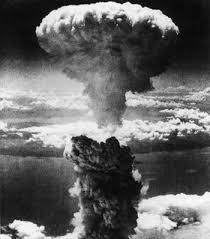
It appears that North Korea detonated a 13-kiloton atomic bomb not too long ago, burying it six miles deep in a huge cavern to disguise detectable details about the blast.  It was most likely an implosion device similar to the "Fat Man" design first tested at Alamogordo by the United States in the Trinity shot, July, 1945.  A Fat Man bomb was detonated over Nagasaki on August 9, 1945, with horrific results, as we know too well.  The kiloton yield of this bomb was similar to Nagasaki.

While many Western commentators are quick to analyze Kim Jong Ill's dogged determination to go nuclear as an effort to deter Western (and more specifically American) invasion, I have a feeling it's not as simple as all that.  That's a comforting analysis used by those who are somewhat over-ready to blame America for everything, and while there's always much to criticize about a country which is so influential and controversial, it seems more likely to me that Kim wants a bomb because he's nuts.  Arguing that he wants a bomb to "protect" his North Korean subjects is doubtless a contradiction in terms; if he actually cared about North Koreans, they would not live in a dirt-poor police state, subject to immediate internment (and probable death) in the Yodok Concentration Camp, which may rival Auschwitz in terms of sheer numbers killed at this point.  If one argues that Kim is simply being rational and self-defensive (as is argued often when talking about Ahmadinejad), then it reverses the argument and places the onus on the United States to behave rationally.

Yet, as noted, there's no particular reason to believe that Kim Jong Ill is rational at all.  He is hypothesized as rational in order to fit into the scheme of a predetermined argument, which is that all the United States has to do is behave itself and nothing bad will ever happen, at least where North Korea is concerned.  Rational motives and self-regard are imputed to Kim: he wouldn't be so foolish as to launch a preemptive strike against the West Coast of the United States because his own country would be vaporized in return.  He would, in other words, be committing suicide.  And as we know, no one ever commits suicide.  So we can rule out that danger.

Thus, irony aside, we can see that there's no comfort whatsoever in such simplistic analyses. Kim Jong Ill may be completely nuts and he may be building an atomic bomb so he can use it against another country.  His treatment of North Koreans strongly suggests that he is indifferent to
their fate.

So what do you do when a nut owns an atomic bomb?  We can't really say for sure what he'll do with it.  Those in possession of nuclear technology, such as A.Q. Khan of Pakistan, sometimes become promiscuous about sharing their secrets.  Khan was probably instrumental in the development of both North Korean and Iranian technology.  So what if Kim Jong Ill decides to sell a Fat Man to al-Qaeda?  Is that so far-fetched?  He always needs cash, and al-Qaeda has a lot of Arab (particularly Saudi) bankrollers.  We know that from the famous 28 redacted pages in the 9-11 investigation - Bush & Cheney's intervention to avoid Saudi embarrassment.

"A number of U.S. government officials complained to the Joint Inquiry about a lack of Saudi cooperation in terrorism investigations both before and after the September 11 attacks. [---redacted---]. A high level U.S. government officer cited greater Saudi cooperation when asked how the September 11 attacks might have been prevented. In May 2001, the U.S. government became aware that an individual in Saudi Arabia was in contact with a senior al-Qa'ida operative and was most likely aware of an upcoming al-Qa'ida operation." 
That part escaped redaction. If they let that part out, you can imagine how explosive the stuff was that they suppressed.  Still, Cheney, I must admit, has always focussed more than most on the danger of a nuclear explosion within the United States.  Now we can be assured that there is an anti-U.S. nut with a functioning atomic bomb.  It's doubtful it's ready for assembly atop one of those Taepodong missiles - that's very advanced stuff.  We began by dropping bombs out of B-29 bombers in 1945, a far more forgiving technology since the payload doesn't have to withstand all the G-forces involved in intercontinental ballistics.  But maybe one reason Kim buried his bomb so deep was to conceal the bomb's radioactive "signature:"  that particular array of radiation peculiar to specific designs.  That's just a hunch of mine.  If you were going to sell your bomb, that could have obvious advantages.  It might make it harder to trace the origins of the "device."  Would the United States vaporize North Korea on the suspicion it was Kim's bomb?

It's a horrifyingly fascinating subject because of the sui generis nature of nuclear weapons.  You can't fit them into the usual intellectual frameworks for discussing foreign policy. What we now know about even "limited" atomic bomb exchanges is that they will do so much damage to the Earth's ozone layer that it's folly to consider atomic warfare a "local" phenomenon.  If India and Pakistan exchange 30 or 40 atomic bombs detonated over cities, that may doom the Northern Hemisphere to unsustainability.

The subject has always perplexed me.  Nuclear weaponry is a subject so fraught with terror and existential implications that it's impossible to analyze it conventionally.  You have to invent a new kind of survival thinking in order to approach it intelligently, giving up the usual categories of "liberal" and "conservative" positions and becoming absolutely practical.  It's not a question of whether we "ought" to have the bomb and they shouldn't, or whether each "sovereign" who signs the Nonproliferation Treaty should be allowed to develop nuclear technology.  Those are nice, formal arguments which may win the debate for your team but do not alter the fundamental question.  A nut has the bomb; what are we going to do about it?

May 27, 2009

Men, Not Laws, Part 2


I mean, don't get me wrong. The most disappointing thing to me about Obama's adoption of Bushian Doctrine on Guantanamo, military commissions, "preventive detention," and escalation of the war in Afghanistan, state secrets (which he has actually expanded), and shielding from prosecution any violations of FISA or the Convention Against Torture, is that the most predictable result of such passivity and acquiescence has now come to pass.  Since Barack is a liberal hero, he has succeeded in educating the half of the country which resisted Bush's depradations against the Bill of Rights and lawless approach to governing that it was, after all, okay.  You can feel it in the air. Except for a few holdouts, such as the American Civil Liberties Union and Center for Constitutional Rights, promotion of the Bill of Rights is seen as part of a "leftist agenda."  The most dangerous thing about Obama's enthusiastic adoption of the Cheney doctrine of "preventive detention without trial and without charges" (which so clearly violates the 5th Amendment rights of "any person" (not just Americans) is that it now vests in people the final decision on whether someone is set free or imprisoned.  Not a set of laws.  Not a predictable system of procedures.  The say-so of a politician.


A long time ago I wrote about the real meaning of the Jose Padilla case.  I saw it as Cheney's experiment.  He was curious whether he could arrest an American on American soil and imprison him indefinitely without charges and detain him in an American brig without (a) a public outcry and (b) Congressional interference.  He succeeded on both counts.  That's the thing you have to concede to Dick: he thinks big.  It was a test case to determine whether the Democrats in the House and Senate were the pussies he thought they were.  I watched and listened for that impassioned speech, that convening of hearings by Harry Reid or Nancy Pelosi, which would spell out why the Padilla case was so outrageous and outside the bounds of ordinary American judicial procedure.  Never happened.

"9-11 changed everything."  So the self-protective solons in Congress were not going to do anything to make themselves look soft on terrorism.  Never mind that Padilla was never charged with the crime he was arrested for, the "dirty bomb" plot which Rumsfeld made up.  Instead, he was driven nuts through years of solitary confinement and abuse so that he could not effectively participate in his own defense in a conspiracy case he was sucked into down in Florida.

Could that happen to you or me?  Well, let's see.  If you're reading this, you're probably an American citizen, although it's probably worse for you if you're in America and you're not. Maybe you're on American soil right now.  And you haven't participated in a dirty bomb plot either.  Thus, so far, you're pretty much exactly where Jose Padilla was.  You're certain, however, that it won't happen to you and regard the suggestion that it might as paranoid.  You're probably right.

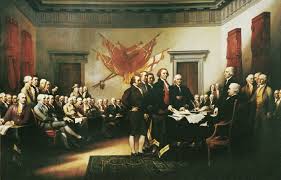
The Sons of Liberty in the late 18th Century in this country, however, didn't look at things that way.  One of their biggest gripes against King George III was his practice of "executive preventive detention" and abridgement of legal process.  It's right there in the Declaration of Independence, which hangs on my office wall:  "For depriving us in many cases of the benefits of trial by jury."  They weren't going to stand for that, because that's a tyrannical power, to declare the freedom or imprisonment of individuals on the basis of "executive decision."  And they included the 5th Amendment in the Bill of Rights:

No person shall be held to answer for a capital, or otherwise infamous crime, unless on presentment or indictment of a Grand Jury, except in cases arising in the land or naval forces, or in the Militia, when in actual service in time of War or public danger; nor shall any person be subject for the same offense to be twice put in jeopardy of life or limb; nor shall be compelled in any criminal case to be a witness against himself, nor be deprived of life, liberty, or property, without due process of law; nor shall private property be taken for public use, without just compensation.

I understand the counter-argument: the world is now too dangerous for Constitutional rights. It's better to abridge liberties in the case of the individual in order to ensure the safety of the larger citizenry.  It seems to me, however, that if we're going to do that, we should amend these charter documents.  There is no serious argument that Padilla, for example again, was held beyond the "48-hour" period of permissible detention before presenting charges against him.  He was held for years with no charges.  He was denied his right to counsel.  He was denied his right to a speedy trial, and he was deprived of his life and liberty, for years, without due process of law.  

What is vexing about Obama's decision to make the Padilla treatment standard procedure is that I'm almost certain George W. Bush was unaware that the Bill of Rights existed.  I'm sure he never read them.  Barack, on the other hand, studied them and taught them.  He's aware of what he's doing.  And what is it that he's doing?  I think he wants to be taken seriously as a guy who's just as tough as Dick Cheney.  I think that's the image he and his handlers are working on. And one has to admit that it looks mighty tough to do unconstitutional things to protect the country.

So I said yesterday that Barack's preventive detention scheme looked "silly" and inconsistent when you compared it to the fate of terrorist suspects who are actually tried and convicted and given determinate sentences and ultimately released, and someone asked me what I meant. So to spell it out: presumably there will be Guantanamo inmates who are tried and convicted, one way or another, and given sentences which they outlive.  This has already happened in the very few cases which have actually gone to trial in the 7 years Guantanamo has existed.  So these convicted terrorists will then be eligible for release into the wide, wide world.  At least I assume they will be.  So we then would have these two categories of terrorist detainees: the Category 5 detainees who have never been charged because they can't be convicted but are considered too "dangerous" to release; and terrorists who have actually been convicted, proved guilty, and are now eligible for release.

That seems completely crazy to me.  It's the sort of arbitrary, nonsensical thing that begins to happen when you start operating outside the rules because of "special circumstances."  This kind of lawless approach spreads like a contagion until the system is no longer reliable or fair. Thomas Jefferson and John Adams understood such things; I'm not sure there are many people around today who still do.

May 26, 2009

A nation of laws


I was probably as surprised as the next bleeding heart liberal that it would be Barack Obama, a Constitutional law professor, who would come up with the idea of formalizing our "perpetual preventive detention without charges or trial" policy for dealing with terrorist suspects.  I shouldn't say "suspects," actually; maybe "suspicious individuals" or "suspicious Muslims" would be closer to the mark.  In his recent speech, delivered ironically enough in front of a mural of the Constitution at the National Archives, Prez O outlined the 5 categories of individuals detained by the U.S. held at Guantanamo and elsewhere.  That actually would be a good movie title for Michael Bay or Ang Lee or one of those guys who concoct movies for teenage boys, mainly using an Apple computer instead of a camera.  "The Fifth Category."  That's not bad.  In fact, instead of writing this blog...


Anyway, the Fifth Category is defined as a bad guy who can't be tried for war crimes, or violations of U.S. law, either in a civilian court (U.S. federal district court) or a military commission (juris macropus rufus), because no conviction is obtainable. Thus, it follows that there's no sense in charging such a person with a crime.  What you might think follows from that is that you let the guy go, but not so fast.  If the Executive Branch concludes that such a person, while more or less immune from the legal process, is nevertheless "dangerous," then he's simply detained indefinitely.  For how long?  Well, the President hasn't really said, except to say that his version of the Great War on Terror (GWOT) should probably last at least another, oh, ten years.

This seems to imply that a Category 5 Detainee will be held until the GWOT is over.  However, as much as I respect President Obama's intellect, it seems to me he has made a fundamental error in logic here.  To declare the GWOT over, I suppose we have to be assured that no terrorists anywhere pose any threat to the United States whatsoever.  If we don't mean that, what could we mean?  The existence of even one Category 5 detainee (and let's face it, there are going to be a lot more than one), means that a corps of hardcore, dangerous terrorists remain alive.  If you let them out when the GWOT is declared over, then you've started the GWOT all over again. Suppose there were 19 Cat-5 Detainees.  Well, that's just the right number for another 9-11, isn't it?

So you can't let them out ever.  That's not fanciful, that's logic directly connected to the policy Obama announced.  So that leads to the next logical conclusion.  Why are we keeping dangerous Muslims alive in U.S. custody?  We can't try them, because we can't prove they've committed any crime, even in a rigged court room run by the Department of Defense and staffed with soldiers where hearsay is allowed and evidentiary rules are "relaxed" in favor of conviction (the Military Commission route).  We can't let them out because they're dangerous.  We can't set a release date because that is a contradiction in terms with the end of the GWOT.  

So wouldn't the most logical handling of dangerous detainees who can't be convicted in any forum simply be summary execution?  Isn't that what Pinochet did?  Hitler?  Stalin? Mao?  Of course that's what they did, because a dangerous dissident or troublemaker is most effectively put out of commission by killing him.  Then when the GWOT is finally over for good, no residual corps of terrorists remains in custody subject to release, except for the Supermax or military brig prisoners actually convicted with determinate sentences, but that's a logical problem which makes the whole idea of Category 5 a little silly and we don't want to do that.  We're being serious here.  Introducing all the logical inconsistencies in a piece of Right Wing pandering by the President is not my intention.

Or, alternatively, we could use the Due Process Clause of the Fifth Amendment to the United States Constitution, which really is more than just a backdrop for a pretty speech eviscerating civil liberties.  It's worked for a very long time.  Why not give it another shot?

May 25, 2009

Basic Rule of Hyperpartisan Politics


Carolyn Lochhead, a San Francisco Chronicle reporter, yesterday did her usual good work in laying out the essential nugatory facts about the national finances.  Her piece is here at http://www.sfgate.com/cgi-bin/article.cgi?f=/c/a/2009/05/24/MN2B17PDPL.DTL&hw=lochhead&sn=002&sc=718 .  What I like about her analyses is that she's already up to date on the essential vocabulary of Medicare, Social Security, GDP, national debt, et cetera, and so doesn't have to rediscover these facts each time she writes about our looming catastrophes.  For example, Ms. Lochhead appreciates that when a government official, say with the General Accounting Office, refers to the "Social Security Trust Fund," he means "nothing."  That is, Trust Fund = Zero.  This simplifies one's understanding. Similarly, she comprehends the distinction between the external national debt (owed to China & Japan) and the internal national debt (owed to the various "Trust Funds.") With respect to the second category, a "moral imperative" only will force us to honor this debt to ourselves, which is to say, the promises are not worth the paper on which they're written (and stored in that famous file cabinet in West Virginia).


Plus Ms. Lochhead can call on the estimable Alan Auerbach at Berkeley's Haas School of Business, another dismal realist and highly quotable academic pundit.  Alan points out that frightening things like the downgrade of U.S. debt to less than AAA (as has already happened to Great Britain) is one of those things "that don't happen until they happen."  Which is to say, they seem like bad dreams until you wake up and find they're  the surrounding reality.  Our national debt to GDP ratio would already ban us from membership in the European Union, so some inconceivable things have already happened. The Big Kahuna, of course, is the potential loss of the dollar's world reserve currency status.  Apres ca, le deluge.

The leading edge of Carolyn's article is President Obama's current budget, which borrows a buck for every buck it spends, which is to say that we've reached the point where half the federal budget is done on credit.  By humble analogy one senses immediately that a household budget done on the same basis is a bankrupt situation, but macroeconomics, we're assured, are not the same as such lowly analogies, so it's all good. Increasingly, it is the external national debt that is being increased, that is, real money owed to real creditors and not debt we can erase by passing legislation stating, for example, that Social Security is no more.  The national debt, probably by not later than 2020, will stand at $20 trillion, and probably 2/3 of that will be real external debt.  Thus, the real external debt will = current GDP.  We've come a long way, baby.

It's hard to say what, if anything, we can do about any of this.  I suspect nothing.  Which brings me to my Basic Rule of Hyperpartisan Politics.  We have two political parties who take turns running things in our country. When one party is in power, the other party lusts for power and will resort to anything, even treason and actively working for the deterioration of the American standard of living, in order to regain power. Sometimes this is said openly; the official spokesman for the Republican Party, for example, Rush Limbaugh, stated candidly that he hoped Barack Obama's economic recovery would fail.  That way the Republicans could ascend to the throne and resume cutting taxes, exacerbating the debt problem, and increasing the military budget, so the Soviet Union will fall.  Certain ruts, they can't get out of.

A party wishing to retain power cannot afford to take any action, therefore, which risks short-term reversals.  In our everyday lives, we probably recognize there are times when one must retrench, reeducate ourselves, sacrifice, in order to move forward again. This is part of the natural cycle of life.  But such rationality is impossible in American national politics.  For example, the rotten-to-the-core banking system, overloaded with bad debt built on reckless gambling (itself enabled by repeal of the Glass-Steagal Act), could have been taken into receivership by the United States, its creditors and stockholders wiped out and only its depositors protected under FDIC rules.  Then, over time, a solid banking system built on actual regulation and legitimate business could have been rebuilt.  So, instead of lending or "investing" about $12 trillion in federal funding (money which we obviously don't have), we would have used the regulatory and police power of the American government to achieve a different system.

But that would have taken time - probably a lot of time.  A great deal of economic and financial dislocation would have occurred, including among the all-important Big Rich/Campaign Donor Class, and with the attention span (and comprehension) of John Q. Public, the Republicans would have had a field day with such a "responsible" approach. You can multiply examples. Rather than lending money to General Motors, this bankrupt company could be allowed to go bankrupt.  Michigan would revert over decades to seasonal farming country.  The money thrown away could have been invested in mass transportation, such as railroads run on alternative energy, technologies with real futures, rather than "shovel ready" projects such as repaving freeways and building more roads under the Stimulus Package.

On and on.  Nothing can be done unless the short-term fallout can be controlled.  The theory is that the long-term consequences (such as bankrutpcy of the country) can be disguised or deferred, but losing power is something that happens NOW. Yet some problems simply cannot be rationally solved without a period of loss and retrenchment, because you can't always continue to invest and support obsolescence while creating innovation.  There simply isn't enough money or human capital to go around.

Thus, let's face it.  The country cannot be fundamentally changed. We've passed that Rubicon. That is why "healthcare reform" has already fallen apart.  To fix healthcare, you have to get rid of the for-profit basis of the system. The party which does that will lose the financial support of Big Healthcare (Pharma, Insurance, Hospitals), confuse and rattle the general public, and thus be out on its ear.  

Relax, in other words, and enjoy the ride.  Quell thy reformist tendencies and watch, with fascination, as Nature, which always bats last, steps into the box.