April 14, 2011

Herzog the Blogger


One of my favorite books from high school years, and my favorite among all of Saul Bellow's novels, was Herzog, about a stressed-out, middle-aged, cuckolded academic who undergoes a nervous breakdown and begins compulsive letter writing. He writes to everyone he knows, then to politicians, then finally to the famous dead, in long, complicated, highly literate language, complaining about the state of the world and his place in it. It is an intellectual tour-de-force.


Gee, wonder why I liked that novel. It's pretty obvious Herzog was a proto-Blogger. I don't know if one of the ten million blogs out there is called "Herzog," but one ought to be (along with "Impotent Information Overload"). With their limited readership, at least half the point of an amateur blog is self-therapeutic, although things didn't work out that well for Herzog himself.

You can now post comments to columns and blogs, of course, so if in the course of gassing on in your own blog you don't quite pontificate enough, you can do that too. I did, today, on Paul Krugman's blog, which he calls "Conscience of a Liberal" (just the slightest touch sententious, do you think?). Prof. Krugman was writing recently about the august, esteemed title he has in German society because of his degrees and standing, to the effect that he is Herr Doktor Doktor Krugman (he's not actually, because he doesn't understand how those German honorifics work for foreigners). That's where "Dokrugman" comes from.

What's distressing to me, Dokrugman (portmanteau of Herr Doktor Doktor & Krugman) is that (a) you're over-using this "serious" trope (which I think, along with Very Serious Person or VSP, might be an unattributed borrow from Glenn Greenwald; is that possible?) and (b) you're getting involved in "budget-cutting" discussions at all. I don't read "The Conscience of a Liberal" to be reminded of the grim reality that the United States faces in its budget difficulties. I read this blog for its Keynesian hopefulness, where $150 billion in income against $330 billion in expenses (as in March's Treasury Statement) is okay and nothing much to worry about. Maybe the deficit will go to $2 trillion this year (or roughly total income), but it doesn't matter because, as you say, the Treasury is hardly "cash strapped." It can easily borrow as much money as it needs at rock bottom rates. For some strange reason. And only conspiracy theorists think that Treasury auctions are simply a rigged market, and if the PBOC calls the whole thing a "Ponzi scheme" (as they did recently), it only proves that they are not VSPs. Or proves that they are, I'm not sure which way the snark cuts.

So please, do not get bogged down in ways to "cut the deficit." That's for the others. You should be urging the government to spend more, to increase the deficit to $4 trillion per year, to $20 trillion. Whatever we need. Because the Treasury can simply borrow $20 trillion at 1% in perpetuity, with no problems once the Fed adds the bills and bonds to its mounting stash. And the 1% the Fed earns on its $20 trillion per year ($200 billion) can be remitted to the Treasury as income, reducing the deficit, thus...

What was the PBOC saying again? Anyway, please: no more belt tightening. Leave that to the uninformed.

Dokrugman does believe we'll be okay and that we should not be worried about cutting "now now now" (as he says over over over), but should keep spending and stimulating until the economy recovers to its mid-Bubble heights. Of course, I've never understood what economy we are aspiring to return to. The reason we went to Bubblenomics was because (a) Wall Street needed a cash cow, and housing was The Last Frontier, and (b) our so-called "Real Economy" is gone, shipped overseas along with all the middle class jobs it used to provide. So Americans can go "back to work," but it's all crap jobs and completely inadequate to provide a real tax base.

How do such obvious things remain hidden from view when they're lying in plain sight? If housing prices are once again correlated to income, and incomes are stagnant or even losing ground, how can housing prices do anything other than continue to go down? And if housing prices continue to go down (which they are, which they will, with 13 million houses empty in the U.S., with 20% of all real estate in Florida vacant), what is the economic driver of consumer spending, and thus jobs, and thus recovery, and thus federal fiscal solvency? Huh?

My inability to answer such questions explains why I do not have a Nobel Prize in Economics, I suppose. I'm just a lonely Herzog, crying in the wilderness.


April 13, 2011

Apocalypse fatigue


I have to admit that it was more fun to write this blog (which I've been doing, off & on, since 2006) when the idea of American decadence, of an actual fiscal or resource-based collapse, was more the stuff of dystopian fantasy than present-day reality.


I just looked at the latest Monthly Statement from the Treasury and it's a true horror show. About $150 billion in revenue against $330 billion in expenses. The figures are so far out of whack that they would make more sense if one of them, say revenue, was from Angola or Belize or somewhere, and the second was from the combined budgets of the entire European Union. They just don't belong on the same balance sheet. It raises a serious question: who are we trying to fool with this nonsense? A $180 billion deficit in one month.

I do not consider myself a deficit hawk or a deficit dove or a deficit anything in particular. I think I can understand, in broad outline, how this absurd situation came about. I have watched it happen over my lifetime. The largest whole number divisor of my age, other than the age itself, is 21. To give a further clue, I am not 21, 42 or 84. If my life is divided in thirds, then the first segment belongs in the period of American Triumphalism, 1948 to 1969. The second occurred during the beginning of the Descent Phase, 1969 to 1990. And the third happened during the period of American Decadence, 1990 to 2011.

It is fashionable now to engage in Good Guy/Bad Guy narrative analyses and to begin American history in 2007 or slightly later, at the Fall of the House of Lehman. This is convenient for political polemics because it enables both groups to analyze America's current predicament from the viewpoint of innocent victims. The Commoners are the victims of a sell-out political system and Big Business. The fat cats themselves are the victims of Socialism and excessive government regulation.

Having observed this slow-motion train wreck, however, I am more inclined to see American decadence as a broad-based social enterprise. America was once very rich and worked very hard. After we stopped working hard, or shipped all of the jobs where hard work was productive, to nations where slave labor is allowed, we lost our competitiveness and assigned all of the benefits of Globalization to an elite managerial class which could leverage foreign low wages to domestic profitability. This process was enabled by the federal government through tax laws and free trade agreements. It never made any sense that it could redound to the benefit of the American commoner, but it was sold to the American public as if it could by its many champions, including stalwart "Liberals" such as Thomas Friedman and Paul Krugman. The Conservatives never bothered with the populist cover story; they were just in it for the money.

The Commoner was not left totally out of the picture. The flow of the world's reserve currency, the dollar, between the United States and mostly Asian producers (of consumer goods and oil), allowed America to keep interest rates low and to produce serial bubbles in, first, the dot.com field and then in housing. This produced a "wealth effect" despite wages which stagnated and which by themselves were incapable of supporting the actual standard of living which the country pretended to. This "system" of recycled dollars worked until the actual wage structure of the American middle class was inadequate to the demands of the debt service assumed in order to keep the consumer society functioning.

The whole thing, at long last, finally crashed. The political class, such as the feckless President Obama, are left with a smoldering pile of debris where a Borrower's Shangri-la used to be. Since the political class cannot explain to the American people how this came to be without admitting their complicity in the ruination of America, this End Stage must be treated as a temporary blip, a "Recession," which will be cleared up with adequate money-printing, fiscal stimuli or some other gimmick.

As I say, however, an uninformed American electorate permitted all of this by continuously electing politicians who allowed it to happen, or even encouraged it to happen. Freed from hard work and encouraged in the belief that prosperity consisted in the accumulation of gaudy toys and distractions, Americans began to believe that their privileged lifestyle was a matter of "Exceptionalism" separated from the Laws of Thermodynamics or even common sense, and that we would continue to prosper in the Information Economy or some other arrant foolhardiness.

It's not going to happen that way. What happens when such thinking continues too long is that a country pretends that it has a $330 billion lifestyle based on $150 billion worth of income, and fights tooth and nail over cutting so much as a dime from the sum of expenditures (the vaunted $38 billion in "cuts" represents in point of fact a reduction in planned increases in the budget).

Under such circumstances, I think it is ludicrous to discuss seriously Paul Ryan's idea to balance the budget in 2040 or President Obama's plans to cut expenses long after he's already left office. It's not going to happen like that. This is not a country that is going to engage in an orderly process of sorting things out. It will lurch and careen from side to side with both sides continuing to blame the other for what was, at base, a failure of the democratic process. Where it ends up will be based on the dictates of Reality, which has a well known Realistic Bias.

April 04, 2011

Obama Rides Again


I think the character from fiction most reminiscent, for me, of President Barack Obama is Douglas Adams's creation Zaphod Beeblebrox, who served for a time as President of the Galaxy. Zaphod had two heads and three arms, but despite these anomalies was a charming, unctuous, devil-may-care fellow who was unfailingly affable and upbeat and had a keen eye for the photo op. Zaphod shows up in various episodes of The Hitchhiker's Guide to the Galaxy (the trilogy with four books).


Mr. Obama has announced (by Tweet) his intention to run again, which of course was a foregone conclusion. I don't know if he will win, but early indications are that he's the front-runner. I still get a lot of email from the Obama people, and I've never spammed it or attempted to filter it. I'm not bitter, after all. I gave more money to Mr. Obama's campaign in 2008 than in any previous election, but I'm not inclined to duplicate the effort. For one thing, he won't need the money. It was obviously his strategy to leverage private donations from average Americans (the Commoners) in 2008 on a campaign of Hope & Change, then to shift gears when actually in office to serve the usual Big Business interests, that is to say, the financial sector of the American economy. Wall Street & Co. will take up the slack now that they know Mr. Obama, despite the gaudy rhetoric of 2008, works for them.

Mr. Obama, like President Beeblebrox, is nonchalant about his campaign misrepresentations. I am hard put to think of a single promise he has actually kept. It's an astonishing record, in fact. I think the mistake I made, and one made by a lot of older Americans, is that we keep thinking of campaigns in terms of "issues" and complicated policy questions, such as civil liberties or environmental problems or sustainable energy programs, and this is simply not the way things are done anymore. These are the hobby horses of bloggers and other malcontents. Take for example the latest reversal coming out of the White House. A very big deal, according to Obama in 2008, was to close Guantanamo Bay, our concentration camp on Cuba. He also argued strenuously that military commissions were unconstitutional (I can cite specific words if necessary, but it's easier just to click over to Glenn Greenwald and read, on a daily basis, about the astonishing 180's which the O-Man pulls every single day). Today we learn that Attorney General Eric Place Holder is going to try the 9-11 mastermind Khalid Sheikh Mohammed before a military commission at Guantanamo. This approaches the Hat Trick of campaign reversals. All that's needed is a decision to allow evidence elicited by torture as part of the case against the Sheikh and we're there, and that's the sort of thing the President can do while choosing a club on the 8th tee.

As I say, however, this focuses on the wrong things entirely. I don't think the American public really cares about details like this, and it is a measure of Obama's political savvy that he recognizes (as did President Beeblebrox before him) that the American people don't care about this sort of thing. All the public cares about is the official unemployment rate, if that, and Hilda Solis over at the Dept. of Labor has demonstrated an amazing gift for bringing the UE number relentlessly down even in the face of declining labor force participation. I've said it before, I'll say it again, Secretary Solis is the true MVP of the O Admin.

In the post-modern political world, politics is about celebrity, and Obama has that. He's become famous for being famous. He doesn't really have any ideas, I don't think he's a deep thinker, he decides issues based on who will give him the least grief if he goes against them, and then flashes a big smile. Most of what he does in foreign policy is indistinguishable from George W. Bush and Dick Cheney, ditto civil liberties (he may actually be a little worse, but he was able to build on the public's apathy about the previous administration's unconstitutional excesses and go from there: He Stands on the Shoulders of Unconstitutional Giants, in other words).

I think Dimitry Orlov is right: our political situation has become Sovietized. What the government does has nothing to do with the people anymore. Washington lives in its own Imperial City, and we should simply stop expecting anything from them. Tea Party activists are the latest to be utterly conned by campaign rhetoric. The Washington Village people are different from you and me. They may as well have two heads and three arms.

March 24, 2011

Another way of looking at nuclear energy


I was reading Karl Denninger the other day on his "Market Ticker" site. Karl, in my opinion, is very good on things like the federal deficit and American over-indebtedness in general. Very few writers get down to his level of fine-grain detail on the question of why the United States believes it can afford a $3.8 trillion budget on about $2.1 trillion in income. (I note, by the way, that the Treasury projections for fiscal 2011 have been reduced to that figure from the previous $2.4 trillion. Apparently someone in the Office of Management & Budget or somewhere calculated that the tax and FICA reductions passed at the end of the year, with the enthusiastic support of President Holograma, would blow another $400 billion hole in federal financing; thus, the $100 billion "reduction" proposed by the PigMen of Congress is in reality a $300 billion increase in federal deficits.) Mr. Denninger draws attention to facts like that.


He's an enthusiastic supporter of nuclear energy, despite the fact that he seems dubious about the reality of global warming. Global warming is about the only rationale I can think of to support the idea of nuclear energy at all. He is claiming now that the problems at Fukushima are being overblown by a "hard left, anti-nuke" press." I think Mr. Denninger needs to get out of the Florida Panhandle a little more; the Redneck Riviera is beginning to addle his thinking. Anyway, the thrust of his argument, which he makes in his usual arrogant way, is that we can't find a way to replace the 20% of electrical energy supplied currently by nuclear power plants.

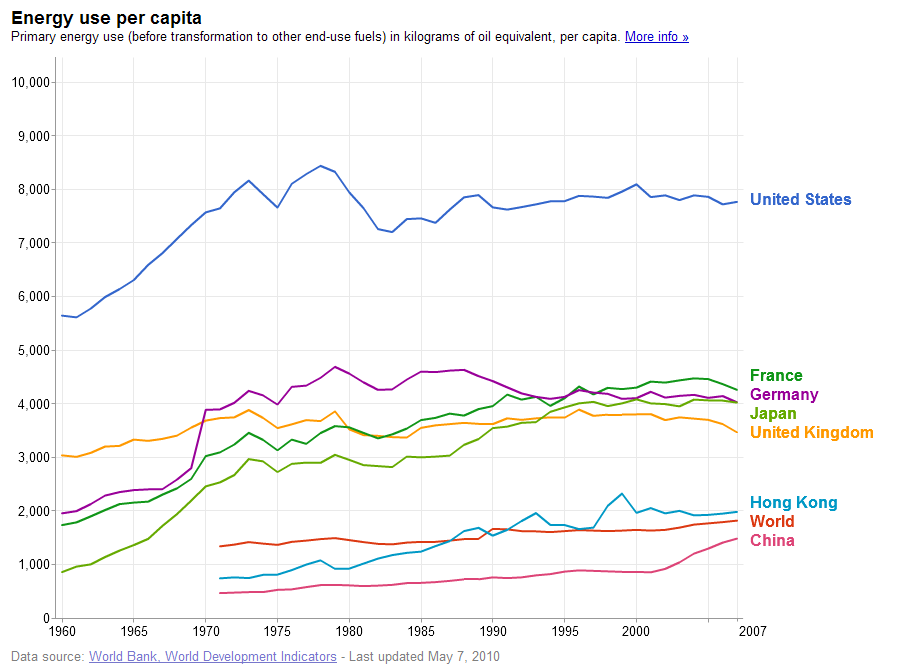
The graph above suggests another way of thinking about the problem (I think if you right-click on the graph, you can see the whole thing more clearly in a separate window). I have heard the various rationales for why America "needs" to expend twice the energy per capita as other developed First World countries - it's a big country, the distances we travel are greater, we rely on suburbs for housing, et cetera. All well and good, and all cases of (a) self-indulgence and (b) begging the question. As James Howard Kunstler points out on a weekly basis, the whole suburban build-out is based on a misperception that the availability and price of oil are stable and reliable, which they are not. We are now beginning to see with full force how dangerous it was to entertain such an illusion. And at the level of generality, the greater size of the United States than the European countries graphed above (and Japan) is surely offset by the circumstance that France and Germany, for example, are located much farther north than most of the United States, and consequently have much greater needs for heating energy.

Yet they use half of what we do. A big part of our problem, I think, is that we have politicians like Dick Cheney who tell us "conservation is a private virtue." Aside from being the kind of typically meaningless drivel this guy was always famous for, there is nothing particularly private about conservation. It's been cast in those terms because a president who actually confronted the American people with the stark reality of our dangerous reliance on foreign oil, Jimmy Carter, was hounded from office by a movie actor who recited the lines the country wanted to hear. In time, the "normative tendency of the factual" made us incapable of even seeing that the per capita use of energy in this country was anything other than our God-given right. This is the delusion, I think, that Mr. Denninger suffers from. He often talks about his boat, his SUV, his need for air conditioning of his big Florida house and the rest of the typical American PigLife.

I would not try to make the argument that our standard of living is twice as good as that found in France or Germany. We equate materialism and an ever-expanding GDP (whatever its source, including credit default swaps written on mortgage-backed securities which the purchaser of the CDS does not even own - that's how abstract our "inputs" into GDP have become) with the "good life," and now we've hit the wall, because there's no way to sustain even this anemic, largely-mythical "recovery" (or to increase federal tax revenue) with gasoline going to five bucks a gallon.

So we don't really need nuclear energy. We need a new way of looking at how one goes about living. Sad to say that it's highly unlikely we're going to hear anything about that from Washington.


March 23, 2011

Bad week at the office


As fate would have it, "Fukushima" means "good fortune island" in Japanese. Nature not only sides with the hidden flaw, it apparently loves a cruel joke.


The idea of dropping water into a spent fuel rod pool from a helicopter and pumping seawater into nuclear reactors smacks, just a little, of complete desperation. To say the least, I doubt that you'll find this one in the Nuclear Regulatory Commission's Code of Federal Regulations. This is fly-by-the-seat of your pants stuff. To the left and right above you can see a picture of Reactors #3 and #4 at Fukushima (smoke is rising in the left picture from the twisted wreck of reactor building #3). The current plan, as I understand it, is to reconnect a power supply to the reactors so that the cooling pumps for both the reactor vessels and the spent fuel ponds can be reactivated. Time is definitely of the essence for the reactor in Building #1, which is dangerously overheating and is probably already in a state of meltdown.

A question I have, which never seems to get addressed by normal media outlets (such as the New York Times) is this: does the twisted wreck of steel and concrete in the picture above left really look extension-cord-ready to you? As I've said before, it really does not help public confidence that the level of discussion of such basic points in the MSM is so atrociously stupid.

Reactors 1 through 4 at the Dai-ichi plant sustained, in order, a 9.0 earthquake; a 7-meter tidal wave; ferocious hydrogen explosions; and fires secondary to nuclear overheating and zirconium cladding degradation. That's a bad week at the office. Yet every single event was fully predictable.

In thinking about the "rarity" of nuclear accidents, I recall the observations of the late great Richard Feynman about the space shuttle program. The NASA engineers always assured the public that the odds of catastrophic failure were in the 1 in 50,000 range. Despite this magnificent safety margin, the space program has suffered tragedies at a rate greatly in excess of these odds. Feynman concluded that the odds were simply pulled out of thin air. So too the nuclear power industry. To get the public to accept nuclear power, with its horrific "side effects" of creating huge "dead zones" (as around Chernobyl, a restricted area of 15,000 square miles, the size of Switzerland), nuclear bomb proliferation (from all the plutonium mass produced in boiling water reactors) and unsolvable waste disposal problems (one idea being to fire all the waste into the sun by means of rockets, which would allow us to combine the odds of the nuclear program with the space program), you have to tell the public that it's safe, that the odds of something going catastrophically wrong are just plain minuscule.

Yet in the 40 years since Three Mile Island, we've had the partial meltdown at Three Mile itself; the utter devastation of Chernobyl (which is still getting worse, by the way, as the next big problem might be contamination of the ground water of Kiev, as the nuclear pile continues to melt under the concrete "sarcophagus"); and now, what could be the worst one of all, Fukushima. Are those really such minuscule odds? In what frame of reference?

Let's suppose that the Japanese are finally forced to admit that this is not World War II, the kamikaze spirit has mercifully faded away, and no worker is going to volunteer to walk into these reactor buildings and start rebuilding cooling water pumps and everything else you need to get the cooling systems working again. (Without moving water, there is no way to successfully keep the temperature levels down in either the reactors or the cooling ponds.) So the "sarcophagus" solution is then deployed, burying the reactor buildings under mountains of concrete and sand. Unfortunately at Fukushima, I would surmise that the water table (the Pacific Ocean) is not really very far down at all. Covering up the reactor buildings with concrete and sand will stop the airborne dispersal of radiation and radioactive particles, but all that nuclear crud under the concrete will continue decaying and melting in ways that Enrico Fermi did not really plan on in the squash court at the University of Chicago.

The Japanese know all this, of course, and would rather not talk about the stark reality, which is that there are really no good options. The riposte is to fall back on the Space Shuttle Gambit that all these misfortunes were the weird concurrence of an incalculably rare combination of events. As noted, that's bogus. The plants were built where they were, in the way they were, with the assistance of General Electric, with full recognition that Japan exists at the Western edge of the Ring of Fire, the huge earthquakes are not rare, that tsunamis often follow them, and that a damaged nuclear reactor building would naturally result in a plant built right on the edge of the ocean.

In case you're wondering, the square mileage of Honshu, Japan's main island (where 80% of the land mass and 80% of the population are located), is about 90,000 miles, or six times the size of the Switzerland/Chernobyl exclusion zone. The total land mass of the USA is about 3.8 million square miles; a comparable loss (1/6th) of American land mass would eliminate the state of Alaska (with about 670,000 square miles). Just for a sense of proportion.

I suppose the possible upside of ocean contamination is that Dr. Evil may finally get a fish with the frickin' laser beam attached to its head that he so desperately wanted.

March 16, 2011

Nuke nomenclature


As the MSM commentariat has become stupider and stupider, it becomes increasingly difficult to tell just what the hell is going on in Fukushima, or, alternatively, just what the Fukushima is going on in Hell.


Terms seem to get used interchangeably. "Containment vessel," "reactor building," "containment structure," et cetera. At the bottom of all this ambiguity is the simple reality that the reporters don't really understand what they're talking about. This has become a major problem in recent years as one tries to follow a big story like the nuclear disaster in Japan.

I do not profess to be any kind of expert on Japanese nuclear plant design, but just looking at the pictures and diagrams, it doesn't really seem all that complicated. Working from the inside out, you have the reactor pressure vessel, which is built along the lines of a tank car in a railroad train. It is made out of very thick steel. Inside the reactor vessel you have the nuclear fuel rod arrays which are immersed in water (to slow the neutron exchange and to cool the fissile process).

At the next level, you have the secondary concrete shield wall. This is an added level of safety which was not present, for example, at Chernobyl. This is a steel-reinforced concrete structure surrounding the reactor vessel.

Lastly, you have the reactor building, which is another, larger box (a building) surrounding the other two structures. It's also made out of concrete. One might think of the whole thing as Satan's Russian Doll.

The fuel storage pool is apparently inside the reactor building and above the containment structure, sort of like a shelf or drawer built below the reactor building roof. These are approximate cubes about 40 feet on a side, filled with bluish, boronated water.

Somehow or other, there have been a number of violent explosions at Fukushima reactors Nos. 1,2 & 4, and in one case at least it apparently blew the roof off the reactor building (No. 2) and in No. 4 blew two 8-meter holes in the side of the reactor building. Here is what (among many things) is troubling about the explosion in Reactor #4: it apparently originated in the spent fuel pool. Trying to reason through this logically, how does an explosion blow holes in the side of the reactor building (see diagram above) without blowing holes in the side of the spent fuel pool?

I suppose it's technically possible, but the confused reporting about what's going on never attempts to explain this clearly. This would appear to be the most severe threat posed to Japan, since the spent fuel rods (or nuclear waste) are huge repositories of all kinds of radioactive stuff. If, as the nuclear site reports, there is extensive damage to nuclear cores within several reactor pressure vessels, but the vessels themselves are still intact (as appears to be the case), then the most logical explanation for the very high levels of radiation being recorded onsite would seem attributable not to the occasional steam releases intentionally performed by the staff but to exposed (uncovered by water) spent fuel rods in one or more storage pools fizzing away their radioactive cesium, iodine, strontium, plutonium and other diabolical stuff. Quite understandably, it's hard for the onsite staff to observe what's going on directly because they don't want to go near the thing.

I don't know, and I know the New York Times will never be able to tell me in comprehensible terms. But I suspect that what's really going on is that there is at least one spent fuel pool with holes in the wall, to put the matter simply, and that the coolant water is leaking through those walls faster than it can be replaced (since the Japanese have no good options for replacing it rapidly). And that the spent fuel rods, as a result, are exposed to air, the zirconium cladding is oxidizing away, and a witch's brew of toxic crap is spewing into the atmosphere.

Only a hunch. Nuclear power plants. As one guy said way back in 1980, it's a lot like using a pile driver to crack walnuts, this business of employing a nuclear chain reaction to boil water. Absolutely fraught with risk, at every stage of production.

March 15, 2011

We're havin' a meltdown


I've been so remiss with the blog that even Dmitry Orlov is posting more than I do, and he swore off frequent posting over a year ago (he didn't stick with it because this process is somewhat addictive). There's a lot going on, as usual, but I haven't been able to develop any particular "take" on it that inspires me to blog, or even bloog. Anyway, the good Dmitry offered this up today:


You see, you have to be a certain sort of person to say “Sure, using a precariously controlled subcritical nuclear pile to boil water to run steam turbines to generate electricity is a great idea!”


That's about where I come out on the subject, although my thinking is not quite the categorical, straight-line approach which Mr. Orlov characteristically takes. I fold the whole analysis into an overall, despondent realization that humanity is probably not going to do much else about global warming in a systematic, timely way, and at least nuclear power has the advantage of being relatively carbon-neutral. Dmitry's view is clearer, I think, because he lives on a sailboat in Boston Harbor, uses solar power (wind) for transportation and solar power (photovoltaics) for electricity. Like the other guy who lived in Massachusetts, whom I honor with the title of this blog, this integrity allows him to state simple truths without compromise. Because, of course, the real answer isn't to find ways of producing more power than we need, but to learn to live with a great deal less of it. It is always the exigencies of advanced technology, and "comfort," that compel us to take these awful risks.

I think I mentioned a couple of times that I was involved, as a lawyer, in the licensing hearings for PG&E's Diablo Canyon nuclear reactors. Those are also boiling water reactors built near an earthquake fault line. As with the reactors at Fukushima, these reactors will be safe until they're not. Part of the drill in participating in licensing hearings is to come up with "scenarios," based on the types of threats (terrorism, weather, natural disaster, war) that a civilian reactor is likely to encounter. If anyone had suggested that Diablo Canyon should prepare for a 9.0 earthquake, followed by a tsunami, followed by electrical failure, followed by human error, followed by desperation attempts to cool reactor cores and spent fuel ponds with seawater, they would have been laughed from the room. C'mon, they would have said, don't you also want to throw in Al-Qaeda while you're at it?

Isn't it amazing. Confirmatory of my "favorite" (and most sinister) of Murphy's Laws: Nature always sides with the hidden flaw. The Fukushima reactors were built near a massive subduction fault line, of precisely the kind that produces huge tsunami waves ("tsunami" being a Japanese word for "harbor wave"). Japan has recorded over 195 tsunamis in its shaky history. You can't really say that what just happened was not foreseeable. It clearly was. The quake was bigger than Tokyo Electric planned for, but the quake did not do the direct damage. The tsunami did. The rest of the sequence was predictable too: electrical failure (grids do not operate as well underwater), pump failure, hydrogen build-up, explosions, panicky responses by humans trying to do too many things in an extremely limited time frame.

So we could see it all coming. We just assumed it wouldn't happen because all these complications get in the way of what we want to do so we can be "comfortable." Similar ideas led to the brilliant solution of placing the spent fuel ponds at Fukushima (I don't know what "shima" means, but if it means "you" it's all becoming clear) on top of the containment buildings. A kind of satanic twofer: if the (unvented) hydrogen from melting fuel rods in the reactor (unventable because of General Electric's design: I thought they brought "good things to life") causes the roof to blow off (as happened there), then you can blow up the fuel pond too, which has a lot more deadly radiation than in the reactor core. Indeed, the Japanese were using MOX fuel, which contains plutonium, so that is also present in the spent fuel rods on top of the (exploding) containment buildings.

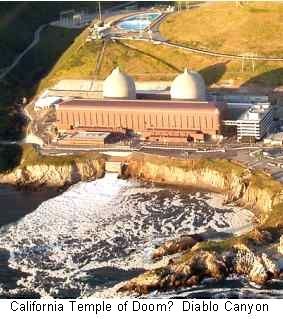
Nothing to worry about, because it plainly couldn't happen although it did. So back to Diablo Canyon. Those bad boys are pictured up above, hovering there on a cliff above the Pacific. Safely above sea level. Uh-oh, wait a minute. Wasn't there something about sea level rise predicted by global warming? They won't even need a tsunami down in San Luis Obispo to inundate the plant, although (in mitigation) nature will take care of the solution of flooding the reactors with seawater. Thus, if we continue to melt Antarctica and Greenland (which between them contain 90% of the Earth's fresh water) and we achieve that 200+ foot sea level rise, we'll see how they do.

Or, we can just continue assuming that nothing bad can happen.