April 26, 2014

Saturday Morning Essay: This Week in the Oligarchy

Brought to you by Peet's Major Kong blend...

Conspiracy theorists have every reason to feel vindicated these days with various empirical studies confirming conclusively their most outlandish conceptions of political reality. Take, for example, the recent study published by Martin Gilens of Princeton University and Benjamin Page of Northwestern regarding the extent to which America can actually claim to be a functioning representative democracy. 

https://www.princeton.edu/~mgilens/Gilens%20homepage%20materials/Gilens%20and%20Page/Gilens%20and%20Page%202014-Testing%20Theories%203-7-14.pdf

Their query was: who actually controls political decisions in America, majorities of average citizens or a small group of economic elites?  And their conclusion:


"When a majority of citizens disagrees with economic elites and/or with organized interests, they generally lose. Moreover, because of the strong status quo bias built into the US political system, even when fairly large majorities of Americans favor policy change, they generally do not get it."

Their money shot is as follows:

Despite the seemingly strong empirical support in previous studies for theories of majoritarian democracy, our analyses suggest that majorities of the American public actually have little influence over the policies our government adopts. Americans do enjoy many features central to democratic governance, such as regular elections, freedom of speech and association, and a widespread (if still contested) franchise. But we believe that if policymaking is dominated by powerful business organizations and a small number of affluent Americans, then America’s claims to being a democratic society are seriously threatened.

To arrive at their startling conclusions, Givens & Co. amassed a great deal of data concerning the policy preferences of the general public in America on 1,779 discrete issues over the period 1981 to 2002, and then compared these findings to the actual policies adopted by the federal government.  What they found was that the preferences of "economic elites" dominated the actual outcome of policy contests; to the extent that John Q. Public is vindicated by federal policy, it's more or less a coincidence.  The general public is represented by its Congress when its preferences overlap with those of the economic elites who actually own the Congress.

What the good professors are telling us, in other words, is that America has the bells and whistles of a democracy, with regular elections, TV ad campaigns purveying holographic images of candidates, and all of that; however, we don't actually have a representative democracy.  We have a kind of feudal or oligarchic system, a government run by monied elites.

I hope that the study is brought up to date.  I doubt that the conclusions will change at all. If anything, they will be strengthened, particularly in light of the decisions of The United States Supreme Court, Incorporated on questions of campaign funding.

You may wonder, for example, about a couple of more contemporary political issues.  Consider Congress's refusal to allow Medicare to engage in bulk-buying discounts with drug companies.  That may seem like a head-scratcher.  Why would the United States, which has chronic budget problems (relying as the Treasury does on the extent to which America's wealthy will allow their incomes to be taxed), disable itself from using its economic clout in favor of Big Pharma's interests?  Well, now you have your answer.

Or: even after the Democrats seized majority control over the House in 2006, with Nancy Pelosi at the helm, why did the Iraq war continue to receive its funding?  Recall that by 2006 everyone knew that all justifications for the invasion of Iraq were well and publicly known to be entirely fraudulent. Iraq posed no threat to the security of the United States.  Iraq had no weapons of mass destruction. Saddam was not the arch-mastermind behind 9/11.  So why did the Democrats continue to give George W. Bush all the money he needed in order to keep fighting a war which a substantial majority of Americans opposed?

A final note: why does Congress allow the banking industry to charge interest rates of 19-29% on credit card balances?  Why not a usury law which caps interest rates at the 10-year Treasury bond rate plus 5%, in line with other usury statutes?

The answer to all these riddles is the same. Congress works for an economic elite to the exclusion of American commoners, and pro bono publico laws are passed only if they also favor this elite. 

It follows that voting, per se, is pointless.  What makes more sense is to vote a straight party line and then form public interest PACs to buy the politicians of one's own party.  For example, an Anti-War political action committee could insist that American military forces cannot be committed by the Executive Branch to a foreign theater without a declaration of war (as the Constitution requires). Money that would otherwise be wasted by donating to individual candidates in elections (who can never be trusted, simply by electing them, to do the right thing) could be invested in such single-issue PACs.  A candidate once elected could then be purchased with such PAC money on a quid pro quo basis, as Big Pharma and defense contractors purchase theirs.  This is not entirely fanciful.  AARP and labor unions (what's left of them) operate on this principle and achieve results. But the scattered, atomized, powerless individual American, even if part of an overwhelming majority, has no chance of reaching his representative solely on the basis of persuasion; thus, circulating petitions, flooding Congressional offices with phone calls, posting on Facebook and the rest of it is entirely useless.

We owe a substantial debt to Professors Gilens and Page for this bracing dose of empirical proof. American democracy does not actually exist.  That is their conclusion, and they lay out the evidence. Forget the "quality" of the representatives you are electing.  In general, they're all pretty unimpressive anyway.  Look for the best bargain.

April 19, 2014

Saturday Morning Essay: Mr. Krugman's Other Science


Brought to you by Peet's Anniversary Blend...

Lately, Paul Krugman, Ace Economic Columnist for a Great Metropolitan Newspaper, has been weighing in on global warming.  I sense that he has become aware that his "economics in a vacuum" approach to reality was beginning to strike the more educated members of his reading audience as a trifle bizarre.  As I think I've mentioned any number of times, I admire Mr. Krugman, first and foremost, as a tireless self-promoter.  He is living proof that the American Dream can still be achieved with diligence, fierce ambition and a willingness to blog fourteen or fifteen times a day, with your main subject being how right you have been over the last five years about low inflation, money printing and the Liquidity Trap.  Mr. Krugman has taken what appears to be a fairly mundane intellect (although, admittedly, he seems like Einstein considered in the context of the Council of Morons at the New York Times Op-Ed department), and a wooden, cliche-ridden writing style, and made himself into the go-to public intellectual on the American scene.  Which suggests just how deep our problems run these days. And to prove that Mort Sahl was right, satire is dead in America because reality is funnier than anything you can dream up: Mr. Krugman is moving to City University of New York as a "Distinguished Professor," at the princely sum of $225,000 per year (twice the going rate for tenured professors at this Harlem-based campus) without taking on, actually, any teaching duties.  He's going to "build up" the university's leadership in....income inequality in America

But back to global warming, which Mr. Krugman has figured out how to fold into his "growth forever" paradigm, a solution which has the incidental and beneficial effect of making his own brand of economics marginally relevant, at least for a little while longer
Why are some powerful individuals and organizations so opposed to action on such a clear and present danger? Part of the answer is naked self-interest. Facing up to global warming would involve virtually eliminating our use of coal except to the extent that CO2 can be recaptured after consumption; it would involve somewhat reducing our use of other fossil fuels; and it would involve substantially higher electricity prices. That would mean billions of dollars in losses for some businesses, and for the owners of these businesses subsidizing climate denial has so far been a highly profitable investment.

I've taken a couple of on-line university courses in global warming, including David Archer's University of Chicago course (Prof. Archer is apparently still required to teach, but then again he has an actual scientific subject at his command).  I've attended seminars and conferences, just out of general interest.  I've read many books by the leading lights in the field.  I don't know of any informed climate scientist who would describe the solution to climate change in the terms Mr. Krugman employs here.

In a recent blog post, Mr. Krugman reiterates:
In fact, it’s possible that solar will displace coal even without special incentives. But we can’t count on that. What we do know is that it’s no longer remotely true that we need to keep burning coal to satisfy electricity demand. The way is open to a drastic reduction in emissions, at not very high cost.
There it is again.  Coal.  What stands between us and a climate catastrophe is the substitution of solar electrical generation in place of burning coal.  A pie graph on carbon dioxide emissions from the EPA website:

Coal burning by itself accounts for about 24.9% of total emissions, and it is included primarily in the electricity and industry sectors.  Since the Wreck of the Old 97, we have not used coal much in transportation, even for locomotives.  Thus, cars, trucks, planes, trains and ships, by themselves, all of which depend on petroleum fuels, are a bigger problem in this country than coal.  In fairness to Mr. Krugman, he does say that we need to reduce fossil fuels other than coal "somewhat."  As usual, he's not very precise, but in further fairness, that's only because he has no idea what he's talking about.

Granted, burning coal is a filthy process, and beyond the emission of carbon dioxide it causes all kinds of other pollution problems, such as acid rain and mercury contamination.  Replacing coal-burning with solar electricity is a very good idea.  Still, it's important to remember that once carbon dioxide is in the atmosphere, it has a tendency to hang around for about one thousand years.  During that millenium, it has a tendency to forget where it originally came from; nevertheless, it goes on about its business of capturing infrared radiation from Earth and re-radiating the heat into the air, land and oceans.

While I'm not quite sure what's going on in Mr. Krugman's devious little mind, I have a sneaking suspicion it has something to do with the Keystone XL pipeline.  Mr. K has been silent on this issue, which numerous climate scientists, including James Hansen, and activists such as Bill McKibben at 350.org, regard as a make-or-break decision.  President Obama, in his usual decisive, forthright way, has apparently "deferred" a decision on Keystone until "after November."  I guess he doesn't want to "politicize" the issue, meaning: he doesn't want Democratic incumbents saddled with the burden of a rare principled decision by Mr. O.

As we know from Mr. Krugman's endless cheerleading for Obamacare, the Harlem-based millionaire is fully in the tank for the President.  We must admit that there are no plans to send coal down the XL pipeline.  If all we have to do is eliminate coal, then what's the fuss about Keystone, hmm?

It's something like that.  Plus, China uses lots of coal.  As Mr. Krugman points out, China has become the world's #1 carbon dioxide emitter.  True, it has four times the population of the United States, and we emit almost as much, meaning our economy uses four times as much energy per capita (and twice that of Europe per capita), but still - coal, that's the thing to eliminate, then we won't be like China.  Then, 2 or 3% shaved off oil and natural gas and we're there.  Right?

Huh?

April 12, 2014

Saturday Morning Essay: Book Review, Michael Lewis and "Flash Boys"

Michael Lewis's new book about high-frequency trading (HFT) in the stock markets is about systematic cheating in financial investing.

While HFT takes many forms, all of it is based on a couple of simple principles: First, powerful computers using algorithms can execute trades at lightning speed; and second, one can gain enough of an advantage over other investors through sheer proximity to the stock exchanges, even when one is dealing with communication speeds nearing the speed of light, to game the system.

The proprietary trading departments (prop trading) of the big Wall Street banks, the hedge funds, the bucket shops specializing in HFT, all do it.  They all cheat by using HFT.  As a result, HFT investors can take the risk out of investing and can report strings of profitable investing days running into the thousands, as many of them have.  HFT investing acts, in essence, as a kind of tax on the world of finance, a tax extracted at the rate of a fraction of a penny at a time, repeated millions of times each day (this is the "high frequency" of high-frequency trading), money earned simply by gaming the system so the HFT player cannot lose.

Michael Lewis gives many examples of how it's done, but a systems analysis involves these key elements.

1.  Under what is known as Regulation NMS, passed in 2007, a broker-dealer licensed by the Securities & Exchange Commission (SEC), when given an order to buy or sell stock by a customer, must search the available exchanges to find the NBBO, the national best buy or offer.  In other words, the broker-dealer (a company like Paine Webber, when there used to be a Painer Webber and people would stop what they were doing, like stealing home, to listen to them) must seek to execute the order on the best terms available.

2.  It is critical to understand that the world of stock exchanges in America has fragmented over the years into about 16 different and discrete exchanges, mostly located in New Jersey on the far side of the George Washington Bridge.  The New York Stock Exchange that serves as a backdrop for the CNBC show, for example, is mainly a stage set.  The actual trading is done by a computer server in a large room on the west side of the Hudson River.  This is also the case for the other exchanges: stacks of electronic boxes in large, mostly empty rooms, scattered around New Jersey.  There are no "trading pits" where buyers scream out orders to a guy in a colored jacket feverishly scribbling confirmation notes and thrusting them at the reaching hands.  That's the old way. The new way is the silent flow of electrons through circuit boards, executing trades in microseconds, over and over, all day long.

3. The Flash Boys (well-financed Wall Street Banks and hedge funds) bribe the various exchanges (the NYSE, NASDAQ, Direct Edge, various others) to allow them to "co-locate" their electronic connections immediately adjacent to the stacks of computer boxes comprising the exchange. They pay a lot of money for the privilege.  Thus, a communication from an HFT "trader" only has to travel a few feet on fiber optic cable to hit the exchange.  This tiny advantage in speed makes all the difference. A trading floor on Wall Street might reach the exchange in 3 or 4 milliseconds (3 or 4 one-thousandths of a second).  To get a sense of this duration, the blink of a human eye takes a little under 100 milliseconds to complete.

4.  If, for example, a trader on the prop floor of the Royal Canadian Bank (RCB, where Michael Lewis's hero, Brad Katsuyama worked) receives an order to buy 1,000 shares of Procter & Gamble at a price not to exceed $80.05 (a limit order, as most purchasing is done), RCB submits the order on its "slow" 3 or 4 millisecond connection.  Finding 1,000 shares of P&G for sale might involve a search among numerous exchanges, since SEC rules now allow multiple exchanges to sell the same stocks.  The HFT trader exploits this environment by using its connections, which transmit data to the exchanges in microseconds (millionths of a second).  The HFT trader "sees" the RCB limit order, then "front-runs" the order by instantaneously searching the exchanges for a buy at less than the limit order price of $80.05, completes that transaction, and then sells the P&G stock to the RCB trader.  The HFT trader might make a penny a share or less, or ten bucks minus transaction costs, on the whole deal; but scaled up into a full day of trading, where such scams are repeated millions of times a day, it becomes real money.  In effect, the HFT trader is an uninvited middleman standing between a seller and a buyer and taking from both.

This is but one form of differential "arbitrage" used by HFT algorithms.  There are numerous others, limited only by the imagination of the mathematics Ph.D's and computer programmers who comprise the money-making wings of the big U.S. banks and hedge funds.

As noted, Michael Lewis tells the story from the vantage point of Brad Katsuyama, a Japanese-Canadian who worked for RCB, got fed up with HFT tactics, and started his own exchange, the Investor's Exchange (IEX), designed to foil HFT tactics.  Whether it will work in the long run or not remains to be seen.  It IS interesting that contemporaneous with the roll-out of the book, and the renewed focus on HFT brought by the book, the stock market has softened and headed south (even Attorney General Eric "Place" Holder has apparently been jostled out of his customary coma and now vows an "investigation" of a practice which has been the dominant force on Wall Street for five years).  The largely illusory trading of HFT accounts for nearly SEVENTY percent of all investment activity on American stock exchanges, and the total volume of trades on the exchanges has doubled since about 2007, reflecting the "echo" transactions of the HFT players.  It is a cash cow for the exchanges and for the scammers who run these investment games.

It might be difficult to overestimate the impact that a curtailment of HFT might have on the American economy generally.  Our President, who never met a Fat Cat Banker he didn't like (and didn't shield from prosecution, such as the Great & Honorable Jon Corzine, formerly of MF Global), is either aware or has been told that he should be aware, that the old school method of investing, to buy stocks and hold them over time ("going long") has had its day, and that as with mortgage-backed securities and money printing by the Federal Reserve, financial scams comprise at least half of what appears to be purposeful economic activity in the United States.  We might be left with only IPO issuances in social media stocks if this keeps up, and how many more hours do Americans really have left to waste on Facebook and Twitter?

Perhaps the wiser course is to cool out on the moralizing about HFT.  Let Goldman Sachs, J.P. Morgan, Citadel, and the HFT shops in leafy Connecticut continue to game the system (which involves lots of foreign money, after all).  Let them extract their toll of fractional pennies on every stock transaction.  Let the rich get richer.  They pay all the income taxes, after all, and always max out their FICA obligations.  They provide the funding to the feds which allows all the vast hordes of Americans living on government assistance to keep their heads above water, to keep the SNAP cards topped off, to keep those S.S. checks coming, to receive those diabetes treatments as they wallow in their immense lipidinous carcasses in the trailer parks of Bullhead City.  Noblesse oblige.  What the rich are able to save from taxation they send offshore.  That's okay too.  It keeps "bankers" in the Cayman Islands in the market for late-model Benzes.  It's all good.  Let the Flash Boys have their fun.  Brad Katsuyama, after all, was just a greedy bastard with a pang of conscience, or maybe a grudge against playahs who were scamming his trades. So he turned his IEX into his own money-making investment.  He should have called it the BuzzKill Exchange, if you ask me.  What's he going to do when the whole American investment edifice comes tumbling down around his ears, hmm?  And what about Bullhead City?

Nice work, Michael Lewis.  Good luck with your next book, when everybody's flat busted.

April 05, 2014

Saturday Morning Essay: Mr. Obama's Brussels Sprouts

Brought to you by Peet's High-Octane Dark French Roast

The most frequently quoted passage in President Obama's speech last month (March 26) in Brussels at the  Palais des Beaux-Arts concerning Ukraine and Russia is the following distinction which the President drew between Russia's annexation of Crimea and the American invasion of Iraq in 2003:

The president specifically cited the Iraq War, and acknowledged that it was the subject of vigorous debate both in America and abroad:

But even in Iraq, America sought to work within the international system,” he said. “We did not claim or annex Iraq’s territory. We did not grab its resources for our own gain. Instead we ended our war, and left Iraq to its people in a fully sovereign Iraqi state that can make decision about its own future.” 

The legions of liberal critics of Mr. Obama, which have grown exponentially in recent years, were quick to point out that the United States did not really work "within the international system" in its unilateral decision to invade Iraq; rather, the U.S. short-circuited the United Nations process by deciding in March, 2003, that Hans Blix & Co. had had enough time to find weapons of mass destruction, that the inspectors should clear out, and that it was time for a little Shock & Awe.

United Nations Resolution 1441, passed in late 2002, was supported by a 15-0 vote in the Security Council, including affirmative votes from Russia and China.  While 1441 declared Saddam Hussein in "material breach" of prior Resolutions relating to WMD and reparations to Kuwait (among other violations), there was no "automaticity" in the Resolution, meaning (as the Russians insisted as a condition of giving their consent) that 1441 by itself did not authorize an invasion.  John Negroponte, the American Ambassador to the United Nations, stated that this was also his understanding of 1441. 

Bush & Cheney gave some passing thought, in early 2003, to seeking a specific U.N. Resolution authorizing an invasion, but opted instead for a more intimate meeting among like minds, with the U.K. and Spain in the Azores in mid-March to finalize plans for war.  International cooperation had worked as far as it went, but it seemed very likely that the French, at least, would veto any Resolution authorizing an invasion while Hans Blix and the other U.N. inspectors were still at work and still finding absolutely no evidence of weapons of mass destruction, Colin Powell's disgraceful speech to the United Nations notwithstanding.

Still, we should note that Mr. Obama only said that the United States "sought to work" within the international system. He didn't say we actually worked through the system, because, of course, we didn't, or at least we abandoned it when we decided it wouldn't do what we wanted.  We had not worked within the international system insofar as we had not obtained authorization to invade a sovereign nation, something the U.N. Charter is all about.  This weasel phrase has not received any attention that I have seen, such as in the lengthy exegesis by David Bromwich on the Huffington Post.  I doubt seriously that the caveat was accidental; Obama's speechwriter was giving the President an escape route in the event (as has happened) he was accused of outright misrepresentation. 

So is that enough for the world's only remaining Superdooperpower?  If we make the right gesture toward international cooperation, but truncate the process because we're pretty sure those lame Frenchies (and Russians and Chinese) will put the kibosh on our Neocon dreams, have we "distinguished" ourselves sufficiently from those vile, jumped-up Commies?  Let's look again at the list of points of departure:

We did not claim or annex Iraq’s territory. We did not grab its resources for our own gain. Instead we ended our war, and left Iraq to its people in a fully sovereign Iraqi state that can make decision about its own future.”

I confess that there is something about Mr. O's comparison that reminds me of a husband and wife, both caught out in acts of infidelity, accusing the other of being worse.  Whatever is different in the two transgressions becomes the most important point of defense.

Husband: "Well, yeah, but she came on to me! You went out looking for it!"
Wife: "Oh yeah? Well, at least I didn't flaunt it all over town and make a monkey out of you!"
Husband:  "Sure you didn't. Because it was my best friend you were protecting!"
Wife: "And I cut it off after a month.  You kept it going for years!"

Et cetera. 

Every point of comparison that Mr. Obama makes about Iraq is debatable, and some of it is true only because it's trivially obvious.  No, we didn't attempt to make Iraq the 51st state.  That must be conceded; however, Iraq was a fully sovereign state before we invaded.  Sovereignty means that a state makes decisions about its own future.

There are distinctions to be made on Russia's side as well; for example, unlike Iraq and the United States, for most of modern history Crimea has been part of Russia or the Soviet Union.  The Crimeans do not speak Arabic; they are ethnically Russian and speak Russian.  The Crimeans voted, in essence, to annex themselves to Russia, and while Mr. Obama has criticized the referendum as "coerced" and the result of "intimidation," I have never seen any evidence to support this criticism.

The larger point being, perhaps, that the America-Iraq situation is a lousy analogy for the Russia-Crimea situation.  They don't have anything to do with each other.  Aside from being factually and historically bogus, Mr. Obama's analogy just seems kind of dumb, to use the adjective he used to use to describe the Iraq war.

So why did he do it at all? At the end of his speech in the Palais, one could almost hear the sound of crickets chirping.  Well, there was a literal "smattering" of applause: clap, clap, clap. Europeans are nothing if not polite.  But gone were the halcyon days of Obamamania in Europe, such as his rock star greeting in Berlin years ago. Less brainwashed than their American counterparts by American Mainstream Media propaganda, the Europeans have a much clearer recollection of how Iraq happened. They had not forgotten the Lancet/Johns Hopkins epidemiological study which concluded that the Iraq invasion resulted in one million deaths in Iraq over and above what you might call the Saddam baseline.  They were aware that we had replaced the Sunni dictatorship with a Shiite junta more closely aligned with Iran.  The Europeans were privy to inconvenient facts about Iraq, such as its continuing existence as a free-fire zone, with car bombs continuing to explode with the regularity of alarm clocks or the daily call to prayer.

With this speech, as the stunned audience at the Palais must have realized, all distinctions between Obama's foreign policy and that of the Bush/Cheney regime have been erased.  President Obama is now proud of this American project; it proves we're better than the Russians. 

I can't help but think that Mr. Obama's tragic devolution into a Neocon harks back to the one brazen speech he made in Cairo a few years back where he dared to call America out on its not-so-secret history as the instigator of numerous overthrows of democratically-elected heads of state in Third World countries: Iraq, Iran, Chile, Guatemala, the list goes on.  He took a lot of heat for that, from the likes of Charles Sauerkrauthammer, who questioned whether Mr. Obama was really an "American," if he could talk like that.  An accusation of unAmerican-ness hits Mr. Obama where he lives, and he was chastened by his own daring.  He had lost the approval he most craves, that of super-patriot conservative authority figures.  Senator John McCain knows that the O Man can always be brought to heel, and motivated to make weird anti-Russian noises, simply by making snide remarks about the President's "wimpiness." Character is destiny, as an authority figure in my own life used to say.

We're going to have to watch this demoralizing spectacle for a few more years, and then we'll see what Hillary does, as the Royal Couple return to the West Wing.  By then I imagine we'll all be ready for something that seems new, even if it's the same old thing.

March 29, 2014

Saturday Morning Essay: Simple Stringed Pleasures, Episode 1

Brought to you by Trader Joe's Bay Area Dark Roast...


Our great and glorious masterpiece is to live appropriately. All other things, to rule, to lay up treasure, to build, are at most little appendices and props.  -  Michel de Montaigne (1533-1592).
 Sir Paul tells a nice anecdote to introduce "Blackbird."  As Liverpudlian youth, he and George Harrison did not want people to think they were "thick" so they played a little classical  music as a "party piece" (an Irish term for casual performance at a get-together; you know, the way that Americans don't). McCartney played a few bars in the video above from the Bourree in E Minor by Johann Sebastian Bach, one of the dance movements from the Lute Suite No. 1.  Some of what the talented knight plays is clever improvisation, stylish and musical in his usual way. 

I wondered about a connection between the two pieces from the time I first heard "Blackbird."  "Blackbird" is in the key of G major (an easy guitar key which shares the key signature of E minor, the key of the Bourree), and the two-note counterpoint in both tunes is similar, with a smooth flow up and down the fretboard.  If you know the Bourree, "Blackbird" is not too difficult; your hands have been there before. It doesn't mean you'll play the Beatles tune like Paul McCartney, but only Paul can do that. 

I was thinking about classical guitar recently when I came across an instructional book by Aaron Shearer in an old steamer trunk here at the house.  The copyright was 1964, which means that when my cousin Jim first recommended it to me, it had only been in print a few years.  Jim wrote the name of the book down one evening in Saratoga, California (in what we now call the Silicon Valley, but what was then only a country town down among the fruit orchards of the Santa Clara Valley).  It was one of the family get-togethers, complete with party pieces, that always happened during the holidays. They all sort of run together in my mind now; I wouldn't be able to tell you whether there were ten such gatherings or fifty, a memory lapse maybe a little like Dylan Thomas's inability to remember whether it snowed for eight days and nights when he was twelve, or twelve days and nights when he was eight. The Christmases of his childhood were in Wales as my Thanksgivings were often in Saratoga, and childhood everywhere seems as if it's meant to last forever. You don't count things at the time, because nothing is finite.

"Get this book," Jim said, in his usual no-nonsense way, which was nevertheless always full of nonsense.  "Get to the end of the book and you'll be able to read music for guitar, then you can buy sheet music and play whatever you like."  That seemed like an amazing promise at the time, and it was just as amazing when it turned out to be true.

The Bourree was in the Shearer book, in fact; later anthologies I bought always included the Bourree in E Minor from Lute Suite No. 1 by Johann Sebastian Bach.  No matter where you turned in the world of classical guitar, there was the Bourree in E Minor.  It occupies a place similar in classical guitar to Fur Elise on piano.  Everybody who plays classical guitar plays it, and what a kick to realize that Paul McCartney did, too, only he did it by ear and made up his own licks.

One difference between the guitar and the piano is that the literature written directly for the piano is, comparatively speaking, immense.  For the classical guitar, one is mostly limited to transcriptions from other polyphonic instruments (piano, cello, lute) and some pieces written directly for the instrument by talented guitarists, such as Francisco Tarrega, Fernando Sor (the "Chopin of the guitar"), and Heitor Villa-Lobos.  The pandemonium among classical guitarists created by Mason Williams when he unleashed "Classical Gas" in the mid-1960's is perhaps better understandable in this context. First, it was a terrific piece; and second, at last, something new in the genre. 

In his marvelous story, "How Playing Country Music Taught Me to Love My Dad" cousin Jim Houston recounts his father's musicality, which is where Jim picked up his own bad habits.  Since, au contraire Michel de Montaigne, the American ethos lies squarely in the direction of a Philistinian laying up of treasure so as to afford a comfortable funeral, playing a lot of music in a nonprofessional way is a decided waste of time.  Anyway, Jim's father Dudley hailed from an area (you couldn't really call it a town) of East Texas called Pecan Gap, and to escape this province, Dudley dropped out of high school, joined the Navy, and ended up at Pearl Harbor in the 1920's, working on a submarine crew. That will get you out of East Texas, alright.

When he left Honolulu for San Francisco, Dud brought back a couple of ukuleles and and a Hawaian steel guitar.  If memory serves, it was always my dad who coaxed Dudley into bringing the steel guitar out at Thanksgiving to play "The Hilo March" or "Steel Guitar Rag."  He was much diminished, even way back then, by chronic disease and arthritis, but he could really play.  HIs talent influenced his son, the older of two children.  Jim recounts his own years of guitar obsession in the same story:

"For several years I spent half my mornings on classical and flamenco guitar. By that time he [Dudley] had pretty much quit playing. After the family moved down to Santa Clara Valley, his old picking buddies were too far away to meet with. Most of them had packed up their instruments anyhow, when their fingers gave out. And by that time I was married, living here in Santa Cruz, starting my own family, taking on a few guitar students for the extra cash, and trying to go the distance with the classical repertoire - Villa-Lobos, Tarrega, Fernando Sor."

I have always liked that passage, in part because it displays Jim's gift for producing a snapshot of transition in life, of an ending episode ("they packed up their instruments anyhow, when their fingers gave out"), and in part for its unintended hilarity.  Because it seemed completely natural to Cuz that during a time when he is "starting a family" (three children, in fact), he would spend "half [his] mornings on classical and flamenco guitar."  That, more or less precisely, is the portrait of the artist as a young man.  There must have been times (perhaps many times) when his wife, listening to the guitarist work his way through the (admittedly very beautiful) Villa-Lobos Prelude No. 3 (which Jim taught me to play the right way) when she wondered, "What the hell is going on around here?"

Or maybe not.  Anyhow, I have always been the same way.  Don't ask me what the point of it is; I wouldn't be able to tell you.  I picked up the bad habit from Jim; my younger brother picked up the bad habit from me.  Without bad habits, life would be a very poor thing indeed, devoid of great and glorious masterpieces.


March 22, 2014

Saturday Morning Essay: Civilizational Collapse Goes Mainstream, or Catastrophe's Jimmy Durante Moment

Brought to you by Peet's High-Intensity French Roast Colon Cleanser...

For the unemployed or under-employed twenty- or thirtysomethings: Verily I say unto you, don't sweat it.  Why start something you can't finish?

Personally, I had a "career," so to speak.  While it was fundamentally a dumb way to live, and represented a triumph of social programming over native inclination, that's the way it happened. As Thoreau said once, if I apologize for anything, it is for my good behavior.

Comes now the Goddard Space Flight Center (part of NASA) with a team of multi-disciplinary scientists who conclude as follows:
Civilization was pretty great while it lasted, wasn't it? Too bad it's not going to for much longer. According to a new study sponsored by NASA's Goddard Space Flight Center, we only have a few decades left before everything we know and hold dear collapses.The report, written by applied mathematician Safa Motesharrei of the National Socio-Environmental Synthesis Center along with a team of natural and social scientists, explains that modern civilization is doomed. And there's not just one particular group to blame, but the entire fundamental structure and nature of our society.Analyzing five risk factors for societal collapse (population, climate, water, agriculture and energy), the report says that the sudden downfall of complicated societal structures can follow when these factors converge to form two important criteria. Motesharrei's report says that all societal collapses over the past 5,000 years have involved both "the stretching of resources due to the strain placed on the ecological carrying capacity" and "the economic stratification of society into Elites [rich] and Masses (or "Commoners") [poor]." This "Elite" population restricts the flow of resources accessible to the "Masses", accumulating a surplus for themselves that is high enough to strain natural resources. Eventually this situation will inevitably result in the destruction of society.

So there you have it: this is where all of our collective efforts have led us.  To utter ruin.

I would probably quibble with the study, to the extent it emphasizes elite overuse of natural resources.  It seems to me that the overuse of natural resources in Western industrialized countries particularly has been very much an egalitarian phenomenon.  The destruction of Earth as a human habitat has been a group effort.  We all pitched in, and it's unfair to give the One Percent all the credit, now that the job is done.

The other aspect of the report's summation that seems overly optimistic, to the point of being Pollyannish, is comparing previous overuses of resources to the current orgy of destruction being carried on by Earth's 7 billion inhabitants.  A matter of scale.  No previous civilizations, for example, ever managed to kill the entire planetary ocean, as we have done.  And, previous overuses of nonrenewable resources were "secular," in a way.  There were still plenty of such natural resources available on Earth, it's just that societal breakdown made it impossible to utilize them. See the difference?  We've blown past that restriction.  When we say we've decimated the natural resource base, we mean it.  We're talking gone for good.  We demand our props.

Plus, I don't think it's realistic to talk only in terms of "social" collapse and to isolate climate change as simply one of the factors.  Read, for example, Michael Mann's latest essay in Scientific American where he describes the dangerous threshold humanity will reach as early as 2036. http://www.scientificamerican.com/article/earth-will-cross-the-climate-danger-threshold-by-2036/. The game is on the line, and the world's nations are still being led by fundamentally stupid, limited people who refuse to see it that way.

Which, really, is the essence of the problem.  Now, the late, great Fyodor Dostoevsky tried to warn us in his sublime Notes From The Underground.  Those who lead tend to be men (and women, in modern times, though not in Fyodor's, except for hereditary rulers) of action.  What was it he said? Ah yes, that "a man of action was a fundamentally limited man."  And why? Because such a man mistakes intermediate effects for final realities.

These "intermediate effects," social status, fame, wealth, general prosperity, are all illusions that can probably best be explained psychologically as an effort to cheat one's own mortality.  Take for example the Koch brothers, the Destructive Duo who finance and run the Republican Party in the United States of America. They devote much of their money, time and industry to ensuring the destruction of Earth as a livable habitat.  I'm sure they don't look at it that way; it's simply the effect they produce, which they don't see because they're living out a personal dream of "self-fulfillment," in their case the accumulation of wealth so vast that neither they nor the twenty generations of descendants who follow them would ever have a chance to spend it (because in part those twenty generations will never exist, thanks to the Koch brothers in some measure).

We live at the mercy of these Limited Men, and people like them.  So to the Slackers, to Gen-X, to the Millenials, and all of your fellow travelers: don't worry about a career, don't worry about accumulation, don't worry about anything. There's nothing to prove to anyone.  There never was, but now it's become increasingly obvious that the effort to prove your "self-worth" and social value, in any conventional sense, simply lays down another brick in the Road to Perdition.  Enjoy what you do as you do it, and take no thought for the morrow, because believe me, sufficient unto the day are the troubles thereof.  The age-old questions, Why am I in this handbasket? And where am I going?  have been answered.

A great convergence of opinions about our fate is underway.  Quite breathtaking to behold, for someone who has followed the early rumblings since the Club of Rome put out its Limits to Growth in 1972.  NASA, the Department of Defense, very disparate institutions from all over, are coming around to similar conclusions.  As the Great Schnozzola said, "Everybody's gettin' intuh the act!"

March 15, 2014

Saturday Mroning Essay: Jean-Paul Orders Cafe-Mais-Non-Lait

Brought to you by Santa Cruz Roasters Full City Blend...

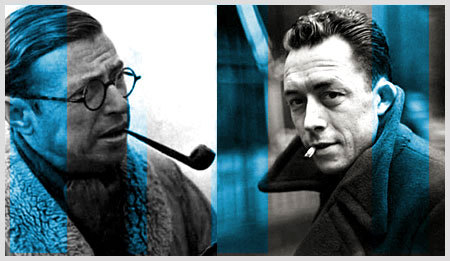
Jean-Paul Sartre, working on a draft of his existential work, Being & Nothingness, is in a Parisian cafe.  The waiter asks him what he wants.

"I'll have coffee with no milk," Sartre answers.

"We don't have any milk," answers the waiter.  "Would you like it without cream?"

Sartre would get the joke (la blague), playing, as the joke does, with concepts of negation, the state of not being in terms of human expectation.  The milk and cream become casualties of phenomenology, something J-P studied in the works of Heidegger and Husserl while a prisoner of war in 1940-41.  He then became a screenwriter for Woody Allen:
"Based on an examination of the nature of phenomena, he describes the nature of two types of being, being-in-itself and being-for-itself. While being-in-itself is something that can only be approximated by human being, being-for-itself is the being of consciousness."
In this interpretation,  Simone de Beauvoir becomes Diane Keaton.  Frequently people have wondered whether her open marriage to Sartre made her happy; the short answer is that no one knows, but it never failed to get a laugh.

My cousin, the writer who lived his life in Santa Cruz, preferred Albert Camus to Jean-Paul.  In essence, Camus was less of a bullshitter and just liked horsing around, whereas Sartre was a hopeless smart ass.  Jean-Paul would have gone on for an hour about the milk and cream deal, while Albert would have spent the time checking out the ladies at the next table.  Chacun à son goût, n'est-ce pas?

Nevertheless, these French horndogs  provided a valuable philosophical bridge between ancient, traditional religiosity, and modern, what the fuck are we doing here? thinking.   WTFAWD thinking has now become the dominant paradigm, or is in the process of doing so, and it has even left behind the seminal tropes and themes of existentialism, with its authenticity baloney about a man being "engaged" in the historical struggles of his time and the rest of it.  Yeah, right.  Bo-r-r-ing.

In the age of Twitter, no one is going to sit at a table in a cafe along St Germain des Prés and scribble notes about phenomenology, but as mankind rose up from the obscurantism of God and the rest of it, it must have been thrilling to sketch out a new framework for human consciousness. Not to mention how such lines would have worked at a Parisian par-tay.  Particularly with a beret and a heavy cloud of Galois smoke swirling around your head.   

In the refrigerator, I have only half & half.  Philosophically, I'm stumped: what shall I not have my coffee with?  


March 08, 2014

Saturday Morning Essay: Ukraine, Honey Is That You?

My official position on the Crisis in Crimea, the casus belli of World War III, the Developing Situation in Ukraine:  How would I know?  All I know is what I read in newspapers that don't exist anymore.  All sources are secondary: people reading what other people surmise and then reproducing these biased conjectures as objective truth.

I was amused by Hillary Clinton's political application of Godwin's Law.  Godwin's Law is an Internet rule which posits that as the length of any comment thread increases, the odds that someone will make a comparison of someone else to Hitler approach 1/1.  Hillary, solidifying her position as the frontrunner for the Dems in 2016, the Heiress Apparent, compared Putin's move into Ukraine to Hitler's annexation of the Sudetenland in Czechoslavakia prior to World War II.  That's fairly good, as historicity goes; Hitler's rationale was that the Germanic peoples living in the Sudetenland were being oppressed by non-Germanic majorities, as Putin claims the ethnic Russians in Ukraine are being pushed around by the various factions of skinheads, anti-Semites, Neo-Nazis and other statesmen (collectively, "America's allies") urging the ouster of Ukraine's recently departed President.

However, why should Hillary reach so far back in time if the principle she is upholding is that of the right of sovereign nations to be free of unlawful invasion by another country?  Why not Afghanistan in 2001 or Iraq in 2003, invasions which Hillary voted for and passionately supported?  I've probably answered my own question.

No, one must build one's take on international events from the ground up these days.  One must state first principles and then derive one's position. This is science.  So, is Andrew Levine, writing for Counterpunch, correct?

All indications are that Obama would like to pull China down a notch or two.  Why else “pivot” towards Asia?   But if there is a way to do that without also harming the interests of the fraction of the one percent he lives to protect and serve, he has yet to figure out how... Russia, however, is another story. There, separatist forces are strong, and the economic stakes are high.  And, though you would never know it from our media, opportunities for stirring up trouble abound because the level of state repression is low.  Think how far Pussy Riot had to go to provoke an illiberal (“authoritarian”) reaction. 

Probably so, and Levine has stated an important Axiom, which we will label Axiom 1:  A nation's foreign policy is identical to its domestic business policy.  How could it be otherwise?  Thus, Secretary of State John Kerry (described by Jim Kunstler as "a haircut in search of a brain") can fulminate in his Kennedyesque way (a always pronounced as in "father") about sovereignty, but this argument is really about oil and gas pipelines around the Black Sea.  If these are personally important to you, then you should be very interested in developments in Ukraine.

The second principle (Axiom 2) is that, although Levine makes it sound like Obama's unqualified support for a tiny sliver of the American populace (the Fat Cat Coalition) is a bad thing,  it is not Obama's fault that wealth inequality has reached absurd levels of imbalance in modern America; modern American Presidents always serve the interests of the business community in everything they do. It's just that when they do that now, they're only working for about 43 people, those people who own the country.  So Axiom 2 can be restated: the President takes the nation's ownership as he finds it.  These are the people he goes to work for.  Or she will go to work for, in 2016.

And what about Putin?  Well, he works for companies that have Prom endings to their titles (Gazprom, for example).  Thus, the photo up above.  He can't let Ukraine's network of oil and gas pipelines, and his warm water port on the Black Sea, come under the control of decidedly anti-Russian elements.  Axiom 3, therefore: our opposite number in these "crises" operates from the same first principles.

Do we really want to ensure the free flow of oil and gas from the fossil fuel-rich Caucasus, as it's often called?  No, because then we'll all be incinerated by global warming.  Will we go to (nuclear) war over Ukraine?  No, because both sides recognize that the destruction of all human beings is among the worst things that can happen to business interests.

Leading to Axiom 4, which might make a good title for a blockbuster disaster movie: Humankind is bound up in a matrix of interlocking death wishes from which there appears to be no easy means of escape.

March 02, 2014

Twelve Steps to Extinction

I didn't write a Saturday Morning Essay because I was at the University of California, Santa Cruz, at a conference on climate change.  Some true heavyweights in the field were there, including Michael Mann of Penn State, the "Hockey Stick" proponent who took on Rep. Joe Barton of Texas and is now suing the National Review, William F. Buckley's old rag,  for libel.  How can one not admire a man like that?  Also, Gavin Schmidt of NASA Goddard, a mainstay at Realclimate.org, Ben Santer of Lawrence Livermore, and Susan Solomon of MIT. 

I am familiar with the work of these scientists through my reading on the subject, which, admittedly, borders on the quasi-obsessive.  Well, we all have our hobbies.  I stayed with friends who live adjacent to the university, and it was a cool and bracing walk up the hill, on a blustery, rainy day, to the multi-purpose room where the conference was held.  Despite the weather and the early hour, the event was well-attended. 

The first panel (pictured up above in the writer's own photo) conducted a cursory review of the current state of the science of climate change.  This was, frankly, a little humdrum, and I suspect this was inevitable.  Four speakers given ten minutes each to say something about a science so complicated is not a process likely to produce a lot of breakthroughs, and it didn't.  More interesting to me was the second panel, which featured some genuine, working bureaucrats from the state of California who described what California is doing and plans to do about climate change. 

You might say that California is the American version of Germany and Holland.  It's a Green state with a lot of economic clout: 38 million people and the 8th largest economy in the world.  On its legislative books we have AB 32, which requires California to achieve a 35% reduction in greenhouse gas emissions below 1990 levels by 2020; thus, by this target year California is to emit not more, in the aggregate from all sources, 427 million tons of CO2.

To give full credit where it's due, this law was supported and ushered into law by the Austrian muscleman himself while he was governor in 2006.  Strangely enough, the Governator's dream seems likely to be fulfilled.  After that, the plan is to achieve reductions of 80% of GHG emissions (again, with 1990 as a benchmark) by 2050.  California is going about this in a variety of ways, including big pushes in solar and wind power plants, electric cars, and energy efficiency.  Ideas from Holland are being studied, such as the idea of covering the very long California aqueduct with solar panels, a non-invasive way (where animal habitat is concerned) to build power facilities with the added plus of reducing evaporation.  The Dutch are doing the same thing with their vast array of canals.  The Germans have all kinds of good ideas, such as super-insulation of housing and ways to localize power production. And, of course, Steven Chu's idea of painting, or building, all housing and commercial structures with white roofs. It's odd that white roofs are not already national policy.  I haven't done any calculations, or seen any by anyone else, but it seems to me that some of the slack in the loss of Arctic albedo could be corrected if every habitat in the world was reflecting ultraviolet radiation from the sun back into space instead of absorbing it and radiating infrared light into our greenhouse gas-clogged atmosphere.

I read a few "collapse" blogs, of course, and a morning spent listening to positive ideas clearly expressed by highly intelligent people places me in a state of mild cognitive dissonance.  We have the Denial crowd (such as "idiot politicians," as Gavin Schmidt called them; I happened to glance over at Michael Mann as Schmidt said this, and Mann was looking my way, and we both laughed - a nice moment of connection).  But beyond these increasingly irrelevant ranters and ravers (the Flat Earth contingent of modern times), we have the Collapsarians who have become deeply emotionally invested in hopelessness.  Thus, a contingent of pragmatic, can-do people such as those assembled yesterday are squeezed from both sides: they are called "unrealistic" by the Deniers because there's no problem to begin with, and unrealistic by the Collapsarians because we're plainly beyond all hope and the hour of our extinction is almost at hand.

Humans are strange psychological phenomena.  Between these two ideological phalanxes, it is hard to say which is more damaging.  The Denialists are being marginalized, day by day.  The Collapsarians, however, sneer, deride and laugh at any attempt to do anything about our predicament, because the earnest, deluded Mitigators are just listening to climate scientists who are "corporate shills" and/or who smoke "Hopium" all day.  There are even organized groups who celebrate their Realism together, such as the NTHE Support group (Near Term Human Extinction).  On Facebook, I have seen some of the ringleaders suggest "rules" for posting on their threads: one should not "troll" by saying anything positive which creates the illusion that anything can be done.  If you do, you're immediately identified as a Pod Person.

That's an odd idea.  One is already doomed, yet there are "rules" for describing your feelings about it. (Sort of like the great line in "Butch Cassidy & The Sundance Kid:"  "Rules?  In a knife fight?").  For example, perhaps you would be tempted to comment (or Comment) on one of their threads, as someone I know did (actually, it may have been me) that the "methane bomb" thesis where the Arctic is concerned is unsettled science, and that arguments "establishing" this is happening are found only in non-peer reviewed speculation; indeed, perhaps the world's leading authority on methane and carbon loads in the Arctic generally, and the East Siberian Arctic Shelf particularly, Natalia Shakhova of the University of Alaska, does not endorse the "methane bomb" thesis, stating the science does not yet support such a conclusion.  But for the NTHE crowd, the fuse is already burning.

I am sure that the desire to "belong" may indeed override all other instincts in some individuals, including the will to survive. Thus, in their addictive clinging to their own annihilation, they find comfort and solidarity.  It doesn't make any sense to me.  We don't actually "know" the things that the Collapsarians base their demise upon.  I'm sorry, folks, but the actual science does not conclusively support your position.  Your confidence about hopelessness is an artifact of your smug sense of superiority, which you have not earned.  You haven't made your case.

Anyway, it's the wrong case to make.  Why go down without a fight? Why wallow in despair? How futile, how inhuman, how...boring.  Far more interesting is the attempt to solve the problem.  Take the side of life, not death. Death will be along regardless, and then you can be dead for as long as you like.  But while you're alive, be alive.


February 22, 2014

Saturday Morning Essay: The Woody vs. Mia Papers: Exegesis on a Dispatch from the Council of Morons

Brought to you by Peet's Colombian Dark Roast store-bought...

(It's good from time to time to take a break from the ongoing destruction of the biosphere; it doesn't always need a play-by-play from me.)

I should make my own "full disclosure" since Nicholas Kristof discloses in his hit piece that he's tight with the Farrow clan. My introduction to Woody's filmmaking was in 1971, when I was living in Berkeley, waiting to see what the Department of Defense wanted to do with the 1-A status they had bestowed upon me at the Oakland Induction Center.  I had time on my hands, you could say.  I saw "Bananas" at the old movie house on Shattuck, a drafty auditorium with a full balcony in the years before it became the inevitable multi-screen rabbit warren.  I saw it first with my old pal Gwinn Hinkle, a polio survivor taking a break from his iron lung on the fourth floor of Cowell Hospital. Even in those years Berkeley was a good place to be a freak of nature, as I imagine New York City has always been a good place for a different kind of freak like Woody Allen to live and work.  More tolerant, more who gives a shit.  You're like you; that's nice.

Then I went to see "Bananas" three more times during the course of the next couple of weeks.  I couldn't get enough of Woody's post-modern tomfoolery.  I sensed he was doing something different with making films, knocking down the wall between the antics on the screen and the viewer.  Making fun of the fun he was having while he made the movie.  Woody has always operated at a level deeper than his usual critics dream of in their philosophy.  A reading of his inspired japery in his New Yorker stories should convince even the cynics of that. 

 But it's the way of the world to be tedious, quotidian, and conventionally judgmental,  and cornballs like Nicholas Kristof of the New York Times, a hack writer who hails from Eastern Oregon farm country, is among those who are there to remind us of how tedious the world can be.
So Nicholas, sensing a chance to capitalize on his "friendship" with the Farrow group and to give his flagging ratings a boost, allowed his blog to be used as a sounding board to revive the old story about Woody, Mia and Dylan Farrow.

Woody Allen was honored by the Golden Globes with the Cecil B. DeMille Award for Lifetime Achievement, celebrating Woody Allen as a great auteur and creative force who has given us many wonderful movies over a very long working life. Clearly, that demands an "answer."  Doesn't it? No, I don't think so either.

Dylan Farrow (who now goes by another name), the daughter who claims she was molested by Woody Allen when she was seven years old, felt sick at heart because of the honor bestowed upon Allen, and wrote a letter to her friend at the New York Times.  Kristof, who disclosed (as noted) in a column that he was friends not only with Dylan and her brother Ronan but also Mia Farrow (the three people who undoubtedly hate Woody Allen more than all other humans on Earth combined), decided to publish Dylan Farrow's letter on his blog, in full, unexpurgated form.  Thus, an event which allegedly took place about 22 years ago, and was exhaustively dealt with by the legal system, was again given a public airing, and Nicholas Kristof's dreadful column will survive, it would appear, for at least a few more weeks.

Kristof, who is kind of a junior associate member of the Council of Morons (the Big Morons are Paul Krugman, Thomas Friedman, David Brooks and Maureen Dowd - I actually like Roger Cohen) struggled to find a rationale for his decision to be used in this way, and came up with this:

"Look, none of us can be certain what happened. The standard to send someone to prison is guilt beyond a reasonable doubt, but shouldn’t the standard to honor someone be that they are unimpeachably, well, honorable?

"Yet the Golden Globes sided with Allen, in effect accusing Dylan either of lying or of not mattering. That’s the message that celebrities in film, music and sports too often send to abuse victims."

Okay, that's as lame as anything can get.  Any lamer and it would need to be shot and put out of its misery. Like Kristof's column at the New York Times, for example.  One can understand that Kristof's readership has probably fallen through the floor in recent years; to the extent that people read newspapers at all anymore, it's unlikely that many of them read the dull prose of Nicholas Kristof.  The New York Times no longer employs some really good writers, like Frank Rich and Bob Herbert, but for some reason this fellow keeps a seat warm at the Council's round table.

The two paragraphs up above don't make any sense at all.  Take the first question: "Shouldn't the standard to honor someone be that they are unimpeachably, well, honorable?"

First off, you have to figure out what the term "honorable" even means in this context.  Take for one grandiose example the case of Dr. Martin Luther King, Jr.  It is widely known that Dr. King liked to drink and was something of a womanizer.  Should we, therefore, discontinue MLK's birthday as a national holiday, as Republicans such as Dick Cheney often tried to do?  Should his "Dream" speech be forbidden on national TV?  I don't think we can say that Dr. King was unimpeachably honorable, not in the sense that Kristof wants, which is a reputation free of any suspicion of socially conventional misbehavior. Kristof wants to use a "Caesar's wife" standard, I guess.  And since Kristof does not require conviction of a crime, or even a finding by a jury in a civil case, in order to seal the deal, then accusations against anyone by anyone relating to moral misbehavior are sufficient for a lifetime ban from the awards shows.

These shows are going to become very lonely affairs.

The second paragraph above goes entirely through the Looking Glass.  To review:

"Yet the Golden Globes sided with Allen, in effect accusing Dylan either of lying or of not mattering. That’s the message that celebrities in film, music and sports too often send to abuse victims."

Catch that?  "In effect." Thus, to follow Kristof's logic, the Golden Globes, which are awarded by the Hollywood Foreign Press Association (and not an American institution, such as the Academy Awards), met in some secret cabal (probably at a deserted barn in the Midwest on a moonless night where Satanic rituals and child abuse were practiced) and said to each other in their polyglot way, "in effect," "So we have to decide which side we're on concerning this family episode involving Woody Allen which allegedly occurred 22 years ago.  All those in favor of accusing Dylan Farrow of lying or not mattering, please throw your goat entrails out into the center of the circle."

Alternatively, the Foreign Press Association could have decided that Woody Allen's lifetime achievement in film entitled him to an award, and did not consider, or even remember, accusations made long ago which were never proved.  In fact, if Mr. Kristof were to do a little digging in the archives at, for example, the New York Times, he would find this:

"March 19, 1993 - A team of child-abuse investigators at Yale-New Haven Hospital here cleared Woody Allen of Mia Farrow's assertion that he sexually molested their 7-year-old daughter, Mr. Allen and his lawyer said today."

So maybe the Hollywood Foreign Press Association considered a conclusive finding made after an exhaustive investigation a point in Woody Allen's favor.  You know how those Europeans are; they have this annoying habit of thinking

The investigators studied the allegations and all of the evidence presented for seven months.  Still, the original accusations by Dylan Farrow and her mother Mia remain, and since they're friends of Nick Kristof, that's good enough for him. I'm surprised, in a way, that Mia would bring all this up again, since she was the beneficiary not only of all those starring roles in Woody Allen films (which she ruined with her wispy, irritating acting), but benefitted as well from all of the child support payments which Woody Allen made on behalf of Ronan Farrow, up above, pictured with his "dad," and also next to another fellow who Mia admits may in fact be Ronan's father.

Gee, ya think?  Maybe the Yale - New Haven team can be brought in to work on that one. It probably won't take seven months.  Woody, I'm sure, will donate some DNA to the cause.  Ronan can do the same, and since he detests Woody Allen, I would imagine he would be anxious to do so.  Nancy Sinatra and Frank, Jr. are still around, no doubt ready to welcome a new member of the family (or Family).

And Mr. Kristof, one more thing: is it entirely and unimpeachably honorable to accept child support payments for years and years for a son fathered by someone else?  And if the answer to that question is no, how do you justify allowing your column to be used by such people to launch a blindside attack on Woody Allen?

February 19, 2014

On the Isle of Patmos

An old friend writes:

"A few weeks ago when the drought was at its driest I woke up in the middle of the night and thought, "Is it all over?"  I was thinking that perhaps I was living at the pivot point, when the California I grew up with began to become something entirely different...and more demanding of its residents.  I was frightened by the thought, as only a 3 a.m. thought can frighten.  But it also occurred to me that the thought also carried a degree of human arrogance and exhilaration--if it's all over, at least I was there when it happened.  Funny collection of thoughts."

I simply have to stop scaring my friends with this blog; however, truth be known, I have had similar thought parades in the middle of the night this past year. I grew up in California, as my friend did, and one becomes accustomed to a mild, easygoing rhythm of seasons where nothing much happens.  The summers are mostly cool and windy, with a lot of fog, but occasionally punctuated by a heat wave. This gives way to the dry, perfect weather of September and October, a kind of equipoise where the air is so light on the skin that it all feels like a dream. Toward the end of October or early November the rains begin.  December and January send a lot of cold rainstorms barreling down on us from the Gulf of Alaska.  These give way to the easier rains of February and March, and then a cold, windy spring is here, and then back to the moderate dry air of summer.  

That was it.  That was our climate.  It worked sufficiently well that California produced 50% of America's fruit, vegetables and nuts, and is also the largest dairy state in the country.

I find now, and this is a difficult act of resignation because I am a creature who loves routines, that I don't count on anything like that old climate returning to California.  It seems very unlikely that it will ever be like that again. I don't think this year of drought, interrupted by one "atmospheric river" storm of Biblical proportions (I had 17" of rain here where I live, as measured by a gauge, over a 4 day period), will give way to the old patterns based on a very different jet stream configuration, a different Arctic, and different concentrations of greenhouse gases.  The endless deluges in the United Kingdom, where one ferocious storm packing 100 mph winds and fetching 50 foot waves is followed by another, is part of this same freak show, as are the polar vortex excursions, the repeated ice storms in the Deep South of the USA.

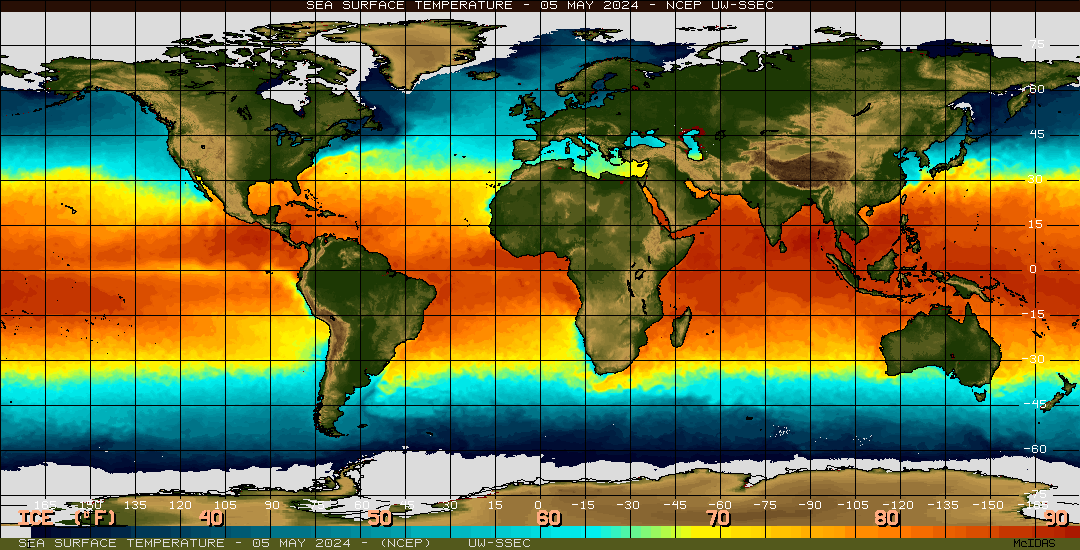
Thus, forecasts of a "hundred year drought" for California may be premature, given the new uncertainties in the weather.  Indeed, such thinking may represent the Fallacy of Reversion to the Mean, when the Mean has left the building for good.  Our dry years have corresponded to strong Las Ninas in recent years, when cooler surface ocean waters held down atmospheric temperatures.  The Baby Girl has served as a marvelous heat sink, masking the relentless rise in global average temperatures on land and air by taking up a lot of the atmospheric heat.  Tradewinds blowing east to west (from the Americas to Australia and the Phillipines) of unprecedented strength have pushed enormous volumes of surface water toward the other side of the world.  This has permitted an upwelling of colder, deep ocean waters off the Americas, and the resulting temperature gradient has been favorable for heat uptake off our coasts.  This now appears to be changing, as the good folks at NOAA are forecasting the return of the Baby Boy (El Nino) sometime during 2014.  And what will that mean?  The useful New Zealand site seemorerocks provides a suggestion:


The unprecedented heat bleed from the Pacific doesn’t occur without a number of severe weather consequences. Especially under the gun for this, most recent, potential event of human caused climate change is California and the Desert Southwest. Having labored under drought since the early 2000s, the region sees a radical shift to unprecedented stormy conditions. During winter, a massive flow of heat driven moisture rides up from the Pacific and arcs over California carrying with it a stream of storms. The stormy period drags out for weeks, beginning to resemble the megastorm of centuries past. Cities and industries laboring under the strain of too little water see a sudden and radical, though brief, shift in the opposite direction. California, under the gun for tens of billions of dollars in damages from water shortages and drought instead falls under the gun for possibly hundreds of billions of dollars in storm damages.

So next winter our new problem may be trying to keep the land we're standing on from simply floating away.  It seems that the old weather patterns are giving way to exaggerated caricatures of themselves; when it's dry, it's Saharan dry.  When it's wet, it will be our very own monsoon.  All of it amped up on greater water vapor content in the atmosphere, higher air temperatures, a melted Arctic, and a jet stream doing the funky chicken.

So cheer up, old buddy.  Maybe the old climate was a little dull.  Many East Coast transplants often complained about that very thing, while, we noted, they never thought of leaving.  Seven years of fat, seven years of lean, seven years of drought, seven years of flood, but I don't think it's ever going to be quite the same Old California again.

February 15, 2014

Saturday Morning Essay: Sometimes A Great Notion


Brought to you by Peet's Dark Roast Colombian...

For the hell of it, I Googled "Waldenswimmer" and came across this:

"Once in a while in that vast nothingness of the internet I’ll happen across a blog from someone who has something of substance to say. I have also learned that Dmitry Orlov is likely discontinuing any more ‘collapsitarian’ blog posts. Probably not a good subject to dwell on when you have an infant son. In ’Dmitry flicks it in‘, Harry Willis reminds us that America has been the epicenter of capitalism, always for sale to the highest bidder and now home to a new growth industry – Doomsaying."

Thus begins a post from the blogmeister at collapseofindustrialcivilization.com.  He then proceeded to quote virtually the whole post (from November, 2013).  The post was nominally about Dmitry Orlov's retirement from the field of collapse writing.  Not that I actually think Dmitry will do that, because it's his brand and power base.  If he's serious about writing only about things like sailing and his newfangled idea of a different alphabet for the English language, he'll soon be down in the weeds with me and the bloggers who write about new brownie recipes.  Keep collapsing, Dmitry; it's where the action is.

The post went on to describe Sheldon Wolin's concept of "inverted totalitarianism," something I've done on several occasions but at greater length there.  I have to say the post made me sound a little more radical than I really am by nature.  I'm more of a passive "social systems analyst."  I'm very curious about how we got into the present configuration of wealth distribution, for example, and why the hold of Big Money over Big Government is so absolute, worldwide.  Sketching out my ideas about how that happened is an absorbing enterprise.

The basic facts become more fantastic by the day.  Paul Beckwith quotes an analysis showing that the wealthiest 85 individuals have as much wealth as the bottom one-half of all humanity (over 3.5 billion people, that is to say).  This factoid is related to what I was writing in November and to Sheldon Wolin's thesis.  Because of globalization, the same kinds of forces of monopolization, market dominance of brands, and acquisition of smaller business entities by giant holding companies tend to continue the relentless process of concentrating money and power in fewer and fewer hands.  It is a self-reinforcing feedback loop: vast concentrations of wealth enable acquisition, acquisition of competition enables monopoly, monopoly enables vertical integration of ownership of everything, including governments.

This last step is a consequence of the McLuhan Age, naturally enough.  Politics in America is now mostly a sub-specialty of the advertising and public relations business.  To achieve visibility in American politics requires access to big media, which in turn are owned by six large corporations.  Without such visibility, a candidate has no chance of breaking through to a position of power; however, only a candidate from one of the two officially sanctioned political parties will be given the visibility, or "oxygen," necessary to become a brand that the minority of Americans interested in politics will vote for.  Thus, although we nominally have a democracy, it is in fact controlled and circumscribed by the same financial forces that control everything else.

Like chain restaurants and hotels, such concepts typically begin in America but then through globalization tend to spread to all parts of the modern industrial world, and the next thing you know, 85 individuals control as much wealth as three and a half billion similar mammals. Humans are indeed a species which tends toward hierarchical arrangements, and these hierarchies tend to become more rigid and inefficient the longer they are in place, until the hierarchy's only raison d'etre is the perpetuation of its own power.

Attempting to shift or reform the negative consequences of such ossification is extremely difficult, even in a democracy with an educated electorate.  This would certainly leave the United States of America out of the loop.  For one salient example, a recent survey demonstrated that one in four Americans did not know the Earth revolves around the Sun.  This mighty cohort of 25% of American adults are included in the same electorate who must assess America's energy policies, for example, and its effect on climate change.  One could even argue from such data that perhaps an enlightened power elite may be the best hope for steering us through the dangerous cataracts up ahead.

Maybe The Big 85 can be in Paris in 2015 at the make-or-break conference on climate change.  They're probably pretty well informed.  At a certain juncture in the history of civilization, maybe even the fattest of fat cats realizes that all the money in the world profiteth a man nothing if he doesn't have a tolerable planet to spend it in.

As for Paul McCartney up above: I just found the video astounding.  Abstractions and conceptualization are one thing; watching a genius casually demonstrate why he's who he is quite another, and a needed balm for the contemporary soul. Besides, money can't buy talent like that. 


February 12, 2014

The New "On the Beach" Scenario


Someone was suggesting recently that what was needed to galvanize mass reaction to the catastrophe of climate change was a work of art similar in effect to Nevil Shute's On the Beach.  That's not a bad idea.  Semi-inspired, as Dan Jenkins might have written.

Nevil Shute authored the novel in 1957 after he had immigrated to Australia from his native England.  Shute was 58 at the time he wrote this story about the last survivors on Earth living out their final days in Melbourne, awaiting a deadly cloud of radiation drifting down from the Northern Hemisphere after a nuclear holocaust in the early 1960's.

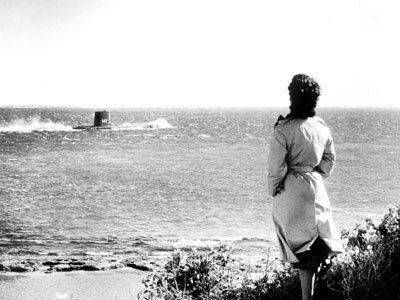
A movie was made of the novel in 1959, and like most disaster movies, the film was forced to focus on the personal as the only way to carry the narrative.  The idea was not to make a documentary about nuclear war, after all; still, as I remember the movie, things were a little hokey, with Fred Astaire driving race cars as a way to demonstrate the desperate devil-may-care attitude of the survivors.  There's a doomed love story, of course; disaster flicks must always have two things happening in the middle of the general desperation: a doomed love story and a part for Ernest Borgnine (although for some reason he wasn't in this cast, which included Gregory Peck, Ava Gardner and Anthony Perkins). Gregory Peck is the straight-arrow Navy captain of the Sawtooth, a submarine which happened to be on patrol near Australia when Armageddon broke out. His wife and kids were in the United States, and while rationally he knows they were doomed, he maintains a kind of hopeful denial.  Ava Gardner falls for him, of course, because who can resist Atticus Finch in Navy whites.

There is a long reconnaissance submarine voyage to California and eerie scenes of deserted streets in San Francisco and San Diego.  Everyone up north is dead.  Pretty soon everyone in Australia will be dead, too.

In British usage, "on the beach" means retired from the naval service.  It's catchy if you know the slang, otherwise a little mystifying.  In Australia all the denizens were On the Beach, having retired from the world of normality to the waiting room of extinction.

A creative mind could doubtless come up with a scenario where a personal story is told with global warming, presumably in an advanced state, as a backdrop.  Ernest Borgnine will obviously not have a part, so that leaves George Clooney, Matt Damon, Brad Pitt and Don Cheadle.  One of them is no doubt cast as a climate scientist.  That's probably Matt Damon, since he likes roles where he plays a super-bright character, as unlikely as that usually looks. Another is a fighter pilot who's trying to figure out a way to bomb humanity back to a stable climate.  Maybe Don Cheadle is the President; why, he asks himself, did I play golf all those Saturdays? Amy Adams, Rachel McAdams and Michelle Williams will have parts, since no one is ever sure which one is which anyway.

I see some difficulties in mounting a production with the same impact or social utility as "On the Beach."  For one thing, what was of great relief to audiences leaving theaters in 1959 (I remember seeing the movie at the drive-in and feeling creeped-out when I first saw that "1964" on the calendar - we're not in the present anymore, Toto!)  was the sense that they had just seen a movie based on a fantasy: as of 1959, there had been no nuclear war.  The Cuban Missile Crisis had not yet occurred.  Everything the viewers had just seen could all be avoided.  It was "out there" somewhere, not a living reality.  When you went home, it was not to a house seething with radioactivity.

A disaster movie about global warming, by contrast, is about a world which is already undergoing critical, perhaps catastrophic, climate change.  When you walk out of the theater, it is not with the sensation of escaping from a disturbing fantasy world; it is with a sense of looking at the world around you with newly horrified eyes.  An honest movie about climate change cannot truthfully portray a reality where the disasters depicted are necessarily avoidable.  The tag line can't be, if you want to avoid the world you just observed for 128 minutes, then support immediately a new energy paradigm.  It must be, if we finally do something other than continuing to emit gigatons of CO2 from fossil fuel combustion, we have a shot at not living the nightmare you just saw. As The Dude said when he read the ransom note handed to him by Philip Seymour Hoffman in the role of Brandt:  "Bummer, man. That's a real bummer."

Still, I hope Soderbergh or some other talent takes this on.  Not Scorsese, because whacking everybody is not going to get us under 400 parts per million all by itself.  Someone needs to write the novel.  Probably not Cormac McCarthy, great as he is, because when I finished The Road I wondered for a few days why I was getting up in the morning.  But someone, and the sooner the better.


February 08, 2014

Saturday Morning Essay: Surf's Up In England

Brought to you by Peet's store-bought...

"What is the use of a house if you haven't got a tolerable planet to put it on?"  Henry David Thoreau.

Always far, far ahead of his time.  The principles of global warming, through the greenhouse effect and the capacity of various atmospheric gases to absorb and re-emit infra-red radiation (depending upon peculiarities of their molecular bonds), were actually worked out in 1857 by an Irish contemporary of Thoreau, the physicist John Tyndall.  Presumably, since the pure scientific discovery did not threaten any big fossil fuel companies, Tyndall's work did not give rise to a Denialist movement, and I'm not aware that he was charged with participating in a liberal hoax and conspiracy.  He just figured it out, and even calculated that it was water vapor that was the strongest gaseous contributor to heating the troposphere.  

I've been reading a lot lately about the psychological effects of abrupt climate change.  To wit, people are freaking out at the disruption of normal patterns.  It is not normal, for example, for 75-foot waves to break onshore in Cornwall, on England's south coast.  

John Nissen, writing in Ecologist, notes:

 The long spell of wet weather here in the UK this winter is due to a stuck pattern of the polar jet stream, such that it frequently passes over us. Meanwhile the mid-US has been experiencing an extreme cold spell, as the jet stream meanders southwards in a gigantic loop. Strong scientific evidence suggests that this jet stream behaviour, producing an increasing frequency of weather extremes at mid-latitudes, is primarily driven by Arctic warming; global warming is only a secondary, compounding factor.


Mr. Nissen then urges prompt action to avert "abrupt climate change."  I know that his intentions are good, but um...if it's already happening, if it's attributable to Arctic amplification, then isn't abrupt climate change here?  Which, I must say, is a complete bummer, because if it's here, then it's here for reasons that will never go away during any relevant lifetime or era.  What's going to put the ice back at the North Pole?

Paul Beckwith is a great explicator of the phenomenon.  It's good we have people like Paul or we would be left only with the analyses of contemporary life offered by such august bodies as the Council of Morons at the New York Times, who seem unaware that the fundamental conditions of human life have changed.  Personally, I think this is newsworthy, but then what do I know?

Paul Beckwith explains abrupt climate change and Arctic amplification with an economy of effort that reflects, in my view, a deep understanding.  (He's a chess master, and thus thinks with a clear logic.)  The jet stream, in its classic formation of yesteryear, depended on a temperature gradient between the Equator and the North Pole.  The consistently warm weather at the Equator tended to flow north toward the cold Arctic.  The rotation of the Earth deflected this flow eastward, or to the "right," because of Coriolis force (principles first worked out by Richard Feynman, using a few idle moments of his immense intelligence).  These dynamics tended to keep the eastward flowing jet stream in the Northern Hemisphere within a fairly tight band, with predictable peaks and troughs.

With the Arctic warming 4 or 5 times faster than the Equator, however, the gradient has broken down, and what Paul calls a general "equilibration" of temperature in the Northern Hemisphere means that just about any kind of weather can happen anywhere at any time. The jet stream is a meandering, lethargic, unpredictable mess, plunging southward, streaking northward, breaking into pieces. Arctic cold in Georgia, drought in California (except that right now we're having an "atmospheric river" storm which is dumping huge amounts of rain on the Bay Area), and waves at Cornwall which make the breakers at Maverick's in Half Moon Bay seem puny by comparison.

A little too late for "averting" anything, I think.  We're into adaptation, and as with everything else about climate change, arriving decades ahead of the formal, model-based predictions.  The Denialists appear to have been right about the climate scientists after all: their models were way off.  They were much too optimistic.