Brought to you by Trader Joe's Italian Dark Roast blend...
A longtime buddy of mine and I once kicked around the idea of writing the "definitive history" of the housing tract where we grew up. This Peninsula subdivision was built about 18 miles south of San Francisco as the seagull flies, in an area that had once been part of San Francisco Bay but then filled in and covered with modest family homes in a rectilinear grid. Trees were planted, a school was built, a park in the center of the tract was laid out, and a shopping mall was erected at the far north end of the main street running north-south through the grid. Houses were built on quarter-acre lots, two or three bedrooms, one bath, a dining room, a living room and a kitchen. Yards front and back, a single-car garage. In the second California Gold Rush, beginning with the Dust Bowl and continuing through and after World War II, such subdivision housing sold out quickly, acquired by people like my parents, in search of a better, or at least different, life than that experienced elsewhere. Which makes me think that life elsewhere might have been pretty rough.
Later I discovered that it was unnecessary to write such a history, bestseller though it might have been, because a fellow named D. J. Waldie had written a book with the unlikely title Holy Land, about the town of Lakewood, a suburb of Los Angeles. D. J. described housing tracts which were a lot like the ranch-style ghetto of my youth. In his meticulous re-creation of the town's planning and development (enabled by voluminous research into newspaper archives, land records, court files and minutes of the planning commission), and through his own detailed account of the experience of growing up in Lakewood, Waldie captured the sense of alienation from the natural world induced by such a place, how the abstract nature of a layout where the houses, the street lamps, the scrawny trees (tapping their roots into saline soil), the mall, the school, the amenities and even the designed relief from the monotony (the park) were so utterly predictable. You might even say: abstract.
An assignment in a first-year English class at Berkeley, taught by the marvelously self-important Oscar Pemantle, was Notes From the Underground by our man Fyodor, often referred to on this very blog as perhaps the most definitive of the existential writers, although I realize he is not ordinarily grouped with them. In Notes, Dostoevsky wrote about the only subject which serious literature can seriously address, which is the meaninglessness of life. At one point St. Petersburg is described as the most "abstract" city in the world, and Professor Pemantle, trolling for suckers, asked the class what Fyodor had in mind. Thinking about my own humble origins in the housing tract, I told Oscar I would give it a try, and then opined that maybe Dostoevsky was suggesting that St. Petersburg was too carefully planned and constructed, leaving one with the disturbing feeling of living somewhere unnatural and contrived, "alienating the psyche from its habitat." I thought that last phrase had a genuine Berkeley pseudo-intellectual flair, and Oscar seemed to like it, even if there was no communication between us of what either of us thought it meant.
Nevertheless, when Oscar Pemantle gave his formal lecture on the book, he did not adopt this insight as his own. These were performance pieces, by the way, these "definitive" lectures. The class was full to overflowing with the regular students, and with other professors and their teaching assistants sitting in, along with many drop-ins from Berkeley's endless supply of scholastically omniverous intellectuals, all there just looking in on the high-minded fun. Oscar would don a three-piece blue suit, a silk tie, wing tips, and even sport a gold watch chain for good measure, which he would ostentatiously consult during his oration. Magnificent in his glowing, unlined mahogany skin and stylish barrister's attire, his dark hair swept back, his gold-framed glasses glinting, his voice, with its faint Indian intonation, chopping and parsing words with great precision, prancing and preening, wheeling and dipping as he walked back and forth across the classroom, Professor Pemantle told us that the book was really about...love.
I didn't buy it, myself. I thought he was just trying to be controversial.
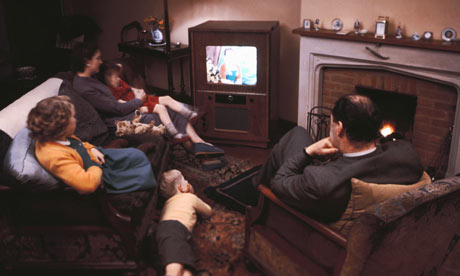
I think I understand abstraction, because I lived it first-hand. Bear in mind also that my generation was really the first to go all-in for video life. I doubt seriously that life would have been conceivable in the housing tract without it, unless you were from one of those extraordinarily weird families who sat around a table reading Bible verses to each other, and then plotting the axe murders of everyone they knew. Thus, outside in the "real world" (the abstract suburb) was nothing recognizable as nature, and in the house was a television.
In 1968 I bought Mason Williams's music book, a book called "Music" in his usual deadpan way, for $2.50. If you've been paying attention, you know that by 1968 I could read music for the guitar, and I wanted to learn "Classical Gas," the better to charm Berkeley co-eds with. Mason included some poetry in his book, such as "The Censor," which had a line about television which knocked me out:
"And light up like welding shops the ho-hum rooms of America."
I used to walk or ride a bike home at night through the tract, often after hanging out with the buddy who is co-author of the unwritten book. There were no easy paths home since in my part of the subdivision the blocks were laid out in long, parallel, dogleg fashion, with no cross-streets breaking through. You can imagine why. It would have been much nicer to relieve the monotony of a long street lined with identical houses, but you lose a lot or two every time you penetrate the avenue with something as useless as a cross-street. Anyway, I would gaze into the ho-hum rooms of America as I walked in the cold, windy air, and that's exactly what they looked like: blue welding shops, fusing the families together with an alloy of intense boredom and self-loathing.
Later, years after university days, I read the social critic Lewis Mumford's observation that the experience of living in suburban houses ruled by television sets "inured" the American populace to the idea of nuclear annihilation. To wit, at least a thermonuclear holocaust would be something to do, strange as it might be, and Americans were already thoroughly imbued with the sensibility that life was, at base, kind of preposterous in its usual routines. In a sense now we have taken television culture to an exponentially higher level, since electronics permit forms of television to be carried on the person at all times, so that even the outdoors can be included within the ho-hum regions of America, since the generations that succeeded mine have eschewed the natural world altogether in favor of its holographic representations.
I don't know what Mumford would make of the present situation. The United States these days appears to be deliberately provoking Russia in the service of a geopolitical "strategy" to maintain American hegemony. President Obama, in his utterly goofy, clueless way, is being wheeled around like a ventriloquist's dummy by various D.C. "power players," and since Mr. O can't really tell the difference between a good idea and a very bad one, he goes along, since the alternative would be to disagree, mounting a powerful, cogent argument of his own, forcefully delivered. More or less in the style, come to think of it, of Oscar Pemantle in days of yore, and I don't see that happening.
If a thermonuclear holocaust begins (and it all simply depends on whether Vladimir Putin decides to start one in response to relentless American provocation), there will be a lot of "platforms" to get the word out, providing a lot of "content" which will instantly go "viral" until an electromagnetic pulse shuts it all down. That will be the main bummer about the whole overkill thing; since nothing in our times can be said even to exist until it is Tweeted or texted, captured by cell phone camera or iPad and included in a conversation thread on Facebook, in a way the end of civilization won't really happen in terms we can grasp anymore. There will just be time for a cliche or two: "Didn't see that coming!" "WTF?" And then our abstract habitations, such as they are, will all be fused glass.
Ho-hum.