Showing posts with label America the Beautiful. Show all posts

December 23, 2009

It's that time of year


We're nearing one year of President Obama's tenure, and I was thinking it might be nice to lighten up a little. One way of thinking about what we've been through, after all, is to recognize this is what most of us thought would happen. We knew last year that 2009 would be a lousy year for anybody to be President. Remember? I think the President was so caught up in the campaign to become President that it perhaps did not register just how tough this job would be at this particular time.


"America was in a throe, a kind of eschatological heave..." Norman Mailer wrote those words in his wonderful Armies of the Night book, way back in the Vietnam protest days. Something like that is going on now. Most of the bad news is economic, of course. We're going through a painful and long-delayed transition from the import/service/information economy to something else, probably based on Green energy and smaller scale enterprises. Obviously it will take years to get there, but the journey has to be made. Presidents who govern at such times, during difficult transitions, usually have a miserable time and are thrown out of office as thanks for their efforts. I'm thinking of Jimmy Carter in 1976-1980. He's generally denounced as a lousy president in our revisionist histories, and a lot of this concerns high inflation and the Iranian hostage crisis. But another major problem he faced was the transition from American peak oil (around 1970) to the beginnings of OPEC power over the American economy, which we allowed to happen by not dealing with the energy crisis then. Carter was definitely on to this, but Americans did not want to hear about "shortages" or "conservation" or efficiency or anything else sensible. It was better just to get rid of the guy who talked this way, and give us a President who would tell people what they wanted to hear: it's Morning.

So we went from oil self-sufficiency to the present state of helpless dependency where we import about 2/3rds of what we use: 14 million barrels out of a daily habit of about 20, or 25% of world usage. All that oil costs a fortune, and it has been the main driver of the imbalance of trade. And it makes us responsible for a hugely disproportionate (per capita) contribution to climate change. My guess is that Barack Obama, a bright guy, figured out what happens to Cassandras who acquaint Americans with inconvenient truths. The problem is: how do we ever confront the necessity of change without having it forced upon us in the present, chaotic, dislocating way by Reality? This seems to be the chief problem with over-reliance on "free market" ideology: it's a blind pig staggering around a crystal show room.

Meanwhile, the blogs (like mine) are in full roar, having gotten addicted to negative dissidence during the Bush years. At this point, you can read so many different versions of the same apocalyptic prognoses, on so many different blogs, in so many different ways, that it's getting a little silly. I do think there is quite a bit of stabilizing inertia built into the world's interlocking economies, after all. It's not all negative stochastics. For example, the Chinese have warned us that they don't have as much money to buy Treasuries anymore. The Selbstschadenfreueders immediately leap upon this as definite proof that America's complete bankruptcy is only days away. They drive this point into the ground. I read it one place, then see that blog's point quoted on another blog, then another blog starts talking about the "consensus" that we're bankrupt, and pretty soon 5 million angels are doing the mazurka on the head of a pin. I think what the Chinese were trying to convey is that they've got a large stake in dollar-denominated assets, and the U.S. needs to cool it in terms of demanding more investment.

And so Obama has begun talking about fiscal restraint as a main focus next year. You know: duh. Then the liberal Keynesians (Krugman, Dean Baker) call this restraint "idiocy" and bad economics because only by running up the deficit can we hope to revive the economy that wasn't really working in the first place. I think this is the difference between pundits and people who actually have to make decisions in the real world, based on real world restraints. Krugman is reciting something he read in a text, Obama is looking at an overdrawn check book and a banker making ominous noises about calling loans. Obama's right, Krugman's wrong.

If Obama can get past this economic crisis, maybe he will have the elbow room to demonstrate some innovation. It's not really possible now - it's all damage control, all the time. I'm not that optimistic about him, however, and that's a conclusion I'd rather not reach. Some very exciting, interesting things could be done, but I don't think he's going to do them. But maybe the American people will lead the way, for once, and the leaders will rush to get in front of a parade already in progress.

Merry Christmas, one and all.

October 13, 2009

Obama as our guide to oblivion


A preliminary note from the always entertaining/informative Dmitry Orlov:


I've said it here before: Obama is the new Gorbachev, the smiling face behind the crumbling imperial façade, the personable, non-threatening loser. Gorbachev got his Nobel Consolation Prize in October 1990; a little less than a year later the USSR was no more and he was unemployed.

In awarding him the Peace Prize, the Nobel committee actually did some good: by reaffirming his legitimacy as a leader, it helped to weaken the hand of the conservative forces within Russia, which later staged an unsuccessful coup in an effort to reclaim control of the dissolving empire.

Gorbachev certainly deserves credit for making sure that the USSR disintegrated with a whimper and not a bang. May Barak Obama be just as successful in completing the dissolution of the USA, quietly and without any undue bloodshed. Moving forward, I wish him a long and happy unemployment.

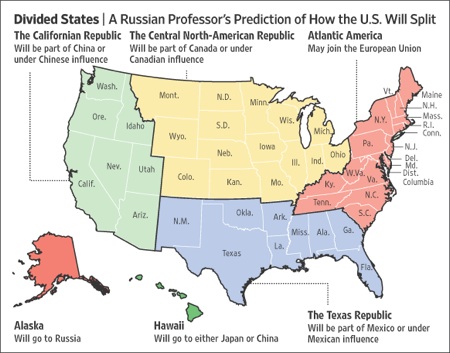
Now is that actually the case? Dmitry likes the analogy between the collapsing Russian state and what he sees as the same inevitable American fate; and I myself have conceded that if there is one polity that springs readily to mind when considering the ossified condition of American politics, it's the old Soviet Union. Congress and the White House are incapable of responding to real problems, and largely this is because of our own superannuated Politburo, which we call the U.S. Senate.

It's a pity that during the expansion of the U.S. westward, with the inclusion of all those new states beyond the original 13, that we simply didn't get rid of the Senate. It's profoundly undemocratic, since very small populations are vastly overrepresented. Those tiny electorates in South and North Dakota, Wyoming, Montana: they all have two Senators, just like California, yet California has a population twelve times the combined population of all those states (about 3 million for them; 36 million for the Golden State- by that logic, shouldn't Los Angeles have 8 Senators all of its own?). What's with the bicameral legislature? Nebraska doesn't have one, and who's got more corn than they do? The bicameral legislature is obviously a kind of vestigial artifact from the Houses of Lords & Commons, and why do we want to be reminded of that?

But the main problem with all those ancient pols in the Senate is that (a) they're a stationary target for lobbyists, and (b) they have that stupid 60-vote rule which they put in place so they would never have to do anything other than approve wars and pass unconstitutional legislation (Telecom immunity, Military Commissions Act, the Patriot Act, etc.). The Senate assures that lobbyists can use their money efficiently to buy votes. A little systems analysis allows the influence peddlers to figure out where the key committees are, how many votes they have to buy, and how to use the 60-vote rule to choke off anything they don't like. The Senate is the choke point for all meaningful reform in this country. Pretty obvious when you think about it. Why is the health care reform bill such a watered-down, soggy piece of nothing? Because it has to get through the lobbyist-infested Senate.

I don't know if Dmitry is right, but the Senate certainly doesn't hurt his case. The U.S. is in a depression and Congress really cannot do much about it because they are institutionally incapable of reordering American spending priorities. Look how much talk is still devoted to this Afghanistan question. 20% unemployment, $1.5 trillion deficits, the states going broke, and the Senate argues endlessly about whether in this 9th year of the Afghan war we should add 20 thousand or maybe 40 thousand more troops.

That's why it doesn't surprise me that the early rumblings about secession have come from large, cash-strapped (there's another kind?) states, such as Texas. You begin to wonder how to make ends meet locally, how to pay for schools, roads, state employees, and you realize that all those federal taxes your citizens pay go into the insatiable maw of the military-industrial complex, which exists not primarily to protect you but to enrich itself with your money, and you think....is there a simpler way to do this? Like just keeping the money here?

As the depression persists, more talk of that sort will surface. Orlov could be right that Obama might be the perfect president, with his fetishistic attachment to mediation and everyone getting along, to oversee the orderly breakup of the U.S. of A. Better him than Bush, that's for sure. Bush would have launched a preemptive strike against the first state that tried it. Not so Barry. It might be change he could believe in.

August 10, 2009

America Calms Down Just in Time for Fall TV


I guess the recession is over indeed. Everyone is saying so. In truth, I was wearying of the Armageddon/End of Days talk on Zero Hedge, Mike Whitney, Clusterf**k Nation, Peter Schiff and the rest. It's boring to admit, but as Paul Krugman writes today, the administration actually managed to maneuver the U.S. through the shoals and submerged reefs of financial calamity and avoided Great Depression II. James Kunstler, at Clusterf**k, has been reduced to bringing out W.B. Yeats and his "rough beast slouching," this time in the form of U.S. Treasury insolvency. When a Peak Oil guy has to resort to the same line of attack as Pete Petersen and his hysterical crew, you know he's running on empty. I'm just not impressed.


Yes, it's true the United States is in hock up to its eyeballs, but oddly enough this is also true of most modern democracies. That might surprise you, but the CIA (always our first line of defense) maintains figures on the public debt of other countries, and the U.S.A. is pretty far down the list when you measure our public debt versus our GDP. Japan is much worse, Germany and France are not as well off as we - and Zimbabwe? In a class by itself, fortunately. Now it's true that in absolute numbers the United States owes more than anyone (the "biggest debtor nation"), but after all - our GDP accounts for about $14 trillion of the world total of $55 trillion. We're bound to be bigger in every category than everyone else, including, of course, the sheer mass of our people - we're the fattest people on Earth, too. Well, obesity (historically) has been associated with prosperity, instead of diabetes and heart disease; we've just decided to give it a bad rap.

As usual in such discussions, it's important to define terms and know what the Central Intelligence Agency (and it's cool the spooks actually publish such useful stuff on the 'Net) means by "public debt." It's not money a country owes itself. The U.S. owes a tone of money in the form of "intra-governmental" obligations, such as the Social Security Trust Fund. Once upon a time, the idea was that S.S. would sustain itself by current FICA payments until 2017 or so, but the Recession (and it has been that) has probably moved that date up to 2013 - which, of course, is really not so far away. Resort will then have to be made to the "Trust Fund," which currently has zero dollars in it, and will have zero dollars in 2013 as well. That is because Congress spent the Trust Fund surplus over the last 26 years or so. People with lively senses of humor talk about Congress's sacred commitment to "honor" the Trust Fund and "redeem" the "bonds", and I just wish they wouldn't do that when it makes coffee splurt out of my nose.

But I'm just not in the mood to crack on the White House, and not only because I don't want to be reported to flag@whitehouse.gov, Obama's snitch line for those spreading "disinformation." A threshold question always arises - who determines what "disinformation" is? The Bureau of Labor Statistics - should they be reported? You see how easy it is to fall into negativity and wind up being denounced. Do I have to remind you that Guantanamo is still open for business?

So in years like 2013, we'll have some adjustment problems, I think, but look at it this way: just because 2013 arrives doesn't mean that suddenly Social Security will have no money. There will just be a shortfall. At first Congress will borrow the money "from abroad," or the Federal Reserve will lend it to itself, or whatever. The details are not as important as realizing that the U.S.A. is a country of immense resources, and we'll figure something out. Such as telling people who don't need Social Security they can't have it anymore. That's known as "means testing," and it will become a happening thing.

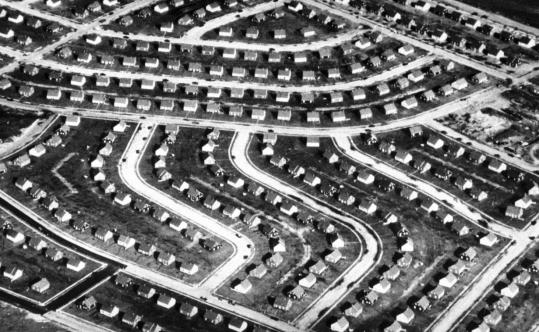
The other thing Kunstler was complaining about again today was ugly suburbia. He's got this thing about the hideous appearance of Subdivision America. Well, okay - it's not so great, I'll grant you that. It so happens I grew up in a kind of West Coast Levittown (orig. NY version pictured above) - actually, a lot more than "kind of." Such places drive the Clusterf**k Man up a wall - sanitized, amenity-free, uniform, boring, etc. Well, look - you're only going to grow up once. Should you really spend your adult life hating your hometown? And here's another question - did you see "Slumdog Millionaire"? Neither did I, because I can't stand Indian cinema, but nevertheless - I'll bet you the conditions in Bombay or Mumbai or whatever where all these slumdogs live are just atrocious, and I can personally attest that the slums around Mexican cities like Guadalajara are unbelievably primitive and depressing - so was it so terrible to grow up in a housing tract where the sewage system worked, we had running water, reliable electricity and plenty to eat? Only if you're like Kunstler and want to complain for a living, and that's only because his novels don't sell.

So "Curb Your Enthusiasm" starts next month and damn if I'm going to spend my time worrying about an economy that's well on the road to recovery, thanks to the steady hand of our surprisingly boring new President. It's okay to be boring, Barack. Ike was boring, too, you know. You will preside over a country where the standard of living has locked in at a level considerably, noticeably, definitely lower than we thought it was about three years ago, based on the consumption levels made possible through 133% household debt-to-asset ratios. The 33% is gone, that's for sure, so settle in, choose your premium channels carefully, and thank your lucky stars you don't live in Bombay. Or Mumbai, or wherever.