Showing posts with label American Political Scene. Show all posts

May 07, 2011

Red State, Blue State


Just for the record, I do sometimes read conservative writers to gain a perspective on their points of view and to avoid the bubble-ization of my own political ideas. For example, I frequently read Karl Denninger's "Market Ticker" blog (I suppose Mr. Denninger is technically a libertarian); Peter Schiff; and, most fun of all, Redstate, which actually publishes some very good writing, much of it pretty funny. Redstate provides a lot of grist for the mill of the "Sorry, No!" blog, in fact, the photo-shop based lampoon site.

The difference between liberal and conservative often seems a species of theology in this country, and it concerns, logically enough, the relevant role of central government in everyday life. The extreme views of either side lead to equally implausible outcomes. The conservative belief in the "market" and capitalism as the solution to everything is just wildly impractical in modern times because of environmental issues. Conservatives, however, just can't see that; they honestly believe that the capitalist world, left to its own devices, will work life-and-death ecological matters out just fine without any Big Government oversight. This is the very height of naivete, and is in a sense the mirror image of the Enlightenment silliness about the "perfectibility" of man.

Liberals, on the other hand, often think that socialist/communist economic programs of mutual cooperation, centrally planned, are sustainable. They aren't. Certain features of a modern democracy can be socialistic, such as socialized health care, the post office, public education and transportation; in fact, the social democracies of Western Europe demonstrated that these systems worked best with such a socialistic framework. Those same social democracies are now in trouble because they decided to move away from such approaches toward the go-go, unfettered, Reaganesque capitalism of the United States, and now the American conservatives gleefully point out how wrecked Europe is becoming. Europe has imported not only all of our problems of wealth disparity and too-powerful central banks holding smaller countries (Ireland, Greece) in peonage, but also the practice of excessive import-based economies.

The world's power, obviously, has swung toward the East, and American political maneuvering now in an era of decline is about grabbing what you can and taking advantage of connections with the East for the future. We still have our big military, our trophy "kills" and dubious victories (bin Laden; invading Libya, where the oil is, but not Syria, where it isn't), but this isn't much compared to the general economic decline. It was kind of amazing that Barack Obama's "turnaround" in national polls centered on three events in the space of one week: revealing his "long form" birth certificate, trumping Trump at the Correspondents' Dinner, and pulling off the bin Laden hit. These pushed his sagging poll numbers up about 10%. What all three of these events had in common was that not one of them had anything to do with economic prosperity. Had they not happened, the United States would have been in the same position, no better, no worse.

The more realistic way of looking at politics in this country, at this point, is through the lens of Sheldon Wolin's "inverted totalitarianism," as described in Democracy, Inc., that is, as seeing the United States government as a wholly-owned subsidiary of the Fortune 500. In such an environment, the actual "left-right" dichotomies don't matter. The utter neutering of the Tea Party caucus in the House of Representatives is an example of this process. A lot of noise is made about "debt ceilings" and "fiscal prudence" and the rest of it, but when the votes are actually taken, we can see that Wall Street, Big Business and the military-industrial complex are assured of power, as always, as ever. I read Paul Krugman's blog, as an example from the Left, and he continues the good fight against evil Republicans and rallies round the righteous Democrats, but this is all just show biz. He advocates "more government spending," and is confident that a Treasury market where the Federal Reserve is the effective buyer of 80% of the Treasury's issuance can go on forever. Or he pretends to believe such things in order to remain a Keynesian partisan and to denounce the "cruelty" of the Paul Ryan plan.

Simply street theater for the masses. All designed to earn a paycheck for the punditocracy (including, very notably, Mr. Krugman), and leaving undisturbed the actual predicament of the nation. A pathetic percentage of the working-age population with actual, decent jobs (not more than 58%), huge wealth disparities, and a globalized economy which keeps bringing the United States closer to a Third World mean.

So I read the Huffpost, and I read Redstate, with really only one thing on my mind: who's funnier today?

October 29, 2010

Thoughts on the New Reichstag Coming to a Capital Near You


American self-loathing gets as tiresome as American self-love, it's just that the first followed pretty naturally on the heels of the second. The idea of American Exceptionalism was a misperception based upon a faulty appreciation of the simple fact that the country was founded on third base and had an easy walk home. Latitude, diverse geography, climate, resources, two oceans - America was unique. The fact that all we could come up with was suburbia and a car culture says more about human beings than it does about anything uniquely American. Given the same advantages, other groups of homo sapiens would have screwed it up just as badly. They just didn't have the chance.


Now that we're way down the list in everything constituting the "quality of life" among civilized nations, it's slowly becoming apparent that our day has come and gone. I suppose that's why the analogies to Germany under the Third Reich are sort of fascinating to me. That was their story, too. Under the guidance of the Iron Chancellor, Otto von Bismarck, Germany was united and held sway over all of Europe in the late 19th century. Then after a disastrous World War I, an even more disastrous peace settlement at Versailles, the hyperinflation of the Weimar Republic beginning in 1922, and Germany arrived at that point where it could see it all slipping away. The Nazis saw a chance to seize the initiative by promising the Germans they could be great again. It wasn't the fault of the true German, they were told, it was the presence of "parasites" and "undesirables" in their midst.

There were a lot of dumb and unimpressive people leading the National Socialists during their rise to power. The purges of Jewish Germans from academic, professional and artistic positions in Germany after passage of the Nuremberg Laws guaranteed the mediocrity of the movement. It took a fearful toll on the country's competence, but they replaced excellence with violence and intimidation, and (it has to be admitted) with ruthless discipline and organization.

Under the analogy, Barack Obama becomes a kind of von Hindenburg character in the piece. Well-intentioned, not very forceful, a little clueless about what he's really up against. Obama keeps thinking, against all evidence, that he can cooperate with the increasingly Rightist Republican Party and "get things done." This is a total illusion. The Republicans will enforce their iron determination to give him nothing.

What the Republicans are missing, at present, is a Hitler character. They're an organization of second bananas. They have no one who really lights up the national stage. Well, analogies are never perfect. What is similar is the sense of national humiliation, and the reaction against it. For some reason, humans seem to think the answer is always in uber-nationalism and reactionary movements. By Tuesday night, the lower Haus of the Reichstag will be solidly Republican, on the order of 230 to 205. The Senate will still be in Democratic "control," but only by counting the fellow travelers of the Right Wing, the sell-outs and the closet Republicans. Obama will have no trouble getting money for war, but everything else will be a hopeless struggle.

Another area where the analogy breaks down is that Hitler saw himself as a new Napoleon, and under the guise of seeking Lebensraum, he set about conquering the Old World. It's best to remember that he had an awful lot of support right here in the United States. Contrariwise, the Tea Party and ultra-Rightist Republicans do not appear interested in conquering Mexico and Canada. Their motivations seem equal parts theocratic and anti-government, although in truth there is no coherent philosophy that leaps out at you from their various slogans and war cries. They're against Obama, they're clear on that. They don't like health care, science, big government, deficits, the EPA or the Department of Education. I think if they could be assured they would always have the right to carry guns into bars and churches, they would feel that 90% of their program had been enacted.

Things have been weird and they're going to get weirder. People who were unthinkable as candidates even four or six years ago, racists, idiots, are being taken seriously as political leaders with an excellent chance of election to the highest positions in the country.

I take some comfort in remembering that the Third Reich lasted only twelve years. But then, it had a very different America to put it out of its misery.

October 26, 2010

Our very own Sturmabteilung


English words never sound quite as sinister as their German equivalents, which is one of the reasons that American Fascism just seems like a lot less fun than the Italian and German versions. I mean, really: Tea Party? I enjoyed reading Johnny Tremaine as much as the next young patriot when I was a kid, and the Boston Tea Party seemed like a thrilling caper that really showed those stuffy Brits that we had arrived on the world stage. Thus, what a come-down that the movement which borrowed the name has nothing to do with the American Revolution but is mostly just a religiously-inspired, regressive, Christian-revanchist goose step down memory lane. (Patent pending on that sentence, btw.)


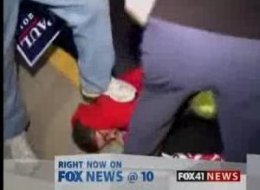
As proof that we can't do anything right, including mob violence, here's a picture making the rounds of a Rand Paul supporter stepping on the head of a MoveOn.Org troublemaker who showed up at one of Rand's Klan meetings. Point one: the SA would never have worn white sneakers. Das ist so lahm. Although Rand Paul's supporters do utilize the main technique of the Brown Shirts, the Sturmabteilung, which is violence to make a point. Let's face it, there simply comes a time when you know you're so damn right that anyone who disagrees with you needs to get their head stomped. Rand's supporters have become sick and tired of all these intellectual digressions, these "discussions" and whatnot. So get out of here or we'll throw you to the ground and stomp on your head.

Such an approach does discourage the expression of opposing points of view. We should be under no illusions about that. Hitler's National Socialists never actually achieved an electoral majority in Germany, either (as the Tea Party will fail here to do as well), so to compensate for that shortfall, that "delta" between where Adolf wanted to be and where he got through the electoral process, Hitler used what you might call his political Irregulars, enforcers who kept the whole open debate thing from getting out of hand. The young woman who showed up at the Rand Paul rally with an offending placard no doubt got off lightly compared to the Brown Shirt treatment circa 1936, say, but we've got to give the Tea Party a chance. They're learning, after all. Hitler did not perfect the art of violent intimidation overnight either. These things take time.

Turning the country into an open-air asylum takes time, too, but we're getting there. I note with singular satisfaction that the First Amendment is now under open assault from the Tea Party gang. Ken Buck, who is leading in the Colorado race for the U.S. Senate as the Republican/Tea Party candidate, does not like the idea of separating church from state, although he likes the idea of forbidding the government from "establishing" a religion (because, for example, what if a Jewish president were elected? Or a Muslim? Okay, another Muslim, the TP's would say.) Then America, obviously a Christian nation from the get-go, could find itself in a messy situation, with the Koran calling the shots instead of the Ten Commandments as God intended.

Buck has a half percent lead, and Nate Silver thinks he's got a 54% shot at getting elected. One of Ken's concerns is that he finds it "scary" how "secular" the country is becoming. Well, we can't have that. It's the secularists (Sekelar Hoomanists, as the church of my childhood used to call them) who advocate ideas such as science, with the dire threat it presents of a detailed and accurate understanding of reality. Science has produced such ridiculous red herrings as global warming and evolution, for example, ideas so pernicious and subversive that one poll showed that 14% of Tea Party people themselves believed in man-made climate change! Only 86% of the Party is cleaving to the Party line! Fortunately, as any student of history can tell you (that is, most people not in the Tea Party), Hitler knew how to deal with dissidents within his own party as well.

So anyway, just picking up the pace of posting in advance of next Tuesday. Heh heh. After which, I think a dissenting view like mine, contrary as it is to the general drift of the country, might place my head more or less where that young lady's is in the picture. And thinking about the steadily deteriorating educational system in this country, I would not think that the tendency of the populace is going to be away from superstition, religious intolerance, anti-intellectualism, obscurantism and that whole constellation of crazy stuff. Quite the contrary. Might not be a bad idea to develop at least a contingency plan for moving somewhere else, some country where the rule of law, high intellectual and educational standards, open debate, freedom of artistic and political expression - where all such things are common and revered.

You know, someplace like Germany.

The sign post up ahead reads Twilight Zone


It's never true until Nate Silver says it's true, so I guess it's now the case: the Republicans are going to take the House of Representatives. Nate's done his "Monte Carlo" simulations (at least 100,000 of them), and the tumblers keep falling in the same place: about 230 Republicans, 205 Democrats. A gain of 50 seats in two years.


I liked it better when Nate ran a stand-alone blog (his "538" site) instead of as a prognosticator for the New York Times, but his work looks much the same. He tends to be scary accurate. In the Senate, it appears likely the Democrats will wind up with about 51 or 52 seats, and the current odds favor the election of Sharron Angle over Harry Reid, although it's a very close race. A world without Mr. Mumbles - I just can't imagine it.

Thus endeth the days of Democratic hegemony, of the powerful dominance in the House and the near "veto-proof" advantage in the Senate. We will have a completely divided government. A Republican House, a Democratic Senate, a Republican Supreme Court and an undeclared White House. I imagine that President Obama will move from irrelevant to invisible, but at least he will have the consolation of a ready-made excuse: what can he possibly do with a divided Congress, one house of which is implacably hostile to any of his ideas and the other saddled with the "60-vote" rule?

We will thus transition from the era in which almost nothing was accomplished to an era where nothing whatsoever gets accomplished. In some ways, if your mind is partial to controlled experiments and the scientific method in general, this will present an opportunity for learning. The USA, instead of being primarily a place where the conflicts are internal, will now face two new foes: the rest of the world's population and Mother Nature. This should be interesting. I'm as bored as the next person listening to all the usual formulations, the "Progressives" against the "Conservatives," et cetera. Keith Olbermann versus Bill O'Reilly (although now that I've discontinued cable television, I don't see much of that). The American electorate seems so absolutely devoid of new ideas that it is simply, and reflexively, going to return the Republicans to power because they're the other choice. That's what the Republicans have going for them: they're not the Democrats. What a creative society!

While Obama was President with a Democratic Congress, he was unable to do anything. He couldn't get any global warming legislation passed. The costs of healthcare are as sky high and unaffordable as ever. Wall Street is still running amok, with the pace of wealth-concentration in the upper one percentile undiminished. Unemployment, realistically speaking, is about 20%. The dark shadow of Peak Oil hangs over everything, and we didn't do a thing about it. The value of everything continues to deflate, other than the stock markets pumped on Federal Reserve money-printing operations. In about one year, about 30 to 40% of all houses in America will have loans against them greater than the value of the house itself. Homelessness and poverty will continue to proliferate. And meanwhile, the world at large, which has gotten extremely tired of American currency manipulation and systematic fraud as its main economic outputs, is steadily reorganizing itself for the post-American future.

On issues such as climate change, the USA will increasingly play the role of world pariah. Using about 25% of the world's fossil fuels (with 4% of the population) and producing 20% of the world's greenhouse gases, America is being left behind by countries which are facing the truth about the need to change to sustainable energy, including, oddly enough, the People's Republic of China. The wars we keep fighting and fomenting (and which we ask other countries to finance) irritate the hell out of the rest of the world.

So against this backdrop, we will switch gears from 2nd down to 1st, forgoing even the appearance of adaptation in favor of theocratic distractions, witchcraft, Rand Paul-like Luddite racist reaction, gay-bashing and other stuff which was last this popular during the Dark Ages. America, I think, will be more like a howling mob controlled by corporate bastions behind security gates, bastions which employ people in other, poorer (but not for long!) countries to make stuff and produce their wealth, with the occasional invasion of another country to remind us that we're all patriotic Americans being "kept safe" by the Pentagon.

An Armed Madhouse, as Greg Palast described it. This should be interesting, in a macabre way.

May 19, 2010

Chinese menu approach to politics


Liberals, who now call themselves progressives because they were cowed into shaming themselves by Right Wing attacks, are an endangered species in American life, which will do them no good because the EPA itself is under merciless assault. I don't know if there is much to be done about it. My own political belief system might be called Jeffersonian liberalism; I am not a "Big Government" fan, per se, but I think it's unrealistic to think that modern Big Business can be regulated and controlled by a weak central government, and I'm certainly not a Free Market Purist of the Ayn Rand persuasion. That, to me, is the nuttiest approach of all. A completely unregulated business world leads to environmental and economic collapse of any complex modern society. These very days we are seeing the handiwork of unregulated Big Business, and it's not a pretty picture. The Gulf oil spill, which will probably turn into the greatest environmental catastrophe in the history of the world when its full extent is known and calculated, can be seen as the end result of believing that business, when left to its own cost-cutting devices, will take environmental effects into account. Ha ha. To save a few million in "mud pumping," British Petroleum has destroyed an entire eco-region.


Jefferson was suspicious of the power of government to oppress the individual. Such a wise political thinker. He feared the "tyranny of the majority," which is what the Bill of Rights is designed to prevent. The full power of the central government can crush any individual unless certain procedural rules are put into place to give him/her a fighting chance. It is surprising to me that the present Presidential incumbent is so indifferent to this concept, but that's the way the political winds are blowing. Jefferson (and Benjamin Franklin, another political genius) thought that society should risk some of its precious "security" to avoid tyranny, but if you are witnessing the craven capitulation of Obama and Holder to the calls for "restricting" Fifth Amendment rights of certain classes of criminal suspects, you can see that these particular Democrats do not belong in that Jefferson-Franklin tradition. They prefer pandering to the scaredy-cats. Ironically, once you begin down that path (as Franklin presciently tried to warn us), the central government itself becomes the most serious threat to personal liberty. Hitler, for example, once he consolidated power through "legitimate" means, used incarceration and execution of political dissidents to make sure no one got in his way. All tyrannies, in fact, operate this way. So while Obama nonchalantly allows (or tells) his Attorney General to use this "forum" or that (federal civil courts this week, military commissions the next) depending on how politically popular the move is, you can be assured that such a process, if it goes on long enough, will not be confined to just "Arab" terrorists of foreign citizenship. It will get to the (probably apocryphal) level of Pontius Pilate asking the mob which defendant ought to be executed today, and which set free.

Some of the Tea Party people seem, dimly, to be aware of such ideas, but of course you never get everything you want (or even close to what you want) from a Tea Party "platform." The victory of Rand Paul in Kentucky is illustrative. There are certain things he says with which I wholeheartedly agree; for example, on the necessity of declaring war if the country is going to war. That's what the Constitution says, conferring the power on the Congress and the Congress alone. So how does the United State fight war after war with no formal Declarations since December, 1941? And if the answer is, "the War Powers Act," how can this reassignment to the Executive Branch be Constitutional without an amendment? So Rand Paul is right: it gives everything a completely different feel if we require the President to seek, for example, a Formal Declaration of War between the United States and Iraq. Imagine that, a Congressional Declaration announcing that "a State of War Exists Between the United States of America and Iraq." It looks absurd, doesn't it? Iraq sitting over there in 2003, run by a tinpot dictator with no weapons to threaten anyone with, but we want the oil his country lies atop. So Congress, that mighty deliberative body, convenes and Declares War on Iraq. That means the President must carry out an invasion and wage war, because he's sworn to faithfully execute the laws. I don't think it ever would have happened. But if Congress can simply "Authorize" war, and leave it up to President Bush to decide whether or not to use his "Authorization," then Congress, Pilate-like, can wash its hands of the whole business and claim that the President thought that invasion was best. A slight difference with huge consequences.

I also agree with Rand Paul that the banks should have been allowed to fail in 2007-2008 without bailouts. If one says, arguing contra, that such a course would have caused an economic crisis, then please tell me what we're in right now if not an economic crisis, and moreover one in which the biggest banks have consolidated their power and the public debt has skyrocketed.

On the other hand, Rand is named after Ayn. That's more than just a spooky reference point; he's a dyed-in-the-wool, cradle-to-present Free Market Fundamentalist.

Mick Jagger told us we can't always get what we want, and especially these days. Anyone you can vote for, who's electable, comes with all kinds of baggage you also don't want. You wind up saying stuff like, "I'm for his position on the bailouts, while I recognize that his desire to consign homosexuals to labor camps is regrettable. So on balance..."

It's really a mess, sort of like the country this political scene is part of. November is shaping up to be a real freak show.

March 22, 2010

Much Ado About Not Much


In the gestural world of American politics, symbols are now everything. Why were the Democrats mostly for health care reform? Because they had made it their signature issue and needed to prevail in order to show that "big things were still possible." And why did the Republicans oppose HCR so vehemently (and unanimously)? Because the Democrats wanted it.


Did the substance of the bill have anything to do with these polar positions? Not that I can see. It seems like no huge, courageous accomplishment to eliminate preexisting conditions, beginning in 2014, as a reason to deny health coverage. It's amazing the American public (and their elected "representatives") tolerated this outrage as long as they did. It should always have been part of the charter of every health insurer to provide some means of insuring the "uninsurable," or to create at least an assigned risk system. Nor should they be allowed to drop someone from coverage because they get sick while insured.

Beyond that, we have a very complicated method now of subsidizing the purchase of insurance by those near or under the poverty line. The private system is not only maintained, it's enhanced by additional customers, driven to them by the federal government and its refusal to do anything vaguely "socialist" like a single payer system.

So what on earth was all the sturm und drang about? One test I use is to ask whether this bill will have any effect whatsoever on my personal life. Bearing in my mind that I am what used to be thought of as the Epitomized Standard American (ESA), that is, white, male, Baby Boom and self-employed, I can say that, as always, the "system" assumes I can take care of myself and so the various enactments of our "activist" Congress never have anything to do with me. Nothing will change at all. I will continue to pay $8,000 per year with a $5,000 deductible for health insurance which I hope I never use. Since Congress, to show everyone how tough they are, did not provide any sort of coverage mechanism for "undocumented Americans," these people will continue to use emergency rooms as their primary care physician and so, in the event of an accident or actute illness involving me or a loved one, that situation will remain unmitigated.

It's scary to think that such an innocuous piece of legislation, bringing together in one place, finally, bits and pieces of ideas that should have been law long ago, could spark such implacable hatred and partisanship. A very, very bad sign. I never watch or listen to any of the Right Wing hatemongers (Rush, Beck, Hannity, et al), so I'm uninformed, I suppose, as to the tidal forces pushing the Right toward hysteria. One sad effect of all the confusion is that it allows the real miscreants, such as the bandits on Wall Street, to get away with murder, while the Tea Party rages on about Obama as Hitler or Stalin or Pol Pot and the rest of his predecessors in evil. The complete severance of popular movements from any rational basis should be freaking people out, but it appears there is nothing that can be done. You can't reason with mob rage when there is no underlying rationality. The lock-step Republican Congress hopes to ride this wave of nihilism back into power in order to accomplish...what, exactly? I suppose what any authoritarian national party uses power for, to wield it with the assistance of the Useful Idiots in the mob supporting it, much as Hitler (him again) employed the systematic violence of the Brown Shirts, in pursuit of the grandiose and delusional.

Meanwhile, polarization just gets worse and worse. Rather ironic, I think, that the post-partisanship President should wind up presiding over the most schismatic populace in American history since the Civil War.


January 21, 2010

Things Are "Changing" All Right


Probably the best blog I read on a regular basis is Glenn Greenwald's Salon column, which is alternatively labeled "Unclaimed Territory," which is how his old independent blog used to be titled. Glenn gets quoted a lot in news media, and is something of a thorn in the side of Establishment journalism because of his habit of pointing out the systematic fallacies in "Beltway Conventional Wisdom." You might summarize Glenn's main point this way: what is cited as "mainstream opinion" in America is actually nothing of the kind; rather, it is a self-serving consensus worked out by media and political elites as a justification for what they would like to keep doing regardless of "mainstream opinion." Whether he is conscious of it or not, I think Greenwald's ideas are derivative of Noam Chomsky's seminal insight, that "manufactured consent" actually controls the parameters, or bandwidth, of "acceptable" political opinion in American public life.


Two political issues illustrate the accuracy of Glenn's argument: the war in Iraq and the late, lamented "public option" in the increasingly useless "health care reform" bill staggering its way through Congress. On the cable talk shows, on the editorial pages of the Washington Post or the Wall Street Journal, the claim was often made that the "people" supported the Iraq War and did not favor a withdrawal, precipitous or otherwise. As Greenwald documented over and over again, citing statistically accurate surveys of public opinion, by about 2005 the majority of Americans in fact did favor a withdrawal of American soldiers from Iraq, and this percentage grew to over 60% as the war raged on and casualties mounted. This did not stop the Democratic and Republican leadership in both the Senate and House from labeling the "anti-war" crowd radical and "leftist," nor did it stop the talking heads on "This Week" with George Stephanopoulos from repeating ad nauseum that the "people" wanted to withdraw from Iraq only on a "responsible basis," when the "mission had been achieved." The "people" interposed no such caveat; they just wanted us to get the hell out.

The same dynamic has occurred with respect to the public option. A decisive majority, more than 70% of the American people, favor the essential expansion of Medicare to cover everyone. Some polls put the number as high as 74% when support crested. That hope is gone now, lost in the dilatory and confusing "deliberations" of Congress, as they and the White House worked out deals with the insurance and pharmaceutical industries. Party operatives within the Democratic Party, such as Evan Bayh, nevertheless claim that Massachusetts was lost because the Democrats kowtowed too much to their "leftist" wing in the health care debate. Run that one by me again? No, don't think so. The Democrats lost because they never get anything frigging done.

The media and political elites in the Imperial City live in a comfy and insulated little world where the maintenance of the status quo is profitable, career-enhancing and self-perpetuating. The madding crowd out there on Main Street is a disturbing element for this complacency; the trick is to mollify the unrest while maintaining the status quo, because that's what keeps the money flowing from Wall Street, Big Pharma and Lobbyist Nation.

It now appears that this gambit is becoming less and less successful. The "Renegade," Barack Obama, threatened to upset the apple cart when he was running for office, to challenge this smug self-satisfaction when he arrived at the White House. On arriving there, however, something happened. The origins of his reversal (many call it a betrayal) can be debated without any kind of definitive answer. I choose to look at the situation "behaviorally;" I don't think there's much doubt that he's not doing what he said he would do (one can cite many, many examples of his reversal of position), and the reasons for that are beside the point. The real point is that now he, and the other political elites who played the game of placating the unrest of the common man with ineffective gestures, are beginning to pay a heavy price. The election of Scott Brown and the Republican upsets which preceded his victory in Virginia and New Jersey signal a further advance in what I called in a previous blog "the rise of grudge voting."

These Republicans are being put over the top by independent voters, the same voters who elected Barack Obama. I note today that at long last Obama is talking about (horrors!) actually using the anti-trust laws for the purposes they were enacted: to break up monopolistic behemoths that are "too big to fail" and pose a threat to free competition. That's how far the Washington Establishment had slipped into its solipsistic trance: it looks "radical" now when a Chief Executive talks about enforcing laws put on the books during the term of Teddy Roosevelt. What next? A prosecution for violating the War Crimes Act? (Let's not get hysterical.)

My guess is that these impotent gestures won't make any difference now. It's just a little too obvious what they're doing, and why. Besides, this kind of stuff is not the same as actually being on the side of the Little Guy. If they were on the side of the Little Guy, they would tell credit card companies that they cannot charge usurious rates. They would make the re-importation of prescription drugs legal, and they would allow (for crying out loud) Medicare to use its bargaining leverage with pharmaceutical companies to bring down the price. They would repeal the Bankruptcy Reform Act, Joe Biden's Frankenstein monster of anti-populist intent. These things all provide direct, immediate help to the cash-strapped denizens of Main Street, and they don't cost the federal government anything (they save money). And Congress and Obama won't do any of these things because they would upset their corporate donors. So they engage in these pantomimes of compassion, like "regulating" the size of Wall Street banks. Whoop-de-you know, like-do.

The slightly satisfying feeling now, however, is that this crap isn't going to work anymore. Obama is going to do for the Democratic Party what George W. Bush did for the Republicans: bring it down around his ears. And seriously - who would have predicted that?

November 24, 2009

Can you run that one by me again, Nancy?


See, this is how I get confused sometimes, and why I come around to Dmitry Orlov's idea that there is a Uniparty formed by two branches of the same party, both of the Center Right, which pretend to disagree on policy issues to maintain the marketability of their respective "brands."

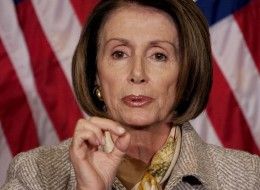
I am certain that you recall, as I do, the dynamic leadership of Nancy Pelosi (D-Golden Gate Bridge) who, upon ascending to the Speakership of the House in the fall of 2006, immediately withdrew funding from the Iraq War except as necessary to bring the troops home. She knew that the American populace had grown completely disenchanted with this pointless misadventure, saw it as a colossal, counter-productive folly, wasteful of lives and scarce American treasure, and saw the big victory of the Democrats in the 2006 midterms as a mandate for change. Which is why she immediately said:

“We will not cut off funding for the troops,” Pelosi said. “Absolutely not,” she said.

A reporter had asked Pelosi if the new Democratic-controlled Congress would vote to end the funding of the war if Democrats were unable to persuade President Bush to change his Iraq strategy.

“Let me remove all doubt in anyone’s mind; as long as our troops are in harm’s way, Democrats will be there to support them, but… we will have oversight over that funding,” she said.


Correct me if I'm wrong, but I think the Constitution pretty much guarantees that the House has "oversight" over that and all other funding. So that's not as reassuring as it sounds on first hearing. But along with taking "impeachment off the table," Nancy, while playing various games designed to demonstrate that the Democrats would certainly end the war if only they could (which they always could, by ending funding), decided that the voters didn't really mean it in 2006, and that the public opinion polls demonstrating the massive unpopularity of the war (along with the polls taken in the voting booths) should not be taken too literally, and certainly not to the extent of actually ending the war. So the war went on and on. Which, since Nancy Pelosi remained Speaker then and now, must in turn be taken to mean that despite occasional noises to the contrary, she must have really believed in the Iraq war. Because any contrary inference would mean she was just as cynical as Bush, and kept funding the war for Bush just so she could position the Democrats to retake the White House in 2008. Which is to say, Nancy Pelosi was willing to leave soldiers in harm's way, getting blown up and killed, or their limbs traumatically amputated, or blinded or brain-damaged, simply for a political leg up.

And I'm just not going to buy that. So I must conclude that she supported the war funding because she believed in the mission, the war in Iraq, and the sacrifice of our soldiers. Although, here I go again (and I'm getting whiplashed from all the volte-faces), then I heard her say to a group of econobloggers by conference call just yesterday::


"What did we decide, that Iraq was at least $2 trillion? And for what? I mean, God bless our soldiers for their courage and their sacrifice and that of their families. But $2 trillion for what?" said Pelosi. "Think of the opportunity cost when you break it down, when we talk about cancer, for example. We spent in two weeks in Iraq what we spent in a year on cancer research. With all that scientific opportunity that was available to us, we couldn't afford to do more. But we certainly could afford -- or so they told us -- to be in Iraq."

Um, okay Nancy, but you see where I'm getting confused. I completely agree with you about the opportunity cost, and we've all become acquainted with Joseph Stiglitz's estimate of the long-term costs of the Iraq War, where $2 trillion is the low estimate. And really, when you think about it, there was only one person in the United States, beginning in January, 2007, who was actually in a position to put the brakes on the Bush/Cheney war juggernaut, who had the political power as the head of the funding branch of Congress under the U.S. Constitution, to end the war by the only means that Bush would have been forced to recognize: by defunding the war. That person is you, Speaker Pelosi. You were the leader with the power. So when you say, "so they told us" that we could afford the war, who is it you're referring to?

So just to sum up: what the hell are you talking about? You are absolutely the last person in America who should be talking about all the lives and money wasted in Iraq, because you're right: the war was for nothing, your sops to the troops in the midst of your latest political posturing are insulting and disingenuous, and you completely blew it for you and the rest of us when you had the chance to change things but decided to be a politician instead.

And you're hinting now that Obama is going to have a tough time getting funding for his Afghan surge? Since that's not actually what you mean, what is the lie for this time?

November 04, 2009

The rise of grudge voting in America


This gets confusing. I'm pretty sure Frank Rich of the New York Times, among others, confidently predicted the death of the Republican Party as recently as three days ago. Rich, in writing a GOP obituary on Sunday, noted confidently,


It’s also why [failure to take into account the changing demographics of the American population] the G.O.P. has been in a nosedive since the inauguration, whatever Obama’s ups and downs. In the latest Wall Street Journal-NBC News poll, only 17 percent of Americans identify themselves as Republicans (as opposed to 30 percent for the Democrats, and 44 for independents).

Then on Tuesday the Republican candidate wins the governor's seat in Virginia by a 60-40 margin, a state which Obama carried a year ago. In New Jersey, a reliably Democratic stronghold, a Republican defeats the incumbent Democrat John Corzine.

It's odd that Rich doesn't see the answer to the riddle in his own quoted stats. It may be that nearly twice as many people identify themselves as Democrats than Republicans; but the two parties together are only slightly larger than the Americans who want nothing to do with either party. If the Democrats can only claim 30% of the electorate, aren't they also in a "nosedive?" I guess Rich's training as a theater critic did not include a course in statistics.

I saw Jesse "The Body" Ventura on TV a couple of days ago, the former rasslin' governor of Minnesota (a state which must have been in a puckish, demoralized state of its own). He suggested that members of Congress should stop wearing business suits and instead copy the style of NASCAR drivers, silvery jackets emblazoned with patches and decals of their corporate sponsors. That way we would know who they were legislating for. There would be Chris Dodd and Chuck Schumer all decked out in logo-splashed thermal suits emblazoned with "Goldman Sachs" and "Citigroup," with maybe a corporate motto thrown in: "Too Big to Fail." Senator Max Baucus in a gold satin jacket featuring "Blue Cross" and "Aetna" -"Our Profits Sky When You Die."

That's a very funny idea, Jesse. I wouldn't mind a system where the Congressional "drivers" were directly compensated for their endorsements, either. Let's keep it all above board. But slightly more seriously, let's face it: except for a tiny sliver of Americans actually directly involved in either Democratic or Republican politics (as part of the machinery, in other words), most Americans regard themselves as simply captives of a completely dysfunctional two-party system, and this includes, no doubt, significant fractions of those nominally "affiliated" with the two parties as registered members. The Democrats and Republicans pull votes because they're the only game in town. No serious third (or fourth or fifth) party is on the horizon to challenge their hegemony, and the Mainstream Media, which controls what is in the consciousness of its American subjects, is too invested in these fascinating two-party "horse races" to allow the choices to expand to include, I don't know, candidates and positions that have something to do with the reality of life for actual Americans.

So now you'll see lots and lots of stories from the usual pundits about how these two off-year elections are a "litmus test" for the Obama Administration, how he's let his "progressive base" (huh? who dey?) down, about the failure to enact "comprehensive health care reform with a robust public option," about the continued waste of two useless wars, on and on, signal "danger" for the Democrats in 2010, and the rest of it. Sure, go ahead and write that stuff. That's also part of the two-party paradigm: the analysis of everything in terms of the two parties.

I think it's simpler than that. The great majority of Americans hate everyone in office. They get tired of them, they resent them. They're sick of their lies and corruption. Yet they're trapped, without real choices, condemned to this pointless plebiscite on the rise and fall of whatever party is "in power" and is currently lining their pockets and letting America go to hell.
My hope is that the Republican Party becomes more "mainstream," less infested with wackos like Sarah Palin and Rush Limbaugh, or radically dangerous subversives like George W. Bush and Dick Cheney, because they're going to get their turn again. American voters derive their one pleasure in voting from throwing out of office the people they've gotten sick of, and currently there are more Democrats to hate than Republicans. So the GOP will be back, we will remember how awful they are too, and then we'll throw them out and...you get the picture.

I still think those logo jackets are a swell idea.


September 22, 2009

Confusion in the Ranks: Sheetless Klan Meetings


I've been noodling on various alternative names for the White People's Rallies, and Teabagesque meetings everywhere, and haven't hit on anything completely satisfactory. KooKoo Klan was a possibility; also Koo Klutz Klan. Not quite there, but that's the creative process for you: hit & miss.


Jimmy Carter thinks there is something "racist" in these attacks on Obama. Gee, ya think? Along with Jimmy's usual haul of annual UN humanitarian honors, I think he should be 2009's frontrunner for the Duh Award. I'm wondering: can Kenny Chesney update that awful song of his and call it "No Sheet, No Shoes, No Problems"?

Anyway, Frank Rich inspired Glenn Greenwald to write about the Glenn Beck Perplex, and specifically how this highly histrionic, lachrymose, unstable bundle of nerves manages to "lead" a movement when it's obvious Beck himself has no idea where he's going. You might say the Teabaggers and others marching under his banner cannot get their sheet together.

In the bad old days, between the Emancipation Proclamation and the Civil Rights Act, the angry white mobs had a tighter focus: anti-Negro, pro states' rights (which, in the manipulative hands of pols like George Wallace and Orval Faubus, were just the two sides of the same coin). Then as now, the reason these mobs tend to look melanin-deprived and basically confused is because they are drawn from the ranks of the white dispossessed. Economically anxious, debt-ridden, grievance-filled. Thus, they hold up signs that say, "I will protect the Constitution by any means necessary." So, in an unfair, slightly-too-sophisticated way, you might be tempted to ask: which part of the Constitution? Glenn Beck and others, operating at a level you might call superficial if that did not imply more depth than is actually there, have encouraged these mobs to think that "Obamacare" is unconstitutional because the federal government has no proper role in health care. Which is confusing, since Medicare is definitely a federal program, as are the Veteran's Administration hospital system and the Center for Disease Control. The issue was settled a long time ago by the Supreme Court through a generous interpretation of the Commerce Clause: the feds can basically do anything they want, such as tell a motel in Mississippi that they cannot discriminate in renting rooms, because, like it or not, they participate in "interstate commerce."

Or the tax thing, which our typical, well-fed protestor above is worked up about. The top federal marginal rate (35%) was brought down to its lowest level since Ronald Reagan under President George W. Bush. He did this at the behest of the plutocratic buddies who put him in office. Among other factors (such as the abandonment of anti-trust laws and the globalization agreements which encourage the shipping of American jobs out of the country), this shifting of the tax burden down has helped skew the wealth distribution to its present ridiculous imbalance. About two-thirds of the national net worth is controlled by 10% of the population; the bottom 40% own much less than 1%. I'm thinking (though I can't prove) that the political activist pictured above is not in the top 10%, and thus his enlistment in the anti-tax shock troops of Fox News is kind of, you know, nuts.

The Teabag Mobs or Sheetless Klan also encourage a "9/12" mentality, which means that they think we're on the verge of succumbing to the existential threat of an amorphous Islamic force. I suppose we could be; but this paranoiac approach to things doesn't jibe well with another Teabag hobby horse, the new-found concern about the National Debt. That's a legitimate worry, to say the least. So why have so many of the same Teabaggers, in the past, supported George W. Bush and his militaristic budget-busting, adding one-half trillion each year to the debt while in office? Why the support for "nation-building" in Iraq and Afghanistan when we're sinking in an ocean of red ink here at home? Or if they supported bank bailouts when Bush was doing it, why the protest over Obama doing the same thing?

You could call all the politics of the Teabaggers and the Koo Klutz Klans chaotic, but that makes it sound more coherent than it really is. The situation does call to mind one of the fundamental problems with democracy. As society gets more and more complicated, the intelligence and education necessary to grasp, even dimly, the precise way in which you're getting screwed increase beyond the level of the people doing the actual voting.

I read a long piece in the Boston Globe about Hyman Minsky, the iconoclastic economist, and prophet not honored in his time, who predicted the precise economic collapse the United States recently underwent in books and articles he was writing thirty and forty years ago. (Hyman even did a short stint as an Associate Professor at Berkeley in the early Sixties.) Minsky took a skeptical view of capitalism; he considered it inherently unstable (sort of like Glenn Beck, but different). He outlined three stages of capitalist development. In the first, borrowers and investors are pragmatic and conservative: they borrow only at a level where they can repay both the interest and the principal. I think of my parents' generation emerging from the Great Depression as representative of this paradigm. As the economy grows, and assets begin to inflate in value on a predictable basis, borrowers take on some risk: they borrow at a level where they can make the interest payments, but the principal is beyond them. Think Baby Boomers. This, of course, is the basic principle of leverage. This is Speculative Borrowing. At the third level, Minsky wrote, the borrowers throw caution to the wind and engage in "Ponzi borrowing," where they cannot reliably pay either the interest or the principal and depend entirely on inflation to make short-term profits. This exuberance (which was built up during the latter part of the Clinton years and into the Bush regime) lasts until some failure of a key component, maybe just one big company (Bear Stearns?) incites hysteria among over-extended, over-leveraged borrowers and investors and panic selling begins, bringing on rapid deflation and a deep recession/depression.

Minsky thought the government had an important role in mitigating the effects of Capitalist Bipolarity. When the bottom falls out, the government should institute a hiring program of the unemployed, enlisting them to work on roads, trails, railroads, clean-up, etc., in an effort to maintain a basic standard of living and to place a floor under the minimum wage. This was his "bubble-up" theory of recovery. In corporatist America, of course, we went the other way and decided to bail out a specific set of boards of directors and management teams at certain well-connected commercial and investment banks, to nationalize none of them, and to spend all of our money there. The Federal Reserve and Treasury are now tapped out.

Obama, out of fear of being called a Socialist, decided to follow the dubious lead of Bush and use a trickle-down approach to the problem. I was hoping, when GM failed, that Obama would try something audacious and nationalize the company, using its factory base and trained workers to build mass transit (high-speed and light rail). The U.S. paid enough to buy the companies outright based on their capitalization at the time. Instead, Obama "reassured" everyone that GM would stay in private hands; America's ownership would remain limited to holding a bad debt. I am now reconciled, or resigned, to the idea that Barack, unlike FDR (who used something like Minsky's idea in his Work Projects Administration and Civilian Conservation Corps), is simply not an audacious person. He tinkers a little (Cash for Clunkers, etc.) and that's it. If he fails, it will be failure based on tried-and-true modes of failure. It's what makes almost hilarious the cries from the mobs that he's a "revolutionary" or a "Marxist." I don't think Karl Marx would have recruited his economic team from Goldman Sachs and JP Morgan Chase.

You can see, of course, that the Sheetless are not going to hold signs up proclaiming their belief in the alternative approach of Hyman Minsky. For one thing, I suspect there are a lot of anti-Semites lurking in their midst, and the anti-Federal Reserve plank of their "platform" is not so far removed from suspicions about the Protocols of the Elders of Zion. The Teabag people are right that they've been had, and they're lashing out in all directions as a result. Whether what they're for or against has any chance of ameliorating their plight is similar to the probabilities involved in throwing darts at a spinning dart board. Maybe, maybe not. Does anyone represent them? Not really. Is Glenn Beck sincere in his belief in their multi-faceted "cause?" I doubt it. Is their situation going to get better? Uh-uh.