Showing posts with label Health care reform. Show all posts

March 23, 2010

Swiping your ATM card in the ambulance


This post is inspired by the already burgeoning cottage industry of gaming the new health care bill. I've been a lawyer for over three decades, and one thing I've learned is that one of the reasons that lawyers become legislators is that they can't hack the legal field because (a) they can't think clearly and (b) they don't like hard work. I have deduced this hard-won lesson from reading thousands of legislative enactments under conditions where I positively must make sense of what has been written by some blowhard in the state house or in Congress (or more likely, by the lobbyist who wrote it for said blowhard).


Anyway, Karl Denninger at the The Market Ticker thought one way to play the new law ("America's Affordable Health Choices Act of 2009" - uber-clunky) is to forgo any coverage and wait till you need insurance; that is, when you become ill. (Can't get a lot more "affordable" than that.) Since an insurer cannot deny coverage on the basis of a preexisting condition under this new law, the simple solution is to save, every year, the ten grand you were going to throw away on insurance and wait till you need it. All routine medical costs could be paid with cash (which usually add up to less than a standard deductible anyway). The government's fine for not carrying insurance is much less (on the order of 1/5th) than the cost of buying insurance you don't really need (until you do need it) The fine is 2% of AGI; if you make $100,000 as adjusted gross income, the $2,000 fine is only 20% of what you were going to throw away on Humana.

Inspired idea, I thought. It could give rise to a new business paradigm as well: the ambulance or EMT wagon equipped with a credit card terminal so you can buy insurance on the fly, as they speed you to the emergency room. Also steady work for lawyers, because everyone playing this game should have a power of attorney drawn up designating someone to buy the insurance for you in the event your myocardial infarction leaves you temporarily in non-business mode. Just think of it: there you are in the oncologist's office, inhaling deeply on your Marlboro as the doc gives you the bad news from the MRI. He asks if you have insurance, and you casually answer no, not right now. But can I use your phone? Lung cancer, as a preexisting condition, might only have existed for a couple of minutes, but in the old days you would have been on your own. Now you phone up and demand insurance from any insurer you like to cover the few hundred grand your surgery, chemo and radiation are going to set the insurer back. The premiums don't bother you because you've saved fifty thousand large over the last five years going without insurance. (You spent a lot of the savings on cigarettes and booze, in fact.)

Can it really be that easy? I looked the statutory section up:

SEC. 111. PROHIBITING PREEXISTING CONDITION EXCLUSIONS.

    A qualified health benefits plan may not impose any preexisting condition exclusion (as defined in section 2701(b)(1)(A) of the Public Health Service Act) or otherwise impose any limit or condition on the coverage under the plan with respect to an individual or dependent based on any health status-related factors (as defined in section 2791(d)(9) of the Public Health Service Act) in relation to the individual or dependent.

Ah shit, here we go. This is what I hate about these statutes. They're so damn lazy they refuse to just put everything you need to know in one place. You can see right away this is not going to be so easy. It starts right off with the words "qualified health benefits plan" which strongly suggests you're going to have to read the definitions to find out if that's the same thing as an "insurance policy" in our quixotic fantasy about the guy in the ambulance. But what's worse is that you've got to look up something called the Public Health Service Act to find out what a "preexisting condition exclusion" is and what a "health status-related factor" is.

Am I willing to do that? No. Too much damn work, and useless, because it would be folly to attempt living without insurance until 2014, when this provision finally kicks in for adults. Between then and now there will be many test cases for children, who will benefit from the liberalized laws immediately, and an anguished cry from the insurance industry will rise up over this great land as they write, not an insurance policy, but a simple agreement to accept huge debts where the "insured event" is a 100% probability, having already occurred prior to issuance of the policy.

Surely there must be more to it than this. The ATM terminal in the cardiac wagon is supposed to be a kind of burlesque, a joke, not a test question on the bar exam. Yet I think that's the way things, as written, would play out. (I cheated a little, by the way. I read the Public Health Service Act, the relevant sections, and I didn't see anything there which changes the story. That law was written in 1944 and has been amended a few million times so it's hard to follow, but the basic premise seems to hold together. The only caveat is that the insurer is not required to cover an illness or condition which they don't cover anyway, as a general rule, so that if your preexisting condition is something which they always don't cover, then the new law does not compel them to cover it. For example, if the insurer in question does not cover cosmetic surgery, then you, in your uninsured condition, suddenly deciding you want a nose like Demi Moore, could not require your new insurer to pay for the guy with the rubber mallet.)

Anway, something to think about, for those of you who like to play games with Congress's poorly conceived and incompetently structured enactments. And who doesn't like to do that? I don't have anything against health care reform, by the way. It's obviously desperately needed. But I think this particular "discontinuity" between the private sector and public health is going to cause massive litigation, amendments, et cetera, and it's all because the Democratic Congress tried to appease capitalists while selling a pig in a poke to their "liberal" base (giving us a "choice" about which private insurer will get our money). Having refused to do the right thing, they're now attempting an absurd thing.

February 26, 2010

The Health Care Summit


I watched a little, in the morning, for about an hour. I had awakened at 5 am anyway (one of those developments in the aging process, I presume), I was caffeinated on Peet's 91 Octane, and it was on TV. What the heck.


Prez O is getting better and better at whatever it is he's doing in all these meetings with Republicans. Is it strategic? It must be, at some level. I guess the idea is to show the Republicans up for the no-idea obstructionists they are. Although, in truth, once the idea was reached by the O Admin that the fix would consist of maintaining the present system of an unholy marriage between private, for-profit medicine and insurance with government involvement as regulator and partial reimbursor, the game was over anyway. It's just not going to work, because the fundamental premise is wrong. We're really the only modern, industrialized democracy that tries to do things this way, and it's a failure. If you read Paul Krugman's column today, you'll see he has contracted his hopes to a single point: no more "preexisting condition" exclusions. That's it. That's why he supports this bill, because it has that provision.

So while it looks like a lively argument between humane Democrats, and cold, callous Republicans, it's really an argument about which irrelevant approach ought to be passed or not passed, so that, respectively, the Democrats can claim they passed Health Care Reform, or the Republicans can claim that President Obama Has Met His Waterloo. I think the O Man was attempting to demonstrate, on TV, that his ideas are up against irrational obstruction, but that does not come through very clearly because he's championing a tepid, sell-out program in the first place.

I actually thought Tom Coburn had some interesting comments about "defensive medicine" and its contribution to cost overruns. Doctors perform most of their tests so they won't get sued for not performing them. He went on to estimate the cost for such an approach as "$850 billion per year." ?? If health care costs 17% of GDP (the usual number), then medicine in its various forms comes in at about $2.4 trillion. Coburn is saying that 1/3rd of all costs are waste because of the tort system. It's possible there's something to that. If you add wasteful spending to the condition in which the American patient presents himself to the doc in the first place (obese, diabetic, eating a regular diet of toxin-laced processed food), maybe we could begin to get a realistic picture of what's going on, and discover that socialized medicine would not be so terribly expensive after all, if coupled with tort reform and public health proactivism.

For my part, I've always thought that the whole system of private recovery for medical malpractice should cease. This is not to say that medical malpractice does not occur, because it occurs regularly. The question is whether our system of redress does more harm than good for society as a whole. Whether Coburn (who is a doctor) realizes it or not, his argument backs into the regulation of medicine as a public and social utility. Medicine should be regulated, with peer-group review of doctors as the enforcing agents, instead of trials by jury. The various boards of medical quality assurance should take over, and the tremendous savings to doctors allowed by never buying medical malpractice insurance again should in part form a compensation fund for victims of medical malpractice as determined by such panels or other administrative boards (similar to worker's comp). Then doctors could focus on competence and realism instead of looking over their shoulders, and leave it up to medical quality assurance to determine whether a doctor should retain his license.

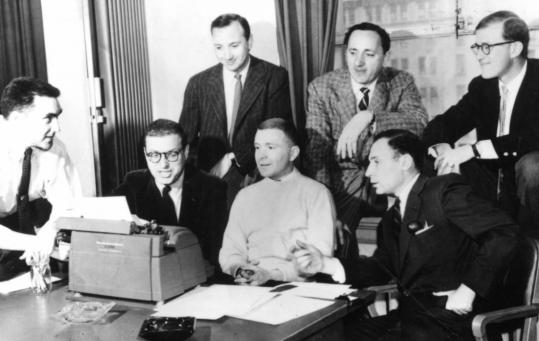
But as I say, I don't think yesterday's meeting will lead to any paradigm shift, and that's the kind of transformation we need. A colloquy of pontificators is not a method for devising intricate or creative work. Maybe when Woody Allen, Mel Brooks, Carl Reiner, Neil Simon, Larry Gelbart and Sid Caesar sat around a table coming up with ideas for "Your Show of Shows," this sort of collaboration provided a creative synergy where the whole was greater than the sum of the parts. When it's Lamar Alexander and John Boehner on one side, and Nancy Pelosi and Harry Reid on the other, not so much.

September 12, 2009

The Michael Moore Medical Insurance Reform Act


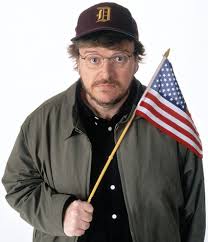
It occurs to me that as unlikely as it might have been that a fellow with Michael Moore's BMI would have nevertheless wound up being the conscience of the health care debate, such has indeed proved to be the case. The two salient points that might survive the Congressional fiasco currently underway are the foci of Moore's movie "SiCKO:" to wit, insurance companies should not be allowed to do business if they systematically exclude people with "preexisting conditions" and they should not be allowed to drop insureds from coverage simply because they get sick, i.e., need the insurance they've been paying thousands of dollars for.


And then Congress ought to fold up the circus tent and move on to the next town.

I watched Anthony Weiner (D-Brooklyn) on Real Time last night, a very sharp, genuinely liberal Congressman with a quick wit, combative nature and high IQ talk about Congress's missed opportunity. He made the obvious point that Obama gave the game away at the start by deciding to work within the existing medical insurance framework. Once you do that, there's not much to talk about, although Obama keeps talking, as he did Wednesday night. One thing I've learned about Prez O is that you should wait a couple of days after one of his speeches before you gauge your own reaction. He's so good at speaking, at the art of oration itself, that you forget about content. There was virtually no content, other than the Two SiCKO Points, and those are good ones. So pass a bill that does exactly those two things and forget the rest, because the rest (a) will not bring down costs and (b) will not expand coverage in the "revenue neutral" way that Obama says it will. There is no way to provide health insurance to 50 million uninsured Americans through the existing predatory private insurance industry without some political entity, the federal govt. or the states (through Medicaid), going bust-o.

President Obama said at the outset that replacing the private insurance system "would be too disruptive," although he would like a Single Payer system. It's clear O doesn't like disruption; for example, during the speech he assured the Republican blowhards that whatever plan gets passed, no federal money would be provided for abortions. Thus, for some reason he feels compelled to reassure us that women (and probably the neediest of women) who need this Constitutionally protected, perfectly legal procedure can't have it, because it upsets Republicans when women exercise their Constitutional rights. He was also clear that undocumented aliens will receive no benefits for any notional "public option;" since neither Congress nor Obama has any intention of ever dealing with the problem of illegal immigration, this means that uninsured undocumented aliens will continue to use emergency rooms as their primary care physician. This sounds tough and jingoist and winds up being stupid.

I hope, as we nation build in Afghanistan, that we do it right over there from the outset. The billions that we spend there can include a model universal health care system to provide cradle-to-grave free access paid for by taxes. The years when America might have done that have obviously passed, but it's still a good idea.

Meanwhile, the Obama Wall Street reforms seem to be dying a slow death as the overmatched White House does battle with the legal sharks of Manhattan. It's only because they're doing things out of order. Moore's new movie opens in a few weeks and will outline the sweet spots. Thank goodness somene is still working hard on our problems.

August 18, 2009

Probably the real reason health care cannot be reformed

It's only my theory, but then again, the whole blog's only my theory. When did that ever stop me before?


I cannot quite understand Barack Obama's apparent kowtowing to Big Pharma (whose lobbying group is practically named Big Pharma) or to the health insurance industry, or his mystifying inconsistency on whether he will or will not insist on a public option as part of the medical insurance scheme. I simply find it hard to believe that he's that cynical. My guess is that he's actually a Single Payer advocate who, in better times, would support a Medicare-for-All Program, or an expansion of the VA hospital system to cover everyone including non-veterans, or some form of socialized medicine.

But these aren't better times. It is perhaps a measure of the spoiled and self-indulgent nature of the American populace, and its tendency toward fatuous and irresponsible political discourse, that a graph such as that above from the St. Louis Fed is never introduced into the dialogue. The fact of the matter is that unless all of federal expenditures undergo a massive and fundamental restructuring, there really isn't money for anything new, and barely enough to do that which we have always done. That is the point that is never discussed. And while it may be true that over time a basic change in the delivery of health care to the American populace (freeing it at last from the ruinous costs of monthly premiums and high deductibles) would substantially improve the economy and federal finances, the problem right now is that the United States simply cannot undertake any heavy expenditures on a massive new social program. In a way, it's nearly insane to talk as if we can.

I think Barack Obama is aware of this fundamental lunacy. It has trapped his presidency. He came into office with health care reform a cornerstone of his Change Program, and then he got The Word. I think this happens to all Presidents-Elect in recent times. A story is told of an ashen-faced Bill Clinton, who met with the outgoing Treasury Secretary and the Chairman of the Fed before Clinton took the oath in 1993, staggering back to Hillary with the news that the federal government could afford "nothing, not even lunch." Those times were flush compared to these. The three lines of the graph above tell the story in chilling detail. Tax receipts (blue) are falling below $2 trillion; the budget (green), including the massive stimulus and such crazy expense items as "nation building" in Iraq & Afghanistan, has shot above $3.5 trillion; and the resulting deficit (red) is pushing $2 trillion. The lines are interrelated, of course, and are all going in exactly the wrong direction.

And against this backdrop we want to introduce a huge social program? I would find the "progressive" position, such as that promoted by Nancy Pelosi, more credible if she combined her advocacy with a demand that the defense budget be cut in half, effective now, and that all but the most essential overseas bases be closed. And went further and announced that the House would approve absolutely no more "supplementals" for Iraq & Afghanistan, with all the troops stranded there brought home as soon as possible. Yet one never hears that kind of logic and common sense, because such a position is not "centrist" enough, not militaristic enough, for Democrats who are always afraid of being labeled soft on....something. Take your pick of bad guys -- Commies, terrorists, narco-dealers.

We will be fortunate at the rate we're going to avoid a Black Swan event with the dollar's value, or a default on national debt obligations. Ben Bernanke has been given the task of raising money in a situation that requires the combined skills of Bret Maverick and the magician David Copperfield. Although Gentle Ben is daily vilified, his conjuring tricks are about the only thing between us and Going All Iceland.

So Obama is involved in his own Cash for Clunkers program. He can't deliver that 700 series BMW we all thought we were going to get. Instead, it looks more like a 1985 Chevy with scaly paint and a smoking exhaust, but honest (he's saying at these town halls), it's really just the same, it's a car. You'll get used to the vinyl, trust me. And most important, it's kind of what we can afford right now.

So he's asking the private sector to help him out, because the federal government just can't do it. It's that simple. He could simply tell us that, and then introduce the subject of where we DO spend most of our money, but I don't suppose that's going to happen either. Not Audacious and Hopeful enough. Honest, maybe, but you know how honesty sells in this country.