Showing posts with label The Decline and Fall of the American Empire. Show all posts

March 04, 2009

All the news that's hard to take


697,000 jobs were lost during February, according to the Department of Labor's preliminary estimate.  This will be revised upward later, of course; you can see the propaganda effect pretty easily in the number.  Ju-u-u-s-t shy of 700,000.  Odd how often that seems to happen with the first number that comes out early in the month: 595,000, et cetera.  Does anyone even have a job at this point, aside from (a) TV news people and (b) government employees, such as the President?In a few months will the Dept. of Labor simply announce, "The rest of the American people lost their jobs last month," and that will be it?

Here's a wiseass from Russia weighing in: 

"MOSCOW — If you're inclined to believe Igor Panarin, and the Kremlin wouldn't mind if you did, then President Barack Obama will order martial law this year, the U.S. will split into six rump-states before 2011, and Russia and China will become the backbones of a new world order."  

Sheila Bair, the head of the FDIC and the remaining federal employee in the financial sector with any credibility left, says the FDIC may become insolvent by the end of the year.  I don't see how that can happen.  Wouldn't the Treasury Department simply "replenish" its capital by "injecting" a few trillion to keep it going?  I think that's our operative principle for everything these days.  A bulkhead buckles, the water starts pouring in, and we patch the hole with more federal "money."  That's why I'm concerned about this guy Panarin; it isn't so much that I see him as some kind of spot-on Cassandra for the West's misery.  It's simply that he's saying it at all.  Like G.K. Chesterton's horse who could play chess: it isn't so much that he plays well, said the wit; it's that he plays at all.  Sort of like that.  Russia, while floundering itself, still has a lot of stuff to sell, namely, oil and natural gas, so they can raise cash.  And we're counting on that cash, and a few trillions like it from China and Saudi Arabia, to keep the party going at the Casino at the End of the Universe.  So we don't want these guys drooling over the prospect of our collapse.  We need the money.

So this outbreak of Schadenfreude is disconcerting, to say the least.  These other... people, as Daniel Plainview says in "There Will Be Blood:"  what are we to do with them? Or without them? Are they going to drink our milkshake?  They are well aware, because they are educated at least as well as we are (okay, better, but I'm looking for a silver lining here), that the immediately precipitating cause, that which gave impetus to a long process of decline in the U.S., was the last great Casino game we could come up with: mortgage laundering.  Mortgages were sold to anyone who could pass the mirror-fogging test, then lumped together into gargantuan pools of "diversified risk," then sold as jigsaw-puzzle bonds.  It's important to remember that what looks like the actual and efficient cause of our problem is really only a symptom of something far more dire.  We had run out of ways to make money in any productive way, in any way that the plutocratic class could use to maintain an extravagant lifestyle, and so the final resort was made to the hocking of the very land of America.

And we've come up snake-eyes.  The Grim Croupier is raking in all the chips and looking askance at our furtive effort to pass off crude chips made of particle board as the real thing.

What's the guy mean by "rump state," anyway?  That sounds like some sort of Commie-speak. They're forever using such terminology in their dialectical analyses.  Bourgeois, proletariat, stooge, apparatchik, rump state.  I think he means some kind of regional federation thrown together in a state of panic.  Not to worry: one of George W. Bush's "secret memos" covers that, the memos containing what Bush/Cheney considered the Real Constitution.  The one without the Bill of Rights, and that allowed the U.S. military to operate within the country to "quell insurrections," even citing the Civil War as an example or a provocation.

Could be Dick & George were on the same page as Igor.  What may be hard for us to accept is that there are situations too dire to get out of.  They happen regularly in world history, often as the result of imperial overreach.  Everything seems okay, manageable, just a rough patch. But it just keeps getting worse, and it gradually dawns on you that you're running out of options. There's no money, no credit, and too many people are beginning to operate independently to save themselves for a cohesive center to hold.

Barack running a regime under martial law?  I was kidding about that Sheriff Bart thing, you know.

February 23, 2009

Twenty-five Years after Nineteen Eighty-Four


One of George W. Bush's recurrent fantasies was that if we could simply democratize the whole world, war and terrorism would disappear, rainbows would appear in the sky on cloudless days and the world's rivers would flow with milk and honey.  History does not really support the point of view that democracies are incapable of aggressive war; this simpleton's analysis was part-and-parcel of what I always thought of as Bush's World Book Encyclopedia approach to international relations.  His ideas about the world entered a condition of stasis when he was about 12 years old and never really developed much beyond that.  Thus, America could do what it wanted because it was "good," and apparently bad things that America did were not bad because it was America that did them.  These ideas are familiar to me as relics of my own elementary school years.  In the dichotomous world of America vs. the Soviet Union, it's how we were all taught to think back then.


In point of fact, the 20th Century was probably the high point for liberal democracy worldwide, yet it's possible to argue that the absolutely worst things in human history happened during the same epoch.  The two total wars, the Holocaust, the Stalinist Gulags, the use of nuclear weapons on civilian populations, the killing fields of Cambodia, the Cultural Revolution in China. These were all events of mass horror and carnage.  They were also all triumphs of state power over the helplessness of the individual.  One can argue that a great deal of the mischief was caused by totalitarian governments, and I would agree.  The essential problem, however, is that even in those situation where a government is elected democratically, as in the case of the National Socialist Party in Germany in 1933, there is no guarantee that a stable regime dedicated to individual liberty will survive. I'm sure that Iraq will bear this thesis out once they are free from our custodial supervision.

Even here in the good ol' USA, a pretty funky devolution is going on right now. A number of modern thinkers are trying to describe it, and Glenn Greenwald (linked to the right) is one of the best, but it's a murky phenomenon that is difficult to encapsulate in a few words.  In essence, there seems to be an almost complete disconnect between what you might call populist sentiment (majority will) and the actual policies pursued by the federal government.  For years, for example, poll after poll demonstrated that the general American populace was way ahead of the Congressional establishment on the subject of Iraq withdrawal. The people wanted out; yet the Congressional consensus, reinforced by the Beltway media, kept repeating that "no one" wanted a precipitous withdrawal or one that "abandoned" our troops.  So one appropriations bill after another was rubber-stamped by Congress, even after the Democrats took over.

The same nonsense has gone on with the question of investigating/prosecuting the Bush regime for war crimes.  In point of fact, reliable polls demonstrate that about 64% of Americans want the Bush people at least investigated, and a substantial plurality want them prosecuted.  Yet the "official" position, which Obama has adopted, is that "no one" wants to get bogged down in a "partisan" argument and that we must "look forward."

I was reminded of this principle reading Paul Krugman's column in the New York Times today where he mused about the Obama Administrations's obvious reluctance to nationalize banks such as Citigroup and Bank of America, choosing instead to shovel money their way even as it becomes apparent that the bailout sums exceed, by several multiples, the total capitalization of the corporations at their current stock price.  Of course, certain individuals at these banks would take a financial hit if the government assumes control, dismisses management and declares the stock worthless, and it's worth remembering that Wall Street in general donated about $18 million to the Obama election campaign.  And the choice of Timothy Geithner as Treasury Secretary, a fellow club member with all the high rollers on the Street, may also be a telltale sign.  

Still, the Obama campaign was the first presidential campaign in history to eschew entirely public financing, raising about $700 million, and most of that from individuals. It seems like a populist triumph; yet the actual policies of the Obama Administration do not seem to line up with the expressed will of the majority of the American people, as reflected in national polls.  This is a little scary.  What does it even mean to have a choice in candidates if the federal government does whatever the hell it feels like doing despite that "choice?"  

Obama is now going to guide his own surge of troops into Afghanistan. In some vague way, I recall that the war in Afghanistan is supposed to have something to do with the 9/11 attack by a group of Egyptians, Lebanese, UAE, Yemenis and (mostly) Saudis as planned in apartments in Hamburg, Germany starting about a decade ago.  (We probably felt like we couldn't bomb Hamburg again, not after the fire bombing of July 1943.) I wonder if the Afghanistan war, at this point, is not a great deal like the war which Oceania fought in perpetuity against East Asia and Eurasia in 1984.  It transfixes the populace and keeps us in a state of constant anxiety and aggressiveness.  We're at war! It doesn't do to question the government excessively when they are leading us in a fight for our very survival against the Evil-Doers.

So Obama, like Bush before him, has his war, which provides a covering rationale for the continued programs of extraordinary rendition, state secrets, telecom immunity, and, most important of all, no reduction in the massive amounts spent on defense and our 700+ military bases in foreign countries. I am beginning to form the opinion that the stock markets, which continue their elevator ride south to the basement, are reacting because of unconscious perceptions at work in the minds of average Americans. A country which continues its profligate waste of money on imperial nonsense, such as the war in Afghanistan, and which refuses to pay for anything with real money in real time, is not a country which is going to evade financial ruin.  So that while the federal government believes that it is escaping the judgment of the American people by traducing their will, it will not escape the judgment of reality, which has always dealt with similar hubris in the same way.

February 16, 2009

Beyond Ideology into the Brave New World


Nouriel Roubini is an Iranian Jew who teaches business at the Stern School at New York University.  From this paucity of facts, that Mr. Roubini, an Iranian Jew, is (a) alive and (b) someone who continues to thrive, we can deduce, in the manner of Sherlock, that he must be an adaptable, savvy and insightful individual.  


On the cable news financial channels, such as CNBC and Bloomberg, he is usually greeted on his occasional guest appearances with all the enthusiasm of the Plague at the costume ball  in Edgar Allen Poe's "The Masque of the Red Death."  He has earned the sobriquet Dr. Doom because of his relentlessly downbeat assessments of the American economy.  He is hurried on and hurried off, appearing only long enough to bum everybody out.  As soon as his spot is over, the regular shills for the financial industry begin bad-mouthing him, and quickly bring on a more reliable cheerleader who talks about a "bottom" having been reached in the Dow and that it's time for John Q. Public to go long on American stocks once again.

Nouriel is a major irritant because he's always right.  He was writing in detail about the bursting of the housing bubble and the tsunami of bad debts that would overwhelm the banking sector about three years ago.  He was steadfast in pointing out that the figures used for subprime losses (originally estimated at maybe $200 billion) were vastly understated.  His own current estimate of the total eventual loss, worldwide, from bad U.S. mortgage debt is $3.6 trillion, about half of which will hammer American banks directly.  With $1.8 trillion in losses, the U.S. banking system is insolvent.  As a result, Mr. Roubini argued yesterday in the Washington Post that the major insolvent banks (Citigroup, Bank of America will no doubt be among them) should be nationalized.

As the amount of bailout money continues to pile up toward the ionosphere, one must admit that Prof. Roubini has a valid point.  There will be no end to the shoveling of "taxpayer" money into the open maw of these insolvent, imprudent, incompetent banks.  Just take them over so the People have direct control.  The bankrupt banks have lost the right to control their own destinies. A lot of support is lining up behind Dr. Doom, and some rather surprising (at first glance) opposition is also taking shape.  

As one prominent example, Barack Obama prefers that the banking system remain in private hands.  One has to wonder: is this a practical decision or an ideological one?  One can understand the reluctance to turn over the banking industry to a deliberative body as thoroughly, irretrievably corrupt and incompetent as the U.S. Congress.  These are the fools who have managed to wreck the Social Security system by burning through its trust fund.  They are as bad as those corporate greed-heads who have run the banks into the ground. Still, nationalization simplifies the role of Congress.  Congress simply has to appropriate the money, and then it can use lawyers to work out the details of acquisition and hire people from the private sector to run the federal bank. Congress can probably handle that; what it can't handle is coming up with a complex solution to guiding and solidifying the banks while they remain in the control of existing management.  That's way past its skill level.

If the banks under private management, despite the coal-tender approach of shoveling money into the corporate furnaces, become officially, recognizably insolvent, then all hell is going to break loose.  That should probably be the operating principle of the Obama Administration: do those things, and only those things, which avoid all hell breaking loose.  We don't want bank runs, we don't want everyone stashing their cash in mattresses, we don't want a bankrupt FDIC.  If the banks are stabilized by taking them over, then we know how much it's going to cost.  Indeed, Dr. Doom has already told us.  We need a couple of tril.

The question then becomes where to get all this money.  Again, simple ways are best.  We'll be borrowing it, and the most likely place to come up with all the money necessary for this (bad-idea) stimulus and the bank acquisition and liquidity "injection" is through a meltdown of the American equities markets. I imagine this will happen on its own as the American economy continues its inexorable contraction.  The Dow to 2,000, the NASDAQ to 20 or so, the Standard & Poor to very poor indeed.  The cash coming out of these corporate yard sales can be funneled into the investment of last resort, U.S. Treasurys (that's the plural spelling the Serious guys use, I've noticed).  So we'll have the cash and the most boring financial market since the USSR, circa 1955. Those who have money to invest can buy Treasurys; those who need to borrow can borrow money from the federal bank.  The interest rates should be set to earn a little for the federal government; say 5% interest paid, 6% loan rate.

There is a name for this kind of arrangement, of course.  In essence, it's a credit union.  Other vital industries, such as car manufacturing (re-tooled to produce mass transit and electric cars), can also be nationalized, now that we see that GM and Chrysler simply present the same problems as the banks.  Buy them, don't throw money at them.

I can see where Barack Obama would resist a lot of this.  He thought he was going to be President of the United States, not General Secretary of some American socialist state.  Still, we'd better get real.  As a friend always includes with her notes: Reality is that thing, even when you don't believe it, refuses to go away. To avoid truly unimaginable social dislocation, President Obama needs to avoid ideological hair-splitting and focus simply on things that will keep the immense, clumsy, faltering American system from total collapse.

February 13, 2009

Another Way to Tell They Aren't Serious in Washington

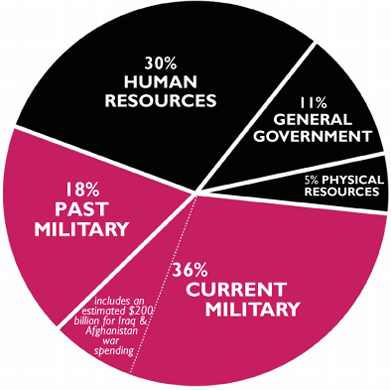
This graph illustrates the essential conundrum of American politics, in my opinion (he added unnecessarily-everything here is my opinion). It's a pictorial representation of the true state of federal budget priorities made plain.  


Not shown here is that slice of the budget pie allocated to the "entitlement programs"such as Social Security and Medicare, and there is a reason for this.  The Social Security program, for example, is a cash-in, cash-out system that has worked since the Great Depression and would have continued working, had it not been for Congressional embezzlement, until at least 2041.  It funds itself through a dedicated system of FICA taxes which have been more than adequate to meet the needs of the retired and disabled; indeed, the surplus built into the system in the early 1980's was designed to create a trust fund that would ensure its future viability.  The Congress Clowns, of course, couldn't keep their oversized mitts off the money, and now the system is on the brink of insolvency.  (This same Congress, by the way, is the one that you and I are counting on to devise a brilliant plan to rescue the United States from the grips of recession.  Yeah, that's going to work.)

And what was Congress doing with the trillions it stole from the Social Security trust fund?  The graph above shows you: playing army.  If you eliminate that part of the federal budget over which Congress acts as little more than a clearing house for collecting money from working people and sending it to retired people, you are left with about $2.5 trillion in "revenue," consisting of income and other (non-FICA) taxes, the money looted from Social Security and the inevitable borrowing. (Why does the federal government borrow money? Because it can.)  54% of this money is spent on the military and homeland security, one way or another, including that part of the national debt service properly attributable to military spending in the past.  We build things like the F-22 bomber, which is essential to our defense against Russian Migs discontinued in the 1980s, but unfortunately can't be used in Iraq because of the sensitivity of its electronics to the garage door openers used by insurgents to detonate IEDs.  We build aircraft carriers so it will be a fair fight against the Japanese Imperial Navy if they move on Pearl Harbor again. We build lots of tanks and half-tracks to guard against a land invasion by the Soviet Union through the Fulda Gap in case that East Berlin situation becomes a hot spot again.  And so forth.

Does the United States actually need to spend as much as the next 15 largest militaries in the world combined, particularly on the kind of weaponry, ships, tanks, bombs and planes suitable for fighting World War II again?  In truth, thermonuclear weapons have made conventional war against other nuclear-armed countries impossible.  The United States cannot start a "conventional war" against Russia, for example, on the expectation the war will remain contained.  Or, for another example, if you wonder why Syria, Egypt and Jordan never invaded Israel again after the Yom Kippur War of 1973, look no further than the Israeli nuclear arsenal.  In the absence of large-scale enemies where it is feasible to use our large-scale military in a conventional war, at least without bringing about the end of human civilization, we have instead embarked on a program of keeping our forces experienced and cutting-edge by fighting unnecessary wars in Vietnam, Grenada, Panama, Somalia, Afghanistan, Iraq, et cetera, and then using these unnecessary wars as the rationale for maintaining a large conventional military in case we need to fight an unnecessary war in the future.

The United States spends well over a trillion dollars per year on defense and homeland security, when you add up the basic Pentagon budget, the "supplementary" appropriations for our vanity wars in Afghanistan and Iraq, the nuclear budget in the Department of Energy, all the espionage agencies (many of them redundant) and the debt service on past budget overruns.  No one in a "serious" position in Washington, including Barack Obama, ever talks about reducing military spending to a rational level commensurate with our true security needs.  

It is yet another illustration of the complete impotence of the federal government in dealing with real problems.  It is locked into ideologies and certain "idees fixes" which it cannot escape, so it begins its confrontation with reality, each and every time, with the result determined in advance.

February 09, 2009

Trying to Avoid the Gorby Syndrome


I've thought for a long time that the closest historical parallel to the current economic and political perplexities in the U.S. is the situation the U.S.S.R. faced shortly before its demise in the early 1990's.  As the Soviet Union did, we have a central government that is in many ways an unimaginative gerontocracy (particularly in the Senate), and which is almost completely unresponsive to the everyday problems of American citizens.  The Soviet Union had its favored oligarchs and Party members, and we have our favored corporations and the revolving door between Washington D.C. and the influence peddlers who control national policy.  Our press is nominally free, but there is a Pravda-like conformity of the Big Media to certain agreed story lines for any given issue. Most recently, for example, we saw the nomination of Tom Daschle to run Health & Human Services go crashing down in flames; what we mostly heard about were his lapses in "optics;" he was a little too obvious about being a pampered lobbyist and didn't pay attention to the tax implications of riding around in a limo all the time on a fat cat's dime.  What was less discussed was that this was the guy Obama chose to revamp the creaking, disintegrating health care "system" in the United States, this former Senator who had grown enormously rich by working for Big Pharma and medical insurers since John Thune did him the favor of retiring him from the Senate.  Tom Daschle was going to put an end to the outrages which Michael Moore lacerated in "Sick-O?"  Look, I've got some shovel-ready infrastructure called the Brooklyn Bridge I'd like to sell you for $10 billion, financing available from the government.


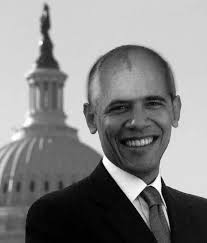
I don't think President O likes the analogy between his situation and Gorby's, but it may be apt just the same, so much so that Google Images even has a picture of Barry with a port wine birthmark ready to go, as above.  Mikhail became the West's favorite Commie of all time, to the point where you forgot, almost, that he was a Red.  Gorbymania swept the world, in fact. The Soviets had glasnost and perestroika, and Barack has "change."  "Change" was never quite defined in Obama's campaign, but we welcomed him, first and foremost, because whoever was elected would not be Bush anymore.  We weren't asking a lot of tough questions, especially since he was running against another Angry Old Man from the Senate with antiquated ideas, a shaky grasp on contemporary America and a sort of omni-directional aggressiveness. 

It wasn't Gorby's idea to break the Soviet Union apart.  Garry Kasparov, former chess genius and current Russian activist, never saw Gorbachev as anything more than another Central Committee apparatchik with charm and a new line of baloney.  It's not Barack Obama's intention to preside over the disintegration of the United States, either.  That's why his first instinct was to gather around him, like defensive ramparts, the stolid, time-tested Clinton Politburo to advise him on how to light a fire under the U.S.A.'s previous go-go consumer economy.

In the living quarters of the White House, Barack must have a dart board with Bush's face as the target because I can't imagine how dismal it must feel for Obama to spend the first three weeks of his glorious ascension dealing with something so soul-killing boring as this "stimulus" "package."  This is what it's come to, thanks to decades of neglect while the U.S.S.A. rotted from the inside out.  Obama is presiding over a loan app.  He needs to re-fi the United States, so first he has to pull together a business plan for his creditors in Beijing and Tokyo and Riyadh to pore over.  ("$27 billion for highways?  Too much. Knock that down.") The bowdlerized, diluted, universally-viewed-as-useless piece of dreck the Ancient Mariners in the Senate came up with will (a) increase the national debt enormously while (b) maybe delaying the inevitable for a little while.

I read in Paul Krugman today that without the stimulus bill the U.S. GDP would contract about $2.9 trillion over the next three years, to which one might say, first: and your point is?  That is less than $1 trillion per year, or about 1/15th of the present American GDP, which is 25% of the world's GDP.  So about 6.67% contraction per year.  Not to be flippant or hard-hearted about this, but we can't abide that?  We don't have the internal resources, the innovative spirit and adaptability, to figure out how to arrange things differently so we can have an envirnomentally-sustainable economy?  We have to go back to that ruinous "growth" economy because there are no other options, or we're too impatient to figure out what they are? We prefer the reckless alternative of going broke trying to defib the corpse of the American consumer economy?

That stimulus bill just looks awful.  Note how they starve, as always, mass transit and my own hobby horse, inter-city high speed rail.  We never do anything fun.  Government spending aimed at certain high-tech innovations (such as solar and wind energy, desalination, and the aforementioned choo-choo) would get us somewhere and create a lot of jobs.  But not business tax cuts.  Not more freeways and offramps.

Congress just can't do it, anymore than the Politburo or the Presidium or the Central Committe could do it, past a certain point of collapse.  Congress is locked into certain failure modes it cannot escape.  Maybe some people are born Gorbymaniacs (that would be Mikhail himself), others achieve Gorbymania and some have Gorbymania thrust upon them.  I think O may fall into this last category.

February 07, 2009

American Economy and Other Entropic Processes


Graphically illustrated here, we have the history of the top marginal tax rate in the United States of America from the inception of the income tax in 1913, brought to you by the Sixteenth Amendment, through 2003, when the top rate was reduced from the Clinton era rate of 39.6% to the present 35%.  

It's all there, if you look closely.  As with any new toy, the income tax was taken out for a spin by the central government as soon as the law was enacted, the top rate zooming to nearly 80%. The rate was just as precipitously reduced at the outset of the Roaring Twenties to 25%, under the leadership of three consecutiItalicve Republican presidents, Harding, Coolidge and Hoover. These three,  in cahoots with Congress, were the original "supply siders," believing that low taxes on the rich would foster growth and prosperity through trickle down mechanisms.  And so it did, for awhile, and America's economic fortunes improved along with the rest of the world following the catastrophic destruction of World War I.  And also, as the low tax rates were maintained and the financial sector was allowed to run wild with unlimited margins and unsupervised stock markets, the pro-fatcat regime led to the kind of unbalanced wealth distribution not seen again until...now.   Sic semper gloria mundi.
It all crashed in 1929.  Roosevelt, the original creator of the Mother of All Stimulus Packages, the New Deal, had one enormous advantage, visible in the chart above, not available (in any practical sense) to President O.  He could draw upon the accumulated wealth of the country, and that of the plutocrats still earning big money, through the income tax, pushing the top marginal rate from 25% to 80% in his first two terms in office. As World War II reached America's shores, the populace tolerated a confiscatory top rate of over 90%; you see, in those days Americans thought that if the country was at war, it must be something pretty important.  Something worth sacrificing and paying for.

Such quaint ideas.  So World War Twoish. Under George W. Bush, no sacrifice whatsoever was asked of America's disaffected, indifferent masses, the ignorant armies watching TiVo by night. The tax burden was lightened during the Afghanistan and Iraq wars even though these conflicts were ruinously expensive.  But W, after all, was simply a child of his times.  That's how we do things now.  America is not really a nation anymore; it's a market, a demographic, a place to network and make your money,  keeping as much as you can.

That's why the modern "Recovery Act" cuts taxes as part of its program of spending $1 trillion to stimulate the economy.  No one is suggesting that the top rate of 35%, applicable to incomes over $300,000, be increased at all.  No one is suggesting that the FICA tax apply to incomes over its present maximum of $100,000.  Why isn't Congress suggesting something so obvious, so fundamental, particularly with Roosevelt's example to light the way?

Because Congress works for the people whose taxes would be increased.  See how obvious all this becomes with a few simple charts and graphs?  Congress members now tell us, Democrats & Republicans alike, that raising taxes damages economic growth -- this is not something the government does during a downturn.  Huh?  What exactly then was Roosevelt doing in the 1930's?  Suppose we raised the top tax rate to 50% for all incomes over $1 million per year. It would raise a lot of money; is anyone seriously suggesting that the increase of 15% would cause those big earners to stop making money?  Lebron James and A-Rod would hang it up?  Those Fortune 500 CEO's whose incomes average $400 million per year - not worth it anymore?

Yet it's politically unthinkable, isn't it?  So here's something else that is unthinkable: that this "stimulus" plan is going to work.  It can't.  It violates some fundamental thermodynamic rule of money.  If the citizens of this country are not willing to pull together collectively and put each other to work by paying for the government projects contemplated by the Recovery Act, then it's hopeless.  We have to do our own internal redistribution of income and wealth in order for the country to avert catastrophe.  If we are not willing to do that, then the plan will fail.  You cannot borrow your way out of a problem caused in the first instance by excessive borrowing and income inequality.  And beyond that, do we honestly believe that all the foreign creditors who will be asked to finance this enormous outlay at essentially zero return on their investment will not notice that we're not paying for any of it?  That we're reducing our own burdens as our "contribution?"

I'm afraid this one takes the idea of American Exceptionalism way past the breaking point. This is a looming disaster.  We're the ones we've been waiting for?  Will there be another bus along in a minute?


January 31, 2009

Aspiriational Apocaphilia


A term I first encountered while reading a writer named R.J. Eskow, who weighs in periodically on various political blogs. I think the terms refers to the state of ecstasy some writers appear to achieve while composing jeremiads to the imminent downfall of Western Civilization.  Eskow cites as a prime example James Howard Kunstler, whose "Clusterf**k Nation" is linked right here on this page.  Admittedly, there is something orgiastic about Mr. Kunstler's weekly downers, in which he excoriates the United States for being fat, tattooed and stupid, calling America a "clown nation" that cannot do anything right.  He is also absolute in his conviction that we're incapable of any sort of technological fix for the problem; to make certain there's no hope, he relies upon his deus ex machina, Peak Oil.  So even though electric cars are actually right around the corner, and entire countries like Israel are figuring out how to run a national fleet of electric cars on an electrical grid powered by wind and solar, he'll have none of it.  It cannot work, he says, with religious conviction. It's so obvious that he doesn't even bother to explain why it cannot work.


I think he's wrong about that, way wrong in the way that those who are confident about foretelling the future are usually wrong.  The imagination of a single person is unequal to the task of encompassing the unfathomable permutations of scientific discovery in advance.  There is much too much interplay among ideas, synergies of discovery, unanticipated brilliance, breakthroughs, genius - indeed, it is quite arrogant to discount it all on the basis of an emotional predisposition to be pessimistic. Hamlet was right when he told Horatio that there were more things in Heaven and Earth than dreamt of in his philosophy.

What's causing the collapse of the U.S. economy right now is simpler than Peak Oil or Conspiracies among the Illuminati.  What we're seeing is that an entire country, acting collectively, has behaved in ways depressingly similar to a procrastinating, careless individual.  Mr. Kunstler, for example, derides the USA for not doing "productive" things, but he himself is a novelist and a writer of doomsday books.  Knocking the U.S. is a gig, in other words, but it is not a "productive activity" of the kind he urges on the rest of us Americans.  Neither is blogging or the Blogosphere in general.  These are more symptomatic of what's wrong than they are "productive activity."

The United States, as a nation, succumbed to the temptations of great affluence and power.  We have numerous historical antecedents for this behavior, most particularly the Roman Empire.  Take, as one simple point of entry, the current "crisis" involving Social Security.  Congress, to its initial credit, saw this one coming back in the early Eighties and upped the FICA tax to create a surplus.  Congress then proceeded to spend this surplus; one can measure the amount of surplus spent by reference to the multi-trillion dollar portion of the national debt owed to internal "trust funds."  Among other things, the surplus was spent on defense and security.  Seminal economics work, such as that by David Aschauer of the same period (1989), demonstrated that military spending by the government is the least productive form of "infrastructure" investment, and that growing economies, such as China, instead invested in schools, mass transportation, improving the electrical grid and water supply, etc., instead of an army and weaponry.  It's a commonplace observation that the U.S., spends as much as the rest of the world combined on defense, so it is engaged either in (a) complete irrationality or (b) complete corruption by MIC lobbyist influence. Either way,  this form of waste has crippled all other social spending and has foreclosed our ability to have a humane medical system for the citizenry.

Similarly, it was obvious that doing nothing to protect Americans from the huge numbers of relatively high-paying manufacturing jobs sent overseas, and even providing tax incentives for multi-nationals to do so, meant that the USA would devolve into a "consumer society" dependent on imports with our own productive capacity hollowed out.  This "globalization" mania, urged on by President Clinton and his advisor team of Casino Capitalists (Rubin, Summers, etc.), and cheerleaded by "influential" writers like Tom Friedman, left us with no alternative but to ship all our money overseas and hope foreigners would lend it back to us.  

We did nothing about the energy problem, of course, despite the clear warnings from President Carter in the late Seventies.  We allowed dependence on foreign oil to hit the 70% level.  But with or without the added insult of Peak Oil, these other trends have come home to roost.  We invested in what is really the least productive form of capital "hardware," vast subdivisions of new houses.  Houses are good for living in, but they are not places where a country makes any money or gets things done except when they are (a) being built or (b) being bought and sold, and then only at the margins.

Analyses of how we got here tend toward the excessively Byzantine.  It's not really all that complicated.  No one was minding the store.  No one was planning.  It was plain as day what was coming, and many people described it in highly accurate detail.  Nonproductive societies cannot create wealth out of thin air by financial games, not forever anyway, and certainly not by taking on excessive debt.  

America is actually one of those charmed places on Earth which probably could be almost totally self-sufficient with enlightened leadership. We could grow all of our own food and we could meet all of our energy needs by harnessing sun and wind, bridging our way there with the use of natural gas, coal with sequestrated carbon emissions, cellulosic ethanol, nuclear energy  and geothermal.  There would be plenty of work and it would be economically sustainable.

Instead we got what we got.  We're broke, dependent on the kindness of foreigners, and we're entering a prolonged period of completely unnecessary shortages and privation.  But I don't feel "philiac" about it all; it's a damn shame.

January 26, 2009

America's Economy as a Black Hole


I'm sure you share my fascination with the encroachment of scientific terminology on everyday conversation.  It's especially prevalent among liberal arts majors, because nothing adds to the gravitas of otherwise completely unprovable assertions like the generous sprinkling of terms like "critical mass, " "quantum leap," "power curve," and "nanosecond" in otherwise banal discussions. If you add action buzzwords like "get it right" to what you're saying, almost all other content becomes superfluous.  For example, if a Congressman thunders that the stimulus plan must have sufficient critical mass to jump start the economy  to get us ahead of the power curve and that we don't have a nanosecond to lose if we're going to get it right, then you know you're listening to a guy who's learned to take himself very seriously, even while having no idea what he's talking about.  


It's important to remember that none of this pretentious terminology actually indicates that the speaker has any quantitative command over the concepts he's pilfering; this is all qualitative bullshit.  I know, because I do it all the time myself.  For example, I love the term "event horizon" because it sounds so spooky and arcane, but I am unable to crunch the formulas to tell you where it is in relation to any given mass constituting a black hole.  Stephen Hawking, on the other hand, can do that.  I do know that the idea black holes suck up all the surrounding mass, no matter how far away, into their vortex (and over their event horizon - mooooaaaahhhhhaahhhhh!) is just fear-mongering; if the Earth were a black hole, it would be about the size of a ping-pong ball, but the Moon would go on circling the Earth as if nothing much had happened other than those annoying deposits of junk on its surface every few decades would stop.  The mass of the Earth would be the same, so its gravitational pull would be nearly identical.  Just, you know, kinda dense.

Black holes occur because of gravitational collapse of a massive object such as a big star, usually when it runs out of fusionable fuel to maintain the internal pressure resisting gravity.  You can see where I'm going with this.  Senator Chuck Schumer (Gasbag, NY) could talk like this if he would just Wikipedia that shit and read about black holes.  Then he could carry on about whether America is approaching an economic event horizon.

Here's my true, honest-to-God thought on this "recovery program."  All the economic experts, such as Paul Krugman and others who are pushing this massive spending solution, do not really know whether it will "work" at all.  They are talking this way because they don't know what else to say.  America is currently in a state of shock and denial about the "apparent" disappearance of about 40% of its net worth into thin air. Poooof! So the American economy, super-star that it was, is running out of fuel to sustain its gaseous, inflated state.  To drive the metaphor into the ground, that fuel (our hydrogen - if only we'd actually developed it!) was disposable income in the hands of the vast unwashed Booboisie, the open-air Jerry Springer Green Room that is my (and your) modern Homeland, Battlestar Consumerica!  Americans, during the Bush "Ownership Society" period, were getting about half that dough by treating their houses like ATMs.  No more, dat kine, as Hawaii's two 84 year old Senators might say for old times' sake, with Punahou Barack chuckling along.

As the "disposable" income vanishes, the national chain stores are all going bust-o, one by one, at an accelerating pace.  Just like a collapsing star accelerates in its collapse as its mass becomes more concentrated.  Shopping malls empty out, the stores close, the crap jobs disappear, house payments aren't made, credit card bills are ignored, banks teeter on the edge of insolvency, et cetera et cetera, as Yul Brynner said.  This description would be fantastic except that it's actually happening as I write and you read.

President Obama, who presides over this mess, doesn't really know what to do.  Nothing in his specific training or education equips him to deal with this enormously complex problem. America is collapsing under its own weight - huge federal and state budgets, corporate pension obligations, an out-of-control medical system, and Himalayas of private debt.  There just isn't enough money to keep it all puffed up.  We're about 40% short of what we need.  But what the politicians don't want to face, or to say out loud, is that maybe that's just where we are now.  They're professional optimists and their job description doesn't allow them to say things like that.  As Patrick Henry would say now, give me false hope or give me death!

So if Obama and the Democrats in Congress are going to fail in such a spectacular way (a singularity - there's another one), they want to be sure they fail in a way prescribed by the consensus of the experts.  It's safer that way.  And the Republicans, who know this massive spending thing is going to happen anyway, can thus oppose it safely, and then if we go bankrupt, or into hyperinflation because of a worthless dollar, they have another way to win, for whatever that would be worth inside our ping-pong ball sized economy.


The Old Folks at Home

To its great credit, the national media did not focus on the somewhat comical aspects of two elderly Senators collapsing during the Inaugural Luncheon at the Capitol.  To my everlasting shame, I couldn't help but think of all the Mel Brooks and Woody Allen movies I have seen where such a tableau would have fit right into the story line.  I have great respect for Senator Ted Kennedy, I know he has fought tirelessly on education and health care issues, but it's not altogether surprising that a man who will be 77 next month might have some health issues of his own.  As for Robert Byrd, who is now 91, I guess West Virginia may seek at some point a Constitutional Amendment allowing posthumous reelection.


I'm not an agist, I hope, especially as I kind of get up there myself; I know one 91 year old guy living in South Florida who could take Byrd's seat and revitalize the whole Senate. Nevertheless, I think the injection of new blood into any organization, of members whose education is a little closer to their current careers, who are a little more up on what's going on in society in general, is salutary. Crucial, even.  The average age of the U.S. Senate is currently 62 years old; one must count down 59 Senators before you get to a Senator, in fact, who is younger than 60, and then you reach a group of Senators in their late fifties.

The talk these days is how to avoid another Great Depression.  A lot of the current Senators might have first-hand knowledge, because I count 29 of them who were born prior to 1940.  A group of about 4 of them will cross the age 70 Rubicon this year, including Mr. Mumbles himself, Harry Reid of Searchlight, Nevada, who allows the small Republican minority in his House of Congress to block any piece of legislation the Republicans don't like by handing him a note saying they would filibuster if the bill is introduced.  Mumbles rolls over for this; I suspect that a younger, more ambitious Democrat with fire in his/her belly who wanted to make a name for him/herself, would force these obstructionists to stand up at the podium and read the Manhattan telephone directory for weeks at a time instead of thwarting the nation's will.  But gentle Harry likes comity, collegiality, reelection. Once, in the entire history of the Iraq War funding debate, Reid made the Senate pull an all-nighter; then they rolled the day beds away and Reid went back to rolling over for the GOP.

It's a commonplace observation that one of Barack Obama's keys to success was his superior mastery of the new world of Internet communications.  He knew how FaceBook, MySpace, networking all fit together in the national grid.  He raised hundreds of millions of dollars and organized the country down to the block level.  It was a kind of below-the-radar virtual universe that Hillary Clinton and John McCain just couldn't get the hang of.

Barack is now the leader of a country which absolutely has to make some paradigm changes in housing, farming, autos, the electrical grid, photovoltaics and wind power, desalination, and passenger rail in order to revitalize the economy. We have to go from the old system of a corporate growth economy to a steady-state ecological economy, in order to (a) be prosperous again and (b) avoid destroying the natural world.  President O knows we are not going to be successful at "jump starting" the old consumer nonsense.  The serial bubbles have all popped, and you can't get people to spend when they don't have the money anymore.

Barack must sit at those conferences, with a vast frieze of gray hair arrayed around the giant oval table, and think to himself: oy vey iz mir. Thanks to his father, he may know how to say it in Swahili.  He has to work with a Senate Majority Leader who thinks the opposition of Arlen Specter (78), Jim Bunning (77), Richard Lugar (76), Chuck Grassley (75), Bob Bennett (75), Orrin Hatch (74), Richard Shelby (74, but dyed black), James Inhofe (74), among other senior citizens, should carry the day.  Well, the soon-to-be 70 Reid is just respecting his elders, I guess.

I have serious doubts that this ancien regime is going to be equal to the task at hand.  Maybe it's not that funny, but I bet Woody Allen could make a kickass movie out of it.