In our time it is broadly true that political writing is bad writing. Where it is not true, it will generally be found that the writer is some kind of rebel, expressing his private opinions and not a "party line." -- George Orwell, "Politics and the English Language"
I listened to some of the oral arguments yesterday in the Supreme Court concerning California's Prop 8 ban on same-sex marriages. At this point in our social history, of course, the debate is absurd. For example, during his argument the flummoxed lawyer defending Proposition 8 was attempting to reason his way through Justice Elena Kagan's question about gay couples older than 55 who might want to marry. If the goal of the discriminatory law is to implement the state's legitimate interest in controlling the "procreative" situation (this is one of the Last Stand Arguments used by the homophobes), that is, to allow only marriages between one man and one woman in furtherance of "family stability," then why not allow those beyond child-bearing years to marry regardless of sexual orientation?
The Prop 8's lawyer's answer appeared to suggest that a person 55 years old can in fact bear children (regardless of age, regardless of sex, apparently), although Justice Kagan, taking pity, gently disabused him of this notion. When one is defending an irrational prejudice, this is the sort of blind alley you wind up wandering down. You are met at every turn with the utterly stupid implications of what you are advocating.
The best questions were from Justice Kennedy, who could not see why the ban on same-sex marriages was legally distinguishable from the unconstitutional ban on interracial marriages, which the Supreme Court has already disposed of.
Personally, I think the answer to all of these questions is pretty obvious, but hidden in plain sight: get rid of all legal implications and complications of the marital state. Allow anyone or anything to marry any other person or thing, in any number, that he, she or it chooses to marry. If churches want to bless the sacrament of marriage with their rituals, let them. If a guy on your bowling team wants to perform the marriage ceremony for you and your girlfriend on the basis of some incantation he downloaded from the Internet, that should fly. If you want to marry your dog, or turtle (to handle Rick Santorum's gotcha reductio ad absurdum), then you should be allowed to marry your dog, your turtle, or to enter into polygamy with both of them. As long as you're sincere. I insist on sincerity.
As part of the same liberalization, all laws should be restated and restructured to get rid of all references to the marital state. The condition of being married should have no effect on taxation or other legal rights (no filing of "joint returns," no "marital deductions" on estate tax forms, no "survivor's rights" to Social Security, none of this bullshit). If an adult wants to visit you in the hospital, and it's okay with the patient (either through volition or Advanced Directive in the event of incompetence), then the hospital ought to let the person visit. Divorce law, including alimony, property rights and the rest of the traps and snares should be eliminated altogether. Instead of divorce we will have "breaking up," with both parties (male, female, reptile) then left to their own devices.
I am all for marriage equality. It's a bad idea to enshrine prejudice with legal proscription, as was done in California with Proposition 8. California passed, in essence, a Jim Crow law in the (Mormon) guise of "protecting the family." It was a huge step backward, but it will not last. Either the Supreme Court will overturn it (if the white conservative bigots, the African-American Justice Me-Too, and the closet case on the High Court can be overcome), or the people in California will throw it out with a subsequent initiative.
But granting access of gays to marriage (which they deserve, as things stand) leaves in place another prejudice: that against single people or people in relationships not "sanctified" by marriage. We don't see that discrimination so easily because it is the ocean and we are the fish. Like the other prejudices that have given way to modernity in other categories of discrimination, the preference for the absurd institution of marriage will take time to overcome. But it too will pass away in the goodness and fullness of time.
A tip o' the hat to Kathleen Geier for a recent essay in the The National Memo. The tenth anniversary of the Iraq invasion has spawned a number of good retrospectives on the war, an uncomfortable fact for many in the "centrist" community of pundits who pawned their liberal credentials and bought themselves a set of spurs and a pair of shiny six-shooters so they could be real cowboys, too. Without the bizarre support of such "contrarians" as Christopher Hitchens, Andrew Sullivan, Peter Beinart, Tom Friedman, George Packer of The New Yorker, and numerous other supposedly liberal writers and opinion-shapers, it would have been much more difficult for George W. Bush to sell the war.
I think it was the late Hitchens who gave us the term "Islamo-fascist" to describe the radical element of Islamic terrorism, particularly in Iraq. It's difficult to discern any meaning at all in this nomenclature. Mussolini, credited with the original neologism, was describing a "tissue" of government and corporate control over a society, taking the word from the Latin "fascia," the term we use for tissue in English. Since it doesn't make any sense in the Muslim world to describe a religious totalitarianism in this way, we can be fairly certain that this drunken English scribe was simply trying to inflame opinion (and aggrandize his own brave "contrarianism") by conjuring up images of Hitler's dreaded Wehrmact. What an utter load of bullshit that was.
Ms. Geier writes:
"Finally, there’s the most powerful, if most deeply buried
justification of all: Iraq provided an opportunity for dweebish, pasty,
desk-bound dudes to indulge in macho daydreams. Throughout history, men
have asserted masculine dominance through imperial adventures. While few
liberal female pundits were pro-war, many centrist and liberal men were
unable to resist the war’s siren call.
The most infamous example of such macho knucklehead punditry is Thomas Friedman’s 2003 appearance
on The Charlie Rose Show. The war, he said then, was “unquestionably
worth doing” so we could tell the Iraqis to “suck on this.” Commentary
so inane and puerile would sound outrageous coming out of the mouth of
Friedman’s fictional look-alike Ron Burgundy; that an actual, Pulitzer Prize-winning, New York Times columnist said it simply boggles the mind."
I had occasion over the weekend to talk through this phenomenon with an old friend of mine. He shared his father's perspective, that of a World War II veteran, that Americans tended toward the "prima donna" in their modern reactions to adversity. Another World War II veteran and friend of mine, The Incomparable Sage of Boynton Beach (now 96), opined (as I've mentioned before) that the proper reaction to 9/11 would have been to "do nothing," insofar as international invasions and adventurism were concerned. Essentially, the 9/11 attacks were the result of a criminal enterprise carried out on a "war-like" scale by non-state actors who were allowed through Administration negligence to enter the United States, plan their terrorist act, and train themselves to fly American jets at American flight schools while residing here on expired visas.
The dweebish and pasty Keyboard Kommando group seized on the dramatic scale of the damage done in New York City to inflate this caper into the modern equivalent of Pearl Harbor or Hitler's invasion of Poland. This is patently ridiculous. As I've written many times, the tragedy of 9/11 fell upon those who were killed and the loved ones of those who were killed. These were the true losses. Beyond these immediate tragedies, we're talking about a couple of buildings, four jet airplanes, and a wing of the massive Pentagon. 9/11 had no significance for the United States strategically or economically, let alone "existentially."
It's weird, in this context, to note that the invasion of Afghanistan always gets a pass when the over-reactions of the dweebish and pasty cowboys are discussed. Essentially, the displacement of national anger onto Afghanistan was only marginally more sensible than the wholesale madness of the Iraq invasion. Afghanistan was the "ass-covering" war of the Bush & Cheney Knucklehead Show. These two overrated incompetents were so busy concocting an excuse to topple Saddam that they ignored clear warnings from the intelligence community that a terrorist attack was imminent. To distract us from their massive incompetence, they found a way to justify an invasion of a country where the attacks were "planned" or perhaps "financed" or maybe just "talked about," although we were subjected to countless re-runs of captured footage of terrorists-in-training using the Dreaded Jungle Gym Complex of Afghanistan. Something, because it's hard to figure out otherwise when you're dealing with actual terrorists exclusively from Egypt, the UAE, Lebanon and Syria Saudi Arabia, the core elements of which met in Hamburg, Germany.
By the way, because of the movie "Zero Dark Thirty," it's only now becoming generally obvious that the evidence pointing to Osama bin Laden's key role in the 9/11 plot was elicited from The Gurgling Confessor, Khallid Sheikh Mohammed, during his 183 sessions on the waterboard. The report of the 9/11 Commission is riddled with footnotes attributing statements to KSM as the government's chief informant concerning bin Laden. Because of President Obama's Bush-era style of Assassinate Now, Conduct the Trial Later, we killed bin Laden (when it was obvious he could have been captured and tried), so the full story will never be known. That, of course, was the whole idea.
"In questions of power . . . let no more be heard of confidence in man,
but bind him down from mischief by the chains of the Constitution." Thomas Jefferson, the Greatest Thinker in the History of Political Ideas.
Sometimes I've gotten carried away with my newfound fascination with the money system in the United States, and the related question: can a modern economy actually be rescued from failure by printing currency? At its base, that's what Ben Bernanke & Co. are trying to do, or at least the rescue of the economy is the putative reason for "quantitative easing." In practice quantitative easing provides an advantage for those economic players who operate in closest proximity to the Federal Reserve money spigot, namely, the Primary Dealer community who enable the Fed to carry out its "open market" operations in asset "purchases." It's obvious where the bubbles have been blown: take a look at the New York Stock Exchange, the U.S. bond market, and the renaissance of the housing bubble. In other words, here we go again. In a sense, this money is "sequestered," sitting idly in Federal Reserve accounts of large financial institutions or as unrealized gains in equities and housing. It has not found its way into the general economy, and so inflation remains "muted," in one of The Bernank's favorite words.
If all that hallucinated money begins leaking into the general economy, in other words, if you and I begin to prosper along with JP Morgan Chase and the big housing speculators, then The Bernank will have to throw the machine into violent reverse to remove "excess liquidity" from the system. The contraption at that point may begin to vibrate and rattle, lurch from side to side, parts may start falling off, smoke may rise from the Marriner Eccles Building, and the entire system may go supernova. No one knows, because no central bank which has hypertrophied to the extent that The Bernank has overseen has ever attempted to "exit" from such a massive balance sheet.
Sometimes I'm convinced that what The Bernank is doing is overcompensating for his amazingly bad judgment in the period 2005 to 2007 concerning the housing bubble. The Bernank just couldn't see it, or he was attempting to wish it away. So now he's trying to bring back the era of sky-high housing prices and a raging stock market to "prove" that "the fundamentals of the American economy are strong," and that the American commoner can support such a market. The path he's chosen, however, simply further distorts the wealth disparities which have crippled the overall economy and made a mockery of our democracy. In short, he's making the rich richer and the poor poorer.
This is certainly one of the problems Tom Jefferson was talking about. The Bernank IS the Fed, and the Fed is a banking cartel which is essentially unfettered by democratic processes. All I know is that I saw the housing bubble as plain as day as early as 2004, and I think I can see how this process of money conjuration will also end.
Meanwhile, Senator Rand Paul of Kentucky stood his lonely vigil in the Senate, using a filibuster of John Brennan's nomination as an occasion to debate the constitutionality of President Obama's program of killing American "enemies of the State" without due process. This was an interesting conundrum for "liberal" Senate Democrats, and for the American liberal community generally. They needed a pigeon hole for this Tea Party usurper. What were Chris Matthews and Lawrence O'Donnell and Rachel Maddow supposed to say about Rand Paul? What about such champions of civil liberties as Senator Carl Levin? And Chuck Schumer? (Okay, bad example.) Senators Pat Leahy and Bernie Sanders of Vermont stepped up, as did Ron Wyden of Oregon. Principle over party politics, a rarity in this day and age.
The liberal media trope was to marginalize and ridicule Rand Paul. Sure, he had guts, sure he was right (in a way), but does he seriously think that President Barack Obama is going to order a drone strike against Senator Paul while he sits at an outdoor cafe in Washington, D.C., as Paul suggested in his utterly ludicrous hypothetical?
And thus you have the utter dumbing-down of American political discourse, the clear proof that the modern day practitioners of American democracy do not deserve the country that Thomas Jefferson, John Adams, George Washington, Benjamin Franklin and many others put their lives on the line to bequeath them. The idiotic argument against Paul proceeds from the premise that President Barack Obama will always be President, that we can rely on him always to do the right thing while he always remains President, and that the demons of Rand Paul's imagination are entirely fictitious. We can trust a system where the Executive has the unfettered right to imprison Americans without trial, or to execute them without bringing charges, or anything else the Executive cares to do, because the current occupant of the office is a nice guy, and we know he won't abuse this power. And such an attitude, after all, has always worked out in the past, wherever it was practiced.
Bearing in mind at all times Bob Somerby's admonition that "we are where we are because of these people," I give you Tom Friedman's lede in his column today:
"On this 10th anniversary of the U.S. invasion of Iraq, three things are clear. First, whatever happens in Iraq, we overpaid for it in lives and treasure and focus. Second, you can overpay for something decent and you can overpay for total junk. What exactly we overpaid for in Iraq is not yet clear and will be decided by Iraqis. Third, as much as we’d prefer to forget about Iraq, what happens there matters more than ever for the Middle East."
Friedman, of course, is an important "opinion maker" in the United States. Many Americans assume he makes sense, that he has some idea what he's talking about, that he is a learned and wise man. That's a shame, because the man's an idiot, a schmendrick of the first water. However, these days I have a reason to look forward to his columns because of the "Really, Tom Friedman?" parody that haunts and follows Friedman around at reallytomfriedman.com. That's his photo-shop of the peerless thinker above. Some blogger has managed to inhabit Friedman's psyche as a virtual doppelganger, and uses all of Friedman's tricks, mannerisms, non sequiturs, gee-whiz techno-nonsense, Flat Earth crap, and everything else against Friedman. As J.D. Salinger wrote in Raise High the Roof Beam, Carpenters, it's enough to make a man believe in a cosmic Santa Claus. Reallytomfriedman almost makes the real Friedman worth the time to read. As one of the major corporate-media cheerleaders for the Iraq invasion, one might think that Friedman's best ploy would be never to say another word about this misbegotten madness, which a friend of mine has called "the greatest sin committed in the world in the 21st Century." Friedman deliberately conflated "revenge" for the 9/11 attacks with the Iraq war, with his famous tough-guy column in which this (of course, never-in-the-military) fearless warrior told the "Arabs" (in general, I guess) to "Suck. On. This." That should have been Friedman's letter of resignation. The passage quoted above in the lede has all of the usual Friedman elements: (1) It doesn't make any sense. (2) It's grotesque, in that it makes a war in which perhaps one million Iraqis were killed (according to the Johns Hopkins, Lancet epidemiological study, never seriously refuted); over 4,000 Americans were killed, and perhaps one hundred thousand more American soldiers were blinded, brain damaged, amputated (losing one or more limbs), or reduced to madness because of post-traumatic stress disorder - sound like a bartering session over a Persian rug. "You can overpay for something decent and you can overpay for total junk." Please: God save us from this man. And, of course (3), as Matt Taiibi always demonstrates in his hilarious send-ups of this poseur: Friedman manages to contradict himself within one paragraph of writing. This is perhaps Friedman's true gift - his ability to "baffle" himself (to quote the banner at reallytomfriedman.com) as much as he confuses his readers. So three things are "clear," but it turns out that the very thing he's talking about, "what we overpaid for," is not "clear." So Friedman is telling us that we "overpaid" for something but he doesn't know what it is that we "bought." We should be more careful next time we blow three trillion dollars, I guess, and try not to kill a million people while we're at it. Our bad! And golly! - maybe Tom Friedman should be more careful about the wars he pimps for, especially when an Administration like Bush/Cheney is running the show. Ya think? Yet there's another angle, a trap and snare for Friedman's rationale for American top-down imposition of "democracy" on others, and Friedman inadvertently steps into it in his column. He refers to the popular revolutions of the Arab Spring in Libya, Tunisia, Egypt, Syria and elsewhere. What potentiated these revolts? Probably a combination of climate change-related droughts driving up the price of wheat and the effects of social media (Twitter, Facebook) undermining repressive regimes and bringing down American-sponsored dictators like Mubarak in Egypt. In other words: the fall of the Iraqi dictatorship was just a matter of time. Most likely, Iraq would have undergone tribal fission and returned to its condition of post-Ottoman divisions: Sunni, Shia and Kurd without the horror of the Iraq war and the ruination of a crucial decade in the history of the United States of America. Does one find any recognition in Friedman's latest pile of nonsense that he sees this? Of course not. If he had any self-awareness, any sense of common "decency," a word he's so fond of using, he would never have written this column at all. Please, Friedman. Just go away. You've done enough.
The decision to invade Iraq in 2003 is not itself a mystery: Dick Cheney worked with Paul Wolfowitz and Douglas Feith and their Office of Special Plans, that new department in the Pentagon with the Orwellian name, to "stovepipe" unvetted intelligence on Iraq to the White House, free of any complicating involvement of the CIA or other agencies trained in evaluating information. This was "goal-seeking" intelligence work, designed to prove the case for an invasion of Saddam Hussein's Iraq. President George W. Bush was only too happy to go along, since it provided the opportunity to play out a Freudian drama, the wastrel, prodigal son completing the manly work his unmanly father was unwilling to finish while Bush the Elder was President.
To sell the war to the public, it was cast as an act of self-defense. We were told that Saddam Hussein was loaded to the gunwales with weapons of mass destruction, including nuclear weapons, nerve gas and biological contaminants, and we were reminded endlessly that Hussein "had used poison gas on his own people," the Kurds of the north. I confess that for a while the Administration had me going: surely they couldn't be lying about all of this. I did not buy the argument that Hussein had anything whatsoever to do with the terrorist attacks of 9/11, that line of baloney pushed especially hard by Dick Cheney and Richard Perl, with their "Iraqi agent in Prague" ruse. In this respect, I differed from about two-thirds of my fellow American commoners.
Several months before the invasion, I became convinced that the WMD argument was also complete bullshit, and to draw my own historical line in the sand, I marched in February, 2003 in San Francisco in a demonstration against the war. I remember telling my companion on the trip (a ferry ride to San Francisco, then the long hike up Market Street to Civic Center in the company of hundreds of thousands of other demonstrators) that the invasion itself was a foregone conclusion, but it was a nice way to spend a Sunday. By the time Colin Powell destroyed his reputation once and for all with his unbelievable act of cowardice and complicity in his "United Nations" speech, I was pretty sure the entire WMD case was a fabrication from the ground up.
Contrary to the revisionist history that became popular after the invasion, and the failure to find any WMD in Iraq whatsoever, that "everybody thought" Hussein had such weapons, there was always ample evidence available to the general public that the rationale was a complete hoax. That, indeed, is the amazing part. Granted, the official organs of propaganda, including the New York Times and its Administration-aiding mouthpiece Judith Miller, sold the war with a vengeance. A positive feedback loop of self-reinforcing bullshit was set up in which Cheney & Co. would leak stovepiped information from the Office of Special Plans to Judith Miller, who would dutifully write it up as fact-based narrative; then Cheney or Wolfowitz or Feith would appear on a compliant Sunday morning talk show to discuss the latest "findings" in the Times.
Nevertheless, William Arkin, the chief defense writer for the Washington Post, stated categorically before the invasion that it was "almost certain" that Saddam had no WMD. Scott Ritter, the UN weapons inspector, said much the same thing. The UN inspector actually in Iraq before the invasion, Hans Blix, stated over and over that he could find nothing. Blix was attacked by the truly awful Charles Krauthammer of the Post, both professionally and personally, and Bush & Co. belittled everything he had to say on the theory that Saddam was leading him around by the nose. It occurred to me, in light of corroborating reports and the simple reality that Iraq had been hobbled by crippling sanctions for over ten years since the first American invasion, that maybe the reason Blix could not find any WMD was because there weren't any.
It was, as Lillian Hellman said about another era, a "Scoundrel Time." For people who look at history and reality a certain way, the prelude to the Iraq War marked the death of trust in official organs of information, such as the national media of newspapers and television, and the birth of increasing reliance on alternative sources of information, mainly the Internet. It was scary to contemplate, however, just how easy it was to convince a substantial majority of the American people of the truth of demonstrably false propositions, and it remains unsettling to think about the implications of such a truth for the viability of democracy.
"So, while I was dealing with real life yesterday — sorry about the blog silence, but sometimes other things are more important--"
That's not my line. Paul Krugman began a blog post with that apology recently. I think a line like that provides an important insight into Krugman's self-regard: the man blogs all day long, every day, but if he has to attend to some family business which distracts him from his incessant, obsessive "posting," even for a day, he assumes that his audience becomes so emotionally distraught at his absence that he should say he's sorry. How will people get through the day if Krugman doesn't tell them what to think?
Yet I'm grateful for Mr. Krugman and his Science, for he is the clearest advocate for a specific economic "theory:" the Keynesian theory of support for a depressed economy through increased government spending. The central bank (our very own Federal Reserve, which Mr. Krugman loves with a love that is really more than love, as Edgar Allan Poe loved Annabelle Lee) can sometimes tweak an economy back to life through interest rate manipulation, lowering rates and opening up the lending faucets to get things moving; but when we're "up against the zero lower bound" (as Krugman writes 8 or 9 times a day in the course of his 15 or 16 blog posts), where interest rates can go no lower, then unconventional monetary stimulus is the last resort, such as the Fed's crackpot method called "quantitative easing," that is, money printing ad infinitum.
After all, something has to work. That's how "cyclical" analyses of advanced Western economies roll. A generic recession occurs in a generic economy, and after a certain amount of time the economy recovers. How fast this occurs depends on the government's response, according to Keynesian theory; Mr. Krugman has been highly critical of the government's response to the crisis since 2009 - it hasn't been aggressive enough, and this "depression" should already be over.
Notably, Mr. Krugman has been more sanguine about the economy lately. This is odd, in a way, because both major political parties have been preaching the dreaded doctrine of "Austerity," which to a Keynesian is about as appealing as a necklace of garlic bulbs to a vampire. Several hundred times a week in his blog posts, Mr. Krugman derides the stupid Europeans for their belief in "expansionary austerity," and points to their misguided penny-pinching as the reason for their economic wallowing. Yet since 2009, when ARRA was passed and America began paving roads all over this great country like there was no tomorrow, the Congress has not really been into Keynesian overspending of the kind Krugman knows we need.
So how can we be recovering if we're busy "Sequestering" and being all austere and everything? Well, to answer that question: of course, we're not really recovering at all, but Krugman has other theoretical dragons to slay, such as the Republican doctrine of destroying the entitlement safety nets. So to keep the Republicans at bay, Krugman must now argue that the trillion dollar deficits we're running are not in any sense a problem because they are simply related to the current, and temporary, depressed state of the economy. Well, half of the deficit is so related, because "automatic stabilizers" such as long-term unemployment and food stamps kick in during down times. The other half of the deficit is no problem because it's about the right size for a GDP behemoth of America's girth. If this sounds like the deficit was just wished away, those are your words, not mine, although I will concede that Mr. Krugman's science does, on the face of things, seem to involve a little circular reasoning.
It does, of course, unless.....good times are just around the corner. I had alluded in one of my earlier blogs in the Krugman Science Series to a game I play called "Guess What Krugman's Positions Will Be?" The way it works is that you figure out what theoretical position this intellectually dishonest man will need to take in order to support his overall theoretical superstructure, place your bet, and then see where he comes down. Recently, Krugman made passing reference to the work of another economist, Robert Gordon, who has begun to sketch out a "no-growth" scenario for the American economy. Gordon makes a lot of sense, in the same way that Gail Tverberg on her "Our Finite World" blog makes a lot of sense. This is not a "generic" economy; it's the economy embedded in a finite world which is now reaching the limits outlined in the seminal work of the Club of Rome in 1972 and their landmark analysis, "The Limits to Growth." Gail Tverberg understands such reasoning; Krugman does not, or will not, at least, allow it to detract from his academic and intellectual standing among Keynesian economists.
Thus, when Krugman wrote in one of the several million blog posts he submits to the New YorkTimes each year that "Gordon is probably wrong," I was not surprised. Gordon has to be wrong under Keynesian theory or the whole contraption falls into a smoking pile. Unless growth in the "medium term" is assured (whenever that is), the idea of pouring on more and more debt, and supporting it by printing trillions and trillions of dollars, is pure folly, the prelude to our own Weimar-style blowout.
Thus, in Krugman's Science, the world's limits (that is, the real world) must be eliminated from the analysis. Its hard-to-get-at remaining oil (stubbornly stuck at a price that stymies any recovery), its diminishing fresh water supplies, its eroding topsoil, its 7 billion people, its global warming. The current downturn must be temporary and cyclical, or else Krugman's ideas are at least as dumb as the Republicans', and probably more so.
Here's an interesting angle you won't find described among the billions of words Mr. Krugman publishes in the Times each week. From Gail Tverberg:
In our current circumstances, we are reaching debt limits because of a
specific resource limit — lack of inexpensive oil. Oil is used almost
exclusively as a transportation fuel and in many other applications as
well (such as construction, farming, pharmaceutical manufacturing, and
synthetic fabrics). Expensive oil is not really a substitute, and
neither is intermittent electricity. We are reaching other limits as
well. Perhaps the most pressing of these is availability of fresh water.
Fresh water can be obtained by desalination, but expensive water is not
really a substitute for cheap water, for the same reason that expensive
oil is not really a substitute for cheap oil. See my post, Our Investment Sinkhole Problem.
The situation of reaching debt limits because of resource limits is a
worrisome one, because it is hard to see a way to fix the situation.
People often say that our debt problem arises because we have a
financial system in which money is loaned into existence, and as a
result, requires growth to pay back debt with interest. I am not sure
that this is really the problem.
We have been used to a financial system that “works” in a growing
economy. In such a system, it makes sense to take out loans on new
business ventures. In such a system, money is also a store of value. In
a shrinking economy, relationships change. Some loans will still “make
sense,” but such loans will be a shrinking proportion of current loans,
with long-term loans being especially vulnerable. Money will either need
to “expire,” or a high rate of inflation will need to be expected,
making interest rates on loans very high. In a shrinking economy,
businesses will fail much more often, and workers will more often lose
their (fossil fuel supported) jobs.
This is so much closer to the mark, in my opinion. It is a theoretical framework in the tradition of the Club of Rome and Herman Daly's landmark work, Steady State Economics. Mr. Krugman is a carnival barker for the Status Quo and go-go finance, masquerading as bleeding-heart liberal with a "conscience." As the sweet-shooting Bob Somerby says, "We are where we are because of these people."
Actually, who cares about the cliffhanger finish? Leave Dudley and Snidely to their fate. The Bernank is not going to "unwind" the Fed balance sheet; it will swell to about $4 trillion over the next year, and then the Bernank will either decide to keep playing the same game (which is not doing much for the economy), or he'll knock it off. The assets on the Fed balance sheet, for which it paid nothing, will "mature" and die in place. I don't know what happens to a Treasury bond when it matures as a Fed asset. Let's suppose we're dealing with five-year bonds with a value of $10 billion; does the Treasury pretend to pay the Fed so the Fed can pretend to turn around and "remit" it to the Treasury, as it does with interest "payments?" Does the answer to such a stupid question even matter? Once you've entered a make-believe world of conjured money, it's ridiculous to impose "rules." As for the mortgage-backed securities, these dodgy stacks of crap assets will either get paid or they won't (if the underlying properties are foreclosed or become worthless), but either way, the accounting entries on the Fed's books will simply decline to zero. Until that happens, the Fed will keep passing along the payments to the Treasury, a nice stipend and indirect form of taxation, made especially convenient because the Fed paid zero for the right to this income stream.
The Fed doesn't really need to do anything with its cupboard full of assets, all paid for with the big blue sky, unless inflation begins ticking up. There does not seem to be much danger of that currently. One might think of the American economy as a frail old man who has pneumonia but doesn't run much of a fever. He simply lacks the vital force to generate one. Similarly, ridiculously low rates on savings accounts and the pitiful return on passive investments generally are often blamed on the Fed, but I think The Bernank was right in his Senate testimony. The economy is so weak (it was surprising to hear Bernanke admit that so candidly) that America's great slosh of liquidity just sits around like a stagnant pond (not Walden), and there's no particular reason that banks would pay you a lot of money for the privilege of warehousing money for you.
A thought experiment: the Fed could, I suppose, simply disburse this $85 billion it is hallucinating monthly to the American people. Let us suppose that each of America's 300 million people were the recipients; that's $283 per month. A family of four would receive about $1,132 a month. That's a nice chunk o' change (h/t: Henry): $13,500 a year. Who couldn't use that these days? If we want to revive the Planning & Tanning economy, isn't that a move that would jump-start the process?
I would surmise that the Money Printing Amen Chorus (MPAC) would scoff at such an unrealistic suggestion. If the Fed is going to conjure up money, it must be paid only to Primary Dealers, those already fantastically wealthy financial institutions who act as the go-between in Treasury auctions, and the similar fat cat institutions (also mostly Primary Dealers) who sell stacks of crap assets in the form of MBS to the Fed. The benefit to the general American commoner is "indirect;" trickle down, if you will. The Bernank is supporting the housing market and is enabling huge deficit spending by the Congress, including various forms of public handouts. That's how we get our cut. The Fed can't just give us cash directly. Well, in principle it could. What could "ease" things more through Quantitative Easing than just putting us all on Easy Street? The Treasury could even tax our Quantitative Easing payments, thus securing another income source. Say they set that tax rate at 15%, sort of like an additional FICA. That's $150 billion paid into the Treasury annually, enough to offset some of the deficit spending on Social Security and Medicare. The commoners wouldn't mind that much. These would be taxes paid out of money the Fed simply gives us.
The MPAC is beginning to squirm about now. The problem with this idea is that, although it's a reductio ad absurdum, there isn't much difference between this approach and what the Fed is already doing. The Fed thinks it has found a way to print money and yet control the inflationary effect; the problem is that in controlling the inflationary effect, nothing happens in the real economy because real Americans never see the money. If you let real Americans have the money directly, you unleash inflation and it has real effects on the economy, and in time they become disastrous.
Meaning: money printing doesn't work because the only way you can do it is in a way that has no lasting effect. It blows a few temporary bubbles, some more insiders get rich, and the rest of us continue to watch as our standard of living continues to sink.
We emerge now from the world of the Very Small, the quantum field and the Copenhagen Interpretation of Ben Bernanke's mad experiment in money printing, up into the macro-world where conventional reality takes place. Naturally, up here things are less interesting. Up here, we fight vainly the old ennui.
Ben Bernanke has been printing money for four years. His experiments are variations of what he calls "quantitative easing," which is an odd term. It sounds like an obese man loosening his belt after a huge meal. Euphemism, however, is critical in the field of fiat money. It's all made up and it won't do to call things by logical names. Indeed, one odd thing that has happened to my thinking over the last four years, and perhaps it has happened to yours, is that I now reflect on just what we mean by this term "money." As the Shorty character (played by Danny DeVito) says in "Get Shorty," money is very important. "That's why they call it money."
It's not a good thing when people start thinking about what money is in a fiat currency system. It's not helpful. That's why the trillion dollar coin idea went nowhere. It's as if we said, okay, we make it up, but we can't make it up that much.
The thermodynamics of Bernanke's experiment are built on the assumption that extra energy can be added for free to the monetary system, in the form of counterfeiting, and then extracted from the system at the point where the free energy introduced into the system threatens to blow the machine apart in a process called "hyperinflation," or super-debasement of the currency. Thus, it is not quite a perpetual motion machine, and the thermodynamic analysis, while cute, isn't going to allow itself to be carried off completely, to the consternation of your Pond Dweller. Nevertheless, the valiant effort was worth a shot, and it's a catchy blog post title, IISSM (if I say so myself - don't know if that one's in circulation).
I digress. Returning to the Federal Reserve's H.4.1, discussed last time, we note a few important numbers. http://www.federalreserve.gov/releases/h41/current/h41.htm#h41tab9. First, we can see that the actual currency in circulation at the present time isn't all that much. It's about $1.1 trillion (rounding off all numbers in this analysis). The Fed's balance sheet (its monetary base) has hypertrophied through the various iterations of Bernanke's Experiments (QE 1, QE2, Operation Twist, and now QE4-evah) to right around $3.1 trillion. This has occurred through the central bank's "purchases" of Treasuries and various forms of federally-insured housing debt (mortgage-backed securities [MBS] and Fannie/Freddie/FHA agency debt). The Fed bought all this stuff mostly from "Primary Dealers," the insider group of banks and financial institutions (domestic and foreign) that are the main beneficiaries of Fed money printing. The purchases are noted as the "Reserve" account down at the bottom of the H.4.1, currently around $1.7 trillion. At present the Fed is buying $4 billion every working day ($85 billion per month, or $1 trillion per year) and pumping this additional baksheesh into the gaping maw of the U.S. financial monster, already bloated on aerated money. Thus, at the end of this year, the Fed's balance sheet will stand at about $4 trillion and the "excess reserves" of the financial community will clock in at around $2.7 trillion.
The "excess reserves" held by the PDs sit quietly as a computer entry on the Fed's books. To encourage the banks to keep the money there, the Fed pays one quarter of one percent (.25%) interest on these accounts. In theory, the $2.7 trillion in "excess reserves" can be withdrawn by the financial institutions which own them; that's why they're called "excess." What would happen if all this money were withdrawn in a year and spent into the general economy? Well, suddenly the currency in circulation would increase rather dramatically, wouldn't it? From $1.1 trillion to about $3.8 trillion. Suddenly, almost four times as much currency would be chasing roughly the same amount of goods and services in the economy.
The Fed has a solution for that, of course. Bernanke believes he has a solution for everything, which is why he's an academic. His ideas only have to work in theory, and must pass muster with the Amen Chorus of Paul Krugman, Brad DeLong, Mark Thoma, Dean Baker and the other Cosmic Free Lunchers. In the event that inflation picked up beyond the 2% "target range," began to get out of hand, in other words, The Bernank would throw the Machine into reverse. All of those Treasuries and MBS holdings? Bernanke would begin selling them into the general economy and absorb all of the excess money, bringing it back to the Fed where it could be effectively "killed." The money injections would have served their salutary purpose of "pump priming," of creating the "wealth effect" that gets the economy moving again, gets people back to work, and the American Booboisie would go back to limitless Planning (parties) and Tanning, just like God wants them to.
It's the perfect crime. Counterfeiting which does no harm and in fact restores the country to economic health. Isn't it? We must once again depart on a cliff-hanger note. It seems apt for a Saturday morning. Little Nell (the American economy) is tied to the railroad tracks, Simon Legree (hyperinflation), is nyah-nyah-nyahing while stroking his long black mustaches, the train is bearing down, and Ben Bernanke, looking not a whole lot like Sergeant Preston of the Yukon, is riding to the rescue. I may be conflating a bunch of cartoons with a bunch of comic books. But you get the idea. Will he arrive in time? Tune in next time and see.
True, I've developed an unnatural obsession with the U.S. monetary system. I admit this; however, I'm not the only one. I see it among numerous others who have been drawn into this field of inquiry, writers who keep going farther and farther down the Rabbit Hole of unreality that is the fiat currency world. I think of it as a discipline akin to quantum physics: the same sense of pervasive paradox and counter-intuitive, nonsensical phenomena. Except, of course, that the U.S. monetary system does not exist "spontaneously" in the real world. We made it up, and it's a Barnum & Bailey world, as phony as it can be.
I watched Ben Bernanke testify for a while yesterday morning before a Senate Banking Committee. This itself, of course, is kind of a weird thing to do. I noticed that even the Senators were getting a little better at handling the nuances, the strange little ins and outs and what-have-yous (as Dude Lebowski would say) of the relationship among the Federal Reserve, the Treasury and the U.S. money supply. Not that they actually understand all of this: these are American politicians, after all.
The Chairman was taking some heat from Senator Robert Corker of Tennessee on these very topics yesterday. Bob seems to be a Tea Party type, with that sense of omni-directional, poorly-focused rage against, well, everything, that seems to typify this "movement." One curious aspect of this Politics of Resentment is that it's always been the Tea Party, and not the Democrats, who have led the fight against Too Big to Fail, against TARP and the sequential bailouts, and the financial oligopolies who hold the national government as another asset on their books. The Democrats are fine with all that. Bernanke is the nominal leader of the financial cartel, the head honcho of the "public-private" combine known as the Federal Reserve System, and Bernanke is the Democrats' guy.
Although, nominally, Bernanke is a Republican appointed by George W. Bush. As I said, this is all suffused with the aura of the quantum physical world. Anyway, the hot topic du jour is the "unwind" of the Fed's balance sheet, that bloated financial document showing just north of $3 trillion in assets, consisting mostly of Treauries ($1.7 trillion) and mortgage-backed securities (MBS - just over $1 trillion), and a smattering of other things. This is an arcane subject, certainly, and it is premised on the idea that interest rates, at some future, undetermined date, will go up, and then the Fed is going to be presented with some difficult problems vis-a-vis its balance sheet. To wit, the balance sheet assets of the Fed are "interest rate sensitive." The Treasuries on the balance sheet in particular have a face value that is inverse to the interest rates generally prevailing in the economy; since the Fed has labored mightily to force interest rates down across the board, the Treasuries on its balance sheet (all $1.7 trillion of them) have a low yield, historically speaking. Who would buy these bonds from the Federal Reserve on the open market if Treasury rates available in regular auctions are significantly higher? Wouldn't the Fed have to discount its Treasuries heavily in order to sell them to the public? This is the heavy question. Thus, the Fed, having made up the money to buy these $1.7 trillion in bonds out of thin air, would "lose" money when it sells the bonds to the public measured as the difference between the (positive) amount it receives on their discounted value and zero, the amount the Fed actually paid. We should all be lucky enough to sustain such losses. This is the big problem that Corker was presenting to Bernanke.
The contraption the Fed is running goes sort of like this: in 2007, before the Great Recession hit (or, you might say, before the fundamental weakness in the American economy was revealed), the Fed's balance sheet stood at $869 billion, and almost all of it was Treasuries. The is was the "monetary base" of the U.S. money supply. The banks in the Federal Reserve system held only nominal "reserves" on the balance sheet. Everything was hunky-dory.
Then all Hell broke loose. The housing bubble burst, the stock market tanked, unemployment skyrocketed. Riding to the rescue was the Fed and U.S. Marshal Wyatt Earp, disguised as a mild-mannered, bald, bearded academic from the Princeton Economics Department. A student of the Great Depression and the Japanese "Lost Decades," Gentle Ben was presented with a chance to try out his somewhat unconventional monetary ideas: to wit, he would hallucinate money, buy up everything in sight, and singlehandedly prevent the overvalued assets of the American market place from deflating in value. The Fed's efforts are reflected in its current H.4.1 statement (I told you I'd gone off the deep end). http://www.federalreserve.gov/releases/h41/current/h41.htm#h41tab9.
You see, down deep Ben Bernanke is identical to his colleague at Princeton, Paul Krugman. The U.S. monetary system, in some deep, fundamental way, isn't "real." It's just like quantum physics - it's what we "observe" it to be. It is money seen through the lens of the Copenhagen Paradigm. The economy is not a "morality play" (Krugman's favorite phrase) and there is no need to suffer. House prices can be reinflated, if you are ingenious enough and (this is huge) if you happen to be the issuer of the world's reserve currency. Other countries tied to our system through globalization have to sit still for our shenanigans because everybody needs bucks in order to buy oil. The stock market can be revived. A "wealth effect" can be generated that will get everybody back to work, planning parties, tanning at the local salon. Planning & tanning: just like the good ol' Consumer Economy!
And c'mon, admit it: it's kinda worked, hasn't it? Housing prices in California have gone up about 8% in the last year, and they're predicted to do the same in 2013. That's more or less what was happening in the years leading up to 2006. The stock market? Need you ask? To the moon, Alice!
This befuddles the moralistic tut-tutters. There should be a steep price to pay for such unearned wealth -- shouldn't there? You can't really sustain an economy just by tapping in long strings of zeroes on Bernanke's computer in the corner of his office. Can you?
Corker and the other Mad Hatters in the Tea Party are seething with rage as this genial, somewhat defensive, 1600-on-his-SATs Jewish guy (I was kidding when I said Kevin Phillips was smarter - no one is smarter than Bernanke) bats away their impotent questions with answers he's already thought through with more penetrating clarity than they have.
Although, there might be one little teensy-weensy weakness in this whole situation. One tiny point of metal fatigue in the Money Machine Contraption. Which I will take up next time.
This is what I think sometimes: do we actually know what's going to happen but we've decided not to say it out loud? I have had this suspicion for some time. Indeed, the first time I read about this problem, the rise of CO2 levels in the atmosphere as measured by the Keeling instrumentation on Mauna Loa on the Big Island (this was in 1969), I recall saying to my brother, who's now a Distinguished Research Scientist at the Great Southwestern University, that this was probably the deal breaker. Pollution might come and go, the threat of nuclear war could be handled by diplomacy, but a rise in baseline CO2 levels creating the greenhouse effect was too intricately involved with everything we do to sustain life on Earth to deal with effectively in the time remaining.
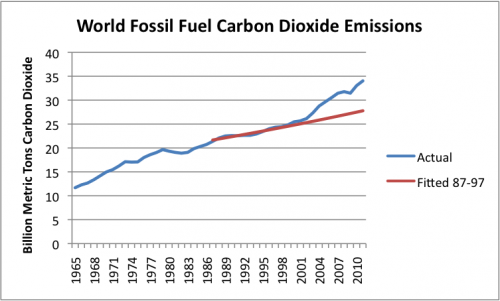
CO2 levels were only about 6% over pre-Industrial baselines at the time. They are now about 35% and increasing. The world is pumping more carbon dioxide into the atmosphere each year not only in increasing amounts but at an increasing rate. Astonishing, but true. From, as usual, the indispensable Gail Tverberg's blog, Our Finite World:
America's economists and national politicians, liberal and conservative alike, are arguing about ways to get the American consumer economy to grow again, to get people spending, to revive the American auto industry, to build the Keystone XL pipeline, to use Obama's "all of the above" energy policy including "clean coal," natural gas, oil, and, just to demonstrate his heart is in the right place, solar and wind power, too. We're so proud of ourselves for reducing the amount of oil we import as we go after all of the domestic "tight" supplies of oil and natural gas, hammer and tong, or dredging up enormous quantities of, well, the Canadian province of Alberta in the mining of tar sands (bitumen).
One of these days, however, we'll begin turning these trends around. We're not certain when, but we realize AGW is a problem and we can't put it off forever. Just as soon as the "recovery" is well under way and the unemployment rate is down we'll get right on it. It would be a bad idea right now, but (we admit a little nervously) the disappearance of the Arctic sea ice in the summer, and the accelerating melting of most of the world's glaciers (which poses a threat to the essential water supplies of billions of the world's people) - yeah, have to admit: those do seem more like late-stage developments of global heating than the preliminary signs. Those are the sorts of problems we should have been working to prevent 40 or 50 years ago, not using as a catalyst for planning action at some undetermined date in the remote future.
So I come back to the question: is it possible, given all this, that the world's elite academies of atmospheric science (MIT, Stanford, Scripps Oceanographic, Berkeley's alternative energy group at Lawrence Berkeley Lab), numerous European centers of study - that they actually know the die is cast? I've said this before, but the most chilling comment I have ever heard came from Inez Fung, a leading climate science at Lawrence Berkeley, at a U.S. - China conference on climate change back in 2006 at Wheeler Auditorium. Basically, Dr. Fung said that scientists who study climate change are "very, very worried." They are "terrified" by the implications of what they're learning.
Guy McPherson, who writes the Nature Bats Last blog (indexed on the right), recently had this to say about climate change:
Let’s ignore the models for a moment and consider only the results of a single briefing to the United Nations Conference of the Parties in Copenhagen (COP15).
Regulars in this space will recall COP15 as the climate-change meetings
thrown under the bus by the Obama administration. A footnote on that
long-forgotten briefing contains this statement:
“THE LONG-TERM SEA
LEVEL THAT CORRESPONDS TO CURRENT CO2 CONCENTRATION IS ABOUT 23 METERS
ABOVE TODAY’S LEVELS, AND THE TEMPERATURES WILL BE 6 DEGREES C OR MORE
HIGHER. THESE ESTIMATES ARE BASED ON REAL LONG TERM CLIMATE RECORDS, NOT
ON MODELS.”
In other words, Obama and others in his administration knew near-term
extinction of humans was already guaranteed. Even before the dire
feedbacks were reported by the scientific community, the Obama
administration abandoned climate change as a significant issue because
it knew we were done as early as 2009. Rather than shoulder the
unenviable task of truth-teller, Obama did as his imperial higher-ups
demanded: He lied about collapse, and he lied about climate change. And
he still does.
Kind of grabby, isn't it? If you're playing along at home, 6 degrees C or more temperature increases and 80 feet rises in sea level, along with all of the other effects, are Game Over scenarios.
Climate change deniers tend to use a "conspiracy theory" argument to support their contention that the "liberal" scientific community is overplaying climate change as an issue in order to attract grant and research money, since the "alarmist" take on AGW is the "popular" one with the liberal media and so on and so forth. (This is often the view among non-scientific global warming deniers. The "scientific" deniers they cite to support their viewpoint very rarely actually deny AGW; on the contrary, such scientists [Freeman Dyson, Richard Linzen and others] admit that the atmosphere is warming and that humans are a principal cause, but claim the negative effects are overstated or that there are countervailing positive effects. This group, by the way, no longer includes Richard Muller, a Big Time Denier at Berkeley. http://www.sfgate.com/science/article/UC-climate-change-skeptic-changes-views-3748148.php The Denier ranks are thinning; such apostacy! ).
Since I can theorize conspiratorially myself, I would posit a contrarian thesis: isn't it probable at this point that the real conspiracy of silence among the scientific community is manifested by the general absence of defeatism in their ranks? See what I mean? The argument that global warming is a made-up story by "liberal" scientists to attract funding is just getting kind of stupid at this point. However, a "defeatist" attitude, if it became the general consensus (openly, I mean) among their ranks would lead to the same problem of de-funding (and loss of stature), and would have the awfulpermanence and irreversibility of being based on the truth, not a Bible Belt canard.
Thus, it's better to talk about reducing carbon emissions 80% by 2050, or whatever. It's better to be Al Gore and Laurie David and urge the world "to act now" to "avert" the worst consequences of climate change. It's better if we all smile at each other and approve of each other's new Priuses - we're taking it seriously now!
This is what I'm trying to get at. We don't like thinking any other way than there has to be hope. But (the largest "But" I've ever written): Maybe there isn't any hope. Maybe it's way, way too late.
Ye shall know the Truth, and the Truth shall set you free. I hope more scientists break ranks and start laying it on the line if in fact we're past all "tipping points." There are decisions to be made. Should the present generation of child-bearing age who haven't had children procreate? Would they be introducing their offspring right into the middle of the absolutely worst consequences of climate change as they reach their main years of life?
The facts are the facts, ma'am. Carbon dioxide, methane, water vapor and the other greenhouse gases have a very long persistence in the atmosphere. They are building up. The thermal inertia of the ocean is beginning to yield up its latent heat to the atmosphere. The great methane (a gas with perhaps 100 times the potency of CO2 as a greenhouse gas) blooms from the softening Alaskan and Siberian tundras are expanding exponentially. China is opening a new coal-fired electrical plant every five days or so. Does it make any difference what I, as an individual, do at this point? Is an attempt at conservation or frugality simply a narcissistic expression of my projected self-importance (sort of like blogging)? If I want a 409 horsepower vintage GTO, want to slam a CD into the player and crank up Ronnie & the Daytonas, should I just go the hell ahead and do it?
Once upon a time in a blog post far, far away, I made a prediction which was stunning in both its scope and later accuracy. I wrote that the stock market would fall at least 35% from its 2007 Dow high of 14,000. I made this prediction long before the stock market started falling. As it turned out, the Dow "over-corrected" and kept heading south from 9,000 or so.
My prediction was based mostly on a single data point which I had gleaned from the writings of Kevin Phillips, in books he published in 2004 and 2005. Perusing this very intelligent man's writings, I was struck by the essential role which the Housing Bubble played in the maintenance of the "consumer economy" which gave the United States its illusion of prosperity. Mr. Phillips informed us that between about 2000 and 2005 about half the apparent "income" fueling the consumer jamboree was actually money derived from re-fi, house sales, and equity lines of credit (LOC); in other words, the house as piggy bank. Since it seemed to me that the Bubble could not be sustained (because it depended on financing tricks such as "teaser rates" and variable interest loans which would reset and bring reality crashing down on the borrowers), when it popped about half the money apparently in circulation would vanish. Since consumerism is 70% of the American economy, this implied a 35% drop in the economy. To the extent that the Dow reflected underlying economic fundamentals, it would show up there as a massive sell-off.
My ideas were not based on "conspiracy theories;" indeed, I was trying to find, to the limits of my ability, the underlying Reality of the U.S. economy. Meanwhile, the Grand Poo-Bahs of the intellectual elite in America were doing their best to confuse the issue. This effort was led by the New York Times and its Gaggle of Morons in the Op-Ed department. Maureen "I Hate Men" Dowd, Tom "Globalization" Friedman, Paul "Just Print Money & We'll Be Fine" Krugman, David "Even If In the Middle Is Over the Cliff, That's Where I Want to Be" Brooks, Gail "Here's Another Fatuous Column" Collins, and their ace staff of reporters who provided the echo chamber for the Bush Administration's sale of the Iraq War. As Bob Somerby, he of the felicitous turn of phrase and nice fall-away jumper, put it in The Daily Howler, "We are where we are because of these people." The moral of the story is straightforward: Just listen to varsity basketball players from the Mid-Peninsula League of the mid-1960's and you'll be fine.
Paul Krugman and his academic chum in the Princeton Economics Department, Ben Bernanke, failed to see the housing bubble until it was much too late. Since Kevin Phillips is not one of their Economic Mandarins, they thought he could be safely ignored, even if Phillips was much smarter than both of them put together. As the housing bubble burst, Ben Bernanke was assuring Congress in live testimony that it was not bursting. Few men have been so utterly wrong about something so fundamental in such a public way. His chagrin at his stupendously wrong call must have produced a determination in Bernanke that history could be reversed, as in a sci-fi movie, and he could re-engineer the housing bubble, the stock market bubble, and, for that matter, the Bubbles of Lawrence Welk and the Champagne Orchestra.
Cheered on by Krugman & the Morons, Bernanke began printing money and becoming a one-man enabler of profligate federal spending by buying up every Treasury bond he could find and scarfing up all of the country's shitty loans smooshed together in mortgage-backed securities (MBS). Goddammit, he muttered, I'll show them. Krugman provided the intellectual cover for this insanity by insisting that the ultra-low rates paid by the federal government had nothing to do with the Federal Reserve's role as the ultimate buyer of 75% of the Treasury issuance, or as establisher of the nation's short-term interest rates. Nothing to do with the Fed's position now as the world's single largest holder, by far, of Treasury bonds. And as for printing money, the U.S. economy is exactly like a baby-sitting co-op in Washington, D.C., so there's no problem. Go ahead: google "Krugman and baby-sitting co-op" and see what happens. I dare you.
Thus, Tom Friedman, perhaps the stupidest influential writer in the history of the Republic, gave us globalization, that Royal Road to Perdition on which we have traveled since about 1980. And Krugman has given us the The Return of the Bubbles. Bob Somerby: nuthin but net.
Fortunately, we have Gail Tverberg, writing at Our Finite World, to provide much needed doses of clarity and common sense. In one stunning post (her latest), entitled "Twelve Reasons Globalization Is A Huge Problem," she dispenses with the illusions of globalism and money-printing in two simple paragraphs:
At this point, high oil prices together with globalization have led to
huge US deficit spending since 2008. This has occurred partly because a
smaller portion of the population is working (and thus paying taxes),
and partly because US spending for unemployment benefits and stimulus
has risen. The result is a mismatch between government income and
spending (Figure 11, below)...
Thanks to the mismatch described in the last paragraph, the federal
deficit in recent years has been far greater than the balance of payment
deficit. As a result, some other source of funding for the additional
US debt has been needed, in addition to what is provided by the reserve
currency arrangement. The Federal Reserve has been using Quantitative Easing
to buy up federal debt since late 2008. This has provided a buyer for
additional debt and also keeps US interest rates low (hoping to attract
some investment back to the US, and keeping US debt payments
affordable). The current situation is unsustainable, however. Continued
overspending and printing money to pay debt is not a long-term solution
to huge imbalances among countries and lack of cheap oil–situations that
do not “go away” by themselves.
Krugman and Bernanke will never admit that a plain-spoken insurance actuary from the Midwest can run circles around them analytically, and so we'll continue crashing into walls in our Hall of Mirrors Economy, which will stagger along for a while yet (as long as the U.S. has the reserve currency and the rationale for buying our scrip in order to participate in the global oil market persists). But, as Gail says, "it's not a long-term solution." We don't have any long-term solutions. Take it from the two-guard. I've got a clear look at the hoop, and this one's money.
(I think the blog post works better if you're playing the Talking Heads while you read.)
I remind myself periodically that "Economy" was the first and longest chapter of Walden. Thoreau used the term in the broadest possible sense: the nature of the transaction between humans and Earth by which we sustain our survival.
Thoreau was a generalist; indeed, you might say he was the generalist's generalist. He did it all - farming, building, foraging and maintaining his vital heat under rudimentary conditions in Massachusetts around 1840. Modern Americans are not so lucky. As a rule we pick out some narrow specialty by which to earn a living, then use the money received to buy everything that Thoreau garnered through physical effort in a direct, hands-on way from the environment. Our existences are "mediated." In a way we're all like household pets: completely dependent on the functioning of our "masters" running huge agri-business, bringing oil from Saudi Arabia, drilling for natural gas deep under the floor of the Gulf of Mexico, then piping it thousands of miles to the furnaces in our basements.
In recent years something seems to have gone wrong with the "organic society," the gizmo made of wheels, springs, sprockets and gears that keeps us all warm and fed. For many people living in modern Western societies, including denizens of the United States, the system does not appear to be working. The "specialized" jobs just aren't there. When you get right down to it, that's the most important function of a modern economy. It has to give people something they can do through which they can earn money so they can buy all the stuff they need in order to maintain their vital heat, and, if that doesn't take up all their time (which it usually does), to create a little "margin" so they can enjoy the experience of being alive. (Thoreau reckoned it took him a few hours out of the 168 available weekly to do everything he needed to do to survive. I leave it to you to judge the wisdom of the modern bargain with Planet Earth.)
As I have noted numerous times in recent weeks, the actual number of jobs in the United States has been stuck at around 132 million for well over a decade. The employment rate of the working age population (ages 15 to 64) in the U.S. is down around 62%. Despite this, we're told that the U-3 unemployment rate is 7.9%. Such a percentage is generated by playing games with the numerator and denominator used to calculate it. In turn, the games are motivated by political considerations: the desire of the parties in power (always the same two) to look good. Common sense tells you that the population of the United States has not been stagnant for over a decade. It grows at a rate slightly over 1% per year, or three million, so while the number of jobs has remained fixed, at least 30 million people have moved into the job pool during the same decade, roughly speaking.
There appear to be three major theories about why America has hit the economic wall. The first is that a medium-sized investment bank, Lehman Brothers, failed in 2008, and this sent a "financial shock" through the system from which we just can't seem to recover. This is the favorite, I think, of the academic economists, who like historical perspectives and "cyclicality." I call this theory the "whistling past the graveyard" approach, since it implies this will all be over soon if we just wait it out.
The second theory concerns environmental/resource depletion factors, and in particular the high cost of the "master resource," petroleum, which is up around $100 per barrel. This high cost finds its way into virtually everything: food production (fertilizers, transporting food to market); driving cars to work; international shipping; pharmaceuticals; and airline travel. It represents a huge and hidden tax on everything we do.
The third theory is that America and other Western countries have simply "matured out" of their prime years of affluence. How many more baubles (expensive cars, McMansions, flat-screen TVs) and unnecessary services (massages, tanning sessions, party planning) are we really planning to buy to give meaning to our lives now that the Baby Boomers (the ones with all the money) have reached the age where all of these things are more annoying than sources of diversion and pleasure?
For my money, I would reject the first theory out of hand as a piece of academic gobbledegook, the kind of thing that professors with very little experience of the real world would argue about in the faculty lounge at Princeton. The second and third theories together, however, might be combined into one Grand Unified Theory of Economic Senescence which explains the crisis of the affluent society. And indeed, we've really got a helluva problem on our hands now.
Having severed the natural relationship between Homo sapiens and Earth, we are now dependent, as noted, on the economic gizmo in order to stay alive. The gizmo, however, is broken and cannot provide, under our capitalist system, the employment necessary for a very large chunk of the population to get by. The "demand side" liberal economists (Paul Krugman, Robert Reich, Dean Baker) claim that the problem is "inadequate demand" from the population for goods and services. Yet let me ask you this: can you think of a single thing, anything, that you need or would simply like to have that you could not find, right now, by driving a few minutes? What would that thing be? Food? An electronic device? A pair of jeans? A tank of gasoline? We have all those things in fantastic surplus. You're probably not producing them and neither am I. They're just there. Who is supplying them? Large monopolistic companies are providing them, that's who. Large monopolistic companies that are doing everything they can to eliminate the employment of actual people through robots and other automation, who seek to become more and more "efficient" by getting rid of people with their incessant need for 'health care" and benefits and "workers' rights."
The demand for the products and services of a few large monopolies (Wal-Mart, Costco, Home Depot, General Motors, Toyota, Standard Oil, BP, Shell, Dupont, Cargill, Monsanto, Archer Daniels Midland, Merck, U.S. Airways/American, United/Continental, Apple, Microsoft) is currently enough to keep them in business. They supply everything we need. The "demand" for the vanished services and products of the Bubble Economy which existed in various forms between about 1992 and 2007 is gone, along with the money. The Bubble years (dot.com, then the housing bubble) provided cash sources for sustaining all of the "discretionary" economic activities which proliferated when (a) cash existed for the commoners and (b) the cost of energy was cheap so that "discretionary cash" remained relatively plentiful.
Those conditions aren't here anymore. They aren't likely to return. They were conditions which existed once in a lifetime. Into the blue again, after the money's gone.
After all, it's traditional to say something, and when George W. Bush was delivering these things, they were always good for a laugh. It's hard to know how to react anymore when listening to the State of the Union Address. Nothing the President actually says has any importance; the commentators appear to concede that as a matter of course. It's all about "tone" and "drama" and "framing." Congress is under no obligation to enact anything the President recommends, of course, but the President has a Constitutional duty to show up from time to time and tell Congress what he thinks they ought to do:
"He shall from time to time give to Congress information of the State of
the Union and recommend to their Consideration such measures as he shall
judge necessary and expedient." Article 2, Section 3.
Like so many things in our made-for-TV American lives, we've naturally turned these events into a once-a-year, highly-stylized affair, sort of like the Oscars. There's even a Red Carpet: the President's entrance, with the choice positions near the aisle so you can press the Prez's flesh or maybe score a bro-hug or exploding fist bump. I realize that times change, and it's unlikely that George Washington would have been handing out exploding fist bumps. Nevertheless, you get the idea from the Constitution that the Framers were actually suggesting that the Executive coordinate with Congress in an effort to get things done, by periodically meeting with them (not necessarily once a year) and giving them his ideas. There's nothing in there about a "speech;" a speech is an empty ritual. Yet this is so typical of our unserious times. All surface, no substance. You can't televise work sessions effectively, so we get a speech in response to Article 2, Section 3.
I look upon these things as a prime-time Reality version of watching a historical reenactment. In the audience we have lots of ancient white men who have been in Congress forever, as sclerotic now as the institution they represent. None of them has had a new idea in the past quarter century, which is why they are content with this performance in which the President urges them to do a lot of things they'll never do, such as expanding the reach of the federal government ever farther. President Obama now wants Washington, D.C. to take over the country's nursery schools, I think I heard him say.
The actual "state" of the union would appear to encompass negative trends and developments over the last year; so I would think on a fair reading of the Constitution. However, a literal description of what's actually going on is not allowed, as contrary to the rules of modern politics. The campaign never stops. The President did not make any direct reference to the astonishing growth in the use of food stamps, for example. Nor did he say directly that the actual number of non-farm American jobs, about 132 million, is just about exactly what it was in January, 2000, 13 years ago. The labor participation rate (the percentage of working-age adults with employment) is stuck at about 62% and has been stuck there more or less forever.
This is my question: why not simply say so in the State of the Union? This graph is not from some Libertarian, bunker-dwelling, paranoid-schizophrenic website that rants and raves about the Bilderberg Group or the Protocols of the Elders of Zion. It's from the U.S. Department of Labor. Why not bring an easel up to the dais and plop this baby up there? Wouldn't that at least be the beginning of wisdom? The State of the Union: "You know what, folks: it just doesn't seem to work for most of us anymore. Dunno what's wrong, but the economy just doesn't seem to be happening. Maybe we should try doing something really, really different. That's what I'm Recommending as Necessary and Expedient."
Instead, we get this kind of thing about gasoline usage:
"We have doubled the distance our cars will go on a gallon of gas and the
amount of renewable energy we generate from sources like wind and
solar, with tens of thousands of good, American jobs to show for it. We
produce more natural gas than ever before, and nearly everyone’s energy
bill is lower because of it. And over the last four years, our emissions
of the dangerous carbon pollution that threatens our planet have
actually fallen."
Yeah, they've fallen because we're too broke to fill up and drive anywhere. Gail Tverberg's latest chart on the allocation of this "economizing" from her superb blog, Our Finite World:
About 7% of the savings in petroleum usage results from our cars getting "twice" the mileage; another 25% (almost four times as much) results from a decrease in VMT, vehicle miles traveled. Americans just aren't driving as much anymore, because they can't afford gasoline.
An even better idea: why doesn't the President just bring Gail Tverberg up on stage with him and hand her the pointer? I know, I know, Article 2, Section 3 says "He." But we're bigger than that, aren't we?
How about this? Instead of extolling the wonders of increased mileage in autos, and how Americans are determined to save the planet by going broke and leaving their cars in the garage, why don't we build some fricking railroads? How about suggesting that the able-bodied ride bikes? Or walk? You know: how about some ideas?
Writing about columnists at the New York Times (and I blame Bob Somerby and his superb line, "We are where we are because of these people" for the digression) is certainly amusing and diverting, but it's not really consistent with the Mission Statement of this blog. Although there is no such Mission Statement. If there were, however, the Mission would relate to the very title of the blog and to the analytical method and style of thinking of Henry David Thoreau, who anticipated most if not all of the problems that Industrial Civilization would face as the age of specialization advanced, as humans became cogs in an economic machine, and as we pushed the ecological limits of the world to the point of our own extinction. I mean, it's all right there in the pages of Walden.
What I find fascinating about my own years of life is that my span happened to overlap the transition from borderline sustainability of Homo sapiens as a primate (not Papal, the ape kind) to clear unsustainability. I mean, it was bound to happen sooner or later, given the technological proclivities and aptitudes of this ape form which is, as Craig Dilworth wrote, Too Smart for Our Own Good. If humans had the intelligence and rugged, natural "lifestyle" of chimpanzees or gorillas, for example, you might expect to find about 100 million of us roaming the surface of the Earth. We would, at this level, be pushing the limits of the environment's ability to sustain our numbers, and natural cycles (droughts, diseases) would periodically cause a die-off of our numbers down to some equilibrium point. Or we might, as the Norway rats did in the crowding experiment near the beginning of Professor Dilworth's book, utilize certain adaptive instincts to control our own numbers (some of which the Republican Right would find sacrilegious).
We're at this point because of the exponential growth function of population (as Paul Erlich tried to warn us) and the technological breakthroughs giving rise to what Dilworth calls the Vicious Circle Principle (VCP): faced with limits imposed by our burgeoning numbers, we devise breakthroughs (the Green Revolution in agriculture, for example) which allow us, temporarily, to go on multiplying and pushing the ecosphere to a new crisis point.
The last couple of books I've read on the subject of modern civilization at the crossroads were by Jeff Rubin, a Canadian economist: Why Your World Is About to Get A Whole Lot Smaller and The Big Flatline. Both are mainly about the limiting effects of expensive and increasingly scarce petroleum, a "master resource." Petroleum is intimately connected, for example, to the ongoing success of the Green Revolution. Oil shortages and a related problem, global warming, are both growth-limiting factors as we move forward. For example, despite a massive fall-off in petroleum usage in the United States over the last several years (a lot of it related to decreases in miles driven), the prices of West Texas Intermediate and Brent Crude oil remain stubbornly high, confounding the usual supply and demand analysis. The growth of GDP in the American economy (and elsewhere) is inextricably related to the price of petroleum on the world market. Simply put, the price is now too high to allow growth, and what appears to be "growth" since 2008 occurs only because the United States (a) borrows 40% of what the federal government spends, yet nonetheless (b) GDP includes government spending. This is a way of saying that the American economy, net of borrowing from the future, has been contracting for the last 5 years.
This is what I don't see reflected in the analysis of "New York Times" columnists. The presumption underlying the call for deficit spending, borrowing and printing money is that the American economy will revert to its "trend line." This is necessary to make all of these monetary games work out, of course, because debt is an exponential function (Dmitry Orlov does a wonderful job with a parable on this very subject in his post today at cluborlov.com). As we pile on debt with payable interest (even with the very low interest rates of the ZIRP environment), the accruing interest also generates interest and outruns any growth except growth which is no longer attainable, given resource and environmental constraints. Stated another way, economists such as Paul Krugman (regardless of his beneficial motives) are arguing that historical "cycles" will once again assert themselves despite the underlying changed circumstances which make such reversion to a previous trend line impossible.
Meanwhile, the "globalized economy" has engendered a race by the developing nations (such as Brazil, Russia, Indian and China) to attain the level of (former) affluence enjoyed in America. China, for example, has become the world's number one market for new automobiles. It is bringing on-line a new coal-fired electrical generating plant about every five days, and yet its energy use per capita is only about one-tenth of the American usage. I don't think their energy usage is ever going to match the American standard, because energy is a zero-sum game on a finite planet, and the climate implications will not allow it. Even James Inhofe would admit he was wrong about the "hoax" of global warming before we reached that point.
So what will we actually do? Probably react to events in a perpetual pattern of crisis-mode, is my guess. Promise technological fixes to bail us out one more time, in the spirit of the Vicious Circle Principle. I suppose we could sustain the world's population of 7 billion using solar and wind power (which are both forms of solar power) supplemented by the dregs of fossil fuels at levels safe (and available) to use. But the question the "deep ecologists" ask is: at what level could humans be sustained using only natural cycles? That's the missing part. Probably not at a level where Paul Krugman could appear on "This Week" every week and pronounce on the state of the "recovery." Another "thought experiment" we might pose for ourselves is this: gorillas essentially survive on solar power. Would planet Earth support 7 billion of them? You might say no, because they're not as smart as we are. Which takes you into a labyrinth you might call Vicious Circle Reasoning.
The video embedded below, along with the draft script and supporting links,
can be freely viewed on the Nature Bats Last Substack account. Comments are
ena...
With the recent closure of the Strait of Hormuz, many expect oil prices to
spike and stay high. . . . Looking at energy data going back to 1820, low
demand...
[Note: I am pushing this article live two days early because ZeroHedge
somehow managed to get a hold of it and post it before I did. Needless to
say, I do...