February 09, 2009

Trying to Avoid the Gorby Syndrome


I've thought for a long time that the closest historical parallel to the current economic and political perplexities in the U.S. is the situation the U.S.S.R. faced shortly before its demise in the early 1990's.  As the Soviet Union did, we have a central government that is in many ways an unimaginative gerontocracy (particularly in the Senate), and which is almost completely unresponsive to the everyday problems of American citizens.  The Soviet Union had its favored oligarchs and Party members, and we have our favored corporations and the revolving door between Washington D.C. and the influence peddlers who control national policy.  Our press is nominally free, but there is a Pravda-like conformity of the Big Media to certain agreed story lines for any given issue. Most recently, for example, we saw the nomination of Tom Daschle to run Health & Human Services go crashing down in flames; what we mostly heard about were his lapses in "optics;" he was a little too obvious about being a pampered lobbyist and didn't pay attention to the tax implications of riding around in a limo all the time on a fat cat's dime.  What was less discussed was that this was the guy Obama chose to revamp the creaking, disintegrating health care "system" in the United States, this former Senator who had grown enormously rich by working for Big Pharma and medical insurers since John Thune did him the favor of retiring him from the Senate.  Tom Daschle was going to put an end to the outrages which Michael Moore lacerated in "Sick-O?"  Look, I've got some shovel-ready infrastructure called the Brooklyn Bridge I'd like to sell you for $10 billion, financing available from the government.


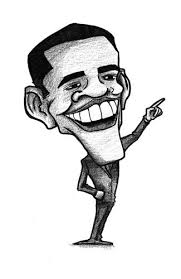
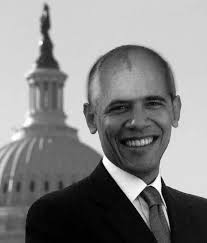
I don't think President O likes the analogy between his situation and Gorby's, but it may be apt just the same, so much so that Google Images even has a picture of Barry with a port wine birthmark ready to go, as above.  Mikhail became the West's favorite Commie of all time, to the point where you forgot, almost, that he was a Red.  Gorbymania swept the world, in fact. The Soviets had glasnost and perestroika, and Barack has "change."  "Change" was never quite defined in Obama's campaign, but we welcomed him, first and foremost, because whoever was elected would not be Bush anymore.  We weren't asking a lot of tough questions, especially since he was running against another Angry Old Man from the Senate with antiquated ideas, a shaky grasp on contemporary America and a sort of omni-directional aggressiveness. 

It wasn't Gorby's idea to break the Soviet Union apart.  Garry Kasparov, former chess genius and current Russian activist, never saw Gorbachev as anything more than another Central Committee apparatchik with charm and a new line of baloney.  It's not Barack Obama's intention to preside over the disintegration of the United States, either.  That's why his first instinct was to gather around him, like defensive ramparts, the stolid, time-tested Clinton Politburo to advise him on how to light a fire under the U.S.A.'s previous go-go consumer economy.

In the living quarters of the White House, Barack must have a dart board with Bush's face as the target because I can't imagine how dismal it must feel for Obama to spend the first three weeks of his glorious ascension dealing with something so soul-killing boring as this "stimulus" "package."  This is what it's come to, thanks to decades of neglect while the U.S.S.A. rotted from the inside out.  Obama is presiding over a loan app.  He needs to re-fi the United States, so first he has to pull together a business plan for his creditors in Beijing and Tokyo and Riyadh to pore over.  ("$27 billion for highways?  Too much. Knock that down.") The bowdlerized, diluted, universally-viewed-as-useless piece of dreck the Ancient Mariners in the Senate came up with will (a) increase the national debt enormously while (b) maybe delaying the inevitable for a little while.

I read in Paul Krugman today that without the stimulus bill the U.S. GDP would contract about $2.9 trillion over the next three years, to which one might say, first: and your point is?  That is less than $1 trillion per year, or about 1/15th of the present American GDP, which is 25% of the world's GDP.  So about 6.67% contraction per year.  Not to be flippant or hard-hearted about this, but we can't abide that?  We don't have the internal resources, the innovative spirit and adaptability, to figure out how to arrange things differently so we can have an envirnomentally-sustainable economy?  We have to go back to that ruinous "growth" economy because there are no other options, or we're too impatient to figure out what they are? We prefer the reckless alternative of going broke trying to defib the corpse of the American consumer economy?

That stimulus bill just looks awful.  Note how they starve, as always, mass transit and my own hobby horse, inter-city high speed rail.  We never do anything fun.  Government spending aimed at certain high-tech innovations (such as solar and wind energy, desalination, and the aforementioned choo-choo) would get us somewhere and create a lot of jobs.  But not business tax cuts.  Not more freeways and offramps.

Congress just can't do it, anymore than the Politburo or the Presidium or the Central Committe could do it, past a certain point of collapse.  Congress is locked into certain failure modes it cannot escape.  Maybe some people are born Gorbymaniacs (that would be Mikhail himself), others achieve Gorbymania and some have Gorbymania thrust upon them.  I think O may fall into this last category.

February 07, 2009

American Economy and Other Entropic Processes


Graphically illustrated here, we have the history of the top marginal tax rate in the United States of America from the inception of the income tax in 1913, brought to you by the Sixteenth Amendment, through 2003, when the top rate was reduced from the Clinton era rate of 39.6% to the present 35%.  

It's all there, if you look closely.  As with any new toy, the income tax was taken out for a spin by the central government as soon as the law was enacted, the top rate zooming to nearly 80%. The rate was just as precipitously reduced at the outset of the Roaring Twenties to 25%, under the leadership of three consecutiItalicve Republican presidents, Harding, Coolidge and Hoover. These three,  in cahoots with Congress, were the original "supply siders," believing that low taxes on the rich would foster growth and prosperity through trickle down mechanisms.  And so it did, for awhile, and America's economic fortunes improved along with the rest of the world following the catastrophic destruction of World War I.  And also, as the low tax rates were maintained and the financial sector was allowed to run wild with unlimited margins and unsupervised stock markets, the pro-fatcat regime led to the kind of unbalanced wealth distribution not seen again until...now.   Sic semper gloria mundi.

It all crashed in 1929.  Roosevelt, the original creator of the Mother of All Stimulus Packages, the New Deal, had one enormous advantage, visible in the chart above, not available (in any practical sense) to President O.  He could draw upon the accumulated wealth of the country, and that of the plutocrats still earning big money, through the income tax, pushing the top marginal rate from 25% to 80% in his first two terms in office. As World War II reached America's shores, the populace tolerated a confiscatory top rate of over 90%; you see, in those days Americans thought that if the country was at war, it must be something pretty important.  Something worth sacrificing and paying for.

Such quaint ideas.  So World War Twoish. Under George W. Bush, no sacrifice whatsoever was asked of America's disaffected, indifferent masses, the ignorant armies watching TiVo by night. The tax burden was lightened during the Afghanistan and Iraq wars even though these conflicts were ruinously expensive.  But W, after all, was simply a child of his times.  That's how we do things now.  America is not really a nation anymore; it's a market, a demographic, a place to network and make your money,  keeping as much as you can.

That's why the modern "Recovery Act" cuts taxes as part of its program of spending $1 trillion to stimulate the economy.  No one is suggesting that the top rate of 35%, applicable to incomes over $300,000, be increased at all.  No one is suggesting that the FICA tax apply to incomes over its present maximum of $100,000.  Why isn't Congress suggesting something so obvious, so fundamental, particularly with Roosevelt's example to light the way?

Because Congress works for the people whose taxes would be increased.  See how obvious all this becomes with a few simple charts and graphs?  Congress members now tell us, Democrats & Republicans alike, that raising taxes damages economic growth -- this is not something the government does during a downturn.  Huh?  What exactly then was Roosevelt doing in the 1930's?  Suppose we raised the top tax rate to 50% for all incomes over $1 million per year. It would raise a lot of money; is anyone seriously suggesting that the increase of 15% would cause those big earners to stop making money?  Lebron James and A-Rod would hang it up?  Those Fortune 500 CEO's whose incomes average $400 million per year - not worth it anymore?

Yet it's politically unthinkable, isn't it?  So here's something else that is unthinkable: that this "stimulus" plan is going to work.  It can't.  It violates some fundamental thermodynamic rule of money.  If the citizens of this country are not willing to pull together collectively and put each other to work by paying for the government projects contemplated by the Recovery Act, then it's hopeless.  We have to do our own internal redistribution of income and wealth in order for the country to avert catastrophe.  If we are not willing to do that, then the plan will fail.  You cannot borrow your way out of a problem caused in the first instance by excessive borrowing and income inequality.  And beyond that, do we honestly believe that all the foreign creditors who will be asked to finance this enormous outlay at essentially zero return on their investment will not notice that we're not paying for any of it?  That we're reducing our own burdens as our "contribution?"

I'm afraid this one takes the idea of American Exceptionalism way past the breaking point. This is a looming disaster.  We're the ones we've been waiting for?  Will there be another bus along in a minute?


February 06, 2009

Marco Polo In the Court of Congress


That was some riveting theater the other day before the House Subcommittee on SomethingorOther when Harry Markopolos, the avenging angel of the Re-Regulation Forces, appeared to describe to the Committee his futile efforts to get the New York office of the SEC to do something about Bernard Madoff's massive fraud scheme.  For fans of Schadenfreude, it was like Weinachten in February.


The comfy bureaucrats at the SEC had it made during the Bush years, of course, reveling in their sinecures as friends of the High and Mighty. The whole idea was to leave the securities industry alone and let the "invisible hand" of the market work its magic. You might say that certain miscreants took advantage of this libertine situation, and no one more than Bernie Madoff.  Harry Markopolos was himself in the investment game, a self-described expert on derivatives with long experience on Wall Street, and he simply refused to believe that Madoff's "split-strike" strategy for returning about 12% to his investors, in good years and bad, was humanly possible.  So, using a "Mosaic" technique, he spent years investigating Madoff with the assistance of his "team."  He summed it all up in a long letter dated November, 2005, to the SEC, stating bluntly that it was his conclusion that it was "most likely" that Madoff was running the biggest Ponzi scheme in world history.

Markopolos never met Madoff, never interviewed anyone who worked in his organization.  In some ways, what Markopolos did in that letter (which you can find in pdf by Googling "Markopolos letter to SEC") is reminiscent of the work of the legendary Polish cryptologist Marian Rejewski, who deduced the internal wiring and basic structure of the Nazi Enigma machine without ever seeing one, by using permutational mathematical analysis of German encrypted messages.  Truly one of the astounding feats of mental deduction of all time.  I wouldn't put Marko Polo's work in that category, but it's pretty good.  He figured out that (a) Madoff was running a Ponzi scheme, (b) that the amount involved was somewhere between $20 and $50 billion, and (c) that Madoff had been a crook since at least 1991.  All from studying the "performance" of the Madoff fund, Madoff's relationship with the places where he got his money, and Madoff's obsession with secrecy.  A virtuoso demonstration of logical analysis.

Watching Markopolos testify, you couldn't help but think that he probably has a screw loose somewhere.  For one thing, both testifying and in his Nov. 2005 letter, Harry is a little, how to say it, egotistical.  A tendency toward the grandiose, describing himself (with his business degree from Boston College) as one of the few people in the world with the mathematical background to understand derivatives well enough to do the analysis he did. Actually, I read his letter, and on the basis of my own very limited experience with securities litigation, I was able to follow it pretty easily.  You just need to know a few basic concepts, such as what an option is, what a put versus a call is, what "out-of-the-money" means as applied to options, and a few other things, and you've got the basic hedging strategy that Madoff claimed to be running. You don't really need to have a PhD in mathematics as so many of those brainiacs who devised the algorithms for Long Term Capital Management possessed, who might even go a little deeper in math than Harry Markopolos.

That, I think, was sort of the problem with Harry for the SEC.  In addition to his borderline megalomaniac tendencies, Marko kind of presented himself as a Wall Street Maxwell Smart, offering to go undercover, to disguise himself, and warning of the grisly fate that awaited him if his cover was blown.  I don't doubt that physical danger was a serious threat when you're dealing with that much money and with a crook as bent as Bernie Madoff.  But if Harry Markopolos presented about 30 "red flags" in his letter re: Madoff, then the SEC probably found as many red flags about Harry in Harry's letter to them.  Which is what the SEC really wanted to find, because the last thing they wanted to do was to take on Bernie Madoff.

So natually, just as Harry predicted, the SEC sided with Madoff, because Bernie was a Wall Street maven, a Mensch, a power player who was in on the ground floor of the establishment of NASDAQ.  The New York office decided that Markopolos was a jealous whistleblowhard (to coin my own term), maybe a little nuts, and not someone they should allow to tell them what to do.

Man, did they pay for that dismissive attitude.  What's worth YouTubing and playing is Rep. Gary Ackerman's smackdown of the entire top brass (minus the weasly Christopher Cox) of the SEC on national TV.  This New York Democrat absolutely tore the counsel staff a new one in unsparing, scathing terms, telling them they couldn't find their ass with both hands in a room with the lights on. They're all going to get canned, they know that, and anyway they're all mostly holdovers from the Bush Roaring Aughts Era.

The problem for the SEC is that Harry Markopolos, one citizen working with an ad hoc "team," figured the whole thing out right down to the ground.  He was right about everything, astonishingly so, and he was right over three years ago.  How much additional money was lost because the SEC sat on their hands?  Billions and billions and billions.  Markopolos predicted the cascading failures in other hedge funds as the High Net Worths all scrambled to liquidate and cover their Madoff losses, the collapse of the "feeder funds," of private banks in Europe which were heavy into Madoff. Harry saw it all coming, laid it all out for the SEC, and the SEC did nothing.  And then had to sit silently and listen as Harry Markopolos described, in excruciating detail, their incompetence, their corruption and their utter worthlessness.

One of those days where it just feels good to be alive.  Thanks, Marko Polo.

February 05, 2009

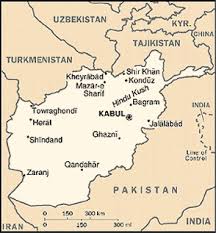
Why Are We Still in Afghanistan?


One thing you learn by writing down your thoughts on a semi-regular basis, as Ralph Waldo suggested might happen in "Self Reliance," is that you find what appears to you as the apparent lack of logical answers to questions about public matters reflects the real absence of logical answers to those same questions.  Which is to say, if you trust your own instincts about matters of poltiical concern, you often find that what parades as "conventional wisdom" is simply the repeated formulations of "opinion makers" who want to sound very Serious and who wish to speak the language of other Serious People who shape public debate.


I think this tendency grew exponentially worse during the Bush years because The Decider ushered in an agenda of Mass Stupidity that distorted rational discourse beyond all recognition.  The war in Afghanistan is an excellent, perhaps the prime, example of this destructive effect.  Afghanistan is widely regarded as the "good war," the one we definitely had to fight after the terrorist attacks of 9/11.  No dissent from this view was allowed, on the Right (certainly) or even on America's "Left."  Everyone from James Inhofe (Troglodyte,-OK) to Al Franken agreed that Afghanistan must be invaded.  An opinion in favor of invading Afghanistan was the one true sign of an American Patriot.  No ifs, ands, buts, cavils or misgivings allowed.  It had to be done.

"It" is still going on.  It's now 2009 and the invasion began in the fall of 2001.  This war has now been going on (a) twice as long as our involvement in World War II and (b) somewhat longer than the main part of the Vietnam War.  The theory was that Afghanistan provided a "breeding ground" for terrorists, or a "swamp" that must be drained, a reference, I guess, to anti-malarial measures taken in tropical countries.  Osama, Zayman, Atef, all the bad guys were there. Plus, the Taliban were mean to women, unlike, say, the Saudis.

The 19 guys who flew planes into the World Trade Center and the Pentagon were not from Afghanistan.  Had they ever been to Afghanistan?  I would like to see the federal government prove it with testimony other than that of the Gurgling Confessor, Khallid Sheikh Mohammed, who is quoted extensively, not to say exclusively, in the Report of the 9-11 Commission as the source of this evidence.  Now that we know what we know about torture during the Bush years, is there any reason to rely definitively on this testimony?

What we do know is that the 19 Arabs were Egyptian, Saudi, Lebanese, UAE and Yemeni.  The main plotters formed their cell in Hamburg, Germany, as members of the same mosque, and did their flight training in the United States, as well as most of their logistical planning.  Hey, don't take my word for it; read the Commission Report.

A whole war against Afghanistan seems pretty dumb in such a context, but then George W. Bush was a very dumb guy.  The urge to do something about 9/11 was definitely on his side, however, no matter how dumb. So we invaded the hated Taliban, who may have provided sanctuary to a guy who may have met with some of the guys who actually attacked us in September, 2001, and we came with the full force of the U.S. military, and it was a sterling victory until it fell completely apart.

However, then the Afghanistan War caught its big break.  Bush outdid his own stupidity by launching another war against another irrelevant country, this time Iraq.  Now the war in Afghanistan acquired the cachet of being the smart war that "Liberals" could favor, that should have been "finished," and the comparison, no matter how inane, allowed Democrats to appear "tough" and "belligerent" while at the same time exhibiting superior judgment and leadership.  It also allowed Barack Obama to promise a "surge" in Afghanistan once he was elected, the dumb war he favored over the war in Iraq which he had famously called "dumb" when Bush was running it.

It's as if a guy starts a grease fire in his kitchen and then while casually and desultorily fighting it with an extinguisher, decides to start another fire in his bedroom.  The kitchen becomes the "smart fire" which must be put out even though the dumb fire in the bedroom will also burn his house down if it keeps burning.  "It was dumb to start that fire in the bedroom while I was still dealing with that grease fire," Joe, the distraught homeowner said to reporters in front of the charred ruins of his house.  "I thought Joe was dumb to start that bedroom fire.  I thought the grease fire in the kitchen was the smart fire, the one I would have fought," said Dirk, his neighbor, who's a pain in the ass.

The theory in both Afghanistan and Iraq is that there is some magical, unknown point, if we just stay long enough (forever, even), where both of these Muslim countries, thoroughly unpracticed in the tradition of Western democracy, will become stable, enduring, reliable strongholds of liberty.  This is completely crazy.  Once we leave both places, absolutely anything may happen in our absence.  It is likely that both Afghanistan and Iraq will degenerate along tribal lines or devolve into dictatorships or military juntas, and go through the cyclical periods of unstable democracy and despotism found in modern Pakistan or Iran, just as two, highly relevant examples.

Meanwhile, bin Laden and Zawahiri are still at large.  They could still get messages to another group of 20 Arabs, I suppose, and come up with something else.  What do these wars have to do with that?  Were those jungle gyms actually essential to hijacking American airplanes?
February 04, 2009

Last Train for the Coast


I heard Don McLean's full-length version of "American Pie" on the oldies station yesterday and realized that exactly 50 years had passed since a small plane carrying Buddy Holly, Ritchie Valens and The Big Bopper crashed in a storm in Iowa.  February 3, 1959, the day the music died.  The three men Don McLean admired most Went West on that fateful day.  Buddy Holly would have appreciated the subtle irony of McLean's lyrics: that'll be the day that this'll be the day that I die.


The imagery of the song conveys a loss of innocence in the decade that passed between the plane crash and McLean's great breakout hit.  Asked what all the references were, what the song meant, Don just said the song meant that "I'll never have to work again."  McLean was born a year before I was, and I know what he was writing about.  It's all there, James Dean, Bob Dylan, The Beatles, The Rolling Stones, the last Candlestick concert, Altamont, Janis Joplin ("I saw a girl who sang the blues, and I asked her for some happy news, but she just smiled and turned away...").  All the formative icons of my own youth.  We had that one somnolent decade, the Fifties, the era one Beat called "The Air Conditioned Nightmare," and then America started happening at warp speed. Race riots, Vietnam, four dead in Ohio, the breakdown in trust between rulers and ruled.

I kind of felt for James Howard Kunstler, the Clusterf**k Man linked to the right, as I read through his latest paean to a Gone America a couple of days ago.  He always writes as if he's trying to summon some idealized future into existence, but I think what he's doing (as another almost exact contemporary of mine) is trying to invoke a vanished past.  He wrote about his recent trip to Montgomery, Alabama and the "asteroid belt" of chain stores, strip malls, "muffler shops," fast food joints.  He was even a little hard on the old town center around the Capitol, depicted in my own photo of Dexter Avenue up above, taken from the street in front of Dr. King's Baptist Church.  It's not all that bad around the state house, I didn't think, but I do know what he means about the asteroid belt and the faded green and ocher color of the land around Montgomery. It was approaching Montgomery from the east on old U.S. 80 five years ago that I first realized that my sketchy recollections of the Old South had no counterpart in contemporary reality.

I owe to Mr. Kunstler the data bit that about 70% of all manmade structures around us in America were built (or thrown up) since about 1950, so the America that Buddy, Ritchie and the Bopper said goodbye to a long time ago has been fundamentally altered in the decades since.  Not just the music and the simplicity, but the basic look of the place is very different.  I grew up in a subdivision built right at the beginning of the post-War boom, so in some ways I never knew anything else.  I understand what the Celebrated Mr. K is writing (and grousing) about, completely, this uglified look of the American Crapscape. Still, I don't think it does much good to live in a fugue of constant revulsion, to exist in an emotional war with your senses as you drive around America and take it all in.  James is just one of those exquisitely aware souls who reacts (violently, almost) to the depredations of modernity, to the abolition of beauty. For better or worse (and it's decidedly worse), this is what we came up with when we decided to "develop" the suburban areas of America. It's hideous. Almost all of it is an unrelieved horror, punctuated only by the enclaves of the wealthy, where Nature is allowed a tenuous continuity. (You see, it's not that we don't know what's pleasing to the senses; we just don't think it's important for anyone who can't afford it.)  

You have to take from that what you can.  The aesthetics are intellectual, that's for sure.  You can glean something of an understanding about how humans relate to one another, the kinds of habitations they will build for one another to live in (to wit: a maximized return on investment achieved by building dwellings at the lowest possible level of acceptability), and how we relate to Nature, that is, by completely obliterating all sign of it.  That is something to know, however.  Something you pick up during your journey of life.  As Thoreau said, a single Truth is enough for the seeker.

Not strange, then, that we look always for that transcendent moment of grace. Even when February makes you shiver, you're glad for the great ones who made the journey with you, and made it all a little easier to take.

February 03, 2009

The Quiet Presidency of Barack Obama


I have to admit that I find President O's governance of the country a little boring.  I wonder if he does.  I imagine the early thrill of all the job perks is beginning to ebb a little.  Has he been to Camp David yet?  He doesn't have a ranch, or a seaside compound to escape to, the way the Republican presidents did.  No Drama Obama, his campaign staff called him.  He just works hard, isn't given to histrionics or nervous fits or Freudian acting-out, like his predecessor.


A big problem is that the main subject matter of his presidency is intensely boring.  How much can we talk about this stimulus thing without our eyes glazing over?  It's dull.  It's a big, messy, incomprehensible hodge-podge of farm subsidies, financial aid to states, FICA tax reductions, medical insurance extensions, blah blah blah.  I tried reading some of the Senate version.  It's over 750 pages long.  I think that's one of the ways the solons protect themselves. No one, not even the legislators themselves, could be forced at gunpoint to read one of those things all the way through.  No one at a major newspaper is ever going to read it.  A cable news anchor would never waste his time reading so much as the preamble.  So no one can tell, in advance, if it's going to work because no one is ever going to have a handle on the thing.  It's a simultaneous equation with 750 unknown variables.  It's hopeless.

So all O can do is go from conference to conference and talk about the "urgent need" for this perplexing enactment, that is, when he's not deflecting questions about why his latest Cabinet appointee failed to pay $140,000 in taxes.  That's what his presidency has been about so far, Cabinet heads who amend their tax returns and this gargantuan spending bill.  The glamorous stuff all has to wait, I guess, the brilliant moments when Hamas and the Likud dance the hora, America signs the successor protocol to Kyoto, Guantanamo closes, the solar and wind electricity grid is up and running, everything is all green all the time.

That is, after we raise $4 trillion to recapitalize the banks, get all the troops out of Iraq and Afghanistan, and find the bottom of the real estate market and the top of the unemployment rate.  Being realistic about things, just the clean-up operations are going to consume Obama's first four years.  This is what happens when a huge, powerful country with many negative trendlines, many financial and economic and environmental disasters waiting to happen, decides to hire someone as President, back in 2000, who is completely incompetent, and whose every initiative tends to exacerbate the degenerative processes underway.  And then that country doubles down on its bad choice by rehiring the clown in 2004 so he can finish us off.

No doubt a person as comprehensively perspicacious as the present incumbent is quite aware now of the true depths of the disaster Bush has left him.  It is such a clusterf**k that there is simply no time for politics.  The blogsters and the conspiracy theorists and the Alexander Cockburn and Ralph Nader types who absolutely must see that all parties and all politicians are essentially alike must read into every little Obama nuance confirmatory proof of their underlying thesis.  In fact (and despite my own indulgences in this tendency), there are major differences between the Democrats, the party of the Enlightenment, secularism, science and due process, and the Republicans, the party of theocracy, obscurantism, intolerance and a priori reasoning.  The Republican President and that awful Republican Congress between 2001 and 2007 absolutely, totally, and ruinously ran this country into a ditch from which it may not be able to extricate itself.  

Obama simply could not be more different from Bush, in every way imaginable.
It's the difference between a person who thinks and a person who spastically twitches instead of thinking.  It's the difference between a smart and deliberative person who uses his mind in a systematic way to comprehend complex problems and a brain-damaged clown who lurches from one stupid move to the next.  I only wish I could hear what Barack actually says, in private to his advisors or to Michelle at the end of another interminable day, about the true depth of the piles of steaming crap left by Bush for O to handle.  And I think I know what that "note" was that Bush left for Obama in the Oval Office:  "You're screwed. Hehhehheh."

Little by little President Obama is leaking out the horrible news to us.  Such as that $4 trillion number to stabilize the American banking system.  To put things in perspective, when America was in comparatively better shape, say in 2004, we were nonetheless borrowing about 65% of all money borrowed by any country in the world.  That's how much we ask the world to subsidize our irresponsibility, so we can play GloboCop.  If half a trillion represented 65% of all borrowing, how much will $2 trillion, this year's likely deficit, represent?

It doesn't even compute. Prez O is in unchartered territory, a potentially disastrous problem where the solution may not be possible.  Well, here's a direction we might look:  

"Militarization does not help resolve the problem but only pushes it back, taking from the economy vast financial and material resources that could be used much better elsewhere. I'm confident that reasonable constraints on military spending along with the strengthening of global security will ultimately yield economic dividends."

I think the guy who said that might be on to something.  It was Vladimir Putin of Russia, a few days ago at Davos.  Maybe he's sincere.  Maybe what he's been looking for, like so many other people in the world, is someone leading the United States who doesn't spend his time peering into souls or hearing voices telling him to "attack!" but just wants to have an intelligent conversation about real solutions.  When things are this bad, maybe even something that crazy could work.

January 31, 2009

Aspiriational Apocaphilia


A term I first encountered while reading a writer named R.J. Eskow, who weighs in periodically on various political blogs. I think the terms refers to the state of ecstasy some writers appear to achieve while composing jeremiads to the imminent downfall of Western Civilization.  Eskow cites as a prime example James Howard Kunstler, whose "Clusterf**k Nation" is linked right here on this page.  Admittedly, there is something orgiastic about Mr. Kunstler's weekly downers, in which he excoriates the United States for being fat, tattooed and stupid, calling America a "clown nation" that cannot do anything right.  He is also absolute in his conviction that we're incapable of any sort of technological fix for the problem; to make certain there's no hope, he relies upon his deus ex machina, Peak Oil.  So even though electric cars are actually right around the corner, and entire countries like Israel are figuring out how to run a national fleet of electric cars on an electrical grid powered by wind and solar, he'll have none of it.  It cannot work, he says, with religious conviction. It's so obvious that he doesn't even bother to explain why it cannot work.


I think he's wrong about that, way wrong in the way that those who are confident about foretelling the future are usually wrong.  The imagination of a single person is unequal to the task of encompassing the unfathomable permutations of scientific discovery in advance.  There is much too much interplay among ideas, synergies of discovery, unanticipated brilliance, breakthroughs, genius - indeed, it is quite arrogant to discount it all on the basis of an emotional predisposition to be pessimistic. Hamlet was right when he told Horatio that there were more things in Heaven and Earth than dreamt of in his philosophy.

What's causing the collapse of the U.S. economy right now is simpler than Peak Oil or Conspiracies among the Illuminati.  What we're seeing is that an entire country, acting collectively, has behaved in ways depressingly similar to a procrastinating, careless individual.  Mr. Kunstler, for example, derides the USA for not doing "productive" things, but he himself is a novelist and a writer of doomsday books.  Knocking the U.S. is a gig, in other words, but it is not a "productive activity" of the kind he urges on the rest of us Americans.  Neither is blogging or the Blogosphere in general.  These are more symptomatic of what's wrong than they are "productive activity."

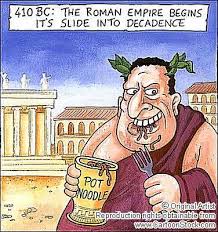
The United States, as a nation, succumbed to the temptations of great affluence and power.  We have numerous historical antecedents for this behavior, most particularly the Roman Empire.  Take, as one simple point of entry, the current "crisis" involving Social Security.  Congress, to its initial credit, saw this one coming back in the early Eighties and upped the FICA tax to create a surplus.  Congress then proceeded to spend this surplus; one can measure the amount of surplus spent by reference to the multi-trillion dollar portion of the national debt owed to internal "trust funds."  Among other things, the surplus was spent on defense and security.  Seminal economics work, such as that by David Aschauer of the same period (1989), demonstrated that military spending by the government is the least productive form of "infrastructure" investment, and that growing economies, such as China, instead invested in schools, mass transportation, improving the electrical grid and water supply, etc., instead of an army and weaponry.  It's a commonplace observation that the U.S., spends as much as the rest of the world combined on defense, so it is engaged either in (a) complete irrationality or (b) complete corruption by MIC lobbyist influence. Either way,  this form of waste has crippled all other social spending and has foreclosed our ability to have a humane medical system for the citizenry.

Similarly, it was obvious that doing nothing to protect Americans from the huge numbers of relatively high-paying manufacturing jobs sent overseas, and even providing tax incentives for multi-nationals to do so, meant that the USA would devolve into a "consumer society" dependent on imports with our own productive capacity hollowed out.  This "globalization" mania, urged on by President Clinton and his advisor team of Casino Capitalists (Rubin, Summers, etc.), and cheerleaded by "influential" writers like Tom Friedman, left us with no alternative but to ship all our money overseas and hope foreigners would lend it back to us.  

We did nothing about the energy problem, of course, despite the clear warnings from President Carter in the late Seventies.  We allowed dependence on foreign oil to hit the 70% level.  But with or without the added insult of Peak Oil, these other trends have come home to roost.  We invested in what is really the least productive form of capital "hardware," vast subdivisions of new houses.  Houses are good for living in, but they are not places where a country makes any money or gets things done except when they are (a) being built or (b) being bought and sold, and then only at the margins.

Analyses of how we got here tend toward the excessively Byzantine.  It's not really all that complicated.  No one was minding the store.  No one was planning.  It was plain as day what was coming, and many people described it in highly accurate detail.  Nonproductive societies cannot create wealth out of thin air by financial games, not forever anyway, and certainly not by taking on excessive debt.  

America is actually one of those charmed places on Earth which probably could be almost totally self-sufficient with enlightened leadership. We could grow all of our own food and we could meet all of our energy needs by harnessing sun and wind, bridging our way there with the use of natural gas, coal with sequestrated carbon emissions, cellulosic ethanol, nuclear energy  and geothermal.  There would be plenty of work and it would be economically sustainable.

Instead we got what we got.  We're broke, dependent on the kindness of foreigners, and we're entering a prolonged period of completely unnecessary shortages and privation.  But I don't feel "philiac" about it all; it's a damn shame.

January 29, 2009

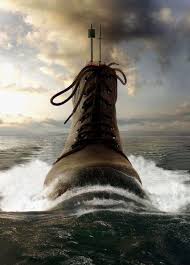
Will Das Boot Rise from the Bottom?


In a great scene from "Das Boot," the German movie about the horrors of submarining in World War II that was perhaps the most effective anti-war movie ever made, the captain and crew are trapped on the bottom of the Mediterranean near the Straits of Gibraltar.  The submarine has been damaged by Allied fire, and the only chance for survival rests on the ability of the strange, selpulchral, hollow-eyed chief engineer who is attempting to jerry-rig enough battery power to blow the ballast tanks so Das Boot will rise.  The crew sits quietly waiting while he works; the ship is running low on oxygen, the tension is overpowering, and they all know they have one chance.  If the power surge fails, they're doomed to suffocate on the bottom of the sea (the fate, in fact, of most German submariners during the war).


While we go about our business here in the Heimatland, Captain Obama and his chief financial engineers are rigging up a similarly desperate fix.  If you look at the figures for growth in the national debt for the period ending September 30, 2008, you will note that the number increased by $1 trillion, the largest annual leap (by about a factor of 2) in U.S. history.  As we know, however, we ain't seen nothin' yet.  All the subsequent bailouts and the impending recovery jolt of $800 billion are surely going to result in a measured increase this September in the two to three trillion dollar range.  It goes without saying the United States does not have this kind of cash lying around.

So it must be borrowed.  Sales of Treasury bills have been brisk over the last year, even at highly depressed interest rates, because there's nowhere else for money to go.  Money pouring out of the equities market has been redirected into these zero-growth instruments on the theory at least they're "safe."  But supposing that the deficit really does go to $2 trillion or above: with the money already squeezed out of the stock market, are there enough sovereign wealth funds and individual investors around to buy up this much debt?

The foreign creditors, such as central banks in Saudi Arabia, the Gulf States, Japan and China, have reliably recylced trade surplus dollars on the order of $700 billion per year.  While this is nice as a historical fact, there are two problems going forward.  First, the USA is not such a reliable trading partner anymore because the American consumer is cash-strapped.  That $700 B figure is probably shrinking as we virtually speak.  The second is that a donation on the order of $700 billion, even if possible, is not nearly enough.

The neat trick employed by the fulminating Congresspeople at hearings and Mike-Stand Moments is to talk angrily about the "taxpayers" and how they're being robbed by the necessity of bailing out all the banksters.  It's true that the "taxpayers" have been asked historically to pay interest on all this money borrowed, but we're obviously losing contact with any ability ever to pay back the principal amount.  The national debt is now approaching one year's total GDP for the United States.  We're not going to shake that money out of our sleeve. All the taxpayers can do is provide the cash flow on which more massive borrowing can be based.

So what happens if the funding sources simply aren't there?  If the money can't be borrowed because there just aren't enough dollars lying around the world in the hands of people willing to buy Treasury notes? What then?  I think I can say that I have never heard a politician of either party, or the Chairman of the Federal Reserve, or the Treasury Secretary, or even Paul Krugman, address this question directly (of course, in a recent column Prof. Krugman opined that budget deficits weren't that "big a deal, because it's basically money we owe ourselves," a head-scratcher if I ever heard one. I think Wen Jiabao would answer, "Speak for yourself, Caucasian.")

President O, who would really like to be "transparent" (I do believe that), probably wrestles with this conundrum every night. The limited intellect of his predecessor shielded Bush from similar anguish.  Should Obama lay it out, that maybe there just isn't enough money to make this thing work, that we can "appropriate" all we want, but if you ain't got it, you ain't got it? 

I think it would be good if someone just laid it out for once.  At least describe the risk of insolvency so the populace would know where we're at.  The captain of Das Boot told his men ahead of time that they had one shot at clearing the ballast tanks.  They knew what they were up against.  So that when the sub began to lift up off the bottom, ever so slowly at first, they knew what they had escaped.

January 28, 2009

I'm Skipping Davos This Year


Admittedly,  a little grandiose.  I wasn't invited and there's no auditing allowed.  Security in Davos (pronounced Dah-VOHS, if you care to get it right) is tighter than a drum.  That's because a lot of troublemakers think the annual meeting of the World Economic Forum (WEF) is just an excuse for a lot of celebrities to convene and be rich together.  To network with other greedheads so they can all get richer. Personally, I would like to see the WEF merge with the WWF so Vlad Putin and George Soros could meet in a fight-to-the-death cage match.


If you want to protest, the Swiss will let you hold up placards in, say, Zurich or Basel, but you're not getting anywhere near Davos, the highest city and biggest ski area in Europe.  The WEF is a non-profit organization dedicated to "global issues" like the environment and world health.  Hard to get more global than the environment, I suppose.  Arianna Huffington is going and wrote an excited blog on the eponymous HuffPost about all the forums she'll be attending, with names like "Empowering the Netroots for Change in a Changing World."  I made that up, but it doesn't make any difference. The real titles are equally meaningful. The WEF has been holding Davos since 1971.  That corresponds pretty neatly with the expansion of the biggest wealth disparity between rich and poor in modern history.  Also, the accelerating takeoff of CO2 concentration in the atmosphere, the death of 95% of all large predator fish in the oceans, the disappearance of Arctic sea ice, the pandemic of AIDS and the looming disaster of bird flu. Just the jets flying into Switzerland for this shindig alone probably moved us five years closer to the greenhouse tipping point. Some deep ecologists (such as those quoted in James Speth's "The Bridge at the Edge of the World") rate the odds of Earth being habitable for humans in 2100 at no more than 50/50.  But if you're a glass-half-full person, you might say that without Davos maybe it would be 50/50 next week.

I wrote Arianna in the comments section and asked her the question the Beatles once asked:

How does it feel to be
One of the beau-ti-ful
Peo-ple!!?

The HuffPost wouldn't accept it.  Did I hit a nerve?  Globalization, of course, has been a disaster for everyone except for people who go to things like Davos.  It has allowed huge multinational corporations to ride roughshod over local law and custom so that poorly-paid workers (dark melanin) can make stuff and sell it to people who used to make it themselves (less melanin), thus bringing about a new "global" standard of living for both light & dark, that is, dirt poor. Much as the much-maligned Karl Marx predicted; hey, just because he was an evil Commie doesn't mean he wasn't right.  But as Freud said about Marxism, Karl was right about the greedy self-centeredness of humans which leads to exploitation, but his solution won't work because of the greedy self-centeredness of humans.

I'm dreaming of a White Dah-VOHS!
Just like the ones I'll never know,
Where the ass-holes gather
To drink and blather
And watch...fat cats in the snow...

The last line is Bono's summary take on Davos.  We'll breathlessly await dispatches from the slopes.  Thank God these beautiful people are hard at work, looking out for you and me.

January 26, 2009

America's Economy as a Black Hole


I'm sure you share my fascination with the encroachment of scientific terminology on everyday conversation.  It's especially prevalent among liberal arts majors, because nothing adds to the gravitas of otherwise completely unprovable assertions like the generous sprinkling of terms like "critical mass, " "quantum leap," "power curve," and "nanosecond" in otherwise banal discussions. If you add action buzzwords like "get it right" to what you're saying, almost all other content becomes superfluous.  For example, if a Congressman thunders that the stimulus plan must have sufficient critical mass to jump start the economy  to get us ahead of the power curve and that we don't have a nanosecond to lose if we're going to get it right, then you know you're listening to a guy who's learned to take himself very seriously, even while having no idea what he's talking about.  


It's important to remember that none of this pretentious terminology actually indicates that the speaker has any quantitative command over the concepts he's pilfering; this is all qualitative bullshit.  I know, because I do it all the time myself.  For example, I love the term "event horizon" because it sounds so spooky and arcane, but I am unable to crunch the formulas to tell you where it is in relation to any given mass constituting a black hole.  Stephen Hawking, on the other hand, can do that.  I do know that the idea black holes suck up all the surrounding mass, no matter how far away, into their vortex (and over their event horizon - mooooaaaahhhhhaahhhhh!) is just fear-mongering; if the Earth were a black hole, it would be about the size of a ping-pong ball, but the Moon would go on circling the Earth as if nothing much had happened other than those annoying deposits of junk on its surface every few decades would stop.  The mass of the Earth would be the same, so its gravitational pull would be nearly identical.  Just, you know, kinda dense.

Black holes occur because of gravitational collapse of a massive object such as a big star, usually when it runs out of fusionable fuel to maintain the internal pressure resisting gravity.  You can see where I'm going with this.  Senator Chuck Schumer (Gasbag, NY) could talk like this if he would just Wikipedia that shit and read about black holes.  Then he could carry on about whether America is approaching an economic event horizon.

Here's my true, honest-to-God thought on this "recovery program."  All the economic experts, such as Paul Krugman and others who are pushing this massive spending solution, do not really know whether it will "work" at all.  They are talking this way because they don't know what else to say.  America is currently in a state of shock and denial about the "apparent" disappearance of about 40% of its net worth into thin air. Poooof! So the American economy, super-star that it was, is running out of fuel to sustain its gaseous, inflated state.  To drive the metaphor into the ground, that fuel (our hydrogen - if only we'd actually developed it!) was disposable income in the hands of the vast unwashed Booboisie, the open-air Jerry Springer Green Room that is my (and your) modern Homeland, Battlestar Consumerica!  Americans, during the Bush "Ownership Society" period, were getting about half that dough by treating their houses like ATMs.  No more, dat kine, as Hawaii's two 84 year old Senators might say for old times' sake, with Punahou Barack chuckling along.

As the "disposable" income vanishes, the national chain stores are all going bust-o, one by one, at an accelerating pace.  Just like a collapsing star accelerates in its collapse as its mass becomes more concentrated.  Shopping malls empty out, the stores close, the crap jobs disappear, house payments aren't made, credit card bills are ignored, banks teeter on the edge of insolvency, et cetera et cetera, as Yul Brynner said.  This description would be fantastic except that it's actually happening as I write and you read.

President Obama, who presides over this mess, doesn't really know what to do.  Nothing in his specific training or education equips him to deal with this enormously complex problem. America is collapsing under its own weight - huge federal and state budgets, corporate pension obligations, an out-of-control medical system, and Himalayas of private debt.  There just isn't enough money to keep it all puffed up.  We're about 40% short of what we need.  But what the politicians don't want to face, or to say out loud, is that maybe that's just where we are now.  They're professional optimists and their job description doesn't allow them to say things like that.  As Patrick Henry would say now, give me false hope or give me death!

So if Obama and the Democrats in Congress are going to fail in such a spectacular way (a singularity - there's another one), they want to be sure they fail in a way prescribed by the consensus of the experts.  It's safer that way.  And the Republicans, who know this massive spending thing is going to happen anyway, can thus oppose it safely, and then if we go bankrupt, or into hyperinflation because of a worthless dollar, they have another way to win, for whatever that would be worth inside our ping-pong ball sized economy.


The Old Folks at Home

To its great credit, the national media did not focus on the somewhat comical aspects of two elderly Senators collapsing during the Inaugural Luncheon at the Capitol.  To my everlasting shame, I couldn't help but think of all the Mel Brooks and Woody Allen movies I have seen where such a tableau would have fit right into the story line.  I have great respect for Senator Ted Kennedy, I know he has fought tirelessly on education and health care issues, but it's not altogether surprising that a man who will be 77 next month might have some health issues of his own.  As for Robert Byrd, who is now 91, I guess West Virginia may seek at some point a Constitutional Amendment allowing posthumous reelection.


I'm not an agist, I hope, especially as I kind of get up there myself; I know one 91 year old guy living in South Florida who could take Byrd's seat and revitalize the whole Senate. Nevertheless, I think the injection of new blood into any organization, of members whose education is a little closer to their current careers, who are a little more up on what's going on in society in general, is salutary. Crucial, even.  The average age of the U.S. Senate is currently 62 years old; one must count down 59 Senators before you get to a Senator, in fact, who is younger than 60, and then you reach a group of Senators in their late fifties.

The talk these days is how to avoid another Great Depression.  A lot of the current Senators might have first-hand knowledge, because I count 29 of them who were born prior to 1940.  A group of about 4 of them will cross the age 70 Rubicon this year, including Mr. Mumbles himself, Harry Reid of Searchlight, Nevada, who allows the small Republican minority in his House of Congress to block any piece of legislation the Republicans don't like by handing him a note saying they would filibuster if the bill is introduced.  Mumbles rolls over for this; I suspect that a younger, more ambitious Democrat with fire in his/her belly who wanted to make a name for him/herself, would force these obstructionists to stand up at the podium and read the Manhattan telephone directory for weeks at a time instead of thwarting the nation's will.  But gentle Harry likes comity, collegiality, reelection. Once, in the entire history of the Iraq War funding debate, Reid made the Senate pull an all-nighter; then they rolled the day beds away and Reid went back to rolling over for the GOP.

It's a commonplace observation that one of Barack Obama's keys to success was his superior mastery of the new world of Internet communications.  He knew how FaceBook, MySpace, networking all fit together in the national grid.  He raised hundreds of millions of dollars and organized the country down to the block level.  It was a kind of below-the-radar virtual universe that Hillary Clinton and John McCain just couldn't get the hang of.

Barack is now the leader of a country which absolutely has to make some paradigm changes in housing, farming, autos, the electrical grid, photovoltaics and wind power, desalination, and passenger rail in order to revitalize the economy. We have to go from the old system of a corporate growth economy to a steady-state ecological economy, in order to (a) be prosperous again and (b) avoid destroying the natural world.  President O knows we are not going to be successful at "jump starting" the old consumer nonsense.  The serial bubbles have all popped, and you can't get people to spend when they don't have the money anymore.

Barack must sit at those conferences, with a vast frieze of gray hair arrayed around the giant oval table, and think to himself: oy vey iz mir. Thanks to his father, he may know how to say it in Swahili.  He has to work with a Senate Majority Leader who thinks the opposition of Arlen Specter (78), Jim Bunning (77), Richard Lugar (76), Chuck Grassley (75), Bob Bennett (75), Orrin Hatch (74), Richard Shelby (74, but dyed black), James Inhofe (74), among other senior citizens, should carry the day.  Well, the soon-to-be 70 Reid is just respecting his elders, I guess.

I have serious doubts that this ancien regime is going to be equal to the task at hand.  Maybe it's not that funny, but I bet Woody Allen could make a kickass movie out of it.

January 25, 2009

George W. Bush as America's Chernobyl

The Chenobyl nuclear reactor explosion on April 26, 1986, was in fact more catastrophic than is commonly believed.  The total radioactive contamination released, a full array of fissile products, was 400 times the total output of the bomb dropped on Hiroshima on August 6, 1945.  A permanent evacuation of 336,000 people from around the area of Pirpyat in the Ukraine was necessary.  The red cloud in the accompanying photograph demonstrates the worldwide distribution of radioactivity as it appeared the day after the steam explosion at Reactor 4 at Chirnobyl destroyed the containment building, exposing the reactor core to oxygen and igniting the graphite moderator.  The resulting fire from hell propelled radioactivity 20,000 feet into the air, where it drifted as far as the Pacific Coast of North America.


Reading a good book lately about the epic chess matches between Americans and Russians (White King and Red Queen, by Daniel Johnson), especially the famous showdown between Bobby Fischer and Boris Spassky in 1972, I was struck by a remark in passing about Chernobyl (Kasparov and Karpov, playing for the championship in 1986, donated their prize money to disaster relief in the Ukraine).  Gorbachev thought the disaster, and the botched Soviet response and attempted coverup of the extent of the damage, was the single biggest factor leading to the demise of the Soviet Union, which occurred within a few years.  The Soviet populace finally lost all faith in the ability of the government to do anything competently, even in mounting a propaganda campaign, something at which the Soviets had once excelled.

A tantalizing thesis.  Of course, we had our own non-radioactive disaster with Hurricane Katrina, and I doubt there is an American anywhere who doesn't have serious doubts about the competence of the federal government in the wake of that fiasco. Yet the Bush years provided so much more.  A war to eliminate weapons that did not exist, followed by an occupation so obviously botched that a book all about it entitled Fiasco was a best seller.  And as Bush left office, the American economy fell completely apart.

I am reading with amazement these days about the transmogrification of the "recovery plan" into yet another in an apparently endless series of "tax cuts."  The impetus for this compromise is Republican resistance to the spending bill, Republicans who, if I remember correctly, now comprise an almost irrelevant minority in both Houses of Congress.

Conservative estimates of the budget deficit for fiscal year 2009 run in the $2 trillion range, larger by a factor of 4 than any previous deficit in American history.  This estimate is based upon a fairly rosy view of the fate of the government "investment" in all the failed financial institutions it has been bailing out on a 24/7 basis over the last year, such as buying mortgage-backed securities with no known secondary market.  If this has been money down a rat hole, then the deficit might approach $3 trillion, according to prognosticators such as the always dour Paul Craig Roberts.  

In the face of such surreal deficits, if I understand things right, the federal government is proposing to reduce its income while simultaneously passing the hat among the usual American foreign benefactors, asking for unprecedented subscriptions. America seems to be settling into a kind of subprime mentality; if we can fog a mirror, they'll lend us the money.  I'm not so sure. We've been the linchpin of the world economy for a long time, and a worldwide recession is underway because of our slump, but I strongly suspect that money managers of all the "sovereign wealth funds" are asking themselves some hard questions right now about their dollar positions.  Such as, have the Americans just completely lost it?  And can we get out before the whole thing blows?


January 23, 2009

Blogito, Ergo Sum


Naturally a compulsive blogger such as myself is given pause by the Advent of the O.  Does it usher in a new Era of Good Feeling where my admittedly satirical instincts will be inappropriate, even mean spirited?  Maybe so.  I take heart, however, in early signs from the Obama Administration that many of the lampoonable features of the Bush years will survive in the Years of Change.


As one example, I am indebted to Chris Kelly for pointing out that Obama has already violated his own proscription regarding the "revolving door" between private industry lobbying and government service. And not just in a minor, marginally-relevant way: William Lynn, his choice for Deputy Defense Secretary, was the Vice President of Raytheon, and its government liaison, until Thursday of last week.  This falls somewhat short of the two-year blackout period of The O's new ethics rules; indeed, the ink was still drying on the rules when Lynn was tapped for a big new job where he can help decide whether new defense contracts ought to be signed with, oh, say Raytheon, the huge defense contractor.

This isn't just Change we can believe in; this is Change we can blog about.  And despite Barack's well-intentioned promises about avoiding a "Christmas Tree" approach in the "stimulus bill," the CongressClowns are already loading the thing up with baubles and trinkets for their constituents back home.  It does bring to mind the old joke about the shark who offers to help the castaway get from his leaking boat to shore, then eats the man halfway there.  "Why?" is the dying man's last word.  "Because it's my nature," answers the shark.

So asking the Clown Troupe to set aside partisan bickering, self-interest, obeisance to their corporate sponsors who buy their reelections, a chance to grandstand -- Obama & Biden (who surely knew better) were asking these people to act contrary to their nature.  In the face of the most gigantic appropriation bill in American history, with an opportunity to broadcast money like a farmer sowing the fields, was there any chance that Congress would actually exercise restraint simply for the sake of saving the country?

Of course not.  They can't.  One of the hardest lessons to take in, to internalize and believe, is that modern American legislators are careerists.  They are not otherwise successful lawyers, entrepreneurs, doctors, et alia, simply on leave from the private sector where they can make some real money.  These federal gigs are as good as it gets for them, and they hold on to their seats with a death grip.  As the U.S.A. has progressed toward Banana Republicanism, one feature we have come to share with those emerging African and Latin American republics of forty and fifty years ago is that the "civil service" is where the money is.  The "real economy" is an uncertain, scary place where businesses fail left and right, where jobs are scarce, where one lives by one's wits. Contrast this sorry state of affairs with a CongressClown with a full staff, a travel allowance, a salary approaching $200K, guaranteed health care, perks galore.  So their basic "cultural" norm is simple: don't do anything heroic or stupid to get yourself unelected.  Keep your face in front of the camera when some new gewgaw gets signed, appear on C-Span when your committee conducts a hearing, do what the corporate lobbyists tell you to do (let them write your bills, in fact, they're better at it), and spread the money around back home.  And you're good to go.

This behavior is the ultimate Bipartisanship, and its ubiquity is why bloggers will never run out of stuff to write about.  The satirical point of entry is Mark Twain's: "Congress is America's only distinct criminal class."  As things get worse in the Real World, the Clowns become more determined than ever to hang on to their jobs.  One can begin to appreciate why George W. Bush became such a pariah among Republicans, why they refused to be photographed in the same state he was visiting.  He screwed up the game for the Red Team and allowed the ascendancy of the Blues.

But be careful what you wish for.  The Blues now have such a dominant position that the real chance the whole economy could go in the dumper poses an existential peril.  This is not what they signed on for, but if they don't come through, it could be Game Over.  Then what?  They'd have to go back to living (gulp) in America.

January 22, 2009

Talking about prosecuting war criminals and other ways of pretending to care


We come now to the curious case of Senator John Cornyn of Texas, who is holdng up the confirmation of President Obama's choice for Attorney General, Eric Holder, until Mr. Holder comes clean on whether he intends to prosecute Americans for torture.  Since we live in Wonderland, you of course already know that Cornyn needs to be reassured that Holder won't. 


"Part of my concern, frankly, relates to some of his statements at the hearing in regard to torture and what his intentions are with regard to intelligence personnel who were operating in good faith based upon what their understandng of what the law was," Cornyn said yesterday. 

What Cornyn is trying to say is that both the Detainee Treatment Act of 2005 and the Military Commissions Act of 2006 retroactively provide defenses to those who might otherwise be charged with war crimes or Geneva Convention violations; these might loosely be called "state of mind" defenses, and Cornyn is pretending to be worked up at the prospect of a new Administration nullifying the august and sacred pronouncements of the Senate in carefully "crafting" these loopholes.

You know -- as if.  Senator John, whose law degree from someplace called St. Mary's College in Texas probably does not entitle him to lecture Yale's Eric Holder about how to read criminal statutes, especially since Holder is an actual lawyer and Cornyn is another in an endless series of Lone Star Bullshitters, doesn't care about "intelligence personnel."  Cornyn is holding down the fort for Bush and trying to flush Holder out on whether he's going to prosecute the Big Dog.  Obama, Holder, and the American Public are not going to sit still for another Abu Ghraib bottom-feeding exercise where the Justice Dept. goes after some low-level staffer as a "bad apple." If the procedure of tying an Arab down to a table and pouring water into his lungs was the officially sanctioned policy approved by the "Principals" in the Situation Room, as reported, then there's your target.  Otherwise, forget it.

But it's nice of Cornyn to help Bush decide, while things are still up in the air for the ex-Preznit, between settling down on a ranch near Crawford or un rancho cerca de Asuncion.  But not to worry, W.  You're feeling a little vulnerable right now and your native paranoia has your mind working overtime.  But it's all good.  I know my fellow Americans, and this will all pass.  This is just a fun game for us.  It's all so dramatic  -- torture!  It allows us to pretend to care about other humans (even Arabs!), to simulate concern for our "standing" in the world, and even to feign reverence for the "rule of law."

Oh for crying out loud.  What a bunch of malarkey.  Obama knows it too, which is why he's settled into this "looking forward" mantra as a way to deflect the temporary mania for vengeance. Pres. O has one great gift: an unerring feel for the Zeitgeist.  He knows what works and what don't.  It's why he knew he could get away with Rick Warren and with voting for telecom immunity. And he knows that Americans don't want to see former presidents, vice presidents, attorneys general, secretaries of state or defense, or anyone else prosecuted as war criminals.

It isn't going to happen.  So let it go, Glenn Greenwald, Keith Olbermann, Dahlia Lithwick.  O can't go for that, no can do.  Now it's true that the international Convention Against Torture, signed by President Reagan and with the force of a treaty within the United States (thus: the supreme law of the land under Article 6 of the Constitution) requires us to prosecute torture against anyone found within our borders who is suspected of having engaged in it, with no excusing circumstances such as necessity, peril or anything else. The Convention is quite explicit and unqualified in demanding compliance from its signatories. But seriously folks, we also signed the Nuclear Nonproliferation Treaty, the Anti-Ballistic Missile Treaty and the U.N. Charter, and did that stop us from, respectively, (a) selling fissile materials and nuclear technology to India, a non-NPT party, or (b) unilaterally abrogating the ABM Treaty with Russia or (c) invading Iraq?  Hell no.

So our vaunted "respect" for international law and our "deep concern" about our international standing are simply more cudgels we use for domestic purposes, namely, to beat up on each other.  Americans are smug, indifferent, insular scofflaws whose sleep is never disturbed by any such considerations.  And this same mass media-mediated state of semi-consciousness we call our national "conscience" is not going to arouse us to prosecute anyone for torturing Arabs.  We wouldn't prosecute Jack Bauer, would we?  Of course not.  And he's a real TV character.


January 20, 2009

New Reality, Just Like the Old Reality

I imagine that at some point later in the day, maybe after he woke up from a nap aboard his flight to Texas, someone tentatively explained to George W. Bush that he had been dissed by the following passage in President Obama's inaugural speech: 

As for our common defense, we reject as false the choice between our safety and our ideals. Our Founding Fathers, faced with perils we can scarcely imagine, drafted a charter to assure the rule of law and the rights of man, a charter expanded by the blood of generations. Those ideals still light the world, and we will not give them up for expedience's sake. And so to all other peoples and governments who are watching today, from the grandest capitals to the small village where my father was born: know that America is a friend of each nation and every man, woman, and child who seeks a future of peace and dignity, and that we are ready to lead once more.

Recall that earlier generations faced down fascism and communism not just with missiles and tanks, but with sturdy alliances and enduring convictions. They understood that our power alone cannot protect us, nor does it entitle us to do as we please. Instead, they knew that our power grows through its prudent use; our security emanates from the justness of our cause, the force of our example, the tempering qualities of humility and restraint.

It was kind of the new President to use a word like "expedience," which was guaranteed to go over the former President's head.  It allowed Bush, at least while he sat on stage, to remain blissfully unaware that the major operative principle of his presidency (the Unitary Theory, under which he could do anything he wanted) had just been trashed.  Although it must be pointed out that O's hortatory examples are in fact false.  During World War II President Roosevelt rounded up, dispossessed, and shipped off to concentration camps thousands of innocent Americans of Japanese ancestry.  So American ethnocentrism and unconstitutional oppression of target groups have been around for a long time.  There was no "humility and restraint" about jailing the Japanese at Manzanar, Tule Lake and elsewhere, and after their ordeal was over, there was nothing "just" about compounding this disgraceful episode by refusing to return to them their houses, cars, fishing boats, businesses and other stolen property.  But it sounded so good to put Bush down by comparing him to an imaginary, idealized tradition.  If we want to commend ourselves, it would perhaps be better to argue that our concentration camps, such as Manzanar and Guantanamo have been "nice" (or "first rate," in Wheelchair Dick's description) compared to the Soviet Gulag or Auschwitz, and let it go at that. Our concentration camps are still monstrosities of injustice, they still completely ruin the lives of their inmates, but we're "good," as Bush always argued, and in a sense he's right.  We're much better in our injustice than Stalin or Hitler and for that we should commend ourselves.

Just as a general proposition, on the other hand, we might want to introduce the concept of realism as we move forward and give up once and for all the idea of American Exceptionalism because it's only getting in the way.  One way of looking at our economic problems, which are huge, is that they reflect that reality.  I think there is a lingering feeling that the object of Obama's "recovery" plan is to restore America to that level of wealth and prosperity which it seemed to enjoy at the height of the housing bubble in 2006.  This is entirely chimerical.  In corporate law the concept of "watered stock," a term which has surprisingly fallen out of general use, refers to common stock where the total worth of such stock is less than the capital investment in the corporation. When the "water" is squeezed out of the nominal value of the stock, it more closely approximates the true financial position of the company.  


The national epidemic of upside-down loans, of negative equity, of foreclosures, of plummeting commercial real estate, of ravaged financial statements at all the major banks, the trashed Dow Jones -- these are all signs of that squeezing process. We're about 40% down across the board, and it is futile to attempt to reinflate the bubble which sustained our artificial level of wealth because it relied on conditions which will not be repeated.  

I think President O gets all this; unlike the idiot who preceded him, Obama thinks rationally and arrives at consensus reality the way smart people usually do.  He's not a "free market" ideologue who worships at the throne of Milton Friedman.  I think he'll do what can be done to transform the American economy, but he's going to meet with powerful resistance from the tiny sliver of America's business world who profited from the Bush/Clinton Casino days and the legislators who work for them. But great men are those who meet great challenges and succeed against all odds.  You go, O.


January 19, 2009

Lessons from MLK

This is my own photograph of the Dr. King mural in the basement of the Dexter Avenue King Memorial Baptist Church in Montgomery, Alabama.  Martin Luther King, Jr. served as pastor there from 1954 to 1960, in the earliest days of the Civil Rights Movement.  I stood looking at the mural for a long time one afternoon in April, 2004, in the course of a long drive across the United States and through my distant memories of the Deep South. I was emotionally overcome by the sheer power of the art; the painting is simple, direct, but it contains everything.  You can see Rosa Parks, the buses organized by Dr. King as an alternative to the segregated buses of Montgomery, George Wallace, the Klan, the Capitol just up the street.  It was a quiet afternoon in this little museum, this shrine to Dr. King.  I was just about the only patron, and it felt almost silly to stand there with tears rolling down my cheeks. Almost, but not really.


Dr. King was that rarest of humans, a truly great man.  A noble being.  He graced our lives during his short span on Earth, gave us an insight into what true courage looks like.  How to stand up to evil power when you really don't know if you'll win or not, whether you even stand a chance.  He was, of course, the greatest orator in the history of America.  There are really no close seconds.  He was to public speaking what Muhammed Ali was to boxing, Jordan to basketball, Beethoven to the symphony. Simply in a class by himself..  He was as well a deep and courageous writer, a powerful and complex thinker, a visionary.

It is just and fitting that Barack Obama should be inaugurated the day after Dr. King's birthday, the national holiday finally installed after a battle with old guard racists like Dick Cheney and John McCain, who doggedly fought it.  Barack's ascension is in a sense the end of Dr. King's journey, the final resting place for the march that began on the Edmund Pettus Bridge in Selma so long ago.  I know that Barack Obama reveres and emulates Dr. King, that he has internalized some of King's oratorical flourishes and cadences, and that his attitude of nonviolent inclusiveness is modeled on King, to a certain degree. It's important, however, to recall that Barack Obama got to the mountain top by a route different from that traveled by Dr. King.  Martin Luther King suffered through the sweltering heat of Southern racial bigotry and segregation, played always with a deck stacked against him,and came from nothing to become the unrivaled leader of the Civil Rights Movement.  I think Barack Obama still has to learn some of the things that Dr. King instinctively knew from the cradle.  If Barack really wants to be the "People's President," he's going to have to learn how to piss people off sometimes, to challenge their sense of power and supremacy.  Not all, not even most, opposition can be charmed and mollified.  He's taking on a power structure that is dedicated and consecrated, more than anything else, to the preservation of the perogatives of the very rich: tax structure, government funding of the military-industrial complex, health care - over the last 30 years, it has all been set up to serve their interests.  They are not going to give Barack what he says he wants; he's going to have to take it.

That's what Martin Luther King did.  He gladly accepted the help and good wishes of the sympathetic and well-intentioned.  And as to those who opposed him and his cause, he took it to the street.

January 18, 2009

And Now for the Future


My recent screed on George W. Bush will be my last.  At this point (well before this point, really) we have crossed the line of diminishing returns in talking about W.  He was never that personally interesting; he was only interesting as a phenomenon, to wit, how could an advanced country, the world leader in so many ways, find itself in the position of having Bush as its President? Herein lie the disturbing riddle and the question fraught with significance.  


As a parting shot, I would only say that in some ways Bush was the Opposite President, in the same way that Opposite George once served as the theme of a Seinfeld episode.  Bush's particular gift was to achieve disaster when the aleatory processes of flipping a coin or using a Magic 8-Ball would have assured him of at least a 50% better overall result. For example, presented with the famous PDB of August, 2001, if Bush had asked his Magic 8-Ball, is this a serious threat?, and the Swami within had answered, "As I see it, yes," Bush would have demanded a follow-up to FBI reports that probably would have thwarted the 9-11 plot.  Or, after various experts had expressed opinions on the presence of WMD in Iraq, a shake of the Ball might have floated up, "My sources say no."  Was the Mission Accomplished in May, 2003?  "Outlook not so good."

Et cetera.  On his way to the worst approval ratings in American history, Bush defied probability theory by achieving bad results which are almost statistically impossible.

We will no longer have this kind of diversion.  If America continues to flounder, to go broke, to obstruct the greatly-needed changes in our energy regime and approach to environmental crises (chief of which is climate change), then we will not be able to simply blame the leadership.  Our failure will reflect something far more sinister about American society, something hinted at by its election of Bush in the first place, of course, but will confirm how deep the problems run.  Did we become too greedy, too under-educated, too distracted by shiny baubles, too distorted by ideas of American Exceptionalism to see straight anymore?  The election of O militates against such sweeping generalizations, as Obama himself points out.  Americans actually did rise up, in astonishing numbers, to meet the fierce urgency of Now.

Obama is everything that Bush was not: sane, organized, reasonable, informed, hard-working, forward-thinking, non-delusional, ego-realistic, inclusive, collegial, intellectually competent and confident -- in his own way, O is the Opposite W. Objective science will again be accepted as the basis for public policy involving science.  The U.S. Constitution will again be used as the legal framework for American government. Once the United States becomes acquainted again with Objective Reality, instead of forced to make decisions on the basis of apparitions appearing only to Bush, then we can take steps appropriate to dealing with that reality.  

I think Barack Obama will have to take a considerable amount of time to come to terms with what's he dealing with, but at least progress is now possible. Anyway, there is not much upside in looking back.  I do feel for the kids who, for the sake of an arithmetically simple example, are now 16 years old and have spent half their lives under the bumbling, corrupt leadership of Bush. Their public consciousness, in other words, was formed on the basis of what they saw and heard from Bush and his cronies. In my own youth, Eisenhower and Kennedy were the Presidents during similar passages, sane, emotionally complete men who obviously cared about the country and did not use the position as a place to work out the tiresome Oedipal dramas of their own inner demons.  I will assure our youth that you will now see what the country is like when someone who worked hard to become President and is a decent human being takes control.

I'm trying to remember what it was like myself.