November 16, 2009

Further thoughts on U.S. insolvency


An old friend from school days adds his comment, re: my last post, that in his opinion the budgetary Ponzi scheme commenced when Congress began systematically raiding the Social Security surplus and using FICA payments as simply another general budgetary revenue source. While meticulously earmarking the surpluses as "Special Issue Treasury Bonds," stuffing them into a file cabinet in West Virginia, and waiting for the day when they would need to be "redeemed." The reset of FICA rates in 1983 has relentlessly produced an overpayment in Social Security payments, so that the sigma of overpayments currently = $2.5 trillion. This is the "Trust Fund:" a file cabinet full of Blue Ridge Mountain air.


This is an excellent point my faithful reader makes. The telltale mark of a Ponzi scheme is the acceptance of "investment," with payments to early investors made from revenue from later investors, and with inadequate reserves to repay the principal of the investors because of ongoing embezzlement of the money. What Congress has done with FICA overpayments meets the definitional criteria almost perfectly. Madoff got 150 years for operating this way; Congress calls it its "budgetary process."

So in the last post, I admit that I gave a somewhat misleading picture of the overall gravity of the U.S. revenue shortfall in the sense that one month is only a snapshot of a year-long process; however, the year-over-year decline in income is serious indeed, 18% in one year. Still, the deficit added up to $1.4 trillion, exclusive of the $163 billion described in the next paragraph.

The Social Security theft continues unabated, necessarily so (you could say) since FICA payments are nearly equal to the total amount of income tax paid by all Americans. For fiscal year 2009, $890 billion in FICA payments were received, and $727 billion paid out. The difference of $163 billion was transmuted into those magical Special Issue Treasury Bonds and stuffed in the file cabinet over there in Almost Heaven land. The cash was just spent, of course, as part of (inter alia) our ongoing efforts to provide a good life for Iraqis and Afghanis. These embezzled funds add up nearly to 10% of the revenue available (on a cash basis) to the U.S. government.

The most ominous problem relates to demographics. It's one thing to swipe the excess FICA payments in 1983, when the Baby Boomers are all in their prime earning years. Quite another when they're undergoing cataract and hip replacement surgery and getting ready to receive those monthly stipends. The leading edge of Boomer retirement now enters the pay-out zone. How realistic is it to keep pretending that those West Virginia IOUs will get the job done for much longer? Divide $163 billion by 12, and you get $13 billion per month. That's the cushion for FY 2009. But note on the chart from the last blog that FICA inflows in October 2009 had dropped to $61.5 billion per month. On a 12-month basis, that's $738 billion, or $11 billion more than the amounts paid out in fiscal 2009. Extrapolated out, that means the cushion has shrunk to less than $1 billion per month. Meanwhile, the Boomers start collecting (or try to), the income shrinks and the outgoes increase.

Where is Congress going to steal 10% of its operating budget if FICA income matches outgoes? Where are they going to find the money to pay Social Security when the income is less than the outlay? That was supposed to happen in 2017. It doesn't look to me that we'll have to wait that long for the "break-even" point. The American unemployment Depression will probably guarantee its arrival much sooner.

Which is why, despite my credentials as a Liberal and everything, I think that the advocates of huge deficit spending must be smoking something very powerful and deranging. Unless you can more or less guarantee that the stimulus trillion or so (maybe taking the yearly deficit to $2 trillion, so that the deficit itself becomes larger than all income received by the Treasury) will absolutely, positively produce all those jobs and increase income and, thus, increase tax receipts, it seems like something akin to financial suicide to undertake it. I think what we have is a huge structural problem with the economy in this country that no feasible amount of government spending is going to fix. This is the result of waiting way too long to look at the problems of offshoring good jobs, running huge current account deficits and playing GloboCop with our gargantuan military budgets. Reality's a mean mo'fo', and it always bats last.

Paul Krugman at the New York Times is convinced that Stimulus II, the Sequel, could do the trick and get Americans spending again, which highlights the problem. That's what the moribund U.S. economy was based upon before it crashed. He calls deficit reduction "bad economics," because stimulus spending will lead the way, eventually, to a balanced budget. Yet if a system is far enough along in insolvency and unemployment, that promised day of equilibrium may arrive too late to avert sovereign debt repudiation, that bugaboo of countries such as Argentina and Zimbabwe. Maybe it's better to live within our means and work our way out of this problem instead of attempting to borrow the money and then hoping that John Maynard Keynes was not only right, but psychic enough to think his prescriptions would apply to modern day America.

November 12, 2009

The origins of Selbst Schadenfreude


((Click on table to enlarge in new screen.)

In the ongoing effort to enrich the Blogospherical vocabulary, I offer Selbst Schadenfreude, which I will translate as meaning "the malicious pleasure taken in one's own difficulties or downfall." I think there are whole websites devoted to this pastime, and I read some of them: Zerohedge.com, Kunstler's Clusterfucknation, The Market Ticker, and many others. In the modern United States, there is a lot to work with, which probably explains the tendency in the first place, along with a sense of unconscious guilt arising from the simultaneous perception of (a) such a bounteous birthright of beauty, fertility, temperate climate, resources and historical timing and (b) such a piss-poor utilization of it all in recent times. Thus, the marked tendency toward self-laceration, doomsday prophesying, and the rest. Selbstschadenfreude.

The chart above is from the helpful public data made freely available by the Department of the Treasury. It is the national "P&L," in a way. If the United States were strictly a business, one would have to say that this is the financial picture of a company which has gone belly up. This is the most recent P&L, for October. Granted, I would not expect tax receipts to be their highest in October, although this is the designated extension month used by many taxpayers. Nevertheless, if one looks at the year-over-year decline from October 2008 to the present, perhaps a cold chill will also crawl up your spine. Last year $30 billion more in tax receipts arrived in October. This suggests two things: (a) we're in a steep nosedive financially, and (b) how the hell do you match up a fall-off of about 18% in tax revenue with the official unemployment rates? In October 2008 the rate was 6.5%; now it's 10.3%. How can these two data points be reconciled unless someone is seriously fudging the unemployment numbers? Is it possible that another Selbstschadenfreudemeister (Germans love those portmanteau words), John Williams at Shadow Government Statistics, is right that the true unemployment figure is about 21%?

The other really eerie thing about this chart is the expense side: $311 billion, including $70 billion for defense. Well, some things never change. So we've got $135 billion coming in, $311 billion going out. Does anyone see anything at all wrong with this picture? In what possible universe is this sustainable? Against this backdrop of utter insolvency, the generals are arguing that Obama should send more troops to Afghanistan and Paul Krugman of the New York Times is urging another round of stimulus, only really big this time. This is getting seriously nuts.

I would like to think that our sane, rational, deliberate President is looking at this chart the same way I am. I suspect he is. I think he is weighing the political demands from the rabid Right Wing militarists against the economic reality. I think he did the same thing with the national health care issue. I don't think he thought we could afford it. I don't think he believes we can afford an escalation in Afghanistan, or even to be there at all. Or to maintain those 750 overseas bases that the great, brilliant Chalmers Johnson has been trying to warn us about in his Nemesis trilogy. No one would listen to guys like Chalmers Johnson or Kevin Phillips, although they did their fricking homework, like crazy. They went very, very deep. They weren't guessing.

And now here it is. We're attempting to turn the national finances into an immense Ponzi scheme, where a little bit of income is used to leverage massive borrowing, where the ability to repay the principal is fading into a ridiculous fantasy, so that all we can hope to do is to keep borrowing, make interest payments on the national debt, until....until what? There's the problem. Until we emerge from this Depression and revenue begins flooding into the Treasury again? We have no idea when that will happen. The reason the stimulus was able only to mitigate the deplorable state of local budgets (to keep teachers and cops on the job) is because we waited way too long to begin investing in this country. Bush spent all that dough on Iraq and Afghanistan and on a pointless build-up of an already hypertrophied military establishment. Because a bunch of Saudis hijacked planes and flew them into buildings. So now we're in that very dangerous situation where time is not on our side. The economy has to turn around, fast, or....what? We publish this data, after all, and President Obama is in China now, and the Chinese are looking at the same figures he is.

Anyway, I'm very glad it's President Obama at the helm right now. If it were Bush, I'd still be taking night classes in French at the local junior college.

Fort Hood & the War on Definitions


The tragic event at Fort Hood last week appears to have settled down into more of a conventional news story. 12 soldiers and one civilian were murdered by an Army psychiatrist who went berserk. Many others were wounded, some very seriously (well, I suppose any gunshot wound is serious). The story would take its quiet place in the annals of American mass murders, along with disgruntled postal killers, school and college massacres and the rest in the sad litany of carnage in Free Fire Zone America, except for one salient fact: the shooter was a Muslim of Palestinian descent who had been in contact with a radical Muslim imam, who in turn had presided over mosques where three al-Qaeda, 9-11 hijackers had attended, in Virginia and San Diego (including one of the pilots, Hani Hanjour). The two San Diego 9-11 conspirators were the "muscle" hijackers who gave the CIA the slip in Southeast Asia and settled into suburban life in Southern California. You can read all about them in the Report of the 9-11 Commission.


This fact raised the stakes considerably. The forces of Political Correctness were mobilized immediately, of course, so that there were stories about the story almost before there was a story. Although Major Nidal Malik Hasan was himself pretty clear that his attack was motivated by "religionist" thinking (what else do we think it could have been? why was he shooting exclusively soldiers in the Readiness Center who were about to deploy to Iraq & Afghanistan?), it became verboten, in the beginning, to even talk this way. Many other Muslim soldiers in the Army were "consulted" so that a balanced view could be presented. Glenn Greenwald, who's real good on civil liberties and the law but goes a little crazy when anyone utters an anti-Muslim sentiment because of his deep dislike of Israel-U.S. connections, did a kind of Chomsky number where he started talking about Predator drones conducting "terrorist" attacks in Pakistan and Afghanistan. You know, who you calling a terrorist? I forget exactly how he got there, but I'm sure his logic was impeccable. It's just that it has nothing to do with the real world.

David Brooks went the other way and stated his conclusion that there's just something about Islam which results in its adherents regarding other people as sub-human. Of course, Mr. Brooks first had to begin at the beginning and set the context for this view, which in his case is always to build civilization from the ground up: "Humans breathe air. We all breathe the same air. Yet what we do with that air is different. Different cultures use the air for different things..." Poor David. He knows he's really, really smart. He just can't seem to prove it to anyone else's satisfaction.

After the political correctness wore off, people got down to business and started arguing (a) whether this was a terrorist attack, and if so, (b) who should be blamed. Now we're talkin'.

Was it a terrorist attack? First of all, you can't have a terrorist attack without a terrorist, can you? So was Hasan a terrorist before he shot up Fort Hood, as a result of shooting up Fort Hood, or not at all?

Like David Brooks, of course, we need to back up and lay the groundwork. For about an hour or so. I don't want to use the definition of terrorism currently in vogue, because it's case-specific. It has to do with our ongoing efforts to defeat Radical Islam. So I'll resort to the American Heritage Dictionary: "Terrorism, n. The systematic use of terror, violence, and intimidation to achieve an end."

Interesting. Nothing said there about "asymmetrical" warfare or any of that, which appears to be a definitional gloss on the topic to differentiate anything done by a nation-state from nonstate actors. On the other hand, what the hell does the American Heritage Dictionary know?

Anyway, it seems to me that Hasan gets a free pass from the dictionary, because it's hard to call what he did "systematic." Maybe the important take-away point is that these definitions don't really help much. After you get through defining it, the case remains that of an Army major who decided to shoot a lot of American soldiers for religious reasons of his own. You can't escape that. In psychiatric terms, this psychiatrist was in a state of profound cognitive dissonance over being part of a military which was in turn engaged in fighting countries where his co-religionists are the overwhelming majority, and the internal conflict apparently drove him to murder.

Did he kill all those soldiers as part of his part in worldwide Islamic jihad? We'll never know, I don't think. Was he okay with the West, in general, but this specific conflict overwhelmed his religious conscience and drove him to kill? We'll probably never know that either.

Like most murders, it has the "greater meaning" we assign to it, which we do in order to cope with tragedy. But it remains murder. A lot of dead individuals caught up in one man's internal turmoil. It doesn't tell us anything about the War on Terror, nor much about the wars in Afghanistan and Iraq. It does suggest that a determined individual in the United States who wants to act out on his impulses, religious, ideological or otherwise, can find the means and firepower to do so, apparently even when he's on the FBI's radar because of consorting with suspected Islamic radicals, and there isn't much we can do about it if we want to remain a free society. That's not a popular conclusion in this country, but I think it remains true nonetheless.

November 11, 2009

Veterans & the Dogs Who Love Them

http://74.125.155.132/search?q=cache:http://www.mentalfloss.com/blogs/archives/40324


November 11, 2009. If you can watch these with dry eyes....well, then you're different from me.

November 10, 2009

Actual basis for Obama disillusionment syndrome (Freudian analysis)


Okay, look: I'm an inveterate amateur psychoanalyst in the great tradition of amateur everythings, such as the amateur sleuths Sherlock Holmes of Sir Arthur Conan Doyle, Lord Peter Wimsey of Dorothy Sayers, and Father Brown of G.K. Chesterton. Anyway, it's not that difficult to be an amateur Freudian shrink. All you have to do is to attribute everything to unconscious motivations, and if anyone disagrees with you, you simply argue that they're engaged in Resistance based on Denial. A closed loop.


The great physicist Richard Feynman took issue with the validity of psychology on the ground that the advances in the field were too frequent and too variable to be characteristic of a real science. He pointed out that it took hundreds of years to get from Newtonian physics to relativity and quantum physics, whereas psychology seems to go through a major paradigm shift every decade or so. That's not characteristic of real science, only "heuristic" musing or subjective philosophy. Leave it to Feynman to think about things in a way which would occur to no one else. One of the many reasons his loss is so immense.

So anyone should be able to use psychoanalysis because it's not real in the first place. Dr. Phil certainly doesn't let his lack of the appropriate credentials get in his way.

Back to Obama: here's how it works. Consider an analogy, always helpful in the fairy-tale based "science" of psychoanalysis. A woman meets a charming, dynamic man, and they engage in a whirlwind romance. She's just coming out of an eight-year relationship with a lying, semi-deranged, hard-drinking brute, who knocks her around, cheats and is monumentally insensitive. The new guy really looks like a step up, especially by comparison. They get married, and then on their wedding night something strange happens. Prince Charming drinks a little, says something derogatory to her, and then hits her one in the mouth.

That's it. He never strikes her again, and in the ensuing months he's pretty reliable. Not a bad husband.

So here's the analogy. Most progressive, liberal types saw Obama as the Great Redeemer during his campaign and just before his inauguration. We had been through eight years of George W. Bush, who had fabricated evidence for an unnecessary war in Iraq; gotten about 4,000 soldiers killed over there, and refused to count the numbers of Iraqi dead (he couldn't be bothered); established a torture regime (Abu Ghraib, Bagram, Guantanamo, rendition) which violated the Geneva Conventions, the U.S. War Crimes Act and the Convention Against Torture; routinely and systematically violated the FISA law and the Fourth Amendment by spying without warrants on American citizens; and established a concentration camp in Cuba where the due process rights of many innocent people were completely obliterated.

Not a word of the above accusations is in any sense exaggerated, false or even controversial. Some of it has faded from memory, of course, but that's part of (Freudian) suppression. The overwhelming assumption among Obama's ardent followers (such as, ahem, Dr. Walden) was that Obama would kick some holy ass once he took power and cleanse the temple of all this filth and corruption. We can invent some convenient amnesia if we like, but that truth remains. Those salutary actions included the much-ballyhooed (and never realized) "accountability" moment so many talked about during the Bush years. If it meant that members of Bush's administration, including Bush himself, would be the subject of investigation and/or prosecution, so be it. Joe Biden said during the campaign that all of that was on the table; Obama kept saying that "no one was above the law."

Once Obama was sworn in (the wedding night), however, all of that changed for good. His murmured preference for "looking forward, not backward" became fixed policy. Then he took it further. His Administration, through his Justice Department, began interfering with private litigation based on Bush's various war crimes and felonies, using a broader definiton of the "State Secrets" doctrine than had Bush himself. He argued against releasing any more photos of detainee abuse "for the safety of the troops," meaning, of course (since the enemies of the troops were already well aware of the extent of the abuse), for Bush's safety from prosecution. His Administration redacted the CIA Inspector General's Report of 2004 on torture to an almost comic level. Once he decided to protect Bush from scrutiny, Obama used every legal and extra-legal method available to avoid inciting the citizenry's fading and dormant demand for justice.

Dormant, perhaps, but not really forgotten. It resides in a kind of collective unconscious. It affects the way we look at Obama. He's not our knight in shining armor at all. He kinda punched us all in the mouth. He's more like the previous guy than we really want to admit.

So he does good things, no doubt. He's progressive on health care, global warming, scientific research, a bunch of things where Bush was very much in the way. The world community respects us more, and they welcome a humane and emotionally healthy American President. Yet there's that lingering, shocking betrayal. Residing as it does deep in the unconscious, it "colors" our perceptions, and not in any racial way, not at all. I suspect that Freud was right, that our unconscious pushes our emotions around as undersea currents move the oceans. We can't help feeling the way we do, and it's just not possible to get excited about the new guy anymore. He just seems like a lot of talk, because that moment for action came and went and he displayed his true mettle. He never meant any of it.


November 09, 2009

Post-Disillusionment Syndrome


One good thing about writing a blog on current events in the hammock years between the denouement of the Bush Presidency and the ascension of the Obama is that you do get over yourself, in terms of how and what you write. One might begin, as many bloggers probably do, in a "hortatory mood," as if finding this outlet might, in fact, make some sort of a difference. This is of course only symptomatic of the projection-based nature of human psychology. Over time you come to terms with the idea that this diary of ideas (thanks again, Eric Blair) mainly just chronicles your own intellectual journey. And, you know, in the age of disclosure, why not do so in public? (Or in semi-private, most of the time.)


So that your analysis, in modern America, tends to devolve toward the forensic rather than the reformative. It's just an out-loud attempt to understand what is. If nothing else, modern America is very interesting. While we resist the notion that huge changes are occurring, that doesn't stop Reality from moving us in the direction of social evolution anyway. Right now, the American leadership is locked in collective denial about what's going on outside the Village. The idea seems to be that tweaking the interest rate, or emailing money to certain large banks, or recycling tax dollars (augmented by borrowed dollars) from the American citizenry right back to the American citizenry (the stimulus approach) will right the ship of state and restore us to the halcyon days circa 2005.

Like death itself, however, a Big Change was inevitable sometime, and ours began in earnest in 2007. It took a lot of preparation, however, to get America ready for the demolition of its economy. One leading indicator (along with, and related to, the off-shoring of all our good jobs) was the destruction of the American public school system. Under the sway of anti-tax ideologues marching under the banner of Our Patron Saint, Ronald Reagan the Divine, everything government did, including public education, was seen as inefficient and wasteful. It made sense that a man as intellectually limited as Reagan would denigrate education. So we began undereducating an entire generation of Americans, beginning in the 1970's. This worked okay so long as we had a "service economy" to provide jobs for the increasingly deficient products of our school systems. These were the serfs for the Crap Job Economy: the baristas, the fry cooks at McD, the ex-con zombies staggering in the canyons of Home Depot, vast legions of call center phone jockeys. The Crap Job Economy depended on lots of disposable income to keep all the retail outlets open, places where the increasingly rotund American could waddle in and dump some fiat currency. So we allowed everyone to turn their houses into ATMs, either with lines of credit or re-fi, so that we could all participate in the American Debt Orgy.

Then all of that became unhooked. Americans were living way beyond their means and borrowing to a level 30 to 40% above the lifestyle actually supported by their stagnant incomes. There was time for one more Bubble, the Bubble at the End of the Universe, called the mortgage-backed security fraud, which allowed the government-backed Big Boyz to vacuum up all the nation's mortgages, replace them with mortgages too good to be true (and programmed to fail), make a killing on the front end, and then walk away as the explosive charges detonated. There were few other ways for the Business Elite to get obscenely rich at the point when the Great American Mortgage Heist began, and obscenely rich is the only kind that plays in this country. Stocks had been stagnant for 7 or 8 years (even now the Dow is only at the level it attained in 1999). So the hypothecation of America's very land was about the only asset left to play, and the good part was that Wall Street (with the connivance of the government de-regulators, all still on the job) could entice everyone in America, in effect, to play the market (whether they realized it or not), because their mortgage had just been made into a marketable bond. The past was prologue to our present. Then: ka-blooey.

Obama's Administration wants to stimulate the American economy into producing 3.5 million jobs over the next three years. It claims (fraudulently) that it has "created or saved" 640,000 so far, courtesy of the ARRA. Deep inquiries into this number have yielded uncomfortable truths for our smiling leader. Half of this number, or 320,000 jobs, represent government jobs at one level or another. Where a raise is granted by means of the stimulus, this counts as a job "saved," although, of course, this makes no sense. Obama promised that 90% of the 3.5 million jobs would be created in the private sector, which means that he and his advisors originally prognosticated that only 350,000 jobs would be public; thus, Obama only has room left for 30,000 more jobs "created or saved" (or perhaps: "improved") in the public sector before he has to go all-private, all the time, on the balance of 2,860,000 jobs still to go. Hmmm. Well, you shouldn't use all your trumps so early in the hand.

First, of course, the private sector needs to quit firing people, which it's still doing at the rate of 200,000 per month. The current unemployment figure of 10.3% (the one most flattering to the Bureau of Labor Statistics) is already significantly higher than the prediction of Christina Romer, O's head of the Council of Economic Advisors, for the worst case American situation without the stimulus. So the reality (that word again) is that the unemployment rate is worse than the worst-case scenario predictions with and without the stimulus. So what does this tell us about the value of the Council's "predictions?"

I'm not surprised they're so wrong. It's just that, as Villagers, they live in a privileged world. They don't really know what's going on out in the real world, where stores are closing, commercial buildings are empty, strip malls are abandoned, banks are failing, and millions of residences sit empty. They're busy figuring out the Over/Under on Afghan troop deployments. The Japanese see this situation and buy our Treasury bonds, even at their low yield, on the theory that the longer-term (3 to 5 years) will become more valuable as the American economy continues to sink. They see our unemployment going to 13% and things continuing to unravel, and they base their predictions on Japan's own Lost Decade, to which our predicament bears an eerie resemblance.

Fasten your seat belts. It's gonna be a bumpy night.

November 04, 2009

The rise of grudge voting in America


This gets confusing. I'm pretty sure Frank Rich of the New York Times, among others, confidently predicted the death of the Republican Party as recently as three days ago. Rich, in writing a GOP obituary on Sunday, noted confidently,


It’s also why [failure to take into account the changing demographics of the American population] the G.O.P. has been in a nosedive since the inauguration, whatever Obama’s ups and downs. In the latest Wall Street Journal-NBC News poll, only 17 percent of Americans identify themselves as Republicans (as opposed to 30 percent for the Democrats, and 44 for independents).

Then on Tuesday the Republican candidate wins the governor's seat in Virginia by a 60-40 margin, a state which Obama carried a year ago. In New Jersey, a reliably Democratic stronghold, a Republican defeats the incumbent Democrat John Corzine.

It's odd that Rich doesn't see the answer to the riddle in his own quoted stats. It may be that nearly twice as many people identify themselves as Democrats than Republicans; but the two parties together are only slightly larger than the Americans who want nothing to do with either party. If the Democrats can only claim 30% of the electorate, aren't they also in a "nosedive?" I guess Rich's training as a theater critic did not include a course in statistics.

I saw Jesse "The Body" Ventura on TV a couple of days ago, the former rasslin' governor of Minnesota (a state which must have been in a puckish, demoralized state of its own). He suggested that members of Congress should stop wearing business suits and instead copy the style of NASCAR drivers, silvery jackets emblazoned with patches and decals of their corporate sponsors. That way we would know who they were legislating for. There would be Chris Dodd and Chuck Schumer all decked out in logo-splashed thermal suits emblazoned with "Goldman Sachs" and "Citigroup," with maybe a corporate motto thrown in: "Too Big to Fail." Senator Max Baucus in a gold satin jacket featuring "Blue Cross" and "Aetna" -"Our Profits Sky When You Die."

That's a very funny idea, Jesse. I wouldn't mind a system where the Congressional "drivers" were directly compensated for their endorsements, either. Let's keep it all above board. But slightly more seriously, let's face it: except for a tiny sliver of Americans actually directly involved in either Democratic or Republican politics (as part of the machinery, in other words), most Americans regard themselves as simply captives of a completely dysfunctional two-party system, and this includes, no doubt, significant fractions of those nominally "affiliated" with the two parties as registered members. The Democrats and Republicans pull votes because they're the only game in town. No serious third (or fourth or fifth) party is on the horizon to challenge their hegemony, and the Mainstream Media, which controls what is in the consciousness of its American subjects, is too invested in these fascinating two-party "horse races" to allow the choices to expand to include, I don't know, candidates and positions that have something to do with the reality of life for actual Americans.

So now you'll see lots and lots of stories from the usual pundits about how these two off-year elections are a "litmus test" for the Obama Administration, how he's let his "progressive base" (huh? who dey?) down, about the failure to enact "comprehensive health care reform with a robust public option," about the continued waste of two useless wars, on and on, signal "danger" for the Democrats in 2010, and the rest of it. Sure, go ahead and write that stuff. That's also part of the two-party paradigm: the analysis of everything in terms of the two parties.

I think it's simpler than that. The great majority of Americans hate everyone in office. They get tired of them, they resent them. They're sick of their lies and corruption. Yet they're trapped, without real choices, condemned to this pointless plebiscite on the rise and fall of whatever party is "in power" and is currently lining their pockets and letting America go to hell.
My hope is that the Republican Party becomes more "mainstream," less infested with wackos like Sarah Palin and Rush Limbaugh, or radically dangerous subversives like George W. Bush and Dick Cheney, because they're going to get their turn again. American voters derive their one pleasure in voting from throwing out of office the people they've gotten sick of, and currently there are more Democrats to hate than Republicans. So the GOP will be back, we will remember how awful they are too, and then we'll throw them out and...you get the picture.

I still think those logo jackets are a swell idea.


November 03, 2009

I come to praise Obama, not to mess with him


Okay, it's become fashionable to knock the O-Man. Bill Maher is doing it, "liberal" talk radio guys are doing it, Arianna Huffington, you name it. All the fun, in other words, has gone out of the game.


I was an early critic. Partly this is because I pay attention to civil liberties cases and the Bill of Rights, a result of my legal background. Barack has been a train wreck on such matters. He absolutely will not put any distance between himself and Bush on controversies ranging from illegal NSA wiretapping to use of the "state secrets" option of terminating litigation which might reveal embarrassing and/or illegal activity such as rendition and complicity in torture. Something I heard Ed Schultz say on the radio the other day brought to mind a minor suspicion of mine. Ed was opining that the reason Obama is so intent on "bipartisanship" for his health care reform bill is that he just wants to make certain that Olympia Snowe, Susan Collins or someone with an R next to their name is standing in the circle of grinning solons at the signing ceremony. In the same vein, I have thought that the reason Obama absolutely, positively will not allow anything out into the open about Bush's torture regime (forcing all litigants and journalists and legal groups to use FOIA requests [always highly contested by the O Administration] to get anything) is because when all the "living Presidents" gather in the Oval Office for one of those heartwarming moments of camaraderie, Obama does not want a damper on the good times; you know, like a felony indictment of George W. Bush prosecuted by Eric Holder.

President Obama does not believe in transparency any more than did Dick Cheney, although for different reasons. Cheney hid everything so he could stir up trouble; Prez O hides things so everyone can get along. He's in the wrong job for that attitude, but the job remains his. So...what to think?

Well, my legal career has been mostly about helping the underdog, and now Barack is getting a little too much heat, in my opinion. So I rise, sort of, to his defense. We're starting to forget that he did in fact inherit an economic catastrophe, and two unnecessary wars, from the inept, bungling W. Further, Barack really had no time to learn on the job. The country was falling apart when he took the oath, and then the problems accelerated with massive job losses and unprecedented levels of foreclosure and equity losses. Couple these circumstances with the fact that there was nothing in Obama's background which really prepared him for such crisis management, and you begin to understand why he basically froze up and clung to as many advisors and Bush appointees, particularly in the defense and financial fields, as he did. Thus, Gates at defense, Bernanke (a Republican) at the Fed, Geithner (from the New York Fed and a Greenspan acolyte) at Treasury, McChrystal for Afghanistan, Petraeus at CentCom, and holdovers from the Clinton Bubble Era such as Larry Summers. He also added a bunch of Goldman Sachs alumni for key positions in the financial nomenklatura.

A lot of these people were in on the ground floor of the economic catastrophe in the first place; yet, to Barack's mind, at least they knew about the extremely complicated, arcane nature of modern finance - derivatives, securitization, interest rate policy, capitalization of the banks - and they might be able to pull us back from the brink of utter disaster. And this suspicion of his has proved correct, so far. Everyone wanted Obama to be a "populist" from the get-go based on his promises of "Change," but think about it: a radical approach of allowing moral hazard to destroy every large financial institution in the country might be the way to go (empircally), but if he started his Administration on that tack and things went absolutely in the shitter, then the game was up right on Day One.

FDR might have taken such an approach, risks be damned, but his background was as Governor of New York State, which at the time was the most populous and powerful state in the Union. He was used to making big decisions. Barack, on the other hand, was the junior Senator from Illinois who barely spent two years on active duty before hitting the campaign trail for good. What was there in his past that remotely prepared him for Chief Managing Officer of the country? I can appreciate that he had the benefit of many briefings by experts during the campaign, but realistically he did not really know what he was doing last January 21, 2009, when he began making (or allowing others to make) all these momentous decisions.

But no doubt he'll get better. How much better, I don't know, and I doubt that anyone else does either. Everything depends on his qualities as a person. His critics from the liberal side always append the observation that Barack is "brilliant." Here's Bill Maher, just as one example: how

It's still too early to lose hope in a guy as smart and talented as Barack Obama. But I would counsel him to remember: If you're going undercover to infiltrate how Washington works, so you become one of them for a while, to gain their confidence, well, it can be just like all those movies where a cop goes deep, deep, DEEP undercover with drug people and -- f***, he's a drug addict, too! ...Logic tells me that really smart guys like Obama and Rahm Emanuel know better what they're doing than I do.

How do we really know that he's "really smart?" We don't, actually. He may in fact be, but that's a different matter. There's no question he ran a disciplined, highly effective campaign, and his managers were among the first to understand that the electronic media had become essential to success (unlike the Luddite McCain campaign). Barack displayed enormous talent in giving speeches, but so did Jimmy Stewart in "Mr. Smith Goes to Washington." Still, there's an element of reverse racism in all this confident adulation of Obama's intellect; white critics routinely called Bush a moron, but this remains such a race-conscious country that Obama's intellectual capacities cannot be the basis of criticism among his liberal detractors. So they've settled on this "timidity" and "conflict-adverse" meme as the basis of their comments.

As I say, I just don't know. When he speaks off the cuff, it sounds okay - not blindingly brilliant, by any means, but compared to Bush, of course, he sounds like Winston Churchill. He doesn't make up new words not found in any dictionary and he can get from one end of a sentence to the other without making ten or eleven grammatical and syntactical errors. Hey, we'll take it.

He's going to be the President for at least three more years, so I'm hoping he gets better with the passage of time. Naturally, since I'm a patriot. Most of the time, I fear, he will be struggling with an economy mired in a semi-Depression, but better Obama at the controls than Bush (or McCain). He inherited a country in serious decline. At least he understands the need for Change; he just needs to implement it.

November 01, 2009

I don't even like economists, and now I are one

Zero Hedge afforded a lot of space to a guest post by Contrarian Investor, a post which I found enlightening, brilliant, iconoclastic and spot on. I lavish these encomia on this piece because it agrees with me. The essence of the CI analysis can be stated simply: we're not getting out of this recession by the same means which put us in this recession; that is to say, we're not going to borrow and spend our way out of it. (Double click on the chart to see the right hand side if truncated in your browser.)


The authors of the study deliver this news: American consumers, that durable engine of the world's prosperity, are up on blocks]'. News for the Chinese: we've gone Chinese on your ass. We're saving money now. We're not using credit cards. We're not borrowing. We're done. Get used to it.

Now it's true that we've arrived at this enlightened, spiritual, non-materialistic, gewgaw-detached state through a rather rude path. We're broke. The reason we're not offloading pallets of flat-screen TVs at the loading ramp attached to our 12-car garages is that we ain't got no money anymore. The nurturing, misting spray of trickle-down turns out to have been a thirty-year old Elephant taking a piss on us. Since the days of Ronnie RayGun, we've been engaged in a group orgy of magical thinking - if we just get rid of unions, manufacturing, real jobs, education and the tax base, we can turn everything over to a gang of wealth-conjurers on Wall Street who can shuffle the debts around and make everybody rich without working. Those who want to do something can learn to make lattes or run a tanning salon, but your real wealth will reside, like you, in your house.

Now how could a program like that fail? Maybe this way: we built up household debt beyond the point where our shitty incomes from our crap jobs and zero savings could sustain it. Then a minor tremor and the entire edifice falls down on our heads. That's the slope above to the right and downward: the diminution in household debt as a percentage of GDP. Americans are getting out from under household debt in any way they can: by being foreclosed upon, by defaulting on credit cards, by cutting back expenses, even (gasp) by paying off their debts. And since unemployment is sky high and wages are actually falling, one can imagine that it takes prodigious effort, and considerable change in habits of consumption, to produce the simoleons to actually make such a thing happen. The CI guys think a range of 70% of GDP is "reasonable" as the new baseline, but they admit they're trying not to be alarmist. Regression to the mean of 53% seems more reasonable (if inconceivable just a couple of years ago), and that implies tons and tons of further deleveraging and deflation in asset prices. Stuff like the Dow Jones, the S&P and your house.

The mainstream, cheerleading economists, such as Paul Krugman (or his Doppelganger), think that the end of the recession, ipso facto, will bring back the "surge in spending" the economy so badly needs in order to "recover." In the first place, the recession "ended" because the government borrowed and spent a lot of money on our behalf. This can be demonstrated quantitatively. Since GDP counts the positive entry of government spending but does not subtract the borrowing necessary to fund it (a credit without a debit; that is, Fantasyland), the feds can say the "recession" is over and number-fixated mainstream economists, who have not looked out their windows at the row of "For Sale" signs on every lawn, think it's all good. Once they see a positive GDP number for a quarter, the recession ends for them and they confidently await the consumer spending to come roaring back, restoring everything to the Old Normal.

This, however, is the New Normal, the economy which exists after RayGun zapped us in the balls with his loony-tunes economic theory, which, in turn, was solely a cover story and pretext for reducing top-margin tax rates on the oligarchs who supported that idiot and the "ideas" in his microgram-sized brain. A primary Axiom of Analysis in the Waldenswimmer world is that one must not analogize between factual situations which are factually dissimilar. In 1965, Americans bought clothing which was 95% Made in America; in 2009, Americans buy clothing which is 5% American-made. In 1965, General Motors was the largest corporation in the world; today, it is looking for its latest government hand-out in order to remain on life support. Instead of a workforce which knows how to mount a flywheel on a 409 Pontiac, we're learning how to make a dry as opposed to a wet cappuccino, and leave the complicated stuff to the Japanese and Germans. Thanks, Reagan, you treasonous bastard.

So the American consumer is not going to come roaring back, not today, not tomorrow and not the day after that. The Contrarian Investor compiled the charts; in the other recessions in the post-War period, the consumer led the way, beginning to ramp up spending even before the recession officially ended. In this case, spending continues to decline even as the recession ends. People don't spend what they don't have when they can't borrow it, and the house-as-ATM era is over. If the Deutsche Bank analysis is correct, by 2011 half of all American houses will be underwater in terms of mortgage. So if Reagan and his "theoretical" heirs, such as Bush I & II, are expecting a normal "recovery" this time, it cannot be led by the 95% of Americans who suffered as a result of their cruel, radical capitalism. That 1-3% who made out under Reagonomics are going to have to do it. So get to work, Fat Cats! Get on down to CostCo and Wal-Mart, grab an aircraft carrier-sized shopping cart, and start spending all that money those low tax rates left you with! We're counting on you. It's your patriotic duty, and we know how much patriotism means to you.

October 29, 2009

Blasphemy, pure & simple


I confess I didn't think that at first when I watched "Curb Your Enthusiasm" last Sunday night. Larry David's character (Larry David) is at the house of a midriff-baring young assistant, offering her the job back as his assistant on the David-Seinfeld reunion show. The assistant had taken umbrage and quit upon hearing Larry's complaint about her attire, revealing as it did one of those typically fatty High-Fructose-Corn-Syrup bellies that young women often display now in America. Anyway, Larry, who's apparently taking a drug like Flo-Max or something, needs to take a leak at the house. An earlier scene had already "established," through a comment by Jerry Seinfeld ("You have Seabiscuit in there with you?") that Larry is producing a prodigious flow when he goes. While he's using the john at the assistant's house, backsplash from the toilet hits a painting of Jesus on the wall just below Jesus's eye. Larry sees it, makes no effort to wipe it off, and hurries from the house. Q: Why didn't he just wipe it off? A: Because it would ruin the set-up of the joke.


The HFCS-Belly girl and her mother see the painting, mistake the stain for tears (of course) and decide to tour the country in a minivan and display the miracle. Images of Jesus on English muffins and French toast, on grilled cheese sandwiches, in snowflakes, in the pattern of syrup on sno-cones, on the walls of houses, etc., are regularly reported in the trash media and on e-Bay; we all know that, and that's what Larry was making fun of: the easy credulity of the belief-inclined, which does not include Larry David. It didn't have to be pee. It could have been water, but then that wouldn't have been funny. The Flo-Max connection was the predicate for the joke, which gives you an idea of how utterly wild David's imagination is, the crazy synthetic nature of his comedy. Suppose, he thinks, we've got a guy taking one of those prostate drugs. He can't control the flow, it's so enormous. It goes all over everything. What could it splash on? I've got it! It creates a crying Jesus, like all those plastic crying Jesuses that people rig up in their front yards using a concealed garden hose down in Florida.

That's how he got there. There has been a storm of protest. Father Donohue, whoever he is, is not amused at all. I guess he didn't laugh out loud (like I did). People are forgetting (or maybe remembering, and now they've had enough) that this is hardly the first time that Larry David has been down this road. In one of the first seasons (maybe the first, in fact), Larry arrives late to an immersion baptism in Northern California and rushes to break it up, thinking it's an attempted drowning. In a later season, Larry is anxious to nail a mezuzah to the doorway before his father (Shelley Berman) arrives, so Larry will look somewhat observant. He can't find a nail, so he lifts a crucifix nail, hanging by a cord around the neck of his sleeping father-in-law (this was about the time of "The Passion of the Christ"), and uses that. In the same episode, Larry, who has hired actors to stage a manger scene in his front yard in an act of contrition aimed at his Christian wife, winds up getting into a fist fight with Joseph.

Larry David has also made fun of Jewish kosher rituals such as burying plates which have been used for both dairy and meat, for example, and burial of his mother in the non-kosher part of the cemetery because she had a small tattoo (Larry is caught digging her up in the middle of the night). He hasn't spared Muslims (he tells the Muslim private eye he hires to determine Larry's parentage that he's not so sure they're as "peace-loving" as the PI claims).

David makes fun of all belief systems, all meaningless and irrational social habits and conventions, and practically everything else. Everything irritates him (he is told to "smile!" by a woman he does not know as he walks down a West L.A. sidewalk; he turns, glares, and yells: "Why don't you mind your own business? How 'bout that?"), and he makes every effort to simplify his life so it is completely devoid of ritual, cant and empty obligation. His money has made this a possibility. He likes people who make him laugh, and that's about it.

In other words, he's my hero.

Still, "blasphemy" is defined as "a contemptuous or profane act, utterance, or writing concerning God." (G_d, in Jewish usage; my American Heritage Dictionary is blasphemous, in Jewish contemplation, in the way it defines blasphemy.) Can one seriously argue that Larry David has not been contemptuous and profane concerning G_d? I'm not even going to try, and it's hardly a defense to say that he's contemptuous of everything, true as that might be.

October 27, 2009

Judge Antonio on Desegregation

Speaking at a forum recently at the University of Arizona Law School, Justice Antonin Scalia (whom Bush called "Antonio") stated that he probably would have dissented in the landmark case of Brown vs. Board of Education and voted to maintain that stately Southern (and not just Southern, of course) institution known as "separate but equal." According to Antonio, if a state decides to segregate its schools along racial lines, that's well within their rights because the Constitution is "silent" on such a point. His expatiated on his reasoning as follows:

Using his "originalist'' philosophy, Scalia said he likely would have dissented from the historic 1954 Brown v. Board of Education decision that declared school segregation illegal and struck down the system of "separate but equal'' public schools. He said that decision, which overturned earlier precedent, was designed to provide an approach the majority liked better.


"I will stipulate that it will,'' Scalia said. But he said that doesn't make it right. "Kings can do some stuff, some good stuff, that a democratic society could never do,'' he continued.

"Hitler developed a wonderful automobile,'' Scalia said. "What does that prove?''

"The only thing you can be sure of is the Constitution will mean whatever the American people want it to mean today,'' Scalia said. "And that's not what a Constitution is for. The whole purpose of a constitution is to constrain the desires of the current society."


In the first place, the idea that Hitler developed the Volkswagen is somewhat apocryphal, but it's curious that's where Tony's mind went. I agree that whether or not Hitler designed a wonderful automobile seems pretty far removed from the question of whether black students in Kansas in 1954 (and later elsewhere, of course) should have been confined to all-black schools run by the state. I'm just not seeing how Scalia's Hitler point really relates to the argument he was making. The problem, of course, must be mine, because everyone knows how smart Judge Scalia is.


I'm pretty sure that Brown vs. Board of Education was based on the Equal Protection Clause of the 14th Amendment to the United States Constitution. Here's the text:

Section. 1. All persons born or naturalized in the United States and subject to the jurisdiction thereof, are citizens of the United States and of the State wherein they reside. No State shall make or enforce any law which shall abridge the privileges or immunities of citizens of the United States; nor shall any State deprive any person of life, liberty, or property, without due process of law; nor deny to any person within its jurisdiction the equal protection of the laws.


So here's the first question that comes to my mind under Tony's "originalist" approach: what does "due" mean in the due process clause? It doesn't actually say. I guess a circular approach is all that is left to us. Due process is the process of law that is due to an American citizen. The Sixth Amendment gives us some clues: j


In all criminal prosecutions, the accused shall enjoy the right to a speedy and public trial, by an impartial jury of the State and district wherein the crime shall have been committed, which district shall have been previously ascertained by law, and to be informed of the nature and cause of the accusation; to be confronted with the witnesses against him; to have compulsory process for obtaining witnesses in his favor, and to have the assistance of counsel for his defense.


Justice Tony adds an important caveat: not if you're a Muslim captured by the United States anywhere in the world.


Still, confining the issue to American criminal defendants, suppose the state of Texas decides to streamline its capital punishment process so that defendants, once convicted by a jury, are summarily executed by firing squad the same day. (The Third Reich used this approach, in the unlikely event there was a trial in the first place.) What Constitutional limit stops Texas from doing so? We all know Governor Perry (and George W. Bush, way back when) would prefer this expedited method. Antonio would have to let this one go, too, I'm afraid, just like segregation.


Judges not quite as smart as Scalia concluded back in 1954 that a state which divided up its schools along racial lines, with whites clearly in the majority and in better facilities, created a situation which was "inherently unequal," and one reason for this conclusion was the stigma of segregation itself. Tony went to a private Catholic high school in Manhattan, so it didn't matter all that much to him.


I doubt that the Founding Fathers, even the slave owners, really thought that the purpose of the Constitution was "to constrain the desires of the current society," if that meant that the desire of a society for equal protection should be defeated because we can't find the word "desegregation" in the document itself. It's possible that Enlightenment thinkers such as Thomas Jefferson were even smarter than Antonio, and did not imagine that the Constitution they created would be limited by intellectual gimmicks like "originalism." Indeed, they were smart enough to know they didn't know everything yet, which is why they used general words like "due process" and "equal protection," without attempting to enumerate the precise application of those words to every social situation. They were writing a guideline, not the Encyclopedia Brittanica.


October 26, 2009

Obama's golf game


Apparently, Barack hits the links on Sunday afternoons, often playing on military courses in the D.C. area. He's only been playing golf for about 15 years or so, and his handicap is around 24, which means on an average 72 par course, he shoots around 96, but often strays into the low 100's. In other words, he's not a very good golfer. He's good-natured about it, though, although he likes to "trash talk" on the course to get "into other players' heads."


I'm kind of thinking right now: gimme a frigging break.

Bush claimed that he gave up golf at some variable time (there were reports of Bush playing after his "decision") out of deference to the feelings of the families of soldiers in harm's way in Afghanistan and Iraq. More deference, perhaps, could have been shown by simply bringing the soldiers home from these pointless wars, but in the USA it's often true that "optics" are as good as something real, especially when you can get the Mainstream Media to go along with the gag. Barack, whose American soldiers in Iraq are now mainly sequestered out of the free-fire and free-exploding zones, perhaps does not feel that the same deference is necessary or particularly meaningful, and besides, since he was not a silver spoon kid like W, he didn't get a chance to grow up in country clubs. So he's "earned" his right to the vaguely Republican-looking pastime.

I don't really begrudge Obama's leisure-time choices. He needs to get away from the Oval Office and from whatever it is that he's doing there, and I'm starting to think that, as with Bush, the less he actually does, the better. His access to nice courses where other players are cordoned off while his pack of duffers and hackers shanks and pounds their way through is something he won't always have, like his weekend trips to Camp David, so the more taxpayer-subsidized golf he can get in now, the better for him. He can hone his game up till about January, 2013, at which point I strongly suspect he won't be the U.S. President anymore.

I see where the New York Times has picked up and stolen the painstaking work of Glenn Greenwald about Obama's complicity in the Bush-era atrocities committed against one Binyam Mohamed, a British citizen who was the victim of rendition and torture by the CIA and U.S. military. His torture went way, way beyond waterboarding; indeed, compared to the torture inflicted on Mr. Mohamed (such as slicing his scrotum with a scalpel), waterboarding seems like shooting a siphon down someone's baggy pants. The British security apparatus went along with the Bush demand that no record of Binyam's torture be made public, on pain of a loss of cooperation with the CIA regarding terrorist threats against Britain. And you're reading that right (it's reflected in the opinion of the British High Court): the U.S. told Great Britain that if they publicized the torture of Mohamed, the U.S. would keep secret actionable intelligence indicating the possibility of an attack on Britain. Britain's spy services yielded to the threat, and demanded that a court hearing Binyam's case redact the Famous Seven Paragraphs which detail the tortures inflicted upon him. The lower court went along with this; the High Court has now reversed this decision and is prepared to publish the opinion in full. Here's what the Times has to say:

Victims of the Bush administration’s “enhanced interrogation techniques,” including Mr. Mohamed, have already spoken in harrowing detail about their mistreatment. The objective is to avoid official confirmation of wrongdoing that might be used in lawsuits against government officials and contractors, and might help create a public clamor for prosecuting those responsible. President Obama calls that a distracting exercise in “looking back.” What it really is is justice.

The Obama Administration is pretty lathered up about this, and they are pressuring the British government to appeal this latest decision. In so doing, Obama is not only ratifying the violations of Geneva Conventions by the Bush Administration, and acting contrary to the requirements of the Convention Against Torture (which requires Obama to investigate and prosecute where appropriate any credible allegation of torture), but Obama is now becoming complicit in a direct effort to subvert the judiciary for political reasons.

All of which is to cover for Bush/Cheney war crimes.

I'm starting to think that Obama is a pretty weird bird. I just don't get it. He casually lies about lots and lots of things, and has so alienated his "progressive" base at this point that he must know that when 2012 rolls around, the money from the base won't be there. Why would anyone get excited about him?

That's the way it is. I never expected anything from Bush but the worst, and man did he deliver. I thought Obama would produce great things and chart a new course, go for the long ball, but he's content to chip and putt, I guess. We're pretty much on our own, while he flies off to Martha's Vineyard, buzzes up to New York in some fat cat's Gulfstream for "date night" in New York, speaks at two-grand-a-plate dinners with the banksters on Wall Street, and in general carries on like a guy completely out of touch with the people that actually elected him.

Whatever. Play through, Mr. Prez.


October 22, 2009

Nothing new under the financial sun


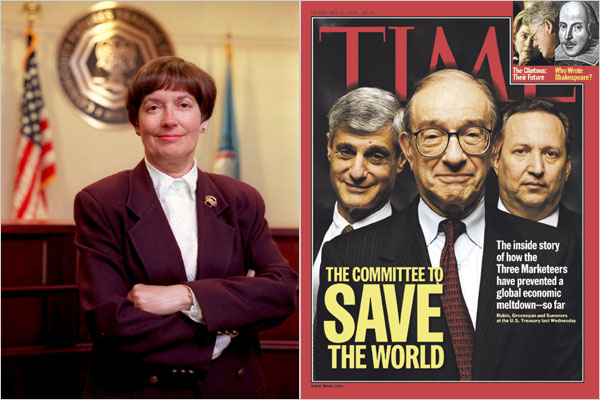
This week "Frontline" did an interesting report on Brooksley Born (left photo), probably someone you haven't heard of because her tenure in government was abruptly truncated when she failed to act like one of the boys. She was Clinton's original choice as head of the Commodities Future Trading Commission. A Stanford law graduate, a very seasoned securities litigator with Arnold & Porter in Washington, D.C., she took her rather obscure job seriously and immediately became concerned about the immense volume of unregulated derivatives traded over the counter with no federal oversight at all. So she proposed regulations to force this off-site gambling into the open, where it would be subject to normal capital requirements, disclosure and reporting.


She was aggressively opposed by Clinton's Three-Headed Monster of Deregulation: the misogynistic Larry Summers, the arrogant Robert Rubin (Sec. of Treasury) and the Ayn-addled Alan Greenspan, Chairman of the Fed. They didn't want any regulation at all, being market "fundamentalists." Greenspan went so far as to dispute the necessity of regulating securities fraud, arguing that the "market" (which had a kind of holy, talismanic meaning for him) would take care of it. They blocked Brooksley at every turn, showing up at Congressional hearings with her and kneecapping her ideas. Clinton, in the thrall of the go-go tech IPO craze and the booming market on Wall Street, sided with the Boyz, of course, since his weaselly cowardice where women were concerned (think Lani Guinier) made his decision easy. Clinton became a champion of financial deregulation (he signed the repeal of the Glass-Steagall Act, which is why you see securities dealers inside your local Bank of America), globalization and offshoring of American jobs. In a lot of ways, George W. Bush simply executed Clinton's plan for the destruction of the American middle class and ruination of the American economy. The hard work of making America vulnerable to grifters and banksters was well underway when Bush took charge in the Oval Office. With the financialization of the economy a done deal, Bush could concentrate on his true passion, war.

Anyway, after Born quit in frustration, the derivative business (credit default swaps, etc.) exploded into a business with a notional value greater than the combined GDP's of the nations of the world. It was a situation completely out of control. Various geniuses, such as those at Long-Term Capital Management, based their opaque investment schemes on the unregulated derivatives market, and made a killing in ways which they claimed were immune from failure. Then the Russian economy collapsed and LTCM, for reasons no one could completely understand (since no one really understood their business) went into free-fall, losing hundreds of millions of dollars every day. LTCM was so interconnected with the banks on Wall Street that the failure of the hedge fund threatened to bring the American economy down with it, which may sound familiar. So Robert Rubin organized a cartel of big banks to bail LTCM out and the crisis passed. Rubin's role as savior of Wall Street is remembered; his seminal role in thwarting regulation of the business that sank LTCM, less so.

The derivatives business went totally nuts under the malignant neglect of Bush&Cheney, reaching, by some estimates, a notional value of one quadrillion dollars. The collapse of AIG was directly attributable to its land office business in credit default swaps, side bets on the success or failure of securities such as mortgage-backed bonds. And, of course, there was no real oversight of the mortgage-backed security business itself, another multi-trillion dollar business in which all the big commercial and investment banks were deeply involved. When Bear Stearns failed in 2007, it started a domino collapse of the entire financial industry. This time the banks themselves could not save the system (so they said, since they were the ones who needed saving), so it was left to the federal government and the Federal Reserve, the lender of last resort, to bail everyone out.

It must be a little strange for President Obama to meet with his economic advisors, see Larry Summers sitting on the other side of the desk in the Oval Office, and realize this somewhat porcine and definitely self-satisfied guy is one of the principal architects of the problem we're in now. And yet he leans heavily on his advice; after all, Summers is really, really "smart." Obama tends to marginalize Paul Volcker, an occasional ex officio advisor, because Volcker has lately taken to calling for the nationalization of banks such as Citigroup, Bank of America and Wells Fargo, on the grounds that they're "zombie banks." (If for no other reason, I am grateful to the financial crisis for this colorful usage, lifted from the Afro-Caribbean voodoo tradition.) They're being propped up by bailouts and zero percent loans, and by the government's acquiescence in allowing them to count the hundreds of billions in cruddy loans on their books as if they had real value. Volcker thinks this is pointless, especially since they're not really lending, just hoarding. As Max Keiser has said, America needs a banking system, but it doesn't follow that we need exactly these banks run by these specific, well-connected individuals.

Well, despite such thinking, I do believe this is another instance where Obama is loath to fail in a unique and original way, and if all the Goldman Sachs alums and Goldman Sachs cronies around him tell him that we must save The Banks in the Club (the ones left after Goldman helped the government get rid of competitors like Merrill Lynch and Lehman Brothers), so be it. If the economy goes down for the count (if America becomes a failed state), he wants to make certain that he is following the corrupt consensus in Washington, D.C., and the de-regulating, Wall Street-pandering, bribe-accepting cadres supposedly representing us remain definitely in the ascendant in D.C. As a recent example, Obama raised $2 million for the Democrats on Wall Street just this past Tuesday night - how tough do you want to be with your Sugar Daddies?

Oil is now $82/barrel despite slumping demand and massive overstock. Makes a lot of sense, huh? It does when you see a Euro costs a buck fifty now. Bernanke is reaching the end of his capacity to stoke Treasury purchases by "quantitative easing." If we don't buy our own debt, who will? That will become a very interesting question, and one where the answer, I'm afraid, is going to be delivered during Barack's first term. He's going to be dealing with crises, seriatim, that will make LTCM seem like someone's overdraft at the local credit union.

October 21, 2009

Nonsensical Slogans as Official Policy


I've remarked a few times on a phenomenon which has become the norm in American politics over the last decade or so, namely, the Nonsensical Slogan as official policy. As a prime example, there was Bush/Cheney's deathless repetition of the real reason for the war in Iraq: "We're fighting them there so we don't have to fight them here." In my naivete, I was prone to thinking this moronic incantation only demonstrated that Bush & Cheney were foolish. How wrong can a person be? They were way ahead of me, in actuality, because the slogan worked.


Although the statement itself made no sense. Bush, in a press conference, admitted unequivocally that Saddam had "nothing" to do with 9/11. So - what was the basis for the insistence that we would fight Iraqis here if we did not fight them there? Have we ever fought Iraqis here? Have they ever tried to invade or attack us here? We've been in combat with Iraqis, in desultory fashion, on and off since 1991. In all that time, with all that provocation, did they ever attack us? Yet Bush & Cheney (and Rove), seasoned pols that they were and are, had a better reading of the American booboisie than I, I have to admit.

It's at least reassuring to read other writers once in a while who refuse to abandon common sense in the face of propaganda. Take, for example, Johann Hari, a fine writer who contributes on the HuffPost sometimes. He was analyzing the various rationales for continuing the American occupation of Afghanistan. The Nonsensical Slogan most often trotted out, by Bush originally and now by the Obama Administration, is that we cannot allow Afghanistan "to become a safe haven for terrorists planning attacks against the United States." At the surface, at least (that is, before you spend two or three tenths of a second thinking about it), this rationale seems more plausible than fighting them over there so we don't have to fight them here. Hari points out, however, as I've tried to do before, that this reasoning is equally lame.

He adds a few facts I hadn't thought of. Since 9/11, there have been two other headline terrorist attacks, the 3/11 attacks on the trains in Madrid, and the 7/7 attacks on British public transit. None of these attacks (including 9/11 on New York and D.C.) was actually "planned" in Afghanistan. As far as preparations for 9/11, most of those were done in Hamburg, Germany, and in South Florida. It is strictly and only the temporary residence of Osama bin Laden and a few top al-Qaeda henchmen in Afghanistan that provided cover for what was actually simply an acting out of American rage against a plausible foe. Except that Bush & Cheney completely blew it where bin Laden was concerned, so it's difficult to see now what in the hell it was about.

The other aspect which Hari talks about is what might be called the Whack-A-Mole problem. Supposing for a moment that terrorists need a "safe haven" to "plan attacks" (and in the three examples above, there is no evidence for this), why is it that Islamic terrorists would cooperate by all migrating to Afghanistan so we can annihilate them? That presents a contradiction in terms: if they're that stupid, what's the real problem anyway? If General Jim Jones is correct (no one has authoritatively contradicted him), there are currently about one hundred members of al-Qaeda left in Afghanistan. One shudders to think that if there were many more before, then like toothpaste being pushed from the tube, they are now all over the border in nuke-armed Pakistan. How helpful. But more to the point, what is it about Afghanistan that makes it uniquely suitable as a "terrorist base" as opposed to other Muslim states such as Yemen, Indonesia or Algeria, or, to refer to the actual home states of the actual 9/11 hijackers, Egypt and Saudi Arabia? The United States cannot actually invade, occupy and nation-build in every last country that might be used as a terrorist "base," and to repeat: why does a terrorist need a "base?" Timothy McVeigh used the United States as a base, and he accomplished what he was after.

I work on the assumption that President Obama is a pretty clear thinker and must see these easily-grasped points. It does not make sense to confer upon Afghanistan the unique status as "terrorist stronghold" simply because it was bin Laden's last-known forwarding address, following stints in Saudi Arabia and Sudan. Yet Obama repeats, over and over, that the Afghanistan War is a "war of necessity." Necessary for what, and to whom?

October 20, 2009

Nero's Hoedown


For those curious about the fate of the world, I recommend Dmitry Orlov's cluborlov.blogspot for the first of a three-part series on global temperature increase, and particularly the estimates on sea level rise. A business as usual approach to carbon emissions will result, according to the Hadley Centre in Britain, by the year 2055, in a 7.2 F temperature increase, with catastrophic implications for the two largest repositories of land-based fresh water, Greenland (10%) and Antarctica (90%). I suppose the usual divergence of opinion in this country remains: those who say there's no problem, like Sen. James Inhofe (R,-Hades), and those in the scientific community who claim there will be a 7.2 F global average temperature rise in the next 45 years if we don't take drastic action.


At least there's a clear choice. Meanwhile, the debate rages on how many troops to send to Afghanistan. President Obama seems captivated by the Friedman Gambit for the moment: if Karzai is corrupt (he is), then we have no one to "partner with." How can we commit the Sacred Blood of our Brave Young Men and Women, so the sanctimonious cackle of the Chickenhawks goes, without someone to partner with? We'd really love to sink into a quagmire, we really would, but not without someone to partner with. If Karzai were a little more like John Adams, and would stop wearing that Shriners' hat, we could get somewhere, like up to our necks in quicksand.

Glenn Greenwald dusts off a largely-forgotten report from 2004 by the Defense Science Policy Board (whoever they might be) which roundly criticized the approach to counter-terrorism of Bush/Cheney (although the report was put together during their reign) because fighting wars in Muslim countries just makes things worse. It uses fancier language than that, but that's what it says. They don't hate us "for our freedoms," as the silly shibboleth went, but because of our support of corrupt dictatorships in the Muslim world (Egypt, Saudi Arabia) and because we bomb them and invade them. Hey, don't look at me: Donald Rumsfeld commissioned the report of this group.

That's something I've wondered about. We're all concerned about instability in Pakistan now, but why did things get so sketchy there during the last 8 years? Any connection to what we're doing next door (and in Pakistan itself)? If the presence of American forces in the Muslim world is the problem, how does increasing the number of troops solve it?

Is there any connection between the two parts of this blog? Probably, but I'm not sure I've thought of it yet. I'm beginning to think that we cling to our wars in more or less the same way Great Britain hung on to its empire in the early part of the last century, before it finally had to release its grip on the "jewel in the Crown," India, after World War II. By demonstrating our military might, we conceal such inconvenient realities as our $12 trillion dollar national debt, half owed to foreigners; the projected increase in the debt by $9 trillion before 2020; the pathetic actuarial state of the entitlement programs; the skewing of 90% of the nation's wealth to about 1% of the population; the corruption of Congress; the destruction of the USA's manufacturing base in favor of a "financialized," paper-shuffling economy; 20% unemployment; and various other signs and portents. We're so systemically ill that we can barely rouse ourselves to pay attention to the next catastrophe, so we talk about some more wars to keep us "safe." In Copenhagen at the end of the year, when the nations of the Earth meet to draw up plans to deal with global warming, we should probably do the world a favor and just stay out of the way. Maybe rather than weighing in with a lot of ideas we won't follow through on (you can't get a meaningful climate change bill through this Congress), we should just vote "present."