November 29, 2009

A Modest Proposal for Saving the Country


I mean, you have to think big.

Let us posit at the outset that the United States, as presently constituted, simply does not work anymore. The compromises necessary to keep this place together in its present format, and under the present system, have reached the point where no one really gets what he or she wants out of the government, except for those very people in the government in Washington, D.C. Most of them probably like it just fine; they have fame, power, job security, enormous benefits and virtually no talent other than the artful skill of telling routine lies to their constituents so as to assure reelection. Too harsh? You know it isn't.

The country is comprehensively bankrupt. The finances of the federal government are a sick joke at this point. The Feds are simply running a Ponzi scheme to keep the game going by borrowing enormous sums at an accelerating pace, and using those funds and the diminishing tax base to run a military-industrial complex to benefit insiders and to pay the mounting interest on past borrowings. The Feds will never touch the principal of the national debt again. It's too big and they lack all discipline and sense of priorities, such as cutting the defense budget, necessary to achieve it.

The central government, meanwhile, vacuums up money from the states that they could use to run their own governments with balanced budgets and with a regionalized sense of priorities. For example, if Georgia and Oklahoma choose to ban the teaching of evolution in their schools, make the science curriculum wholly a matter of religious indoctrination, and outlaw all abortion under any circumstance, it's okay with me. I say that because I don't live there, and I'm very tired of the dreary compromises that must be made, for example, in choosing Supreme Court justices on the basis of one criterion, and one criterion only, the issue of "choice." In turn, I imagine the Christians in the Southern states and elsewhere in Red America, where they constitute the majority, are very weary of having secularists tell them what must be taught and what must be allowed. As well they should be.

Thus, let us put more emphasis on the Tenth Amendment to the U.S. Constitution; to wit,

The powers not delegated to the United States by the Constitution, nor prohibited by it to the States, are reserved to the States respectively, or to the people.

Naturally your first instinct might be to imagine that I've gone all Strom Thurmond or George Wallace on you, but I haven't. I'm simply very tired of the dysfunctional Congress which is incapable of accomplishing anything, and of the Executive Branch which spends all of its time devising (a) ways to make sure its campaign donors in New York City are taken care of, and (b) wars. What has happened is that the several states have allowed the Federal government to run afoul of Thomas Jefferson's basic axiom, "that government is best which governs least." We have allowed the central government, and its illegitimate financial arm, the Federal Reserve Bank, to run roughshod over the Tenth Amendment.

Power must be reasserted at the local level. The Tenth Amendment needs to be the rallying cry. The Federal Government is tremendously expensive and yet it accomplishes nothing. The Social Security fund, for example, is a self-sustaining system paid for by the citizens of the country and would be solvent except that Congress stole all of the surplus for its own uses. The same can be said of Medicare. The arrogation of power by the Federal government has been accomplished by expansive readings of Constitutional provisions by the Supreme Court, in particular the Commerce Clause, by which the feds assumed jurisdiction over practically anything (literally) that moved.

Along with many other legal thinkers, such as those at Balkinization, I think a new Constitutional Convention is needed to address the multiform dysfunctional aspects of American government. Such as:

1. Dropping the direct election of a President. The tremendous disappointment almost all of his supporters feel in Barack Obama ought to mark the termination point of this quadrennial farce. He's simply another operator, a machine politician pretending to care about American citizens. Enough of that. The United States (or whatever it winds up being called - maybe just "America") should adopt a parliamentary system whereby the electoral districts of the country vote in Representatives or Members of Parliament, to serve four-year terms. The electioneering period for such elections will be limited to six weeks and a serious cap placed on campaign financing. The various caucuses elected nationwide (meaning parties, and I really hope there are five or six) will appoint a Prime Minister or President from among the membership (by majority vote) to serve one six-year term. Votes of No Confidence will be allowed whenever a majority of Parliament concludes that legislative business cannot be successfully pursued, giving rise to special elections for new Parliamentary members.

2. The House of Lords (Senate) will be abolished. Since the average age of the Old White Man's Club is about 137, they may not notice for several years. A replica of the Senate chamber can be built on the outskirts of Las Vegas as a tourist attraction, and the "Senate" can hold hearings there and talk about the "60-vote" rule, just as they do now, until each "Senator" drops dead (if this can be detected).

3. The electoral districts will be apportioned on a strictly one person, one vote basis, so that each district has the same per capita right as all other districts in the country. There will be no more 435 member artificial limitation, which results in disproportionate under-representation in populous states. Choose any number which seems practical, for example, 1,000 members of Parliament, meaning that about every 300,000 citizens have one Member. Every electoral district would have the right to recall or impeach its own Member. Reapportionment would be done every eight years, to coincide with alternating election cycles.

After the first meeting of Parliament, the rest will fall into place. The Members will know that they have to do the business of the people back home or they're through. The Federal central budget will be cut to the bone in favor of local taxation, where a much more efficient use of revenue can be made. The Federal Reserve system will be abolished in favor of state banks, as North Dakota has now. The common defense can be worked out. As many of the expensive and inefficient accretions of the present system as are possible to be rid of, will be gotten rid of. The new federal capital will be located in the center of the country; Washington, D.C. can be turned into a theme park, like the ruins of ancient Rome.

Think about it. Never again will you have to hear about any presidential candidate's "national campaign" (especially four years before the election), watch an ad, or listen to Chris Matthews or Bill O'Reilly tell you how it will turn out. A person living in a theocratic state can move, but the whole country will not be turned on its head in the impossible pursuit of a "workable compromise," because no such thing exists, and hasn't for a very long time. Progressive states which want to live in the modern world will have the money and the political freedom to do so, without federal interference.

It's just crazy enough to work. If nothing is done voluntarily, I'm reasonably sure the United States will undergo chaotic and uncontrolled mutations in the not so distant future, either in the form of (a) insolvency, (b) imposition of martial law or (c) both.

November 26, 2009

Thanksgiving Day Musing: Obama's Ratio Decidendi


A little odd, I suppose, to crank out one of these posts on this holiday morning, but I awoke last night in the middle of the night (it may have been cat-related; they are nocturnal hunters, you know, even if the prey comes in a can) and something occurred to me that may be worth passing on (and "passing on" can be taken in either the transmittive or dismissive sense).


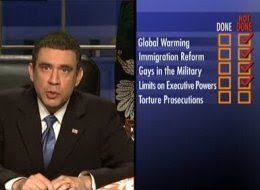
I think I understand President Obama's M.O. It was prompted by recent stories that he fired his White House Counsel, Greg Craig (whose parents really should have dug a little deeper for names), because Craig kept bringing up uncomfortable "discontinuities" between Obama's campaign positions and his policies in office; to wit, closing Guantanamo within a year (will not happen), warrantless wiretapping of American citizens and telecom immunity therefor (Obama was vehemently against during the campaign, it's okay with him now), military commissions as trial courts (Obama was completely against them, now he plans to use them), the state secrets doctrine (Obama demanded transparency, now he freely uses the doctrine to get rid of troublesome lawsuits prying into war crimes), publication of photos of detainee abuse (Obama wanted full disclosure, now he helped Lieberman permanently withhold them from the reach of FOIA requests), and, of course, the enforcement of the investigatory obligations under the Convention Against Torture (which Obama used to honor by saying "no one is above the law," but now says, "if a putative war crime happened in the Past, it cannot be prosecuted; only crimes which happen in the Future can be prosecuted Now, except they can't, because they haven't happened"). You can add to the list the unconstitutional decision to exercise preventive detention for those who can't be convicted but might do something someday, and the denial of habeas corpus to Bagram detainees (who sometimes wind up there by being shipped from Guantanamo, where they do have such rights). Craig had a problem with every one of the Presidential positions on these issues; so he got canned, having become an irritant.

It's quite a list. Even if Greg Craig's parents had an off-day when christening came around, they must have instilled in him something we used to call ethics and principles. I guess Obama made a mistake by appointing someone so "unpragmatic" to such a key spot.

So back to the thesis: you read everywhere about Obama's yearning for "bipartisanship," which I'm beginning to see is off the mark. That isn't it. It works this way, I think. The key lies in his reason for abandoning the idea of Single Payer in the health care debate, another principle he advocated on the campaign trail but abandoned once in office. If you're going to reform the system, that's about the only thing that would really work. Trying to restructure health care around the existing system of for-profit insurance companies just creates a Rube Goldberg contraption that combines the worst of government incompetence and insurance gouging. But Obama said that "single payer" would be "too disruptive," and that was that.

That's the answer, the sword that slices through the Gordian Knot. Can you imagine FDR in 1932 shying away from some big initiative to turn things around because it was "too disruptive?"Being disruptive" was the whole idea. That's how you effect change when the system is highly dysfunctional. Obama's great gift as a politician is his uncanny sense for the consensus status quo. The current status quo on many issues was formed by Obama's predecessor, who didn't mind being "disruptive" at all. Bush/Cheney were blatantly illegal, unconstitutional and radical; in time, the country sort of got used to it, but they got rid of Bush because they wanted their country back in some recognizable form. The precedents that Bush established, however, became a kind of new status quo or consensus position. The Washington/New York media, always following a herd instinct, stopped pointing out the unconstitutionality and illegality of many political actions. Thus, we became a lawless country.

It was probably within Obama's reach to bring the country back within a legal and constitutional framework, but he decided not to do so. I think, again, it was because the actions necessary to do so would have been "too disruptive." We've gotten used to the idea of being a country which tortures people, fights major wars without formal Declarations of War under Article I of the Constitution, which disregards the Bill of Rights, conducts show trials which allow the introduction of evidence produced under torture, and which scoffs at its treaty obligations under the Convention Against Torture. If we went the other way and operated within a framework of laws, it would require a major shift in public policy. Obama does not use such guidelines as his North Star; instead, he figures out the consensus, however illegal the premise on which the consensus is based, and uses that as his starting point for consideration of "Change." Since the country drifted fairly far to the Right during the Bush years, the consensus position on may issues of civil rights and legality also drifted to the Right. Since Obama rules from this position, he himself has become a Rightist or conservative President who is actually far more at home with Republicans than with his nominal affiliation.

His transmutation will become more apparent during the Afghanistan surge discussions and the speech he will give next week. You will hear him preach the gospel of fiscal restraint, sanctity for human life, of the necessity of "off-ramps" (he seems sometimes more like an L.A. traffic engineer than a chief executive), and "partnering" with the Afghan leadership. All glad noises designed to make him sound kind of liberal and rational. Then he'll announce the only part that matters, a big commitment of more troops on an open-ended basis. When I first heard that McChrystal wanted 40,000 more troops, I knew instinctively (using my new decoder ring) that Obama would decide on a number which was closer to McChrystal's number than to zero, because that's how he operates: in an ingratiating way, where he gives the status quo the benefit of the compromise. I thought the number, therefore, would be about 25,000. It will apparently be 35,000, or roughly the same number as the Iraq surge.

Sic semper gloria mundi. We're all just Pilgrims here, I guess.


November 24, 2009

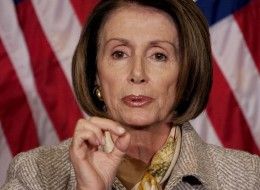
Can you run that one by me again, Nancy?


See, this is how I get confused sometimes, and why I come around to Dmitry Orlov's idea that there is a Uniparty formed by two branches of the same party, both of the Center Right, which pretend to disagree on policy issues to maintain the marketability of their respective "brands."

I am certain that you recall, as I do, the dynamic leadership of Nancy Pelosi (D-Golden Gate Bridge) who, upon ascending to the Speakership of the House in the fall of 2006, immediately withdrew funding from the Iraq War except as necessary to bring the troops home. She knew that the American populace had grown completely disenchanted with this pointless misadventure, saw it as a colossal, counter-productive folly, wasteful of lives and scarce American treasure, and saw the big victory of the Democrats in the 2006 midterms as a mandate for change. Which is why she immediately said:

“We will not cut off funding for the troops,” Pelosi said. “Absolutely not,” she said.

A reporter had asked Pelosi if the new Democratic-controlled Congress would vote to end the funding of the war if Democrats were unable to persuade President Bush to change his Iraq strategy.

“Let me remove all doubt in anyone’s mind; as long as our troops are in harm’s way, Democrats will be there to support them, but… we will have oversight over that funding,” she said.


Correct me if I'm wrong, but I think the Constitution pretty much guarantees that the House has "oversight" over that and all other funding. So that's not as reassuring as it sounds on first hearing. But along with taking "impeachment off the table," Nancy, while playing various games designed to demonstrate that the Democrats would certainly end the war if only they could (which they always could, by ending funding), decided that the voters didn't really mean it in 2006, and that the public opinion polls demonstrating the massive unpopularity of the war (along with the polls taken in the voting booths) should not be taken too literally, and certainly not to the extent of actually ending the war. So the war went on and on. Which, since Nancy Pelosi remained Speaker then and now, must in turn be taken to mean that despite occasional noises to the contrary, she must have really believed in the Iraq war. Because any contrary inference would mean she was just as cynical as Bush, and kept funding the war for Bush just so she could position the Democrats to retake the White House in 2008. Which is to say, Nancy Pelosi was willing to leave soldiers in harm's way, getting blown up and killed, or their limbs traumatically amputated, or blinded or brain-damaged, simply for a political leg up.

And I'm just not going to buy that. So I must conclude that she supported the war funding because she believed in the mission, the war in Iraq, and the sacrifice of our soldiers. Although, here I go again (and I'm getting whiplashed from all the volte-faces), then I heard her say to a group of econobloggers by conference call just yesterday::


"What did we decide, that Iraq was at least $2 trillion? And for what? I mean, God bless our soldiers for their courage and their sacrifice and that of their families. But $2 trillion for what?" said Pelosi. "Think of the opportunity cost when you break it down, when we talk about cancer, for example. We spent in two weeks in Iraq what we spent in a year on cancer research. With all that scientific opportunity that was available to us, we couldn't afford to do more. But we certainly could afford -- or so they told us -- to be in Iraq."

Um, okay Nancy, but you see where I'm getting confused. I completely agree with you about the opportunity cost, and we've all become acquainted with Joseph Stiglitz's estimate of the long-term costs of the Iraq War, where $2 trillion is the low estimate. And really, when you think about it, there was only one person in the United States, beginning in January, 2007, who was actually in a position to put the brakes on the Bush/Cheney war juggernaut, who had the political power as the head of the funding branch of Congress under the U.S. Constitution, to end the war by the only means that Bush would have been forced to recognize: by defunding the war. That person is you, Speaker Pelosi. You were the leader with the power. So when you say, "so they told us" that we could afford the war, who is it you're referring to?

So just to sum up: what the hell are you talking about? You are absolutely the last person in America who should be talking about all the lives and money wasted in Iraq, because you're right: the war was for nothing, your sops to the troops in the midst of your latest political posturing are insulting and disingenuous, and you completely blew it for you and the rest of us when you had the chance to change things but decided to be a politician instead.

And you're hinting now that Obama is going to have a tough time getting funding for his Afghan surge? Since that's not actually what you mean, what is the lie for this time?

What kind of country can we actually afford?


http://www.youtube.com/watch?v=XN-ui28SlHU

One aspect of number analysis that I find very satisfying is the coherence that a consideration of Large Numbers seems to bring to any issue. I'm not primarily a quantitative guy (I have a nephew who handles that role), but I prefer the mathematical analysis of issues to general, how shall we call it, bullshit argumentation that passes for so much public discourse in these here United States.

For example, there is currently raging (sort of) a big argument about whether the "deficit hawks" or the "Keynesians" occupy the intellectual high ground on how to get the American economy moving again. The deficit hawks are numerous: Kent Conrad and Byron Dorgan of the Senate Democrats, the Blue Dogs of the Democratic Caucus in the House, many others. The Keynesians are the Nostalgic Liberals, such as Paul Nobel Krugman and Dean Baker. The latter notes in a recent essay on the HuffPost:

"There is another side of this Japan story that makes the idiocy of the deficit scare stories even more apparent. According to the deficit fear mongers, the dollar has been falling in recent months because investors are becoming increasingly worried about the U.S. government's ability to pay off its debt. But one of the currencies that the dollar has fallen against is the yen. Are investors who are worried about the U.S. government's ability to pay off its debt selling dollars to buy the bonds of the Japanese government, which has an even higher debt burden?"

It strikes me that it's a little harsh, in this day and age, to talk about the "idiocy" of deficit scare stories. Mr. Baker has also co-written a book about the "myth" of the Social Security crisis, and has also, tellingly, co-authored with Paul Nobel. I think I'm beginning to understand their underlying thesis: the United States and its economy are in a sense Mathematical Constants, like the Speed of Light (C) or the force of gravity in falling body equations. We are, and always will be, preeminent among nations, and any slump (such as the current "recession") is simply a negative deviation from the mean. Thus, it is perfectly alright to take on debt in any amount, regardless of how dire current finances are (and they are very dire indeed), because the stimulus spending enabled by massive borrowing will fire up the economy, improve the tax inflow, and restore us to fiscal balance.

Really, when you think about it, no other analysis of their arguments makes any sense. That must be what they're contending. So sure is Mr. Baker of this thesis that he feels confident in labeling those who think otherwise "idiots" and "deficit scare mongers." This "Recession," you see (which often seems like so much more than that) is a cyclical dip, like all those before it since World War II, and will pass soon, and we'll go back to our merry life where 72% of our commercial activity was based on trips to Sonoma Williams or picking up the newest version of XBox360 Call of Duty World at War for the little kids at home. Thus, if current tax inflows to the Treasury are about $1.9 trillion, consisting of approximately equal flows of income tax and FICA (plus minor contributions from estate tax and other payroll taxes), which they are; and if our budget is about $3.4 trillion, which it is; that even if this looks horrifying at first glance, it's only because you're an idiot and a scare monger, and you don't understand economics as well as people who write books and win Nobel Prizes.

But suppose, just suppose, that the figure of $1.9 trillion is about what the American people can now afford to pay in taxes, that it's a best case for years to come because of a fundamental shakeout in national economics. Isn't there, really, a pretty good case for that? Does that number really seem like it was picked out of a hat? How could it be? It's what the American people are actually paying. Krugman/Baker and others who use ad hominem terms to describe their lesser fellow mortals (not that I don't appreciate the use of the ad hominem) are assuming that the tax receipts will soon soar up to the $3 trillion level or so, to match the budget expenses, if we'll just do the sensible thing and spend another tril keeping teachers and firefighters on the job and extending unemployment benefits to some of our 20% nonworking citizens. That's all it will take; Keynes said so. It's just not that big a deal.

Yet (and here's where the Big Number Ideas come in) I keep coming back to that "insight" I had long ago that the U.S. economy is fictitious, as a sustainable matter, to the extent of about 35% of its nominal worth. I admit it was a guess; but I had the hunch that the stock market, when it was at about 14,000 Dow, would fall to about 9,000 (it went me one better, of course). I based this intuition on reading I had done, specifically, books by Kevin Phillips and Chalmers Johnson. They went deep, way down into the ugly entrails of the American economy. What they found was that we weren't really earning all the money we were spending, not by a long shot. We borrowed all that money and that made the economy seem more robust than it was. Thus the Pond Thesis: half the money during the Bush "boom" years was borrowed on the basis of real estate (re-fi, lines of credit); 70% of economy = spending, take away half, what ya got? 35% reduction.

Now consider this: during the Bush years, the top tax receipt year was about $2.7 trillion (that was the era when even corporations were paying income taxes, which essentially they do not anymore.) What percentage drop is implied by a reduction from $2.7 trillion to $1.9 trillion? Gee, it seems right in the range of 30%, doesn't it? All that borrowing enabled spending, which enabled corporate profits, which enabled employment, which made possible an actual Federal budget based on income instead of a Ponzi scheme where we pretend that a ridiculously inadequate cash flow supports unlimited borrowing in order to pay interest on previous borrowing.

Oh sure, it could be a coincidence. But have you looked around at your America lately? We're in trouble. Borrowing huge sums is not going to restore us to prosperity. It's going to be the work of years, not a financial trick where we "get well" because the loan came through. I have no idea what kind of country a $2.0 trillion dollar federal budget would support, but it probably would put an end to speculations on how many Middle Eastern countries we can afford to rebuild at any given moment. Those folks in the Emerald City (D.C.) should get out a little more; take a drive through East Oakland or Riverside, California, or overbuilt Florida, Phoenix or Anywhere, U.S.A. This isn't going to be over soon, but the fantasy that it will is a very dangerous delusion.

Although, before closing, I would add one thought. There is something that could be done to bring us much closer to balance. 40% of the Treasury's income taxes are paid by 1% of the population, the plutocrats. Remarkable, eh? So restore marginal tax rates to their Eishenhower-years levels, and......oh right: hahahahahahahahahahahahahahahahahahah!!!

November 17, 2009

The Gurgling Confessor Goes to Trial


I admit I was surprised when the Obama Administration's Department of Justice announced that Khalid Sheikh Mohammed (among others) would be tried in a regular federal court in Manhattan for his role in the 9-11 plot. KSM, as he's known (which has always made him sound like a lite rock FM station), was captured in Pakistan in 2003, rendered around, and then was shipped to Guantanamo in 2006. I remember the timing pretty well because I watched George W. Bush's riveting speech on television in a breakfast room in Lyon, France. You may recall it yourself. W's impassioned plea was for immediate action on the Military Commissions Act, which incorporated a trial mechanism for the arrival of the "worst of the worst" from overseas dungeons, including the anticipated landfall of KSM in Cuba. Skeptics (I'm busted!) suggested that Bush's hurry-up had more to do with a couple of other factors, namely, the imminent midterm elections of 2006 and the exoneration clause (from any war crimes that might have been committed by, oh, the Bush Administration) helpful Republican lackeys (like Lindsey Graham) had stuck in the law. So George, whose own vanilla beans were caught in the ice cream maker of justice, was adamant that the bill get passed fast, because the bad guys were due to arrive in Cuba at any moment! And the really bad guys were due to arrive in Washington, D.C. in January!


Not to worry, W. The lame-o Democrats (including erstwhile Republican Arlen Specter, who admitted he was voting for an unconstitutional bill) rolled over, as usual, and passed Bush's get-out-of-jail free card just as they were ordered. No filibuster, no obstruction, not a whimper. Then, mysteriously, the urgency seemed to disappear. Hell, KSM could rot for all W cared. Let the next guy figure it out.

Which Eric Holder did. The reason I'm surprised by the choice of venue is that KSM was waterboarded, by CIA count, 183 times. I thought this pretty much guaranteed KSM immunity from actual trial; he would never set foot outside of prison, of course, but I thought the "preventive detention" doctrine, announced by our Constitutional Law Professor-President as an alternative to what we used to call "due process," sort of had KSM in mind. Otherwise...

Otherwise, KSM (who's gained quite a reputation as a loose cannon) is going to use these last public days of his life, and the district federal court, as a forum for anti-American raving and for a detailed description of the tortures and mistreatment worked upon him. Since he's apparently confessed to everything, up to and including the Lindbergh kidnapping and the Kennedy assassination, his lawyer will have to introduce evidence of coercion in order to zealously represent him, as bar rules require. Being waterboarded 183 times over about a month's period no doubt qualifies as coercion.

All rather odd. I'm well past the point where I expect Obama or his justice department to proceed on the basis of the Bill of Rights simply because, you know, we're a nation of laws. That ship has sailed. So something else is up. Partly, I'm sure, it's the politics: KSM worked his evil in Manhattan, so that's where he should be tried. His lawyer may move for a change of venue (just to go through the motion, so to speak), but he's counting on losing. Would KSM rather be tried in Georgia or Alabama? Thought not. But I don't believe that KSM is actually going to be tried. He's admitted everything already, and I suspect he's going to dismiss his lawyer, plead guilty, and confine his theatrics to that moment before sentencing when the judge asks him, "Is there anything you wish to say?"

Then everyone will get an earful. What I can't imagine is that Holder's DoJ is actually going to set up a forum where the United States, while laudably affording a despised terrorist his day in court, is dragged through the mud for days on end while its torture methods are described in gruesome, unending detail as "catnip" for the cable news shows to display and analyze, ad infinitum. Obama, after all, encouraged Congress to pass an amendment to the Freedom of Information Act allowing the Secretary of Defense, in his unfettered discretion, to withhold any photo of detainee abuse where he thinks disclosure "might endanger U.S. armed services personnel," thus putting an end to a successful FOIA case brought by the ACLU seeking the release of about 2,000 photos of various acts of torture and abuse. And now Holder is going to allow an al-Qaeda member to testify, at length, about waterboarding and rendition, and flights in the belly of a C-5 while chained to the floor, and hypothermia, and sleep deprivation, and getting stuck in a coffin box, and all the rest of it? How will that one play in Kandahar?

There is something we haven't been told yet. I will believe this trial when KSM takes the stand, under oath, and begins to rant and rave.

November 16, 2009

Further thoughts on U.S. insolvency


An old friend from school days adds his comment, re: my last post, that in his opinion the budgetary Ponzi scheme commenced when Congress began systematically raiding the Social Security surplus and using FICA payments as simply another general budgetary revenue source. While meticulously earmarking the surpluses as "Special Issue Treasury Bonds," stuffing them into a file cabinet in West Virginia, and waiting for the day when they would need to be "redeemed." The reset of FICA rates in 1983 has relentlessly produced an overpayment in Social Security payments, so that the sigma of overpayments currently = $2.5 trillion. This is the "Trust Fund:" a file cabinet full of Blue Ridge Mountain air.


This is an excellent point my faithful reader makes. The telltale mark of a Ponzi scheme is the acceptance of "investment," with payments to early investors made from revenue from later investors, and with inadequate reserves to repay the principal of the investors because of ongoing embezzlement of the money. What Congress has done with FICA overpayments meets the definitional criteria almost perfectly. Madoff got 150 years for operating this way; Congress calls it its "budgetary process."

So in the last post, I admit that I gave a somewhat misleading picture of the overall gravity of the U.S. revenue shortfall in the sense that one month is only a snapshot of a year-long process; however, the year-over-year decline in income is serious indeed, 18% in one year. Still, the deficit added up to $1.4 trillion, exclusive of the $163 billion described in the next paragraph.

The Social Security theft continues unabated, necessarily so (you could say) since FICA payments are nearly equal to the total amount of income tax paid by all Americans. For fiscal year 2009, $890 billion in FICA payments were received, and $727 billion paid out. The difference of $163 billion was transmuted into those magical Special Issue Treasury Bonds and stuffed in the file cabinet over there in Almost Heaven land. The cash was just spent, of course, as part of (inter alia) our ongoing efforts to provide a good life for Iraqis and Afghanis. These embezzled funds add up nearly to 10% of the revenue available (on a cash basis) to the U.S. government.

The most ominous problem relates to demographics. It's one thing to swipe the excess FICA payments in 1983, when the Baby Boomers are all in their prime earning years. Quite another when they're undergoing cataract and hip replacement surgery and getting ready to receive those monthly stipends. The leading edge of Boomer retirement now enters the pay-out zone. How realistic is it to keep pretending that those West Virginia IOUs will get the job done for much longer? Divide $163 billion by 12, and you get $13 billion per month. That's the cushion for FY 2009. But note on the chart from the last blog that FICA inflows in October 2009 had dropped to $61.5 billion per month. On a 12-month basis, that's $738 billion, or $11 billion more than the amounts paid out in fiscal 2009. Extrapolated out, that means the cushion has shrunk to less than $1 billion per month. Meanwhile, the Boomers start collecting (or try to), the income shrinks and the outgoes increase.

Where is Congress going to steal 10% of its operating budget if FICA income matches outgoes? Where are they going to find the money to pay Social Security when the income is less than the outlay? That was supposed to happen in 2017. It doesn't look to me that we'll have to wait that long for the "break-even" point. The American unemployment Depression will probably guarantee its arrival much sooner.

Which is why, despite my credentials as a Liberal and everything, I think that the advocates of huge deficit spending must be smoking something very powerful and deranging. Unless you can more or less guarantee that the stimulus trillion or so (maybe taking the yearly deficit to $2 trillion, so that the deficit itself becomes larger than all income received by the Treasury) will absolutely, positively produce all those jobs and increase income and, thus, increase tax receipts, it seems like something akin to financial suicide to undertake it. I think what we have is a huge structural problem with the economy in this country that no feasible amount of government spending is going to fix. This is the result of waiting way too long to look at the problems of offshoring good jobs, running huge current account deficits and playing GloboCop with our gargantuan military budgets. Reality's a mean mo'fo', and it always bats last.

Paul Krugman at the New York Times is convinced that Stimulus II, the Sequel, could do the trick and get Americans spending again, which highlights the problem. That's what the moribund U.S. economy was based upon before it crashed. He calls deficit reduction "bad economics," because stimulus spending will lead the way, eventually, to a balanced budget. Yet if a system is far enough along in insolvency and unemployment, that promised day of equilibrium may arrive too late to avert sovereign debt repudiation, that bugaboo of countries such as Argentina and Zimbabwe. Maybe it's better to live within our means and work our way out of this problem instead of attempting to borrow the money and then hoping that John Maynard Keynes was not only right, but psychic enough to think his prescriptions would apply to modern day America.

November 12, 2009

The origins of Selbst Schadenfreude


((Click on table to enlarge in new screen.)

In the ongoing effort to enrich the Blogospherical vocabulary, I offer Selbst Schadenfreude, which I will translate as meaning "the malicious pleasure taken in one's own difficulties or downfall." I think there are whole websites devoted to this pastime, and I read some of them: Zerohedge.com, Kunstler's Clusterfucknation, The Market Ticker, and many others. In the modern United States, there is a lot to work with, which probably explains the tendency in the first place, along with a sense of unconscious guilt arising from the simultaneous perception of (a) such a bounteous birthright of beauty, fertility, temperate climate, resources and historical timing and (b) such a piss-poor utilization of it all in recent times. Thus, the marked tendency toward self-laceration, doomsday prophesying, and the rest. Selbstschadenfreude.

The chart above is from the helpful public data made freely available by the Department of the Treasury. It is the national "P&L," in a way. If the United States were strictly a business, one would have to say that this is the financial picture of a company which has gone belly up. This is the most recent P&L, for October. Granted, I would not expect tax receipts to be their highest in October, although this is the designated extension month used by many taxpayers. Nevertheless, if one looks at the year-over-year decline from October 2008 to the present, perhaps a cold chill will also crawl up your spine. Last year $30 billion more in tax receipts arrived in October. This suggests two things: (a) we're in a steep nosedive financially, and (b) how the hell do you match up a fall-off of about 18% in tax revenue with the official unemployment rates? In October 2008 the rate was 6.5%; now it's 10.3%. How can these two data points be reconciled unless someone is seriously fudging the unemployment numbers? Is it possible that another Selbstschadenfreudemeister (Germans love those portmanteau words), John Williams at Shadow Government Statistics, is right that the true unemployment figure is about 21%?

The other really eerie thing about this chart is the expense side: $311 billion, including $70 billion for defense. Well, some things never change. So we've got $135 billion coming in, $311 billion going out. Does anyone see anything at all wrong with this picture? In what possible universe is this sustainable? Against this backdrop of utter insolvency, the generals are arguing that Obama should send more troops to Afghanistan and Paul Krugman of the New York Times is urging another round of stimulus, only really big this time. This is getting seriously nuts.

I would like to think that our sane, rational, deliberate President is looking at this chart the same way I am. I suspect he is. I think he is weighing the political demands from the rabid Right Wing militarists against the economic reality. I think he did the same thing with the national health care issue. I don't think he thought we could afford it. I don't think he believes we can afford an escalation in Afghanistan, or even to be there at all. Or to maintain those 750 overseas bases that the great, brilliant Chalmers Johnson has been trying to warn us about in his Nemesis trilogy. No one would listen to guys like Chalmers Johnson or Kevin Phillips, although they did their fricking homework, like crazy. They went very, very deep. They weren't guessing.

And now here it is. We're attempting to turn the national finances into an immense Ponzi scheme, where a little bit of income is used to leverage massive borrowing, where the ability to repay the principal is fading into a ridiculous fantasy, so that all we can hope to do is to keep borrowing, make interest payments on the national debt, until....until what? There's the problem. Until we emerge from this Depression and revenue begins flooding into the Treasury again? We have no idea when that will happen. The reason the stimulus was able only to mitigate the deplorable state of local budgets (to keep teachers and cops on the job) is because we waited way too long to begin investing in this country. Bush spent all that dough on Iraq and Afghanistan and on a pointless build-up of an already hypertrophied military establishment. Because a bunch of Saudis hijacked planes and flew them into buildings. So now we're in that very dangerous situation where time is not on our side. The economy has to turn around, fast, or....what? We publish this data, after all, and President Obama is in China now, and the Chinese are looking at the same figures he is.

Anyway, I'm very glad it's President Obama at the helm right now. If it were Bush, I'd still be taking night classes in French at the local junior college.

Fort Hood & the War on Definitions


The tragic event at Fort Hood last week appears to have settled down into more of a conventional news story. 12 soldiers and one civilian were murdered by an Army psychiatrist who went berserk. Many others were wounded, some very seriously (well, I suppose any gunshot wound is serious). The story would take its quiet place in the annals of American mass murders, along with disgruntled postal killers, school and college massacres and the rest in the sad litany of carnage in Free Fire Zone America, except for one salient fact: the shooter was a Muslim of Palestinian descent who had been in contact with a radical Muslim imam, who in turn had presided over mosques where three al-Qaeda, 9-11 hijackers had attended, in Virginia and San Diego (including one of the pilots, Hani Hanjour). The two San Diego 9-11 conspirators were the "muscle" hijackers who gave the CIA the slip in Southeast Asia and settled into suburban life in Southern California. You can read all about them in the Report of the 9-11 Commission.


This fact raised the stakes considerably. The forces of Political Correctness were mobilized immediately, of course, so that there were stories about the story almost before there was a story. Although Major Nidal Malik Hasan was himself pretty clear that his attack was motivated by "religionist" thinking (what else do we think it could have been? why was he shooting exclusively soldiers in the Readiness Center who were about to deploy to Iraq & Afghanistan?), it became verboten, in the beginning, to even talk this way. Many other Muslim soldiers in the Army were "consulted" so that a balanced view could be presented. Glenn Greenwald, who's real good on civil liberties and the law but goes a little crazy when anyone utters an anti-Muslim sentiment because of his deep dislike of Israel-U.S. connections, did a kind of Chomsky number where he started talking about Predator drones conducting "terrorist" attacks in Pakistan and Afghanistan. You know, who you calling a terrorist? I forget exactly how he got there, but I'm sure his logic was impeccable. It's just that it has nothing to do with the real world.

David Brooks went the other way and stated his conclusion that there's just something about Islam which results in its adherents regarding other people as sub-human. Of course, Mr. Brooks first had to begin at the beginning and set the context for this view, which in his case is always to build civilization from the ground up: "Humans breathe air. We all breathe the same air. Yet what we do with that air is different. Different cultures use the air for different things..." Poor David. He knows he's really, really smart. He just can't seem to prove it to anyone else's satisfaction.

After the political correctness wore off, people got down to business and started arguing (a) whether this was a terrorist attack, and if so, (b) who should be blamed. Now we're talkin'.

Was it a terrorist attack? First of all, you can't have a terrorist attack without a terrorist, can you? So was Hasan a terrorist before he shot up Fort Hood, as a result of shooting up Fort Hood, or not at all?

Like David Brooks, of course, we need to back up and lay the groundwork. For about an hour or so. I don't want to use the definition of terrorism currently in vogue, because it's case-specific. It has to do with our ongoing efforts to defeat Radical Islam. So I'll resort to the American Heritage Dictionary: "Terrorism, n. The systematic use of terror, violence, and intimidation to achieve an end."

Interesting. Nothing said there about "asymmetrical" warfare or any of that, which appears to be a definitional gloss on the topic to differentiate anything done by a nation-state from nonstate actors. On the other hand, what the hell does the American Heritage Dictionary know?

Anyway, it seems to me that Hasan gets a free pass from the dictionary, because it's hard to call what he did "systematic." Maybe the important take-away point is that these definitions don't really help much. After you get through defining it, the case remains that of an Army major who decided to shoot a lot of American soldiers for religious reasons of his own. You can't escape that. In psychiatric terms, this psychiatrist was in a state of profound cognitive dissonance over being part of a military which was in turn engaged in fighting countries where his co-religionists are the overwhelming majority, and the internal conflict apparently drove him to murder.

Did he kill all those soldiers as part of his part in worldwide Islamic jihad? We'll never know, I don't think. Was he okay with the West, in general, but this specific conflict overwhelmed his religious conscience and drove him to kill? We'll probably never know that either.

Like most murders, it has the "greater meaning" we assign to it, which we do in order to cope with tragedy. But it remains murder. A lot of dead individuals caught up in one man's internal turmoil. It doesn't tell us anything about the War on Terror, nor much about the wars in Afghanistan and Iraq. It does suggest that a determined individual in the United States who wants to act out on his impulses, religious, ideological or otherwise, can find the means and firepower to do so, apparently even when he's on the FBI's radar because of consorting with suspected Islamic radicals, and there isn't much we can do about it if we want to remain a free society. That's not a popular conclusion in this country, but I think it remains true nonetheless.

November 11, 2009

Veterans & the Dogs Who Love Them

http://74.125.155.132/search?q=cache:http://www.mentalfloss.com/blogs/archives/40324


November 11, 2009. If you can watch these with dry eyes....well, then you're different from me.

November 10, 2009

Actual basis for Obama disillusionment syndrome (Freudian analysis)


Okay, look: I'm an inveterate amateur psychoanalyst in the great tradition of amateur everythings, such as the amateur sleuths Sherlock Holmes of Sir Arthur Conan Doyle, Lord Peter Wimsey of Dorothy Sayers, and Father Brown of G.K. Chesterton. Anyway, it's not that difficult to be an amateur Freudian shrink. All you have to do is to attribute everything to unconscious motivations, and if anyone disagrees with you, you simply argue that they're engaged in Resistance based on Denial. A closed loop.


The great physicist Richard Feynman took issue with the validity of psychology on the ground that the advances in the field were too frequent and too variable to be characteristic of a real science. He pointed out that it took hundreds of years to get from Newtonian physics to relativity and quantum physics, whereas psychology seems to go through a major paradigm shift every decade or so. That's not characteristic of real science, only "heuristic" musing or subjective philosophy. Leave it to Feynman to think about things in a way which would occur to no one else. One of the many reasons his loss is so immense.

So anyone should be able to use psychoanalysis because it's not real in the first place. Dr. Phil certainly doesn't let his lack of the appropriate credentials get in his way.

Back to Obama: here's how it works. Consider an analogy, always helpful in the fairy-tale based "science" of psychoanalysis. A woman meets a charming, dynamic man, and they engage in a whirlwind romance. She's just coming out of an eight-year relationship with a lying, semi-deranged, hard-drinking brute, who knocks her around, cheats and is monumentally insensitive. The new guy really looks like a step up, especially by comparison. They get married, and then on their wedding night something strange happens. Prince Charming drinks a little, says something derogatory to her, and then hits her one in the mouth.

That's it. He never strikes her again, and in the ensuing months he's pretty reliable. Not a bad husband.

So here's the analogy. Most progressive, liberal types saw Obama as the Great Redeemer during his campaign and just before his inauguration. We had been through eight years of George W. Bush, who had fabricated evidence for an unnecessary war in Iraq; gotten about 4,000 soldiers killed over there, and refused to count the numbers of Iraqi dead (he couldn't be bothered); established a torture regime (Abu Ghraib, Bagram, Guantanamo, rendition) which violated the Geneva Conventions, the U.S. War Crimes Act and the Convention Against Torture; routinely and systematically violated the FISA law and the Fourth Amendment by spying without warrants on American citizens; and established a concentration camp in Cuba where the due process rights of many innocent people were completely obliterated.

Not a word of the above accusations is in any sense exaggerated, false or even controversial. Some of it has faded from memory, of course, but that's part of (Freudian) suppression. The overwhelming assumption among Obama's ardent followers (such as, ahem, Dr. Walden) was that Obama would kick some holy ass once he took power and cleanse the temple of all this filth and corruption. We can invent some convenient amnesia if we like, but that truth remains. Those salutary actions included the much-ballyhooed (and never realized) "accountability" moment so many talked about during the Bush years. If it meant that members of Bush's administration, including Bush himself, would be the subject of investigation and/or prosecution, so be it. Joe Biden said during the campaign that all of that was on the table; Obama kept saying that "no one was above the law."

Once Obama was sworn in (the wedding night), however, all of that changed for good. His murmured preference for "looking forward, not backward" became fixed policy. Then he took it further. His Administration, through his Justice Department, began interfering with private litigation based on Bush's various war crimes and felonies, using a broader definiton of the "State Secrets" doctrine than had Bush himself. He argued against releasing any more photos of detainee abuse "for the safety of the troops," meaning, of course (since the enemies of the troops were already well aware of the extent of the abuse), for Bush's safety from prosecution. His Administration redacted the CIA Inspector General's Report of 2004 on torture to an almost comic level. Once he decided to protect Bush from scrutiny, Obama used every legal and extra-legal method available to avoid inciting the citizenry's fading and dormant demand for justice.

Dormant, perhaps, but not really forgotten. It resides in a kind of collective unconscious. It affects the way we look at Obama. He's not our knight in shining armor at all. He kinda punched us all in the mouth. He's more like the previous guy than we really want to admit.

So he does good things, no doubt. He's progressive on health care, global warming, scientific research, a bunch of things where Bush was very much in the way. The world community respects us more, and they welcome a humane and emotionally healthy American President. Yet there's that lingering, shocking betrayal. Residing as it does deep in the unconscious, it "colors" our perceptions, and not in any racial way, not at all. I suspect that Freud was right, that our unconscious pushes our emotions around as undersea currents move the oceans. We can't help feeling the way we do, and it's just not possible to get excited about the new guy anymore. He just seems like a lot of talk, because that moment for action came and went and he displayed his true mettle. He never meant any of it.


November 09, 2009

Post-Disillusionment Syndrome


One good thing about writing a blog on current events in the hammock years between the denouement of the Bush Presidency and the ascension of the Obama is that you do get over yourself, in terms of how and what you write. One might begin, as many bloggers probably do, in a "hortatory mood," as if finding this outlet might, in fact, make some sort of a difference. This is of course only symptomatic of the projection-based nature of human psychology. Over time you come to terms with the idea that this diary of ideas (thanks again, Eric Blair) mainly just chronicles your own intellectual journey. And, you know, in the age of disclosure, why not do so in public? (Or in semi-private, most of the time.)


So that your analysis, in modern America, tends to devolve toward the forensic rather than the reformative. It's just an out-loud attempt to understand what is. If nothing else, modern America is very interesting. While we resist the notion that huge changes are occurring, that doesn't stop Reality from moving us in the direction of social evolution anyway. Right now, the American leadership is locked in collective denial about what's going on outside the Village. The idea seems to be that tweaking the interest rate, or emailing money to certain large banks, or recycling tax dollars (augmented by borrowed dollars) from the American citizenry right back to the American citizenry (the stimulus approach) will right the ship of state and restore us to the halcyon days circa 2005.

Like death itself, however, a Big Change was inevitable sometime, and ours began in earnest in 2007. It took a lot of preparation, however, to get America ready for the demolition of its economy. One leading indicator (along with, and related to, the off-shoring of all our good jobs) was the destruction of the American public school system. Under the sway of anti-tax ideologues marching under the banner of Our Patron Saint, Ronald Reagan the Divine, everything government did, including public education, was seen as inefficient and wasteful. It made sense that a man as intellectually limited as Reagan would denigrate education. So we began undereducating an entire generation of Americans, beginning in the 1970's. This worked okay so long as we had a "service economy" to provide jobs for the increasingly deficient products of our school systems. These were the serfs for the Crap Job Economy: the baristas, the fry cooks at McD, the ex-con zombies staggering in the canyons of Home Depot, vast legions of call center phone jockeys. The Crap Job Economy depended on lots of disposable income to keep all the retail outlets open, places where the increasingly rotund American could waddle in and dump some fiat currency. So we allowed everyone to turn their houses into ATMs, either with lines of credit or re-fi, so that we could all participate in the American Debt Orgy.

Then all of that became unhooked. Americans were living way beyond their means and borrowing to a level 30 to 40% above the lifestyle actually supported by their stagnant incomes. There was time for one more Bubble, the Bubble at the End of the Universe, called the mortgage-backed security fraud, which allowed the government-backed Big Boyz to vacuum up all the nation's mortgages, replace them with mortgages too good to be true (and programmed to fail), make a killing on the front end, and then walk away as the explosive charges detonated. There were few other ways for the Business Elite to get obscenely rich at the point when the Great American Mortgage Heist began, and obscenely rich is the only kind that plays in this country. Stocks had been stagnant for 7 or 8 years (even now the Dow is only at the level it attained in 1999). So the hypothecation of America's very land was about the only asset left to play, and the good part was that Wall Street (with the connivance of the government de-regulators, all still on the job) could entice everyone in America, in effect, to play the market (whether they realized it or not), because their mortgage had just been made into a marketable bond. The past was prologue to our present. Then: ka-blooey.

Obama's Administration wants to stimulate the American economy into producing 3.5 million jobs over the next three years. It claims (fraudulently) that it has "created or saved" 640,000 so far, courtesy of the ARRA. Deep inquiries into this number have yielded uncomfortable truths for our smiling leader. Half of this number, or 320,000 jobs, represent government jobs at one level or another. Where a raise is granted by means of the stimulus, this counts as a job "saved," although, of course, this makes no sense. Obama promised that 90% of the 3.5 million jobs would be created in the private sector, which means that he and his advisors originally prognosticated that only 350,000 jobs would be public; thus, Obama only has room left for 30,000 more jobs "created or saved" (or perhaps: "improved") in the public sector before he has to go all-private, all the time, on the balance of 2,860,000 jobs still to go. Hmmm. Well, you shouldn't use all your trumps so early in the hand.

First, of course, the private sector needs to quit firing people, which it's still doing at the rate of 200,000 per month. The current unemployment figure of 10.3% (the one most flattering to the Bureau of Labor Statistics) is already significantly higher than the prediction of Christina Romer, O's head of the Council of Economic Advisors, for the worst case American situation without the stimulus. So the reality (that word again) is that the unemployment rate is worse than the worst-case scenario predictions with and without the stimulus. So what does this tell us about the value of the Council's "predictions?"

I'm not surprised they're so wrong. It's just that, as Villagers, they live in a privileged world. They don't really know what's going on out in the real world, where stores are closing, commercial buildings are empty, strip malls are abandoned, banks are failing, and millions of residences sit empty. They're busy figuring out the Over/Under on Afghan troop deployments. The Japanese see this situation and buy our Treasury bonds, even at their low yield, on the theory that the longer-term (3 to 5 years) will become more valuable as the American economy continues to sink. They see our unemployment going to 13% and things continuing to unravel, and they base their predictions on Japan's own Lost Decade, to which our predicament bears an eerie resemblance.

Fasten your seat belts. It's gonna be a bumpy night.

November 04, 2009

The rise of grudge voting in America


This gets confusing. I'm pretty sure Frank Rich of the New York Times, among others, confidently predicted the death of the Republican Party as recently as three days ago. Rich, in writing a GOP obituary on Sunday, noted confidently,


It’s also why [failure to take into account the changing demographics of the American population] the G.O.P. has been in a nosedive since the inauguration, whatever Obama’s ups and downs. In the latest Wall Street Journal-NBC News poll, only 17 percent of Americans identify themselves as Republicans (as opposed to 30 percent for the Democrats, and 44 for independents).

Then on Tuesday the Republican candidate wins the governor's seat in Virginia by a 60-40 margin, a state which Obama carried a year ago. In New Jersey, a reliably Democratic stronghold, a Republican defeats the incumbent Democrat John Corzine.

It's odd that Rich doesn't see the answer to the riddle in his own quoted stats. It may be that nearly twice as many people identify themselves as Democrats than Republicans; but the two parties together are only slightly larger than the Americans who want nothing to do with either party. If the Democrats can only claim 30% of the electorate, aren't they also in a "nosedive?" I guess Rich's training as a theater critic did not include a course in statistics.

I saw Jesse "The Body" Ventura on TV a couple of days ago, the former rasslin' governor of Minnesota (a state which must have been in a puckish, demoralized state of its own). He suggested that members of Congress should stop wearing business suits and instead copy the style of NASCAR drivers, silvery jackets emblazoned with patches and decals of their corporate sponsors. That way we would know who they were legislating for. There would be Chris Dodd and Chuck Schumer all decked out in logo-splashed thermal suits emblazoned with "Goldman Sachs" and "Citigroup," with maybe a corporate motto thrown in: "Too Big to Fail." Senator Max Baucus in a gold satin jacket featuring "Blue Cross" and "Aetna" -"Our Profits Sky When You Die."

That's a very funny idea, Jesse. I wouldn't mind a system where the Congressional "drivers" were directly compensated for their endorsements, either. Let's keep it all above board. But slightly more seriously, let's face it: except for a tiny sliver of Americans actually directly involved in either Democratic or Republican politics (as part of the machinery, in other words), most Americans regard themselves as simply captives of a completely dysfunctional two-party system, and this includes, no doubt, significant fractions of those nominally "affiliated" with the two parties as registered members. The Democrats and Republicans pull votes because they're the only game in town. No serious third (or fourth or fifth) party is on the horizon to challenge their hegemony, and the Mainstream Media, which controls what is in the consciousness of its American subjects, is too invested in these fascinating two-party "horse races" to allow the choices to expand to include, I don't know, candidates and positions that have something to do with the reality of life for actual Americans.

So now you'll see lots and lots of stories from the usual pundits about how these two off-year elections are a "litmus test" for the Obama Administration, how he's let his "progressive base" (huh? who dey?) down, about the failure to enact "comprehensive health care reform with a robust public option," about the continued waste of two useless wars, on and on, signal "danger" for the Democrats in 2010, and the rest of it. Sure, go ahead and write that stuff. That's also part of the two-party paradigm: the analysis of everything in terms of the two parties.

I think it's simpler than that. The great majority of Americans hate everyone in office. They get tired of them, they resent them. They're sick of their lies and corruption. Yet they're trapped, without real choices, condemned to this pointless plebiscite on the rise and fall of whatever party is "in power" and is currently lining their pockets and letting America go to hell.
My hope is that the Republican Party becomes more "mainstream," less infested with wackos like Sarah Palin and Rush Limbaugh, or radically dangerous subversives like George W. Bush and Dick Cheney, because they're going to get their turn again. American voters derive their one pleasure in voting from throwing out of office the people they've gotten sick of, and currently there are more Democrats to hate than Republicans. So the GOP will be back, we will remember how awful they are too, and then we'll throw them out and...you get the picture.

I still think those logo jackets are a swell idea.


November 03, 2009

I come to praise Obama, not to mess with him


Okay, it's become fashionable to knock the O-Man. Bill Maher is doing it, "liberal" talk radio guys are doing it, Arianna Huffington, you name it. All the fun, in other words, has gone out of the game.


I was an early critic. Partly this is because I pay attention to civil liberties cases and the Bill of Rights, a result of my legal background. Barack has been a train wreck on such matters. He absolutely will not put any distance between himself and Bush on controversies ranging from illegal NSA wiretapping to use of the "state secrets" option of terminating litigation which might reveal embarrassing and/or illegal activity such as rendition and complicity in torture. Something I heard Ed Schultz say on the radio the other day brought to mind a minor suspicion of mine. Ed was opining that the reason Obama is so intent on "bipartisanship" for his health care reform bill is that he just wants to make certain that Olympia Snowe, Susan Collins or someone with an R next to their name is standing in the circle of grinning solons at the signing ceremony. In the same vein, I have thought that the reason Obama absolutely, positively will not allow anything out into the open about Bush's torture regime (forcing all litigants and journalists and legal groups to use FOIA requests [always highly contested by the O Administration] to get anything) is because when all the "living Presidents" gather in the Oval Office for one of those heartwarming moments of camaraderie, Obama does not want a damper on the good times; you know, like a felony indictment of George W. Bush prosecuted by Eric Holder.

President Obama does not believe in transparency any more than did Dick Cheney, although for different reasons. Cheney hid everything so he could stir up trouble; Prez O hides things so everyone can get along. He's in the wrong job for that attitude, but the job remains his. So...what to think?

Well, my legal career has been mostly about helping the underdog, and now Barack is getting a little too much heat, in my opinion. So I rise, sort of, to his defense. We're starting to forget that he did in fact inherit an economic catastrophe, and two unnecessary wars, from the inept, bungling W. Further, Barack really had no time to learn on the job. The country was falling apart when he took the oath, and then the problems accelerated with massive job losses and unprecedented levels of foreclosure and equity losses. Couple these circumstances with the fact that there was nothing in Obama's background which really prepared him for such crisis management, and you begin to understand why he basically froze up and clung to as many advisors and Bush appointees, particularly in the defense and financial fields, as he did. Thus, Gates at defense, Bernanke (a Republican) at the Fed, Geithner (from the New York Fed and a Greenspan acolyte) at Treasury, McChrystal for Afghanistan, Petraeus at CentCom, and holdovers from the Clinton Bubble Era such as Larry Summers. He also added a bunch of Goldman Sachs alumni for key positions in the financial nomenklatura.

A lot of these people were in on the ground floor of the economic catastrophe in the first place; yet, to Barack's mind, at least they knew about the extremely complicated, arcane nature of modern finance - derivatives, securitization, interest rate policy, capitalization of the banks - and they might be able to pull us back from the brink of utter disaster. And this suspicion of his has proved correct, so far. Everyone wanted Obama to be a "populist" from the get-go based on his promises of "Change," but think about it: a radical approach of allowing moral hazard to destroy every large financial institution in the country might be the way to go (empircally), but if he started his Administration on that tack and things went absolutely in the shitter, then the game was up right on Day One.

FDR might have taken such an approach, risks be damned, but his background was as Governor of New York State, which at the time was the most populous and powerful state in the Union. He was used to making big decisions. Barack, on the other hand, was the junior Senator from Illinois who barely spent two years on active duty before hitting the campaign trail for good. What was there in his past that remotely prepared him for Chief Managing Officer of the country? I can appreciate that he had the benefit of many briefings by experts during the campaign, but realistically he did not really know what he was doing last January 21, 2009, when he began making (or allowing others to make) all these momentous decisions.

But no doubt he'll get better. How much better, I don't know, and I doubt that anyone else does either. Everything depends on his qualities as a person. His critics from the liberal side always append the observation that Barack is "brilliant." Here's Bill Maher, just as one example: how

It's still too early to lose hope in a guy as smart and talented as Barack Obama. But I would counsel him to remember: If you're going undercover to infiltrate how Washington works, so you become one of them for a while, to gain their confidence, well, it can be just like all those movies where a cop goes deep, deep, DEEP undercover with drug people and -- f***, he's a drug addict, too! ...Logic tells me that really smart guys like Obama and Rahm Emanuel know better what they're doing than I do.

How do we really know that he's "really smart?" We don't, actually. He may in fact be, but that's a different matter. There's no question he ran a disciplined, highly effective campaign, and his managers were among the first to understand that the electronic media had become essential to success (unlike the Luddite McCain campaign). Barack displayed enormous talent in giving speeches, but so did Jimmy Stewart in "Mr. Smith Goes to Washington." Still, there's an element of reverse racism in all this confident adulation of Obama's intellect; white critics routinely called Bush a moron, but this remains such a race-conscious country that Obama's intellectual capacities cannot be the basis of criticism among his liberal detractors. So they've settled on this "timidity" and "conflict-adverse" meme as the basis of their comments.

As I say, I just don't know. When he speaks off the cuff, it sounds okay - not blindingly brilliant, by any means, but compared to Bush, of course, he sounds like Winston Churchill. He doesn't make up new words not found in any dictionary and he can get from one end of a sentence to the other without making ten or eleven grammatical and syntactical errors. Hey, we'll take it.

He's going to be the President for at least three more years, so I'm hoping he gets better with the passage of time. Naturally, since I'm a patriot. Most of the time, I fear, he will be struggling with an economy mired in a semi-Depression, but better Obama at the controls than Bush (or McCain). He inherited a country in serious decline. At least he understands the need for Change; he just needs to implement it.

November 01, 2009

I don't even like economists, and now I are one

Zero Hedge afforded a lot of space to a guest post by Contrarian Investor, a post which I found enlightening, brilliant, iconoclastic and spot on. I lavish these encomia on this piece because it agrees with me. The essence of the CI analysis can be stated simply: we're not getting out of this recession by the same means which put us in this recession; that is to say, we're not going to borrow and spend our way out of it. (Double click on the chart to see the right hand side if truncated in your browser.)


The authors of the study deliver this news: American consumers, that durable engine of the world's prosperity, are up on blocks]'. News for the Chinese: we've gone Chinese on your ass. We're saving money now. We're not using credit cards. We're not borrowing. We're done. Get used to it.

Now it's true that we've arrived at this enlightened, spiritual, non-materialistic, gewgaw-detached state through a rather rude path. We're broke. The reason we're not offloading pallets of flat-screen TVs at the loading ramp attached to our 12-car garages is that we ain't got no money anymore. The nurturing, misting spray of trickle-down turns out to have been a thirty-year old Elephant taking a piss on us. Since the days of Ronnie RayGun, we've been engaged in a group orgy of magical thinking - if we just get rid of unions, manufacturing, real jobs, education and the tax base, we can turn everything over to a gang of wealth-conjurers on Wall Street who can shuffle the debts around and make everybody rich without working. Those who want to do something can learn to make lattes or run a tanning salon, but your real wealth will reside, like you, in your house.

Now how could a program like that fail? Maybe this way: we built up household debt beyond the point where our shitty incomes from our crap jobs and zero savings could sustain it. Then a minor tremor and the entire edifice falls down on our heads. That's the slope above to the right and downward: the diminution in household debt as a percentage of GDP. Americans are getting out from under household debt in any way they can: by being foreclosed upon, by defaulting on credit cards, by cutting back expenses, even (gasp) by paying off their debts. And since unemployment is sky high and wages are actually falling, one can imagine that it takes prodigious effort, and considerable change in habits of consumption, to produce the simoleons to actually make such a thing happen. The CI guys think a range of 70% of GDP is "reasonable" as the new baseline, but they admit they're trying not to be alarmist. Regression to the mean of 53% seems more reasonable (if inconceivable just a couple of years ago), and that implies tons and tons of further deleveraging and deflation in asset prices. Stuff like the Dow Jones, the S&P and your house.

The mainstream, cheerleading economists, such as Paul Krugman (or his Doppelganger), think that the end of the recession, ipso facto, will bring back the "surge in spending" the economy so badly needs in order to "recover." In the first place, the recession "ended" because the government borrowed and spent a lot of money on our behalf. This can be demonstrated quantitatively. Since GDP counts the positive entry of government spending but does not subtract the borrowing necessary to fund it (a credit without a debit; that is, Fantasyland), the feds can say the "recession" is over and number-fixated mainstream economists, who have not looked out their windows at the row of "For Sale" signs on every lawn, think it's all good. Once they see a positive GDP number for a quarter, the recession ends for them and they confidently await the consumer spending to come roaring back, restoring everything to the Old Normal.

This, however, is the New Normal, the economy which exists after RayGun zapped us in the balls with his loony-tunes economic theory, which, in turn, was solely a cover story and pretext for reducing top-margin tax rates on the oligarchs who supported that idiot and the "ideas" in his microgram-sized brain. A primary Axiom of Analysis in the Waldenswimmer world is that one must not analogize between factual situations which are factually dissimilar. In 1965, Americans bought clothing which was 95% Made in America; in 2009, Americans buy clothing which is 5% American-made. In 1965, General Motors was the largest corporation in the world; today, it is looking for its latest government hand-out in order to remain on life support. Instead of a workforce which knows how to mount a flywheel on a 409 Pontiac, we're learning how to make a dry as opposed to a wet cappuccino, and leave the complicated stuff to the Japanese and Germans. Thanks, Reagan, you treasonous bastard.

So the American consumer is not going to come roaring back, not today, not tomorrow and not the day after that. The Contrarian Investor compiled the charts; in the other recessions in the post-War period, the consumer led the way, beginning to ramp up spending even before the recession officially ended. In this case, spending continues to decline even as the recession ends. People don't spend what they don't have when they can't borrow it, and the house-as-ATM era is over. If the Deutsche Bank analysis is correct, by 2011 half of all American houses will be underwater in terms of mortgage. So if Reagan and his "theoretical" heirs, such as Bush I & II, are expecting a normal "recovery" this time, it cannot be led by the 95% of Americans who suffered as a result of their cruel, radical capitalism. That 1-3% who made out under Reagonomics are going to have to do it. So get to work, Fat Cats! Get on down to CostCo and Wal-Mart, grab an aircraft carrier-sized shopping cart, and start spending all that money those low tax rates left you with! We're counting on you. It's your patriotic duty, and we know how much patriotism means to you.