February 19, 2009

Tentative Feelings of Buyer's Remorse


I'm coming to terms with my disappointment in Barack Obama.  I was an enthusiastic supporter of his during the campaign, and I don't regret the choice of O over the unthinkable John McCain, but I must admit that Obama has settled into the all-too-predictable pattern of selling out to Beltway modes of behavior much sooner than I thought he would.  I worked in his campaign, I flew to Florida to work as a precinct lawyer, all on my own dime, I contributed more money to his campaign than I had ever previously donated to any candidate.  I know some of this smacked of desperation to avoid another Bush in the White House, another warmongering, "gut-following," intellectually limited inhabitant of the Oval Office, but a lot of it was based on that most fragile of emotions, blind hope.


In truth, Obama's done some very positive things.  His stance on global warming, for example, which despite its occasional eclipse as a front-running issue, remains the existential problem of our time.  Obama has completely reversed Bush's policies on allowing the individual states to set carbon-reducing standards higher than the federal government.  That is crucial, because federal action requires Senator Harry Reid to overcome his fetish about the "60-vote" rule, behind which Reid hides his own deep conservatism.  Reid will always tell us he can't do anything because the Republicans will tell him he can't if he tries.  

Obama's actions to stem foreclosures are another major breakthrough, because he has led the U.S. Congress actually to enact legislation, mirabile dictu, which assists the ordinary American citizen.  Since almost all Congressional enactments of recent years are designed to punish average Americans for their bad judgment in not being very rich, I had forgotten that Congress had that power.  Consider, for a moment, the Bankruptcy "Reform" Act of a few years ago, passed to make it more difficult for consumers to write off usurious credit card debt.  Joe Biden, your Vice President, was the lead man for the Democrats on that nasty piece of anti-commoner work.  He's now the head of Obama's "Middle Class Task Force."  Hey, good luck, Middle Classers!  And remember when Congress made it illegal for Medicare to negotiate bulk discounts with Big Pharma as part of its senior "Medicare prescription" bill?  That's why, in Michael Moore's "SiCKO," the woman who paid $120 for an inhaler in the U.S. could buy the same device in Cuba for five cents, because your Congress wants you to have no escape from monopolistic captivity.

I notice there's been no reversal of that ridiculous provision even though the Democrats now hold a commanding majority.  Also, the Military Commissions Act is still on the books even though the Supreme Court has ruled that the habeas-stripping provision is unconstitutional, and even though the retroactive exoneration provisions violate the Convention Against Torture (making it also unconstitutional).

Speaking of which, Obama's temporizing on whether the Bush officials involved in torture should even be investigated is beyond lame.  The Convention Against Torture, to which the United States became a signatory under Ronald Reagan, requires the United States to investigate and prosecute all torture offenses committed by its citizens where credible evidence exists of the crime.  In our situation, Bush & Cheney have admitted that they ordered torture (waterboarding, among other offenses).  The Convention expressly eliminates any excuse for torture: no "national security," no "advice of counsel," no "following orders," no other rationales work (on this ground alone, the Military Commissions Act is unconstitutional, since treaties are the supreme law of the land and prevail over domestic statutes).  It does not matter, according to the clear standards of the Convention, whether drowning the evil-doers, or flying them around to places like Jordan and Egypt to be tortured, was designed to "keep us safe."  

So Obama's bullshit about his "focus on the future" and "getting it right moving ahead," does not fly.  There are some awfully smart lawyers out there, such as Glenn Greenwald, Jonathan Turley, Bruce Fein, Michael Rattner, Jack Balkin and others, who know there is only one way to deal with the Convention Against Torture honestly: comply with it, or expressly declare that for some reason the United States, which has always demanded that other nations comply with the Convention (and has assisted in the prosecution of war criminals based upon it), is not subject to a law which appears in the United States Code Annotated and expressly covers the offenses which Bush and Cheney have admitted openly.  Obama can give all the pretty speeches he wants about "bipartisanship" and "healing" and the rest of it; if he wants to be taken seriously as an intellectually honest lawyer, he's going to have to convince them.

President Obama is never going to be pressed on this specific, unavoidable point by the craven favor-seekers at one of his press conferences.  (I notice, sadly, that he has picked up Bush's practice of going down a list of reliable Media Stars when "calling on" reporters.)  It is to Obama's shame that he is not dealing openly with the issue.  If he wants to be "honest and transparent," then he needs to announce as follows:  "The United States is a signatory to the Convention Against Torture.  Credible evidence exists that members of the Bush Administration, including the President and Vice President, ordered acts of torture proscribed by the Convention.  We are under a mandatory duty to investigate and to prosecute, if warranted by the investigation.  Despite these clear, unequivocal and explicit duties, I am ordering my Department of Justice to violate the Treaty because... [fill in a reason]."

If he doesn't do that, he's dishonest.  If he does do that, he's complicit and part of an obstruction of justice.  The only way to avoid dishonesty and complicity is to seek an express abrogation of the Treaty and to declare that the United States, alone among all civilized nations, does not prosecute its citizens for torture prohibited by the Act.

February 18, 2009

Urban Outdoorsman


A fellow living in Golden Gate Park in San Francisco said that he preferred the term above to "homeless."  One thing about people who more or less completely drop out of the network of society's compromises is that they typically develop droll senses of humor.  Thoreau certainly had one.  Thoreau considered himself a denizen of the woods while he lived at Walden Pond between 1845 and 1847, but I doubt that he would have objected to "urban outdoorsman" as an interchangeable term.  Thoreau, after all, went to Harvard and held jobs in the straight world before he decided, at the age of 28, that such a "lifestyle" was too limiting and decided to transact his business directly with nature.


This guy living in GG Park, Tom Sepa by name, resides in a tent in less-traveled parts of the park, places where Mayor Gavin Newsom's homeless-rousting cops are less likely to find him.  He has a laptop and a cell phone and works as a telemarketer, logging on each morning at a Richmond District cafe. He prefers the park to homeless shelters because he doesn't like the annoying presence of drunks and dopeheads in the city facilities.  He says he makes about $2,000 to $3,000 a month, and can save almost all of it.  He maintains a low overhead, of course, but his budget allows him to check into a motel about twice a month for a shower.  He's got a line on available bathrooms in the area and prefers Starbucks, since you can lock the door.

I would imagine that Tom knows firsthand that Thoreau's essential premise, that the fundamental requirement of life is the maintenance of vital heat, is ineluctable.  You have to eat to fuel metabolism and protect yourself from the elements to conserve the heat thus generated.  An energetic scientist (in both senses of the word) writes:  

"I've mentioned to you before the parameter of daily energy expenditure called the Physical Activity Level (PAL), which is the ratio of daily total energy expenditure over the resting metabolic rate. 70 kg humans rest at about 75 watts and typical hunter-gatherers have a PAL of about 2.0. So on an average day primitive humans operate at about 150 watts over the 24 hr of a day (put another way, a total daily energy expenditure of 24 hr x 150 watts = 3.6 kilowatt-hrs). The US energy grid is delivering about 3.4 terawatts at any given moment, so the average American accounts for over 10,000 watts. It's like we have 10,000/150 = about 60 hunter-gatherers working for each of us around the clock."

A fellow like Tom Sepa obviously is not pulling his weight.  I wouldn't be surprised if his body weight is the idealized 70 kg, but I would surmise that his exogenous power usage (unrelated to his own ambling and talking on his cell phone) is confined to plugging in his laptop at the Zephyr Cafe and recharging the phone.  On the other hand, I'm sure he does a lot more walking than most Americans, but this pulls no power from the grid.  He is not hunting or gathering, per se, but he is moving, which is closer to our aboriginal roots. Since he's not chasing down zebra, it's quite possible he's in the 1.5 range above resting wattage, a goal worthy of emulation. 

The breakdown of the "consumer" economy, where finance plays a 20% role in our GDP and 72% of all GDP is related to consumer spending (and where manufacturing has shrunk to about 12% of GDP), will have the tendency to move the majority of Americans along a continuum away from Donald Trump and in the general direction of Tom Sepa, the Urban Outdoorsman. Despite the efforts of Washington D.C., with its bought-and-paid-for bias in favor of reestablishing the status quo ante, that of a Bubble Economy built upon extravagance, asset inflation and prodigious overuse of energy, we will move relentlessly toward simpler and less energy-intensive ways of maintaining our vital heat.  We need this, the planet needs this. Maybe what the Obama Administration could do, most efficiently, is simply give us all of our money back (instead of giving it to Citigroup and B of A) and let us take it from here, establishing local economies built to local scale. Then Barack could become mayor of Washington D.C. and the Congress could hold hearings about holding hearings.

Americans are moving in these directions, mostly because they have no choice.  We're driving less, saving more, and doing without.  Imagine the cushion that most of us have versus the Urban Outdoorsman, who demonstrates how wide the margin is between waste and basic viability. Maybe we can cut down our personal hunter-gatherer workforce to, say, 30 aboriginals.  We could do this while still living indoors if we think it through.

February 17, 2009

Don't You Know It's Gonna Be, Shooby Do, All Right


First, as an exercise in relaxation, do the following.  Go to YouTube and type in "Sungha Jung i will."  That's really all you have to do to brighten your mood for the rest of the day.  If a smile does not break out on your face while you listen to this absolutely amazing twelve year old kid from South Korea work his way through the Paul McCartney tune, then there isn't really much I can do for you anyway.  What makes it so beautiful is that Sungha, who looks nine, not twelve, and plays the acoustic guitar with an angelic grace and touch that few mortals ever achieve in anything, does not appear to take himself seriously at all.  Maybe that's the way it is with genius: no straining after effect.  If you need further proof, then dial up his take on Glen Hansard's "Falling Slowly," for which there are probably a hundred lesson videos by other guitarists showing you how to play it.  Sungha's arrangement, and playing, will simply blow your mind.  Same tune, but so different.


Somewhere back in the 1960's Paul McCartney dreamt up a simple melody based on a routine chord progression found in half of all folk songs and a great deal of other music besides, and then wrote lyrics (with John Lennon) suggesting a somewhat whimsical, yet nevertheless steadfast, love for a woman he apparently has not yet met.  "For if I ever saw you/ I didn't catch your name/but it never really mattered/I will always feel the same."

It was on the 68th take on September 17, 1968, that the Beatles got "I Will" just the way they wanted it and added it to the White Album.  It runs 1 minute 53 seconds.  Forty years later a Korean boy brought that beautiful little ditty back to life.

"The world is wide and full of marvelous people."  Oscar Wilde said that, and it behooves us to remember it.  These seem like tumultuous times, and indeed they are, but paroxysms often precede paradigm shifts.  America could not keep going the way it was going and so it will not.  It will change and I strongly suspect it will change for the better.  Humility, whenever it is learned, is a good thing, and America will be profoundly humbled by the changes underway.

In the meantime, listen to Sungha and bear in mind that time is nature's way of keeping everything from happening at once.  Meanwhile, I'll give this "I Will" arrangement a shot.  It's in D major, I can see that, even if I can't follow a lot of the up-fretboard stuff.  But I'm inspired.  Out of the mouths of babes, you see. In youth is the renewal of the world.

February 16, 2009

Beyond Ideology into the Brave New World


Nouriel Roubini is an Iranian Jew who teaches business at the Stern School at New York University.  From this paucity of facts, that Mr. Roubini, an Iranian Jew, is (a) alive and (b) someone who continues to thrive, we can deduce, in the manner of Sherlock, that he must be an adaptable, savvy and insightful individual.  


On the cable news financial channels, such as CNBC and Bloomberg, he is usually greeted on his occasional guest appearances with all the enthusiasm of the Plague at the costume ball  in Edgar Allen Poe's "The Masque of the Red Death."  He has earned the sobriquet Dr. Doom because of his relentlessly downbeat assessments of the American economy.  He is hurried on and hurried off, appearing only long enough to bum everybody out.  As soon as his spot is over, the regular shills for the financial industry begin bad-mouthing him, and quickly bring on a more reliable cheerleader who talks about a "bottom" having been reached in the Dow and that it's time for John Q. Public to go long on American stocks once again.

Nouriel is a major irritant because he's always right.  He was writing in detail about the bursting of the housing bubble and the tsunami of bad debts that would overwhelm the banking sector about three years ago.  He was steadfast in pointing out that the figures used for subprime losses (originally estimated at maybe $200 billion) were vastly understated.  His own current estimate of the total eventual loss, worldwide, from bad U.S. mortgage debt is $3.6 trillion, about half of which will hammer American banks directly.  With $1.8 trillion in losses, the U.S. banking system is insolvent.  As a result, Mr. Roubini argued yesterday in the Washington Post that the major insolvent banks (Citigroup, Bank of America will no doubt be among them) should be nationalized.

As the amount of bailout money continues to pile up toward the ionosphere, one must admit that Prof. Roubini has a valid point.  There will be no end to the shoveling of "taxpayer" money into the open maw of these insolvent, imprudent, incompetent banks.  Just take them over so the People have direct control.  The bankrupt banks have lost the right to control their own destinies. A lot of support is lining up behind Dr. Doom, and some rather surprising (at first glance) opposition is also taking shape.  

As one prominent example, Barack Obama prefers that the banking system remain in private hands.  One has to wonder: is this a practical decision or an ideological one?  One can understand the reluctance to turn over the banking industry to a deliberative body as thoroughly, irretrievably corrupt and incompetent as the U.S. Congress.  These are the fools who have managed to wreck the Social Security system by burning through its trust fund.  They are as bad as those corporate greed-heads who have run the banks into the ground. Still, nationalization simplifies the role of Congress.  Congress simply has to appropriate the money, and then it can use lawyers to work out the details of acquisition and hire people from the private sector to run the federal bank. Congress can probably handle that; what it can't handle is coming up with a complex solution to guiding and solidifying the banks while they remain in the control of existing management.  That's way past its skill level.

If the banks under private management, despite the coal-tender approach of shoveling money into the corporate furnaces, become officially, recognizably insolvent, then all hell is going to break loose.  That should probably be the operating principle of the Obama Administration: do those things, and only those things, which avoid all hell breaking loose.  We don't want bank runs, we don't want everyone stashing their cash in mattresses, we don't want a bankrupt FDIC.  If the banks are stabilized by taking them over, then we know how much it's going to cost.  Indeed, Dr. Doom has already told us.  We need a couple of tril.

The question then becomes where to get all this money.  Again, simple ways are best.  We'll be borrowing it, and the most likely place to come up with all the money necessary for this (bad-idea) stimulus and the bank acquisition and liquidity "injection" is through a meltdown of the American equities markets. I imagine this will happen on its own as the American economy continues its inexorable contraction.  The Dow to 2,000, the NASDAQ to 20 or so, the Standard & Poor to very poor indeed.  The cash coming out of these corporate yard sales can be funneled into the investment of last resort, U.S. Treasurys (that's the plural spelling the Serious guys use, I've noticed).  So we'll have the cash and the most boring financial market since the USSR, circa 1955. Those who have money to invest can buy Treasurys; those who need to borrow can borrow money from the federal bank.  The interest rates should be set to earn a little for the federal government; say 5% interest paid, 6% loan rate.

There is a name for this kind of arrangement, of course.  In essence, it's a credit union.  Other vital industries, such as car manufacturing (re-tooled to produce mass transit and electric cars), can also be nationalized, now that we see that GM and Chrysler simply present the same problems as the banks.  Buy them, don't throw money at them.

I can see where Barack Obama would resist a lot of this.  He thought he was going to be President of the United States, not General Secretary of some American socialist state.  Still, we'd better get real.  As a friend always includes with her notes: Reality is that thing, even when you don't believe it, refuses to go away. To avoid truly unimaginable social dislocation, President Obama needs to avoid ideological hair-splitting and focus simply on things that will keep the immense, clumsy, faltering American system from total collapse.

February 13, 2009

Another Way to Tell They Aren't Serious in Washington

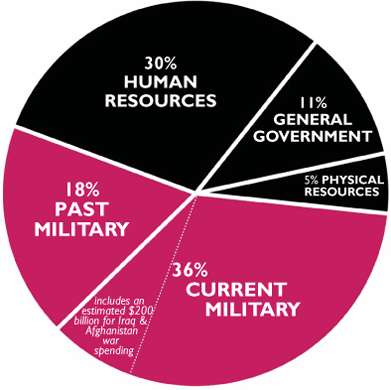
This graph illustrates the essential conundrum of American politics, in my opinion (he added unnecessarily-everything here is my opinion). It's a pictorial representation of the true state of federal budget priorities made plain.  


Not shown here is that slice of the budget pie allocated to the "entitlement programs"such as Social Security and Medicare, and there is a reason for this.  The Social Security program, for example, is a cash-in, cash-out system that has worked since the Great Depression and would have continued working, had it not been for Congressional embezzlement, until at least 2041.  It funds itself through a dedicated system of FICA taxes which have been more than adequate to meet the needs of the retired and disabled; indeed, the surplus built into the system in the early 1980's was designed to create a trust fund that would ensure its future viability.  The Congress Clowns, of course, couldn't keep their oversized mitts off the money, and now the system is on the brink of insolvency.  (This same Congress, by the way, is the one that you and I are counting on to devise a brilliant plan to rescue the United States from the grips of recession.  Yeah, that's going to work.)

And what was Congress doing with the trillions it stole from the Social Security trust fund?  The graph above shows you: playing army.  If you eliminate that part of the federal budget over which Congress acts as little more than a clearing house for collecting money from working people and sending it to retired people, you are left with about $2.5 trillion in "revenue," consisting of income and other (non-FICA) taxes, the money looted from Social Security and the inevitable borrowing. (Why does the federal government borrow money? Because it can.)  54% of this money is spent on the military and homeland security, one way or another, including that part of the national debt service properly attributable to military spending in the past.  We build things like the F-22 bomber, which is essential to our defense against Russian Migs discontinued in the 1980s, but unfortunately can't be used in Iraq because of the sensitivity of its electronics to the garage door openers used by insurgents to detonate IEDs.  We build aircraft carriers so it will be a fair fight against the Japanese Imperial Navy if they move on Pearl Harbor again. We build lots of tanks and half-tracks to guard against a land invasion by the Soviet Union through the Fulda Gap in case that East Berlin situation becomes a hot spot again.  And so forth.

Does the United States actually need to spend as much as the next 15 largest militaries in the world combined, particularly on the kind of weaponry, ships, tanks, bombs and planes suitable for fighting World War II again?  In truth, thermonuclear weapons have made conventional war against other nuclear-armed countries impossible.  The United States cannot start a "conventional war" against Russia, for example, on the expectation the war will remain contained.  Or, for another example, if you wonder why Syria, Egypt and Jordan never invaded Israel again after the Yom Kippur War of 1973, look no further than the Israeli nuclear arsenal.  In the absence of large-scale enemies where it is feasible to use our large-scale military in a conventional war, at least without bringing about the end of human civilization, we have instead embarked on a program of keeping our forces experienced and cutting-edge by fighting unnecessary wars in Vietnam, Grenada, Panama, Somalia, Afghanistan, Iraq, et cetera, and then using these unnecessary wars as the rationale for maintaining a large conventional military in case we need to fight an unnecessary war in the future.

The United States spends well over a trillion dollars per year on defense and homeland security, when you add up the basic Pentagon budget, the "supplementary" appropriations for our vanity wars in Afghanistan and Iraq, the nuclear budget in the Department of Energy, all the espionage agencies (many of them redundant) and the debt service on past budget overruns.  No one in a "serious" position in Washington, including Barack Obama, ever talks about reducing military spending to a rational level commensurate with our true security needs.  

It is yet another illustration of the complete impotence of the federal government in dealing with real problems.  It is locked into ideologies and certain "idees fixes" which it cannot escape, so it begins its confrontation with reality, each and every time, with the result determined in advance.

February 11, 2009

I guess we don't need to worry about Barack's "connections" to Bill Ayers


Is that the whole camel in the tent now?  This is from the editorial in today's New York Times concerning the position taken by Obama's Department of Justice in the case of Mohamed vs. Jeppesen in the Ninth Circuit Court of Appeals, which, admittedly, sits in San Francisco rather than in the formal territories of the United States.  Still, read on:  


The Obama administration failed — miserably — the first test of its commitment to ditching the extravagant legal claims used by the Bush administration to try to impose blanket secrecy on anti-terrorism policies and avoid accountability for serial abuses of the law.

On Monday, a Justice Department lawyer dispatched by the new attorney general, Eric Holder, appeared before a three-judge panel of the United States Court of Appeals for the Ninth Circuit in San Francisco. The case before them involves serious allegations of torture by five victims of President Bush’s extraordinary rendition program. The five were seized and transported to American facilities abroad or to countries known for torturing prisoners.

And what that dispatched lawyer told the 9th Circuit is that the Mohamed case must cease because it invades the "state secrets" of the federal government.  Much to the surprise of the three-judge panel.  So the good news is that all of those Right Wing noise-makers who were so concerned about Radical Barack can calm down. Meet the new boss, same as the old boss.  It is becoming apparent that Barack Obama is a profoundly conservative politician who has absolutely no intention of doing anything which will in any way embarrass his predecessor and whose first instincts are authoritarian rather than civil libertarian.  To gain a perspective on how surprising this move by Obama's DOJ before a three-judge panel was, one can read the estimable Glenn Greenwald, linked to the right, who's been writing extensively about this development.  He's right, as usual, and he's joined by Andrew Sullivan, the ACLU, the lawyers at Balkinization, and, well - me. 

I don't quite get it, actually.  In the first place, there are no "state secrets" left in the Mohamed case, and not much with regard to the rendition/torture subject in general.  Seymour Hersh has written extensively about it, the Swedish government paid a large damage award for their role in the illegal capture and rendtion of some of the plaintiffs in this action, and the case at issue is not actually directed against the United States.  The action names the "travel agent" for the CIA involved in the logistics of illegal capture and rendition.  It's a private lawsuit.  As Ben Wizner, attorney from the ACLU,  has said, the only place where people are not allowed to talk about this matter of common knowledge is in a federal court room.

Barack Obama, as a Constitutional lawyer, must realize this is a ridiculous extension of the "state secrets" doctrine.  While he has declared that the practice of capturing foreigners and shipping them to countries known to practice torture, a program known as rendition and tantamount to a war crime, will not be part of his approach to anti-terrorism, his DOJ refuses to allow a factual investigation of just such a case which occurred during the Bush years.  Since no discovery of an actual, extant program can occur if the program no longer exists, the only plausible reason for using the "nuclear option" of the state secrets doctrine to blow Mohamed's case out of the water is this:  Obama is worried that a detailed description, in open court, of the ways in which the plaintiffs were detained, drugged, chained in the belly of a plane, and taken to places like Egypt where they were electrocuted and savagely beaten (as the United States knew they would be) would add impetus to the calls for war crimes investigations of the Bush Administration.

And Obama doesn't want that.  He wants to look forward, not backward.  It is becoming apparent that Obama is a master temporizer.  No one is above the law, but we must face the future, not the past.  Something like that.  

Anyway, Barack's no radical.  Calm down, Rush.  There's nothing to worry about.  We have a thoroughly conventional President, judged by the standards of the New Normal, which is just about where George W. Bush left things.  He'll upset a few Constitutional "purists' (the unreasonable who believe in the Bill of Rights and Due Process), but he's Mainstream.  I'm sure Bill Ayers would agree.


February 09, 2009

Trying to Avoid the Gorby Syndrome


I've thought for a long time that the closest historical parallel to the current economic and political perplexities in the U.S. is the situation the U.S.S.R. faced shortly before its demise in the early 1990's.  As the Soviet Union did, we have a central government that is in many ways an unimaginative gerontocracy (particularly in the Senate), and which is almost completely unresponsive to the everyday problems of American citizens.  The Soviet Union had its favored oligarchs and Party members, and we have our favored corporations and the revolving door between Washington D.C. and the influence peddlers who control national policy.  Our press is nominally free, but there is a Pravda-like conformity of the Big Media to certain agreed story lines for any given issue. Most recently, for example, we saw the nomination of Tom Daschle to run Health & Human Services go crashing down in flames; what we mostly heard about were his lapses in "optics;" he was a little too obvious about being a pampered lobbyist and didn't pay attention to the tax implications of riding around in a limo all the time on a fat cat's dime.  What was less discussed was that this was the guy Obama chose to revamp the creaking, disintegrating health care "system" in the United States, this former Senator who had grown enormously rich by working for Big Pharma and medical insurers since John Thune did him the favor of retiring him from the Senate.  Tom Daschle was going to put an end to the outrages which Michael Moore lacerated in "Sick-O?"  Look, I've got some shovel-ready infrastructure called the Brooklyn Bridge I'd like to sell you for $10 billion, financing available from the government.


I don't think President O likes the analogy between his situation and Gorby's, but it may be apt just the same, so much so that Google Images even has a picture of Barry with a port wine birthmark ready to go, as above.  Mikhail became the West's favorite Commie of all time, to the point where you forgot, almost, that he was a Red.  Gorbymania swept the world, in fact. The Soviets had glasnost and perestroika, and Barack has "change."  "Change" was never quite defined in Obama's campaign, but we welcomed him, first and foremost, because whoever was elected would not be Bush anymore.  We weren't asking a lot of tough questions, especially since he was running against another Angry Old Man from the Senate with antiquated ideas, a shaky grasp on contemporary America and a sort of omni-directional aggressiveness. 

It wasn't Gorby's idea to break the Soviet Union apart.  Garry Kasparov, former chess genius and current Russian activist, never saw Gorbachev as anything more than another Central Committee apparatchik with charm and a new line of baloney.  It's not Barack Obama's intention to preside over the disintegration of the United States, either.  That's why his first instinct was to gather around him, like defensive ramparts, the stolid, time-tested Clinton Politburo to advise him on how to light a fire under the U.S.A.'s previous go-go consumer economy.

In the living quarters of the White House, Barack must have a dart board with Bush's face as the target because I can't imagine how dismal it must feel for Obama to spend the first three weeks of his glorious ascension dealing with something so soul-killing boring as this "stimulus" "package."  This is what it's come to, thanks to decades of neglect while the U.S.S.A. rotted from the inside out.  Obama is presiding over a loan app.  He needs to re-fi the United States, so first he has to pull together a business plan for his creditors in Beijing and Tokyo and Riyadh to pore over.  ("$27 billion for highways?  Too much. Knock that down.") The bowdlerized, diluted, universally-viewed-as-useless piece of dreck the Ancient Mariners in the Senate came up with will (a) increase the national debt enormously while (b) maybe delaying the inevitable for a little while.

I read in Paul Krugman today that without the stimulus bill the U.S. GDP would contract about $2.9 trillion over the next three years, to which one might say, first: and your point is?  That is less than $1 trillion per year, or about 1/15th of the present American GDP, which is 25% of the world's GDP.  So about 6.67% contraction per year.  Not to be flippant or hard-hearted about this, but we can't abide that?  We don't have the internal resources, the innovative spirit and adaptability, to figure out how to arrange things differently so we can have an envirnomentally-sustainable economy?  We have to go back to that ruinous "growth" economy because there are no other options, or we're too impatient to figure out what they are? We prefer the reckless alternative of going broke trying to defib the corpse of the American consumer economy?

That stimulus bill just looks awful.  Note how they starve, as always, mass transit and my own hobby horse, inter-city high speed rail.  We never do anything fun.  Government spending aimed at certain high-tech innovations (such as solar and wind energy, desalination, and the aforementioned choo-choo) would get us somewhere and create a lot of jobs.  But not business tax cuts.  Not more freeways and offramps.

Congress just can't do it, anymore than the Politburo or the Presidium or the Central Committe could do it, past a certain point of collapse.  Congress is locked into certain failure modes it cannot escape.  Maybe some people are born Gorbymaniacs (that would be Mikhail himself), others achieve Gorbymania and some have Gorbymania thrust upon them.  I think O may fall into this last category.

February 07, 2009

American Economy and Other Entropic Processes


Graphically illustrated here, we have the history of the top marginal tax rate in the United States of America from the inception of the income tax in 1913, brought to you by the Sixteenth Amendment, through 2003, when the top rate was reduced from the Clinton era rate of 39.6% to the present 35%.  

It's all there, if you look closely.  As with any new toy, the income tax was taken out for a spin by the central government as soon as the law was enacted, the top rate zooming to nearly 80%. The rate was just as precipitously reduced at the outset of the Roaring Twenties to 25%, under the leadership of three consecutiItalicve Republican presidents, Harding, Coolidge and Hoover. These three,  in cahoots with Congress, were the original "supply siders," believing that low taxes on the rich would foster growth and prosperity through trickle down mechanisms.  And so it did, for awhile, and America's economic fortunes improved along with the rest of the world following the catastrophic destruction of World War I.  And also, as the low tax rates were maintained and the financial sector was allowed to run wild with unlimited margins and unsupervised stock markets, the pro-fatcat regime led to the kind of unbalanced wealth distribution not seen again until...now.   Sic semper gloria mundi.

It all crashed in 1929.  Roosevelt, the original creator of the Mother of All Stimulus Packages, the New Deal, had one enormous advantage, visible in the chart above, not available (in any practical sense) to President O.  He could draw upon the accumulated wealth of the country, and that of the plutocrats still earning big money, through the income tax, pushing the top marginal rate from 25% to 80% in his first two terms in office. As World War II reached America's shores, the populace tolerated a confiscatory top rate of over 90%; you see, in those days Americans thought that if the country was at war, it must be something pretty important.  Something worth sacrificing and paying for.

Such quaint ideas.  So World War Twoish. Under George W. Bush, no sacrifice whatsoever was asked of America's disaffected, indifferent masses, the ignorant armies watching TiVo by night. The tax burden was lightened during the Afghanistan and Iraq wars even though these conflicts were ruinously expensive.  But W, after all, was simply a child of his times.  That's how we do things now.  America is not really a nation anymore; it's a market, a demographic, a place to network and make your money,  keeping as much as you can.

That's why the modern "Recovery Act" cuts taxes as part of its program of spending $1 trillion to stimulate the economy.  No one is suggesting that the top rate of 35%, applicable to incomes over $300,000, be increased at all.  No one is suggesting that the FICA tax apply to incomes over its present maximum of $100,000.  Why isn't Congress suggesting something so obvious, so fundamental, particularly with Roosevelt's example to light the way?

Because Congress works for the people whose taxes would be increased.  See how obvious all this becomes with a few simple charts and graphs?  Congress members now tell us, Democrats & Republicans alike, that raising taxes damages economic growth -- this is not something the government does during a downturn.  Huh?  What exactly then was Roosevelt doing in the 1930's?  Suppose we raised the top tax rate to 50% for all incomes over $1 million per year. It would raise a lot of money; is anyone seriously suggesting that the increase of 15% would cause those big earners to stop making money?  Lebron James and A-Rod would hang it up?  Those Fortune 500 CEO's whose incomes average $400 million per year - not worth it anymore?

Yet it's politically unthinkable, isn't it?  So here's something else that is unthinkable: that this "stimulus" plan is going to work.  It can't.  It violates some fundamental thermodynamic rule of money.  If the citizens of this country are not willing to pull together collectively and put each other to work by paying for the government projects contemplated by the Recovery Act, then it's hopeless.  We have to do our own internal redistribution of income and wealth in order for the country to avert catastrophe.  If we are not willing to do that, then the plan will fail.  You cannot borrow your way out of a problem caused in the first instance by excessive borrowing and income inequality.  And beyond that, do we honestly believe that all the foreign creditors who will be asked to finance this enormous outlay at essentially zero return on their investment will not notice that we're not paying for any of it?  That we're reducing our own burdens as our "contribution?"

I'm afraid this one takes the idea of American Exceptionalism way past the breaking point. This is a looming disaster.  We're the ones we've been waiting for?  Will there be another bus along in a minute?


February 06, 2009

Marco Polo In the Court of Congress


That was some riveting theater the other day before the House Subcommittee on SomethingorOther when Harry Markopolos, the avenging angel of the Re-Regulation Forces, appeared to describe to the Committee his futile efforts to get the New York office of the SEC to do something about Bernard Madoff's massive fraud scheme.  For fans of Schadenfreude, it was like Weinachten in February.


The comfy bureaucrats at the SEC had it made during the Bush years, of course, reveling in their sinecures as friends of the High and Mighty. The whole idea was to leave the securities industry alone and let the "invisible hand" of the market work its magic. You might say that certain miscreants took advantage of this libertine situation, and no one more than Bernie Madoff.  Harry Markopolos was himself in the investment game, a self-described expert on derivatives with long experience on Wall Street, and he simply refused to believe that Madoff's "split-strike" strategy for returning about 12% to his investors, in good years and bad, was humanly possible.  So, using a "Mosaic" technique, he spent years investigating Madoff with the assistance of his "team."  He summed it all up in a long letter dated November, 2005, to the SEC, stating bluntly that it was his conclusion that it was "most likely" that Madoff was running the biggest Ponzi scheme in world history.

Markopolos never met Madoff, never interviewed anyone who worked in his organization.  In some ways, what Markopolos did in that letter (which you can find in pdf by Googling "Markopolos letter to SEC") is reminiscent of the work of the legendary Polish cryptologist Marian Rejewski, who deduced the internal wiring and basic structure of the Nazi Enigma machine without ever seeing one, by using permutational mathematical analysis of German encrypted messages.  Truly one of the astounding feats of mental deduction of all time.  I wouldn't put Marko Polo's work in that category, but it's pretty good.  He figured out that (a) Madoff was running a Ponzi scheme, (b) that the amount involved was somewhere between $20 and $50 billion, and (c) that Madoff had been a crook since at least 1991.  All from studying the "performance" of the Madoff fund, Madoff's relationship with the places where he got his money, and Madoff's obsession with secrecy.  A virtuoso demonstration of logical analysis.

Watching Markopolos testify, you couldn't help but think that he probably has a screw loose somewhere.  For one thing, both testifying and in his Nov. 2005 letter, Harry is a little, how to say it, egotistical.  A tendency toward the grandiose, describing himself (with his business degree from Boston College) as one of the few people in the world with the mathematical background to understand derivatives well enough to do the analysis he did. Actually, I read his letter, and on the basis of my own very limited experience with securities litigation, I was able to follow it pretty easily.  You just need to know a few basic concepts, such as what an option is, what a put versus a call is, what "out-of-the-money" means as applied to options, and a few other things, and you've got the basic hedging strategy that Madoff claimed to be running. You don't really need to have a PhD in mathematics as so many of those brainiacs who devised the algorithms for Long Term Capital Management possessed, who might even go a little deeper in math than Harry Markopolos.

That, I think, was sort of the problem with Harry for the SEC.  In addition to his borderline megalomaniac tendencies, Marko kind of presented himself as a Wall Street Maxwell Smart, offering to go undercover, to disguise himself, and warning of the grisly fate that awaited him if his cover was blown.  I don't doubt that physical danger was a serious threat when you're dealing with that much money and with a crook as bent as Bernie Madoff.  But if Harry Markopolos presented about 30 "red flags" in his letter re: Madoff, then the SEC probably found as many red flags about Harry in Harry's letter to them.  Which is what the SEC really wanted to find, because the last thing they wanted to do was to take on Bernie Madoff.

So natually, just as Harry predicted, the SEC sided with Madoff, because Bernie was a Wall Street maven, a Mensch, a power player who was in on the ground floor of the establishment of NASDAQ.  The New York office decided that Markopolos was a jealous whistleblowhard (to coin my own term), maybe a little nuts, and not someone they should allow to tell them what to do.

Man, did they pay for that dismissive attitude.  What's worth YouTubing and playing is Rep. Gary Ackerman's smackdown of the entire top brass (minus the weasly Christopher Cox) of the SEC on national TV.  This New York Democrat absolutely tore the counsel staff a new one in unsparing, scathing terms, telling them they couldn't find their ass with both hands in a room with the lights on. They're all going to get canned, they know that, and anyway they're all mostly holdovers from the Bush Roaring Aughts Era.

The problem for the SEC is that Harry Markopolos, one citizen working with an ad hoc "team," figured the whole thing out right down to the ground.  He was right about everything, astonishingly so, and he was right over three years ago.  How much additional money was lost because the SEC sat on their hands?  Billions and billions and billions.  Markopolos predicted the cascading failures in other hedge funds as the High Net Worths all scrambled to liquidate and cover their Madoff losses, the collapse of the "feeder funds," of private banks in Europe which were heavy into Madoff. Harry saw it all coming, laid it all out for the SEC, and the SEC did nothing.  And then had to sit silently and listen as Harry Markopolos described, in excruciating detail, their incompetence, their corruption and their utter worthlessness.

One of those days where it just feels good to be alive.  Thanks, Marko Polo.

February 05, 2009

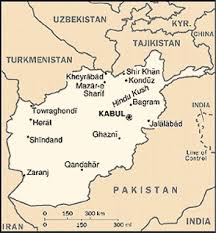
Why Are We Still in Afghanistan?


One thing you learn by writing down your thoughts on a semi-regular basis, as Ralph Waldo suggested might happen in "Self Reliance," is that you find what appears to you as the apparent lack of logical answers to questions about public matters reflects the real absence of logical answers to those same questions.  Which is to say, if you trust your own instincts about matters of poltiical concern, you often find that what parades as "conventional wisdom" is simply the repeated formulations of "opinion makers" who want to sound very Serious and who wish to speak the language of other Serious People who shape public debate.


I think this tendency grew exponentially worse during the Bush years because The Decider ushered in an agenda of Mass Stupidity that distorted rational discourse beyond all recognition.  The war in Afghanistan is an excellent, perhaps the prime, example of this destructive effect.  Afghanistan is widely regarded as the "good war," the one we definitely had to fight after the terrorist attacks of 9/11.  No dissent from this view was allowed, on the Right (certainly) or even on America's "Left."  Everyone from James Inhofe (Troglodyte,-OK) to Al Franken agreed that Afghanistan must be invaded.  An opinion in favor of invading Afghanistan was the one true sign of an American Patriot.  No ifs, ands, buts, cavils or misgivings allowed.  It had to be done.

"It" is still going on.  It's now 2009 and the invasion began in the fall of 2001.  This war has now been going on (a) twice as long as our involvement in World War II and (b) somewhat longer than the main part of the Vietnam War.  The theory was that Afghanistan provided a "breeding ground" for terrorists, or a "swamp" that must be drained, a reference, I guess, to anti-malarial measures taken in tropical countries.  Osama, Zayman, Atef, all the bad guys were there. Plus, the Taliban were mean to women, unlike, say, the Saudis.

The 19 guys who flew planes into the World Trade Center and the Pentagon were not from Afghanistan.  Had they ever been to Afghanistan?  I would like to see the federal government prove it with testimony other than that of the Gurgling Confessor, Khallid Sheikh Mohammed, who is quoted extensively, not to say exclusively, in the Report of the 9-11 Commission as the source of this evidence.  Now that we know what we know about torture during the Bush years, is there any reason to rely definitively on this testimony?

What we do know is that the 19 Arabs were Egyptian, Saudi, Lebanese, UAE and Yemeni.  The main plotters formed their cell in Hamburg, Germany, as members of the same mosque, and did their flight training in the United States, as well as most of their logistical planning.  Hey, don't take my word for it; read the Commission Report.

A whole war against Afghanistan seems pretty dumb in such a context, but then George W. Bush was a very dumb guy.  The urge to do something about 9/11 was definitely on his side, however, no matter how dumb. So we invaded the hated Taliban, who may have provided sanctuary to a guy who may have met with some of the guys who actually attacked us in September, 2001, and we came with the full force of the U.S. military, and it was a sterling victory until it fell completely apart.

However, then the Afghanistan War caught its big break.  Bush outdid his own stupidity by launching another war against another irrelevant country, this time Iraq.  Now the war in Afghanistan acquired the cachet of being the smart war that "Liberals" could favor, that should have been "finished," and the comparison, no matter how inane, allowed Democrats to appear "tough" and "belligerent" while at the same time exhibiting superior judgment and leadership.  It also allowed Barack Obama to promise a "surge" in Afghanistan once he was elected, the dumb war he favored over the war in Iraq which he had famously called "dumb" when Bush was running it.

It's as if a guy starts a grease fire in his kitchen and then while casually and desultorily fighting it with an extinguisher, decides to start another fire in his bedroom.  The kitchen becomes the "smart fire" which must be put out even though the dumb fire in the bedroom will also burn his house down if it keeps burning.  "It was dumb to start that fire in the bedroom while I was still dealing with that grease fire," Joe, the distraught homeowner said to reporters in front of the charred ruins of his house.  "I thought Joe was dumb to start that bedroom fire.  I thought the grease fire in the kitchen was the smart fire, the one I would have fought," said Dirk, his neighbor, who's a pain in the ass.

The theory in both Afghanistan and Iraq is that there is some magical, unknown point, if we just stay long enough (forever, even), where both of these Muslim countries, thoroughly unpracticed in the tradition of Western democracy, will become stable, enduring, reliable strongholds of liberty.  This is completely crazy.  Once we leave both places, absolutely anything may happen in our absence.  It is likely that both Afghanistan and Iraq will degenerate along tribal lines or devolve into dictatorships or military juntas, and go through the cyclical periods of unstable democracy and despotism found in modern Pakistan or Iran, just as two, highly relevant examples.

Meanwhile, bin Laden and Zawahiri are still at large.  They could still get messages to another group of 20 Arabs, I suppose, and come up with something else.  What do these wars have to do with that?  Were those jungle gyms actually essential to hijacking American airplanes?

February 04, 2009

Last Train for the Coast


I heard Don McLean's full-length version of "American Pie" on the oldies station yesterday and realized that exactly 50 years had passed since a small plane carrying Buddy Holly, Ritchie Valens and The Big Bopper crashed in a storm in Iowa.  February 3, 1959, the day the music died.  The three men Don McLean admired most Went West on that fateful day.  Buddy Holly would have appreciated the subtle irony of McLean's lyrics: that'll be the day that this'll be the day that I die.


The imagery of the song conveys a loss of innocence in the decade that passed between the plane crash and McLean's great breakout hit.  Asked what all the references were, what the song meant, Don just said the song meant that "I'll never have to work again."  McLean was born a year before I was, and I know what he was writing about.  It's all there, James Dean, Bob Dylan, The Beatles, The Rolling Stones, the last Candlestick concert, Altamont, Janis Joplin ("I saw a girl who sang the blues, and I asked her for some happy news, but she just smiled and turned away...").  All the formative icons of my own youth.  We had that one somnolent decade, the Fifties, the era one Beat called "The Air Conditioned Nightmare," and then America started happening at warp speed. Race riots, Vietnam, four dead in Ohio, the breakdown in trust between rulers and ruled.

I kind of felt for James Howard Kunstler, the Clusterf**k Man linked to the right, as I read through his latest paean to a Gone America a couple of days ago.  He always writes as if he's trying to summon some idealized future into existence, but I think what he's doing (as another almost exact contemporary of mine) is trying to invoke a vanished past.  He wrote about his recent trip to Montgomery, Alabama and the "asteroid belt" of chain stores, strip malls, "muffler shops," fast food joints.  He was even a little hard on the old town center around the Capitol, depicted in my own photo of Dexter Avenue up above, taken from the street in front of Dr. King's Baptist Church.  It's not all that bad around the state house, I didn't think, but I do know what he means about the asteroid belt and the faded green and ocher color of the land around Montgomery. It was approaching Montgomery from the east on old U.S. 80 five years ago that I first realized that my sketchy recollections of the Old South had no counterpart in contemporary reality.

I owe to Mr. Kunstler the data bit that about 70% of all manmade structures around us in America were built (or thrown up) since about 1950, so the America that Buddy, Ritchie and the Bopper said goodbye to a long time ago has been fundamentally altered in the decades since.  Not just the music and the simplicity, but the basic look of the place is very different.  I grew up in a subdivision built right at the beginning of the post-War boom, so in some ways I never knew anything else.  I understand what the Celebrated Mr. K is writing (and grousing) about, completely, this uglified look of the American Crapscape. Still, I don't think it does much good to live in a fugue of constant revulsion, to exist in an emotional war with your senses as you drive around America and take it all in.  James is just one of those exquisitely aware souls who reacts (violently, almost) to the depredations of modernity, to the abolition of beauty. For better or worse (and it's decidedly worse), this is what we came up with when we decided to "develop" the suburban areas of America. It's hideous. Almost all of it is an unrelieved horror, punctuated only by the enclaves of the wealthy, where Nature is allowed a tenuous continuity. (You see, it's not that we don't know what's pleasing to the senses; we just don't think it's important for anyone who can't afford it.)  

You have to take from that what you can.  The aesthetics are intellectual, that's for sure.  You can glean something of an understanding about how humans relate to one another, the kinds of habitations they will build for one another to live in (to wit: a maximized return on investment achieved by building dwellings at the lowest possible level of acceptability), and how we relate to Nature, that is, by completely obliterating all sign of it.  That is something to know, however.  Something you pick up during your journey of life.  As Thoreau said, a single Truth is enough for the seeker.

Not strange, then, that we look always for that transcendent moment of grace. Even when February makes you shiver, you're glad for the great ones who made the journey with you, and made it all a little easier to take.

February 03, 2009

The Quiet Presidency of Barack Obama


I have to admit that I find President O's governance of the country a little boring.  I wonder if he does.  I imagine the early thrill of all the job perks is beginning to ebb a little.  Has he been to Camp David yet?  He doesn't have a ranch, or a seaside compound to escape to, the way the Republican presidents did.  No Drama Obama, his campaign staff called him.  He just works hard, isn't given to histrionics or nervous fits or Freudian acting-out, like his predecessor.


A big problem is that the main subject matter of his presidency is intensely boring.  How much can we talk about this stimulus thing without our eyes glazing over?  It's dull.  It's a big, messy, incomprehensible hodge-podge of farm subsidies, financial aid to states, FICA tax reductions, medical insurance extensions, blah blah blah.  I tried reading some of the Senate version.  It's over 750 pages long.  I think that's one of the ways the solons protect themselves. No one, not even the legislators themselves, could be forced at gunpoint to read one of those things all the way through.  No one at a major newspaper is ever going to read it.  A cable news anchor would never waste his time reading so much as the preamble.  So no one can tell, in advance, if it's going to work because no one is ever going to have a handle on the thing.  It's a simultaneous equation with 750 unknown variables.  It's hopeless.

So all O can do is go from conference to conference and talk about the "urgent need" for this perplexing enactment, that is, when he's not deflecting questions about why his latest Cabinet appointee failed to pay $140,000 in taxes.  That's what his presidency has been about so far, Cabinet heads who amend their tax returns and this gargantuan spending bill.  The glamorous stuff all has to wait, I guess, the brilliant moments when Hamas and the Likud dance the hora, America signs the successor protocol to Kyoto, Guantanamo closes, the solar and wind electricity grid is up and running, everything is all green all the time.

That is, after we raise $4 trillion to recapitalize the banks, get all the troops out of Iraq and Afghanistan, and find the bottom of the real estate market and the top of the unemployment rate.  Being realistic about things, just the clean-up operations are going to consume Obama's first four years.  This is what happens when a huge, powerful country with many negative trendlines, many financial and economic and environmental disasters waiting to happen, decides to hire someone as President, back in 2000, who is completely incompetent, and whose every initiative tends to exacerbate the degenerative processes underway.  And then that country doubles down on its bad choice by rehiring the clown in 2004 so he can finish us off.

No doubt a person as comprehensively perspicacious as the present incumbent is quite aware now of the true depths of the disaster Bush has left him.  It is such a clusterf**k that there is simply no time for politics.  The blogsters and the conspiracy theorists and the Alexander Cockburn and Ralph Nader types who absolutely must see that all parties and all politicians are essentially alike must read into every little Obama nuance confirmatory proof of their underlying thesis.  In fact (and despite my own indulgences in this tendency), there are major differences between the Democrats, the party of the Enlightenment, secularism, science and due process, and the Republicans, the party of theocracy, obscurantism, intolerance and a priori reasoning.  The Republican President and that awful Republican Congress between 2001 and 2007 absolutely, totally, and ruinously ran this country into a ditch from which it may not be able to extricate itself.  

Obama simply could not be more different from Bush, in every way imaginable.
It's the difference between a person who thinks and a person who spastically twitches instead of thinking.  It's the difference between a smart and deliberative person who uses his mind in a systematic way to comprehend complex problems and a brain-damaged clown who lurches from one stupid move to the next.  I only wish I could hear what Barack actually says, in private to his advisors or to Michelle at the end of another interminable day, about the true depth of the piles of steaming crap left by Bush for O to handle.  And I think I know what that "note" was that Bush left for Obama in the Oval Office:  "You're screwed. Hehhehheh."

Little by little President Obama is leaking out the horrible news to us.  Such as that $4 trillion number to stabilize the American banking system.  To put things in perspective, when America was in comparatively better shape, say in 2004, we were nonetheless borrowing about 65% of all money borrowed by any country in the world.  That's how much we ask the world to subsidize our irresponsibility, so we can play GloboCop.  If half a trillion represented 65% of all borrowing, how much will $2 trillion, this year's likely deficit, represent?

It doesn't even compute. Prez O is in unchartered territory, a potentially disastrous problem where the solution may not be possible.  Well, here's a direction we might look:  

"Militarization does not help resolve the problem but only pushes it back, taking from the economy vast financial and material resources that could be used much better elsewhere. I'm confident that reasonable constraints on military spending along with the strengthening of global security will ultimately yield economic dividends."

I think the guy who said that might be on to something.  It was Vladimir Putin of Russia, a few days ago at Davos.  Maybe he's sincere.  Maybe what he's been looking for, like so many other people in the world, is someone leading the United States who doesn't spend his time peering into souls or hearing voices telling him to "attack!" but just wants to have an intelligent conversation about real solutions.  When things are this bad, maybe even something that crazy could work.

January 31, 2009

Aspiriational Apocaphilia


A term I first encountered while reading a writer named R.J. Eskow, who weighs in periodically on various political blogs. I think the terms refers to the state of ecstasy some writers appear to achieve while composing jeremiads to the imminent downfall of Western Civilization.  Eskow cites as a prime example James Howard Kunstler, whose "Clusterf**k Nation" is linked right here on this page.  Admittedly, there is something orgiastic about Mr. Kunstler's weekly downers, in which he excoriates the United States for being fat, tattooed and stupid, calling America a "clown nation" that cannot do anything right.  He is also absolute in his conviction that we're incapable of any sort of technological fix for the problem; to make certain there's no hope, he relies upon his deus ex machina, Peak Oil.  So even though electric cars are actually right around the corner, and entire countries like Israel are figuring out how to run a national fleet of electric cars on an electrical grid powered by wind and solar, he'll have none of it.  It cannot work, he says, with religious conviction. It's so obvious that he doesn't even bother to explain why it cannot work.


I think he's wrong about that, way wrong in the way that those who are confident about foretelling the future are usually wrong.  The imagination of a single person is unequal to the task of encompassing the unfathomable permutations of scientific discovery in advance.  There is much too much interplay among ideas, synergies of discovery, unanticipated brilliance, breakthroughs, genius - indeed, it is quite arrogant to discount it all on the basis of an emotional predisposition to be pessimistic. Hamlet was right when he told Horatio that there were more things in Heaven and Earth than dreamt of in his philosophy.

What's causing the collapse of the U.S. economy right now is simpler than Peak Oil or Conspiracies among the Illuminati.  What we're seeing is that an entire country, acting collectively, has behaved in ways depressingly similar to a procrastinating, careless individual.  Mr. Kunstler, for example, derides the USA for not doing "productive" things, but he himself is a novelist and a writer of doomsday books.  Knocking the U.S. is a gig, in other words, but it is not a "productive activity" of the kind he urges on the rest of us Americans.  Neither is blogging or the Blogosphere in general.  These are more symptomatic of what's wrong than they are "productive activity."

The United States, as a nation, succumbed to the temptations of great affluence and power.  We have numerous historical antecedents for this behavior, most particularly the Roman Empire.  Take, as one simple point of entry, the current "crisis" involving Social Security.  Congress, to its initial credit, saw this one coming back in the early Eighties and upped the FICA tax to create a surplus.  Congress then proceeded to spend this surplus; one can measure the amount of surplus spent by reference to the multi-trillion dollar portion of the national debt owed to internal "trust funds."  Among other things, the surplus was spent on defense and security.  Seminal economics work, such as that by David Aschauer of the same period (1989), demonstrated that military spending by the government is the least productive form of "infrastructure" investment, and that growing economies, such as China, instead invested in schools, mass transportation, improving the electrical grid and water supply, etc., instead of an army and weaponry.  It's a commonplace observation that the U.S., spends as much as the rest of the world combined on defense, so it is engaged either in (a) complete irrationality or (b) complete corruption by MIC lobbyist influence. Either way,  this form of waste has crippled all other social spending and has foreclosed our ability to have a humane medical system for the citizenry.

Similarly, it was obvious that doing nothing to protect Americans from the huge numbers of relatively high-paying manufacturing jobs sent overseas, and even providing tax incentives for multi-nationals to do so, meant that the USA would devolve into a "consumer society" dependent on imports with our own productive capacity hollowed out.  This "globalization" mania, urged on by President Clinton and his advisor team of Casino Capitalists (Rubin, Summers, etc.), and cheerleaded by "influential" writers like Tom Friedman, left us with no alternative but to ship all our money overseas and hope foreigners would lend it back to us.  

We did nothing about the energy problem, of course, despite the clear warnings from President Carter in the late Seventies.  We allowed dependence on foreign oil to hit the 70% level.  But with or without the added insult of Peak Oil, these other trends have come home to roost.  We invested in what is really the least productive form of capital "hardware," vast subdivisions of new houses.  Houses are good for living in, but they are not places where a country makes any money or gets things done except when they are (a) being built or (b) being bought and sold, and then only at the margins.

Analyses of how we got here tend toward the excessively Byzantine.  It's not really all that complicated.  No one was minding the store.  No one was planning.  It was plain as day what was coming, and many people described it in highly accurate detail.  Nonproductive societies cannot create wealth out of thin air by financial games, not forever anyway, and certainly not by taking on excessive debt.  

America is actually one of those charmed places on Earth which probably could be almost totally self-sufficient with enlightened leadership. We could grow all of our own food and we could meet all of our energy needs by harnessing sun and wind, bridging our way there with the use of natural gas, coal with sequestrated carbon emissions, cellulosic ethanol, nuclear energy  and geothermal.  There would be plenty of work and it would be economically sustainable.

Instead we got what we got.  We're broke, dependent on the kindness of foreigners, and we're entering a prolonged period of completely unnecessary shortages and privation.  But I don't feel "philiac" about it all; it's a damn shame.

January 29, 2009

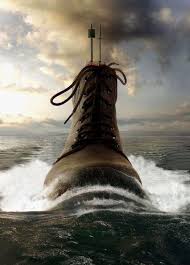
Will Das Boot Rise from the Bottom?


In a great scene from "Das Boot," the German movie about the horrors of submarining in World War II that was perhaps the most effective anti-war movie ever made, the captain and crew are trapped on the bottom of the Mediterranean near the Straits of Gibraltar.  The submarine has been damaged by Allied fire, and the only chance for survival rests on the ability of the strange, selpulchral, hollow-eyed chief engineer who is attempting to jerry-rig enough battery power to blow the ballast tanks so Das Boot will rise.  The crew sits quietly waiting while he works; the ship is running low on oxygen, the tension is overpowering, and they all know they have one chance.  If the power surge fails, they're doomed to suffocate on the bottom of the sea (the fate, in fact, of most German submariners during the war).


While we go about our business here in the Heimatland, Captain Obama and his chief financial engineers are rigging up a similarly desperate fix.  If you look at the figures for growth in the national debt for the period ending September 30, 2008, you will note that the number increased by $1 trillion, the largest annual leap (by about a factor of 2) in U.S. history.  As we know, however, we ain't seen nothin' yet.  All the subsequent bailouts and the impending recovery jolt of $800 billion are surely going to result in a measured increase this September in the two to three trillion dollar range.  It goes without saying the United States does not have this kind of cash lying around.

So it must be borrowed.  Sales of Treasury bills have been brisk over the last year, even at highly depressed interest rates, because there's nowhere else for money to go.  Money pouring out of the equities market has been redirected into these zero-growth instruments on the theory at least they're "safe."  But supposing that the deficit really does go to $2 trillion or above: with the money already squeezed out of the stock market, are there enough sovereign wealth funds and individual investors around to buy up this much debt?

The foreign creditors, such as central banks in Saudi Arabia, the Gulf States, Japan and China, have reliably recylced trade surplus dollars on the order of $700 billion per year.  While this is nice as a historical fact, there are two problems going forward.  First, the USA is not such a reliable trading partner anymore because the American consumer is cash-strapped.  That $700 B figure is probably shrinking as we virtually speak.  The second is that a donation on the order of $700 billion, even if possible, is not nearly enough.

The neat trick employed by the fulminating Congresspeople at hearings and Mike-Stand Moments is to talk angrily about the "taxpayers" and how they're being robbed by the necessity of bailing out all the banksters.  It's true that the "taxpayers" have been asked historically to pay interest on all this money borrowed, but we're obviously losing contact with any ability ever to pay back the principal amount.  The national debt is now approaching one year's total GDP for the United States.  We're not going to shake that money out of our sleeve. All the taxpayers can do is provide the cash flow on which more massive borrowing can be based.

So what happens if the funding sources simply aren't there?  If the money can't be borrowed because there just aren't enough dollars lying around the world in the hands of people willing to buy Treasury notes? What then?  I think I can say that I have never heard a politician of either party, or the Chairman of the Federal Reserve, or the Treasury Secretary, or even Paul Krugman, address this question directly (of course, in a recent column Prof. Krugman opined that budget deficits weren't that "big a deal, because it's basically money we owe ourselves," a head-scratcher if I ever heard one. I think Wen Jiabao would answer, "Speak for yourself, Caucasian.")

President O, who would really like to be "transparent" (I do believe that), probably wrestles with this conundrum every night. The limited intellect of his predecessor shielded Bush from similar anguish.  Should Obama lay it out, that maybe there just isn't enough money to make this thing work, that we can "appropriate" all we want, but if you ain't got it, you ain't got it? 

I think it would be good if someone just laid it out for once.  At least describe the risk of insolvency so the populace would know where we're at.  The captain of Das Boot told his men ahead of time that they had one shot at clearing the ballast tanks.  They knew what they were up against.  So that when the sub began to lift up off the bottom, ever so slowly at first, they knew what they had escaped.

January 28, 2009

I'm Skipping Davos This Year


Admittedly,  a little grandiose.  I wasn't invited and there's no auditing allowed.  Security in Davos (pronounced Dah-VOHS, if you care to get it right) is tighter than a drum.  That's because a lot of troublemakers think the annual meeting of the World Economic Forum (WEF) is just an excuse for a lot of celebrities to convene and be rich together.  To network with other greedheads so they can all get richer. Personally, I would like to see the WEF merge with the WWF so Vlad Putin and George Soros could meet in a fight-to-the-death cage match.


If you want to protest, the Swiss will let you hold up placards in, say, Zurich or Basel, but you're not getting anywhere near Davos, the highest city and biggest ski area in Europe.  The WEF is a non-profit organization dedicated to "global issues" like the environment and world health.  Hard to get more global than the environment, I suppose.  Arianna Huffington is going and wrote an excited blog on the eponymous HuffPost about all the forums she'll be attending, with names like "Empowering the Netroots for Change in a Changing World."  I made that up, but it doesn't make any difference. The real titles are equally meaningful. The WEF has been holding Davos since 1971.  That corresponds pretty neatly with the expansion of the biggest wealth disparity between rich and poor in modern history.  Also, the accelerating takeoff of CO2 concentration in the atmosphere, the death of 95% of all large predator fish in the oceans, the disappearance of Arctic sea ice, the pandemic of AIDS and the looming disaster of bird flu. Just the jets flying into Switzerland for this shindig alone probably moved us five years closer to the greenhouse tipping point. Some deep ecologists (such as those quoted in James Speth's "The Bridge at the Edge of the World") rate the odds of Earth being habitable for humans in 2100 at no more than 50/50.  But if you're a glass-half-full person, you might say that without Davos maybe it would be 50/50 next week.

I wrote Arianna in the comments section and asked her the question the Beatles once asked:

How does it feel to be
One of the beau-ti-ful
Peo-ple!!?

The HuffPost wouldn't accept it.  Did I hit a nerve?  Globalization, of course, has been a disaster for everyone except for people who go to things like Davos.  It has allowed huge multinational corporations to ride roughshod over local law and custom so that poorly-paid workers (dark melanin) can make stuff and sell it to people who used to make it themselves (less melanin), thus bringing about a new "global" standard of living for both light & dark, that is, dirt poor. Much as the much-maligned Karl Marx predicted; hey, just because he was an evil Commie doesn't mean he wasn't right.  But as Freud said about Marxism, Karl was right about the greedy self-centeredness of humans which leads to exploitation, but his solution won't work because of the greedy self-centeredness of humans.

I'm dreaming of a White Dah-VOHS!
Just like the ones I'll never know,
Where the ass-holes gather
To drink and blather
And watch...fat cats in the snow...

The last line is Bono's summary take on Davos.  We'll breathlessly await dispatches from the slopes.  Thank God these beautiful people are hard at work, looking out for you and me.

January 26, 2009

America's Economy as a Black Hole


I'm sure you share my fascination with the encroachment of scientific terminology on everyday conversation.  It's especially prevalent among liberal arts majors, because nothing adds to the gravitas of otherwise completely unprovable assertions like the generous sprinkling of terms like "critical mass, " "quantum leap," "power curve," and "nanosecond" in otherwise banal discussions. If you add action buzzwords like "get it right" to what you're saying, almost all other content becomes superfluous.  For example, if a Congressman thunders that the stimulus plan must have sufficient critical mass to jump start the economy  to get us ahead of the power curve and that we don't have a nanosecond to lose if we're going to get it right, then you know you're listening to a guy who's learned to take himself very seriously, even while having no idea what he's talking about.  


It's important to remember that none of this pretentious terminology actually indicates that the speaker has any quantitative command over the concepts he's pilfering; this is all qualitative bullshit.  I know, because I do it all the time myself.  For example, I love the term "event horizon" because it sounds so spooky and arcane, but I am unable to crunch the formulas to tell you where it is in relation to any given mass constituting a black hole.  Stephen Hawking, on the other hand, can do that.  I do know that the idea black holes suck up all the surrounding mass, no matter how far away, into their vortex (and over their event horizon - mooooaaaahhhhhaahhhhh!) is just fear-mongering; if the Earth were a black hole, it would be about the size of a ping-pong ball, but the Moon would go on circling the Earth as if nothing much had happened other than those annoying deposits of junk on its surface every few decades would stop.  The mass of the Earth would be the same, so its gravitational pull would be nearly identical.  Just, you know, kinda dense.

Black holes occur because of gravitational collapse of a massive object such as a big star, usually when it runs out of fusionable fuel to maintain the internal pressure resisting gravity.  You can see where I'm going with this.  Senator Chuck Schumer (Gasbag, NY) could talk like this if he would just Wikipedia that shit and read about black holes.  Then he could carry on about whether America is approaching an economic event horizon.

Here's my true, honest-to-God thought on this "recovery program."  All the economic experts, such as Paul Krugman and others who are pushing this massive spending solution, do not really know whether it will "work" at all.  They are talking this way because they don't know what else to say.  America is currently in a state of shock and denial about the "apparent" disappearance of about 40% of its net worth into thin air. Poooof! So the American economy, super-star that it was, is running out of fuel to sustain its gaseous, inflated state.  To drive the metaphor into the ground, that fuel (our hydrogen - if only we'd actually developed it!) was disposable income in the hands of the vast unwashed Booboisie, the open-air Jerry Springer Green Room that is my (and your) modern Homeland, Battlestar Consumerica!  Americans, during the Bush "Ownership Society" period, were getting about half that dough by treating their houses like ATMs.  No more, dat kine, as Hawaii's two 84 year old Senators might say for old times' sake, with Punahou Barack chuckling along.

As the "disposable" income vanishes, the national chain stores are all going bust-o, one by one, at an accelerating pace.  Just like a collapsing star accelerates in its collapse as its mass becomes more concentrated.  Shopping malls empty out, the stores close, the crap jobs disappear, house payments aren't made, credit card bills are ignored, banks teeter on the edge of insolvency, et cetera et cetera, as Yul Brynner said.  This description would be fantastic except that it's actually happening as I write and you read.

President Obama, who presides over this mess, doesn't really know what to do.  Nothing in his specific training or education equips him to deal with this enormously complex problem. America is collapsing under its own weight - huge federal and state budgets, corporate pension obligations, an out-of-control medical system, and Himalayas of private debt.  There just isn't enough money to keep it all puffed up.  We're about 40% short of what we need.  But what the politicians don't want to face, or to say out loud, is that maybe that's just where we are now.  They're professional optimists and their job description doesn't allow them to say things like that.  As Patrick Henry would say now, give me false hope or give me death!

So if Obama and the Democrats in Congress are going to fail in such a spectacular way (a singularity - there's another one), they want to be sure they fail in a way prescribed by the consensus of the experts.  It's safer that way.  And the Republicans, who know this massive spending thing is going to happen anyway, can thus oppose it safely, and then if we go bankrupt, or into hyperinflation because of a worthless dollar, they have another way to win, for whatever that would be worth inside our ping-pong ball sized economy.