March 23, 2011

Bad week at the office


As fate would have it, "Fukushima" means "good fortune island" in Japanese. Nature not only sides with the hidden flaw, it apparently loves a cruel joke.


The idea of dropping water into a spent fuel rod pool from a helicopter and pumping seawater into nuclear reactors smacks, just a little, of complete desperation. To say the least, I doubt that you'll find this one in the Nuclear Regulatory Commission's Code of Federal Regulations. This is fly-by-the-seat of your pants stuff. To the left and right above you can see a picture of Reactors #3 and #4 at Fukushima (smoke is rising in the left picture from the twisted wreck of reactor building #3). The current plan, as I understand it, is to reconnect a power supply to the reactors so that the cooling pumps for both the reactor vessels and the spent fuel ponds can be reactivated. Time is definitely of the essence for the reactor in Building #1, which is dangerously overheating and is probably already in a state of meltdown.

A question I have, which never seems to get addressed by normal media outlets (such as the New York Times) is this: does the twisted wreck of steel and concrete in the picture above left really look extension-cord-ready to you? As I've said before, it really does not help public confidence that the level of discussion of such basic points in the MSM is so atrociously stupid.

Reactors 1 through 4 at the Dai-ichi plant sustained, in order, a 9.0 earthquake; a 7-meter tidal wave; ferocious hydrogen explosions; and fires secondary to nuclear overheating and zirconium cladding degradation. That's a bad week at the office. Yet every single event was fully predictable.

In thinking about the "rarity" of nuclear accidents, I recall the observations of the late great Richard Feynman about the space shuttle program. The NASA engineers always assured the public that the odds of catastrophic failure were in the 1 in 50,000 range. Despite this magnificent safety margin, the space program has suffered tragedies at a rate greatly in excess of these odds. Feynman concluded that the odds were simply pulled out of thin air. So too the nuclear power industry. To get the public to accept nuclear power, with its horrific "side effects" of creating huge "dead zones" (as around Chernobyl, a restricted area of 15,000 square miles, the size of Switzerland), nuclear bomb proliferation (from all the plutonium mass produced in boiling water reactors) and unsolvable waste disposal problems (one idea being to fire all the waste into the sun by means of rockets, which would allow us to combine the odds of the nuclear program with the space program), you have to tell the public that it's safe, that the odds of something going catastrophically wrong are just plain minuscule.

Yet in the 40 years since Three Mile Island, we've had the partial meltdown at Three Mile itself; the utter devastation of Chernobyl (which is still getting worse, by the way, as the next big problem might be contamination of the ground water of Kiev, as the nuclear pile continues to melt under the concrete "sarcophagus"); and now, what could be the worst one of all, Fukushima. Are those really such minuscule odds? In what frame of reference?

Let's suppose that the Japanese are finally forced to admit that this is not World War II, the kamikaze spirit has mercifully faded away, and no worker is going to volunteer to walk into these reactor buildings and start rebuilding cooling water pumps and everything else you need to get the cooling systems working again. (Without moving water, there is no way to successfully keep the temperature levels down in either the reactors or the cooling ponds.) So the "sarcophagus" solution is then deployed, burying the reactor buildings under mountains of concrete and sand. Unfortunately at Fukushima, I would surmise that the water table (the Pacific Ocean) is not really very far down at all. Covering up the reactor buildings with concrete and sand will stop the airborne dispersal of radiation and radioactive particles, but all that nuclear crud under the concrete will continue decaying and melting in ways that Enrico Fermi did not really plan on in the squash court at the University of Chicago.

The Japanese know all this, of course, and would rather not talk about the stark reality, which is that there are really no good options. The riposte is to fall back on the Space Shuttle Gambit that all these misfortunes were the weird concurrence of an incalculably rare combination of events. As noted, that's bogus. The plants were built where they were, in the way they were, with the assistance of General Electric, with full recognition that Japan exists at the Western edge of the Ring of Fire, the huge earthquakes are not rare, that tsunamis often follow them, and that a damaged nuclear reactor building would naturally result in a plant built right on the edge of the ocean.

In case you're wondering, the square mileage of Honshu, Japan's main island (where 80% of the land mass and 80% of the population are located), is about 90,000 miles, or six times the size of the Switzerland/Chernobyl exclusion zone. The total land mass of the USA is about 3.8 million square miles; a comparable loss (1/6th) of American land mass would eliminate the state of Alaska (with about 670,000 square miles). Just for a sense of proportion.

I suppose the possible upside of ocean contamination is that Dr. Evil may finally get a fish with the frickin' laser beam attached to its head that he so desperately wanted.

March 16, 2011

Nuke nomenclature


As the MSM commentariat has become stupider and stupider, it becomes increasingly difficult to tell just what the hell is going on in Fukushima, or, alternatively, just what the Fukushima is going on in Hell.


Terms seem to get used interchangeably. "Containment vessel," "reactor building," "containment structure," et cetera. At the bottom of all this ambiguity is the simple reality that the reporters don't really understand what they're talking about. This has become a major problem in recent years as one tries to follow a big story like the nuclear disaster in Japan.

I do not profess to be any kind of expert on Japanese nuclear plant design, but just looking at the pictures and diagrams, it doesn't really seem all that complicated. Working from the inside out, you have the reactor pressure vessel, which is built along the lines of a tank car in a railroad train. It is made out of very thick steel. Inside the reactor vessel you have the nuclear fuel rod arrays which are immersed in water (to slow the neutron exchange and to cool the fissile process).

At the next level, you have the secondary concrete shield wall. This is an added level of safety which was not present, for example, at Chernobyl. This is a steel-reinforced concrete structure surrounding the reactor vessel.

Lastly, you have the reactor building, which is another, larger box (a building) surrounding the other two structures. It's also made out of concrete. One might think of the whole thing as Satan's Russian Doll.

The fuel storage pool is apparently inside the reactor building and above the containment structure, sort of like a shelf or drawer built below the reactor building roof. These are approximate cubes about 40 feet on a side, filled with bluish, boronated water.

Somehow or other, there have been a number of violent explosions at Fukushima reactors Nos. 1,2 & 4, and in one case at least it apparently blew the roof off the reactor building (No. 2) and in No. 4 blew two 8-meter holes in the side of the reactor building. Here is what (among many things) is troubling about the explosion in Reactor #4: it apparently originated in the spent fuel pool. Trying to reason through this logically, how does an explosion blow holes in the side of the reactor building (see diagram above) without blowing holes in the side of the spent fuel pool?

I suppose it's technically possible, but the confused reporting about what's going on never attempts to explain this clearly. This would appear to be the most severe threat posed to Japan, since the spent fuel rods (or nuclear waste) are huge repositories of all kinds of radioactive stuff. If, as the nuclear site reports, there is extensive damage to nuclear cores within several reactor pressure vessels, but the vessels themselves are still intact (as appears to be the case), then the most logical explanation for the very high levels of radiation being recorded onsite would seem attributable not to the occasional steam releases intentionally performed by the staff but to exposed (uncovered by water) spent fuel rods in one or more storage pools fizzing away their radioactive cesium, iodine, strontium, plutonium and other diabolical stuff. Quite understandably, it's hard for the onsite staff to observe what's going on directly because they don't want to go near the thing.

I don't know, and I know the New York Times will never be able to tell me in comprehensible terms. But I suspect that what's really going on is that there is at least one spent fuel pool with holes in the wall, to put the matter simply, and that the coolant water is leaking through those walls faster than it can be replaced (since the Japanese have no good options for replacing it rapidly). And that the spent fuel rods, as a result, are exposed to air, the zirconium cladding is oxidizing away, and a witch's brew of toxic crap is spewing into the atmosphere.

Only a hunch. Nuclear power plants. As one guy said way back in 1980, it's a lot like using a pile driver to crack walnuts, this business of employing a nuclear chain reaction to boil water. Absolutely fraught with risk, at every stage of production.

March 15, 2011

We're havin' a meltdown


I've been so remiss with the blog that even Dmitry Orlov is posting more than I do, and he swore off frequent posting over a year ago (he didn't stick with it because this process is somewhat addictive). There's a lot going on, as usual, but I haven't been able to develop any particular "take" on it that inspires me to blog, or even bloog. Anyway, the good Dmitry offered this up today:


You see, you have to be a certain sort of person to say “Sure, using a precariously controlled subcritical nuclear pile to boil water to run steam turbines to generate electricity is a great idea!”


That's about where I come out on the subject, although my thinking is not quite the categorical, straight-line approach which Mr. Orlov characteristically takes. I fold the whole analysis into an overall, despondent realization that humanity is probably not going to do much else about global warming in a systematic, timely way, and at least nuclear power has the advantage of being relatively carbon-neutral. Dmitry's view is clearer, I think, because he lives on a sailboat in Boston Harbor, uses solar power (wind) for transportation and solar power (photovoltaics) for electricity. Like the other guy who lived in Massachusetts, whom I honor with the title of this blog, this integrity allows him to state simple truths without compromise. Because, of course, the real answer isn't to find ways of producing more power than we need, but to learn to live with a great deal less of it. It is always the exigencies of advanced technology, and "comfort," that compel us to take these awful risks.

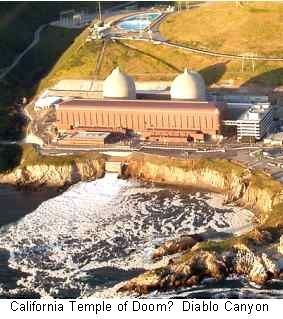
I think I mentioned a couple of times that I was involved, as a lawyer, in the licensing hearings for PG&E's Diablo Canyon nuclear reactors. Those are also boiling water reactors built near an earthquake fault line. As with the reactors at Fukushima, these reactors will be safe until they're not. Part of the drill in participating in licensing hearings is to come up with "scenarios," based on the types of threats (terrorism, weather, natural disaster, war) that a civilian reactor is likely to encounter. If anyone had suggested that Diablo Canyon should prepare for a 9.0 earthquake, followed by a tsunami, followed by electrical failure, followed by human error, followed by desperation attempts to cool reactor cores and spent fuel ponds with seawater, they would have been laughed from the room. C'mon, they would have said, don't you also want to throw in Al-Qaeda while you're at it?

Isn't it amazing. Confirmatory of my "favorite" (and most sinister) of Murphy's Laws: Nature always sides with the hidden flaw. The Fukushima reactors were built near a massive subduction fault line, of precisely the kind that produces huge tsunami waves ("tsunami" being a Japanese word for "harbor wave"). Japan has recorded over 195 tsunamis in its shaky history. You can't really say that what just happened was not foreseeable. It clearly was. The quake was bigger than Tokyo Electric planned for, but the quake did not do the direct damage. The tsunami did. The rest of the sequence was predictable too: electrical failure (grids do not operate as well underwater), pump failure, hydrogen build-up, explosions, panicky responses by humans trying to do too many things in an extremely limited time frame.

So we could see it all coming. We just assumed it wouldn't happen because all these complications get in the way of what we want to do so we can be "comfortable." Similar ideas led to the brilliant solution of placing the spent fuel ponds at Fukushima (I don't know what "shima" means, but if it means "you" it's all becoming clear) on top of the containment buildings. A kind of satanic twofer: if the (unvented) hydrogen from melting fuel rods in the reactor (unventable because of General Electric's design: I thought they brought "good things to life") causes the roof to blow off (as happened there), then you can blow up the fuel pond too, which has a lot more deadly radiation than in the reactor core. Indeed, the Japanese were using MOX fuel, which contains plutonium, so that is also present in the spent fuel rods on top of the (exploding) containment buildings.

Nothing to worry about, because it plainly couldn't happen although it did. So back to Diablo Canyon. Those bad boys are pictured up above, hovering there on a cliff above the Pacific. Safely above sea level. Uh-oh, wait a minute. Wasn't there something about sea level rise predicted by global warming? They won't even need a tsunami down in San Luis Obispo to inundate the plant, although (in mitigation) nature will take care of the solution of flooding the reactors with seawater. Thus, if we continue to melt Antarctica and Greenland (which between them contain 90% of the Earth's fresh water) and we achieve that 200+ foot sea level rise, we'll see how they do.

Or, we can just continue assuming that nothing bad can happen.

February 27, 2011

Austerity, Then & Now


At a very personal, selfish level, I don't really care how "austere" the government decides to become. I don't have any real skin in the game, other than the increasingly perilous adventure of trying to drive on California's potholed roads. America doesn't really have any public amenities which are threatened by greater austerity; for example, we don't have a real passenger rail system, or much of anything in the way of public transportation. The conditions of accommodations and facilities (bathrooms, etc.) in national and state parks are usually a complete disgrace, and so forth. The graffiti-strewn walls, the urban blight, the shitty, cheap, tawdry look of so much of what's been built in this country in the last 60 years, are all reflections of the people who live here, their aesthetic criteria, their social mores. It's how we live and we've all gotten used to it. The public realm in general in the United States is a vast wasteland, in fact, and is the emblem of our governing ethos; to wit, beauty and grace in life are "private virtues" which must be earned and purchased. You must amass enough money to buy your own sylvan enclave, or your house on the beach, in order to escape the crapscape (h/t: James Kunstler) of American life in general. Amazingly, the financial elites who own such an overwhelmingly large proportion of the wealth in this country, and can afford to insulate themselves from the trash heap, have enlisted the help of the some of the most disadvantaged (the Tea Party types and Southern Rednecks, not always the same people) to assist them in enforcing this way of doing things. Thus, the Tea Party has as one of its main platform planks the perpetuation of the "Bush tax cuts," as if such a top-margin benefit could possibly help them at all.


When the public realm is in such a catastrophic state, the key strategic move is to insulate yourself as much as possible from its effects. Although I'm eligible for Social Security now, I don't draw on it; I continue working. I'm too young for Medicare, and I'm self-employed, so I will never receive a penny in unemployment, welfare, public pension, or (currently) government-furnished health care. Thus, I read the weekly reports of new UE (unemployment claims) and even the unemployment numbers themselves (since I will never be counted one way or the other) with a great measure of personal detachment. In a way, none of this has anything to do with me.

I have a lot of company in this state of societal anomie, of course. Millions and millions of people, just like me. Working stiffs with no safety net all. As I said a few posts back, the sense of national "cohesion" in this country is in an advanced state of deterioration. We're kind of a mixture of a Hong Kong-style economy, with a manic desire for deregulation and anything-goes entrepreneurship, and a Greek-style approach to complete fiscal irresponsibility and mass tax avoidance. The same financial elites who own the government and manipulate the Right Wing booboisie (h/t: H.L. Mencken) with empty slogans and rhetoric favor complete deregulation, except when they blow themselves up and need hallucinated "money" to restore them to "balance," and otherwise advocate absolute minimization of any financial support for the country of which they are nominally a part.

Thus, what does "austerity" have to do with anything anymore? The financial elites are just as happy to borrow money on the "credit" of the Treasury as the so-called "liberals." The budget cutting antics of the Republicans are simply Kabuki theater. They know, and we know, and they know that we know, that the paltry reductions they are suggesting will do absolutely nothing to avert American bankruptcy. Their frivolous posturing, however, does impress some of the rubes in the cheap seats, who are too lazy, ignorant and ill-informed to perform the very simple math involved in assessing national income (about $2.2 trillion, the subtrahend), comparing it to national spending (about $3.8 trillion, the minuend), producing a difference of $1.6 trillion. Now let's do some more math: $100 billion/$1.6 trillion = 1/16 = 6.25% of the budget deficit. This is the House Tea Party contingent's big proposal, this is their extreme position, the one that may shut the government down.

Goldman Sachs, that company famous for doing God's work here in His Earthly Kingdom (God, I mean, not Lloyd Blankfein), recently prognosticated that a $50 billion reduction in federal spending would produce a 1% reduction in national GDP. Now, G-Sax is not exactly bearish on American prospects, since part of their scam is to encourage the endless funneling of money from the Federal Reserve into Wall Street, the better to "stimulate" the economy into "recovery." In a linear extrapolation, this would imply that $100 billion (the aforesaid 6.25% "slashing") would cause a 2% loss in GDP, or the current estimate of the entire growth for 2011 (revised downward recently, since the government has begun to notice that despite their rosy UE stats, no one is actually working). Let us continue this morning's math session. Assuming this same linear extrapolation holds for greater amounts of budget "cutting," what would be the effect on the economy of doing the only rational thing, living within our actual means? Well, let's figure it out. If $50 billion = 1%, then since $1.6 trillion is 32 times larger than $50 billion, G-Sax is implying that a balanced budget would result in a 32% fall in GDP. How much did the GDP of the United States fall during the depth of the Great Depression? Answer: 30%.

Such ruminations may suggest to you just how utterly phony this so-called American economic "recovery" actually is, and why despite all of the fake number crunching at the Bureau of Labor Statistics, the country has not actually produced any new full-time jobs for the populace in over ten years. We are sustaining the economy with the same false source of prosperity (massive debt) which fueled the run-up to the crash in 2007-08, only now it is the public sector which is pulling the laboring oar on the slave-galley ship of penury.

Thus, there won't be any austerity. There can't be, because the political class cannot face the ruinous consequences implied in their own austerity rhetoric. They'll run this scam in Washington as long as humanly possible, they'll use every trick in the book, they'll print money, ship it to England, and pretend that the "UK" is buying American Treasury bonds, along with the Federal Reserve, which is already printing money to "buy" bonds from Primary Dealers, who in turn often had just closed the purchase themselves a few moments before, pretending that this indicates bond-buying "interest."

Austerity, like prosperity in this country, will eventually become a "private virtue." It will be what we have left. Thus, 'tis best to cultivate an attitude of mind which anticipates such a state of affairs. The Zen of detachment, an austerity of expectation.

February 22, 2011

Raise High the Tax Level, Carpenters


Faithful reader JM weighs in with the question about raising taxes. There are, after all, two approaches to balancing the budget. My own sense is that there is enough money sloshing around in the American economy to achieve a federal balance without significantly damaging the Lifestyles of the Rich & Famous. It would take two significant moves: One, an increase in the top marginal rate paid by the pluto-oligarchs; and Two, a more rational approach to defense spending which would reduce the outlay to, say, the $500 billion level (and that's everything, tips, gratuities, even the gift bags). To solve Social Security, the cap on the maximum income subject to FICA tax needs to be raised and perhaps titrated, year-by-year, to achieve a balance between outgo and income. And the health care system needs to be nationalized.


The Pluto-Oligarchs will, naturally, point to the following chart, which demonstrates that about 70% of all income taxes are already paid by the top 10%. This fact, of course, tends to demonstrate that income inequality in the United States has reached obscene, Gilded Age levels. Caricatures of the very rich come easily to mind. Do they really need 5 vacation homes when 4 should get the job done? Is it necessary to travel by helicopter to the Hamptons when a chauffeured limo is cheaper? If John McCain isn't even certain how many houses his heiress/USC cheerleader wife owns, isn't that an indication of excess and not just of mental vacuity?


Percentiles Ranked by AGI

AGI Threshold on Percentiles

Percentage of Federal Personal Income Tax Paid

Top 1%

$380,354

38.02

Top 5%

$159,619

58.72

Top 10%

$113,799

69.94

Top 25%

$67,280

86.34

Top 50%

$33,048

97.30

Bottom 50%

<$33,048

2.7


I would answer that just because the wealthy are paying a lot (relative to the total paid) does not mean they are paying enough. It all comes down to a question of what kind of country we actually want, which is an oblique way of saying: what happened to the concept of patriotism in this country? Why do the rich, through their army of lobbyists, want to hamstring the federal government through relentlessly lowering the top marginal rates (and why does the Crypto-Republican, Barack Obama, play along)?

One idea I have is that modern American politicians, such as the aforementioned Mr. Obama, wear the American flag lapel pins popularized by the Bush-era Gauleiters to remind themselves that they are, in fact, Americans. It's not always obvious. The move to globalization, the tax breaks for offshoring companies, the preference for spending money in places like Iraq and Afghanistan instead of Detroit and Baltimore, confuse the issue of just whose interests they're really serving. Increasingly, I get the idea that patriotism in this country is not only the last refuge of scoundrels, but is an entirely outmoded concept. Saying such a thing in the wrong redneck bar in Columbus, GA, could be a huge mistake, of course, because all those soldiers transiting from Fort Benning to the killing fields of Baghdad and Kandahar, and who come home with one leg, or no eyes, or a damaged brain, don't want to hear about this "death of patriotism" stuff, so keep it to yourself, you Berkeley fag-radical.

A conversation to be avoided, at least in that context. Still, the people responsible for sending these soldiers overseas, by an overwhelming majority, do not themselves place their asses on the line, nor those of their close relatives (Bush, Cheney, Obama, Wolfowitz, Rice, Feith, Limbaugh, Beck, O'Reilly, Coulter et alia ad nauseum). Nor do they actually foment and sustain these wars out of patriotic motives; they're entirely mercenary, the acts of war profiteers or of political opportunists. Sadly, this is the emotional trap, the cover story of an inapt patriotism, which ensnares the military grunts, the ones actually in harm's way. I feel for them. You could say it's my patriotic duty.

All of this is a roundabout way of saying that I think The Powers That Be in this country essentially use the United States, for want of a less techno-hip word, as a platform for commercial purposes. America is a headquarters country, and the richest use the USA as a base of operations without sinking deep roots into our native soil. They build their factories overseas and they seek to starve their own country of nationality of the tax benefits of their largess (billions in corporate profits are kept permanently overseas so that they can avoid the problem of "repatriating" the money and exposing it to taxation). A compliant Congress builds a tax and regulatory regime which enables all of this unpatriotic activity.

Which is why I don't think a massive restructuring of the tax paradigm is worth the effort anymore. For entirely different reasons from the right wing "small government" freaks, who are primarily interested in dismantling the welfare state so that government's functions can be limited to maintaining the military-industrial complex and bailing out their banks once they screw up again in the course of trying to screw everyone else.

I've become more of a "regional guy," someone who believes the central government apparatus has become too big, too complex and completely unmanageable and unresponsive. These are the reasons I believe that so many Americans feel detached from the nation they grew up in. No matter what the polls show (leave Iraq now, end this decade-long fiasco in Afghanistan, shrink the military, place some rational limit on possession of private Kalashnikovs, give the people some form of socialized medicine we can actually afford, try to keep the ambient air temperature in the sub-100 degree range), the political system remains unswayed. It serves its own interests, not those of the general public.

Most of the things we really need that government provides happen at the local level: schools, fire departments, police, fixing potholes. The federal government has become a very irritating and insanely expensive distraction. So yeah, Grover Norquist: starve The Beast. I'm just picturing something a little bigger and more comprehensive.