April 28, 2012

Saturday Morning Essay: A Modest Proposal for Eliminating the Problem of Fiscal Deficits in the U.S.

 Brought to you by Peet's Costa Rica blend...
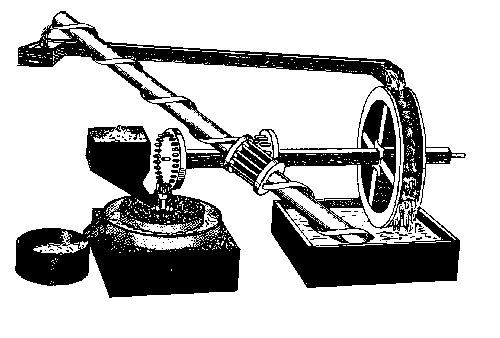


Mankind has always been fascinated by the concept of the perpetual motion machine.  A gizmo that will keep running forever without additional energy inputs, that relies on its own internal feedback loops to supply the forces needed to keep it going.  Alas, such contraptions always seem to run afoul of the basic laws of thermodynamics.  Someday even our Sun is going to flame out, expanding out to engulf Earth and ending everything we know, even Dancing With The Stars.  And this particular solar system will be no more, and unless we first establish contact with an alien civilization with better survival prospects than our own, there will be no history, anywhere, that we ever even existed.

So how serious, really, can any problem actually be?

Still, it pains me to see economists and other learned charlatans struggle with this concept of the national debt and fiscal deficits.  It takes up so much time, and in this day of digitally manufactured money, it just seems silly.  So I wanted to come up with a way, working within existing laws and the basic framework of Federal Reserve finance, to solve this problem once and for all.  And I think I've got it.

I was writing last time out about the ways in which the American money supply has become a thoroughly confused admixture of both "traditional" (debt-based) money and the increasing component of cash which the Federal Reserve and Treasury pull out of their collective ass.  This is one of the advantages of having a very complicated government with a byzantine financial structure, with lots of very serious men and women in dark clothing harrumphing on about "quantitative easing" and "Large Scale Asset Purchases" and "increasing the monetary base" and all the rest of this nonsense.  In the midst of such confusion, it's easy to slip in little money-making tricks like having a pile of IOU's (the Social Security Trust Fund) which essentially say, "The United States Promises To Pay the United States $2.5 Trillion," actually produce money which gets "added" back into the federal budget.  Or having the Treasury issue bonds to Primary Dealers (the Kool Kids on Wall Street) which the Federal Reserve "buys" with billions blown out its bunghole, and then the Treasury is "obligated" to the Federal Reserve, except that the Federal Reserve just uses the "interest" earned on the money it made up out of thin air to pay its expenses and remits the balance to the Treasury.  Thus, the larger the obligation of the Treasury to the Federal Reserve, the more money the Treasury can earn on its debts.

It was this latter realization which caused the light bulb to go on over my head.  Why are we fooling around here with half-measures when the solution is at hand?  I want to reiterate that it is actually adult human beings who are playing the games sketched out above.  They do these silly things while cloaking the whole malarkey in lots of learned discourse and serious verbiage designed to make you think that cowpies are chocolate danish.  So I say, let's just get the whole ridiculous thing over with.  As follows:

The Treasury holds the Final Auction.  At this auction, it will sell Treasury obligations to the Primary Dealers in the total amount of $100 trillion, paying a 5% coupon over 100 years.  The Primary Dealers agree to borrow the money they need to fully fund the auction from the Federal Reserve at the current fed rate of .01%.  The Federal Reserve, acting as any prudent banker, takes as collateral the future expectancy of the bonds themselves, a dodge made necessary by the current, laughable rule that the Federal Reserve cannot bid directly at a Treasury auction (it has to wait, like, a day until the Primary Dealers take down half an auction).  The Primary Dealers buy the Treasuries, they immediately sell them to the Federal Reserve (the Federal Reserve hitting the keyboard to come up with the hundred tril), and now the Treasury Department owes the Federal Reserve $100 trillion, at a 5% coupon.  After deducting the Federal Reserve's insignificant expenses, this allows the Treasury to earn $5 trillion per year on the debt which the Treasury owes to the Treasury (I'm just leaving out the silliness of pretending the Fed is anything other than a proxy for the Treasury in this scheme).

The federal government is fully funded without taxation or further bond sales.  Indeed, the Treasury has about $1 trillion surplus, which can be doled out to every man, woman and child in the United States, on a per capita basis.  A nice little stipend for everybody.  There is no need for inflation, and barely any need for employment.

It's simply a matter of Thinking Big and going for it.

April 26, 2012

Noodling on the National Debt

Paul Krugman is fond of saying that the U.S. economy (or any economy) "is not a morality play." I think I understand what he means.  For example, the current national debt in the United States is about $15.7 trillion (you can follow the number with the gadget over on the right.  As you watch the numbers whirl, you'll see that the "public" part of the debt [about $11.6 trillion] increases at the current rate of about $3 million per minute, a rate which is always increasing, of course.  The magic of exponents!)

What Mr. Krugman is saying, however, can be succinctly summed up as follows: So what?  The absolute numbers do not matter so much, at least at present.  What matters is the actual carrying cost of the public part of the debt, which is to say, interest expense.  The average interest rate applied to the American pile of public debt is currently only about 2%.  The bond auctions conducted by the Treasury usually go off without a hitch, with probably 3 bids for every bond sold.  Shorter term bills (one year and under) essentially pay no interest at all (and relative to inflation, they yield a negative return), yet those are all sold as well.  Indeed, unless you're willing to buy the ultra "long" bond (30 years), you can't earn a real return on any U.S. paper.  Yet the Treasury sells all of it, week in and week out.

The $11.6 trillion figure itself has to be reduced by about $1.3 trillion, because this latter figure represents the holdings of the Federal Reserve.  The Treasury does not really "pay" interest on these bonds; indeed, it works the other way.  The Treasury "credits" the Federal Reserve with interest on the bonds the Fed holds, and the Fed uses this "money" to pay its expenses and then remits the "balance" back to the Treasury, representing "income."  Thus, the more "debt" the Fed holds, the more money the Treasury can make on its own debt.  This is one of several ways that the United States Treasury hallucinates money into existence.  Another is the "interest" paid by the Treasury on the "intragovernmental" part of the debt (about $5.6 trillion, representing the Social Security and Medicare trust funds and other funds, such as government pensions).  The current shortfalls in Social Security, for example, measured as the difference between the amount of FICA taxes actually collected and the amounts paid out to the burgeoning rolls of recipients (the Boomers! my Peeps!) is made up by pretending the huge stack of stationery in a couple of file drawers in West Virginia (this was actually one of George W. Bush's insights, and I thank him for the colorful description) actually produces "money."

Still, suppose we keep doing what we're doing (and we will) and the public part of the debt rises to $30 trillion over the next decade or so.  Let's suppose that the Fed holds its position as a 9-10% stakeholder, or about $3.0 trillion, leaving $27 trillion actually owed to the public.  Well, if the carrying cost stays at about 2%, the total interest expense, to the extent it matters, is about $540 billion per year.  And against this figure we can subtract the money the Treasury "earns" by pretending to pay interest on the money the Fed pretends to pay back to the Treasury, which should be about $60 billion or so (the Fed currently "pays" about $75 billion per year to the Treasury, reflecting, I guess, some higher-paying vintage bonds). 

Krugman and New Keynesians like him are, I believe, influenced by the ideas of Modern Monetary Theory, and when you come right down to the cult-like basis of MMT, it is a concept that money does not, as it traditionally did, bear a real relationship to some point of reference, such as gold or the underlying value of goods and services which money can pay for or command.  Money (or the idea we call Money) Is A Thing Unto Itself now, an electronic creation, which enters the economy by government fiat, and once it's there, it's the same dollar in your pocket regardless of its origins. Thus, the whole system is now permeated and shot through with huge elements of both "traditional" money and the increasing supply of conjured electronic money, and the American economy depends on both without differentiation.

All the big central banks (European Central Bank, the Bank of England, the Bank of Japan, most certainly the Federal Reserve) are now playing this game.  "Rogue" economists such as Steve Keen point out, indisputably in my opinion, that this is little more than an electronic Ponzi scheme: electronic money is conjured out of thin air in order to pay preexisting debts, many of which were also based on obligations created with "fictitious" money.  The whole contraption of international money does have a slightly queasy, vertiginous feel to it, as the printers at the various central banks, faced with huge, unpayable debts (unpayable in the sense of paying with the "old" money based on reference to an underlying measure of value) go into hyper-overdrive.

Still, it's not a "morality play."  I agree with that. We're a long ways past the old traditional, Mom 'N Pop ideas of thrift and understandable finances. The lives, and the livings, of millions and millions of real people, who are themselves cut off from things of real value and sustenance (such as food producing land) depend on the continuation of this game.  It is a game, however, with many hidden points of vulnerability, as with any complex system with many interacting parts providing negative and positive feedback loops, and many of the factors are not under direct U.S. control.  But we can't suddenly stop playing this game, even if it's the "moral" thing to do.  The U.S. deficits are "structural" at this point.  Raising income tax rates on the super-wealthy will not come close to closing the gap. Cutting defense by 50% will not come close, even in combination with massive tax increases (and cutting defense will entail the negative feedback of huge job losses, since war is an important American industry - one of the biggest).  The U.S. economy cannot really create enough jobs that pay enough money to provide a tax base that can stay up with ever-increasing U.S. federal and state expenditures.

Unless we want to face what this is (and we don't), we're stuck.  It's not a "morality play."  It might be a different drama, however:  Jean-Paul Sartre's "No Exit."

********************************************

Many thanks to John M. for his very helpful suggestion of a Kindle version for some of my cousin's out-of-print books.  I have passed that idea along to Jim's literary executor, with credit where it's due.

April 20, 2012

Obama, Romney & Ruth Bader Ginsburg

(Okay, it's #1,000, but I've always preferred the everyday to the special celebration.  Special celebrations are merely annoying distractions from the more interesting aspects of everyday life.)

I saw my first "Anybody But Obama" bumpersticker right here in my chic-Lib county yesterday.  It was cleverly done.  In the lower right-hand corner was a tally sheet.  The left-hand column was headed "Promises Kept," and beneath that was "0."  The right-hand column was marked "Promises Not Kept," and beneath that heading were tally marks adding up to about 30, as far as I could tell on quick perusal.

I imagine the Obama Campaign is doing a lot of internal polling, now that they know (for certain) that Mitt Romney will be the GOP candidate.  Not that anyone in America ever had any real reason to doubt that the media would ultimately insist on an Obama-Romney runoff.  The electorate at large can only focus and talk about those candidates given visibility by television shows.  Romney and Obama have The Look that plays well on TV, whereas candidates like Santorum (geeky, weird), Gingrich (chubby, snide) and Ron Paul (elderly, cranky, wheedling voice) don't work as TV characters.

So Central Casting has narrowed down our American Idols to the two obvious choices.  But back to the Obama Campaign, and their internal polling: Pretty soon Nate Silver at the New York Times will begin giving us the real story on how this titanic contest is going, but I suspect the Obama people are pretty nervous.  It's not a good sign when a bumpersticker such as the one I saw shows up in a county which is so Orthodox-Progressive.  It's jarring, and it means that people now feel safe to admit the truth: Obama has been a huge, epic disappointment.  Obama's base is essentially limited to (a) Democratic operatives, (b) public employee unions and (c) minority pressure groups.  It's difficult to conceive of an actual Independent being genuinely excited about reelecting Barack Obama, and yet Independents are the cohort, we are told, who decide modern elections.  Essentially, all those Americans who hate both political parties but feel they need to participate in our Game Theory Politics to avoid a more-evil outcome.

Obama will not have the "Hope & Change" shtick this time around, and since his signature accomplishment, Obamacare, was actually borrowed from Mitt Romney, that's probably not a good thing to boast about (especially since most Americans hate it anyway).  Obama's foreign policy is identical to that of the Bush/Cheney regime, only more unconstitutional and warmongering.  Obama runs an opaque administration with a fetish for State Secrets and has compiled a terrible record on civil liberties.  Obama coddles the banks and his anemic Attorney General, Eric Holder, never lifts a finger to enforce the law against big campaign donors.

The Onion ran a hilarious piece in the latest issue about the Obama campaign's decision to tone down the slogans from "Yes We Can!" to "Some Stuff We Might Try, But It Probably Won't Work."  Amid all the commentary about the implacable hostility of Republicans to Obama's "initiatives" that we have heard over the last three-plus years, and the rest of the excuses,  the American public still has trouble avoiding an uncomfortable (inconvenient even) truth: Obama just isn't very effective.  Don't know exactly what the problem is.  Hard to put your finger on it, exactly.

The intrepid bumpersticker guy probably knows that in our Game Theory Politics his position (Anybody But Obama) is equivalent to "Let Romney Win."  Indeed, the bumpersticker was in red, white & blue (get it?).  This could be a clever Romney tactic in areas where overt advocacy for a Republican is just unthinkable (where I live, e.g., or West L.A. or most of Manhattan).  It's a hip way to seem aloof from politics.  Bringing us to the question: what happens if Romney is elected (and there is a pretty fair chance he will be)?

Three words:  Ruth Bader Ginsburg, the ailing and elderly Supreme Court Justice.  If Romney is elected, he will choose her sucessor during his first term, and then regardless of which side of the bed Justice Anthony Kennedy gets out of a particular morning, the Supreme Court will be firmly conservative and Roe vs. Wade will be overturned. As I have written before, the effect of a Roe reversal is not the immediate outlawing of abortion; it is a return of the sovereignty of the individual states to decide the issue of criminality.  It's possible that certain Blue States (California, New York, Massachusetts, Illinois, Oregon, Washington) will retain the right as under Roe.  Each of these states will become a kind of abortion Reno, at least for a while.

Otherwise, I don't think the changes will be momentous.  America's slide toward Banana Republicanism is already well underway, and a new President (or a second term for the old one) can't do much about that.  I've just been disappointed that Obama never tried.

April 18, 2012

Next Stop, Tehran

I found this exchange last month between Jeff Sessions, Republican Senator from the great state of Alabama, and Leon Panetta, Secretary of Defense, rather telling and instructive on the state of unconstitutional procedures currently in vogue in the U.S. of A.  I don't recall any news coverage of the colloquy, of course; it must have happened around the time that George Zimmerman/Trayvon Martin were dominating the airwaves, or maybe Kim Kardashian had a butt implant go all wrong.

Whatever the reason:  Jeff Sessions, with his slightly inbred look and Yoda ears, presents something of a quandary for me.  He's a former district attorney and is actually pretty good at asking questions, a skill not usually found in serving members of Congress.  Plus, I noticed during the Alberto Gonzales scandal that he was actually, dare I say it?, pretty principled when it came to picking holes in Alberto's obviously perjured testimony.  He clearly did not like the politics that controlled hiring and firing at the Justice Department during the Bush/Rove regime, and Sessions was probably as instrumental as anyone in driving Gonzales from office in 2007.  Of course, as a Republican he is required to participate in many of the standard lunatic orthodoxies of the GOP, but that's to be expected.

Panetta, on the other hand, has always seemed to me the Democrats' version of Dick Cheney.  A reliable functionary and apparatchik who can be counted on to carry out the policy of any president he serves, and in fact Panetta has held many of the same jobs which Cheney held: Chief of Staff, Secretary of Defense, a member of Congress, etc.  Like Cheney, he seems more industrious and can-do than particularly bright or creative.  As you know, I also believe that Panetta got his start playing the pharmacist on the old "Dobie Gillis" series, although I cannot find this on Panetta's Wikipedia entry.

The phrase "Kabuki Theater" gets overused in our cliche-ridden MediaWorld, but this hearing might be aptly described in just such terms.  The question is whether Sessions is in on the fix, or was genuinely "breathless" over the unconstitutionality of Panetta's described approach to war authorization.  As a legal matter, there isn't much to talk about.  Panetta is talking absolute nonsense.  There is no "international" authority for a president to take the country to war, so it doesn't matter what NATO says or wants, and it doesn't matter whether our "international partners" want our help.  These considerations (international cooperation, defense of an ally) might be motivating factors, but the constitutional law remains that only Congress has (a) the authority to declare war, or (b) authorize the use of military force under the War Powers Act of 973, which is Congress's way of sidestepping its obligations to commit the country to war (a sidestepping dance it has performed since 1941, ridiculously enough).

Sessions obviously knows the law, and he reminds the members of the panel (which included Panetta and some top military brass) that they know it, too.  Nevertheless, it is fascinating to watch Panetta refuse to meet Sessions eye-to-eye, and to remain obtuse and opaque in his answers to very clear, well-posed questions.  Panetta does not give an inch, continuing to repeat his message-control mantra that the president has the unilateral right to protect and defend this country, and that "international" considerations guided the president's response in some relevant but not clearly-defined way.

The hearing nominally was supposed to concern Syria, and whether President Obama was going to go off on his own again, as he did in Libya, seeking neither a declaration of war under Article I of the Constitution (obviously, no president ever does that anymore) nor an authorization from Congress, which Bush at least did with respect to Afghanistan and Iraq.  I think, however, that this hearing, and Panetta's canned, robotic resposes, were really about Iran.  A decision has been made by the Obama Administration to attack Iran with its "international partner" Israel and maybe members of the Arab League (such as Saudi Arabia, who do not like the idea of a nuclear-armed Iran, to say the least), and Congress is going to find out about it when the world at large finds out about it.  If the hearing were really about Syria, Panetta would not need to dig in so deeply.  Enforcing a no-fly zone or running bombing runs, as in Libya, is no big deal to Congress, and they've already demonstrated they're completely asleep at the switch and will demand no accountability from Obama for his violation of his oath of office.  That sort of legal nicety is not even talked about anymore, let alone enforced.

But Iran?  That's the Big Persian Enchilada, and it's a hole card Obama wants to keep face down in the event he needs an October Surprise to get him over the hump against Romney  Remember that Bush was reelected in 2004 with a real majority (as opposed to 2000) even though by that point the American electorate knew the war in Iraq had been launched on false pretenses.  Just the fact of being at war probably worked greatly in Bush's favor, a fact obviously not lost on Obama.  And yes, the American electorate is that stupid. 

So no contradictory testimony from Panetta was going to be recorded at this hearing, try as Sessions might to make sense of what he was hearing.  The law is an ass, as Charles Dickens wrote.

April 14, 2012

Saturday Morning Essay, Charlie Bates Versus the Cars

Brought to you by Peet's Major Kong blend

This past Monday was the third anniversary of my cousin Jim Houston's passing, and to do something about the mood this put me in (generally down, and on a Monday to boot), I went to my Jim Houston Library (bottom shelf, bookcase in the den) and pulled out Gasoline, Jim's collection of Charlie Bates stories.  The collection I have was put together by Capra Press of Santa Barbara in 1980, and my volume was signed by Jim in 1986.  All of the stories are terrific, written in Jim's distinctive laconic, simple, flowing prose, which has a way of disguising the penetrating intelligence behind the beguiling language.

I chose "Gas Mask," just for old times' sake, and because it was the first story Jim ever talked to me about personally, as he was writing it in 1964 (he was thirty years old at the time; I was fifteen).  It was a summer get-together at his parents' place in Saratoga.  Jim's mother, Loretta, had made her trademark lemonade with grapefruit-sized lemons fresh from her own orchard.  It remains to this day the best beverage I have ever had the pleasure of drinking.  I asked Jim what he was working on, and he told me it was a story about a guy, Charlie Bates, his Everyman lost in an increasingly confusing and deranged technological wonderland, who is driving home one day on an elevated freeway (it sounds, in the story, like Los Angeles) when the traffic comes to a complete stop.  Charlie feels the pressure of a car pushing against the back of his Volkswagen Bug.  And the drivers, including Charlie, are then stranded with their automobiles in total, city-wide gridlock. After a while a helicopter appears overhead and moves down the road, announcing that traffic is blocked and that it will take at least twenty-four hours to clear.

"He was on a high, curving overpass that looked down on a lower overpass and farther down onto a twelve lane straightaway that led to the city's center.  As far as Charlie could see in any direction cars were jammed end to end, lane to lane, and nothing moved.  The pushing had stopped.  Evidently there was nowhere else to push."

Charlie strikes up a conversation with Arvin Bainbridge, who is in the car adjacent to his driver's side door.  This is the only other driver identified in the story, adding to the mood of alienation and anomie: there are thousands of stranded motorists on this nightmare-scape of roadways, but all are essentially alone and isolated within their steel vehicles. Where Charlie is different (in each story of the collection, actually) from those he finds in his shared predicament, he improvises in the face of these man-made, hostile environments.  He borrows a tow rope from Arvin, ties it to the railing, and goes hand over hand to the freeway level below.  From there he can climb into the top of a tall tree and shinny his way, at last, to terra firma.  He then walks several miles home to his wife Fay. 

Charlie discusses the situation with Fay and a decision is made to borrow a friend's two-seater bicycle and ride back to the freeway.  Eventually they take an elevator to the top of an apartment building with a view of the freeway, where Charlie can use high-powered binoculars to keep an eye on the Volkswagen.  Charlie follows the loops and curlicues of the freeway and realizes there is a way, using onramps and the median strip, to get back to his car on foot.  Meanwhile, the helicopters announce that the gridlock is likely to remain for thirty-six more hours, two more days, three more days.  Fay and Charlie then discover there is an apartment for rent in the building they have used for the roof-top view of the freeway.  They take the apartment and then divide "watches" into four-hour shifts.

A helicopter lowers a portable toilet onto the freeway, and a long line of stranded motorists wait their turn.  Through the binoculars, Charlie sees a woman enter the toilet and close the door. He tells Fay,

"A woman just opened the door and stepped inside."

"What if the cars start moving while she's in there, Charlie?  That's what I'd be worried about."

"It's a risk, all right, one of those risks a person just has to take."

Charlie begins frequent jogs to his car, leaving his bike at the foot of the onramp.  He talks things over with Arvin Bainbridge, who tells Charlie things on the freeway are "bout the same."  It's hot out on the asphalt during the day, and uncomfortable to sleep in the car at night, but Arvin tells Charlie that "you get used to it."  He compliments Charlie on his improving time in getting to and from the Volkswagen.  Charlie's been clocking himself, and Arvin asks for the time.  Charlie tells him.  Arvin is impressed:  "Cuttin her down, hey boy."  Charlie suggests that Arvin come to the apartment, have dinner, a drink, take a shower.  Arvin mulls it over.  He's still making payments on his car, he muses. Finally he tells Charlie that he "just can't."  Arvin wants to be there when the cars start to move again.  Charlie tells him that he understands.

And so the story ends, Charlie and Fay in their eagle's nest vantage point, the cars permanently gridlocked, the drivers in the stranded vehicles hollow-eyed, grimy, in wrinkled clothes, wraiths scattered along an endless terrain of asphalt.  "Gas Mask" cannot have a happy ending, because the madness will obviously continue whether or not the cars ever start moving again or not.  We leave Charlie in an army surplus store, buying a gas mask to help him deal with the eye-stinging, suffocating pollution he encounters during the times he spends on the freeway with his car, as the motorists periodically fire up their engines in anticipation that perhaps this is the Moment of Movement, a hope which spreads virally from car to car like an urban legend.

I've always considered this story a largely unrecognized miracle of dystopian satire.  I think it is brilliant in its spare, matter-of-fact depiction of the insane accommodation of oppressive, inhuman (even anti-human) technology in the lives of ordinary modern people.  It was written by a young man of prodigious talents (in so many arts) who looked on the world with wry bemusement, who understood, deep in his calm soul, that nothing can change the course of progress, that all we will ever do is make seemingly sane adaptations to a thoroughly mad artificial environment, and take the "necessary" risks involved, such as using a toilet on an elevated freeway in the middle of The Traffic Jam at the End of the World, without ever once asking ourselves how we created such a monstrosity in the first place, or what human purposes it serves.


April 12, 2012

Approaching One Grand

This will be the 997th blog post I've hoisted onto this site in the last six years.  I imagine that each one averages about 350 words, so that's a lot of brain-belching.  Still, it's a piker's effort compared to the big boys, like Paul Krugman, who writes about 997 blogs a day.  It should be pointed out that each of Mr. Krugman's blogs is the same as the one before, but it remains a prodigious effort simply to put that many words on paper (or into pixels), as I should know.

Philosophically, I think my orientation has changed over the last six years.  For example,  like many initially afflicted with Blogger Grandiosity Syndrome (BGS), at first I though it was incumbent upon me (even expected of me) to comment on every major meme arising from the maelstrom of American pop culture. 

The Trayvon Martin-George Zimmerman saga is a case in point.  A few years ago, I would have felt it my solemn duty to weigh in on this sorrowful episode with my own pithy insights.  I now see that this is simply falling into the American Meme Trap.  It won't be long before this Crime of the Century will fade into absolute nothingness, and then all we will have as a memory is the unfortunate way that mass media intrude into the legal justice system and make it practically impossible for us to think straight about matters of crime and punishment. 

To fit the agenda of the News Cycle, a "hook" must be found.  It was easy in this case: a non-black shooter kills a black person, and the Florida police and district attorney do not immediately push for prosecution, citing Florida's "Stand Your Ground" law, another artifact of America's gun-happy, bloodthirsty culture.  (It's always Frontier Land here in the U.S.)  The reason becomes immediately "obvious" to everyone: non-blacks shooting blacks are less likely to be prosecuted, while blacks shooting whites are always indicted.  I heard this exact formulation of the "issue" on our local KGO, as advanced by Ronn Owens, probably the dullest and most cliche-ridden talk-radio disc jockey in airwave history (NorCal Division), but with a huge following, it goes without saying.

Crime statistics certainly bear this bias out: African-Americans and other minorities are disproportionately charged and sentenced for crimes against whites, especially in the South.  However, there is a second question: was the decision by the Florida police and D.A. (at least initially) the result of this bias?  This is the difference between statistical tendencies and the facts of a specific case, and as every lawyer knows, only the latter, the relevant facts, have any bearing on the "truth" of a given event.  This did not stop pundits like Lawrence O'Donnell on MSNBC from screaming at the top of his lungs, crying for justice for Trayvon, or the President from making an extremely ill-adivsed comment about Trayvon's resemblance to a son he might have had, whatever that was supposed to mean.  O'Donnell and the President were behaving in extremely irresponsible ways in bringing pressure to bear on a matter under investigation (the second time the President has done so: will there be another Beer Garden photo-op?).  Thus, while it would be worthwhile and responsible to discuss the problem of discrimination in charging and sentencing minorities as a general proposition, we don't do Responsible in American media life.  You can't get the public's attention unless you turn the event into the kind of circus, based on a specific act of violence, as Tom Wolfe so eloquently (and searingly) fictionalized in The Bonfire of the Vanities, the lessons of which everyone has apparently forgotten.

So I've learned to refrain from such "advocacy" based on what is always a very partial understanding (filtered through a sensationalist media) of the actual facts.  What is increasingly more interesting to me these days is to assay the State of the Nation from a longer perspective.  We live at a particularly interesting time, here in 2012.  As Thoreau said in Walden, the Now is a meeting "of two great eternities," and we should "toe that line."  There is little doubt that we are living now in the aftermath of the Great American Experiment in Suburban Living, of the Consumer Society, of the debt-fueled maintenance of an expensive and extravagant lifestyle, which is groaning and collapsing under its own weight, as it has been for a very long time, but now the signs and symptoms have become too obvious for anyone to ignore or to hide behind the veil of American Exceptionalism.

Now there's an interesting topic.  To be of a certain age, old enough to have grown up in, and to have had one's consciousness formed by, the decades of the 1950's and 1960's, when there was no doubt America led the way in everything, and only the Beatniks were around to point out that the way we were leading was probably a very bad direction, indeed.  Nevertheless, the Western World (and Japan) followed us, all the way to the edge of the precipice, where we stand today, in an ecologically and economically unsustainable predicament.

As I mentioned the other day, Thoreau himself "toed a line" between the arrival of the Industrial Revolution in force in America, and a bygone agrarian, pastoral history.  Such times can be eras of acute clarity, and insight, into epochal transformation.  Thus, at Orwell's suggestion, I keep this journal of ideas.


April 08, 2012

The Simpler Way from Down Under


I think I mentioned a while back that as the result of writing about Craig Dilworth's book Too Smart For Our Own Good here at the Pond, I had heard from Prof. Dilworth himself, and that resulted, through the "connective tissue" of the Internet, in access to a lively discussion going on among those one might call Deep Ecologists. These are academics, thinkers and writers whose appreciation of the ecological predicament of mankind goes beyond the conventional "Green" narrative popular in America. The Green narrative suggests that if we all just insulate our houses a little better, support photovoltaics and windmills, and drive a Prius, we probably won't even notice a change from the current American lifestyle. One might even surmise that this way of thinking about the problem is the "Manufactured Consent" (in Chomsky's terms) of the issues: the mainstream media define the divide this way, between business-as-usual and slight tweaking along environmental lines to keep growth humming along and a bigger and brighter future on the horizon forever.

I asked permission from Ted Trainer, one of my new correspondents, who is based in Australia where he writes on Transition issues and oil depletion, if I could post one of his letters contributed to a recent discussion as a particularly good and concise introduction to the notion that the "Green" solution, as popularized in America, is way off the real mark, and Mr. Trainer graciously agreed. So, without any redactions, the letter follows:

[text of letter]

I was not able to contribute to your recent interesting discussion about the global predicament but I’d like to feed in what I see as a game-changing point of view that usually goes unrecognised.

So much of the discussion of the predicament takes for granted a uni-dimensional view of development, wealth, progress. For example many people (especially of the red-left variety) argue that there must be much more economic growth and therefore energy use to increase production so that the poorest billions can rise to satisfactory living standards. They therefore criticise the many green people who are saying that there is already far too much producing and consumption, energy and resource use going on. Many red left people argue for redistribution but many green people say that wouldn’t change the amount of consuming so it wouldn’t reduce resource and environmental pressure. So it looks like an insoluble dilemma.

The way out is to take The Simpler Way. I first put it in Abandon Affluence, Zed, 1985, and have detailed a more elaborate case in The Transition to a Sustainable and Just World, Envirobook, 2010. The first point is that the big global problems cannot be solved unless there is dramatic reduction in the resource consumption, GDP and “living standards” we have in rich countries, probably to one-tenth of their present levels. Several lines of argument within the general “limits to growth” analysis should now leave no doubt about this. For instance the Australian per capita “footprint” is 8 ha of productive land but by 2050 the amount available in the world will be at best .8 ha; so we are 10 times over a level that it would ever be possible for all to have. ...and these numbers totally ignore the absurd commitment to economic growth. Anyone who thinks 9 billion can rise to the “living standards” Australians expect by 2050 given 3% economic growth is assuming the planet can sustain 30 times the present global volume of producing and consuming.

It follows that we must move to ways of living, institutions and systems that allow us to live well on a small fraction of our present rich world affluence, and indeed of the present world resource production levels. The Simpler Way argument is that this could be done, easily and quickly, thereby defusing all the big problems...if enough people saw the sense of it. TSW involves mostly small and highly self-sufficient local economies processing local resources to meet local needs, via intensely participatory and cooperative ways, with no economic growth, in economies that are not determined by market forces...and value systems in which there is no interest in competing or gaining.

Many of us in the ecovillage and Transition Towns movements live in very resource-cheap but quality of life rich ways. I live way under the “poverty line”, never travel, never watch TV, almost never buy new clothes, and could build you a beautiful small earth house for under $5000. My quality of life is high, but nothing like that in some of the communities I know. Meanwhile most of you out there are working three times too hard, going down with depression and obesity, as your social cohesion crumbles. Why don’t you come across to TSW and devote most of your week to your arts and crafts, conversation or just sitting in the sun (…working three hours a week in the remnant offices and factories we’d need)?

Now you might think the prospects for such a transition are remote. My view is that the transition will not be achieved. But that’s not central here. What matters is that you are going to move towards TSW whether you like it or not. We are entering the era of intense and irremediable scarcity. The resources are already inaccessible for most people, and becoming scarcer, especially if you attend to declining EROI (energy return on investment) rather than price. (EROI has halved for oil in a couple of decades.) Only 1.5 billion are using the resources now...just wait until another 8.5 billion go after them. And we few in rich countries are losing our capacity to hog all the available resource wealth as we have for 500 years The Chinese are racing past us and Uncle Sam doesn’t seem to be able to win the necessary resource wars any more. You are in for a rocky road down to getting by on something like your fair share of the world’s resources for a change.

So you might be wise to join us in trying to work out how to run very frugal and self-sufficient communities well, because the most likely alternative will be a nasty feudalism as the rich and the middle classes call for repressive state power to secure their property and privileges against the accelerating scarcity, discontent and breakdown.

My main point is that TSW represents a rejection of the uni-dimensional way of thinking, i.e., that the only way development can be thought about is in terms of moving up the slope of progress towards more jobs, production, income, GDP, wealth and development. No group has been more trapped in this mind-set than one of the teams I belong to, the Marxists. They adopt the same capitalist conception of development as the neo-liberals; development involves investment of capital to increase production for sale...how else could it be conceived? (Marxists just don’t want the capital to be privately owned.) So 3-4 billion Third World people are trapped in hopeless squalor waiting for trickle down from capital invested in the most profitable ventures ... when most of them have all around them the soil, rainfall, forests, traditions, networks, knowledge and labour that could quickly develop the simple but sufficient housing, cooperatives, chicken pens, permaculture gardens, swales, schools, woodlots, sheds, clinics etc. they need to meet most of their basic needs. Appropriate development needs little monetary capital.

Of course the rich countries work hard to prevent the available resources being devoted to such purposes; they must be kept free for use by transnational corporations, and devices such as debt and the Structural Adjustment Packages ensure that they are. (And any country foolish enough to still deviate is likely to find itself invaded on some pretext.) But the main factor preventing appropriate development is the mentality that can’t deviate from the development=growth dimension. It’s as blindingly dominant within NGOs as within the IMF.

The main reason why I don’t think we will make it is because the commitment to affluence is now so deeply entrenched. No one wants to think about moving to any alternative to it. It has a firm grip on academics in general and Marxists in particular. Their classic statement is that the revolution will take the factories off the capitalist class and then everyone can have a Mercedes. The left has no idea about, and evidently no interest in living simply in highly self-sufficient communities. It is still focused on getting control of the state to organise utopia from the centre. Scarcity rules that out; from here on there can be very little centralisation, heavy industrialisation, globalisation, transport , travel or tourism. Now a satisfactory society all could share can only be organised and run by small towns, suburbs and regions via political systems directly involving all in the decision making and implementation. Sorry but the Anarchists have the right vision now. (There will still be a remnant role for centralised “state” bureaucracies...which are given no power...see Chapter 10.)

The Transition book argues that both red and green people urgently need to take these simpler way themes on board.

April 07, 2012

A Higgs Boson Walks Into A Bar...


and the bartender says, "Hey, you know there were some guys looking for you."

Saturday morning essay, brought to you by Peet's Major Kong Blend...

I'm sure that I read the Zerohedge.com site more often than is strictly necessary or beneficial for one's mental health. Among the econoblogs, I think Zerohedge occupies something of a unique place. While it is a roosting place for many conspiracy theorists and Apocalyptics (not to mention anti-Semites, global warming deniers and other assorted cranks), there is also no doubt that Zerohedge really does its homework. It's gotten better and better at it over the years, in fact, and no longer makes some of the obvious errors it made concerning federal finances, for example, during the site's early days.

Half the fun is reading the comment threads at the end of the posts, placed there by the Comment Cowboys (h/t: Dan) who follow "Tyler Durden," the pseudonymous head of Zerohedge, around like the posse in "Butch Cassidy & the Sundance Kid." Indeed, I often wonder: who are those guys? My guess is that many of the Cowboys are pissed-off day traders who have seen what used to be a fun and occasionally lucrative pastime hijacked by the manipulations of the "Central Planners" (the Fed, headed up by "Chairsatan" Ben Bernanke) and by the algo-driven programs of the High Frequency Traders (the "Quants"). Unless you have an HFT platform parked a few feet from the main servers on the floor of the New York Stock Exchange (close enough to take advantage of the milli-micro-nanosecond you might pick up even at speed of light transaction velocity), you can't really compete with the Big Boys. You're along for the ride. Thus, the devolution into the resigned acronym, "just BTFD" - Buy the Fucking Dip in stock prices, go long, follow the Fed's lead, and hope you time it right.

The Comment Cowboys make many references to the Bilderberg Group, the Illuminati, even to the Protocols of the Elders of Zion, not to mention Building 7, JFK's assassination, the FEMA detention camps, the IMF plot to impose One World Government, you name it. Many of the commenters assume an attitude of utter infallibility, of a Higher Knowledge that is characteristic of the complete paranoid, since paranoia is closely aligned psychologically with grandiosity.

I often wonder why I am personally drawn to such stuff. I think, in part, it's just fun. Plus, there's the old joke, "just because I'm paranoid doesn't mean everyone isn't out to get me." A blogger is by nature somewhat grandiose; I mean, I actually think it's worthwhile for me to do this. I suppose this is a form of what Freud would call "projective grandiosity," and it is the flipside of a heightened native fear of the world at large.

What makes the present times so bedeviling, however, is that it's difficult to miss the signs that this a unique era in certain ominous ways. TJR and I read Jacques Ellul's The Technological Society way back in undergraduate days, shortly after the book was first published, and Jacques had this to say about the world of 1964:

"In spite of all the worthy persons who reassure themselves by saying all historical epochs are alike, that the crises of the fourth century resembled those of the ninth, and so on, the fact is that no one ever before saw world economies or world wars, or world and national populations which, on the average, doubled every forty-five years."
When I read that (if I read that; it was on page 271, and you know how it is in undergrad classes, particularly in Mick courses like sociology), I was young, stupid and without an intellectual context, problems I have somewhat corrected with the passing years. I didn't know then why we were reading this French guy and his dreary book. But Jacques was right, he was visionary, and he saw what was truly unique about modern times: Us. So many of us, armed with the "Extensions of Man" (technology) which make possible such utter destruction of the natural habitat, which place such enormous pressure on resources, on other species, on arable land and available freshwater.

Now ordinary "textbook economics" (a term the Keynesian Paul Krugman likes to use, falling into the trap that Ellul describes, that all epochs are like other epochs and the same economic rules apply now as in the days of David Ricardo and John Maynard Keyenes himself) finds itself up against the finite limits of Earth, and the old rules of business and commerce don't seem to work. The United States was particularly ill-prepared for this shuddering halt to "progress," to economic growth, because in reality our economy had stopped growing somewhere around 1980, and everything "accomplished" since then has been done on credit, building up huge public and private debts to maintain a lifestyle that we haven't been able to afford in actuality for a long time, and now all the chickens (which look a lot like vultures) are coming home to roost at once: Peak Oil production (the economists are having a hard time explaining why the price of oil stays so relentlessly high in the face of sharply dropping American demand), world food shortages, climate change disruption, droughts, melting glaciers threatening the freshwater supply of large fractions of the world's humans, dying fisheries, species extinctions, all the things that come in train with the world Jacques Ellul was describing (damn, I wish I'd studied more).

Henry David Thoreau, in retrospect, was one of those visionaries whose impulse to study simplicity in living, as a practical experiment, was not just coincidental with his times. Think about it: it was around 1840, Thoreau was nearly thirty years old, and he could see, with his immense intelligence, the changes that this Last Turning, the Industrial Revolution, were bringing to America. The hyper-specialization, the urban sprawl, the ghetto-ization of an industrial workforce, the habitat destruction, the destructive "progress" all around him, and he wrote a long jeremiad called Walden, in which he simply said: Don't do this, it leads to a cramped and unsatisfying life, where "the mass of men lead lives of quiet desperation."

The old rules of economics really do not apply anymore, but academics who have built their reputations on certain ideas cannot give them up without admitting they are involved in an irrelevant distraction. So they promulgate ideas for "growth," because we have to "grow" our economy or the laws of exponential functions (which still do apply) mean that there will never be a way to get out of these crushing debt burdens, with their compounding interest rates and yearly mounting deficits, and all the absurdly unfunded loads of the pensions and entitlements which we have no earthly way of ever paying.

The Posse back at Zerohedge are not fond of talking about environmentalism or anything "hippie" like that, because they tend to be right wing money grubbers (environmental concerns are equated with "Fascist" control over others). So all that Zerohedge can ever provide is a description of the problems, and not any proposed solutions. If there are any, in truth. I'm not sure, but then again, I tend to be a little paranoid.

April 05, 2012

In whiich we delve into the strange world of the American economy


It was about two years ago that Charles Biderman, a Sausalito-based financial guy, stated rather boldly that the New York stock markets were completely manipulated by the money-printing games of the Federal Reserve and nothing more. He was denounced, of course, as a conspiracy theorist, and, also of course, since he lived on the West Coast rather than in the Capital of the World, he was seen as small-time and an attention-seeking parvenu. Or something like that.

Now Mr. Biderman's views seem to be the conventional wisdom on Wall Street. When the Fed engages in quantitative easing, or the conjuration of money out of thin air, the markets tend to rise, and when the Fed turns off the spigot, the markets tend to fall. More and more people seem to be saying the same thing. They came to mock Mr. Biderman and stayed to praise him. Sic semper economicus nonsensicus.

I don't really know why there has ever been any serious doubt about this. Reminding ourselves of the engineering dictum that "the power flowing through a system defines the system," the first point of analysis is to find the source of power, if any, in the American economy. There would seem to be two: (1) The dollar is the world's reserve currency, thus other nations have traditionally been desirous of acquiring dollars, particularly to participate in the world's oil trade, which has up until now been conducted almost exclusively in the dollar; and (2) Certain American multinational companies have been well-placed to take advantage of the capital flows between the United States and the rest of the global economy.

To give an example of the second point, consider the trade in mortgage backed securities (MBS) which enriched Wall Street banks and the shadow banking system during the great housing boom between about 1998 and 2006. How did that work? Essentially, it was a conveyor belt running on (temporary) perpetual motion, and I apologize for the contradiction in terms. Americans bought Chinese and other Asian crap. The Asians (principally Japan and China) used the capital flows into their country to buy Treasury bonds. This reciprocal flow allowed the Federal Reserve and Treasury to keep interest rates very low, including on the ten-year bond which influences mortgage rates. This potentiated the housing market, since the absolute price of a house is less important to the buyer than the servicing cost of the mortgage. The creation of ballooning equity in houses (as the bubble expanded) allowed Americans to use their houses as ATMs, enabling further commerce in Asian gizmos and automobiles, giving another push to the conveyor belt. Meanwhile, the avaricious Houses of Deceit on Wall Street came up with novel ideas about packaging all these new, cheap mortgages together into securities (replacing the old retail trade in stocks which had died because of internet competition and the fact the stock market had been flat for about 10 years). These mortgage-backed securities "spread the risk" and allowed an expansion of the mortgage market into dicier markets, such as "subprime," and gave a further boost to skyrocketing housing prices.

Toward the end of this, in legendary testimony to Congress in October, 2005, Ben Bernanke, who presently runs monetary policy at the Federal Reserve, had this to say about the housing bubble, as reported by the Washington Post:

U.S. house prices have risen by nearly 25 percent over the past two years, noted Bernanke, currently chairman of the president's Council of Economic Advisers, in testimony to Congress's Joint Economic Committee. But these increases, he said, "largely reflect strong economic fundamentals," such as strong growth in jobs, incomes and the number of new households.
25% in two years simply reflects "strong fundamentals?" It was after this epic gaffe that Bernanke was appointed (by Bush) as Federal Reserve Chairman, and he was retained by Obama, of course. Raising the question: exactly how far off would you have to be in order to disqualify yourself from a top Washington, D.C. job? Sitting in the very apogee of the huge housing bubble, Ben Bernanke was unable to see that anything was strange.

Such obtuseness is not the indicator of a keen or comprehensive mind (such as that possessed by Charles Biderman, or your Uncle Leo, for that matter), in my humble opinion. Bernanke was unable to see the circularity of his logic: the "strong fundamentals" were the result of the excesses of the "consumer society," and the consumerism was enabled by the house-as-ATM paradigm. The "jobs and incomes" depended on the housing bubble itself, the creation of a massive surplus to make possible all the "discretionary jobs" of the bubble years, not to mention the jobs directly related to the housing industry itself.

And now this is the same guy calling the shots on monetary policy. This was a serious mistake on the part of our naive and unschooled President, to retain this guy at the Federal Reserve. For even if Bernanke had extraordinary acumen, which he clearly does not, keeping Bernanke on the payroll, in such a critical role, set up a situation where Bernanke, drenched in flop sweat from his gigantic blunder in 2005, was determined to demonstrate that he was right all along, that the American economy is "fundamentally strong," and that the total bust of the economy was due solely to the excesses of a few big Wall Street banks and not to the underlying anemia of a hollowed-out industrial base.

No, Benji, that's not it. The Wall Street banks took huge advantage of America's swan song, in their avaricious, sociopathic way, all of that is true. But that's because America's housing stock was the only thing left to play games with, to commoditize, and they rushed into the breach as fast as they could and made money hand over fist before the bubble popped. Then Wall Street was bust-o, too.

Until you came along, Mr. Chairman. Determined to prove that America remained vibrant, you slapped the defib paddles to the corpse of the economy and yelled "Clear!" You began printing money and injecting it into the economy, using the same big Wall Street operators, the "Primary Dealers," as your "transmission mechanism." You used every trick in the book: you took mortgage-backed securities (those that were government-guaranteed by Fannie & Freddie) off the hands of big banks and other holders at their face value, you made massive buys of Treasury bonds from these same PDs while the Treasuries were still hot in their hands from the auction immediately before the "purchase," then you pivoted into Operation Twist, where the Fed sold its short-end Treasuries and used the proceeds to buy up virtually every long-dated bond on the market (about 91% over the last two years). While all of this was going on, you held interest rates at virtually zero, which allowed the same Big Players with access to the Fed's free money machine to borrow for nothing and play the market, or earn the small spread between the Treasury coupon rates and the 0% they had borrowed at.

The net effect of all this money-printing is that the Fed itself is now the largest holder of Treasuries in the world. The Fed's policies have catalyzed the wealth disparity between the American financier class and the rest of the booboisie, who do not enjoy the same borrowing privileges. The Fed-Treasury Complex is now a joke, since it is so clearly a matter of a snake eating its tail. The foreigners are dropping out of the game of buying Treasuries because they were using actual cash while the Fed just hits the "Create Money" key on its computer.

All of these games have been in the service of one primary function: we must not allow ourselves to see the true state of the American economy. The political class, from the President on down, is locked into a rigid narcissism of Reality Denial. Telling the truth can get you thrown out of office. The stock markets have been goosed by the Fed for three purposes: (1) To make the economy look much better than it really is, (2) to sustain the leaky government pension funds which have become completely reliant on stock appreciation for their survival and (3) to prop up the federal deficits, which now run at 40% of all money spent by Congress. Along the way, there is the occasional feeble gesture in the direction of restoring the housing bubble, but that's obviously too daunting a task. The Fed and Obama have done what they could, but the truth is the housing market will not hit bottom until prices are commensurate with what Americans can afford with actual income. That's pretty scary because it reflects reality, the very thing we have been trying to avoid.

If the Fed has in fact decided to cease and desist from money-printing, as some commentators report, one can only wonder about what signs the Fed has begun to see that indicate the dangers its reckless activities have engendered. I don't believe it's because Ben Bernanke really believes that the American economy is now in "recovery" and is in self-sustaining mode. Even Bernanke would not make the same mistake twice in exactly the same way. Who is he, Ned Racine? Do the Federalistas now see hyperinflation coming their way, that as soon as the Euro crisis passes (67% of the relative value of the dollar depends on the euro), the dollar will be exposed for its true value on the open market?

The center is not likely to hold. Some rough beast slouches its way toward Washington, D.C.

March 31, 2012

Saturday Morning Essay: Dr. Jill Stein, Green Party, for President of the United States of America: Because Why the Hell Not?


Brought to you by Peet's Coffee...

Okay, in today's email:

Wally --

I need you with me on this one.

Tonight's deadline is our biggest yet, and I need everyone pitching in.

Give $75 or whatever you can:

https://donate.barackobama.com/Today

Let's go,

Barack
First of all, I like the hip, colloquial language. Why shouldn't these solicitations be fun? They should be. But can I tell you what I thought when I read it? I thought, first of all, that throwing some money into Barack Obama's campaign might be a good way to get me on a different kind of list. You know what I'm saying? Mr. Obama, for all his wonderful qualities, claims the right to assassinate American citizens (a) with no prior warning, (b) with no charges filed, (c) without due process of any kind, and (d) without revealing the official reasoning, apparently contained in a memo written by his Office of Legal Counsel, that permits him to whack Americans according to subjective standards of his own making. So far, it seems, this awesome power will only be exercised against Americans who happen to be out of the country, but logically speaking (to the extent that such a qualifier means anything in such a context), there's no reason the power needs to be so limited.

Thus, your faithful blogger, who enjoys the fairly regular ramble along the sylvan byways of his home town, might one day find himself, as he walks along the shore of the muddy slough we call a creek, trailed by a strange, ungainly aircraft which releases Hellfire upon his person; and then, there where once your faithful blogger stood, is a smoking crater. Waldenswimmer has been vaporized, along with two or three other exercise enthusiasts, a lady pushing a baby stroller, and the local high school crew team who just happened to be rowing by at that unfortunate moment. All of these Americans are "collateral damage" of the Predator strike, and will not be spoken of again.

Seventy-five bucks seems like pretty cheap insurance against such a turn of events. I pay a lot more for car insurance, and I have some control over what happens to me in my car. Yet I can't help but feel that this is a pretty unhealthy way for an American citizen to think about the relationship between himself and his Commander in Chief. Freaking sick, in fact. Should I use a campaign contribution to buy protection from Obama, Inc. ? Plus, Barack Obama doesn't really need my money for his campaign. He's asking for it because he needs cover for the absolutely gargantuan corporate donations he's going to receive. It looks bad (it looks like Romney, in fact) if he's seen as a sort of political NASCAR driver, emblazoned with decals from Goldman Sachs and Citigroup and JP Morgan Chase and Raytheon, and without any real money from the American commoners behind him. You know? So cash from individuals puts a better spin on things. That's what I would be contributing toward: spin control. Either way, the President will spend about one billion dollars in his campaign. He'll set "a new record."
I think we can all be proud.

It sounds as though Dr. Stein thinks the way many of us do. She worked on campaign finance reform in Massachusetts, succeeded in passing an initiative, and then the legislature repealed the measure. She then had an epiphany: you can't change political problems by working on single "issues" from the outside. You have to become involved in politics and throw the bums out. She's also a "sick care" reformer and an environmental activist; for example, she realizes that every human being on Earth now carries around pesticide residues in their living cells, carcinogens that sit there like time bombs. Whether they go off and become cancerous tissues is strictly a matter of chance. Maybe your immune system is a little depressed on the day a mutation occurs in a major organ. So long, but at least the wheat field was bug free!

I think I'll send the money to Dr. Jill Stein. Here's a question I have for myself: how big a mistake could this possibly be? Is it preferable to vote for the Republican Vulture Capitalist or for President Whack-A-Citizen? With or without me, one of those two guys will be the next President. Seriously, how much does it matter which one? I think it matters to two people: Mitt Romney and Barack Obama. That might not be justification enough for my support.

March 28, 2012

Obamacare in the Dock, Day Two


President Obama's lawyer apparently had a rough day during oral argument yesterday as the conservative judges on the Supreme Court reportedly ganged up on him and demanded to know whether there were really any limits to the reach of the Commerce Clause. This approach, coming from the Supremes, certainly takes some chutzpah; after all, the Supreme Court has no problem with federal control over the right of an American citizen to grow marijuana in his own back yard, on the theory that the dreaded weed might enter "interstate commerce," and thus subject the activity to federal jurisdiction.

Judge Antonin Scalia, now in his fourth decade (he was appointed by Reagan in the 1980's) of fun and games on the High Bench, weighed in with this when Solicitor General Donald B. Verrilli, Obama's lawyer, sought to explain the government's right to force a purchase of private insurance by an individual citizen in order to support the cost-sharing scheme of Obamacare. The theory being, according to the Obama Administration, that entering the health care system is not really some remote possibility; it's an absolute certainty, so the government is merely "anticipating" the inevitable "commerce" which results and providing a means to pay for it.

Justice Scalia discussed the universal need to eat.

“Everybody has to buy food sooner or later, so you define the market as food,” he said. “Therefore, everybody is in the market. Therefore, you can make people buy broccoli.”
This may give a suggestion of the dorm-room-bullshit-session nature of learned discourse at the highest court. It all seems so rarefied, so controlled by "precedents" and "statutory construction" and "canons of interpretation" and the rest of it, but at base it's just a bunch of mostly old guys and women making shit up as they go along.

Broccoli? I know that Antonin Scalia is positively in love with himself and holds his own brilliance in the highest possible regard, but this is a very stupid analogy. Yet I imagine beat reporters from the New York Times and Washington Post will be citing this dumb example as yet another instance of Scalia's matchless legal genius.

To deconstruct this idiocy very quickly (Verrilli apparently had problems with it because, understandably, he was nervous and shaken by all the hostility): the federal government does regulate food, Tony. It's called the Food & Drug Administration. The federal government says it can regulate food because it's in interstate commerce precisely because people buy it and it's shipped across state lines. But the Commerce Clause is subservient to the Necessary and Proper Clause, which controls the kind of laws Congress is supposed to pass; to wit, those that are necessary and proper. So the right question is, is it necessary and proper for the federal government to dictate the precise foods which people should eat?

Even Scalia should be able to see the difference between government-mandated broccoli buying and the attempt to fix a broken national healthcare system by applying an insurance mandate. So Scalia's diversion isn't really the fun issue; the fun issue is the French Existential argument, as detailed in the last post about this issue, which recalls the philosophical musings of Jean-Paul Sartre in Being and Nothingness, or the contemplations of the Absurd by Albert Camus in The Myth of Sisyphus. Yes, oui, c'est la seule chose intéressante! Also redolent of a Zen koan: what is the sound of one hand not reaching into a wallet to buy insurance?

Agreed, it's totally ridiculous for something like this to go off on a point of such silliness. The Corporate Judges (Scalia, Roberts, Alito, Thomas, usually Kennedy) are of course torn by conflicting loyalties. One of the things they must like about Obamacare is that it forces millions more Americans into the waiting, untender clutches of the merciless private health insurance industry. There's not much these Big Business shills like more than that. Yet the chance to pretend to a precious Conservatism, and oppose the reach of the federal government into yet another cranny of our private lives! They like that, too, along with a chance to deal a death blow to President Obama's Signature Piece of Shit Legislation.

So much to love, and seemingly so little time. One cold comfort we might take: Obamacare is not really scheduled to kick in until 2014, and since the Democrats (and especially Obama) have never had the political courage to increase federal revenue by, at the very least, rolling back the never-expiring "Bush tax cuts" and allowing the top marginal rate to float back up from about 35% to 39.6%, there is absolutely no way to pay for this boondoggle. It just isn't going to happen. When it was passed, we had not really seen that the federal budget was locked into a more or less permanent 40% shortfall. The existing entitlements, Social Security and Medicare, are already in negative territory; the government's solution is to add a huge third program, without finding a dime of additional revenue to pay for it other than forcing cash-strapped Americans to buy insurance which they may or may not be able to afford, and which they may or may not feel they need.

I sense that this sucker is going to go down because a Supreme Court which leapt at the chance to elect George W. Bush sees a similar chance to deal Obama a major setback in an election year, and if Romney is elected, the Corporate Junta on the bench can look forward to another fellow Torquemada joining them in chambers when Justice Ginsburg inevitably retires.

March 26, 2012

Obamacare in the Dock


In order to settle a dispute among various federal courts of appeal in various circuits, the Supreme Court has taken up the question of the constitutionality of the Affordable Health Care Act, known colloquially as "Obamacare." At the heart of the cases bearing on the issue the Supreme Court will decide is this point: is it constitutional, under the Commerce Clause of the Constitution, for Congress to order American citizens, on pain of a fine or penalty, to purchase health insurance from private insurance companies in order to "spread the actuarial risk" and make the whole scheme work?

I think the first thing to realize is that "the law" bearing on the question does not matter. The Commerce Clause is sort of the Swiss Army Knife of Congressional power. It's been used to make sure lunch counters in Alabama are open to all races, it's been used to build the Interstate Highway System, it's been used for everything Congress wants to do. When Congress can't find clear authority for exercising its jurisdiction over something that looks kind of local, Congress sends in the Commerce Clause.

The Clause itself looks pretty innocuous: Article I, Section 8, Clause 3: " To regulate Commerce with foreign Nations, and among the several States, and with the Indian Tribes." So what does that mean? Well, it means pretty much what anyone wants it to mean. You might think that it would enable the federal government to do things that only affected trade or travel between states, and not matters that were purely within a single state, and that's certainly an innocent and understandable mistake to make, because the Clause does sort of read that way. But you see, unlettered legal scholar that you are, you are not seeing that things that go on within a single state can nevertheless have an "effect" on interstate commerce, and this gives the federal government license to do more, much more, than otherwise meets the eye.

Actually, the subject of national health care is so vast, so huge a component of American fiscal concerns (it's about 20% of total GDP, after all), that deciding whether it's a matter of "interstate commerce" is really a no-brainer. If it's not, then the hundreds of Mickey Mouse things the feds regulate under the guise of the Clause would surely go right out the window. So I would not expect the Supreme Court to spend a lot of time with the argument that issues of national health care are not within the purview of the Interstate Commerce Clause. I think that one's a gimme.

Leaving the truly contentious issue, the Achille's Heel of Obamacare: Can the federal government force you to buy a policy from Blue Shield, and levy a fine against you (empowering the IRS as its bill collector) if you don't cough up? While the issue will be presented to the Supremes in a couple of different ways, that's really the crux of the case. The anti-Obamacare faction has framed the question existentially, in a way: does the Commerce Clause cover a "non act?" That is to say, does the federal government have the right to regulate a person's "inaction" where buying health insurance is concerned? A person is sitting at home in suburban Chattanooga, tilted back in the Barcalounger, taking in the latest from Sean Hannity, not buying insurance. Can the federal government regulate that? It may sound like sophistry (most law is, after all), but a couple of key Circuit Court decisions have been decided on that very Sartre-sounding basis.

Obamacare is an ugly-ass contraption, a long, convoluted, windy, complicated, bureaucratic nightmare of a piece of legislation, exactly the kind of statutory Frankenstein we should expect from the coven of frauds and pretenders who infest the Capitol Building. Neither Obama nor Nancy Pelosi had the guts to really fix the totally broken health care system, and the Republicans, it goes without saying, would not fix health care even for their own dying mothers. As hostages to the fate of Obamacare, Congress threw in a couple of good ideas, forcing the insurance companies to take all comers without regard to preexisting conditions and outlawing the insurance industry's sociopathic practice of dropping insureds in the middle of life-and-death treatment because the insureds had the temerity to submit a claim for their Stage IV cancer. These provisions might stand even after the Supreme Court decision, but if the "mandate" to buy insurance is struck down as unconstitutional, then the whole edifice collapses in a Rube Goldberg pile of cogs, gears, springs, buckets, flywheels and probably hamsters, because those are usually found somewhere in a Rube Goldberg device.

To simplify the issue even more, all depends on Justice Kennedy, in his usual role as "swing vote." I think that Alito, Scalia, Thomas and Roberts would love to see Obama take it on the chin, and will probably find some incomprehensibly involved and complicated legal reason that the "mandate" must be struck down. I imagine Scalia will be the one to write this opinion if it is that majority. The liberals (the four judges other than Kennedy -- Breyer, Kamen, Ginsburg and Soto-Mayor) will probably vote to uphold it and will regard the essential argument against the mandate as a bit of existential silliness.

I don't really care, personally. There is nothing to love in Obamacare, and, as is increasingly obvious, I have tired of all huge nationalistic projects which are just simply too complicated, too unaccountable and too too-everything to provide any help to actual human beings. I would prefer to see a system where doctors must accept as legal tender, for any form of medical service from removing a wart to a quadruple bypass, the gift of a cow or pig or a bushel of tomatoes.

March 25, 2012

The Box, Thinking Outside Thereof


Despite frequent wailing and gnashing of teeth from conservative politicians, I don't think that Social Security and Medicare are really in immediate danger of any wholesale modification. It is true that the current charlatan and talented actor occupying the White House, Barack Obama, has proved more right wing than even most Republicans with respect to Social Security, since reports have it that he has always been willing to "compromise" on this granddaddy of all social welfare programs in the course of "budget" talks with Congress. But that's just Barack being Barack, since he always bends over backwards to please the Republican authority figures in his life (such as the ghost of Ronald Reagan, whom he venerates above all others). I don't think, however, the Republicans are going to take him up on it.

My reasons, naturally, are pretty cynical. Any sort of major curtailment of the two big entitlement programs would, in fairly short order, cause massive numbers of Baby Boomers, and the generation born within, say, ten years of the cutoff Boomer birth year (1964), to ask themselves a gnarly question: just what the hell is the federal government good for then?

The people in Congress, who have very good, well-compensated jobs, especially with respect to their actual skill levels in comparison to people in the country who are genuinely educated and talented, do not want the American voters ever to ask this question. If Medicare and Social Security become so attenuated that they are no longer interesting to the general public, then Congress (and Washington, D.C. generally) are only going to have one excuse for existing: keeping America "safe." Given the general public attitude about all of these nonsensical wars America keeps starting, maintaining, surging and never ending, that won't get the job done. Americans put up with the insanity of imperial wars and the crushing burden of the military-industrial complex because these seem to be the counterweight to the freebies the government hands out in the form of Social Security, Medicare, food stamps, welfare and unemployment. The "transfer payments" among these programs account currently for about 20% of total "income" of the American people; in other words, a full one-fifth of what appears to be "earnings" of the American commoner is actually just recycled money.

Not that the federal government can actually afford all this stuff. Let's look at the current numbers for the fiscal year 2012, which began on October 1, 2011. The first 5 months are now available (October through February) and they tell the usual story. Rounding off (which is reasonable, since much of the accounting is fake anyway), the feds have taken in about $900 billion and have spent $1.5 trillion. Taxes, in other words, continue to furnish about 60% of what the federal government actually spends, and it has been this way for about 5 years. This is not Obama's fault, although the Republicans, of course, try to blame it on him. The real "culprit" is the American economy: it doesn't produce enough to finance the federal government at its current cost, which continues at pre-crisis levels despite the obvious lack of wherewithal to do so.

The problem could be mitigated (but far from solved) by raising taxes on high income earners, but the oligopolic nature of American politics makes this a nonstarter: the wealthy owners of Congress, in other words, are not going to increase their subsistence payments to the commoners. With that 20% income figure noted above, and the 45 million Americans on food stamps, the rich feel as though they've done enough, especially when one considers that the top 20% of all taxpayers are already funding about 2/3rds of all income taxes. Neither party will cut defense for fear of being branded "soft on terror" by the other party, plus it is the MIC which offers the wealthy a return on their investment in the federal government.

It has become fairly obvious that all the new "jobs" being added to the American economy are not the sort of occupations which we traditionally thought of as "real" jobs in the bygone era of American prosperity. Rather, they tend to be temp service jobs which barely move the needle on government revenue and do nothing to improve the labor participation rate, which remains stuck at the same level as ten or fifteen years ago.

This is a picture of a completely dysfunctional system, economically and politically. The Media-Military-Industrial Complex continues to set the agenda concerning (a) what can be talked about and (b) how the issues can be framed, but increasingly this agenda has little or nothing to do with the well-being of the vast majority of American citizens. Since the citizenry cannot think cohesively (that is, as a political force) outside of this frame of reference, the creaky, unwieldy contraption staggers forward under its own momentum, and its fate will be determined by Reality rather than by conscious choice. The political operatives of the Republican and Democratic Parties, the well-connected corporations which benefit from government largesse (Wall Street, the defense industries), and the mass media which control the national conversations (cable news talking heads on Fox and MSNBC, the two big newspapers, TV networks and their Sunday talk shows) will continue to dominate all discourse. Thus, in the fall the American citizens will see their fate as being determined by whether they vote for Barack Obama or Mitt Romney, and whether they check the box for a D or an R on the Senate and House ballots. None of these choices will have the slightest effect on the underlying problems described above.

I keep awaiting the visionary genius who can fully elucidate the interplay between human consciousness, electronic media and the anomie of modern life which produces this bizarre, stagnant impotence in the face of impending disaster, but the problem must be even bigger and more complicated than I can imagine, because no one has done it yet.

March 11, 2012

Democracy in a Complex Age


"However, during the 1850s, Know-Nothing supporters came out of the proverbial closet and formed the American Party. It championed restrictions on immigration, exclusion of the foreign-born from voting or holding public office and a 21-year residency requirement for citizenship. By 1855, 43 Congressmen were American Party members; in 1856, it backed Millard Fillmore for president, who secured nearly 1 million votes, a quarter of all votes cast. The growing battle over slavery led to its demise." David Rosen, "The New Know-Nothings."


I recently heard Eliot Spitzer, one of the more trenchant and perspicacious of the TV political talking heads (also a fearless and effective anti-corruption crusader who, for that very reason, had to be hounded from office so that Fraud As America's Business Model could proceed unimpeded), sum up the modern Republican Party as follows: The GOP is no longer a single, monolithic party representing country club members and pasty-white Commie baiters. Rather, it has degenerated into three separate factions.

The first phalanx remains the golf playing martini drinkers who are interested in politics to the extent it either (a) leaves them alone to make money or (b) channels public money into their business uses, and have no interest in government as a guarantor of social welfare. The second group is the Tea Party, a largely incoherent cohort with poorly-defined political goals who seem to want contradictory things, such as limited government with a strong military establishment dedicated to fighting endless wars. The third group is comprised of the theocrats, mostly Christian Evangelicals who want America returned to a simpler time when sex was suppressed, abortion illegal, marriage (and divorce) only between Christian men and Christian women and generally disfavor any intellectual developments in the modern world which have occurred after the Enlightenment, such as evolution, cosmology, paleontology or climate science.

Since these three tranches do not share common "ideological" ground, it is impossible for any one candidate in the GOP primaries to command a convincing majority, and this situation accounts for the difficulty Mitt the Vulture Capitalist has had in "closing the deal," as they say on the cable news networks.

In line with the idea that there is nothing new under the sun, Mr. Rosen's recall of the Know-Nothings of the 1850's is instructive. The name of the party was derived not so much from a love of ignorance and fondness for the usual scapegoating as from a feigned ignorance concerning domestic terrorism (blowing up synagogues, attacking minorities, the usual Klannish stuff) carried on by the more militant Know-Nothing cadres.

I can certainly sympathize, to a degree, with the plight of the Tea Party activists and even the Evangelical theocrats as they struggle to figure out what happened to America in its desuetude (roughly from 1973 to the present, the long decline after the post-war boom of 1946 to the first oil shocks). America, in a sense, got taken away from the Middle Class, and the thrashing and scapegoating, as in the mid-1800's as the Peculiar Institution which had given the South an economic advantage of free labor, came under attack. Now the entire country is under siege as the result of the globalization of labor and competition for increasingly scarce non-renewable natural resources, such as oil. It's not surprising that the usual scapegoats would emerge: illegal aliens, gays, and now Rick Santorum suggests that pornography has sapped the national vitality, much as flouride in an earlier age sapped our precious bodily fluids and left us vulnerable to the Red Menace.

Simple answers are appealing because it's nearly impossible to understand the true complexities of the modern political-economic reality in this country. To take one example, consider the question, dear to the Tea Party heart, of whether the Wall Street banks should or should not have been bailed out in 2008-09. Hank Paulson, a Republican, Treasury Secretary under Bush, and a Wall Street player from way back, claimed that "tanks would be in the streets" if the banks were not bailed out. In general the new Tea Party cadres in the Republican caucus in the House were opposed to bailouts and TARP, its acronymic symbol, which set up an intra-party schism (along the lines described by Eliot Spitzer). In retrospect, the TARP battle in the House was one of the early signs that the GOP was undergoing a fundamental change. I remember thinking (and writing) at the time that it seemed strange the Republicans would ever do anything which could be seen as anti-Big Business.

Meanwhile, many liberal Democrats were in favor of the bailouts, along with learned pundits like Paul Krugman and Democratic insiders like Tim Geithner, the incoming Treasury Secretary and former head of the New York Federal Reserve. Obama was for the bailouts (or appeared to be, it's always difficult to tell where he actually stands on anything), John McCain was for the bailouts.

Others, such as Nuriel Roubini of NYU and William Black of the University of Missouri, thought that certain of the big banks should be nationalized, their corporate suites cleaned out, and their assets taken into receivership. The concept of "moral hazard," that a bank which can run any sort of unconscionable risk can nevertheless have its losses "socialized" while retaining all the bonuses and ill-gotten gains (that is, from fraud), sets up a pattern of recurring irresponsibility.

The champions of bailouts, such as Krugman, cited dangers such as bank runs if the Too Big to Fails were allowed, after all, to fail, and a total freezing up of credit (which seems to have occurred anyway) and cascading business failures leading to a Depression; thus, the preference for maintaining the status quo and the same gang of bankster operators were left in charge, more monopolistic and rapacious than ever.

How does one resolve the issue? One thing is certain: it is not possible to run a controlled experiment on the economy in such a situation. The bailout advocates, such as Paulson and Geithner, can issue dire warnings and argue no other course was possible, but we really have no way of knowing. Yet among the Tea Party activists, this has become an article of faith, along with a very certain attitude that the Federal Reserve system should be dismantled and replaced with some fixed marker of currency value, such as gold.

We're fond of believing that democracy can work its way through any muddle, but it's very obvious that issues of this kind (and many other policy issues, such as the privatization of pension plans versus Social Security, or the nationalization of health care versus private medicine or ceding of issues of health care and pensions to the local level versus the national) are enormously complicated problems requiring exhaustive research and objective analysis to get anywhere near a clear understanding. And the public, meanwhile, is fairly certain that members of Congress do not approach such issues "exhaustively and objectively," but simply bend with the venal whims of corporate lobbyists.

In other words, there really isn't any way for this system to function democratically anymore, which is why the political process is the giant mess it has become. Everything has been reduced to slogans, bumper stickers, talking points and TV ads because, realistically speaking, a very small percentage of the voting populace has any realistic chance of understanding these complexities in an informed manner, and voting accordingly. Thus, one answer to Thomas Frank's telling question in What's the Matter with Kansas?, that is, why do the middle class people of the Great Plains vote against their own interest, is that they can't even figure out what their own interests are in such a complicated contraption as the American political system.

So Eliot Spitzer's tripartite analysis makes sense. The fat cats vote to keep taxes down (a simple issue), the Evangelicals vote in line with a 2,000 year old book full of old Hebrew wisdom, and the Tea Party people vote for any damn thing on the agenda as long as it sounds kind of angry and anti-Big Government, provided it's not the parts of Big Government they like.

And I really don't see any way this is going to change at all in the foreseeable future. It isn't that the system isn't functioning properly; it's at the point where it can't function at all.