September 29, 2012

Saturday Morning Essay: The Frail Economy

Brought to you by Trader Joe's French Roast (Strong & Dark)...

One of the difficulties in blogging regularly is that my favorite posture for typing is to place my feet on the table with the wireless keyboard in my lap.  However, this is also the posture my cat Jewel likes best, and it is her considered opinion that she ought to be where the keyboard is.  I don't know if you've noticed, but cats have a kind of shamanistic quality that makes it seem, well, unholy to move them once they're settled in.  It upsets some delicate balance in the space-time continuum.

Anyway, a word on the economy, which is again faltering.  Precisely at the point where the incumbent political system (where the Democrats hold the White House, have a bare majority in the Senate, and are underwater in the House) need the economy to show signs of strength, it's softening up again, with incomes stagnating or falling, prices of food and energy rising, and job "growth" failing to keep pace with population growth.  While any reasonably objective observer can see this, plain as day, the political class cannot admit reality because the world of politics exists in an Alternative Reality defined by the virtual dimensions of the TV/Internet Miasma.  In the Miasma, any admission of the obvious is a one-way ticket to Palookaville.  Thus, in August or whenever that was, we were treated to two conventions of the big political parties in which the governing themes were taken directly from 1964 because no one really wants to talk about 2012 in the national arena.

Considering the various schemes and strategems of our federal leaders over the last twenty years or so, we can descry various approaches to maintaining the illusion of overall economic health. There was the Internet or Dot.Com Bubble, followed by the Housing Bubble, giving way finally to the Money-Printing Bubble.   Throughout these exercises in Potemkin Village Building, the rhetoric from Washington, D.C. and from its house organs, the New York Times and Washington Post, never really varied much.

Nevertheless, Actual Reality is not fooled, and this shows up in the Actual Real employment statistics, which simply locked up around the year 2002 and never progressed.  The employment rate of the general population is stuck in the low 60% range, and the overall quality of the jobs which the economy produces continues to decline.  This is the real reason that the big entitlement programs, Social Security and Medicare, are in such big trouble, although the deterioration of the latter is accelerated by the "legacy" expectation of the medical/pharmaceutical industries that their fields should be highly lucrative even if no one can afford them anymore. 

Despite the relentless money printing, inflation remains low (where not explained away by drought effects on crops or on oil shortages).  Interest rates on savings and Treasury bonds remain absurdly anemic.  There is a reason for this other than the libertarian trope of "manipulation by the Fed."  It takes economic activity, broadly based, to generate much in the way of a return on money, which is what interest on a passbook savings account is.  Treasury bonds compete, as an investment, with other forms of passive return, and there is no passive return anywhere to provide competition.

By analogy or metaphor, you might think of the U.S. economy as a very old and frail human being, who, though racked by pneumonia, fails to generate much of an elevated temperature.  The normal temperature does not indicate the absence of infection in such a case; it indicates a general lack of life force.  To extend the metaphor, the money printing which the federal powers have seized on as a way of pushing up the stock market (and providing some means for the vastly underfunded pension and insurance systems to generate a return, however evanescent) is like a feeding tube, designed to extend the life of a terminal patient for as long as possible.

I think that's all we're doing with such shenanigans.  The problem with gimmicks is that they're not a substitute for actual strength.  Take, for example, the parlous predicament of the Social Security "Trust Fund."  By law the "fund" (the accumulation of excess FICA taxes paid in over the last 30 years, currently about $2.4 trillion) must be invested in Treasury bonds.  As the current inflows from FICA taxes are insufficient to pay the swelling rolls of recipients, the deficiency is "funded" by this phantom account.  Since the "account" is earning such a low rate of return, the Social Security "Trust Fund" is now calculated to be completely exhausted by the year 2023, a little over a decade from now and about 14 years sooner than the rosy scenarios that the Bush Administration used to talk about.  Again by law, at that point Social Security benefits must be cut by 25% across the board, and that's the minimum.  Whether the other 75% is payable or not depends on whether the one-and-a-half bartenders, baristas and cocktail waitresses for each Baby Boom retiree can actually keep the game going.

And by then I'm sure bartenders and baristas will have been replaced by robots.  As for cocktail waitresses - we'll have to wait and see, but I hope not.

September 12, 2012

Now is the time for all good men to come to the aid of their party

Dad taught me that.  It uses the most commonly-deployed QWERTY letters on the typewriter except for Q, V, X & Z, and who needs them, most of the time? I guess it could have read, "all very good men," and fixed part of it.  Or  "all quixotic, zany, very good men," but then typing students would not memorize it.  "Now is the time for all quixotic, zany, very good men to come to the aid of their party." I feel I'm on the edge of immortality here.  Not quite solving Fermat's Last Theorem, but a breakthrough nonetheless.

While sitting in Caffe Rulli on Magnolia Avenue, staring at the surface of a cappuccino and wondering, how does the barista form that leaf pattern with milk foam?, I asked the comely ginge who was my companion (excuse the Britishisms, but I'm reading a novel by Martin Amis), "Are the powers that be really doing us any favors by holding off the sea changes that will inevitably arrive for America and the other Western nations over the next decade?"

This is our concern, Dude, as Brandt said to Lebowski.  Is this really a good idea?  All of the deficit financing, the money printing, the reassurances, the promises of economic "growth," the political class's insistence that the American Way of Life, just the way it was, can be restored once we get past the lingering effects of the "financial crisis" ?  Or would it not be better to look at the vast array of forces militating against such a rosy scenario and let nature take its course, thus unleashing the (admittedly chaotic) creativity which will be necessary in order to adapt to these changed circumstances? 

Consider this from a recent Los Angeles Times analysis of the city pension crisis down there, which will bring the City of Angels ("I never found it to be such myself," said the Stranger in the previously cited movie) to the verge of insolvency, or beyond, in the next three or four years. 

"David Zahniser of The Los Angeles Times also contributed to the ground swell by highlighting that the City’s contribution to the $4.8 billion underfunded Fire and Police Pension Plans (“FPP”) is projected to escalate by 56% over the next four years, from $506 million to almost $800 million.

But that is just part of the story as total pension contributions to both LACERS and FPP over the same four year period will increase by over 50%, from $850 million to almost $1.3 billion, representing almost 26% of General Fund revenue.

And if you toss in benefits, pension and benefit expense will total almost $2 billion, representing 40% of General Fund revenue."

Obviously, once you get to the point where a city is using 40% of its general tax revenue to pay for retirement of employees, you are in a Game Over scenario; to wit, L.A. will go Full San Bernadino, which I guess is the City of Saint Bernard, and perhaps I did find it to be such.

I don't think, really, that these city employee benefits are excessive, if judged from the perspective of anticipated growth in the U.S. economy circa 1998 or so; but that's sort of the point.   That was also a Bubble Period, as the housing bubble was a Big Bubble, and we're not forever blowing bubbles anymore.  The difference between Los Angeles and the federal government is that the feds can play all sorts of money-printing games, and borrow 40% of its budget against the future (notice the eerie correlation between the Treasury's need to borrow and the amount that Los Angeles needs from its current budget to keep up with pensions).  This "40%" shows up everywhere you look.  It is a measure of how far beneath our "postulated" standard of living our real means have fallen.  It is a guide to how far housing prices have fallen in much of the country, for example.

The big entitlement programs, Medicare and Social Security, face the awful demographics of the aging American population.  We've crossed that Rubicon where the recipients of Social Security, for example are more than half the number of those working and paying in.  That is to say, there are not even two American workers for every Social Security beneficiary, and this situation will obviously get worse as the vast throng of Baby Boomers move into their sunset years, and depend on bartenders, waiters and baristas to support them.

Throw in Peak Oil, overpopulation of the Earth, global warming which makes increased fossil fuel use a suicide pact, and the falling percentage of Americans in the actual workforce (and those working increasingly toiling away at low-paying service jobs (like waiters, bartenders and baristas), which replaced the high-paying jobs lost over the lasgt 30 years), and you're left with the question: how is this all supposed to work?

And thus my ruminative question to the comely ginge.  If society had a Collective Brain, which worked, it would face the facts and move to a new paradigm.  I suspect, however, that Nietzsche had it about right: 

Madness is rare in individuals but in groups, parties, nations, and ages it is the rule.


September 07, 2012

Now Entering the Binary Zone of the Campaign

There's no sign post up ahead to tell you that, either.  As noted yesterday, the election will now revert to standard amygdala-driven impulses.  Liberal critics of Obama, those chronic malcontents (ahem...you rang?), must now shut up with their endless cavils, their pet complaints, and get with the program.  There is an election to win here.  Forget the Bill of Rights, forget Obama's abandonment of millions of American homeowners who were underwater on their mortgages...

Well, on that point, it appears that even the reliably liberal New York Times is not willing to cut the O Man any slack, going into excruciating detail in an editorial piece about how the President was willing, with the banker-friendly encouragement of Larry Summers and Tim Geithner, at all stages of the game to assist Wall Street banks with their solvency (and bonus) problems, but offered only the pathetic "HAMP" program to help out the millions of Americans whose mortgages exceeded the value of their homes.  There was so much more the President could have done to alleviate this problem, but it was opposed by Wall Street because the resulting "impairment of collateral" in the form of reduced or "crammed-down" mortgages would have negatively affected the balance sheets of the big banks.  And we can't have that; their profitability (and bonuses) depend on their continuing ability to mark-to-fantasy all of the worthless junk they carry as assets, such as all those fraudulently marketed mortgage-backed securities.  In haec verba from the Times article by Binyamin Applebaum:


“Mr. Obama sponsored cramdown legislation as a senator, endorsed it as a presidential candidate and called on Congress to pass it in the Arizona speech.
But he also repeatedly pressed the pause button. When proponents sought to add a cramdown to the Emergency Economic Stabilization Act in September 2008, Mr. Obama, who had flown back to Washington from the campaign trail, persuaded them to postpone the “partisan” effort as an example to Republicans, who said the measure would violate existing contracts.
In February 2009, after Mr. Obama became president, the White House asked Democrats not to attach the measure to the American Recovery and Reinvestment Act, fearing it would cost votes. In March, a watered-down version finally passed the House, but the mortgage industry rallied opposition to block it in the Senate.”

This is, of course, absolutely vintage Obama.  It may recall virtually exact behavior regarding the "immunity for telecom companies" regarding illegal wiretapping, or, more tellingly, Obama's refusal simply to let the "Bush tax cuts" lapse at the end of  2010, when the Democrats controlled the Senate, the House and the White House, and the Bush tax cuts, that fabled marginal rate on all the "millionaires" was going to sundown under its own provisions.  And Obama sold it out to buy another year of unemployment insurance instead, reenacting the mess of pottage deal from another era.

Refusing to help millions of homeowners by using real money, instead of lavishing it all on the "fat cats" he pretends to despise, resulted in millions of Americans forced into the street through foreclosure.

But what about Mr. Obama's soaring rhetoric last night, his populist call-to-arms?  What about, you know....all of that?  Well - it was a good speech.  He's good at doing that.

Yet as I say....it's time to put all of that grousing away.  It's crunch time.  If it's not Obama, it will be that carpetbagger Mitt Romney, the robber baron in funny underwear.  The O Man at least mouths the right attitudes about certain things.  Gay marriage, for example.  And he was willing to admit that global warming is not a "hoax."  It's true that Mr. Obama did not throw much American weight behind the recent Rio Conference (or, actually, even attend), but at least he says climate change is real, whereas the Carpetbagger makes clunky jokes about it.

Thus, um, so what you should do is...hmm, where was I?  I guess that's about it.  I know our President is in a tight spot because the millions of individual donors who rallied to his cause in 2008 seem mysteriously to have disappeared, and we're in the somewhat anomalous situation where the incumbent is in danger of being seriously outspent in this campaign.  I just can't imagine why the President's liberal base has eroded over the last four years.  Whatever.  In America, as in driving a car, voting should be a defensive act.  You don't vote for what you want; you vote to try to avoid what you most fear.  If that isn't Exceptional, please tell me something that is.

September 06, 2012

Who let the Big Dog out?

One must simply give it up for Bill Clinton; he is, indeed, The Natural, as Joe Klein in his anonymously penned book called him.  I don't know exactly how he does it - pure brilliance, I guess. He is a credit to Southern white trash everywhere. I speak from experience. While other speakers appear often stiff and scripted, the Big Dog seems to wing it, speaking off the cuff, stringing together long sequences of grammatically perfect clauses far, far beyond the ability of any other speaker in American politics, including the incumbent President.  It has always amazed me.  At press conferences while President,  he could trip off accurate statistics on EROEI (energy returned on energy invested) for a variety of fuel sources, deal with atmospheric science, then switch to pure political calculation. 

Of course, this is why the Republicans hated him.  Indeed, the moment of psychotic break for the Republican Party can be traced to Clinton's presidency.  I've long suspected that a few of the more prominent Republican "floor leaders" in the impeachment madness (particularly one from South Carolina) were motivated by man-crush jealousy over the smart Jewish girl who temporarily stole Bill Clinton's heart.  Just a guess. 

The Big Dog is a little faded now, hobbled by heart problems, thinned out by a strict dietary regime. He was President between the ages of 44 and 52, and I was an American subject of his Presidency during my stretch from 42 to 50.  In other words, a golden age for both of us.  He was the Boomer's Boomer.  Narcissistic, self-involved, complicated, materialistic, deceptive, thoroughly modern.  He introduced, and perfected, the art of cynical triangulation, of selling out basic American values (such as the easygoing repeal of Glass-Steagall which really started all of the Wall Street debacle); welfare "reform;" and the use of military adventurism as a means of distracting the public from domestic troubles (in his case, "domestic" can be taken quite literally).

His endorsement of Obama will not mean much, of course.  It was all just a feel-good moment for us and, of course, for the Big Dog himself.  Bill, genius that he is, knows that much of the Constitutional fabric of the American Republic lies in absolute tatters, battered by a series of unconstitutional choices made by the last two presidents in particular and the dominant role of money in determining politics.  An indication of Clinton's brilliance is that he can give a rousing speech in praise of the O Man and never get near any of these touchy subjects. It's all good.  And with his acute political sense, Clinton knows that all voting decisions in the television and video age are made by a flash connection between the amygdala and the prefrontal cortex, with no complex cerebration in between.  Just:  Obama, good; Romney, bad.  That's it, a general feeling about which way to vote.

The Big Dog was there to help that feeling along.  Nobody does it better.

September 05, 2012

Charlotte's Web, or the Riddle of the Major Parties

One must not engage in "false equivalence" between the conventions of the two major parties; I have been preemptively warned off such a course by the growling arbiter of all things ethical, Paul Krugman of the New York Times.  The Democrats are good people, the Republicans are evil.

Yet how can one call the party of the White Christians evil?  It seems like a contradiction in terms.  I think what works better (and this gets us past made-for-controversy Manichean dualities such as those indulged in by Krugman) is to look at it this way: the Democrats are the party of Human Perfectibility; the Republicans are the party of Humans After the Fall.  Democrats, in their official outlook, tend to see humans as inchoate saints who just need the support and help of society to become fully realized.  This is an Enlightenment ideal.  On the other hand, the GOP sees the "help and support of society" as the main problem; it tends to produce a nation of dependent, lazy, handout-chasing slackers.

In reality, neuroscience and anthropology (basic biology, for that matter) would not support either of these views of Homo sapiens (although it might be closer to the Republican view).  Human beings are animals which, in very recent times historically speaking, have organized themselves into complex civilizations with interdependent functions.  What we are learning now is that this is not actually a "human" way to live at all.  It's just that the human life span is so short in terms of the epochal transformations of civilization that we have no individual frame of reference by which to judge whether this manner of living is "normal."  There are all kinds of signs that it is not, such as population overshoot, destruction of the natural habitat (i.e., Earth), global warming, oil shortages, alienation of the populace from one another, the threat of nuclear annihilation, and gross worldwide obesity in all the "modern" civilizations. 

Thus producing the "Age of Anxiety" as the chief characteristic of modern life in an advanced culture. The Democrats and Republicans do not deal with such issues in their platforms or in their speeches.  That is because these two political behemoths are fully vested in the continuation of a top-down, bureaucratic Big Government as the solution to everything, continuing an approach based on the "organic society" in which the very basic things (food and energy) are produced by a tiny sliver of the overall population, while the rest of humanity engages in some "specialty" that earns money through which to participate in the "consumer economy."  As I say, we've gotten so used to this that we can't see that human beings have any alternatives, and none is ever offered from the dais of either the Donkeys or Elephants.

Thus, the two major parties simply engage in fables, literally "fabulous" tales of rags to riches that recount one period of historic dominance (post-World War II to about 1973, when the first oil shock hit) which happens to coincide with the cultural memory of most of the old pols still running the machinery of the Big Two.  This is an instance of the Parallax of Nostalgia (trademark forever pending).  The speeches of Ann Romney, Paul Ryan, Mitt Romney, Julian Castro and Michelle Obama all fit into this matrix.  I have no doubt that Barack will not disappoint.  I get the sense that the speechwriters are all using some proprietary software called SpeechMaker 2.0 which tells them exactly where to put the tearful pause when talking about the sacrifices of Mom, just before mentioning that the speaker was the first in the family to go to college, just before casually dropping that the college in question was Harvard.  It all seems like some strange hybrid between Dancing With The Stars and a Chautauqua Revival tent.  The production values are all from Reality TV, and the "scoring" by the panel (Chris Matthews, Rachel Maddow, et al.) are all based on the quality of the "performance."

Granted, the speeches need to be performances to get anybody to watch these things; but the curmudgeonly question that remains for me is, what does any of this have to do with anything? How does it address any of those urgent questions listed up above?  And one other thing: if we're really honest, hasn't the fantasy of the "American Dream" had as much to do with producing that string of nightmares as any other cultural force in history?  What the GOP and the Dems want is more of the same, only on steroids, as the U.S.A. throws open its doors of opportunity to the world at large and becomes the Cesspool of Last Resort.

August 31, 2012

The Cigar Store Mormon at the White Christian Coven

And yet, and yet...there was something oddly affecting about that sea of cheering, well-fed, and (above all else) pale faces in the convention hall in Tampa, as Mitt Romney took his turn at the dais, revving the crowd up with his promises to retain the sanctity of marriage (i.e., gays need not apply), to sanctify life itself (by making sure babies resulting from rape are allowed their chance at it), and even making fun of Obama's (former) preoccupation with that silly liberal hoax, global climate change. (The Know Nothings loved that one.)

It was a tour de force, of course.  The Cigar Store Mormon, clad, no doubt, in his occult undies, promised, as did his running mate, the creation of twelve million new jobs for the beleaguered American commoners.  How will this be accomplished, when growth itself seems increasingly impossible and when the White Christians, first and foremost, believe that charity must begin at home and must never flow from government taps?  These are details, my friends, sordid details which detract from the rousing forward momentum of these galvanizing White Christian speeches.

But back to that eerie feeling, that glow that somehow comes from listening to such tripe...and then the answer seemed plain.  Just as the audience looked like all the people in the suburban neighborhood I grew up in, the words themselves sounded like a convention speech from....about 1960!  That was it.  That is the game that Mitt Romney & Paul Ryan are playing.  Mitt talked about "turning the page" on Obama, but what he's really talking about is turning back the clock.

I admit that 1960 could be fun again.  I was very young, the country was hopeful, America was about to elect a youthful and optimistic President who promised to land a man on the moon and bring him back to Earth safely (and then delivered).  We now live in a country that isn't anything like that.  We've used up so many of the Earth's resources, and damaged so much of its fragile ecology, and so overpopulated its surface, that you can even say we don't live on a planet like that anymore (the world's population has more than doubled during that time period).

The White Christians are simply appealing to nostalgia, harking back to a day when even I was a White Christian (okay, not really, but I was going to church - under duress and all, but still).
 The GOP should consider doing their campaign videos in blurry 8 millimeter Kodak film, with everyone (especially cornball Mitt) wearing Madras shirts and tooling around in 1957 Chevy Bel-Air sedans.  Take us back, Mitt, to the days when we didn't have one-sixth of the American population on food stamps, when the federal government didn't borrow 40 cents of every dollar it spends, when the wealth disparity in the country was not so vast that people, well, like you, Mitt, didn't live in a different economic realm from the hoi polloi.  When Big Government, with its bloated defense budget and endless wars, was not owned and operated by Big Business, when to be extremely rich did not mean total immunity from prosecution from any crime, no matter how egregious and damaging.

Because if you can't put together some sort of Time Machine to get us back to 1960, then you, Mitt, are going to be up against the same overwhelming forces as your predecessor, with a broken, offshored, robotized economy, with fewer than two people working to support every person on Social Security, with local governments going bankrupt and no way to print money to make up the difference (as the feds do), and with the negative effects of climate change (as with this year's epic droughts in the Midwest) right here, right now, in the actual year we're dealing with.

Bummer.  Those were the thoughts that intruded into my peaceful slumber as I awoke this morning.  It's 2012, not 1960.  That's why Mitt's fantasy doesn't work.  It's now, not then, and he's hoping to get elected before anyone notices.

August 30, 2012

From the Proceedings of the White Christian Party

Succumbing to pressures that exist only in my own mind, I tuned in to the proceedings of the White Christian Party in Tampa, Florida (with its delayed start because of the Jewish himacane which had passed through on Monday as some sort of Old Testament tocsin aimed at Southern smarm).  I watched the convention as narrated by MSNBC since the most enjoyment, for me, comes from the cognitive dissonance set up by (a) seeing and hearing something with your own senses as juxtaposed to (b) the immediate, contradictory spin put on what you just saw by the liberal talking heads, such as Chris Matthews, Rachel Maddow and Lawrence O'Donnell.  This makes it fun, almost.  It's like a Spanish translation scene from Woody Allen's "Bananas."

The speeches were pretty dreadful, of course.  Mike Huckabee, an Evangelical like President Obama is an "Evangelical," bent over backwards to find common ground with LDS'er Mitt Romney and Papist Paul Ryan (if all of this sounds like a burning cross meeting in Macon, Georgia, circa 1925, well...).  The White Christians know they're up against it, and they've come out swinging.  They had their Show Negro, Condoleeza Rice, in a prominent role, as if to defuse the very obvious racist innuendo aimed at Obama all night long.  Former Secretary of Something Rice was praised to the sky by the liberal commentators, especially Matthews, because, well, she's black.  I chalk it up to Bush Nostalgia, something I thought could never happen.

On the other hand, Matthews, Maddow and O'Donnell, following a corporate script, couldn't find enough bad things to say about Paul Ryan.  The funniest criticism was that Ryan gave, in essence, a "stump speech."  Full of campaign phrases, such as "we can do this."  Well....yeah.  As opposed to, what?, a lecture with a large blackboard, PowerPoint, and differential equations squiggling from the end of Ryan's chalk?  One gets confused as to the nature of the criticism or what sort of game the commentators think they're playing, sometimes.

Actually, Ryan was pretty effective.  I had seen him speak extemporaneously on C-SPAN in the House, and he seemed like a dim bulb trying to live up to an unearned reputation as a smart, "intellectual" wit.  I'm sure that this impression was accurate.  However, when he memorized a speech written by others (Steve Schmidt, the Republican strategist, gave their names), he did a good job delivering the words.  It made him look smart and sincere, no small task for this guy.  Thus, he has essentially the same talent as Barack Obama himself, that of projecting qualities which he doesn't really have through the medium of television to the 80 to 90% of the voting American populace who react only to these images.

Thus, what the liberal panel should have been talking about was Romney's "wisdom" in choosing such a mannequin (with his pretty, blonde, Catholic wife, and their adorable little brood of pretty, Catholic children) to tour the country with him.  Because Ryan, when given a script, can get the message across that Obama (his dusky doppelganger) wasted his first term by screwing around for a full year on a mess of a health care overhaul that no one likes, that forces American commoners to buy lousy coverage from private industry, and which can be portrayed (although inaccurately, but that doesn't matter) as negatively affecting Medicare.

Which is exactly what the Cigar Store Mormon needs, because Mitt himself is so uninspiring, conflicted, amorphous, and did I mention he was Mormon?  Which is a major strike against him with the White Christian Party, because Mormons believe in a fantastic variation on the mythology believed in passionately by the White Evangelicals.  The Republican factions do remind me often of the old Communist internecine factionalism involving Bolsheviks, Trotskyites and Mensheviks, with their fussy, doctrinaire little quibbles in the middle of a totally unworkable ethos. The quibbles, of course, providing sufficient cause to shoot each other.  It never occurs to the White Christian Party that with regard to Catholics, or Mormons, or Holy Rollers, that everything all of you believe is complete and utter nonsense so what the hell is the difference?

Just an existential take on political discourse.  Anyway, I'm hooked.  I just can't wait for the Tax Haven Meister himself tonight!

August 22, 2012

The Reverse French Revolution


Sometimes Dmitry Orlov is just too funny (from cluborlov.com):

"And if you can't, then why don't you go out and take part in the Reverse French Revolution that's underway in the US. That's where revolting peasants do all they can to elect an aristocrat who will swindle them out of their savings even faster and lock up even more of them in the Bastille. And what makes these peasants so revolting is that they are all fat—from eating cake instead of bread, just as Marie Antoinette had suggested.]"

I don't know how to describe the tendency of the American electorate to "vote against its own economic interest," as Thomas Frank described in "What's The Matter With Kansas?" and as Roy Zimmerman set to music in "Real America" any better than calling it a "Reverse French Revolution." I suppose, back in France in 1789, the French, inspired by the American example of 13 years earlier, could not be so easily distracted by warning them that if the Aristocrats were not allowed to stay in power, the next thing you know, Henry et Jacques will be getting married!  Sacre bleu!

Whereas, in the United States of 2012, that's all you have to do - just tell Americans that, although they're broke, at least raped young women are going to have increasing trouble getting an abortion.  So we've got you covered! 

Meanwhile, the Most Boring Presidential Campaign in American History grinds on toward its electrifying finish - Bank-Coddling Barack versus Offshore Tax Haven Mitt.  I presume that if Mitt is elected, he will enthusiastically endorse (and begin to use) the new power which Obama created, that of the Presidential right to whack American citizens deemed Too Dangerous to Live, without trial, without charges, without giving a reason, for that matter. 

It's all good, all part of the Reverse French Revolution that is the American political process.  Tom, just write another book and call this one What's the Matter with America? 

August 11, 2012

Saturday Morning Essay: Reading The Dharma Bums again

Brought to you by Peet's Costa Rica blend.

It's one of life's interesting things to do to read the same book at different points in one's life.  An old and dear friend of mine, now long gone, once remarked that so much of what we glean from reading depends on "what we bring to the book."  I hear that.  That's what happened when I read Jack Kerouac's The Dharma Bums recently.  It was probably my third reading, I would say, but the first one in decades.  I always liked this Kerouac book more than On The Road, although the latter book, I appreciate, was the seminal work of the Beat Generation.

The Dharma Bums came out just after On The Road finally found a publisher.  Kerouac was living in a small cottage in Orlando, Florida and wrote Bums in about eleven days.  To avoid breaking his stream of consciousness while typing, Kerouac taped pages of teletype paper together so that he could feed a ten-foot length of paper into the typewriter (the Bancroft Library at Berkeley has the similarly written manuscript for On The Road).  When you consider how (and how fast) it was written, passages from The Dharma Bums seem all the more astonishing.  Such as: 

"Everything was fine with the Zen Lunatics, the nut wagon was too far away to hear us.  But there was a wisdom in it all, as you'll see if you take a walk some night on a suburban street and pass house after house on both sides of the street each with the lamplight of the  living room, shining golden, and inside the little blue square of the television, each living family riveting its attention on probably one show; nobody talking; silence in the yards; dogs barking as you pass on human feet instead of on wheels.  You'll see what I mean, when it begins to appear like everybody in the world is soon going to be thinking the same way and the Zen Lunatics have long joined dust, laughter on their dust lips."

It so happens that I grew up in a neighborhood that was absolutely perfect for just such a nighttime ramble.  As a kid, walking what I would guess was the mile from TJR's house to my own, at night under the street lamps, through the housing tract.  And there it was, "house after house," just as Kerouac wrote, the tableaux (Keroauc was of French-Canadian stock after all) of American nuclear families in their small living rooms watching the blue fire of television, internalizing the same stories, the same cheesy morality plays of the American sitcom, the grainy black-and-white globules of useless information we substituted for human community. 

Culture, even one as decadent as the American culture of Eisenhower and post-Eisenhower America, exerts such a powerful, deranging force on the personality that Kerouac remained defensive about his "bum" life, as you can discern from the above passage.  Shouldn't he have been inside one of those little houses watching television, with his life insurance current, his medical plan in place, his car payments up to date, his mortgage half-paid, the kids' orthodontia taken care of, the freezer packed, the two-week vacation planned, even the funeral plot purchased? 

My cousin the Santa Cruz writer, now no longer in the same corporeal form but returned to the star atoms from which he, and all of us, coalesced (and to which we shall all return), included among his aperçus (he was very good with the trenchant aperçu), that it is at the beginning of social trends that we often see the greatest, and most telling, rebellion, because the artists and other observers can most clearly see the trend for what it is.  So it was for the Beats.  American conformity of the Eisenhower Generation (and all that followed) wasn't a cool scene, man.  It was like nowhere. 

Like Vincent Van Gogh, Kerouac may have had too beautiful a soul for this world.  The pain was too intense.  As Gary Snyder (fictionalized as "Japhy Ryder" in Bums) remarks about him, Jack had a "great pity for the world and all the living things within it." Kerouac sought refuge wherever he could, in the nonsense of Zen Buddhism, in alcohol (he was an alcoholic Zen Buddhist, worthy of a koan in itself), but mostly in the physical beauty of the natural world, in moonlight, the Steep Ravine Trail over Mount Tamalpais, the eastern reaches of the Sierra Nevada, the Skagit Valley of Washington state.  He lived 47 years before his addicition killed him.  I doubt that he would have lasted as long in our day and age.

August 04, 2012

Saturday Morning Essay: The Bar Bet Economists in the Tavern at the End of the World


I think of Paul Krugman as my favorite Bar Bet Economist.  His columns and blogs, which are relentlessly self-congratulatory, seem often (almost always) about a couple of economic parameters which he has gotten right and many of his critics and others have gotten wrong. But these parameters (the coupon rates on Treasury bonds and the overall rate of inflation) are somehow trivial when compared to the enormous economic and environmental problems the U.S. and the other developed countries nevertheless face.  Thus, being right on these two indicators is a little bit like the guy on the adjacent bar stool who wants to bet on whether the next car passing in the street will be foreign or domestic, or whether the next woman walking in the bar will be blonde or brunette.  Leave me alone, I'm trying to watch the baseball game.

Mr. Krugman says that he has been right not because he's so smart but because his economic model, the Keynes-Hicks IS-LM model, predicted that in a "liquidity trap" such as the United States is in, where monetary policy (essentially, the lowering of interest rates and unconventional quantitative easing by the Federal Reserve) fails to achieve "traction" in the real economy because the American people are already in debt up to their eyeballs.  Thus, the central bank (here and in Europe and Japan) is "pushing on a string."  Rates can't go any lower, and printing money makes the stock market go up for a while (stock prices are measured in money, after all), but not much else happens, so monetary policy has shot its wad.  Mr. Krugman (who actually does think he's right because he's so smart, of course), who is a good Keynesian advocate, thus says that the remaining way for the U.S. economy to "end this depression now" (as the book he's flogging claims) is for the federal government to stop being so "austere" (running only $1.2 trillion budget deficits) and really spend some money.  Unlike the deluded "bond vigilantes" and those who have been so wrong about soaring interest rates on Treasuries and inflation (so far) like Peter Schiff, Niall Ferguson and others lacking a deep understanding of the IS-LM model, Mr. Krugman, who has won his bar bets, feels that he is entitled to advance his own theory boldly.

Suppose, however, that something else is really going on these days, something more sinister and threatening that is actually at the root of our economic malaise.  Suppose the easy analogies to the ways the U.S. rose from the depths of the Great Depression, or became the world's economic colossus after World War II, are in some ways inapt.  Suppose, in other words, it's 2012 now, forty years after the landmark work of the Club of Rome and its Limits to Growth predictions.

Then we really have a problem, because then we're faced with the problems of the real world and not an internecine academic food fight between guys who want to shine at the expense of their peers at the next gathering of other non-scientists spouting (in Feynman's delicious phrase) their "general dopiness," defending their tiny little theoretical turf on which they've staked their academic reputations.  Or as Paul Craig Roberts puts it:

"Most intelligent people are aware that natural resources are finite, including the environment’s ability to absorb the wastes or pollution from productive activities (see for example, Jared Diamond, Collapse, 2005). But few economists are aware, because economists assume that man-made capital is a perfect substitute for nature’s capital.  This assumption implies that there are no finite environmental limits to infinite economic growth.  Lost in such a make-believe world, economists neglect the full cost of production and cannot tell if the value of the increases in GDP are greater or less than the full cost of producing it."

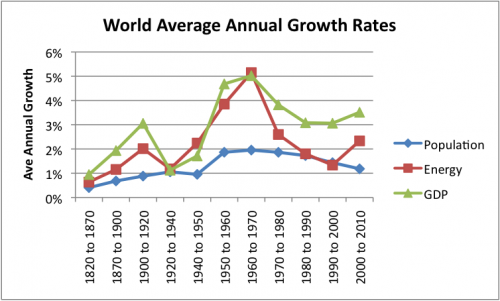
That's it right there.  There is no substitute for nature's capital because we remain, as Thoreau told us about 170 years ago, sapient and sentient beings who nonetheless have a primordial need to maintain their vital heat.  We've gone about this basic task in enormously complicated ways, constructing a vast, interconnected, globalized economy, which is extremely fragile and subject to cascading failure modes, and which is dependent on the enormous expenditure of energy to maintain.  Which, up till the present, has mostly meant fossil fuels. The good and dependable Gail Tverberg over at ourfiniteworld.com has put together a chart demonstrating the symbiotic relationship between the expenditure of energy and the growth of economies based (in the dopey way of economists) on GDP. It is reproduced just above.  Gail's regression analysis reveals an r squared value of .74 between the energy and GDP variables, which is less than ironclad, of course, but highly suggestive in a macro way, and certainly more indicative of how the world works than these crazy nostrums about "stimulus money" and the like from Krugman and other acolytes of a book written in 1935 when the world's population was almost manageable, we weren't cooking the Earth, the seas were 30% less acidic than they are now, the CO2 content of the atmosphere was perhaps 4% elevated versus the 35% we find now.  (If you're tired of reading this post, I commend you to Bill McKibben's brilliant essay in the current issue of Rolling Stone on global warming, where he boils it down to three numbers.)


Thus, as Gail notes, the interdependence of GDP growth and energy use, when considered in light of the manifest need to reduce our expenditure of fossil fuels (on the order of 80% between now and 2050, under the most hopeful scenario, in order to keep global warming under 2 degrees C, which may or may not be safe), means that we are in for a very long, protracted period of declining GDP (not growth, but in real terms) between now and 2050, unless we want to guarantee our extinction.


The situation is actually quite syllogistic and not dependent on malarkey like IS-LM Keynes/Hicks Liquidity Trap Zero Lower Bound Monetary Fiscal Mumbo Jumbo, and the rest of the nonsense Krugman and his ilk use for their useless stock in trade.  We're at the end of the line, we have to switch over to sustainability and reduced populations, and the Bar Bet Economists have to pay their tabs (which are enormous, because they've really messed up the world with their stupid advice) and go home.


July 26, 2012

Yogi Berra's Future

"It's tough to make predictions, especially about the future."  Yogi Berra.

"The winter in Ithaca convinced him that he had to leave, and Caltech, in addition to better weather, had the appeal of not being a liberal arts university like Cornell, where, he said, 'the theoretical broadening which comes from having many humanities subjects on campus is offset by the general dopiness of the people who study these things.'"  Quantum Man by Lawrence Krauss, about Richard Feynman's life in physics.  

Once I was asked by my mother what the university experience was all about (she had not attended college), and I thought about it for a minute and answered that, as far as the subjects I had studied, it seemed to be a reading list.  You could read the books that educated people thought were important, and the university provided a handy list, called a syllabus, as a guide to your reading.  Another approach to such an education, in other words, would be to have someone who attended the college simply give you the lists, and then you could approach your "education" at your leisure.

I think the "classical" style of education probably made more sense - an emphasis on hard sciences and dead languages, specifically Greek and Latin.  These subjects are better learned in a formal academic setting.  You can "figure out" the plays of Shakespeare or Toqueville's Democracy in America on your own - listening to people lecture about such things simply indoctrinates you into a certain subjective approach, which is probably more limiting than helpful.

The blogosphere daily reflects the limitations of "liberal arts" commentators.  I was thinking this as I read through Jim Kunstler's book Too Much Magic, about the general hopelessness of technology to solve our future energy and economic problems.  Kunstler assures us in numerous places that it's inconceivable we'll come up with solutions that "scale" to the problems we'll face,  and ticks off the usual arguments one by one (solar, wind, thermal, nuclear and so forth) and confidently proclaims that nothing is going to work once oil shortages begin to hit.

That's the thing about the blogosphere: it's become highly influential in a relatively short period, but the general reading public does not often reflect on the absence of peer review, that winnowing process in professional scientific journals that gives at least some guarantee that what you're reading is not absolute nonsense.  The absence of any "gating" procedure such as peer review means that a book like Kunstler's, which follows closely the arguments he makes weekly on his blog Clusterfuck Nation, enters the stream of commerce and consciousness without any real vetting.  I try to remember this as I read such confident "predictions" about the future.

Because I fundamentally agree with Yogi Berra.  Yogi, in his trademark way, was suggesting that the future is impossible to predict because of the problem of unknown variables and feedback loops.  Take the problem of water shortages, for example.  The Earth is covered with salt water, to enormous depths, over 70% of its surface (my daughter forwards word from her oceanography class this summer that the coolest theory going currently is that the water in the oceans originated with impacts from ice-bearing asteroids - I really like that one).  Most of mankind (on the order of 75%) lives near or on the sea coasts.  Thus, a major breakthrough in desalination (dealing, essentially, with the energy issues and with the osmotic sludge produced in the process) would solve the fresh water shortage problem in perpetuity.  But, Kunstler assures us, we will not have the energy for such a process.  He specifically rules out any possibility of fusion power as a solution (for desalination or anything else).

Feynman would not have ruled out fusion power; indeed, he encouraged his Caltech students to pursue the engineering issues (the science is well understood) because he was confident the process could be mastered.  So, just supposing, you simultaneously made breakthroughs in fusion power and desalination - immediately, two gigantic problems would be overcome by a synergistic interplay in (that awful word) technology.  (Or, in the Ali G usage I prefer, techmology.)  At one point (in telephone and telegraph days) the internet itself was unimaginable.  It required the development of materials science (something Feynman also got very interested in) alongside the development of computer science, which at the time was a subset of electrical engineering (Feynman was in on the ground floor of computer science as well, and was the first to conceive of quantum computing).

The mistake Kunstler makes, in my opinion, is that he violates the basic rule of the scientific method, and, again, no one could describe the integrity of the scientific method better than Richard Feynman.  Kunstler assumes his conclusion: we are headed back to horse-and-buggy days, with a general store and a cracker barrel, with a potbellied stove in the middle of the plank-floored room, and the women, dressed in gingham, will turn the paddles in the butter churn and gossip about the new young filly who's living in sin just up the road a piece.  Et cetera.  Thus, all variables which seem to defeat this illusion are quickly and summarily dismissed as inconvenient impediments to this anodyne imagery of America in the 1840's.

That's not the way to do it, in my opinion. At the front end of your "thought experiment," you must not presume your conclusion; otherwise, you will, consciously or unconsciously, force all of your data in a direction favorable to your presumed outcome.

In point of fact, there are lots of ideas which have not been tried yet.  For a simple example, people laugh at Steven Chu's suggestion that all roofs in America be painted white. In the Sunbelt, this will have the effect of lowering electrical usage for air conditioning, and, everywhere, the roofs will reflect incoming sunlight creating an albedo effect.  The reflected light will not radiate infrared heat into the atmosphere where it can be captured by greenhouse gases.  Similarly, all roads should be light colored to reduce the "heat island" problem.  Chu also is a proponent of the cellulosic conversion of switchgrass, essentially a weed, into ethanol as a power source for internal combustion engines.  Kunstler only argues about corn ethanol, but corn requires all kinds of heavy inputs, and its use for ethanol has negative impacts on food production.  Not so with switchgrass, which is an herbaceous, woody plant that in effect "self-fertilizes;" it dies back and replenishes the soil out of which it has been harvested.

The obstacles to such ideas are political, not scientific.  I do believe that social movements run in cycles, and currently we're locked into a very destructive one where the "financialization" of the economy has led to oligarchic control of the political process.  I don't think this will last, and the very crises which Kunstler and others describe will be among the reasons for transformation.  I just don't believe that future shortages of oil, which will doubtless happen along the lines Kunstler describes, will mean the end of the Age of Technology, because that's a little like saying that the human race will lose its collective memory of scientific progress, and that just isn't going to happen.


July 23, 2012

A few notes on reading Jim Kunstler's "Too Much Magic"

I regularly read James Howard Kunstler's "Clusterfuck" blog on Monday mornings, and I'm used to his irreverent hilarity when writing about America's throngs of obese, clueless, Cheez-Doodle chompin', Big Gulp slurpin', NASCAR cheerin', Walmart-shoppin' videophiles.  So I was a little surprised at the rather somber tone of his latest book, Too Much Magic, about the misplaced belief, or hope, that he encounters as he roams around the country, lecturing and attending various forms of Doomsday conferences, that America will pull its (over-abundant) fat from the fire with a last minute technological fix to replace the looming natural resource shortages that lie in the not-too-distant future.

Essentially, the thread of logic which Kunstler delineates centers on the collision course between two main facts of American life: (1) Its car-dependent suburbia (the "Happy Motoring fiesta" he often writes about on the blog) and (2) Peak Oil.  I think that Jim Kunstler has better insight into the Sorrows of Suburbia than any other writer I've encountered.  It's a little uncanny when I read his descriptions.  He has it to a tee, and I know something about the housing tract life, having grown up in a neighborhood you might call the Apotheosis of the California Subdivision beginning in the early 1950's. (Kunstler and I were born in the same year.)  He writes rather movingly of the cultural and aesthetic poverty of such places, which have neither the vitality and vibrancy of true city life, nor the peace and pastoralism of the actual country, which the suburb is meant to simulate in an awful, abstract way.  It's really not surprising to me that the vast swaths of American suburbs have produced so many Gaia-paths, to coin a term, a huge cohort of people with so attenuated a connection to the natural world that they despise and discount the Earth entirely.

Anyway, JHK nails it, the streets of vinyl and particle-board homes, on their 1/4-acre lots, hemmed in by boulevards and strip malls, a flat, featureless terrain in the Geography of Nowhere, as he called it in a book of the same name.  As to Peak Oil, I would say this: I wish the Peak Oil theorists would call it something else, such as the Oil Shortage Crisis.  There is something a little cult-like in the Peakers' way of talking, a little too faith-based.  I get the general idea: Peak Oil refers to that point in time when 1/2 of the commercially-retrievable petroleum has been extracted from the ground, and the 50% that remains is less readily-accessible, more expensive or environmentally destructive to get at, or just not worthe the trouble at all.  But what it really adds up to is that there is going to be an oil shortage.

Right now we're straining at the limits of world production, which for actual, straight-up petroleum is about 84 million barrels per day (84 mm bbl/day), and including all "liquid fuels" that can serve similar purposes, the number is around 102 mm/bbl.  Fossil fuels have been a wonderful source of energy-dense power, essential for practically everything in modern life, so ubiquitous that we forget that without it, the whole operation pretty much shuts down.  Groceries don't get to market, commercial planes don't fly people here and there, crops don't get fertilized, the folks way out in the suburban tracts don't get to work, or to the store or to school, the whole system of international trade of goods suddenly ends. 

The question that doesn't really get answered by Peak Oil theorists is the one most on people's minds: at what point, more or less exactly, will the shortages predicted, or the rising price of oil, cause all these dire consequences to unfold?  I sometimes think, as I may have mentioned before, that from the viewpoint of the Peakers, it just can't happen soon enough.  This is part of my Special Theory of Personal Time Horizon Relativity (I'm not sure that anagrams very well - SPOPTHR).  The essential idea behind SPOPTHR is probably the reason humanity won't do anything about global warming until we've blown past all conceivable tipping points and points of no return.  We're simply not motivated, in an evolutionary, genetically-determined way, to do anything about a problem we are not dealing with as an observable crisis right here and now.  The somewhat bucolic, anodyne world the Peakers would like to see return, and which they envision just on the far side of the End of Suburbia, is something they, themselves, want to enjoy during their lifetimes.  I think this bias creeps into their analysis, although on balance, I think JHK and Dmitry Orlov are definitely right about the eventual outcome.

What maybe we didn't see so clearly was that as the world economies became sluggish, and failed to grow (phenomena related to the scarcity and high price of oil, as Gail Tverberg has shown in the graph above), was that petroleum usage, in the United States and elsewhere, would begin to fall precipitously.  And since the United States alone was using more than 20% of all the crude oil pumped from the Earth on a daily basis, this is a major downturn.

So this delays the moment of reckoning.  Of course, since energy inputs are necessary for economic growth, the economies of the world, particularly in the West, Japan and in the former Soviet bloc, are locked in stagnation, so we wouldn't be getting anywhere while we wait to run out of oil, if we try to follow business as usual.

The smart thing to do, as Kunstler says, is to use the available dense-energy fossil fuels to power a transition to a smaller, localized economy, with mass transit based on the old (not high speed) rail system, buses, walkable towns, bike paths and other sustainable approaches such as localized solar power (rooftop, for example) and wind turbines.  That does make sense. It's possible that the slow-motion collapse of the existing system, brought on by the collision course between unserviceable debts (which require, because of their compounding nature, concomitant exponential growth in GDP), on the one hand; and the gradual awakening to the reality that unavailability of oil is becoming a problem, on the other. 

If things happen less quickly than the Collapsarians envision in their Dark Dreams, say over the next 20 years or so, then some of the nascent tendencies already becoming apparent (local community gardens, small-scale farming, grass-fed ranching, a general return to the land) might have time to take shape.  It's not as dramatic, but it might be workable for the generations to come.

July 21, 2012

Saturday Morning Essay: Going B/K in the Golden State


Brought to you by Trader Joe's Dark Roast

 First, I must correct an erroneous slur: it is widely assumed that the bankruptcy of Mammoth Lakes, California, is in some ways comparable to the previous bankruptcies of Vallejo, Stockton and San Bernandino, California.  This isn't fair.  Mammoth Lakes filed Chapter 9 because it wound up on the wrong side of a lawsuit, a $32 million judgment against it, which was enhanced by legal interest and costs to $43 million.  That could happen to any municipality defended by typically incompetent county counsel.  The bankruptcy of Mammoth Lakes is not really indicative of a general trend toward insolvency of cities in California.

The way that bankruptcies in Vallejo, Stockton and San Bernadino are indicative of a general trend toward insolvency of cities in California.  They will soon be followed by a couple of other Southern California cities, probably Compton, then Montebello.  These cities are facing Chapter 9 because they've run out of money.  It's not really a lot more complicated than that.

Chapter 9 was enacted during the Great Depression to give cities and other local government entities (such as transportation districts) a way to "reorganize" in bankruptcy, along the lines of corporate reorganization under Chapter 11.  It imposes an "automatic stay" against further legal action versus the city except through the auspices of the bankruptcy court, which oversees such litigation and the city's plan for reorganization.  While a corporation has the option of converting a Chapter 11 to a straight belly-up Chapter 7 if there is no hope, a city can't really go out of business since technically it's not in business in the first place, and it can't really simply cease to exist.  Otherwise, people living in the city would not be living anywhere, and that violates one or more physical laws, I'm sure.

Cities use Chapter 9, in general, to deal with onerous and unpayable recurring costs (Mammoth Lakes being an exception, as we've seen) such as pensions and muni bond payments.  This is what's going on in Compton, for example, and Stockton rolled over for the same reason (that sleepy little Valley town is the largest muni b/k in history, by the way).  The bankruptcy court can release a city from its collective bargaining agreements with government employees, thus paving the way for relief from pension payments it can't afford or bond payments it cannot make.  Some form of "cram down" can be visited on the unhappy heads of the city's many creditors.

I was thinking that California would be particularly susceptible to muni b/k for a couple of reasons. (You might think of this as a Feynman-style First Approximation, since I've been reading a lot about that remarkable man and his unworldly-smart mind of late.)  California has Proposition 13, which sets strict ad valorem limits on real property taxes, a principal source of revenue for the state and local governments.  A curious feature of Prop. 13 is that it was originally designed to shield homeowners from runaway assessments on the values of their homes back in the go-go days of the mid-1970's in California, when everyone wanted to live here and houses were appreciating at an astonishing rate.

Essentially, taxes are set at 1% of the house's fair market value.  Assessments can only add 2% per year to the tax bill, a constraint on government.  It's all written into the state constitution, of course; Howard Jarvis saw to that.  I believe a War Between the Worlds is necessary to relieve the state of Prop 13's rules - nothing less.  Yet another curious feature of Prop 13 is that it has a yo-yo effect.  It can cause assessments to go down as well as up, and there is no "2% per year" limitation on declining real property values.  Thus, when the housing bubble popped around 2007, and the first waves of foreclosures hit with all of their distress sales and bank repo action, the bottom fell out of state and local governments.  Real property values plummeted and with them that inexorable 1% calculation.

Meanwhile, California's cities and state government had blissfully planned their future based on Jarvis's great fear, that housing prices would always go up, and furthermore that the anomalous period of high capital gains paid during the DotCom boom would represent some kind of permanent bonus for the state treasury.

Alas, no.  As with everything else in matters fiscal in the United States, everything depended on sustained growth, growth which is not happening,  Quite the contrary.  If we strip out deficit spending at the federal level (which has been as high as 10% of GDP), the economy has been contracting as a matter of reality.  What kept California afloat during these five years since the bursting of the bubble was ARRA, aid from the federal government to states in particular.  All of that money, of course, was borrowed or printed or in some form hallucinated into existence, but now Congress doesn't want to do that anymore, and California faces the icy cold winds of penury without that cover.

A disturbing situation.  California tends to lead the way in national trends, after all.  The Golden State is saddled with a 2012 budget based, perhaps, on revenues from 1996 valuations, or at least we're gravitating toward that reality.  Every time a house changes hands at a price below the value carried on the tax rolls, the state budget takes another hit.  Each time a real estate developer applies to downgrade his mid-city skyscraper's tax valuation (permitted under Prop 13, and this is a booming business for lawyers), California goes a little deeper into the red.

The question is how far this will go.  Will there be a tipping point?  Some dreary prognosticators (such as Mike Shedlock) forecast that it is only a matter of time before a big enchilada like Los Angeles or Oakland files for Chapter 9, since all of the same problems seen in miniature in places like Compton and Montebello are present in Large Format in L.A. and Oakland.

To finish my Thought Experiment: it seems that at the root of this malaise is the natural human tendency to conceptualize the future in terms of what's happening in the here and now.  This was unrealistic.  Not only did the housing bubble pop, but with its bursting came the knock-on effects caused by the loss of all that notional "equity," the re-fis and equity loans that powered so many of the "discretionary" businesses in the Golden State.  It was hard to see all that coming, especially if you're a government bureaucrat running a business that isn't really a business, and it doesn't seem to matter, at the time while you've got the job, whether you're right or wrong.

July 19, 2012

How to feel good about any result in November


http://www.youtube.com/watch?v=A7ktYbVwr90&feature=player_embedded

As Matt Taiibi has written, the Presidential campaign of 2012 is likely to be the most boring electoral race in the history of the American Republic.  I don't know what Millard Fillmore sounded like on the campaign trail, or James Buchanan or some of these other hacks, but I'm fairly confident that Barack Obama versus Mitt Romney will be a grueling, mind-deranging thing to watch after they get into high gear, if that is not a contradiction in terms.  We are getting close to that Event Horizon (sorry to use this metaphor two posts in a row, but I think it fits again) where all loyal Democrats are reminded that maybe President Obama's entire presidency is veiled in complete secrecy, maybe he makes war on whistleblowers to an extent never before seen in American politics, maybe he starts wars in foreign countries with no Congressional authorization whatsoever, maybe he has institutionalized a program of whacking American citizens with no due process of any kind, maybe the President of the ACLU says that Obama's presidency is "worse than George Bush" in terms of civil liberties abuses, but dammit - think how bad Mitt Romney will be for the Middle Class!

And yes, President Obama is on the payroll of the same Wall Street financial institutions as his opponent, but gosh, what's a President to do if he betrayed every promise for "Hope & Change" he made to the American people in 2008 and now has no choice but to go hat in hand to the fat cats he used to deride (but no more, you'll notice)?  Without money, there is no way to buy all the media time necessary to fill the airwaves with the half-truths, propaganda and slogans essential to the manipulation of the half of the voting-age populace who will actually show up to vote in November.

Still, Barack is our guy.  More important, he's Our Brand.  Although I'm voting for Jill Stein, the Green Party candidate.  Am I wasting my vote?  Well, of course, in one way of looking at it.  She isn't going to win, not by a long shot.  She'll barely register on the tally, on election night I doubt you'll ever hear her name.  My general feeling is that either President Obama or President Romney will be driving the American Bus in the same direction it's been going for quite some time over the last couple of decades (longer, really, but never mind), and that route is the HOV lane on the Highway to Hell.

And that's okay in my book, because there are more important issues that Planet Earth faces than the tiny comparative economic advantage offered by either of these Empty Suits.  I would encourage you to watch the short lecture by David Roberts embedded in this blog.  I've read his stuff for years on the HuffPost, and I found this video on the Skeptical Science blogsite, which deals with global warming and more specifically with the constant bad faith attacks on the scientific consensus concerning global warming which originate, almost without exception, with American legacy industries with a vested interest in finishing the planet off.

If you take the thesis advanced by Mr. Roberts (and by many, many others who are conversant with the frightening magnitude of the problem) at its face value, then you must admit that, if the world only has about 5 or 10 years to move decisively on global warming or face irreversible consequences, then whatever means are necessary to bring about these changes are the only way to go at this point.  This is simply logical.  The truth, as General Buck Turgidson told us in "Dr. Strangelove," is not always a pleasant thing.

Now the upside of America's slide toward economic collapse is that the world's largest economy, that of the country which is probably the most intransigent and obstructionist on the issue of global warming (shamefully so, because we really have no excuse), is that we have, for example, dramatically reduced our use of petroleum and gasoline over the last 5 years.  Not because we're virtuous and concerned, of course, but because we're broke.  I am confident that either of the two schlemiels running for President can guarantee that nothing will be done to slow this descent toward collapse.  They are the two avatars of the completely sclerotic political system which has ruled this country for decades, a corrupt, non-adapting, thrashing-in-the-tar-pits brontosaurus of a nation. So to speak, at least environmentally.  I mean, how much time do you ever hear Barack Obama or Mitt Romney spend speaking along the lines covered in the Roberts lecture? Exactly.  So if neither spends any time discussing this existential issue, then what is the relevance of either of their candidacies?

Jill Stein does talk about such things, in the tenor and with the sense of urgency appropriate to the magnitude of the threat.  She'll lose, but it's not a "wasted vote.  Wasting your vote is voting for a candidate who pays no attention whatsoever to the mounting environmental catastrophes threatening human survival, instead devoting his time to absurd discussions of "tax policy," and "terrorist threats" and whatever the hell else they waste their time on.

As a concrete example, here's how this Administration deals with the Midwest drought and the devastation of the corn and soy crops: Agriculture Secretary Tom Vilsack prays for rain. It might have been an opportunity to talk about the increased likelihood of extreme weather events that come with climate change.  It might have been an opportunity to wonder aloud whether it's a good idea to devote 40% of the (inedible) corn crop to ethanol production, a process that has a negative energy return on energy invested (EROEI), but continues because of Congressional corruption.  It might have been a time to raise the issue that the failure of a corn crop should have no effect on beef prices, because cows are ungulates which naturally eat grass, and left to their own devices do not graze in corn fields. Which is why they have to be loaded up on antibiotics in feed lots where they eat a nonstop diet of corn.

Jill Stein favors a return to sustainable agriculture and food production.  Thus, I leave others to vote for Coke or Pepsi, confident that November will be a win/win no matter what happens.

July 17, 2012

The Quantum Mechanical Resignations of Mitt Romney


It so happens that I've been reading and hearing about Mitt Romney's difficulties in getting his story straight about when, or even if, he resigned from Bain Capital, the American-job-killing enterprise he wants to use as a stepping stone to leading the American people, at the same time I've been reading Quantum Man, a book by Lawrence Krauss about Richard Feynman's life in physics.

It was a feature of Feynman's early breakthroughs in understanding quantum theory that it is sometimes necessary to postulate that subatomic particles travel backward in time, as in the case of a positron which "quantum fluctuates" itself into existence out of nothing, travels backward in time to annihilate with an electron, and thus preserves various rules of Heisenberg's Uncertainty Principle, Pauli's Exclusionary Principle, and other sacred edicts of the Science of the Very Small.  It's a strange world, way down there, but quantum mechanics has been experimentally verified many times and seems to have real world referents, which differentiates it from, for example, String Theory, which is mathematically impressive but seems to lack any correlation to reality.  String Theory has been likened to a drunken game of darts at a pub, where the players throw the darts any old which way, then walk to the wall and draw a bull's eye around wherever the darts stuck.

Anyway, for reasons related to statistical mechanics, another dense and fascinating subject, it does not seem that the  anomalies of the quantum world happen in the world of Macro-Reality, so we're stuck with plain old entropy where we can tell what time it is, or at least whether Now is later than Before, by watching an egg roll off the kitchen counter.  A highly organized egg on the counter: Then.   A mess of yolk and egg white on the floor: Later.

This is the world that Mitt Romney is stuck in as he attempts to explain his Theory of Retroactive Resignation.  Mitt himself wants to be a big, white, cornball, empty-suit Positron who can move backward in time in a Large Feynman Diagram and quit Bain Capital in 1999, where he wants to have quit, and not years later during a period when Bain was busy shipping jobs to Bangalore and engaging in other anti-American economic activities which form the basic business model of the modern American corporate world.  Not that Bain Capital wasn't bad enough when Romney was definitely in charge, in the years before 1999, but it got worse, and Romney would like as much distance between Himself and his Anti-Particle Self in order to avoid mutual annihilation.

Mitt's big problem is that he remained as President, CEO, Chairman of the Board, and sole shareholder of Bain Capital in SEC filings until probably 2003, and you can't really ignore these filings and claim you had "nothing to do with the company" after 1999 when the corporate record says otherwise.  And since corporations are strictly creatures of statute (something that seems to be overlooked in much of the current discussion), whatever a corporation appears to be as a matter of regulatory filings and corporate formalities is what it actually is, since its Virtual Reality is equivalent in this case to its Actual Reality.  That is to say, Mitt's SEC filings for Bain are not likely to quantum fluctuate themselves out of existence.  Nevertheless, the Romney campaign is striving mightily to sell its version of the retroactive resignation, even if it violates one or more of basic quantum tenets, such as the Bullshit Principle.

Who knows if Mitt will get away with it?  It's amazing to me that the American commoner would contemplate for a moment voting into office a corporate raider who parks his multi-millions offshore, takes advantage of every loophole available in the Internal Revenue Code so that his effective tax rate is lower than that of the baristas down at Peet's Coffee, and, in general, has absolutely nothing in common with well over 99% of the Americans he would serve as President.

Although, you know...I hate to get involved in this kind of thing.  The absurdity of Romney's candidacy is kind of interesting, in a macabre way.  I keep wondering whether there is some sort of rational limit, somewhere, to the capacity of the American Commoner to vote against his/her own interest.  If Americans actually start electing presidents who spent their careers dismantling American business, in the very activities that led to the complete undoing of the American Middle Class, then we've reached some sort of Event Horizon, another fun concept from the world of physics.


July 11, 2012

Gail Tverberg and "Our Finite World"

The website I find the most informative these days is a fairly obscure blog maintained by Gail Tverberg, an actuary, under the masthead "Our Finite World."  It's written in deceptively simple language, but her ideas are profound and always relevant.  She doesn't really go in for much doomsaying; she just lays out the facts and lets them speak for themselves (http://ourfiniteworld.com).    I think Gail's blog is one of the really good things about the Internet; since being a rock star economist (in the style of Paul Krugman, for example) is beyond her, and no one is going to hire her as a columnist for the New York Times or Washington Post (because she's not sensationalist enough), without the Internet, she would have no forum.  She'd just be a numbers-crunching actuary.  Her motivation for writing, she says, is that she's "interested" in the issues she writes about, like human survival, resource depletion, Peak Oil and other matters.

I don't see her precise kind of analysis anywhere else.  For example, her latest piece is about those parts of the world which are still growing economically.  In her characteristic, homespun way, she calls these countries "the growing part of the world" and then explains why they're growing.  They're growing because they're largely poor and have a long way to go to catch up to the consumerist West, and they're using coal as an energy source at an astonishing pace (increasing their coal-burning at more than a 5% per year rate).  The "growing part of the world" is essentially everything that isn't Japan, the United States, Europe or the former Soviet Union bloc, and includes China, India, Africa, Australia, Canada and South America.

The West (ncluding Europe and Japan) and the FSU are economically stagnant, probably for different reasons among them.  In the case of the West, the assumption of huge public and private indebtedness over the last 30 years as the West sought to maintain a luxurious lifestyle (relatively speaking) despite being embedded in a globalized economy (where the hard work and manufacturing were increasingly done elsewhere, particularly in Asia) has at last caught up to these favored specimens of the Homo sapiens species.  I think that's the true Big Picture; I've always considered the possibility that blaming everything on the "housing bubble" was a case of whistling past the graveyard.  The true significance of the housing bubble, and the havoc wreaked by its popping, was simply that the very homes that Westerners lived in, the "housing stock," was sort of the last thing that Americans, Europeans and others had left to hypothecate in order to get another loan.  The loans, "secured" by houses, were what enabled the economy to appear so much more vibrant than it really was.  Lines of credit, re-fi, gains on sale, all that dough poured into the economy and made possible such dubious pastimes and careers as party and wedding planners, "life coaches," tanning salons, all kinds of strange occupations which depend on large surpluses of cash flow in order to be viable.

And then - poof!  It was all gone.  Americans were forced to fall back on, of all things, the actual income they could earn through employment, and real earnings have been stagnant for decades. It is as if the economy needs to reset itself to a 1973 standard of living, adjusted only for modest annual inflation, and move forward from there.  Of course, that isn't the American Way.  Progress is our most important product.

Naturally, there have been many technological improvements in the intervening four decades, so that life in many (certainly not all) respects appears more productive, convenient and efficient.  A great deal of this progress has been achieved by way of the integrated circuit and electronics in general.  In this sense, life seems considerably "richer" to the average citizen.  But in the West this is misleading.  In point of fact, many aspects of life, such as education, housing, energy costs, and food, have gotten a great deal more "expensive," as measured by the proportion of real income (inflation adjusted) necessary to fund these essentials.

To take a personal example: when I entered Berkeley in the fall of 1966, there was no tuition for in-state students.  There was a "Reg Fee" of $81 per quarter, or $243 for the full year.  Berkeley was rated the top academic institution in the country at the time.  After I arrived and settled in, I discovered that you had to buy books in college, so I got a job at Cowell Hospital as an orderly, making (if I remember right) $2.35 an hour.  My mother had been sending me ten bucks a week up to the point when I got the job (about two months after I started), but then discontinued the stipend once I was working.  I don't mention this as a hardship story; it wasn't that way at all, and I never missed the money from home.  I didn't need it.  I sold my books at the end of each quarter and bought new ones.  No big deal.

A country that can afford that sort of an educational institution without strain or pain for anyone involved is a very rich country indeed.  While $243 seems like nothing compared, say, to the $20,000 per year currently charged by UC campuses for tuition for in-state students (and much more for the professional schools - my own law school now charges something on the order of $40,000 per year for an education given to me for $1,500), that $243 in 1966 would have been, I know, a princely sum in Mexico in 1966.  You could have lived in Mexico for a year on $243, including margaritas.

Gail points out that in the West generally gasoline usage is falling backwards to levels not seen since the mid 1990's.  This is especially true in the United States, which thought of cheap gasoline as a national birthright.  The decline is not because Americans have suddenly become paragons of conservation and climate change activists.  Not a chance.  It's because we're broke.  Resources are becoming scarcer and more expensive, and the global competition for something as critical as petroleum results in a very tight fit between supply and demand.  

The rock star economists such as Paul Krugman insist that the economy is "not a morality play," but I think they're essentially wrong.  There is a deep moral element to economic activity, and we approached that ethical responsibility by borrowing the future in order, at all costs, to maintain the lifestyle of the present.  Borrowing is essentially the anticipation of future income, and the future income never really arrived.  But the crushing debt remains.

As cities now declare bankruptcy throughout California, what we're seeing is the dawning realization that budgets were established on the unrealistic expectation that "income" founded on or derived from borrowed money represented an inexhaustible source of revenue.  Real property values, income derived from all those marginal business ventures (the party planning, the bronzed bodies), all of that was ephemeral and based on piling up debt.  I actually think this is the essential malaise of everything going on now economically in the United States, from Social Security, to Medicare, to the public pension crises.  All of the projections were based on unrealistic expectations of continued, uninterrupted growth, and now, as Gail points out, America is no longer in the "growing part of the world."


July 06, 2012

I think I've read all the novels of Nick Hornby

There were about five of them.  One right after the other.  They are gentle, easygoing stories, vaguely absurd and Absurdist in the sense that the characters, thoroughly modern people, recognize that life has no point but you live it anyway.  There is even a lengthy soliloquy in the novel "About A Boy" (made into a movie starring Hugh Grant) about that very thing, The Point.  How, for example, do you explain to a person in great psychic distress that there is a Point?  The unlikely hero of that novel manages to do so with a suicidal woman, and brings her back from the brink.

There always is a Point, of course.  "Thinking" otherwise is just that, tricking yourself into intellectualizing something that is not, fundamentally, intellectual.  That seemed to be one of Albert Camus's conceits, very French in character.  If you can't rationally support the case for existence, then you must, as a matter of principle, kill yourself.  Take it easy, as Ali G might say.

In the last of the five novels I read, one of the characters likes to read the poems of Billy Collins.  I didn't know who Billy Collins was, but here's one of his poems:

Fishing On The Susquehanna In July

I have never been fishing on the Susquehanna
or on any river for that matter
to be perfectly honest.

Not in July or any month
have I had the pleasure -- if it is a pleasure --
of fishing on the Susquehanna.

I am more likely to be found
in a quiet room like this one --
a painting of a woman on the wall,

a bowl of tangerines on the table --
trying to manufacture the sensation
of fishing on the Susquehanna.

There is little doubt
that others have been fishing
on the Susquehanna,

rowing upstream in a wooden boat,
sliding the oars under the water
then raising them to drip in the light.

But the nearest I have ever come to
fishing on the Susquehanna
was one afternoon in a museum in Philadelphia,

when I balanced a little egg of time
in front of a painting
in which that river curled around a bend

under a blue cloud-ruffled sky,
dense trees along the banks,
and a fellow with a red bandana

sitting in a small, green
flat-bottom boat
holding the thin whip of a pole.

That is something I am unlikely
ever to do, I remember
saying to myself and the person next to me.

Then I blinked and moved on
to other American scenes
of haystacks, water whitening over rocks,

even one of a brown hare
who seemed so wired with alertness
I imagined him springing right out of the frame.

 
Billy Collins
 
That illustrates The Point nicely.

June 29, 2012

Being & Nothingness on the High Court, Part Deux

I was a little disappointed yesterday that the Supreme Court did not take seriously the existential arguments of the Southern lower federal courts which had found the Commerce Clause inapplicable to the "act of not buying health insurance."  A typical, classic American, a 280-lb. behemoth just back from buying a half-ton of Pringles at the local Wal-Mart, sprawled in his Barcalounger there in the tract house in East Texas, waiting anxiously with a cold bottle of Lone Star in his chubby hand for the kickoff of the Cowboys-Redskins game - if this man is not buying health insurance, as Obamacare will soon compel him to do on pain of imposing a tax for which no enforcement method is provided - is this man, at this moment of contentment and disheveled repose, engaged in Interstate Commerce within the meaning of the hallowed clause?

We may never know now.  The Supreme Court instead chose to base an almost incomprehensibly fragmented decision on dismayingly clunky arguments, upholding the "individual mandate" to buy insurance (from Aetna, from Anthem, from a bunch of other private, for-profit insurance companies with a captive clientele ushered to their door by the federal government) or suffer the completely undefined consequences. 

It could have been so elegant, so....French.  Now we will have another huge federal bureaucracy with inadequate funding to add to a budget that is currently only about 60% funded with anything other than hallucinated money.  In despair one might seek refuge in some tropical paradise, one that is still above sea level at high tide, to follow the course of Paul Gaugin or Robert Louis Stevenson and simply drop out of the rat race, to exit the noise and tumult of our soul-crushing modern civilization.  To get away from it all, perhaps even in Hawaii, that lovely fleet of islands anchored in the mid-Pacific.  Not one of the over-developed islands, of course, like Oahu or Maui, but a quiet refuge like Kauai, Molokai or Ellison.