December 16, 2009

Jake & Elwood would never break out of this Illinois prison


Obama did promise to close down Guantanamo, and damn if he isn't a man of his word. The hapless denizens of the Cuban Club Fed are moving north to the Thompson Correctional Facility in Illinois (not so far from the Blues Brothers lockup in Joliet), only about 100 miles west of the President's private residence. This major development has all the characteristics of other Obama major developments:


1. It isn't a major development at all. Of the 210 detainees in Cuba, maybe half will go north for now. This makes it look as if there is compliance with Obama's campaign promise to close Guantanamo "within one year" without actually, you know, closing Guantanamo within one year. It is that perfect Obamian compromise with the truth - halfway between doing the right thing and kowtowing to the demands of the howling Right, who believe that the very presence of a Muslim detainee on U.S. soil poses a clear and present danger to the survival of the Republic.

2. Although the transferred prisoners will reside in the American heartland, they will not see the inside of an actual American court room. Some of them will be tried before military commissions; many others will be detained indefinitely without trial, without charges and basically without hope. William Lynn of the Department of Defense has announced that the choice of forum, or the decision not to have any forum at all, is determined on the basis of the likelihood of a favorable outcome for the prosecution. Federal trials in civil court rooms are reserved for those defendants with the least chance of escaping conviction. If the case against a given prisoner is relatively weaker, then trial proceeds before a military tribunal, where the rules of evidence are relaxed in favor of the government and the tribunal itself is more likely to convict. If even this kangaroo proceeding cannot be relied upon to assure conviction, then the government plays its ace in the hole: the prisoner is just held indefinitely with no charges and no trial.

Thus, the system is set up so that the weaker the case against you, the less justice you are afforded. I think this is the Winston Smith principle of jurisprudence.

3. As a legislator and as a Democratic nominee on the campaign trail, Obama was against military tribunals altogether, and spoke out against the tyrannical practice of detention without trial. Now all of that has changed. The underlying rationale which Obama must have adopted during the last twelve months, at some point after his election was assured, is that a Muslim detainee in Guantanamo must be there for some reason, so it's logical to assume that the prisoner is guilty; that is, that a presumption of guilt exists. Whether the United States can prove it or not is somewhat beside the point, although from the viewpoint of the prisoner, I suppose, it is the point entirely. The fallacy, not often publicized (but which my membership in a legal bar compels me to point out, since I am required by the Canons of Ethics to advocate for justice even for those whom society despises), is that the right of habeas corpus, finally regained by the detainees in the Supreme Court case of Boumeddiene, has been exercised successfully by detainees in 29 out of 33 cases, or 88% of the time. The presumption of guilt which has supplanted the previous (220 year) history presuming innocence (as enshrined in the Bill of Rights), has been moved aside for purely political reasons unrelated to (a) actual danger to the United States or (b) common decency. Thus, the idea of detention without trial, in the face of such a procedural history and possibility of error, seems nothing short of tyranny.

I was watching an interview of Rep. Joe Barton (R, Tex.) yesterday as he fulminated against the grave danger of moving these awful terrorists to Illinois, where, despite the supermax conditions (from which no prisoner has ever escaped), they are likely to successully plot the total destruction of the United States. I guess that Barack Obama keeps thinking that if he splits the difference, closes Guantanamo while keeping its spirit of injustice alive, he can mollify his critics on the Right, as he has tried in so many other instances. That it never works doesn't seem to matter. But I suppose what guys like Barton have learned is that if they remain vociferous and keep complaining, even when Obama does more or less exactly what George W. Bush would have done in the same situation, that they can keep moving the President farther and farther in their direction. Until one day, in the probably not too distant future, they may have the satisfaction of thinking that things have never been so good, and that the election about a year ago, which seemed so transformative at the time, actually didn't amount to much at all.

December 15, 2009

Tin foil hats and other seasonal costumes


Sometimes I wonder whether I actually have to have some quote or news item to base one of these cognitive spasms upon. For example, one idea that occurs to me this morning (as I siphon some Peet's coffee into my synapses) is that maybe hikers should just stop climbing Mt. Hood in Oregon in the dead of winter. You know? I mean, doesn't this tragedy get a little repetitious? Is it actually surprising that blizzards would hit a mountain 11,240 feet high in the Cascade range in mid-December?


Just a thought. That's not actually the text of my sermon. I keep getting drawn back to the Economy as a subject. As I've said before, my inspiration, Henry David Thoreau, based his longest chapter in Walden on Economy for the simple reason that what we call the economy is essentially a description of the means by which humans derive their vital heat from Planet Earth in order to sustain life. For this you need food and shelter. Of course, very few Americans are actually engaged directly in these processes anymore. We eat food and we live in houses, but we don't grow the first or build the second. That's because we're "advanced," and live in the "organic" society, which is a very complicated contraption built upon hyper-specialization. Meaning, of course, that most of us are engaged in completely useless functions which can be easily discarded by society with no discernible loss to the core function of maintaining vital heat.

As part of the elaboration of our complexity, American elites thought it would be a good idea to get into a symbiotic relationship with the People's Republic of China, a Communist dictatorship, and to outsource our manufacturing jobs. Those are the jobs we built our former middle class upon. The Commies in Beijing run a command economy of the type favored by Josef Stalin, noted tyrant of the former Soviet Union. This means they can play any game they want with wages, currency fluctuations and anything else. They pegged their yuan to the dollar, which allows them to keep Chinese wages at the munificent average sum of 31 cents an hour, or about $2.50 a day. So the average annual compensation in China is about $3,000. In America, for a little while longer, the average annual earnings are $47,000. However, because of the symbiotic, and somewhat paradoxical, relationship that exists between our two great nations, one would expect that, as water seeks its own level, a gradual evening out would occur to "fix" this disparity. This is currently underway, although it won't continue.

So as I was hoovering in some of Peet's rich, oily, aromatic caffeinated brew, it occurred to me that we could forecast America's fate by simple mathematics. One cannot simply add the two income levels and divide by two, because China's population is four times larger than ours. So a weighted average makes more sense. We can take the sum of $12,000 (4 x $3,000), add that to $47,000 [$59,000], and divide by 5. So we're headed toward average annual earnings of a little under $12,000 per year. Isn't that nice of us to lever up the Chinese that way? I think so. They make stuff and export it to us; we export dollars to them; they export the dollars back to us; we make cheap loans to ourselves and inflate "assets" we can borrow against. This creates "money" that we use to buy more stuff from them.

Oh hell. Like all perpetual motion machines, this neat little setup ran afoul of the laws of thermodynamics. The contraption broke down. While this is a disaster for us, it's also a calamity for the Chinese. They have those 100,000 factories, they're up to their eyeballs in salad spinners, Snugglies, pirated CDs, flat screen TVs, poison dog food and radioactive Gerber's, and they don't have the money to buy it from themselves.

Meanwhile, back at the Ranch on Capitol Hill, certain expectations about the continuance of this neat symbiosis had taken root. We really, really need the Chinese, and other helpful Asians, to help our government with its spending problem. Lately, it's gotten somewhat out of control. In addition to rolling over the Mount Hood of debt (see: this is called "thematic unity") we had already amassed, we thought it would be a good idea this year and the last to throw on another $1.5 trillion or so of new debt, sort of like fresh powder over the frozen pack of yesteryears. So we need a lot of help with flogging about $150 billion per month (October and November indicate we're on pace for a $1.8 trillion deficit, not quite as good as we hoped) of Treasury bills, notes, bonds, you-name-it, over and above all the stuff that keeps coming due from all the previous decades of empire building and defending the world against -- well, Communists.

And dag nab it, right when we needed them most (and isn't this just like a Commie?), the Chinese became kind of disinterested in our problem. They are becoming net sellers of our Treasury IOUs. You see, the conveyor belt needs to run in a complete loop to keep the Chinese focused on our problem. If we stop buying stuff from them (and we're stopping), then they don't receive those dollars to send back to us. And do you think the Chinese are just going to come up with the money to take care of us? My sentiments exactly.

You see, here in America the idea that our standard of living should go down just because the vast majority of us are engaged in completely unproductive employment was absolutely - politically, emotionally, even morally - inadmissible. We would "stimulate" the American economy back to life, dammit.

Well, we still have a few tricks up our sleeve, you know. If the Chinese won't give us our money back (because we didn't send it to them to give us), we'll just make some more, because we are not going to settle for any 12,000 bucks a year, even if it's what we deserve. So if you're looking for a good investment play, I would suggest Lexmark. They make toner cartridges, you know.

December 13, 2009

Signs & Portents


I'm kind of bummed that Dmitry Orlov has indicated he won't write satirical pieces anymore on his blog because it's become "bad taste." By which he means, his predictions of American collapse are now on such solid footing that they are no longer controversial - indeed, it's a matter of looking out the window to verify his prescience. So, he goes on to say, in essence, satirizing America is like "cracking jokes at a wake." Reading James Joyce, however, I get the idea this is exactly what the Irish in fact do at a wake. What else are you going to do? Besides guzzle Jameson's, I mean.


I note with fatalistic alarm that the state of California is putting a whole bunch of office buildings on the market, including the whole Franchise Tax board "campus." Isn't there a little bit of irony there? Taxes themselves are insufficient, so let's sell the damn building itself. That is what you might call late-stage desperation. The idea is that the state could raise as much as $660 million by selling all this real estate. The Controller (John Chiang) is ecstatic at the prospect, and he needs things to elevate his moods, I bet. Let's say that the net/net haul on selling this stuff won't be "optimal" in this particular commercial real estate market, even though Chiang is gung-ho because the new owner gets a "Class A" tenant along with the building. I'm a man who loves a good contradiction in terms. A Class A tenant? Isn't that the very bankrupt state who was just forced to sell the place?

Anyway, let's say that Kal-ee-for-nee-yuh actually raises $500 million. Makes the math easier, and as you'll see, it doesn't make any difference. The state's budget deficit is $20 billion. Thus I can calculate (even though I was educated in California public schools) that this magnificent windfall will take care of 2-1/2% of the deficit. For one year. Now we have to figure out how to take care of the other 97.5%. Or, to round up, the other 100%, because the actual budget deficit is worse than $20 billion. That's just the number Chiang is using to keep from dousing himself with gasoline in a public square and striking a match.

Fortunately, there's a "recovery" underway. So once we retire 2.5% of the deficit this year, everything will be fine next year with our booming economy and everything, and there's no chance of an unlawful detainer action to oust the state from all those buildings it used to own but now leases. I mean, it would be humiliating for the Franchise Tax Board to get evicted and have to resort to collecting taxes from local high school gymnasiums.

One fellow on the Zero Hedge blog, who strikes me as particularly perspicacious (I think the word was on the verbal SAT), commented that he doubted the states were going to have to "secede" or "rebel" or any of that nonsense. The breakup of the USA would occur quietly, almost as a matter of course. It would happen this way: the U.S. Government is going to default on its debt. If you look over there to the right at the National Debt Clock, you'll see a number whirring by. Here's the curious thing: the National Debt Limit is $12.104 trillion. How's this one work? Oh, Geithner & Crew have ways. Anyway, they just don't care anymore. It's gotten to be too much. There's a lot of talk about "replacing" Geithner. You know, as if they'll find someone else anxious to hold auctions every frigging day in a sweat-soaked effort to keep raising all this dough. The estimate is that the U.S.A. will need to "roll" about $5 trillion next year on the public part of the debt, which will soon hit close to $8 trillion. More than half of the debt is in notes with durations of under one year, so it must constantly be rolled over to keep the game going.

Where's the money going to come from? The auctions are already beginning to look a little wobbly - the Treasury is paying more in interest on longer term bonds than it wants to pay, and the action ("bid-to-cover") is falling off. China and Japan have problems of their own, and their export market (the U.S. consumer, in other words) is not that reliably insatiable pack rat he used to be. China buys more cars and refrigerators now than we do.

In short, just as Greece, Latvia and Dubai suddenly imploded, the U.S. could have a full-fledged funding crisis on its hands in the blink of an eye, brought on by one failed auction. That's all it would take for panic to set in. At that point, the states (such as West Austria, where I live), which are already in a hopeless financial condition, are going to wonder whether it makes a lot of sense to keep pouring money into the fiscal black hole known as the U.S. Treasury. Anyway, that's the Zero Hedge guy's theory. Americans will devolve by dissolving into a piecemeal map of independent regions.

One thing has become obvious from watching Congress attempt to deal with anything: they are simply not capable of practical solutions to real problems. On this national debt thing, they plan to attach a rider to the defense spending bill increasing the debt limit to $14 trillion so the Republicans will have to vote "against the troops" to avoid increasing the debt. Pretty clever, huh? And blatantly dishonest, but they don't care about that anymore. D.C. is simply an enclave, a walled and gated community where they take care of themselves and broadcast propaganda to keep the natives calm.

For how much longer?

December 09, 2009

The Good Guy, Bad Guy Narrative Never Gets Old

I acknowledge my debt to Karl Denninger for the graph above (which I think you can see in a separate window by clicking thereon), which he frequently displays on his Market Ticker blog as a Big Picture of American profligacy. I think it's particularly powerful in assessing whether the Little People vs. Robber Barons narrative actually gets at the heart of the American malaise or not. I tend not to think so. It is, of course, alluring and attractive to think that one's own economic woes are attributable to the machinations of the Powerful Few, the Illuminati, the Jewish Banking Cartel, the Overworld, etc. Hitler surely used this kind of rhetoric as a cover story for German debasement after the First World War. It was that dreadful Versailles Treaty and the House of Rothschild, not that atrocious war we started.


We grew up with stories like that. Cowboys & Indians, Cops & Robbers, playing Army where we killed Nazis and Japs. It's part of our mythology, and it forms an unconscious matrix through which we comprehend Reality. For example, lots of the current criticism of Barack Obama has to do with his capitulation to "Wall Street." Here's Robert Scheer today, disgusted by receiving an e-mail from Barack Obama asking for money to fight the cause of "Main Street:"

Barack Obama's faux populism is beginning to grate, and when yet another one of those "we the people" e-mails from the president landed on my screen as I was fishing around for a column subject, I came unglued. It is one thing to rob us blind by rewarding the power elite that created our problems but quite another to sugarcoat it in the rhetoric of a David taking on those Goliaths.

Robbing us blind. Creating our problems. That's how Scheer decides to look at the bailouts, the financial collapse, the Depression. Not as the inevitable result of societal decadence. We were good, honest, thrifty, industrious citizens, and we got taken. They took advantage of our simple, native virtue.

It is true, I will grant in a trice, that we allowed a small handful of super-powerful financial institutions to become "too big to fail." We did this because every president, Democratic and Republican, stopped enforcing the Sherman Anti-Trust Act. Because the SEC went to sleep on the job. Because a Republican Congress submitted a bill in 1999 to repeal the Glass-Steagall Act, which a Democratic President, Bill Clinton, signed into law. And a hundred other affronts to common sense and fiscal sanity. These errors and omissions did not begin occurring when Barack Obama was inaugurated, nor during the misrule of W, nor at any other politically convenient moment to start the clock running on "corruption." They have been part and parcel of the American experience (our "lifestyle") since around 1980 or so. That is what Mr. Denninger's Big Picture is meant to show.

From the post World War Boom through the 1970's, we did fine. Debt to GDP remained stable at about 150%. We then decided that living within our means was unnecessary. This applied across the board, at the individual and government level. If our flat-lining wages (a result of international competition coupled with the beginning of job "off-shoring") were insufficient to maintain us in what Dick Cheney called our "non-negotiable" lifestyle (was ever a stupider man more widely praised for his brilliance?), we would borrow the difference. Reagan took this method to heart, and federal deficits began exploding. We would crush the Soviets by massive increases in defense spending, and support it all by borrowing from around the world. The Soviets could not compete with that. Of course they couldn't. Why would they want to? It was the beginning of the end of the solvency of American government, too, after all.

America's materialist obsessions led to the proliferation of vast tracts of suburban (and "exurban") development, all financed on a thin sliver of equity and massive leverage, as debt to GDP went from a manageable 150% to a totally out-of-control, unsustainable 350%. We built big cars and financed them the same way. We were notorious for our energy inefficiency; when we began to run out of oil here at home (in about 1970 we hit Peak), we started importing increasing amounts, leading to big trade imbalances. Unconvinced that this mattered, Americans began building and buying SUVs, gas-hogging behemoths with the ride characteristics of a dump truck and the entropy profile of a Sherman tank. Houses got bigger and bigger, far more expensive to heat and maintain, and energy usage skyrocketed as every room in the house became the site of a power-surge strip connected to a display of electronics rivaling the control deck of Starship Enterprise.

We gave up on exercise, higher culture, public transportation (where oh where are our high speed rail connections?), and settled in front of the TV to watch Jen & Phoebe dumb-talk their way through another faux-crisis, eating cruddy food stoked up with high fructose corn syrup. Thus, we became a nation of fat, diabetic cardiac candidates, waddling to work as Greeters at our largest employer's Emporia of Despair, a crap merchant specializing in selling lead-based, melamine-enhanced junk.

Yet, in our own minds, we remained Exceptional. We felt entitled to live at a certain level, surrounded by what was largely an eye-offending opulence, engaging in the national pastime of vicarious battle through watching contests between steroid-riddled physical freaks on huge screens of flowing pixels, which we had substituted for "Reality" (at one time known as the "Outdoors.") We were running out of ways to borrow our way to maintained prosperity. The credit cards were maxed, the repo man was out front hotwiring the Escalade, so we looked to that one remaining piece of collateral, the roof over our heads. And it was here that the Banksters, who had already figured out to how to "spread the risk" (to the entire world, in fact), by "securitizing" credit cards and student and auto loans into "bonds," came to the rescue. Hell, they had to do something. The equities markets had peaked in the late 1990's, so the "investment banks," which used to be called "stock brokers," no longer had any "stocks" to "broker." So we came to their rescue, too. The entire mortgage industry could be used as seed money for a new way to gamble at the Wall Street Casino, and the basic bet (the mortgage, which was no bet at all because housing prices "always go up") could be hedged with side bets in the form of credit default swaps (betting the Pass/Don't Pass Line, in other words), and the circle was complete. Wall Street was rich again, the Booboisie could use recycled money from China to live like kings. How could such a scheme fail? Our houses went to work for us. When the loan came due, or you needed a new Lincoln Navigator, you tapped the always-growing equity to roll it all over, pocketing $50 k for toys at CostCo while you were at it.

It was a perfect system until it wasn't. We liked it so much that the Obama Administration and the Fed are working around the clock in feverish attempts to bring Shangri-La back to life.

But now we've turned on them. We've decided, despite that thirty-year history of increasing decadence and irresponsibility occurring on a society-wide basis, that it's not our fault. They tricked us! They told us we could have something for nothing. We could keep electing the same corrupt assholes who were shipping all of our jobs overseas and leaving us with a "service/information" economy (the Information being: we're broke), and it was okay as long as we could sign our name, or fog a mirror, in order to "qualify" for a loan that would put us in a house that would solve all our problems.

As I say: such a nice, convenient, exonerating narrative. Everything that seems to have happened over decades actually didn't start until the fall of 2008. Hey, it works for me. You go, Ben. Bring back my piggy bank, or someone gets hurt. When can I re-fi?


December 06, 2009

Deciphering the Afghanistan Strategery

Marwan al-Shehhi (prior to impact).


While other (monetarily compensated) pundits play the "inconsistency game," demonstrating that Pres. O insists that July, 2011 is a firm deadline, while his acolytes, Hillary and Bob Gates of Defense maintain the date is only some sort of aspirational notion binding on no one; I take the next step, the step of synthesis, and conflate the various interpretations in a Grand Unified Theory of Afghanistan Withdrawal.

I offer you this: if by July, 2011, we can figure out why we were ever there, we'll stay longer. If not, not.

It's really not so hard, you know, to make an effort to see things in a light more favorable to our somewhat embattled Prez. And in my case, I do so without the condescending pandering offered up by the likes of Frank Rich in today's New York Times:
We want to believe that Obama’s marvelous powers of reason can check a ruthless enemy and reverse decades of tragic history in one of the world’s most treacherous backwaters.

It ain't really like that. As I've written before, this kind of comment reflects the effort to be politically correct and kind of conspicuously un-racist, while betraying an underlying racial consciousness. Hey, if Obama is doing dumb things, he's doing dumb things. I'm sure the President would rather be criticized for simply blowing it than to be accused of misapplying his "marvelous powers of reason" in a patronizing criticism. Yet Rich's own marvelous powers of reason seem to have deserted him in repeating the fallacy that the attacks of 9-11 "originated in Afghanistan." Quoting Obama approvingly, Rich notes:

“Most importantly,” the president said, “unlike Vietnam, the American people were viciously attacked from Afghanistan and remain a target for those same extremists who are plotting along its border.” This is correct as far as it goes, but it begs a number of questions.

Look, all I know is what I read in the official Report of the Commission on the 9-11 Attacks. What is amazing is that Obama could give an entire speech about the necessity of the war in Afghanistan and never utter any of the following words: Egypt. Saudi Arabia. United Arab Emirates. Lebanon. That's where the attackers were from. The 15 muscle hijackers, all from Saudi Arabia. Atta, from Egypt. His buddy and main co-conspirator, Marwan al-Shehhi, from the UAE. Heck, even the "mastermind," the Gurgling Confessor Khalid Sheikh Mohammed, was from Kuwait.

Al-Shehhi left the UAE in 1996 and traveled to Hamburg, another site on the terrorist map which Prez O did not mention. At a mosque there he met Mohammed Atta. The suspicion is that these two ringleaders (the actual "masterminds" of 9-11) became radicalized by exposure to the West while students in Germany. In time it would be Atta who hit the first World Trade Center tower, al-Shehhi who hit number two. American intelligence sources also figured out that sometime in the summer of 2001, Atta traveled to Spain for a brief period and probably met with an accomplice/financier. Who was that person? My guess is that it was not a guy who bought an extra seat for his dialysis machine for the flight from Kabul. I'm absolutely certain the CIA figured that one out a long time ago - they know whom Atta met in Spain, and they probably know why. That person may represent the sources who supplied the fairly modest bankrolling the 9-11 plot required, and they may not have been in Afghanistan at all.

But even under the prevailing theory, that Osama bin Laden was the financier and Grand Strategist: To say that the "attacks originated in Afghanistan" is a little like saying that if a Saudi withdraws money from his account at UBS in Switzerland to buy a handgun, travels to the United States and then shoots someone, that the attack "originated in Zurich." It originated in Zurich, as the Bushies claimed 9-11 originated in Afghanistan, if you need it to. That doesn't make it logical or the subsequent war against Afghanistan (or Switzerland) any more justifiable.

Bush came up with Afghanistan because it was the closest thing to a country with a connection to 9-11 that he felt he could invade. He couldn't attack Saudi Arabia or Egypt, obviously, because the thugs in charge of these tyrannies are allies of ours. We couldn't handle the attacks as an international crime (which they were) because, really, almost all the perpetrators were already dead, and anyway, Bush had already declared that the 9-11 attack was an "act of war." And finally, Bush needed a real war, using the whole military, as a massive overcompensation for the tremendous embarrassment to him personally which the 9-11 attacks represented. I mean, think about it: he was specifically warned a month in advance. The FBI under the direction of his Administration had submitted field reports that Atta, Shehhi and others were taking unusual commercial pilot instruction in which they slept in on the days the class covered taking off and landing (exaggeration for comic effect). And they were taking this instruction in American flight schools in Florida and Arizona. 15 of the 19 attackers had violated one or more terms of their visas and were subject to deportation. The plot could have been stopped, as numerous other terrorist attacks have been stopped while still in the planning stages.

For me, that was always the great tragedy of 9-11. Our intelligence agencies, at the field level, actually did their work very well. They did what they were supposed to do.

Maybe by July, 2011, Obama will train those formidable powers of ratiocination on the original reason for the war in Afghanistan and conclude that, after a decade of pointless war, the former presence of a few al-Qaeda operatives and a cluster of jungle gym complexes are not the sine qua non of Islamic terrorism. Pissed-off Muslims are the necessary condition, and the CIA (doing its usual good work, and no irony intended at all) has warned repeatedly that these serial wars of foreign occupation do nothing but expand the numbers of the pissed-off. Pissed-off Muslims, like those radicalized in Hamburg, do not need jungle gyms or one country as a "safe haven." They are ubiquitous, fungible, well-dispersed and they can travel light. The best defense is to do exactly what we did before 9-11, with the exception that we have a government, and a President, who take their jobs seriously.

December 02, 2009

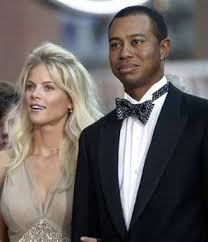
Tiger Tiger Burning Bright


Fearful symmetry indeed. One thing I have to say at the outset, it's hard to see this story as completely tragic. Okay, I know, the kids, the kids. But leaving the kids to one side for a moment...


Also, I do understand it's no one's business except Tiger & Elin's, but where's the fun in that? Anyway, my approach is to offer an angle on the story-within-the-story, to adduce what general truths about humanity might be divined from a careful scrutiny of Tiger's current predicament. And writing about the Federal Reserve Bank gets a little dry.

Tiger's wife Elin is a model (or was, till she struck it rich) from Sweden. She has a brother and a twin sister. That latter fact raises fun speculations. Elin (pronounced Elin) is 29. She and Tiger were married in 2004 on the 19th hole of a golf course in Barbados. Elin is the father of Tiger's two children, neither of which is named Tiger.

The Other Women, so far: Rachel Uchitel, 34, a "club promoter;" Jaimee Grubbs, 24, a cocktail waitress and reality show contestant; Kalika Moquin, 27, "marketing manager" for The Bank night club in Las Vegas. To date, only Rachel is represented by Gloria Allred. I surmise, therefore, she probably has the best story. Gloria will help her roll the story out in a maximally profitable way, while also making sure that Rachel is not "victimized" or "stigmatized" as Other Women so often are, according to Gloria. This is Gloria's niche practice: the representation of people who have no need for a lawyer but are on the periphery of cases involving people who do. Anyway, the dignity of the women involved is important. I note that they are talking in terms of "affairs" or even "relationships" to describe the random hook-ups with Tiger they've enjoyed over the last couple of years. This is true in about the same sense that Tiger has a "relationship" with his rental car while he's in town.

Tiger is 33, by the way. The mean age of Elin, Rachel, Jaimee and Kalika is 28.5. I think this makes things somewhat easier for Elin, although Jaimee, the reality TV show contestant and cocktail waitress, is an outlier who pulls the sample's average down somewhat, which doesn't help Tiger's cause.

Most of these affairs seem to be of fairly recent vintage, starting up after his two children were born. Here's my take on what's been going on: Elin has been busy a lot with the two kids at home in the mansion in Windemere, Florida. Tiger's a touring professional with an awful lot of money and a great deal of time on his hands when he's on the road. He stays in hotels and goes to restaurants and night clubs. There he might meet club promoters, cocktail waitresses and marketing managers with plumped lips and saline (by volume) in their chests equal to the displacement of the Titanic. These "hospitality workers" are on the payroll to doll up the place. To relieve the stress and boredom of life on the road, Tiger started plunking these gals whenever he was in town. While Tiger himself is a Stanford man, it was probably a matter of supreme irrelevance to him whether Rachel, Jaimee or Kalika (or Elin, for that matter) was a member of Mensa.

Tiger apparently told Kalika that married life had gotten a little dreary, which can happen with a couple of rug rats and the same wife he'd already been married to for five whole years. Ultimately, it's a question of philosophy. As to what happened that night at 2 am between Elin & Tiger, maybe what transpired is that Elin slipped Tiger an Ambien as truth serum and went to work on him while he was in a semi-hypnotic state. It's doubtful that rumors of Rachel, Jaimee and Kalika had entirely escaped Elin's attention. Tiger might have been out of it enough to confess to too much, but not so sideways that he couldn't tell it was time to get the hell out of Dodge. Thus, his bumpy ride down to the street, with Elin, still interested in continuing the interview, giving chase while brandishing (what else?) a golf club.

It's only a theory. Depending on what's in the prenuptial agreement, we may or may not find out what really happened. The police cannot force either party to testify against themselves nor the other party (husband and wife privilege).

As to what the future holds, it probably depends in part (but not entirely) on how many other women sashay forth from behind the velvet ropes in night clubs, bars and hospitality suites. The PGA tour goes pretty much everywhere, after all, and there is no name bigger than Tiger's.

He has neither sunk lower, nor risen higher, in my personal estimation. He's obviously a guy who likes to cat around. This is hardly unique, although for some reason everybody always pretends in these situations, including the guy who gets caught, that it is unusual. If Elin and Tiger patch it up this time, Tiger will be back on the prowl in no time, burning brightly in the forest of the night. It's his nature, of course, although currently he's apologizing for it. Gillette is insisting on that, I'm sure. Elin will have choices to make. She's learning, along with the rest of us, what the guy she married is really like. Life might have looked like one long, green fairway a few years ago, but now the ball has landed squarely in the rough.

The Obama Speech, or: Huh?


Well, that was different. Now I really don't get what we're doing in Afghanistan. I think the idea is that we will fight a war against the Taliban and the 100 or so remaining members of al-Qaeda in Afghanistan in order to encourage the Pakistani government to keep the same miscreants away from the nuclear weapons in and around Islamabad. We will keep doing this until about July, 2011, at which point the problem will have been solved, in perpetuity. The cost of the 100,000 troops, based on our new consensus-accepted calculation ($1 million per soldier per year), through July, 2011 will be somewhere in the neighborhood of $150 billion and however many lives are lost.


Something occurred to me as I watched our President go through the motions of this speech. One of Barack's main problems is that Bush left such a disheveled mess of a country in his wake that practically everything Obama does is simply an echo of Bush's agenda, either in furtherance or in contradiction thereof. The wars, the economy, the bailouts, the budget deficit, everything he spends his time doing is in reaction to the colossal catastrophe of the Bush years. The lone exception is health care reform, and let's face it: Congress is simply unequal to the task. It was a mistake for Rahm Emanuel to assign such a monumental undertaking to this group of clowns. They'll never come close to putting anything coherent together.

So the outlines of Rahm's reelection strategy for Barack are now plain. Barack's initiatives are done, because we're out of money, especially with these new war costs. The decision to focus on deficit reduction means that we're barely going to scrape by holding the federal government's core operations together. So Rahm's idea is that Barack, as of the fall of 2011 (one year before the election), will at least be able to say that the country is at relative peace. As for prosperity, maybe things will be somewhat better. One can hope. If so, then the reelection campaign will be based on the concept that Obama brought us peace & prosperity.

If Barack had simply announced a withdrawal from Afghanistan, he would have exposed his Right flank (the only one he cares about) to the criticism that while the redoubtable, pugnacious Bush had the courage of his convictions and ordered a Surge, thus "winning the war" (just before the Ungrateful Nuri told us to leave), Obama didn't have the tenacity to Stay the Course, put Boots on the Ground, and Prevail; that is, to do a Surge of his own. In the fall of 2012, the argument would never have worked that Obama did what he did (pulled the troops) because it was fiscally necessary and the war made no sense anyway. Too complicated - no one can follow that. The reasoning is in two parts, whereas "we stayed and won" is easy to remember. The timing is perfect: the Status of Forces Agreement with the Ungrateful Nuri requires us to have all combat troops out of Iraq by August, 2011, coinciding with the withdrawal of American troops from Afghanistan in July of the same year.

Everyone comes home, and wins across the board! All we have to do in Afghanistan at that point is declare our victory. No one will be able to tell one way or the other. Does anyone know whether we've "won" in Iraq? Nuri is widely regarded by the Iraqi people as a Shiite version of Saddam, running a police state complete with torture chambers, political prisoners, repression and probably the suspension of scheduled elections. He has close ties to fellow Axis of Evil member Iran.

But it's a Win, because it's too complicated to figure out that it isn't. Similarly, any Republican who says that we left Afghanistan (or Pakistan?) before the job was done will be criticized for being a spoil sport and whiner. Of course we won!

So there you have it, the "thinking" behind the Afghanistan Surge. As nearly always the case with Washington, D.C., the non-correlation with reality is just about a perfect 100%. But that's not the business they're in, not anymore. It's the projection of Images of Reality. Those are all that matter, and since there is no chance that a permanent solution to turmoil in Afghanistan and Pakistan will be in place 19 months from now, the Image is all we're going to get.

December 01, 2009

This I gotta see


(A little while before viewing my President's speech on Afghanistan.)


(Cue music from "Rocky.")
Rahm Emanuel Productions Presents: Surge II: Afghanistan - This Time It's Focused!

This had better be good, after all the promo and build-up. Barack has been pretty dull over the last few months, but then how fascinating can you be when you're talking about health care reform and budget deficits? B-o-o-o-ring. So finally the early winter blockbuster (beating the other studios to the punch during the holiday season) we've all been waiting for to break the monotony of endlessly mind-numbing reports on the GDP, and jobless rates and whether or not we'll have another stimulus, fercryinoutloud.

This is all the stimulus the American people need. War! (what is it good for - dadunhdaDUNH!)

Since the O-Man's capitulation to the guys wearing scrambled eggs on their shoulder boards was always a foregone conclusion - (I mean, c'mon: what was he gonna do? Make someone unhappy?) I only hope he doesn't spend too much time apologizing for agreeing to do what everyone told him to do during those "tense," "grueling," "exhaustive" meetings he's been holding with Biden, Gates, Hillary, Petraeus, McChrystal and even, during the last meeting, the budget director Orszag (always a bad sign when one of the suits from the studio shows up to tell you you're running over budget). Knowing the President as I don't, however, I know he's going to hem and haw a lot as he explains all the codicils and conditions attaching to this escalation.

To wit, it's not "open-ended." It's not a "blank check." There will be "benchmarks" to gauge our progress and the progress of the Afghan government in meeting our benchmarks. Also (and this is the bathetic rationale for choosing West Point for the speech, aside from the zero percent chance of hearing anyone yell out "You lie!" from the audience), he will tell us that the hardest thing a President can do is to order men into harm's way, especially when he has to do it in order to placate Right Wing critics who will otherwise criticize him for being too "soft." (Thus forcing his Right Wing critics to criticize him on one of the 732 other bases they use.) Actually, I think there could be a couple of things harder, such as emulating George Washington and actually putting yourself in harm's way, but that's another matter.

Maybe he'll actually use the phrase "off ramps." (What kind? Cloverleaf? Runaway truck?) I sure hope so, but maybe it's too colloquial. Mostly, "mission," "cost" (especially the lives of our brave young men and women) and some stuff about terrorist bases and the like. We can't allow Afghanistan ever again to be the place chosen by those who would do America harm to "plot and scheme" to attack us. Instead, we've forced Bin Laden and Co. to travel 50 yards east into Pakistan.

I'm starting to see the problem with the Sequel as mass entertainment to get our minds off the fact the country is swirling down the toilet bowl economically. Rahm, I'm sure (since he knows the Biz) also is aware of the problem with this "vehicle." The war's over eight years old, you know? It's like "Seinfeld" got in the last season or so: repetitive, contrived, kind of forced. The magic is gone. The cool part was late fall of 2001, when the Marines were overrunning Kandahar and vindicating the American people. Now it's the last month of 2009 and...the Marines are trying to overrun Kandahar and vindicate the American people.

How much boffo box office does this franchise still have? Does it got legs left at all? Oh well. If any front man can sell it, it's our Prez. Hey look - didn't we buy into him?

November 30, 2009

Light at the end of the tunnel?


Goldman Sachs recently published a report indicating that the American economy is about 2/3rds of the way through the financial crisis, beginning its analysis with the concession, "bad loans = big losses." The losses so far are about $1.6 trillion, with total losses estimated in the range $2.1 to $2.6 trillion and about 70% of these losses are connected to real estate, one way or another. This estimate is more or less in line with quantitative analysis Nouriel Roubini performed much nearer the outset of the crisis, when he estimated that the total losses from bad loans would be in the neighborhood of $3 trillion.


Of course, that's still a lot of barbecue patios and breakfast nooks. However, I hope GS is right and its many detractors wrong. For example, Zerohedge immediately went on the attack, noting that Goldman had failed to take into account the FASB (accounting) changes (FAS 166-167) that are coming up which will force banks to bring hidden loan losses residing off-balance sheet up onto the deck where they can be seen. I didn't read, however, that Zerohedge and the witty Tyler Durden were really taking into account that Goldman is allowing for nearly a trillion more in recognized losses, which might encompass that delta between where we are (visible) and where we're going, including slimy creatures that might crawl out from under the rocks when 166-67 are operational.

Such prognostications are a severe test, emotionally, for the Selbstschadenfreudeners such as Zero Hedge, Karl Denninger and others. Their stock in trade is financial doom: dollar implosion, sovereign debt default, chaos and murder in the streets. Partly their hidden agenda is the cultivation of their cherished personal beliefs in gold, as in the mineral Au; they reassure themselves that fiat currency regimes always crash, and that gold, which they're flogging and which the Comment Cowboys (h/t: Dan) on their threads buy a lot of, is the only real depository of value. Naturally, this raises questions: can you actually eat the stuff, or burn it to keep warm? (The answers to the same two questions about greenbacks are, (1) Yes, but pointlessly; and (2) Sure, for a little while.) Nouriel Roubini, usually a favorite of the Selbst-essers because he's known as Dr. Doom and successfully predicted the financial crisis about two years in advance [so did I, but did I sell my house? No-o-o-o-o-o-o-o-o-o-o-o.], recently went on their scheisse list because he refused to recommend gold as a hedge.

It is increasingly apparent that Ben Bernanke's basic operating premise is buying time, or as those in the SS say, extend-and-pretend. The Fed itself has essentially become the secondary market for all mortgage-backed securities (MBS) guaranteed by FannieMae and FreddieMac. Its balance sheet, in the course of about a year, went from less than $800 billion to its present $2.2 trillion, and most of the increase is the purchase, by the Fed, of these distressed securities. Bernanke's strategy is to hold these mortgages long enough to give the housing market a chance to reflate, thus putting these instruments back in the money. In the meantime, and as a complement to this approach, the Fed has been hyperactive in the secondary market for Treasuries as a means of holding interest rates down to (a) add a knock-on depressant effect on mortgage rates and (b) keep the vast deficits being run up by the government under control.

The SSers contend that Bernanke's real aim is "to destroy the middle class by destroying the dollar." This is fatuous, of course, as a statement of volition or intention. No, he isn't. Actually, what he's done (whether it works as well as he hopes or not) is borderline brilliant. Semi-smart, as Burt Reynolds might have said in "Semi-Tough." It's the one way out of this bad loan fiasco that doesn't result in massive bank failure (in the 2,000 + range) and further ruination of the housing market.

Zerohedge, The Market Ticker, et alia, need Bernanke to be wrong because that is their stock-in-trade: the day by day prediction of the Apocalypse. Thus, the attribution to Gentle Ben of these nefarious, Dr. Moriarty-like predilections. We're a society now so drenched in class warfare, and so traumatized by the Depression-like miasma hanging over the country, that it's hard to be reasonable anymore. But in fact, if Bernanke succeeds, as difficult as that might be, it redounds to the benefit of every strata of society.

November 29, 2009

A Modest Proposal for Saving the Country


I mean, you have to think big.


Let us posit at the outset that the United States, as presently constituted, simply does not work anymore. The compromises necessary to keep this place together in its present format, and under the present system, have reached the point where no one really gets what he or she wants out of the government, except for those very people in the government in Washington, D.C. Most of them probably like it just fine; they have fame, power, job security, enormous benefits and virtually no talent other than the artful skill of telling routine lies to their constituents so as to assure reelection. Too harsh? You know it isn't.

The country is comprehensively bankrupt. The finances of the federal government are a sick joke at this point. The Feds are simply running a Ponzi scheme to keep the game going by borrowing enormous sums at an accelerating pace, and using those funds and the diminishing tax base to run a military-industrial complex to benefit insiders and to pay the mounting interest on past borrowings. The Feds will never touch the principal of the national debt again. It's too big and they lack all discipline and sense of priorities, such as cutting the defense budget, necessary to achieve it.

The central government, meanwhile, vacuums up money from the states that they could use to run their own governments with balanced budgets and with a regionalized sense of priorities. For example, if Georgia and Oklahoma choose to ban the teaching of evolution in their schools, make the science curriculum wholly a matter of religious indoctrination, and outlaw all abortion under any circumstance, it's okay with me. I say that because I don't live there, and I'm very tired of the dreary compromises that must be made, for example, in choosing Supreme Court justices on the basis of one criterion, and one criterion only, the issue of "choice." In turn, I imagine the Christians in the Southern states and elsewhere in Red America, where they constitute the majority, are very weary of having secularists tell them what must be taught and what must be allowed. As well they should be.

Thus, let us put more emphasis on the Tenth Amendment to the U.S. Constitution; to wit,

The powers not delegated to the United States by the Constitution, nor prohibited by it to the States, are reserved to the States respectively, or to the people.

Naturally your first instinct might be to imagine that I've gone all Strom Thurmond or George Wallace on you, but I haven't. I'm simply very tired of the dysfunctional Congress which is incapable of accomplishing anything, and of the Executive Branch which spends all of its time devising (a) ways to make sure its campaign donors in New York City are taken care of, and (b) wars. What has happened is that the several states have allowed the Federal government to run afoul of Thomas Jefferson's basic axiom, "that government is best which governs least." We have allowed the central government, and its illegitimate financial arm, the Federal Reserve Bank, to run roughshod over the Tenth Amendment.

Power must be reasserted at the local level. The Tenth Amendment needs to be the rallying cry. The Federal Government is tremendously expensive and yet it accomplishes nothing. The Social Security fund, for example, is a self-sustaining system paid for by the citizens of the country and would be solvent except that Congress stole all of the surplus for its own uses. The same can be said of Medicare. The arrogation of power by the Federal government has been accomplished by expansive readings of Constitutional provisions by the Supreme Court, in particular the Commerce Clause, by which the feds assumed jurisdiction over practically anything (literally) that moved.

Along with many other legal thinkers, such as those at Balkinization, I think a new Constitutional Convention is needed to address the multiform dysfunctional aspects of American government. Such as:

1. Dropping the direct election of a President. The tremendous disappointment almost all of his supporters feel in Barack Obama ought to mark the termination point of this quadrennial farce. He's simply another operator, a machine politician pretending to care about American citizens. Enough of that. The United States (or whatever it winds up being called - maybe just "America") should adopt a parliamentary system whereby the electoral districts of the country vote in Representatives or Members of Parliament, to serve four-year terms. The electioneering period for such elections will be limited to six weeks and a serious cap placed on campaign financing. The various caucuses elected nationwide (meaning parties, and I really hope there are five or six) will appoint a Prime Minister or President from among the membership (by majority vote) to serve one six-year term. Votes of No Confidence will be allowed whenever a majority of Parliament concludes that legislative business cannot be successfully pursued, giving rise to special elections for new Parliamentary members.

2. The House of Lords (Senate) will be abolished. Since the average age of the Old White Man's Club is about 137, they may not notice for several years. A replica of the Senate chamber can be built on the outskirts of Las Vegas as a tourist attraction, and the "Senate" can hold hearings there and talk about the "60-vote" rule, just as they do now, until each "Senator" drops dead (if this can be detected).

3. The electoral districts will be apportioned on a strictly one person, one vote basis, so that each district has the same per capita right as all other districts in the country. There will be no more 435 member artificial limitation, which results in disproportionate under-representation in populous states. Choose any number which seems practical, for example, 1,000 members of Parliament, meaning that about every 300,000 citizens have one Member. Every electoral district would have the right to recall or impeach its own Member. Reapportionment would be done every eight years, to coincide with alternating election cycles.

After the first meeting of Parliament, the rest will fall into place. The Members will know that they have to do the business of the people back home or they're through. The Federal central budget will be cut to the bone in favor of local taxation, where a much more efficient use of revenue can be made. The Federal Reserve system will be abolished in favor of state banks, as North Dakota has now. The common defense can be worked out. As many of the expensive and inefficient accretions of the present system as are possible to be rid of, will be gotten rid of. The new federal capital will be located in the center of the country; Washington, D.C. can be turned into a theme park, like the ruins of ancient Rome.

Think about it. Never again will you have to hear about any presidential candidate's "national campaign" (especially four years before the election), watch an ad, or listen to Chris Matthews or Bill O'Reilly tell you how it will turn out. A person living in a theocratic state can move, but the whole country will not be turned on its head in the impossible pursuit of a "workable compromise," because no such thing exists, and hasn't for a very long time. Progressive states which want to live in the modern world will have the money and the political freedom to do so, without federal interference.

It's just crazy enough to work. If nothing is done voluntarily, I'm reasonably sure the United States will undergo chaotic and uncontrolled mutations in the not so distant future, either in the form of (a) insolvency, (b) imposition of martial law or (c) both.

November 26, 2009

Thanksgiving Day Musing: Obama's Ratio Decidendi


A little odd, I suppose, to crank out one of these posts on this holiday morning, but I awoke last night in the middle of the night (it may have been cat-related; they are nocturnal hunters, you know, even if the prey comes in a can) and something occurred to me that may be worth passing on (and "passing on" can be taken in either the transmittive or dismissive sense).


I think I understand President Obama's M.O. It was prompted by recent stories that he fired his White House Counsel, Greg Craig (whose parents really should have dug a little deeper for names), because Craig kept bringing up uncomfortable "discontinuities" between Obama's campaign positions and his policies in office; to wit, closing Guantanamo within a year (will not happen), warrantless wiretapping of American citizens and telecom immunity therefor (Obama was vehemently against during the campaign, it's okay with him now), military commissions as trial courts (Obama was completely against them, now he plans to use them), the state secrets doctrine (Obama demanded transparency, now he freely uses the doctrine to get rid of troublesome lawsuits prying into war crimes), publication of photos of detainee abuse (Obama wanted full disclosure, now he helped Lieberman permanently withhold them from the reach of FOIA requests), and, of course, the enforcement of the investigatory obligations under the Convention Against Torture (which Obama used to honor by saying "no one is above the law," but now says, "if a putative war crime happened in the Past, it cannot be prosecuted; only crimes which happen in the Future can be prosecuted Now, except they can't, because they haven't happened"). You can add to the list the unconstitutional decision to exercise preventive detention for those who can't be convicted but might do something someday, and the denial of habeas corpus to Bagram detainees (who sometimes wind up there by being shipped from Guantanamo, where they do have such rights). Craig had a problem with every one of the Presidential positions on these issues; so he got canned, having become an irritant.

It's quite a list. Even if Greg Craig's parents had an off-day when christening came around, they must have instilled in him something we used to call ethics and principles. I guess Obama made a mistake by appointing someone so "unpragmatic" to such a key spot.

So back to the thesis: you read everywhere about Obama's yearning for "bipartisanship," which I'm beginning to see is off the mark. That isn't it. It works this way, I think. The key lies in his reason for abandoning the idea of Single Payer in the health care debate, another principle he advocated on the campaign trail but abandoned once in office. If you're going to reform the system, that's about the only thing that would really work. Trying to restructure health care around the existing system of for-profit insurance companies just creates a Rube Goldberg contraption that combines the worst of government incompetence and insurance gouging. But Obama said that "single payer" would be "too disruptive," and that was that.

That's the answer, the sword that slices through the Gordian Knot. Can you imagine FDR in 1932 shying away from some big initiative to turn things around because it was "too disruptive?"Being disruptive" was the whole idea. That's how you effect change when the system is highly dysfunctional. Obama's great gift as a politician is his uncanny sense for the consensus status quo. The current status quo on many issues was formed by Obama's predecessor, who didn't mind being "disruptive" at all. Bush/Cheney were blatantly illegal, unconstitutional and radical; in time, the country sort of got used to it, but they got rid of Bush because they wanted their country back in some recognizable form. The precedents that Bush established, however, became a kind of new status quo or consensus position. The Washington/New York media, always following a herd instinct, stopped pointing out the unconstitutionality and illegality of many political actions. Thus, we became a lawless country.

It was probably within Obama's reach to bring the country back within a legal and constitutional framework, but he decided not to do so. I think, again, it was because the actions necessary to do so would have been "too disruptive." We've gotten used to the idea of being a country which tortures people, fights major wars without formal Declarations of War under Article I of the Constitution, which disregards the Bill of Rights, conducts show trials which allow the introduction of evidence produced under torture, and which scoffs at its treaty obligations under the Convention Against Torture. If we went the other way and operated within a framework of laws, it would require a major shift in public policy. Obama does not use such guidelines as his North Star; instead, he figures out the consensus, however illegal the premise on which the consensus is based, and uses that as his starting point for consideration of "Change." Since the country drifted fairly far to the Right during the Bush years, the consensus position on may issues of civil rights and legality also drifted to the Right. Since Obama rules from this position, he himself has become a Rightist or conservative President who is actually far more at home with Republicans than with his nominal affiliation.

His transmutation will become more apparent during the Afghanistan surge discussions and the speech he will give next week. You will hear him preach the gospel of fiscal restraint, sanctity for human life, of the necessity of "off-ramps" (he seems sometimes more like an L.A. traffic engineer than a chief executive), and "partnering" with the Afghan leadership. All glad noises designed to make him sound kind of liberal and rational. Then he'll announce the only part that matters, a big commitment of more troops on an open-ended basis. When I first heard that McChrystal wanted 40,000 more troops, I knew instinctively (using my new decoder ring) that Obama would decide on a number which was closer to McChrystal's number than to zero, because that's how he operates: in an ingratiating way, where he gives the status quo the benefit of the compromise. I thought the number, therefore, would be about 25,000. It will apparently be 35,000, or roughly the same number as the Iraq surge.

Sic semper gloria mundi. We're all just Pilgrims here, I guess.


November 24, 2009

Can you run that one by me again, Nancy?


See, this is how I get confused sometimes, and why I come around to Dmitry Orlov's idea that there is a Uniparty formed by two branches of the same party, both of the Center Right, which pretend to disagree on policy issues to maintain the marketability of their respective "brands."

I am certain that you recall, as I do, the dynamic leadership of Nancy Pelosi (D-Golden Gate Bridge) who, upon ascending to the Speakership of the House in the fall of 2006, immediately withdrew funding from the Iraq War except as necessary to bring the troops home. She knew that the American populace had grown completely disenchanted with this pointless misadventure, saw it as a colossal, counter-productive folly, wasteful of lives and scarce American treasure, and saw the big victory of the Democrats in the 2006 midterms as a mandate for change. Which is why she immediately said:

“We will not cut off funding for the troops,” Pelosi said. “Absolutely not,” she said.

A reporter had asked Pelosi if the new Democratic-controlled Congress would vote to end the funding of the war if Democrats were unable to persuade President Bush to change his Iraq strategy.

“Let me remove all doubt in anyone’s mind; as long as our troops are in harm’s way, Democrats will be there to support them, but… we will have oversight over that funding,” she said.


Correct me if I'm wrong, but I think the Constitution pretty much guarantees that the House has "oversight" over that and all other funding. So that's not as reassuring as it sounds on first hearing. But along with taking "impeachment off the table," Nancy, while playing various games designed to demonstrate that the Democrats would certainly end the war if only they could (which they always could, by ending funding), decided that the voters didn't really mean it in 2006, and that the public opinion polls demonstrating the massive unpopularity of the war (along with the polls taken in the voting booths) should not be taken too literally, and certainly not to the extent of actually ending the war. So the war went on and on. Which, since Nancy Pelosi remained Speaker then and now, must in turn be taken to mean that despite occasional noises to the contrary, she must have really believed in the Iraq war. Because any contrary inference would mean she was just as cynical as Bush, and kept funding the war for Bush just so she could position the Democrats to retake the White House in 2008. Which is to say, Nancy Pelosi was willing to leave soldiers in harm's way, getting blown up and killed, or their limbs traumatically amputated, or blinded or brain-damaged, simply for a political leg up.

And I'm just not going to buy that. So I must conclude that she supported the war funding because she believed in the mission, the war in Iraq, and the sacrifice of our soldiers. Although, here I go again (and I'm getting whiplashed from all the volte-faces), then I heard her say to a group of econobloggers by conference call just yesterday::


"What did we decide, that Iraq was at least $2 trillion? And for what? I mean, God bless our soldiers for their courage and their sacrifice and that of their families. But $2 trillion for what?" said Pelosi. "Think of the opportunity cost when you break it down, when we talk about cancer, for example. We spent in two weeks in Iraq what we spent in a year on cancer research. With all that scientific opportunity that was available to us, we couldn't afford to do more. But we certainly could afford -- or so they told us -- to be in Iraq."

Um, okay Nancy, but you see where I'm getting confused. I completely agree with you about the opportunity cost, and we've all become acquainted with Joseph Stiglitz's estimate of the long-term costs of the Iraq War, where $2 trillion is the low estimate. And really, when you think about it, there was only one person in the United States, beginning in January, 2007, who was actually in a position to put the brakes on the Bush/Cheney war juggernaut, who had the political power as the head of the funding branch of Congress under the U.S. Constitution, to end the war by the only means that Bush would have been forced to recognize: by defunding the war. That person is you, Speaker Pelosi. You were the leader with the power. So when you say, "so they told us" that we could afford the war, who is it you're referring to?

So just to sum up: what the hell are you talking about? You are absolutely the last person in America who should be talking about all the lives and money wasted in Iraq, because you're right: the war was for nothing, your sops to the troops in the midst of your latest political posturing are insulting and disingenuous, and you completely blew it for you and the rest of us when you had the chance to change things but decided to be a politician instead.

And you're hinting now that Obama is going to have a tough time getting funding for his Afghan surge? Since that's not actually what you mean, what is the lie for this time?

What kind of country can we actually afford?


http://www.youtube.com/watch?v=XN-ui28SlHU

One aspect of number analysis that I find very satisfying is the coherence that a consideration of Large Numbers seems to bring to any issue. I'm not primarily a quantitative guy (I have a nephew who handles that role), but I prefer the mathematical analysis of issues to general, how shall we call it, bullshit argumentation that passes for so much public discourse in these here United States.

For example, there is currently raging (sort of) a big argument about whether the "deficit hawks" or the "Keynesians" occupy the intellectual high ground on how to get the American economy moving again. The deficit hawks are numerous: Kent Conrad and Byron Dorgan of the Senate Democrats, the Blue Dogs of the Democratic Caucus in the House, many others. The Keynesians are the Nostalgic Liberals, such as Paul Nobel Krugman and Dean Baker. The latter notes in a recent essay on the HuffPost:

"There is another side of this Japan story that makes the idiocy of the deficit scare stories even more apparent. According to the deficit fear mongers, the dollar has been falling in recent months because investors are becoming increasingly worried about the U.S. government's ability to pay off its debt. But one of the currencies that the dollar has fallen against is the yen. Are investors who are worried about the U.S. government's ability to pay off its debt selling dollars to buy the bonds of the Japanese government, which has an even higher debt burden?"

It strikes me that it's a little harsh, in this day and age, to talk about the "idiocy" of deficit scare stories. Mr. Baker has also co-written a book about the "myth" of the Social Security crisis, and has also, tellingly, co-authored with Paul Nobel. I think I'm beginning to understand their underlying thesis: the United States and its economy are in a sense Mathematical Constants, like the Speed of Light (C) or the force of gravity in falling body equations. We are, and always will be, preeminent among nations, and any slump (such as the current "recession") is simply a negative deviation from the mean. Thus, it is perfectly alright to take on debt in any amount, regardless of how dire current finances are (and they are very dire indeed), because the stimulus spending enabled by massive borrowing will fire up the economy, improve the tax inflow, and restore us to fiscal balance.

Really, when you think about it, no other analysis of their arguments makes any sense. That must be what they're contending. So sure is Mr. Baker of this thesis that he feels confident in labeling those who think otherwise "idiots" and "deficit scare mongers." This "Recession," you see (which often seems like so much more than that) is a cyclical dip, like all those before it since World War II, and will pass soon, and we'll go back to our merry life where 72% of our commercial activity was based on trips to Sonoma Williams or picking up the newest version of XBox360 Call of Duty World at War for the little kids at home. Thus, if current tax inflows to the Treasury are about $1.9 trillion, consisting of approximately equal flows of income tax and FICA (plus minor contributions from estate tax and other payroll taxes), which they are; and if our budget is about $3.4 trillion, which it is; that even if this looks horrifying at first glance, it's only because you're an idiot and a scare monger, and you don't understand economics as well as people who write books and win Nobel Prizes.

But suppose, just suppose, that the figure of $1.9 trillion is about what the American people can now afford to pay in taxes, that it's a best case for years to come because of a fundamental shakeout in national economics. Isn't there, really, a pretty good case for that? Does that number really seem like it was picked out of a hat? How could it be? It's what the American people are actually paying. Krugman/Baker and others who use ad hominem terms to describe their lesser fellow mortals (not that I don't appreciate the use of the ad hominem) are assuming that the tax receipts will soon soar up to the $3 trillion level or so, to match the budget expenses, if we'll just do the sensible thing and spend another tril keeping teachers and firefighters on the job and extending unemployment benefits to some of our 20% nonworking citizens. That's all it will take; Keynes said so. It's just not that big a deal.

Yet (and here's where the Big Number Ideas come in) I keep coming back to that "insight" I had long ago that the U.S. economy is fictitious, as a sustainable matter, to the extent of about 35% of its nominal worth. I admit it was a guess; but I had the hunch that the stock market, when it was at about 14,000 Dow, would fall to about 9,000 (it went me one better, of course). I based this intuition on reading I had done, specifically, books by Kevin Phillips and Chalmers Johnson. They went deep, way down into the ugly entrails of the American economy. What they found was that we weren't really earning all the money we were spending, not by a long shot. We borrowed all that money and that made the economy seem more robust than it was. Thus the Pond Thesis: half the money during the Bush "boom" years was borrowed on the basis of real estate (re-fi, lines of credit); 70% of economy = spending, take away half, what ya got? 35% reduction.

Now consider this: during the Bush years, the top tax receipt year was about $2.7 trillion (that was the era when even corporations were paying income taxes, which essentially they do not anymore.) What percentage drop is implied by a reduction from $2.7 trillion to $1.9 trillion? Gee, it seems right in the range of 30%, doesn't it? All that borrowing enabled spending, which enabled corporate profits, which enabled employment, which made possible an actual Federal budget based on income instead of a Ponzi scheme where we pretend that a ridiculously inadequate cash flow supports unlimited borrowing in order to pay interest on previous borrowing.

Oh sure, it could be a coincidence. But have you looked around at your America lately? We're in trouble. Borrowing huge sums is not going to restore us to prosperity. It's going to be the work of years, not a financial trick where we "get well" because the loan came through. I have no idea what kind of country a $2.0 trillion dollar federal budget would support, but it probably would put an end to speculations on how many Middle Eastern countries we can afford to rebuild at any given moment. Those folks in the Emerald City (D.C.) should get out a little more; take a drive through East Oakland or Riverside, California, or overbuilt Florida, Phoenix or Anywhere, U.S.A. This isn't going to be over soon, but the fantasy that it will is a very dangerous delusion.

Although, before closing, I would add one thought. There is something that could be done to bring us much closer to balance. 40% of the Treasury's income taxes are paid by 1% of the population, the plutocrats. Remarkable, eh? So restore marginal tax rates to their Eishenhower-years levels, and......oh right: hahahahahahahahahahahahahahahahahahah!!!