December 16, 2010

Half of what I say is meaningless


Wow, an actual person validating my own preconception:


"The whole country is now seeing the story that Michigan has been living with for a long time," said Diane Swonk, chief economist at Mesirow Financial. "We have kicked the can so far down the road that now all we have is a cliff to fall off."

"The recession merely revealed a reality that has been with us for a long time. We faced a growing gap in education and skills that we tried to fill with debt and credit, which gave us the illusion of growth."

I have long thought that the Official Story, that the "financial crisis" was itself alone responsible for our current economic disaster, was a case of whistling past the graveyard. The quote above was from a recent Reuters article which delved deeply into U.S. economic history from the 1960's to the present in a more comprehensive treatment of the origins of the American dilemma than one ordinarily encounters. http://www.reuters.com/article/idUSTRE6BF28720101216 ("Is America the Sick Man of the Globe?") [Note to TJR: a witty play on the old line about Turkey, huh?]

(Those are Diane's pictures, by the way, posted in her honor. Help me out on this, but I think the ring on Diane's left hand is on the middle finger, right? Just checking.)

Reuters goes into a lot of detail about the decline in American manufacturing in the decades since our economic heyday 40 to 50 years ago. At one time, for example, manufacturing accounted for 28% of our GDP; today that number is 11%. In the 1950's about 15 million Americans were employed in manufacturing, a number that has never been surpassed although the population has nearly doubled.

During Reagan's benighted reign, the graph lines representing "financialization" and "manufacturing" crossed paths, with the fast money boyz in the ascendant and the blue collar guys, the backbone of the economy, on the way out. About 40% of corporate profits now are attributable to the FIRE section (finance, insurance, real estate). It used to be that an American worker with only a high school education could nevertheless achieve a middle class standard of living for his family through the engine of American manufacturing prosperity, but those days are long gone. To keep the game going, we substituted debt in all its myriad forms - mortgages, lines of credit, credit cards, the national debt, until we reached the point that total societal debt reached 130% of total GDP. And then the entire house of cards began to teeter and, finally, to collapse.

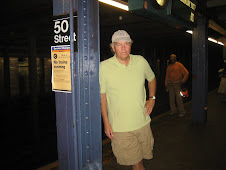
Diane Ms. Swonk, who graduated from the University of Michigan, a fine public institution just like my own alma mater, no doubt has seen first hand the ravages of the hollowing out of the once mighty United States, the epicenter of which is in Detroit and its environs. (Ms. Swonk: if you're Googling yourself and come across this post, that's a fairly recent photograph of me taken in the subway in New York City, although I now sport a rather dapper [if I say so myself ((hey, I guess I just did!))] mustache. So try to picture...) Where was I? Okay, so the point being that...

The point being that in the face of this huge catastrophe, at last brought to full fruition, our political and media institutions are so bereft of new ideas, and so fundamentally dishonest, that they just won't face these awful truths. The weekly pep talks from Tom Friedman are a case in point. He calls for a "reset" et cetera blah blah blah, or whatever computer-tech-derived term he thinks is cool at the moment. The timeline for our recovery is always ludicrously short, as if decades of neglecting education and technological innovation (and training workers to participate in such new fields, such as alternative energy) can be remedied between his Wednesday column and his Sunday cerebro-spasm. Congress and the White House are the same way; it's all tax breaks all the time, or an extension of unemployment benefits, or a crash program to fix as many potholes in the roads as we can immediately fund. Beyond these largely empty gestures, both political parties appear to believe that solutions to real world problems can be fixed by adherence to a particular "ideology." This is so fundamentally nuts.

Without the infusion of trillions of dollars in borrowed and printed money from the federal government, the American economy would, right now, reflect the real further deterioration in our circumstances which has occurred since September of 2008. The elected leaders act as if they are doing us a favor by perpetuating the illusions of "recovery" through goosing the Dow Jones via Federal Reserve injections of fake money or dumping trillions of hallucinated largesse on the vast legions of the unemployed. Anything, anything, to avoid facing the truth. Simply keep denying the basic econo-thermodynamic laws. Never admit that those old jobs, the ones that supported the middle class of my youth (and Di-Di'sMs. Swonk's) are gone and are not coming back, and that the huge cohort of blue collar unemployed workers have no employment prospects for the future. Congress (with notable exceptions, such as Bernie Sanders) cannot admit that without admitting that in essence that economic policy in this country, for a very long time, has fundamentally betrayed the American commoner, the real worker, the foundation of our once-great economic edifice.

When you think about what is really going on, and how we got here, you can see how pathetic the "Keynesian stimulus" ideas of pundits such as Paul Krugman really are. The federal government cannot run yearly budgets of $3.6 trillion against income of about $2.2 trillion and survive forever, and anyway, returning to an economy built on an illusion will not last. I don't understand why Krugman and his ilk can't see that. They imagine that early 2007 or so was some halcyon period in American history, and if we could just get back there... Instead of seeing it for what it really was, the end of the line for a failed economic theory (the empire of debt). Even if we could re-employ all those disenfranchised folks by getting their Best Buy "sales representatives" or Wal-Mart "greeter" jobs back, it could not last, because the actual earnings of Americans (on which we are now going to have to rely) will not support the level of consumption that temporarily made such jobs possible.

These stimulus advocates propose making the situation worse as a way of making it better. Flooding the system with borrowed and printed cash is not going to lift America's educational standards from 15th in the developed world to its former competence. That would require a re-recognition that public education is a positive good, a necessity, of a functioning economy, and such a realization is nowhere to be found. Instead, the American economy will be the victim of our decades of cultural and educational neglect for years and years to come, as the ranks of the hiring pool are filled with victims of our lousy schools. You don't clear out such problems with a short-term "stimulus" jolt, no matter how many "reset" columns Tom Friedman writes. News cycles are one thing, the cycles of Reality quite another.

Sometimes I feel very alone, except for, well you know...I'm not trying to come off like Winston Smith to her Julia, and anyway, I'm not sure the Eurasian authorities will even let me talk to her at this point, but

December 13, 2010

Obamacare hits a snag


Few Constitutional provisions get half the workout of the Commerce Clause, that Article I, Section 9, Clause 3 prerogative of the federal government


"To regulate Commerce with foreign Nations, and among the several States, and with the Indian Tribes".

This is the essential wellspring of the power of the central government to get involved in state matters where the Constitution does not confer primary jurisdiction on the feds (for example, the exclusive federal jurisdiction over bankruptcy, or the law of the high seas, or America's biggest business, war). As a good, die-hard liberal, I have mixed feelings about the overuse of the Commerce Clause. On one hand, without the liberal use of the Commerce Clause, it would have been much harder to rein in the abhorrent practices under the Jim Crow laws. "State action" (such as public education or voting rights or access to the courts) is governed by the Due Process and Equal Protection Clauses of the 5th and 14th Amendments; but private prejudice, such as Rand Paul's desire to return to the days when a black family caught out in the rain and seeking shelter in a Kentucky motel could be turned away as an exercise of the motel owner's "freedom" (his freedom equating to the family's consequent need to drive on up the road to, oh say, Pennsylvania). Or lunch counters in Montgomery, Alabama, or a swimming pool in Macon, Georgia. The Civil Rights Movement was given a tremendous boost by expansive interpretations of the Clause.

On the other hand, I'm also a "small d" democrat in basic agreement with Thomas Jefferson's idea that the government is best which governs least. A pervasive, all-power central government can guarantee civil liberties, but it can also threaten them through NSA spying, TSA sexual assaults at the airport, or an out of control military-industrial complex. No one in this day and age can convincingly argue that the central government is too small.

Along comes today's ruling by a federal judge in the 4th District in Richmond, Virginia holding that the mandatory purchase of medical insurance under the recently-passed health care bill is unconstitutional, to wit, not permitted by the Commerce Clause, and thus an overreach by the central government into areas of state control. Essentially, Judge Henry Hudson concluded that an individual's decision (and resultant inaction) in not buying insurance cannot be "interstate commerce" because the individual...didn't do anything. The language is fancier than that, of course, but that is the essence of it, metaphysical as it may seem (what is the sound of a wallet not opening?, and other Zen koans). Thus, the federal government has no right to force, on pain of monetary penalty, an American citizen to interact with a private insurance company in order to make the actuarial basis of Obamacare viable.

There is, of course (if your mind runs in the same channels mine is most comfortable) a delicious irony in all of this. Had the spineless Dems and the Lawn-Chair-in-Chief offered a public option as part of the solution to the national disgrace of American health care, this problem would not exist. An "option" to buy insurance from a government plan not only (a) would have acted as a serious brake on out-of-control, predatory pricing by the insurance cartel, but (b) is by its very nature proactive, positive action and thus, of course, covered by the Commerce Clause. The federal government can constitutionally regulate the purchase of health insurance on an open, interstate exchange where the government is itself the vendor.

I don't know whether this decision will hold up or not. It seems a little too cute by half. A Zenesque interpretation's survival all the way through the Supreme Court seems iffy at best, for whether or not the individual's inaction is interstate commerce, there is little doubt that the whole business of medical insurance most definitely is (hell, if the feds can regulate the sign-in desk of the R-U-Lonely Motel on the outskirts of Nashville because it's in interstate commerce, they can regulate this), and the mandatory purchase requirement is part of that entire scheme. The judge (a George W. appointee) didn't like the Big Government plan, obviously, and did what judges can do with the vague language of the Constitution and the sketchy guidance of case precedent: he made things turn out the way he wanted them to, and he didn't like the coercion involved in making people buy products from private industry (I don't really like it much myself). The Department of Health & Human Services, as defendant, pointed out that many states make residents buy car insurance if they want to drive, but Judge Hudson distinguished these cases by noting that one can avoid buying auto insurance by not driving, whereas, one has to buy health insurance under Obamacare by virtue of one's "very existence." Hudson might be in the wrong field; he should probably be teaching existential philosophy at the Sorbonne.

Interestingly, however, the Virginia trial court where this occurred (in a proceeding known as a Motion for Summary Judgment) is part of the notorious Fourth Circuit, which occupies the same approximate position for conservatives as the Ninth Circuit (based in San Francisco) does for liberals. It was not accidental that the Bush Administration, when it wanted to deprive an American of constitutional rights (such as Jose Padilla), was careful to incarcerate them within the compassionate confines of the Fourth (Padillia was in a Navy brig in South Carolina). That way the prisoner had to fight his way up through the brutual jurisprudence of the trial courts and appeals court of the Good Ol' Fourth, Confederate flag waving in the background. Ah such glorious memories of our Gulag past! Aren't you glad Obama was quick to reverse all this nonsense? Oh that's right, he didn't.

Thus, the appeal by the Department of Health & Human Services will be to that same Fourth Circuit Court of Appeals, where the Bush-Cheney-Rumsfeld gang had what little judicial success they enjoyed in their war on the Constitution. There is another Virginia case from Lynchburg on essentially the same issue which recently went the other way, so the Fourth Circuit will have to decide which one they like the most. Make no mistake, judicial decisions interpreting vague language such as the reach of the Commerce Clause are far more political than "legal," whatever that may mean.

Ultimately, of course, this mess will wind up in the weird clutches of the Roberts Supreme Court. I don't know how the Robed Rascals will handle this one. One one hand, the court is conservative and sort of believes in states' rights (except where they have the opportunity to reinterpret state election law so they can appoint a president; see, Bush vs. Gore). On the other, these people are in the District of Columbia and hate giving away power. But I would surmise, just to thwart Obama and make him sorry he ever criticized the Citizens United case during last year's State of the Union, that Roberts, Alito, Scalia and Thomas might go with an anti-Obamacare ruling. Breyer, Ginsburg, Sotomayor and Kagan would probably go the other way. So we're where we always are: Judge Kennedy, essentially, is the Supreme Court.

It's what I've always loved about the law: it's so rigorous and scientific.

December 12, 2010

The Naive Manchurian Lawn Chair


I saw "Inside Job" at my local trendy-art theater recently and can report that it is a good, clear exposition of how the financial crash of 2008 came about. The movie is narrated by the sincere, trustworthy voice of Matt Damon, but the star of the show is the writer/producer Charles Ferguson, who never actually appears on screen; however, the intelligent, incredulous questions he asks of the various vermin who stupidly agreed to be interviewed for the documentary are the best part of the movie. Ferguson (who graduated from Berkeley in 1978 with a mathematics degree, then obtained a PhD from MIT in political science) is certainly a match for the shifty economists, politicians, investment bankers and other scum placed under his unrelenting microscope.


At the end of the movie, you have little doubt that American business and politics have descended completely into gangsterism. There is really no other word for it. I've been reading about all this stuff for a couple of years, particularly on sites such as zerohedge.com, Karl Denninger's themarketticker.com, Yves Smith and her nakedcapitalism.com and others, so I didn't really encounter too much that was new or surprising. The American people have been sold out by politicians who take bribes from a highly organized kleptocracy. Yawn. Who didn't know that? You learn in more detail just how vile all the people running the rackets and swindles are, the constant whoring (literally), cocaine abuse, obscene displays of wealth, tax fraud (putting their call girl bills on invoices marked "investment research," etc.). It is a world totally drenched in fraud, with no socially redeeming purpose whatsoever.

The only thing I noticed, watching the movie in a crowded theater, was that the reactions to the moronic visage of George W. Bush are different now. No booing or hissing, not even here in liberal Northern California. What's going on, I think, is that Bush is now seen as nothing particularly special. When you look at the Wall Street/Washington Complex, you realize it was given its first big impetus during the Reagan years, when the idea of government regulation was first characterized as an unmitigated evil. This attitude was carried forward by Bill Clinton, who often sided with pro-business, anti-government Republicans against his own party in passing such bad ideas as NAFTA and the repeal of Glass-Steagall, which gave tremendous impetus to the financialization of the American economy. Bush was kind of a bit player in all this; his focus was always on unnecessary wars, and he left the destruction of the American economy to others.

The movie does not spare Obama. It meticulously notes that all the same characters who promoted the deregulated and over-leveraged Wall Street of Clinton & Bush are still on the scene - Bernanke, Geithner, Summers, Rubin, Gensler, et alia. Nothing has changed. The FinReg bill accomplished nothing - just a lot of populist hot air. Obama's comatose Attorney General, Eric Holder, comes to life only when someone's First Amendment rights need to be squelched. All the frauds and thieves responsible for the financial crash are still running loose, still earning millions. There has been no accountability at all. Obama is forever Looking Forward, Not Backward.

Thus, the liberal side of the American political scene has turned the page on Obama. He's simply another part of the problem. My guess is that this latest fiasco, his collapse in the face of Republican demands that the Bush tax cuts be perpetuated, will turn out to be the last time that the liberal/progressive wing even expected Obama to do the right thing. It will be different now; his cooperation with Republicans, his betrayal of his campaign rhetoric, will be seen as de rigeur, nothing to even talk about. Jon Stewart, Bill Maher, Cenk Ugyur, Robert Reich, Glenn Greenwald, Matt Taiibi, all of the liberal pundits have markedly changed their tune in the face of this latest outrage.

The question for now, where Obama is concerned, is which of the three competing theories is closest to the truth: 1. Obama is in over his head, lacks leadership experience, and just gets taken (Naivete Theory). 2. Obama is in some way congenitally incapable of a fight; he doesn't like controversy or discord, so he folds to avoid unpleasantness, thinking the liberals will forgive him because they're nice, whereas the Republicans are meanies and must be appeased (the Lawn Chair hypothesis). 3. Obama is actually a Reagan conservative who's doing exactly what he always intended to do, shares no values with liberals, and sees the Presidency as a way to set himself up as a plutocrat in the coming years (Manchurian Candidate theory).

I'm beginning to think #3 is definitely the answer. There are definite elements of truth to Nos. 1 and 2; Obama doesn't intimidate anybody, and particularly in terms of organizing his agenda to do the most important things first, Obama is pathetic as a leader. This tax situation is a classic illustration of this problem. Why on Earth are the Democrats trying to negotiate this issue now, after the 2010 elections in which they got hammered, when they had a full two years, with overwhelming majorities and control of both houses, to deal with a Bush tax program which had been enacted in 2001 and 2003? Did it never occur to Obama that one way he might have ameliorated his $1.5 trillion yearly deficits was to roll back the top bracket giveaway to the "Inside Job" crowd?

Well, under Theory #3, it might have occurred to him and he decided he didn't want to do anything about it. More important to spend a year on driving more American citizens into the waiting clutches of the medical insurance complex.

Anyway, no wonder George W. Bush makes it a policy never to criticize Barack Obama in public. Obama's the best thing that ever happened to him.

December 09, 2010

And it's one, two, three...


what are we fightin' for?


I watched the movie "Restrepo" on Netflix recently; it had a short theatrical run a while back, too short for me to get there in time. It was good to save the money, I would say, on actually seeing the movie. I think the producer/cinematographer Sebastian Junger (author of Perfect Storm, that phrase which has forever entered our cliched lexicon as the only allowed description of a confluence of bad coincidences) did a good job with what he had. The movie is essentially static, as the lives of the men of the Airborne platoon posted at the Restrepo base in the Korengal Valley in Afghanistan must have really been during the year they spent there in 2007. Restrepo was the name of one of their fallen comrades, killed early in the deployment.

The movie has three main recurring sequences. Life atop the outpost; patrols; and interaction with native Afghans. The first is boring; the second intermittently gripping or a little theatrical in a self-conscious way, depending on what was filmed; and the third pathetic and very sad. Occasionally the U.S. military kills innocent natives. Then a meeting is held where the young American noncoms sit and explain why these things happen, sometimes in the presence of a dead and bloodied child who got in the way of a firefight or was hit by a rocket fired by a helicopter. These are strange encounters. The GIs are all decked out in their camo and state of the art weaponry, Kevlar helmets with built in spot lights, the works. The tribal elders have long straggly beards, a few teeth, weathered bronze skin, wear robes and turbans. The elders nod inscrutably, betraying no expression at all. The sergeant, through his interpreter, talks a mile a minute, patiently, condescendingly explaining why we're trying to kill the right people but it doesn't always work out that way, and anyway, don't go helping the Taliban or this stuff will happen more often.

There is no real attempt to place the war in context. You do not get the impression that anything the soldiers are doing is helping anything, but on the other hand, you're unable to tell whether it's counterproductive. It isn't made clear what other things those local Afghans would have to put up with in the absence of U.S. soldiers patrolling their valley and barging into their ancient dwellings. Out on patrol, as they take fire (and as two soldiers are hit, one fatally), you get the feeling that context doesn't matter. It's this group of soldiers versus the bad guys, and there's no room for philosophy. The Taliban, the mujahideen, are trying to kill the U.S. soldiers; the GIs want to kill them first and to protect each other. That's essentially the story.

Do the mujahideen want to kill the Airborne soldiers because the insurgents are in league with the attackers of September of 2001? Because they feel just the way an Egyptian ringleader, with an accomplice from the UAE, and a couple of other pilots, and 15 Saudis felt that day in New York and Washington? When they hatched their plan in Germany and perfected it in South Florida? Is that why these American soldiers are humping through the high mountains around the Korengal Valley, because we have to root out....what, exactly? You'll never figure it out from this movie. All you can say is that whatever is going on there seems far removed from one terrorist plot carried out in another part of the world.

The soldiers just seem like average guys. They horse around a lot, the F word is used constantly, they smoke, they're heavily covered in tattoos. Their quarters are messy and dirty and they have virtually no amenities. You get the impression they're well trained with their weapons. One slightly bizarre feature of modern...everything, really, which I hesitate to bring up, given the hardship, privation and mortal danger these guys were in - but even in combat, I noted, this strange modern phenomenon of Americans speaking as if they were characters in a movie was constantly present. Well, I suppose these guys were in a movie, but I couldn't help noticing the huge difference, for example, between the interviews of these soldiers (many of them conducted back home in the States after the deployment was over) and those conducted of the World War II GIs in the HBO series on the European and Pacific theaters. That's probably a brain belch for another day, but it is as if, in our media-saturated times, our very consciousnesses have become so permeated by media images and snatches of dialogue and action movie cliches that any kind of "authentic" behavior and reaction has sort of gone by the boards. You see this all the time in TV interviews after disasters, for example; everyone sounds exactly like the characters in a disaster film sound reciting scripted lines. We all know how it's supposed to sound - it's supposed to sound the way Bruce Willis would say it. The soldiers at Restrepo even spent some of their down time playing "World at War" on their GameBoys. Well, you know: why not? Their lives were imitating the art of our culture anyway.

Whatever the reason, we're still in Aghanistan, more than nine years after the putative cause for our involvement occurred. The soldiers of the Airborne platoon seem competent at killing people, but the "hearts and minds" project is probably in the wrong hands. Why, indeed, should they be expected to carry out such a mission anyway? They've got other things to worry about, like surviving. As it becomes increasingly obvious that President Barack Obama is not very clear on why he does anything, it's hard, after watching a movie like "Restrepo," to escape the conclusion that we're in Afghanistan because we were there when Obama was elected, and he doesn't like to change things, campaign slogans be damned. The military brass told him we should stay, and that was good enough for him. And thus the war drags on and on and on.


December 08, 2010

Washington D.C. Jumps the Shark


The phrase is based on a 1977 episode of "Happy Days" where the Fonz, wearing swim trunks and his trademark leather jacket, water skis on a Los Angeles vacation and jumps over an underwater enclosure containing a shark. The concept seems to refer to some watershed development in a sitcom which forever marks its turning point toward fading out. I think I remember when that happened in "Seinfeld;" it was some episode late in the Seinfeld era (it may have been the last year) where Kramer is taking a test drive with a car salesman and they get into some silly plot point about seeing how far they can drive with the gas gauge warning light on. It seemed like an attempt at the Theater of the Absurd, and it didn't really work at all. It was tedious. Seinfeld had jumped the shark.


Thus, we now have the federal government, itself a kind of sitcom or running gag, jumping the shark with its "tax deal." Make no mistake, this is a major turning point in the history of the republic. Faced with mounting debts which it increasingly cannot handle, Congress and the White House have decided to go all in with their madness. While with one hand Obama has created a Frankenstein of a "deficit commission" headed up by the certifiable lunatic Alan Simpson, former Cowboy/Senator from Wyoming who is openly hostile to America's safety nets, on the other Obama has decided to cooperate with the Republicans in further decreasing America's income stream by perpetuating the "Bush tax cuts" and also decreasing the employee's FICA contributions from 6% to 4%.

These are truly insane ideas. It appears that young Barry has bought into the idea that if you just keep cutting taxes sufficiently, jobs will magically appear. This was Bush's cover story when the "temporary" tax reductions were enacted in 2001 and 2003, but that was not the mendacious former president's real goal. He just wanted to lower the top marginal rate for his plutocrat friends. Knowing how fiscally irresponsible the tax reductions were (and how unnecessary for the chief beneficiaries), Bush & Co. inserted a sundown clause of December 31, 2010 so that in "outer year" calculations the tax cuts would look more benign. Yet the goal was always to make them permanent, using what was assumed to be permanent Republican majorities to do so. What is truly amazing is that Obama and the Democrats are going to allow Bush to get away with his sleight-of-hand. They are going to make the tax cuts permanent for Bush, for no reason, and with disastrous fiscal results for the United States. The last thing this country needs is a deeper deficit hole. We're barely holding on as it is.

Similar concerns apply to the Social Security system. The mythical "trust fund" is cited far and wide as a reason that the system is in good shape, that $2.5 trillion in government IOUs that supposedly guarantee the solvency of Social Security for decades to come. For the last time: there is no trust fund; it is nothing more than the historical record of money stolen from the American people by its politicians and spent on other things. When the trust fund "pays" into the Social Security system to make up for what are already existing cash shortfalls, all that is happening is that the intergovernmental debt is transmuted into public debt, which is to say, the trust fund is "funded" by more borrowing. On a cash in/cash out basis, the Social Security system already does not take in enough money to fund itself. Against this reality, the federal government proposes to make the situation worse.

This is shark jumping, pure and simple. It is a picture of a national government so overrun by incompetence and bad faith that it has gone insane. There is not even a suggestion in any of this that anyone, any adult of good will, actually has a plan to deal with the looming threat of government bankruptcy. China is going to downgrade our bond issuance to junk status; interest rates on longer-term government obligations (such as the 10 year) are already beginning to rise sharply. And to deal with its deadbeat status, the federal government proposes to reduce its own income. As Arthur Fonzarelli would have said, "Wrongamundo."

December 06, 2010

President confined to couch, not allowed on rug

from today's Washington Post (Dec. 6)


Incoming Speaker of the House and Republican Bully John Boehner and Senate Minority Leader and Republican Bully Mitch McConnell continued their Oval Office occupation today with even more onerous restrictions on President Barack Obama's use of his West Wing quarters. Obama was forced to sit on one of the sofas with his feet flat on the hardwood floor and not touching the large oval area rug in the office. Last week the President was allowed to use his desk occasionally to take telephone calls, but that privilege was revoked today. Senator John McCain of Arizona was the only politician allowed to sit behind the President's desk.

Obama is allowed to walk around in the Oval Office, provided he does not step on the rug or touch any of the stuff on the desk. The President was upbeat in his assessment of these new restrictions.

"Mitch and John have been here for about a week now," the President said, smiling. "They've made some demands, such as telling me where I can walk, and of course the rule about not stepping on the rug."

(As he spoke, the President appeared to step on the edge of the rug with his right shoe. Both Boehner and McConnell were quick to point emphatically and yell "Hey!" in unison. The President stepped quickly off the rug.)

"Working with the other side is part of the job," Obama continued, stepping backwards toward his desk. (McCain reached out and poked him in the back with a ballpoint pen, causing Obama to jump forward and almost step on the rug.) "It's made running the Executive Branch a little harder in this case, but I just don't think, with the country needing cooperation from both sides of the aisle, that this is the time to play politics. So I'm working with my friends in the Republican Party."

Obama returned to his seat in the corner of the sofa by carefully walking heel-toe along the edge of the rug and sat down facing Boehner and McConnell. "Can I go to the bathroom now?" he asked.

McConnell checked his watch. "In another twenty minutes," he said.

Since the midterms the Republicans have seemed to flex their political muscle and grow in confidence about their ability to extract concessions from Obama, such as the amazing coup of gaining a Democratic President's agreement to extend the Bush tax cuts of 2001 and 2003, which were only temporary and would have expired without Congressional action in another 25 days; thus, the Democrats only needed to refuse to take a vote, an easy task when they currently control both houses of Congress. Nevertheless, the Democrats and Obama capitulated, completely unnecessary as it may have seemed.

Some White House observers believe that this show of weakness on the President's part may be part of the reason the Republicans have upped the ante and are now restricting Obama's use of the Oval Office. A high White House official, speaking off the record because he is afraid of his own shadow, indicated that starting tomorrow Boehner and McConnell may not allow Obama the use of the sofa, confining the President instead to a side chair in the hall.

"It's one of the options we're looking at," the President said. "Right now, the Republicans are refusing to allow me back to my desk, but politics is the art of compromise and it's possible a bipartisan consensus can be reached which allows me to use my office, at least for a while."

McConnell was less optimistic about reaching a deal. "I think we've made our position plain," the multi-chinned solon drawled. "We're open to suggestions, but I just don't see a compromise where the President uses his desk or starts walking on the rug again. I think the American people need a clear position from us on that."


December 05, 2010

One Moment of Grace of Highway 57

Although I will say this. No matter how debased existence can sometimes seem, there will always be moments of grace possible through a shift in perspective. Could be that Kandinsky, Grosz and others discerned in that very macabre quality of Man's artifacts, his alienating creations, a strange beauty that transcended their surface repulsion.

And in such a way, while riding through that nightmare traffic jam, my daughter asked if I wanted to hear some of the "Symphony of Science" she had downloaded onto her iPod, and I said, "Sure." Not realizing what recordings of transcendent beauty these simple things were. So, if of a Sunday evening, you would like a religious experience of your own, I commend them to you.

(They reminded me too of how much we need people like Richard Feynman and Carl Sagan in our own day and time.)

http://www.youtube.com/watch?v=XGK84Poeynk&feature=related

The Not-So-Open-Road

Out of the rack and ruin of our gangster death, The rape and rot of graft, and stealth, and lies, We, the people, must redeem The land, the mines, the plants, the rivers. The mountains and the endless plain-- All, all the stretch of these great green states-- And make America again!

Langston Hughes


I went to Arizona for Thanksgiving. I left very early Wednesday morning and arrived home very late Saturday night. Of the various ways of traveling between Northern California and the Phoenix area, I decided against taking the high-speed rail line. There was something axiomatic about this choice in the sense that there is no high-speed rail line between Northern California and the Phoenix area, nor will there be during my life time. It is possible, with enough ingenuity, to travel by train between San Francisco and Phoenix, or mostly by train. All you have to do, for example, is to take a bus (buses are prominently featured, oddly enough, on Amtrak's schedules) from Oakland's Jack London Square (picturesque!...in a way) and Santa Barbara, leaving around 10:30 pm (I guess I'm talking about Tuesday night, to make this work) and arriving around 6:30 am Wednesday. When dealing with Amtrak, it's always best to say "around." 15 minutes later (that is, about an hour before your bus actually arrives in Santa Barbara), the Surfliner leaves Santa Barbara for Los Angeles and Union Station. For some reason, this trip (about a hundred miles) takes the better part of three hours. So you pull into Union Station around 9:30, and you wait for 5 hours for the Sunset Limited to leave at 2:30 pm or so. Not for Phoenix, for Tucson, which is on the direct route. This is a distance of about 485 miles by road, yet it takes Amtrak almost 10 hours to cover the distance. Isn't this about the same speed as the old Pony Express?

Obviously, Tucson is not Phoenix, so you haven't arrived, actually. You're 116 miles away. It's now around midnight, Wednesday, or early Thanksgiving morning, and you've been traveling by bus and train for more than 24 hours. You're exhausted; a logical response to your predicament would be to commit suicide there and then, perhaps by leaping in front of an oncoming train. This works for the French TGV, where such suicides are fairly common; however, with Amtrak you might have the problem of trains (a) being so rare you would change your mind before one came along and (b) going so slow they would simply inflict annoying, non-fatal injuries. Somehow or another, another bus I guess, you would get to Phoenix in the small hours of Thursday morning, unbathed, unshaven, sleep-deprived, depressed.

So you can fly or drive. Not thinking it through completely, I drove. I wasn't the only one with this idea on the Wednesday before Thanksgiving. Things reached their hypotheosis sometime around 7 pm on Wednesday night on State Highway 57 between Pasadena and Pomona. I became trapped on an inner lane, #2 or 3, perhaps, of 5 or 6 lanes. The traffic crept along, inching forward in spastic lurches. Looking out over the sad asphalt, it occurred to me that not a single living thing, an insect, a rabbit, a human being, could survive out there for more than a few seconds. It was an alien landscape, a hideous apparition, the sort of subject that a German Expressionist such as George Grosz or Max Beckmann might want to wallow in, if there was some way to capture this claustrophobic perspective. There was no way out, no way forward, no way to change lanes. Cars were everywhere, hemming you in, pushing against your rear bumper, stretched out in front to infinity. I knew that someday, if I did not run out of gas, if I did not abandon my car, I would get to Indio. Indio became a kind of El Dorado - getting to Indio became my own form of Zionism. Aliya - to get to Quartzsite!

Or you can fly, submitting to a probably dangerous dose of radiation (or sexual assault), the madness of airport check-in, the contortionist tricks of sitting in an airline seat, the anxiety of the overhead bins, the expense, the parking, the remote location of airports from where you live and where you ultimately want to go...

The conservative blowhards who don't like trains (I'm not sure why they don't, but they're threatened in some way) insist that trains always require government subsidies to remain viable. I'm sure they do. Of course, even the bone-jarring, axle-cracking, potholed poor excuses for a highway we have now, such as Highway 57, demand huge government subsidies in order to be maintained even in the lousy condition they're in. Roads, railways, take your pick, they have to be maintained, you have to keep investing. So what? Trains, however, offer huge economies of scale in transporting people. They can be run, as in France, with centralized power generated by nuclear plants. You don't need oil as fuel, at a sufficient level of infrastructure build-out. Only one guy has to drive, the engineer. Everyone else can talk, read, sleep, party and carry on.

I've ridden some great trains in Europe. The TGV from Lyon to Paris, a distance of 250 miles, covered in two hours and 15 minutes (scheduled time: we had a suicide that day - see above). The Spanish AVE, from Madrid to Sevilla, under 3 hours to cover 350 miles. The Eurocity from Ulm, Germany to Paris. Cologne to the Frankfurt Airport. These trains all offer a high JDV Factor (joie de vivre factor, or jdv(f*). On the standard 10 scale, they come in at about 9.3. You're glad you're alive when you're riding one of those trains. Life enhancing. It's almost as if the countries who build and operate those trains care something about quality of life. They're nicer than they even have to be.

Highway 57 actually carries a negative jdv(f*). The experience of driving on that road subtracts from your overall will to go on. Highway 57 is ameliorative of the fear of death - you will be dead, but you will never again drive on Highway 57. So buck up.

In modern America, you accept such benisons where they are offered. But you will not travel from San Francisco to Phoenix on the Train A Grande Vitesse. Train A Grande Distress, peut etre.


December 01, 2010

Merry Christmas, California!


California always leads the way. We all know that. Trend-setters, daredevils, iconoclasts - it's what we're about. If you want to see what's going to happen next in the country as a whole, pay attention to California. Of course, with 36 million people officially (and another 5 million currently driving on Highway 57 between Pasadena and Fontana), over 10% of the American population is already here. So there is something of a tautological feel to declaring that California leads the way.


For example, California has an official 12.8% unemployment rate. We all know this is nonsense, of course; if the BLS U-3 for the whole country is 9.6%, whereas the more "comprehensive" (that is, a number that actually counts people out of work) U-6 is 17%, then we must assume (with good reason, let me tell you) that the same differential applies here in the Golden State, and that the real UE rate for California is 12.8 + 7.4 = 20.2%. That seems reasonable. A good, round Depression Era feel to that number, doncha think?

Where it gets interesting, right here on the threshold of the Restoration of the Brown Monarchy in California, is that this month, due to the utter paralysis of the U.S. Congress, extended unemployment benefits are going to run out. Congress is understandably otherwise engaged; for example, they're trying to figure out how to spare the defense budget by raising the Social Security retirement age to the outer reaches of the human life span. The only actual "money" available is that printed by the Federal Reserve (by the cargo container lot) to distribute to the Primary Dealers to reimburse them for the Treasury bonds the PD's just bought the previous week (no joke there: literal truth). This is all in furtherance of the Fed's "dual mandate:" (1) to enrich Wall Street and (2) bankrupt the country.

All effects are bigger in California; thus, when UE shuts down, 410,000 (the official number) Californians will suddenly have no income of any kind. As the winter begins. This number is equal to the combined totals of 27 other states plus the District of Columbia. This number also exceeds the 2010 population of Oakland, California (where, no doubt, a significant fraction of the unemployed-with-no-income will be found). Not to put too fine a racist point on things, but one shudders to imagine what might happen in places like East Oakland and South Central Los Angeles when the money suddenly dries up completely.

Situations like this expose the essential vacuousness of the "trickle down" philosophy, the smug idea that the ultra-rich, the One Percenters, can enjoy their Fed Reserve largesse, their privileged, Congress-maintained assurance of bonuses, low tax rates and offshore fortresses, while the hoi polloi are left to their own devices, while the rich bastards bellow on about "creeping Socialism" (such as the kind that has perpetuated the existence of the zombie banks in the first place). Sad to say, fellas, but it isn't going to work, and if you actually think that an orderly, governable society can be maintained while half a million people are suddenly turned out into the streets, in one state alone (the national figure is two million), with no income of any kind, then I say: good luck with all that.

If Congress goes through with its Marie Antoinette routine, a very poorly controlled experiment, a form of dangerous Street Theater, will commence. People without any money do not simply roll over and die. They will seek shelter, food and money by any means necessary. As with so many of these social currents, the effects may be subtle and confused with background noise at first. A rise in violent crime, particularly mugging, armed robbery and burglary. Gangs will get bigger. Violent stand-offs between the police and criminals will become more frequent. But it will get increasingly obvious that a sea change has occurred, and only the thoroughly intellectually dishonest (i.e., the Mainstream Media) will deny what is really going on.

Who knows? Maybe this is the sort of "social development" necessary to demonstrate to the Elites that solely taking care of their own and affording benign neglect to the rest is not going to work. Congress may even realize, after consultation with their lobbyist-benefactors, that some of the federal swag may have to be diverted to paying tribute to the rebels. If so, California might again lead the way. Mitch McConnell might want to watch some old footage of Watts, 1965, to see how this can play out.

November 21, 2010

California's Pension Nightmare


I use inflammatory titles such as the above because it's a great way to stir up readership for the blog. In general my hit count increases by a factor of about 50 for any post which concerns pensions in California. This is a highly nerve-wracking subject for those directly involved, that is, state pensioners, because this guy Joe Nation and the Stanford Institute for Economic Policy Research just won't shut up about it, much as the pension managers and local politicos wish they would. Last spring, for example, Nation & SIEPR came out with a report on CALPers, the teachers' fund and the UC system which demonstrated that they were unfunded, using reasonable rates of return over the foreseeable future, to the tune of about 1/2 trillion smackers. Now Stanford is back with a study of local (county, city and district) pension systems in California which demonstrates that these smaller funds are also on the short side by about $200 billion. Adding it all up, we're missing about $700 billion in order to guarantee payment of all those pension promises, those Constitutionally-mandated contractual rights, those good-as-gold annuities signed with the sacred blood of John C. Fremont and Ishi, the California Yahi who walked out of the wilderness in 1911 and into the waiting arms of the University of California Anthropology Department.


Serious stuff, in other words. A fiscal nightmare. I couldn't quite follow what was going on with the report as described in headline versions in the Marin Independent-Journal (Marin is one of the worst-funded local governments in the state), which were so unbelievable they seemed like something out of Mad Magazine, so I read the actual report from SIEPR, and I still don't quite get it. But the idea seems to be that the pension funds are in such bad shape that the only hope is to devote large amounts of existing budgets equal to huge fractions of existing employee payroll to cover the pension obligations. Using an 18-year "amortization" approach (that is, an attempt to pull even over an 18 year period), on average local pensions at the city, county and district level will have to devote about 50% of "covered payroll" in order to meet pension obligations.

I can't find a clear definition of "covered payroll," surprisingly enough, since that is the denominator for computing the fraction. I guess it means the payroll for current employees in the pension system, which must be a very large percentage of the government work force.
"The average for all systems
in the 18-year scenario is 50
percent, suggesting that one-half
of future covered payroll will
be required to meet unfunded
pension and OPEB obligations.
It is important to emphasize
that this estimated share of
covered payroll reflects only that
required to eliminate unfunded
obligations; contributions to
fund ongoing pension and OPEB
costs are additional."
Local governments generally have to throw in another 15 or 20% to meet the ongoing pension obligations. Anyway, it's a helluva mess. It explains a few things for me. As a lawyer, I use a lot of county facilities, and things have gotten a little sketchy lately, I've noted. Things just don't happen the way they used to. The clerk's office in Marin County, for example, used to allow access to case files on a more-or-less instantaneous basis; now you phone ahead and maybe a week later they'll call you back, but probably not. The file staff is only there four hours a day.

It's pretty clear what's going on. The county is firing current employees because they need the money to pay people who used to work there. San Rafael is, along with San Diego, one of the worst political entities in the state in terms of unfunded pension and health care liabilities. The SIEPR estimates that in the 18-year scenario, San Rafael will have to pay an amount equal to 82% of its "covered payroll" to meet unfunded liabilities. With slightly worse returns on investment, and higher inflation in health care (both factors more likely than not), San Rafael may achieve that exalted status where it owes more to former employees than it does to current employees, if there are any left.

Ah, the Bubble Years, first the Dot Com bonanza and then the housing boom. It raised such lofty expectations about what was fiscally possible in the coming era. The pension formulas were all based on that Golden Age. Now you're lucky if you can earn 2.5% on a 10-year Treasury bond, the benchmark for pension returns. Yet to work, the funds need to earn 6 or 8% per year, which is why the Illinois teacher's pension, for example, has gotten into writing credit default swaps in an effort to make up massive shortfalls. It worked so well for AIG. This is only one step away from playing the lottery as an investment strategy.

Naturally, the local government entities are not going to go in for anything as logical and orderly as "18 year amortization" plans. That's the stuff of policy institutes, not real life. These are politicians we're talking about, and the first line of defense will be denial (San Rafael is already denying like crazy). When the mathematics become overwhelming, they'll resort to blaming someone else, most likely a predecessor. And finally, of course, like pension systems all across the country, the locals will wait for a federal government bailout. I think this is one of the reasons, in fact, that the Federal Reserve has been manipulating the stock market with "POMO" operations, the shell game by which the Fed slips printed money to Primary Dealers with which to play the market. If the damn stock market will just keep going up (despite the overall weak economy), the pensions can make up some of their losses and delay the inevitable bailout.

In the end, however, none of this can work, any more than Social Security can work or the Fed's other Ponzi schemes. Having "globalized" our economy, we can't just print without limit or we risk a ruinous debasement of the currency. Odd, isn't it, how a former city hall janitor's future solvency depends on what the People's Bank of China thinks about our monetary policy? Byzantine complexity - such a good idea in human affairs!

Krugman & the Wal-Martians


I don't know if you've seen the email-forward shtick called "Wal-Martians," but they're making the rounds in various formats and iterations, the one here being a rather tame depiction of one of your fellow Americans shopping at America's biggest chain (and biggest employer!). Wal-Mart is not only a huge purveyor of imported Chinese junk, but also sells more groceries than Safeway, Ralph's or the A&P.


Where I live we have CostCo, Home Depot and other Big Box, but no Wal-Mart. It's an attitude thing, I think. It's as if the locals consider it the Line in the Sand: if Wal-Mart arrives, the game is up. Civilization as we've known it ends. Personally, I think that's a little delusional. All the other signs of the End Times are here in force; what difference does it make if we add Wal-Mart to the mix? Still, we must take our comforts in American culture where we can find them. There are no Wal-Marts within ten miles of my house - hooray for us! I realize, of course, that the prejudice works both ways. Wal-Mart knows that we're not really their target demographic. Why waste a big, ugly warehouse on us?

The lady in the picture is Wal-Mart's target demographic. Camo shorts, huge caboose, and all on patently obvious display. As I say, these pictures can be multiplied ad infinitum. Largely speaking (ahem), what these specimen slides reveal is rather pathetic and touching, in their way. For what they are actually portraying is a subcategory of Americans (increasing in number by the minute) who are victims of America's agribusiness-sponsored reliance on high fructose corn syrup as a major food stuff, combined with our atrocious system of public education (indeed, our public schools are main purveyors of junk food). 43 million Americans are on food stamps, and a lot of that subsidy goes to buying crap at Wal-Mart. Perhaps you have read about the legions of food stamp zombies who roam the aisles at Wal-Mart at midnight on the last day of the month, waiting for their credit for the next month to kick in.

So in an overall sense, what we have here are people who are unable to defend their alimentary canals from the propaganda and market dominance of ConAgra and Archer Daniels Midland. Diabetes, obesity and premature death are the direct results.

While considering these pictures of Earth-bound extraterrestrials, I was also thinking about that redoubtable economist at the New York Times, Paul Krugman, who has become, in his pugnacious way, the favorite intellectual piñata in the blogosphere and beyond. Krugman takes his field, economics, pretty seriously, which is hilarious in its own way. He regards it as "science," and he wrinkles his rather low brow and pontificates to anyone who will listen to him on a very regular basis, including twice a week in his column, which is actually the same column published twice a week. These essays, which are atrociously written, have a "Groundhog Day" feel to them. Every Monday and Friday, Krugman writes that the stimulus should have been bigger. That's it. I don't know how his editors let him get away with it, but he won the Nobel Prize, so I guess they have to. At any rate, Krugman believes that if the Chinese would just stop manipulating their currency, and the Republicans would cooperate, the United States could borrow more money, pump it into the American economy, and we would recover promptly. Unemployment would be cut in half faster than you could say John Maynard Keynes.

Personally, I'm not so sure. That's where the Wal-Martians come in. Granted, one should not impute too much importance to anecdotal evidence and impressionistic conclusions. These are just pictures of fat people at Wal-Mart, after all. But you see, I can't help thinking that the "science" of economics posits or presupposes some sort of Ideal Actor for its neat formulations to work, some sturdy, moderately-well educated, healthy Person to carry out the actions implied in the formulae. You know? And such animals are in short supply in American society. Wal-Martians are not really Bell Curve outliers anymore. In Krugman's Princeton Ivory Tower, he is somewhat shielded from this reality, which the rest of us live with daily. To him, a statistical cohort is a statistical cohort: Standard Man.

Nope, that ain't right. I can see where Krugman and his ilk would rather not think about this reality. In the first place, how do you statistically "model" Wal-Martians? More important, however, is that Krugman is one of those "globalists" who infest the editorial pages of the New York Times. A free trade advocate, an "internationalist," a bigger-is-better apostle of worldwide integration. He doesn't allow himself to think too much about what those movements have done to the United States, the offshoring of all our productive jobs, the hollowing out of the American economy, the reduction of our business activity to "financialization" and multinational corporate headquarterism. Krugman goes in for a lot of jingoistic attacks on China (and now Germany), but these are red herrings resulting from his willful blindness about his own complicity in the destruction of America.

What did these clowns think would happen if we encouraged a system where Detroit line workers competed head to head with Chinese laborers willing to work for a couple of bucks a day? Globalization has been a disaster for the United States, along with refusal to enforce our anti-trust laws, so that we have now, as Roy Zimmerman sings, "One World, One Bank." 24% of the country's wealth is concentrated in 1% of the population, the average CEO makes over 500 times as much as whatever line workers are left. The elites make their huge salaries and bonuses playing globalist games; the rest of the country is moving to the Red Planet.

Sorry, Paul, but transfusing blood into the American cadaver isn't going to get the job done. That high unemployment is here to stay, along with printing money to pay bills. Keep up the Harry Potter good guy/bad guy tropes and memes, but if you want to see what's really happening, go buy a 50 pound package of frozen Nachos at your local Wal-Mart.

November 19, 2010

Drifiting along with the tumb-a-ling tumbleweed


I still get the occasional email blast or even text message from the Obama PR Department, but their hearts no longer really seem in it. Or maybe that's just a projection. I guess we weren't the ones we've been waiting for after all. Could be another bus will be along in an hour, or twenty years from now or so.


Meanwhile, we just drift along either like the Sons of the Pioneers suggested, or like the Titanic in the earlier hours of April 14, 1912. So far, so good! as the man who fell off the observation deck of the Empire State Building said as he passed the 50th floor. I can't imagine that Barack Obama could actually be reelected in 2012, but that's still a couple of years away, and who would have guessed in 2008 that the Republicans would pick up 60 seats in November, 2010? So maybe a surprising turnaround? I suppose so...

Still, it seems to me that we have a ways to go in the wrong direction because very strong inertial forces are resisting any positive change at this point. The investment and commercial banks which own the U.S. Government are fighting for their very survival, and don't want to be 'resolved" under the Dodd-Frank bill passed as part of financial reform. This is the actual reason (IMHO) for the bailouts and "quantitative easing" that are passed seriatim by Congress and the Feral Reserve, with the full complicity (oddly enough) of Barack Obama. Thing about Barry is, if he had come into office and by some miracle the zeitgeist was completely anti-bank among the outgoing administration and in the halls of Congress, then that's the way Obama would have rolled. He would have been a righteous crusader for us against the banks. Alas, the bought-and-paid-for government, and the revolving door between Wall Street and the Treasury Department and White House, assured us of an overriding presumption that "stability" in the economy depended totally on preserving certain specific, powerful banks. We forget that this is just sort of a "theory," although that itself is too grand a word. It's the way they wanted it. And since they wanted it that way, Barack Obama went along with that program because he doesn't actually like "change." He likes calm, nonadversarial stability, even if it's the stability of a sinking ship (subject to change, in other words).

Thus, Deutsche Bank, Goldman Sachs, JPMorgan, the Bank of America, Wells Fargo and the rest of the gang continue to stagger along, with their "mark-to-fantasy" portfolios of worthless mortgages, HELOCs and junior encumbrances, and their massive exposure to class action lawsuits from angry hordes of suckers sold all that mortgage-backed crap. Until so much in the way of resources (all of our resources, and then some, including hallucinated "money") is directed elsewhere, we can't get anywhere. We're devoting all of our time and money trying to reanimate a dead way of life, where house prices always went up and everyone shopped till they dropped, and we called that lunacy an "economy." We want the past back again because it's all we can remember at this point. If we get it back, it still won't work, because it contained the seeds of its own destruction (i.e., insufficient productive jobs which actually created wealth).

Then we've got the ongoing wars, which we'll apparently never get out of, and the $1 trillion we devote to defense will just keep flowing out the door.

There is no hint of any change in either of these conditions (bankrupt banks and war), because they cannot change through volitional acts. There are no actors on the scene with enough power to change them. The changes the conditions will cause anyway will just happen to us, willy-nilly. Thus, sing along with the Sons.

November 07, 2010

So Long, Texas!


As Inspector Clouseau told us in "A Shot in the Dark," science is hopeless without facts (or "fects," as Peter Sellers would have it). So is every field of organized thinking, including the pointless drivel of the amateur blogger. One must aspire.


Thus, in the wake of a continuing series of American disasters, including Tuesday's elections, one must consider the fects as we move forward if we are to be guided in our thinking in a serious and productive way. Among these fects, I take great solace in the recent announcement, apparently serious, that Texas may withdraw from Medicaid. Their reasoning, if such it can be called, is that Obamacare will require them to add many new people to the state-run medical rolls beginning in 2014, when health care reform really kicks in. For those of you unaware of how it works, aside from a few gimmicky palliatives about who can be dropped from coverage under private plans, this is what Obamacare is: A large expansion of eligibility for Medicaid at the state level, achieved by defining eligibility more broadly. That's all that Congress could come up with, but you're not surprised, are you? Did you expect something useful?

Texas doesn't want that. Texas prides itself on having no income tax, on its independence, and on its plain cussedness. I say: more power. If the eyes of Texas are upon us, ours should also be on Texas. Texas believes it can close its large budget deficit, and avoid a lot of trouble, if it tells Washington to stick Obamacare where the sun don't shine. I like this development, but not because I favor forcing poor people to go without medical care. That inhumane policy I leave entirely to the Lone Star State.

What I like is that this sort of thing is obviously the beginning of the break-up of the USA. Texas is a big and populous state: second in land mass (and wait till the ice melts! yee-haw!) and with 24 million people. Lots of influential politicians come from Texas, or act like they do (George W. Bush, e.g.). Governor Rick Perry is essentially a secessionist, and he's very popular in Texas, not only, obviously, for his high-school-senior-1973 hair. No one outside Texas is going to argue long and hard if Texas decides to leave. Hey, it's their call. They've been a country before, they can be one again. I, for one, would not bother applying for a visa to visit there. Been there, done that. I can't imagine that Washington, D.C. would mount an invasion to force them back into the Union. We did that between 1861-1865, and where did it really get us? They're still unhappy, still resentful. They still want out. You can't make somebody love you.

The beauty of Texas secession is that it sets a precedent, and a painless one. The departure of California, on the other hand, would cause a great deal of consternation elsewhere in the United States. We grow half the country's food. The Midwest "breadbasket" is essentially a corn field. California grows everything else. We'll still sell it to you, though. Just don't try to pay for it with "dollars." Pay for it with trade, with manufactured goods that we need, such as...such as...okay, we'll get back to you on things you make that we need. See, we have these ports, and they look toward the Far East...

Texas has that same disparity in money shipped to Washington versus money received from the Feds as does the Golden State. It's a losing proposition. California has about 33 million people, about half the size of France, yet we have a larger economy than the Frogs. (We're more productive because we don't have nearly as much fun.) Our population is in the same general range of Spain (which has 40 million). Texas is about the size of Romania, and Romania is a weird place, just like Texas.

In fact, in general the populations of the European nations suggest that the USA, at 330 million, is w-a-a-a-y too large to be efficient and governable. Germany is the largest country, at 82 million. We could have four countries the size of Germany, or eight the size of Spain. Or 65 the size of Denmark, where the quality of life is supposedly the highest on Earth. See what I mean?

This could really be the happiest outcome of what happened on Tuesday. We just put ourselves out of our neverending misery. We are NOT going to work things out or avert collapse. We all know that. So let's be smart, for once. 65 countries working at different solutions almost guarantee that someone will come up with a workable program. And so much more diverse and interesting. Who cares, really, if John Boehner is orange, or if Lindsey Graham is trying to convince the rednecks of South Carolina that he's not gay by bombing Iran? Or if David Vitter likes hookers and wearing diapers? Haven't we already done all that?

Creative disintegration: an idea whose time has come. If Texas leaves, California will soon follow, and who could argue with our rejoinder: you let those guys leave. What makes them so special? I mean to say.

October 29, 2010

Thoughts on the New Reichstag Coming to a Capital Near You


American self-loathing gets as tiresome as American self-love, it's just that the first followed pretty naturally on the heels of the second. The idea of American Exceptionalism was a misperception based upon a faulty appreciation of the simple fact that the country was founded on third base and had an easy walk home. Latitude, diverse geography, climate, resources, two oceans - America was unique. The fact that all we could come up with was suburbia and a car culture says more about human beings than it does about anything uniquely American. Given the same advantages, other groups of homo sapiens would have screwed it up just as badly. They just didn't have the chance.


Now that we're way down the list in everything constituting the "quality of life" among civilized nations, it's slowly becoming apparent that our day has come and gone. I suppose that's why the analogies to Germany under the Third Reich are sort of fascinating to me. That was their story, too. Under the guidance of the Iron Chancellor, Otto von Bismarck, Germany was united and held sway over all of Europe in the late 19th century. Then after a disastrous World War I, an even more disastrous peace settlement at Versailles, the hyperinflation of the Weimar Republic beginning in 1922, and Germany arrived at that point where it could see it all slipping away. The Nazis saw a chance to seize the initiative by promising the Germans they could be great again. It wasn't the fault of the true German, they were told, it was the presence of "parasites" and "undesirables" in their midst.

There were a lot of dumb and unimpressive people leading the National Socialists during their rise to power. The purges of Jewish Germans from academic, professional and artistic positions in Germany after passage of the Nuremberg Laws guaranteed the mediocrity of the movement. It took a fearful toll on the country's competence, but they replaced excellence with violence and intimidation, and (it has to be admitted) with ruthless discipline and organization.

Under the analogy, Barack Obama becomes a kind of von Hindenburg character in the piece. Well-intentioned, not very forceful, a little clueless about what he's really up against. Obama keeps thinking, against all evidence, that he can cooperate with the increasingly Rightist Republican Party and "get things done." This is a total illusion. The Republicans will enforce their iron determination to give him nothing.

What the Republicans are missing, at present, is a Hitler character. They're an organization of second bananas. They have no one who really lights up the national stage. Well, analogies are never perfect. What is similar is the sense of national humiliation, and the reaction against it. For some reason, humans seem to think the answer is always in uber-nationalism and reactionary movements. By Tuesday night, the lower Haus of the Reichstag will be solidly Republican, on the order of 230 to 205. The Senate will still be in Democratic "control," but only by counting the fellow travelers of the Right Wing, the sell-outs and the closet Republicans. Obama will have no trouble getting money for war, but everything else will be a hopeless struggle.

Another area where the analogy breaks down is that Hitler saw himself as a new Napoleon, and under the guise of seeking Lebensraum, he set about conquering the Old World. It's best to remember that he had an awful lot of support right here in the United States. Contrariwise, the Tea Party and ultra-Rightist Republicans do not appear interested in conquering Mexico and Canada. Their motivations seem equal parts theocratic and anti-government, although in truth there is no coherent philosophy that leaps out at you from their various slogans and war cries. They're against Obama, they're clear on that. They don't like health care, science, big government, deficits, the EPA or the Department of Education. I think if they could be assured they would always have the right to carry guns into bars and churches, they would feel that 90% of their program had been enacted.

Things have been weird and they're going to get weirder. People who were unthinkable as candidates even four or six years ago, racists, idiots, are being taken seriously as political leaders with an excellent chance of election to the highest positions in the country.

I take some comfort in remembering that the Third Reich lasted only twelve years. But then, it had a very different America to put it out of its misery.

October 26, 2010

Our very own Sturmabteilung


English words never sound quite as sinister as their German equivalents, which is one of the reasons that American Fascism just seems like a lot less fun than the Italian and German versions. I mean, really: Tea Party? I enjoyed reading Johnny Tremaine as much as the next young patriot when I was a kid, and the Boston Tea Party seemed like a thrilling caper that really showed those stuffy Brits that we had arrived on the world stage. Thus, what a come-down that the movement which borrowed the name has nothing to do with the American Revolution but is mostly just a religiously-inspired, regressive, Christian-revanchist goose step down memory lane. (Patent pending on that sentence, btw.)


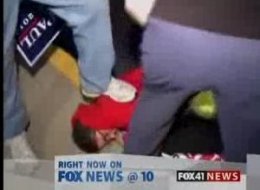
As proof that we can't do anything right, including mob violence, here's a picture making the rounds of a Rand Paul supporter stepping on the head of a MoveOn.Org troublemaker who showed up at one of Rand's Klan meetings. Point one: the SA would never have worn white sneakers. Das ist so lahm. Although Rand Paul's supporters do utilize the main technique of the Brown Shirts, the Sturmabteilung, which is violence to make a point. Let's face it, there simply comes a time when you know you're so damn right that anyone who disagrees with you needs to get their head stomped. Rand's supporters have become sick and tired of all these intellectual digressions, these "discussions" and whatnot. So get out of here or we'll throw you to the ground and stomp on your head.

Such an approach does discourage the expression of opposing points of view. We should be under no illusions about that. Hitler's National Socialists never actually achieved an electoral majority in Germany, either (as the Tea Party will fail here to do as well), so to compensate for that shortfall, that "delta" between where Adolf wanted to be and where he got through the electoral process, Hitler used what you might call his political Irregulars, enforcers who kept the whole open debate thing from getting out of hand. The young woman who showed up at the Rand Paul rally with an offending placard no doubt got off lightly compared to the Brown Shirt treatment circa 1936, say, but we've got to give the Tea Party a chance. They're learning, after all. Hitler did not perfect the art of violent intimidation overnight either. These things take time.

Turning the country into an open-air asylum takes time, too, but we're getting there. I note with singular satisfaction that the First Amendment is now under open assault from the Tea Party gang. Ken Buck, who is leading in the Colorado race for the U.S. Senate as the Republican/Tea Party candidate, does not like the idea of separating church from state, although he likes the idea of forbidding the government from "establishing" a religion (because, for example, what if a Jewish president were elected? Or a Muslim? Okay, another Muslim, the TP's would say.) Then America, obviously a Christian nation from the get-go, could find itself in a messy situation, with the Koran calling the shots instead of the Ten Commandments as God intended.

Buck has a half percent lead, and Nate Silver thinks he's got a 54% shot at getting elected. One of Ken's concerns is that he finds it "scary" how "secular" the country is becoming. Well, we can't have that. It's the secularists (Sekelar Hoomanists, as the church of my childhood used to call them) who advocate ideas such as science, with the dire threat it presents of a detailed and accurate understanding of reality. Science has produced such ridiculous red herrings as global warming and evolution, for example, ideas so pernicious and subversive that one poll showed that 14% of Tea Party people themselves believed in man-made climate change! Only 86% of the Party is cleaving to the Party line! Fortunately, as any student of history can tell you (that is, most people not in the Tea Party), Hitler knew how to deal with dissidents within his own party as well.

So anyway, just picking up the pace of posting in advance of next Tuesday. Heh heh. After which, I think a dissenting view like mine, contrary as it is to the general drift of the country, might place my head more or less where that young lady's is in the picture. And thinking about the steadily deteriorating educational system in this country, I would not think that the tendency of the populace is going to be away from superstition, religious intolerance, anti-intellectualism, obscurantism and that whole constellation of crazy stuff. Quite the contrary. Might not be a bad idea to develop at least a contingency plan for moving somewhere else, some country where the rule of law, high intellectual and educational standards, open debate, freedom of artistic and political expression - where all such things are common and revered.

You know, someplace like Germany.

The sign post up ahead reads Twilight Zone


It's never true until Nate Silver says it's true, so I guess it's now the case: the Republicans are going to take the House of Representatives. Nate's done his "Monte Carlo" simulations (at least 100,000 of them), and the tumblers keep falling in the same place: about 230 Republicans, 205 Democrats. A gain of 50 seats in two years.


I liked it better when Nate ran a stand-alone blog (his "538" site) instead of as a prognosticator for the New York Times, but his work looks much the same. He tends to be scary accurate. In the Senate, it appears likely the Democrats will wind up with about 51 or 52 seats, and the current odds favor the election of Sharron Angle over Harry Reid, although it's a very close race. A world without Mr. Mumbles - I just can't imagine it.

Thus endeth the days of Democratic hegemony, of the powerful dominance in the House and the near "veto-proof" advantage in the Senate. We will have a completely divided government. A Republican House, a Democratic Senate, a Republican Supreme Court and an undeclared White House. I imagine that President Obama will move from irrelevant to invisible, but at least he will have the consolation of a ready-made excuse: what can he possibly do with a divided Congress, one house of which is implacably hostile to any of his ideas and the other saddled with the "60-vote" rule?

We will thus transition from the era in which almost nothing was accomplished to an era where nothing whatsoever gets accomplished. In some ways, if your mind is partial to controlled experiments and the scientific method in general, this will present an opportunity for learning. The USA, instead of being primarily a place where the conflicts are internal, will now face two new foes: the rest of the world's population and Mother Nature. This should be interesting. I'm as bored as the next person listening to all the usual formulations, the "Progressives" against the "Conservatives," et cetera. Keith Olbermann versus Bill O'Reilly (although now that I've discontinued cable television, I don't see much of that). The American electorate seems so absolutely devoid of new ideas that it is simply, and reflexively, going to return the Republicans to power because they're the other choice. That's what the Republicans have going for them: they're not the Democrats. What a creative society!

While Obama was President with a Democratic Congress, he was unable to do anything. He couldn't get any global warming legislation passed. The costs of healthcare are as sky high and unaffordable as ever. Wall Street is still running amok, with the pace of wealth-concentration in the upper one percentile undiminished. Unemployment, realistically speaking, is about 20%. The dark shadow of Peak Oil hangs over everything, and we didn't do a thing about it. The value of everything continues to deflate, other than the stock markets pumped on Federal Reserve money-printing operations. In about one year, about 30 to 40% of all houses in America will have loans against them greater than the value of the house itself. Homelessness and poverty will continue to proliferate. And meanwhile, the world at large, which has gotten extremely tired of American currency manipulation and systematic fraud as its main economic outputs, is steadily reorganizing itself for the post-American future.

On issues such as climate change, the USA will increasingly play the role of world pariah. Using about 25% of the world's fossil fuels (with 4% of the population) and producing 20% of the world's greenhouse gases, America is being left behind by countries which are facing the truth about the need to change to sustainable energy, including, oddly enough, the People's Republic of China. The wars we keep fighting and fomenting (and which we ask other countries to finance) irritate the hell out of the rest of the world.

So against this backdrop, we will switch gears from 2nd down to 1st, forgoing even the appearance of adaptation in favor of theocratic distractions, witchcraft, Rand Paul-like Luddite racist reaction, gay-bashing and other stuff which was last this popular during the Dark Ages. America, I think, will be more like a howling mob controlled by corporate bastions behind security gates, bastions which employ people in other, poorer (but not for long!) countries to make stuff and produce their wealth, with the occasional invasion of another country to remind us that we're all patriotic Americans being "kept safe" by the Pentagon.

An Armed Madhouse, as Greg Palast described it. This should be interesting, in a macabre way.

October 19, 2010

Glum & Glummer


At the urging of Karl Denninger, who has become the de facto doyen of the fraudclosure issue, I watched a panel discussion hosted by the American Enterprise Institute, featuring such prominent gloomsters as Nuriel Roubini and Chris Whalen. Five economists in all, and they competed to see who could be the most pessimistic about the economy. That's one thing I've noticed in recent months: it has become mainstream to be dire, whereas only a short time ago the happy talk seemed to compete on an equal footing, led by the Cheerleader in Chief himself, President Obama.


I think it's healthy, myself, to the extent one can extract any hope from such circumstances. The Federal Reserve is doing what it does, which is contemplating printing another trillion or two and flooding the bank basements with more "liquidity," which the banks won't lend, of course, because there are no qualified or interested borrowers. It's such an odd misunderstanding of what's wrong with the American economy: if you could actually fix it by making entries on a Federal Reserve computer, declaring the existence of more "money" by the typing of long strings of 1's and 0's, then the problem would not be real in the first place. Yet the problem is real, and the principal dilemma is that the economy has been built on a foundation of illusion and fraud for the last thirty years or so. It was only the forward momentum of American advantages which kept things going at a seeming level of prosperity for as long as they did. Various charts used by the Glum & Glummer panel verified this sad fact: it has been the steady build-up of private and government debt which has created the "wealth effect" which allowed our consumerist jubilee to keep going, as the great mass of the populace relied on the steadily rising value of their houses to amass a fortune, extracting this equity as they went to buy stuff from each other (and most of that imported).

Roubini forecasts another 10% drop in housing prices over the next 12 months. The effect, he said, will be to place about 50% of all mortgaged houses underwater, that is, the loans against such houses will exceed the value of the house. Chris Whalen added that we are only about 25% of the way through the foreclosure process for houses that are currently in trouble, let alone the "strategic defaults" to come implied by Roubini's forecast (and Dr. Doom & Gloom is rarely wrong about these things). Ergo, ipse dixit: Roubini is saying the whole damn thing is going to come crashing down around our ears. An economy depending on the wealth effect is going to get hammered if half the mortgaged housing stock represents bad loans and uncollectible debt. The general estimate is that about 60% of all houses have a mortgage to one extent or another; if half of these are negative equity situations, then 30% of the entire American housing stock will be underwater.

Securitizing mortgages made it all possible, because that process "spread the risk." It sure as hell did - it spread the risk to every nook and cranny of the nation. It's becoming apparent what really happened in the fraudclosure scandal. The banks and loan packagers were equally caught up the bubble mania of the boom housing years and simply never thought that any foreclosure problem could become epidemic. It's amazing in retrospect to contemplate something this huge and pervasive and imagine that it was not part of the advanced contingency planning. Housing prices would always go up; thus, the fact that mortgage-backed securities were loaded up with loans that did not meet the specifications of the prospectus (and Eliot Spitzer has recently discussed proof adduced by the Financial Crisis Inquiry Commission that at least 28-29% of the loans in "Triple A" rated CDO's did not meet the underwriter's warranties) would never come to light. A rising tide would continue to lift all boats, and no worries about a few borrowers here and there defaulting; the foreclosure auction would return 100% of the value of the loan back to the pool.

That's also why the big banks and securitizers didn't care that they were riding roughshod over county recording statutes and the Statute of Frauds, why they in effect created their own "real property common law" through the formation of MERS (Mortgage Electronic Registration Systems). Mortages were trading hands so fast, in such huge numbers, that they didn't want to be bothered with paperwork and all the burdensome county recording fees. And again, so what? Foreclosures in signficant numbers were never going to happen, and none of this shoddy, illegal paperwork would come to light. Just the fees at the front end, and the cash flow on sale of the CDOs, baby; that's all they cared about.

It is interesting what an enormous Black Swan the foreclosure crisis now presents to our collective consciousnesses, is it not? No one really saw it happening in just this way. It is a cautionary tale about the dire consequences of excessive complexity coupled with mass integration. When it goes, man, it takes everything with it. We were so much safer when there were thousands of small lenders holding their own mortgages, and the economy itself was diverse, with agriculture, manufacturing, building and all the other varied components of a real economy. Now we've got this mess. A financialized nightmare built entirely on fraud and swindle, and next up, the class action lawyers tearing into the bones of the banking system as they go after all those fraudulent CDOs issued by BofA, Goldman, Bear Stearns, Merrill Lynch, JPMorgan, et alia ad nauseum.

America, as we've known it, is toast. The moral of the story being that one had better seek his or her own diversity where she can find it.