August 04, 2012
Saturday Morning Essay: The Bar Bet Economists in the Tavern at the End of the World
I think of Paul Krugman as my favorite Bar Bet Economist. His columns and blogs, which are relentlessly self-congratulatory, seem often (almost always) about a couple of economic parameters which he has gotten right and many of his critics and others have gotten wrong. But these parameters (the coupon rates on Treasury bonds and the overall rate of inflation) are somehow trivial when compared to the enormous economic and environmental problems the U.S. and the other developed countries nevertheless face. Thus, being right on these two indicators is a little bit like the guy on the adjacent bar stool who wants to bet on whether the next car passing in the street will be foreign or domestic, or whether the next woman walking in the bar will be blonde or brunette. Leave me alone, I'm trying to watch the baseball game.
Mr. Krugman says that he has been right not because he's so smart but because his economic model, the Keynes-Hicks IS-LM model, predicted that in a "liquidity trap" such as the United States is in, where monetary policy (essentially, the lowering of interest rates and unconventional quantitative easing by the Federal Reserve) fails to achieve "traction" in the real economy because the American people are already in debt up to their eyeballs. Thus, the central bank (here and in Europe and Japan) is "pushing on a string." Rates can't go any lower, and printing money makes the stock market go up for a while (stock prices are measured in money, after all), but not much else happens, so monetary policy has shot its wad. Mr. Krugman (who actually does think he's right because he's so smart, of course), who is a good Keynesian advocate, thus says that the remaining way for the U.S. economy to "end this depression now" (as the book he's flogging claims) is for the federal government to stop being so "austere" (running only $1.2 trillion budget deficits) and really spend some money. Unlike the deluded "bond vigilantes" and those who have been so wrong about soaring interest rates on Treasuries and inflation (so far) like Peter Schiff, Niall Ferguson and others lacking a deep understanding of the IS-LM model, Mr. Krugman, who has won his bar bets, feels that he is entitled to advance his own theory boldly.
Suppose, however, that something else is really going on these days, something more sinister and threatening that is actually at the root of our economic malaise. Suppose the easy analogies to the ways the U.S. rose from the depths of the Great Depression, or became the world's economic colossus after World War II, are in some ways inapt. Suppose, in other words, it's 2012 now, forty years after the landmark work of the Club of Rome and its Limits to Growth predictions.
Then we really have a problem, because then we're faced with the problems of the real world and not an internecine academic food fight between guys who want to shine at the expense of their peers at the next gathering of other non-scientists spouting (in Feynman's delicious phrase) their "general dopiness," defending their tiny little theoretical turf on which they've staked their academic reputations. Or as Paul Craig Roberts puts it:
"Most intelligent people are aware that natural resources are finite, including the environment’s ability to absorb the wastes or pollution from productive activities (see for example, Jared Diamond, Collapse, 2005). But few economists are aware, because economists assume that man-made capital is a perfect substitute for nature’s capital. This assumption implies that there are no finite environmental limits to infinite economic growth. Lost in such a make-believe world, economists neglect the full cost of production and cannot tell if the value of the increases in GDP are greater or less than the full cost of producing it."
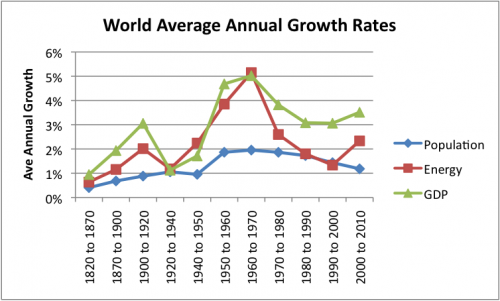
That's it right there. There is no substitute for nature's capital because we remain, as Thoreau told us about 170 years ago, sapient and sentient beings who nonetheless have a primordial need to maintain their vital heat. We've gone about this basic task in enormously complicated ways, constructing a vast, interconnected, globalized economy, which is extremely fragile and subject to cascading failure modes, and which is dependent on the enormous expenditure of energy to maintain. Which, up till the present, has mostly meant fossil fuels. The good and dependable Gail Tverberg over at ourfiniteworld.com has put together a chart demonstrating the symbiotic relationship between the expenditure of energy and the growth of economies based (in the dopey way of economists) on GDP. It is reproduced just above. Gail's regression analysis reveals an r squared value of .74 between the energy and GDP variables, which is less than ironclad, of course, but highly suggestive in a macro way, and certainly more indicative of how the world works than these crazy nostrums about "stimulus money" and the like from Krugman and other acolytes of a book written in 1935 when the world's population was almost manageable, we weren't cooking the Earth, the seas were 30% less acidic than they are now, the CO2 content of the atmosphere was perhaps 4% elevated versus the 35% we find now. (If you're tired of reading this post, I commend you to Bill McKibben's brilliant essay in the current issue of Rolling Stone on global warming, where he boils it down to three numbers.)
Thus, as Gail notes, the interdependence of GDP growth and energy use, when considered in light of the manifest need to reduce our expenditure of fossil fuels (on the order of 80% between now and 2050, under the most hopeful scenario, in order to keep global warming under 2 degrees C, which may or may not be safe), means that we are in for a very long, protracted period of declining GDP (not growth, but in real terms) between now and 2050, unless we want to guarantee our extinction.
The situation is actually quite syllogistic and not dependent on malarkey like IS-LM Keynes/Hicks Liquidity Trap Zero Lower Bound Monetary Fiscal Mumbo Jumbo, and the rest of the nonsense Krugman and his ilk use for their useless stock in trade. We're at the end of the line, we have to switch over to sustainability and reduced populations, and the Bar Bet Economists have to pay their tabs (which are enormous, because they've really messed up the world with their stupid advice) and go home.
Posted by
Unknown
at
6:40:00 AM
0
comments
July 26, 2012
Yogi Berra's Future
"The winter in Ithaca convinced him that he had to leave, and Caltech, in addition to better weather, had the appeal of not being a liberal arts university like Cornell, where, he said, 'the theoretical broadening which comes from having many humanities subjects on campus is offset by the general dopiness of the people who study these things.'" Quantum Man by Lawrence Krauss, about Richard Feynman's life in physics.
Once I was asked by my mother what the university experience was all about (she had not attended college), and I thought about it for a minute and answered that, as far as the subjects I had studied, it seemed to be a reading list. You could read the books that educated people thought were important, and the university provided a handy list, called a syllabus, as a guide to your reading. Another approach to such an education, in other words, would be to have someone who attended the college simply give you the lists, and then you could approach your "education" at your leisure.
I think the "classical" style of education probably made more sense - an emphasis on hard sciences and dead languages, specifically Greek and Latin. These subjects are better learned in a formal academic setting. You can "figure out" the plays of Shakespeare or Toqueville's Democracy in America on your own - listening to people lecture about such things simply indoctrinates you into a certain subjective approach, which is probably more limiting than helpful.
The blogosphere daily reflects the limitations of "liberal arts" commentators. I was thinking this as I read through Jim Kunstler's book Too Much Magic, about the general hopelessness of technology to solve our future energy and economic problems. Kunstler assures us in numerous places that it's inconceivable we'll come up with solutions that "scale" to the problems we'll face, and ticks off the usual arguments one by one (solar, wind, thermal, nuclear and so forth) and confidently proclaims that nothing is going to work once oil shortages begin to hit.
That's the thing about the blogosphere: it's become highly influential in a relatively short period, but the general reading public does not often reflect on the absence of peer review, that winnowing process in professional scientific journals that gives at least some guarantee that what you're reading is not absolute nonsense. The absence of any "gating" procedure such as peer review means that a book like Kunstler's, which follows closely the arguments he makes weekly on his blog Clusterfuck Nation, enters the stream of commerce and consciousness without any real vetting. I try to remember this as I read such confident "predictions" about the future.
Because I fundamentally agree with Yogi Berra. Yogi, in his trademark way, was suggesting that the future is impossible to predict because of the problem of unknown variables and feedback loops. Take the problem of water shortages, for example. The Earth is covered with salt water, to enormous depths, over 70% of its surface (my daughter forwards word from her oceanography class this summer that the coolest theory going currently is that the water in the oceans originated with impacts from ice-bearing asteroids - I really like that one). Most of mankind (on the order of 75%) lives near or on the sea coasts. Thus, a major breakthrough in desalination (dealing, essentially, with the energy issues and with the osmotic sludge produced in the process) would solve the fresh water shortage problem in perpetuity. But, Kunstler assures us, we will not have the energy for such a process. He specifically rules out any possibility of fusion power as a solution (for desalination or anything else).
Feynman would not have ruled out fusion power; indeed, he encouraged his Caltech students to pursue the engineering issues (the science is well understood) because he was confident the process could be mastered. So, just supposing, you simultaneously made breakthroughs in fusion power and desalination - immediately, two gigantic problems would be overcome by a synergistic interplay in (that awful word) technology. (Or, in the Ali G usage I prefer, techmology.) At one point (in telephone and telegraph days) the internet itself was unimaginable. It required the development of materials science (something Feynman also got very interested in) alongside the development of computer science, which at the time was a subset of electrical engineering (Feynman was in on the ground floor of computer science as well, and was the first to conceive of quantum computing).
The mistake Kunstler makes, in my opinion, is that he violates the basic rule of the scientific method, and, again, no one could describe the integrity of the scientific method better than Richard Feynman. Kunstler assumes his conclusion: we are headed back to horse-and-buggy days, with a general store and a cracker barrel, with a potbellied stove in the middle of the plank-floored room, and the women, dressed in gingham, will turn the paddles in the butter churn and gossip about the new young filly who's living in sin just up the road a piece. Et cetera. Thus, all variables which seem to defeat this illusion are quickly and summarily dismissed as inconvenient impediments to this anodyne imagery of America in the 1840's.
That's not the way to do it, in my opinion. At the front end of your "thought experiment," you must not presume your conclusion; otherwise, you will, consciously or unconsciously, force all of your data in a direction favorable to your presumed outcome.
In point of fact, there are lots of ideas which have not been tried yet. For a simple example, people laugh at Steven Chu's suggestion that all roofs in America be painted white. In the Sunbelt, this will have the effect of lowering electrical usage for air conditioning, and, everywhere, the roofs will reflect incoming sunlight creating an albedo effect. The reflected light will not radiate infrared heat into the atmosphere where it can be captured by greenhouse gases. Similarly, all roads should be light colored to reduce the "heat island" problem. Chu also is a proponent of the cellulosic conversion of switchgrass, essentially a weed, into ethanol as a power source for internal combustion engines. Kunstler only argues about corn ethanol, but corn requires all kinds of heavy inputs, and its use for ethanol has negative impacts on food production. Not so with switchgrass, which is an herbaceous, woody plant that in effect "self-fertilizes;" it dies back and replenishes the soil out of which it has been harvested.
The obstacles to such ideas are political, not scientific. I do believe that social movements run in cycles, and currently we're locked into a very destructive one where the "financialization" of the economy has led to oligarchic control of the political process. I don't think this will last, and the very crises which Kunstler and others describe will be among the reasons for transformation. I just don't believe that future shortages of oil, which will doubtless happen along the lines Kunstler describes, will mean the end of the Age of Technology, because that's a little like saying that the human race will lose its collective memory of scientific progress, and that just isn't going to happen.
Posted by
Unknown
at
11:42:00 AM
0
comments
Labels: Modern Luddites
July 23, 2012
A few notes on reading Jim Kunstler's "Too Much Magic"
I regularly read James Howard Kunstler's "Clusterfuck" blog on Monday mornings, and I'm used to his irreverent hilarity when writing about America's throngs of obese, clueless, Cheez-Doodle chompin', Big Gulp slurpin', NASCAR cheerin', Walmart-shoppin' videophiles. So I was a little surprised at the rather somber tone of his latest book, Too Much Magic, about the misplaced belief, or hope, that he encounters as he roams around the country, lecturing and attending various forms of Doomsday conferences, that America will pull its (over-abundant) fat from the fire with a last minute technological fix to replace the looming natural resource shortages that lie in the not-too-distant future.
Essentially, the thread of logic which Kunstler delineates centers on the collision course between two main facts of American life: (1) Its car-dependent suburbia (the "Happy Motoring fiesta" he often writes about on the blog) and (2) Peak Oil. I think that Jim Kunstler has better insight into the Sorrows of Suburbia than any other writer I've encountered. It's a little uncanny when I read his descriptions. He has it to a tee, and I know something about the housing tract life, having grown up in a neighborhood you might call the Apotheosis of the California Subdivision beginning in the early 1950's. (Kunstler and I were born in the same year.) He writes rather movingly of the cultural and aesthetic poverty of such places, which have neither the vitality and vibrancy of true city life, nor the peace and pastoralism of the actual country, which the suburb is meant to simulate in an awful, abstract way. It's really not surprising to me that the vast swaths of American suburbs have produced so many Gaia-paths, to coin a term, a huge cohort of people with so attenuated a connection to the natural world that they despise and discount the Earth entirely.
Anyway, JHK nails it, the streets of vinyl and particle-board homes, on their 1/4-acre lots, hemmed in by boulevards and strip malls, a flat, featureless terrain in the Geography of Nowhere, as he called it in a book of the same name. As to Peak Oil, I would say this: I wish the Peak Oil theorists would call it something else, such as the Oil Shortage Crisis. There is something a little cult-like in the Peakers' way of talking, a little too faith-based. I get the general idea: Peak Oil refers to that point in time when 1/2 of the commercially-retrievable petroleum has been extracted from the ground, and the 50% that remains is less readily-accessible, more expensive or environmentally destructive to get at, or just not worthe the trouble at all. But what it really adds up to is that there is going to be an oil shortage.
Right now we're straining at the limits of world production, which for actual, straight-up petroleum is about 84 million barrels per day (84 mm bbl/day), and including all "liquid fuels" that can serve similar purposes, the number is around 102 mm/bbl. Fossil fuels have been a wonderful source of energy-dense power, essential for practically everything in modern life, so ubiquitous that we forget that without it, the whole operation pretty much shuts down. Groceries don't get to market, commercial planes don't fly people here and there, crops don't get fertilized, the folks way out in the suburban tracts don't get to work, or to the store or to school, the whole system of international trade of goods suddenly ends.
The question that doesn't really get answered by Peak Oil theorists is the one most on people's minds: at what point, more or less exactly, will the shortages predicted, or the rising price of oil, cause all these dire consequences to unfold? I sometimes think, as I may have mentioned before, that from the viewpoint of the Peakers, it just can't happen soon enough. This is part of my Special Theory of Personal Time Horizon Relativity (I'm not sure that anagrams very well - SPOPTHR). The essential idea behind SPOPTHR is probably the reason humanity won't do anything about global warming until we've blown past all conceivable tipping points and points of no return. We're simply not motivated, in an evolutionary, genetically-determined way, to do anything about a problem we are not dealing with as an observable crisis right here and now. The somewhat bucolic, anodyne world the Peakers would like to see return, and which they envision just on the far side of the End of Suburbia, is something they, themselves, want to enjoy during their lifetimes. I think this bias creeps into their analysis, although on balance, I think JHK and Dmitry Orlov are definitely right about the eventual outcome.
So this delays the moment of reckoning. Of course, since energy inputs are necessary for economic growth, the economies of the world, particularly in the West, Japan and in the former Soviet bloc, are locked in stagnation, so we wouldn't be getting anywhere while we wait to run out of oil, if we try to follow business as usual.
The smart thing to do, as Kunstler says, is to use the available dense-energy fossil fuels to power a transition to a smaller, localized economy, with mass transit based on the old (not high speed) rail system, buses, walkable towns, bike paths and other sustainable approaches such as localized solar power (rooftop, for example) and wind turbines. That does make sense. It's possible that the slow-motion collapse of the existing system, brought on by the collision course between unserviceable debts (which require, because of their compounding nature, concomitant exponential growth in GDP), on the one hand; and the gradual awakening to the reality that unavailability of oil is becoming a problem, on the other.
If things happen less quickly than the Collapsarians envision in their Dark Dreams, say over the next 20 years or so, then some of the nascent tendencies already becoming apparent (local community gardens, small-scale farming, grass-fed ranching, a general return to the land) might have time to take shape. It's not as dramatic, but it might be workable for the generations to come.
Posted by
Unknown
at
1:07:00 PM
0
comments
July 21, 2012
Saturday Morning Essay: Going B/K in the Golden State
Brought to you by Trader Joe's Dark Roast
First, I must correct an erroneous slur: it is widely assumed that the bankruptcy of Mammoth Lakes, California, is in some ways comparable to the previous bankruptcies of Vallejo, Stockton and San Bernandino, California. This isn't fair. Mammoth Lakes filed Chapter 9 because it wound up on the wrong side of a lawsuit, a $32 million judgment against it, which was enhanced by legal interest and costs to $43 million. That could happen to any municipality defended by typically incompetent county counsel. The bankruptcy of Mammoth Lakes is not really indicative of a general trend toward insolvency of cities in California.
The way that bankruptcies in Vallejo, Stockton and San Bernadino are indicative of a general trend toward insolvency of cities in California. They will soon be followed by a couple of other Southern California cities, probably Compton, then Montebello. These cities are facing Chapter 9 because they've run out of money. It's not really a lot more complicated than that.
Chapter 9 was enacted during the Great Depression to give cities and other local government entities (such as transportation districts) a way to "reorganize" in bankruptcy, along the lines of corporate reorganization under Chapter 11. It imposes an "automatic stay" against further legal action versus the city except through the auspices of the bankruptcy court, which oversees such litigation and the city's plan for reorganization. While a corporation has the option of converting a Chapter 11 to a straight belly-up Chapter 7 if there is no hope, a city can't really go out of business since technically it's not in business in the first place, and it can't really simply cease to exist. Otherwise, people living in the city would not be living anywhere, and that violates one or more physical laws, I'm sure.
Cities use Chapter 9, in general, to deal with onerous and unpayable recurring costs (Mammoth Lakes being an exception, as we've seen) such as pensions and muni bond payments. This is what's going on in Compton, for example, and Stockton rolled over for the same reason (that sleepy little Valley town is the largest muni b/k in history, by the way). The bankruptcy court can release a city from its collective bargaining agreements with government employees, thus paving the way for relief from pension payments it can't afford or bond payments it cannot make. Some form of "cram down" can be visited on the unhappy heads of the city's many creditors.
I was thinking that California would be particularly susceptible to muni b/k for a couple of reasons. (You might think of this as a Feynman-style First Approximation, since I've been reading a lot about that remarkable man and his unworldly-smart mind of late.) California has Proposition 13, which sets strict ad valorem limits on real property taxes, a principal source of revenue for the state and local governments. A curious feature of Prop. 13 is that it was originally designed to shield homeowners from runaway assessments on the values of their homes back in the go-go days of the mid-1970's in California, when everyone wanted to live here and houses were appreciating at an astonishing rate.
Essentially, taxes are set at 1% of the house's fair market value. Assessments can only add 2% per year to the tax bill, a constraint on government. It's all written into the state constitution, of course; Howard Jarvis saw to that. I believe a War Between the Worlds is necessary to relieve the state of Prop 13's rules - nothing less. Yet another curious feature of Prop 13 is that it has a yo-yo effect. It can cause assessments to go down as well as up, and there is no "2% per year" limitation on declining real property values. Thus, when the housing bubble popped around 2007, and the first waves of foreclosures hit with all of their distress sales and bank repo action, the bottom fell out of state and local governments. Real property values plummeted and with them that inexorable 1% calculation.
Meanwhile, California's cities and state government had blissfully planned their future based on Jarvis's great fear, that housing prices would always go up, and furthermore that the anomalous period of high capital gains paid during the DotCom boom would represent some kind of permanent bonus for the state treasury.
Alas, no. As with everything else in matters fiscal in the United States, everything depended on sustained growth, growth which is not happening, Quite the contrary. If we strip out deficit spending at the federal level (which has been as high as 10% of GDP), the economy has been contracting as a matter of reality. What kept California afloat during these five years since the bursting of the bubble was ARRA, aid from the federal government to states in particular. All of that money, of course, was borrowed or printed or in some form hallucinated into existence, but now Congress doesn't want to do that anymore, and California faces the icy cold winds of penury without that cover.
A disturbing situation. California tends to lead the way in national trends, after all. The Golden State is saddled with a 2012 budget based, perhaps, on revenues from 1996 valuations, or at least we're gravitating toward that reality. Every time a house changes hands at a price below the value carried on the tax rolls, the state budget takes another hit. Each time a real estate developer applies to downgrade his mid-city skyscraper's tax valuation (permitted under Prop 13, and this is a booming business for lawyers), California goes a little deeper into the red.
The question is how far this will go. Will there be a tipping point? Some dreary prognosticators (such as Mike Shedlock) forecast that it is only a matter of time before a big enchilada like Los Angeles or Oakland files for Chapter 9, since all of the same problems seen in miniature in places like Compton and Montebello are present in Large Format in L.A. and Oakland.
To finish my Thought Experiment: it seems that at the root of this malaise is the natural human tendency to conceptualize the future in terms of what's happening in the here and now. This was unrealistic. Not only did the housing bubble pop, but with its bursting came the knock-on effects caused by the loss of all that notional "equity," the re-fis and equity loans that powered so many of the "discretionary" businesses in the Golden State. It was hard to see all that coming, especially if you're a government bureaucrat running a business that isn't really a business, and it doesn't seem to matter, at the time while you've got the job, whether you're right or wrong.
Posted by
Unknown
at
9:21:00 AM
0
comments
Labels: City bankruptcy
July 19, 2012
How to feel good about any result in November
http://www.youtube.com/watch?v=A7ktYbVwr90&feature=player_embedded
As Matt Taiibi has written, the Presidential campaign of 2012 is likely to be the most boring electoral race in the history of the American Republic. I don't know what Millard Fillmore sounded like on the campaign trail, or James Buchanan or some of these other hacks, but I'm fairly confident that Barack Obama versus Mitt Romney will be a grueling, mind-deranging thing to watch after they get into high gear, if that is not a contradiction in terms. We are getting close to that Event Horizon (sorry to use this metaphor two posts in a row, but I think it fits again) where all loyal Democrats are reminded that maybe President Obama's entire presidency is veiled in complete secrecy, maybe he makes war on whistleblowers to an extent never before seen in American politics, maybe he starts wars in foreign countries with no Congressional authorization whatsoever, maybe he has institutionalized a program of whacking American citizens with no due process of any kind, maybe the President of the ACLU says that Obama's presidency is "worse than George Bush" in terms of civil liberties abuses, but dammit - think how bad Mitt Romney will be for the Middle Class!
And yes, President Obama is on the payroll of the same Wall Street financial institutions as his opponent, but gosh, what's a President to do if he betrayed every promise for "Hope & Change" he made to the American people in 2008 and now has no choice but to go hat in hand to the fat cats he used to deride (but no more, you'll notice)? Without money, there is no way to buy all the media time necessary to fill the airwaves with the half-truths, propaganda and slogans essential to the manipulation of the half of the voting-age populace who will actually show up to vote in November.
Still, Barack is our guy. More important, he's Our Brand. Although I'm voting for Jill Stein, the Green Party candidate. Am I wasting my vote? Well, of course, in one way of looking at it. She isn't going to win, not by a long shot. She'll barely register on the tally, on election night I doubt you'll ever hear her name. My general feeling is that either President Obama or President Romney will be driving the American Bus in the same direction it's been going for quite some time over the last couple of decades (longer, really, but never mind), and that route is the HOV lane on the Highway to Hell.
And that's okay in my book, because there are more important issues that Planet Earth faces than the tiny comparative economic advantage offered by either of these Empty Suits. I would encourage you to watch the short lecture by David Roberts embedded in this blog. I've read his stuff for years on the HuffPost, and I found this video on the Skeptical Science blogsite, which deals with global warming and more specifically with the constant bad faith attacks on the scientific consensus concerning global warming which originate, almost without exception, with American legacy industries with a vested interest in finishing the planet off.
If you take the thesis advanced by Mr. Roberts (and by many, many others who are conversant with the frightening magnitude of the problem) at its face value, then you must admit that, if the world only has about 5 or 10 years to move decisively on global warming or face irreversible consequences, then whatever means are necessary to bring about these changes are the only way to go at this point. This is simply logical. The truth, as General Buck Turgidson told us in "Dr. Strangelove," is not always a pleasant thing.
Now the upside of America's slide toward economic collapse is that the world's largest economy, that of the country which is probably the most intransigent and obstructionist on the issue of global warming (shamefully so, because we really have no excuse), is that we have, for example, dramatically reduced our use of petroleum and gasoline over the last 5 years. Not because we're virtuous and concerned, of course, but because we're broke. I am confident that either of the two schlemiels running for President can guarantee that nothing will be done to slow this descent toward collapse. They are the two avatars of the completely sclerotic political system which has ruled this country for decades, a corrupt, non-adapting, thrashing-in-the-tar-pits brontosaurus of a nation. So to speak, at least environmentally. I mean, how much time do you ever hear Barack Obama or Mitt Romney spend speaking along the lines covered in the Roberts lecture? Exactly. So if neither spends any time discussing this existential issue, then what is the relevance of either of their candidacies?
Jill Stein does talk about such things, in the tenor and with the sense of urgency appropriate to the magnitude of the threat. She'll lose, but it's not a "wasted vote. Wasting your vote is voting for a candidate who pays no attention whatsoever to the mounting environmental catastrophes threatening human survival, instead devoting his time to absurd discussions of "tax policy," and "terrorist threats" and whatever the hell else they waste their time on.
As a concrete example, here's how this Administration deals with the Midwest drought and the devastation of the corn and soy crops: Agriculture Secretary Tom Vilsack prays for rain. It might have been an opportunity to talk about the increased likelihood of extreme weather events that come with climate change. It might have been an opportunity to wonder aloud whether it's a good idea to devote 40% of the (inedible) corn crop to ethanol production, a process that has a negative energy return on energy invested (EROEI), but continues because of Congressional corruption. It might have been a time to raise the issue that the failure of a corn crop should have no effect on beef prices, because cows are ungulates which naturally eat grass, and left to their own devices do not graze in corn fields. Which is why they have to be loaded up on antibiotics in feed lots where they eat a nonstop diet of corn.
Jill Stein favors a return to sustainable agriculture and food production. Thus, I leave others to vote for Coke or Pepsi, confident that November will be a win/win no matter what happens.
Posted by
Unknown
at
8:33:00 AM
0
comments
Labels: Presidential election 2012
July 17, 2012
The Quantum Mechanical Resignations of Mitt Romney
It was a feature of Feynman's early breakthroughs in understanding quantum theory that it is sometimes necessary to postulate that subatomic particles travel backward in time, as in the case of a positron which "quantum fluctuates" itself into existence out of nothing, travels backward in time to annihilate with an electron, and thus preserves various rules of Heisenberg's Uncertainty Principle, Pauli's Exclusionary Principle, and other sacred edicts of the Science of the Very Small. It's a strange world, way down there, but quantum mechanics has been experimentally verified many times and seems to have real world referents, which differentiates it from, for example, String Theory, which is mathematically impressive but seems to lack any correlation to reality. String Theory has been likened to a drunken game of darts at a pub, where the players throw the darts any old which way, then walk to the wall and draw a bull's eye around wherever the darts stuck.
Anyway, for reasons related to statistical mechanics, another dense and fascinating subject, it does not seem that the anomalies of the quantum world happen in the world of Macro-Reality, so we're stuck with plain old entropy where we can tell what time it is, or at least whether Now is later than Before, by watching an egg roll off the kitchen counter. A highly organized egg on the counter: Then. A mess of yolk and egg white on the floor: Later.
This is the world that Mitt Romney is stuck in as he attempts to explain his Theory of Retroactive Resignation. Mitt himself wants to be a big, white, cornball, empty-suit Positron who can move backward in time in a Large Feynman Diagram and quit Bain Capital in 1999, where he wants to have quit, and not years later during a period when Bain was busy shipping jobs to Bangalore and engaging in other anti-American economic activities which form the basic business model of the modern American corporate world. Not that Bain Capital wasn't bad enough when Romney was definitely in charge, in the years before 1999, but it got worse, and Romney would like as much distance between Himself and his Anti-Particle Self in order to avoid mutual annihilation.
Mitt's big problem is that he remained as President, CEO, Chairman of the Board, and sole shareholder of Bain Capital in SEC filings until probably 2003, and you can't really ignore these filings and claim you had "nothing to do with the company" after 1999 when the corporate record says otherwise. And since corporations are strictly creatures of statute (something that seems to be overlooked in much of the current discussion), whatever a corporation appears to be as a matter of regulatory filings and corporate formalities is what it actually is, since its Virtual Reality is equivalent in this case to its Actual Reality. That is to say, Mitt's SEC filings for Bain are not likely to quantum fluctuate themselves out of existence. Nevertheless, the Romney campaign is striving mightily to sell its version of the retroactive resignation, even if it violates one or more of basic quantum tenets, such as the Bullshit Principle.
Who knows if Mitt will get away with it? It's amazing to me that the American commoner would contemplate for a moment voting into office a corporate raider who parks his multi-millions offshore, takes advantage of every loophole available in the Internal Revenue Code so that his effective tax rate is lower than that of the baristas down at Peet's Coffee, and, in general, has absolutely nothing in common with well over 99% of the Americans he would serve as President.
Although, you know...I hate to get involved in this kind of thing. The absurdity of Romney's candidacy is kind of interesting, in a macabre way. I keep wondering whether there is some sort of rational limit, somewhere, to the capacity of the American Commoner to vote against his/her own interest. If Americans actually start electing presidents who spent their careers dismantling American business, in the very activities that led to the complete undoing of the American Middle Class, then we've reached some sort of Event Horizon, another fun concept from the world of physics.
Posted by
Unknown
at
10:58:00 AM
0
comments
July 11, 2012
Gail Tverberg and "Our Finite World"
I don't see her precise kind of analysis anywhere else. For example, her latest piece is about those parts of the world which are still growing economically. In her characteristic, homespun way, she calls these countries "the growing part of the world" and then explains why they're growing. They're growing because they're largely poor and have a long way to go to catch up to the consumerist West, and they're using coal as an energy source at an astonishing pace (increasing their coal-burning at more than a 5% per year rate). The "growing part of the world" is essentially everything that isn't Japan, the United States, Europe or the former Soviet Union bloc, and includes China, India, Africa, Australia, Canada and South America.
The West (ncluding Europe and Japan) and the FSU are economically stagnant, probably for different reasons among them. In the case of the West, the assumption of huge public and private indebtedness over the last 30 years as the West sought to maintain a luxurious lifestyle (relatively speaking) despite being embedded in a globalized economy (where the hard work and manufacturing were increasingly done elsewhere, particularly in Asia) has at last caught up to these favored specimens of the Homo sapiens species. I think that's the true Big Picture; I've always considered the possibility that blaming everything on the "housing bubble" was a case of whistling past the graveyard. The true significance of the housing bubble, and the havoc wreaked by its popping, was simply that the very homes that Westerners lived in, the "housing stock," was sort of the last thing that Americans, Europeans and others had left to hypothecate in order to get another loan. The loans, "secured" by houses, were what enabled the economy to appear so much more vibrant than it really was. Lines of credit, re-fi, gains on sale, all that dough poured into the economy and made possible such dubious pastimes and careers as party and wedding planners, "life coaches," tanning salons, all kinds of strange occupations which depend on large surpluses of cash flow in order to be viable.
And then - poof! It was all gone. Americans were forced to fall back on, of all things, the actual income they could earn through employment, and real earnings have been stagnant for decades. It is as if the economy needs to reset itself to a 1973 standard of living, adjusted only for modest annual inflation, and move forward from there. Of course, that isn't the American Way. Progress is our most important product.
Naturally, there have been many technological improvements in the intervening four decades, so that life in many (certainly not all) respects appears more productive, convenient and efficient. A great deal of this progress has been achieved by way of the integrated circuit and electronics in general. In this sense, life seems considerably "richer" to the average citizen. But in the West this is misleading. In point of fact, many aspects of life, such as education, housing, energy costs, and food, have gotten a great deal more "expensive," as measured by the proportion of real income (inflation adjusted) necessary to fund these essentials.
To take a personal example: when I entered Berkeley in the fall of 1966, there was no tuition for in-state students. There was a "Reg Fee" of $81 per quarter, or $243 for the full year. Berkeley was rated the top academic institution in the country at the time. After I arrived and settled in, I discovered that you had to buy books in college, so I got a job at Cowell Hospital as an orderly, making (if I remember right) $2.35 an hour. My mother had been sending me ten bucks a week up to the point when I got the job (about two months after I started), but then discontinued the stipend once I was working. I don't mention this as a hardship story; it wasn't that way at all, and I never missed the money from home. I didn't need it. I sold my books at the end of each quarter and bought new ones. No big deal.
A country that can afford that sort of an educational institution without strain or pain for anyone involved is a very rich country indeed. While $243 seems like nothing compared, say, to the $20,000 per year currently charged by UC campuses for tuition for in-state students (and much more for the professional schools - my own law school now charges something on the order of $40,000 per year for an education given to me for $1,500), that $243 in 1966 would have been, I know, a princely sum in Mexico in 1966. You could have lived in Mexico for a year on $243, including margaritas.
Gail points out that in the West generally gasoline usage is falling backwards to levels not seen since the mid 1990's. This is especially true in the United States, which thought of cheap gasoline as a national birthright. The decline is not because Americans have suddenly become paragons of conservation and climate change activists. Not a chance. It's because we're broke. Resources are becoming scarcer and more expensive, and the global competition for something as critical as petroleum results in a very tight fit between supply and demand.
The rock star economists such as Paul Krugman insist that the economy is "not a morality play," but I think they're essentially wrong. There is a deep moral element to economic activity, and we approached that ethical responsibility by borrowing the future in order, at all costs, to maintain the lifestyle of the present. Borrowing is essentially the anticipation of future income, and the future income never really arrived. But the crushing debt remains.
As cities now declare bankruptcy throughout California, what we're seeing is the dawning realization that budgets were established on the unrealistic expectation that "income" founded on or derived from borrowed money represented an inexhaustible source of revenue. Real property values, income derived from all those marginal business ventures (the party planning, the bronzed bodies), all of that was ephemeral and based on piling up debt. I actually think this is the essential malaise of everything going on now economically in the United States, from Social Security, to Medicare, to the public pension crises. All of the projections were based on unrealistic expectations of continued, uninterrupted growth, and now, as Gail points out, America is no longer in the "growing part of the world."
Posted by
Unknown
at
4:00:00 PM
0
comments
Labels: American economic reset
July 06, 2012
I think I've read all the novels of Nick Hornby
There always is a Point, of course. "Thinking" otherwise is just that, tricking yourself into intellectualizing something that is not, fundamentally, intellectual. That seemed to be one of Albert Camus's conceits, very French in character. If you can't rationally support the case for existence, then you must, as a matter of principle, kill yourself. Take it easy, as Ali G might say.
In the last of the five novels I read, one of the characters likes to read the poems of Billy Collins. I didn't know who Billy Collins was, but here's one of his poems:
Fishing On The Susquehanna In July
or on any river for that matter
to be perfectly honest.
Not in July or any month
have I had the pleasure -- if it is a pleasure --
of fishing on the Susquehanna.
I am more likely to be found
in a quiet room like this one --
a painting of a woman on the wall,
a bowl of tangerines on the table --
trying to manufacture the sensation
of fishing on the Susquehanna.
There is little doubt
that others have been fishing
on the Susquehanna,
rowing upstream in a wooden boat,
sliding the oars under the water
then raising them to drip in the light.
But the nearest I have ever come to
fishing on the Susquehanna
was one afternoon in a museum in Philadelphia,
when I balanced a little egg of time
in front of a painting
in which that river curled around a bend
under a blue cloud-ruffled sky,
dense trees along the banks,
and a fellow with a red bandana
sitting in a small, green
flat-bottom boat
holding the thin whip of a pole.
That is something I am unlikely
ever to do, I remember
saying to myself and the person next to me.
Then I blinked and moved on
to other American scenes
of haystacks, water whitening over rocks,
even one of a brown hare
who seemed so wired with alertness
I imagined him springing right out of the frame.
Posted by
Unknown
at
4:24:00 PM
0
comments
June 29, 2012
Being & Nothingness on the High Court, Part Deux
I was a little disappointed yesterday that the Supreme Court did not take seriously the existential arguments of the Southern lower federal courts which had found the Commerce Clause inapplicable to the "act of not buying health insurance." A typical, classic American, a 280-lb. behemoth just back from buying a half-ton of Pringles at the local Wal-Mart, sprawled in his Barcalounger there in the tract house in East Texas, waiting anxiously with a cold bottle of Lone Star in his chubby hand for the kickoff of the Cowboys-Redskins game - if this man is not buying health insurance, as Obamacare will soon compel him to do on pain of imposing a tax for which no enforcement method is provided - is this man, at this moment of contentment and disheveled repose, engaged in Interstate Commerce within the meaning of the hallowed clause?
We may never know now. The Supreme Court instead chose to base an almost incomprehensibly fragmented decision on dismayingly clunky arguments, upholding the "individual mandate" to buy insurance (from Aetna, from Anthem, from a bunch of other private, for-profit insurance companies with a captive clientele ushered to their door by the federal government) or suffer the completely undefined consequences.
It could have been so elegant, so....French. Now we will have another huge federal bureaucracy with inadequate funding to add to a budget that is currently only about 60% funded with anything other than hallucinated money. In despair one might seek refuge in some tropical paradise, one that is still above sea level at high tide, to follow the course of Paul Gaugin or Robert Louis Stevenson and simply drop out of the rat race, to exit the noise and tumult of our soul-crushing modern civilization. To get away from it all, perhaps even in Hawaii, that lovely fleet of islands anchored in the mid-Pacific. Not one of the over-developed islands, of course, like Oahu or Maui, but a quiet refuge like Kauai, Molokai or Ellison.
Posted by
Unknown
at
6:55:00 AM
0
comments
June 27, 2012
The Supremes & the AZ Immigration Law
While the liberal commentators have spun the immigration decision as a stunning victory for Obama, it was in reality nothing of the sort. Those parts of the law which were overturned were clearly "preemptive" of federal law on the same issues (penalties for working in the United States while an illegal immigrant), and that is a normal basis for finding state overreach. Immigration is supposed to be a federal issue, after all, although in modern times it is simply a political football at the federal level. Conservatives favor loose immigration laws because they like the effects of cheap labor on production, both directly and on the cost of American labor. Liberals like loose immigration laws because it feels generally good to be "humane" and compassionate and because courting the Hispanic vote tends to give the Democrats a competitive edge over the heartless Republicans.
I suspect the motivation of the Arizona legislature was more basic, and not really governed by either of these federal electoral considerations (everything at the federal level is simply game-playing at this late, decadent point in our country's history). Namely, I think Arizona's motivation (and that of the other "Red" states which have passed similar laws) is territorial, in the atavistic, reptilian sense. They're invading us! The part of the law that survived is the only part that mattered - the duty of the local constabulary to ascertain whether a person lawfully stopped for an offense unrelated to immigration status (coasting through a stop sign, for example) is or is not an American citizen where "reasonable grounds" exist to suspect the person is not in the country legally.
How might those "reasonable grounds" manifest themselves? It is on this point that "Godwin's Law" ("As an online discussion grows longer, the probability of a comparison involving Nazis or Hitler approaches 1.") usually raises its ugly, Death Skull head. Asking "for papers" is what the Gestapo used to do, or what the French gendarmes did in the opening scenes of "Casablanca" when they rounded up the usual suspects. Well, think about it: the police always ask "for papers" when they stop you for a traffic offense: license, registration and proof of insurance. Like duh. Suppose you don't have a license, or your car is registered in Matamoros if at all, or the license doesn't match the registration, or the registration is five years out of date. Or the stopped driver is unable to describe with any convincing particularity where he lives. And so forth. One question leads to another and it is ultimately determined that in addition to coasting through a stop sign, the driver is in the country illegally. By the same token, a driver who coasts through stop sign might have alcohol on his breath, and the next thing you know, he's trying to walk a straight line while juggling three tennis balls and reciting the alphabet backwards. Or why the cops can ask whether that's oregano in that plastic baggie you were too stoned to remember you left lying on the back seat. That's why the Supreme Court voted unanimously (liberals and conservatives alike) to uphold this part of the Arizona law. It's "black letter" law. The police can follow up "reasonable suspicions" that arise after the traffic stop (or any other crime). The only controversial thing about the Arizona law is that the legislature did it, whereas a state with entrenched liberal politics, such as California, would never dream of such a thing.
The truth of the matter is that the "privacy" or "equal protection" arguments are all red herrings at this point. There is no privacy in American life; we all know that. If we had actually cared about privacy, we would have paid attention to the massive illegal wiretapping begun under the Bush Adminstration and continued enthusiastically by Obama. The Fourth Amendment is dead and buried, the result of the extreme passivity of the citizenry and the hopeless complexity of American political life in general (as in, who has the luxury of time to think about stuff like civil liberties? Is that something I should be worried about?). By training a temporary, laser focus on an issue like the "stop and ask" law in Arizona, the law can be given an outsized, disproportionate importance it does not really merit. The Arizona immigration law is not going to transform the United States into a "police state." The United States is already well on its way. The President has the power, which no one is apparently worried about, to have an American citizen assassinated based on secret, subjective criteria. Yet we're supposed to get all worked up if Alberto has to prove that he's in the United States legally?
The legal reality is that there is nothing unconstitutional about determining whether someone is in the United States legally. The "parade of horribles" used to deny this truth (the tendency toward proving Godwin's Law, in other words) is simply electoral politics, the meta-reality that now determines all matters of national policy, to the exclusion of all considerations legal, constitutional or environmental (such as the right of a given polity to control its population and rationally plan its use of resources and tax revenues). All such rationality was long ago lost in the electronic cacophony of our daily discourse.
The Conservative Supremes wanted to zing Obama, and they did. That's all that will come of this. Th net effect of the AZ law is that civil rights lawsuits by illegal immigrants will be somewhat curtailed in federal court in Phoenix - that is, the cops had the right to ask, so next case, please. The next zinger will come with tomorrow's decision on the "individual mandate," which might actually have an effect on the Commerce Clause, that Legal Swiss Army Knife which has caused so much loss of local autonomy in America. Although the Supreme Court, a federal institution, might think twice about decentralizing power and surprise even this attentive blogger.
Posted by
Unknown
at
10:08:00 AM
0
comments
June 22, 2012
Blogging in the Post-Dilworth Era
Please excuse the recent hiatus. It was nothing personal.
I would note that since I read Craig Dilworth's Too Smart For Our Own Good, I find it a little harder to come up with interesting topics, or, to put it another way, topics which actually interest me. I suppose this is because, despite my self image as an Aware Dude, I had never really focused on just how utterly hopeless the problem of human overpopulation actually was. Talk about overlooking elephants.
As the result of this "revelation," it has become somewhat harder to get wrapped up in such topics du jour as the "Eurocrisis," for example, which seem merely like passing ripples on a broad stretch of ocean. Financial imbalances can always work themselves out, usually through violent revolution. If you think of the natural progression of capitalism or tyranny, it always goes the same way: money tends to shift toward elites; they take steps to preserve their relative advantages, through monopolies and political influence; a broad class of the dispossessed is created; the dispossessed (the Wretched of the Earth, as Franz Fanon called them) tire of the inequality and begin stringing up, decapitating and shooting the elites. Thus, in no particular order: the American Revolution (taxation without representation), the French Revolution, the Russian Revolution of 1917, the Cuban Revolution of 1959.
An alternative path, if the elites choose to keep their heads firmly attached to their bodies, is to engage in the kind of Debt Jubilee that the renegade Australian economist Steve Keen has proposed. This alleviates the debt peonage of the great unwashed masses and allows a fresh start for the economy; however, it comes at a high price for those in the advantageous positions in the current society, namely, those whose wealth is measured by the debt of others (banks, for example). Thus, the Power Elite are currently in the process of doing everything they can to protect the privileged positions of the banking cartels, particularly in the United States and Europe. Europe has gone so far as to depose the elected leaders of Greece and Italy and to replace them with hand-picked puppets from the banking industry, in bloodless (so far) coups without even the trappings of democracy. I would say we are much closer to the end game of such desperate self-preservation than we are to the beginning, and I would expect the violence to start (but not to end) in Europe first, since they have a long tradition of working things out through war and revolution.
But as I say, at base all of these things are simply problems of the phony world of economics, where the "representation" of wealth (money) can now be electronically generated at will by central banks in crazy attempts to sustain a doomed status quo. One can also add an extra hour to the day by turning the clock back when it's the season for Standard Time again, but how many days in a row can you do that before you're back where you started? (I can add that metaphor, I guess, to the Yossarian Bomb Line Metaphor, which remains my favorite.)
One interesting matter of perspective: I happened to turn on C-Span the other morning and there was Senator John Kerry (immaculately dressed, by the way) delivering a long lecture on global warming. As you might imagine, an address to such an archaic, imbecilic body took the usual form of trying to convince the rest of the Senate that global warming was a problem and not a hoax. That's a measure of our progress on this life-and-death issue. It can't hold a candle, of course, to the news coverage received by Moody's downgrades of Spanish banks, which holds the financial world's rapt attention. There will come a day, of course, when global warming will cast the same sort of spell, when the problem is as immediate as the pension crisis in Greece, but the problem is that while the pension crisis in Greece can be alleviated for a while by firing up the printing press at the European Central Bank, by the time we pay attention to global warming, we will probably be about two decades too late.
Posted by
Waldenswimmer
at
9:02:00 AM
0
comments
Labels: Post Dilworth Blogging
June 07, 2012
Public Service Announcement
http://www.vancouversun.com/health/Gonorrhea+close+being+untreatable/6743424/story.html
Please feel free to use the following mood music as a soundtrack while reading:
Posted by
Unknown
at
1:01:00 PM
0
comments
June 06, 2012
The Yossarian Bomb Line Economy
"All through the day, they looked at the bomb line on the big, wobbling easel map of Italy that blew over in the wind and was dragged in under the awning of the intelligence tent every time the rain began. The bomb line was a scarlet band of narrow satin ribbon that delineated the forward most position of the Allied ground forces in every sector of the Italian mainland.
"For hours they stared relentlessly at the scarlet ribbon on the map and hated it because it would not move up high enough to encompass the city.
"When night fell, they congregated in the darkness with flashlights, continuing their macabre vigil at the bomb line in brooding entreaty as though hoping to move the ribbon up by the collective weight of their sullen prayers. "I really can't believe it," Clevinger exclaimed to Yossarian in a voice rising and falling in protest and wonder. "It's a complete reversion to primitive superstition. They're confusing cause and effect. It makes as much sense as knocking on wood or crossing your fingers. They really believe that we wouldn't have to fly that mission tomorrow if someone would only tiptoe up to the map in the middle of the night and move the bomb line over Bologna. Can you imagine? You and I must be the only rational ones left."
"In the middle of the night Yossarian knocked on wood, crossed his fingers, and tiptoed out of his tent to move the bomb line up over Bologna.”
― Joseph Heller, Catch-22
The financial Big Cheese are awaiting word from Federal Reserve Chairman Ben Bernanke on whether he will announce another round of Quantitative Easing or Large Scale Asset Purchases or Pulling Cash Out of His Asshole and Calling It Money. If he makes such an announcement, or hints that he will, then the stock market will probably head northward again. It's really that easy. The economic indicators in the United States are beginning to soften and ooze again, and the temptation to give the economy a jolt must be overpowering, given how simple the process is. The Fed merely has to use its "transmission mechanism" for introducing electronically generated money into the economy. It does this by buying up preexisting assets which are in the hands of big financial players, mainly the Primary Dealers holding large stakes of Treasury bonds or mortgage-backed securities which are guaranteed by one of the federal agencies (Fannie Mae, Freddie Mac, the FHA).
Since 2009 when the Fed began this process of hitting "Ctrl-P" on the computer in Ben Bernanke's office, the Fed has generated about $2.2 trillion in new money, swelling its balance sheet from about $800 billion pre-crisis to its current size, just under $3 trillion. The Federal Reserve has become the largest Treasury holder in the world through this process, larger than China, Japan or the United Kingdom. When you eliminate the intervening step of Primary Dealer purchase of Treasuries at auction (which precedes the Fed's action in taking the Treasuries off the PD's hands), the entire caper looks suspiciously like a way for the United States to buy its own debt.
All of this has leaked into the general consciousness of anyone with an IQ, say, one standard deviation above baseline normal who pays any attention to any of this. This general awareness is itself something of a problem. John Kenneth Galbraith described the dilemma perfectly in 1975:
“The study of money, above all other fields in economics, is one in which complexity is used to disguise truth or to evade truth, not to reveal it. The process by which banks create money is so simple the mind is repelled. With something so important, a deeper mystery seems only decent.”
Bernanke chose the stock market because it gives him leverage in a way that interest rates alone do not. He knows the housing market is a lost cause. It isn't coming back to 2006 levels unless we move into hyperinflation. But the stock market is the bubble tenuously keeping aloft the public and private pension funds in America, the insurance investments which allow the payment of annuities and claims to policyholders, and all the other funds, foundations and endowments which rely completely on high rates of return (in the vicinity of 7-8%) for their very viability. There is no way to get such returns on conservative investments in a worldwide moribund economy. Only the casino players can generate such out-of-this-world income, and they need juice, Bernanke's Juice, to do so.
If the stock market goes, the game is up. All of the pensions, public and private, will head toward complete insolvency as they use up the corpus (the capital invested, not the return) to pay current beneficiaries the money promised. Insurance companies, even the casualty companies writing auto liability, will have to jack their premiums to the moon in order to remain in business. They will face the same problem which the health insurers already face. Homeowner's insurance, long term care, disability policies - all will face the same fate: a pool of money with no place to invest the funds to earn a decent return, essential to their actuarial reality.
So the Wall Street Players stare at the Bomb Map of Finance. And one night soon, in the wee hours, Bernanke will knock on wood, cross his fingers and tiptoe out of his office to move the Bomb Line up over Bologna.
Posted by
Unknown
at
11:41:00 AM
0
comments
June 02, 2012
Saturday Morning Essay: A Presidential Misstatement, Or More Truth Is Said In Error
Brought to you by Trader Joe's Dark Roast...
"Was it over when the Germans bombed Pearl Harbor?" - John "Bluto" Blutarsky, in the course of a rousing speech to his frat brothers in "Animal House" (1978).
"Obama on Tuesday used the expression "a Polish death camp" while honoring a Polish World War II resistance hero rather than wording that would have made clear that he meant a death camp that Nazi Germany operated on Polish soil during its wartime occupation of Poland." AP, May 30.
Well, sure. Obama blew it, and without the galvanizing effect of John Blutarsky, who also erred but, as Otter said to a frat brother who sought to correct Bluto, "he's rolling." President Obama is the first president than whom I am older. I think I've got that grammar right. I am about 1/2 generation ahead of the O Man, reckoning as we used to that a generation is 25 years or so. (Among younger Americans of my demographic, I think a generation is currently never.) Obama is a full-scale member of the TV generation, that first cohort in American history who grew up, in an undiluted way, under the influence of the tube. My generation was about 50/50. We watched TV, but we also got a lot of information from reading material. If Jerry Mander was right in Four Arguments for the Elimination of Television (he was, of course), you don't really absorb information you consume by way of video images in the same way you do with the linear process of reading. This is probably why many Americans, perhaps a majority, cannot find the United States on a map of North America. It just never sunk in.
Early in his presidential tenure, Mr. Obama sought to alleviate the embarrassment of an Austrian struggling with English at a conference by saying that he (Mr. Obama) "did not speak Austrian, either." This was gracious, if somewhat imbecilic. Compared to this gaffe, the Polish death camp faux pas is minor league. And in any case, the death camps (Auschwitz, Treblinka, several others) were in fact located in Poland, so the statement is not exactly incorrect. One might wonder, indeed, why the Polish President Komorowski is so damn sensitive to a "misinterpretation" of what Mr. Obama said, when it's so obvious what Obama meant.
Especially when you consider that Mr. Obama had taken time out from a busy day of largely ceremonial exercises in statecraft to give a posthumous Medal of Freedom to Jan Karski, a Polish (and Catholic) resistance fighter who allowed himself to be captured by the Nazis in the Warsaw Ghetto so he could be sent to a Polish, er, Nazi death camp and report on what he observed. Somehow he managed to get out of the camp and brought news back to the West about Jewish extermination, er, Nazi extermination of Jews in Auschwitz, Treblinka and elsewhere. When the news reached FDR, Roosevelt realized that the Germans had succeeded where FDR's quotas on Jewish participation in the professions in New York had failed, and he did nothing about Karski's revelations.
Still, it's never too late to do the right thing, so someone told Obama that it would be a good idea, if we want continued Polish cooperation with missile defense against Russia, er, Iran, to recognize the magnificent futility of Jan Karski's heroism in risking his life against unimaginable odds to get the news to an anti-Semitic, anti-American-Japanese, anti-everybody-except-East-Coast-WASPS President.
It was all perfect until Mr. Obama called them "Polish death camps," and then the Polish front office got nervous and touchy again, because while it's true that Poland was a "logical" place for the Nazis to set up their death factories (3.3 million Jews lived in Poland before the war, Poland was away from Eastern and Western Fronts, Poland had a functioning rail network, et cetera), logistics weren't the only consideration. It helps to have a sympathetic local population for such a barbarous undertaking. Couldn't that be true as well? Does a wild Polish Pope shit in the woods?
Posted by
Unknown
at
11:04:00 AM
0
comments
May 30, 2012
Thanks, Doc, for all the pickin'
With Doc Watson in the house, who needed a fiddler? His flowing style reminded me of fast-moving water headed down a rocky stream bed.
http://www.youtube.com/watch?v=IK3xkLtqo7g
Posted by
Unknown
at
12:10:00 PM
0
comments
May 29, 2012
The Mad Tin Foil Hatter, 2
1. The George Bush/Henry Paulson TARP bailout of Wall Street casinos.
2. The specific legislative proscription of Medicare's ability to engage in bulk purchase discounts with America's pharmaceutical companies.
3. The 2005 Bankruptcy reform act which protected credit card companies and banks against the previous unqualified right of individual citizens to declare bankruptcy when they became insolvent.
4. The inability of students to discharge in bankruptcy loans taken on to finance their educations at America's overpriced colleges and universities.
5. Agricultural subsidies paid out to monoculture Big Ag, particularly corn and soybean growers, and the "food pyramid" of the Department of Agriculture recommending a "balanced diet" designed to fatten and finally finish off America's vast hordes of grossly obese citizens.
6. The 10 to one price discrepancy between American pharmaceuticals purchased in America and American drugs purchased just across the border in Canada, with the concomitant illegality of "re-importation" of American drugs into America because of "safety concerns."
7. Wars of choice against various Muslim countries with no discernible connection to any threat to the United States.
8. The Zero Interest Rate Policy (ZIRP) of the Federal Reserve, apparently now a permanent fixture of American finance, which makes it impossible for America's retired citizens to achieve any sort of reasonable return on life savings without gambling on a manipulated stock market.
9. The Citizens United case handed down by the U.S. Supreme Court, guaranteeing continued corporate ownership of the electoral process.
10. Senator Dick Durbin's statement, in reference to the Senate: "Frankly, the banks own this place."
Admittedly, #10 kind of dispels some of the mystery. The overriding point is this: the federal government does not exist, and does not function, for the general welfare of the American commoner any longer. This conclusion was made perhaps most elegantly in Sheldon Wolin's book, Democracy, Inc., with its subtitled reference to "inverted totalitarianism." Professor Wolin (Berkeley, Princeton), in using this description, was distinguishing the American form of tyranny from the Soviet system, where the state owned the means of production (socialist ownership of the economy) and from the Fascist system (derived, as Mussolini told us, from "fascia," meaning tissue) where private ownership of business exists, but the private economy is nevertheless under the effective control of the central state.
In America we've come up with something different. Using the exigencies of globalism as a pretext and rationale for unfettered growth of monopolies and cartels in big business (we have to let our big companies compete on the world stage, after all, and many foreign multinational companies, as in China, are merely extensions of the central government), America's big multinationals and monopolies have achieved a power and dominance such that they effectively own the government.
Obviously, all of this is achieved through money and its corrupting influence on the political electoral process. The rationale behind each of the nine federal enactments or decisions in the list above is that each serves the interests of Big Business, at the expense of the individual American citizen. These federal actions are fully bipartisan. Senator Joe Biden, for example, was one of the prime movers behind the Bankruptcy "Reform" Act; many financial companies use the corporate Reno of Delaware (Biden's home state) as their state of domicile, simply because of the favorable (read: lax) corporate environment provided.
Thus, I think the "conspiracy theories" that matter in American life are not complicated mysteries concerning how a TWA flight went down near Long Island, or whether Elvis is alive and working for the CIA. They're right out in the open, and the "mechanism" of the conspiracy is very simple: a recognition of commonality of interest among America's big businesses and the federal government which serves them.
The needs of Big Business are simple: low tax rates; lax regulation; the absence of any effective criminal prosecution to rein in the excesses of the financial industry; and, to the extent that money paid into the federal government (or, increasingly, "borrowed" from the Federal Reserve) is not wasted on senseless boondoggles like Social Security and Medicare, an "investment" in the military-industrial complex, which requires endless, meaningless wars in order to keep the populace frightened and the money flowing to the Pentagon and defense contractors. Congress and the Executive Branch provide all of this and more.
It's instructive that Senator Russ Feingold, formerly a Democratic Senator from Wisconsin, prided himself on his ability to run campaigns financed almost entirely by contributions from individual supporters. He was in many respects the conscience of the Senate, a legislator who actually sought to hold George W. Bush accountable, for example, for the many felonies committed by the Bush White House in its serial FISA violations (illegal wiretapping). Feingold attracted the support, I believe, of precisely three other Senators for his censure motion. It was not a popular move in that bank-owned institution, and it's certainly significant that Feingold was defeated in a recent election. He didn't play ball, and he paid the price.
Posted by
Unknown
at
8:57:00 PM
0
comments
May 28, 2012
Mad Tin Foil Hatter, Part One
As I recall from my law school days, a criminal conspiracy is essentially an agreement between two or more persons to commit a crime, accompanied by at least one "overt act" in furtherance of the plan. Thus, for example, if Sluggo and Rico are knocking back the muscatel in an alley somewhere and realize, in an unclouded area of one of their brains, that they've run out of money, they might hatch a scheme to knock over the local 7-11 in order to refinance their operation and continue with their lifestyle, which consists of drinking muscatel in an alley and finding creative places to urinate where they won't be arrested. Unlike lower mammalian forms, human life is not always ennobling.
The law school exam "issue" (which you're supposed to "spot") is that no crime has been committed yet. So far we just have two derelicts talking about robbing a convenience store, an activity protected by our precious (if fast disappearing) Freedom of Speech. However, Sluggo, who is resourceful when an acute shortage of muscatel presents itself, remembers that his pal Yerzy has a .38 revolver which could help with the heist, and he and Rico stagger over to Yerzy's to borrow the gun. They brag to Yerzy about their plan, in their incoherent, brain-damaged way, not realizing that Yerzy acquired the policeman's special .38 revolver from an actual policeman, on account Yerzy is a snitch on the payroll of the local fuzz. As soon as Rico and Sluggo stagger off, Yerzy calls the cops. They sweep in and make the bust as S & R approach the unwitting Pakistani behind the counter at the 7-11.
Question: has a crime been committed? Well, yeah. Sluggo and Rico don't actually have to rob the store to be guilty of a conspiracy to commit armed robbery, a felony. There was an agreement and the overt act of borrowing a snitch's revolver to use in the scheme. Sluggo and Rico cop to a year in the local pen, although Sluggo dies of the DTs while awaiting sentencing.
So much for the formal, legal meaning of conspiracy.
We live in a society that is now rife with conspiracy theories of a different kind. Such theories tend to abound, I believe, when conditions of life become excessively complex and incomprehensible. It becomes a great challenge, requiring prodigious exercises of the intellect, to discern any reason at all why things happen the way they do in modern American life. As more and more power becomes concentrated in distant seats of government or non-governmental, financial authorities (Washington, D.C., the International Monetary Fund, the Federal Reserve), the individual citizen becomes simply a passive pawn in the digitized, hyper-reality of a confusing technocratic state, casting votes in a haphazard, more or less random way for either Republican or Democratic imagery.
Leading to questions such as: just what the hell is going on? The esteemed Dimitry Orlov allowed himself a little conspiracy theory, subtly expressed, in one of his recent posts, where he was writing about "skyscraper theory" (the idea that skyscrapers tend to be built in increasing numbers just before financial crashes, citing a theorist who linked the two through interest rate analysis). Dimitry had this to say about the demolition of skyscrapers:
The prospect of collapse is built right into the very concept of the skyscraper. The best case scenario of a controlled demolition requires explosive charges and electronic sensors to be placed in key areas all along its steel frame. The explosions must be triggered in a specific sequence, precise to the millisecond and dynamically adjusted by a computer so as to steer the accumulating avalanche of rubble into the footprint of the skyscraper's basement, to be excavated using heavy machinery once the entire mass stops burning and cools down. Without such precise and active control, things are guaranteed to go sideways because errors multiply rather than cancel. The idea that a skyscraper can collapse down into its own footprint by itself has been disproved by every generation of little children who played with stacking up blocks and knocking them down: the blocks don't land on top of each other in an neat little pile; they scatter all over the living room floor. The worst case scenario is that the entire structure will eventually start to lean a bit, then a bit more, and eventually topple, forming a trench forced with twisted steel. Where the skyscrapers are packed close together, as they are in the many “downtowns” where skyscrapers are to be found, there is a chance of a domino effect, with one skyscraper knocking down others in a chain reaction.
I think I see what he's getting at, and so do you. This is one kind of "conspiracy theory," one that I personally do not place much credence in. There were many eyewitnesses to the two airliners hitting the World Trade Center towers, were there not? To accept this kind of conspiracy theory, you have to believe that there was considerable planning involving the 9/11 terrorists, who were allowed to hijack planes and fly them to lower Manhattan, and domestic authorities who rigged the towers to blow, killing many people including New York fire and police. Thus, in this scenario the Arabs provided a false flag diversion, making it appear that the airplanes were the proximate cause of collapse, but their nefarious American co-conspirators didn't quite have the heart to rig the building to fall down haphazardly, risking an utter catastrophe, as Orlov describes.
Yeah, I know: No Arab-piloted plane hit World Trade Building 7, and it fell down too. Was a plane supposed to have hit it? Nevertheless, is the example provided by "experiments" by children with blocks actually transferable to buildings made of structural steel where the upper floors (weakened by burning jet fuel and damaged directly by impact) pancake onto the floors below? I'm not so sure about that at all. The design flaw of the twin towers, according to the engineer who built them, was that the internal, horizontal members were light and susceptible to failure, compared especially to the heavy strength of the vertical elements. This might explain the "controlled" nature of the collapse.
This kind of conspiracy theory highlights the difficulty of actually knowing anything about anything that happens outside the range of one's own percipient faculties. One is left with the banal common sense of saying things such as, well, if a conspiracy had been involved, wouldn't someone have divulged something, anything by now about how it was carried out? It would take so many people to plan it and put the scheme into operation. This is no Sluggo & Rico caper. By and large, I think such criticisms are valid, and I use this approach for Reality Navigation in my own life.
Without being 100% sure. Yet I do think that most of American life is in fact now controlled by conspiracies of agreed interests, which operate on a different basis and for different purposes. More on that subsequently.
Posted by
Unknown
at
10:03:00 AM
0
comments
Labels: Interlocking Conspiracy Theory
May 16, 2012
"Weight of the Nation," en revista
As a Neo-Caveman interested in the general subject of weight maintenance, and having read some of the seminal books on the somewhat shopworn (at this point) topic of American fatness, I have come away with the basic impression that the problem is not really all that hard to understand. HBO uses the Talking Faces approach to the documentary, and we hear from school administrators, doctors, obesity experts from various prestigious universities (Yale, in particular), and, of course, Congressional panels. The language used to describe the problem is mostly bureaucratic and confusing: we need a "multi-disciplinary, multi-modal" approach to this perplexing problem of fat people that have emerged from the American landscape over the last thirty years like a monster crop of oversized pumpkins ripening in October.
Meanwhile, the documentary shows many clips of kids zonked out in an easy chair pushing buttons on the remote controllers of World At War and many other video games, hear from school administrators who lament the reality that physical education is now maybe a two-hours-per-week or maybe never affair, and also the inevitable excerpts from Dr. Robert Lustig of the University of California, a renowned expert on pediatric obesity. Lustig, who has been very clear on the reasons for the epidemic among children, is lumped in with The Perplexed who just can't understand why the hell Americans are so damn fat, why we're moving toward a society where two-thirds of the people are clinically obese and about half have diabetes.
How about: Americans are physically inert and eat and drink way too much stuff loaded up with sugary calories? Why is that so hard to understand? And why can't HBO just come out and say it?
Well, HBO can't do that, Congress has to obfuscate the hell out of it, and Lustig has to be denatured and taken out of context in order to fit within the Great Mystery paradigm that HBO is selling. Otherwise, you anger the Department of Agriculture and the Corn Distillers Association and Senators and Congressmen from Midwest states who keep the monoculture subsidies coming to corn and soybean farmers year after year.
Within the interstices of the documentary, the truth nevertheless leaks out. School lunches are, of course, roundly lambasted, but in a general, ewwww! way that does not clarify things. Lots of pictures of hot dogs, for example, and railing against saturated fat and carbohydrates. Since that only leaves protein as a nutrient source, and since kids aren't actually felines, it's difficult to understand what the answer is supposed to be. Yet at other places HBO lets drop that Americans today drink twice as many sugary drinks as they did 30 years ago, and that a great deal of this sugar comes from high fructose corn syrup, the convenient byproduct left over from America's vast inedible (unless you're a cow, and even then you're not supposed to eat it) fields of corn.
It's true that portion sizes at fast food restaurants are absurd, including 48-oz. containers of water and HFCS. Still, they can study it all they want, but they will not repeal any of the Laws of Thermodynamics, and a slight upward delta of 500 calories a day over caloric usage, particularly when those calories come in easily fattifiable form such as a Big Gulp or 72 ounces of Bud consumed at a tailgate, and when combined with an American Consumer who gets most of his exercise walking to and from the refrigerator on NFL Game Day -- that delta might tell the whole story, might it not? 500 calories/day = one pound of glistening fat (so colorfully displayed during one of the liposuction closeups on HBO!) per week = 50 pounds per year equals a 650 pound Exceptional American a decade later.
Or, it could be a Big Mystery. Congress should study this and not rush to conclusions. It's possible that two-thirds of Americans have gland problems.
Posted by
Unknown
at
10:15:00 AM
0
comments
Labels: Caveman Diary