March 02, 2013

Saturday Morning Essay: A Thermodynamic Interpretation of Bernanke's Experiment

Brought to you by Peet's Coffee...

We emerge now from the world of the Very Small, the quantum field and the Copenhagen Interpretation of Ben Bernanke's mad experiment in money printing, up into the macro-world where conventional reality takes place.  Naturally, up here things are less interesting.  Up here, we fight vainly the old ennui.

Ben Bernanke has been printing money for four years.  His experiments are variations of what he calls "quantitative easing," which is an odd term.  It sounds like an obese man loosening his belt after a huge meal.  Euphemism, however, is critical in the field of fiat money.  It's all made up and it won't do to call things by logical names.  Indeed, one odd thing that has happened to my thinking over the last four years, and perhaps it has happened to yours, is that I now reflect on just what we mean by this term "money."  As the Shorty character (played by Danny DeVito) says in "Get Shorty," money is very important.  "That's why they call it money." 

It's not a good thing when people start thinking about what money is in a fiat currency system.  It's not helpful.  That's why the trillion dollar coin idea went nowhere.  It's as if we said, okay, we make it up, but we can't make it up that much

The thermodynamics of Bernanke's experiment are built on the assumption that extra energy can be added for free to the monetary system, in the form of counterfeiting, and then extracted from the system at the point where the free energy introduced into the system threatens to blow the machine apart in a process called "hyperinflation," or super-debasement of the currency.  Thus, it is not quite a perpetual motion machine, and the thermodynamic analysis, while cute, isn't going to allow itself to be carried off completely, to the consternation of your Pond Dweller. Nevertheless, the valiant effort was worth a shot, and it's a catchy blog post title, IISSM (if I say so myself - don't know if that one's in circulation).

I digress.  Returning to the Federal Reserve's H.4.1, discussed last time, we note a few important numbers.  http://www.federalreserve.gov/releases/h41/current/h41.htm#h41tab9.  First, we can see that the actual currency in circulation at the present time isn't all that much.  It's about $1.1 trillion (rounding off all numbers in this analysis).  The Fed's balance sheet (its monetary base) has hypertrophied through the various iterations of Bernanke's Experiments (QE 1, QE2, Operation Twist, and now QE4-evah) to right around $3.1 trillion.  This has occurred through the central bank's "purchases" of Treasuries and various forms of federally-insured housing debt (mortgage-backed securities [MBS] and Fannie/Freddie/FHA agency debt).  The Fed bought all this stuff mostly from "Primary Dealers," the insider group of banks and financial institutions (domestic and foreign) that are the main beneficiaries of Fed money printing. The purchases are noted as the "Reserve" account down at the bottom of the H.4.1, currently around $1.7 trillion.  At present the Fed is buying $4 billion every working day ($85 billion per month, or $1 trillion per year) and pumping this additional baksheesh into the gaping maw of the U.S. financial monster, already bloated on aerated money.  Thus, at the end of this year, the Fed's balance sheet will stand at about $4 trillion and the "excess reserves" of the financial community will clock in at around $2.7 trillion.

The "excess reserves" held by the PDs sit quietly as a computer entry on the Fed's books.  To encourage the banks to keep the money there, the Fed pays one quarter of one percent (.25%) interest on these accounts.  In theory, the $2.7 trillion in "excess reserves" can be withdrawn by the financial institutions which own them; that's why they're called "excess."  What would happen if all this money were withdrawn in a year and spent into the general economy?  Well, suddenly the currency in circulation would increase rather dramatically, wouldn't it?  From $1.1 trillion to about $3.8 trillion.  Suddenly, almost four times as much currency would be chasing roughly the same amount of goods and services in the economy. 

The Fed has a solution for that, of course.  Bernanke believes he has a solution for everything, which is why he's an academic.  His ideas only have to work in theory, and must pass muster with the Amen Chorus of Paul Krugman, Brad DeLong, Mark Thoma, Dean Baker and the other Cosmic Free Lunchers.  In the event that inflation picked up beyond the 2% "target range," began to get out of hand, in other words, The Bernank would throw the Machine into reverse.  All of those Treasuries and MBS holdings?  Bernanke would begin selling them into the general economy and absorb all of the excess money, bringing it back to the Fed where it could be effectively "killed."  The money injections would have served their salutary purpose of "pump priming," of creating the "wealth effect" that gets the economy moving again, gets people back to work, and the American Booboisie would go back to limitless Planning (parties) and Tanning, just like God wants them to.

It's the perfect crime.  Counterfeiting which does no harm and in fact restores the country to economic health.  Isn't it?  We must once again depart on a cliff-hanger note.  It seems apt for a Saturday morning.  Little Nell (the American economy) is tied to the railroad tracks, Simon Legree (hyperinflation), is nyah-nyah-nyahing while stroking his long black mustaches, the train is bearing down, and Ben Bernanke, looking not a whole lot like Sergeant Preston of the Yukon, is riding to the rescue.  I may be conflating a bunch of cartoons with a bunch of comic books.  But you get the idea. Will he arrive in time?  Tune in next time and see.


February 27, 2013

The Quantum Physics of Bernanke's Experiment

True, I've developed an unnatural obsession with the U.S. monetary system.  I admit this; however, I'm not the only one. I see it among numerous others who have been drawn into this field of inquiry, writers who keep going farther and farther down the Rabbit Hole of unreality that is the fiat currency world.  I think of it as a discipline akin to quantum physics:  the same sense of pervasive paradox and counter-intuitive, nonsensical phenomena.  Except, of course, that the U.S. monetary system does not exist "spontaneously" in the real world.  We made it up, and it's a Barnum & Bailey world, as phony as it can be.

I watched Ben Bernanke testify for a while yesterday morning before a Senate Banking Committee.  This itself, of course, is kind of a weird thing to do.  I noticed that even the Senators were getting a little better at handling the nuances, the strange little ins and outs and what-have-yous (as Dude Lebowski would say) of the relationship among the Federal Reserve, the Treasury and the U.S. money supply.  Not that they actually understand all of this: these are American politicians, after all.

The Chairman was taking some heat from Senator Robert Corker of Tennessee on these very topics yesterday.  Bob seems to be a Tea Party type, with that sense of omni-directional, poorly-focused rage against, well, everything, that seems to typify this "movement."  One curious aspect of this Politics of Resentment is that it's always been the Tea Party, and not the Democrats, who have led the fight against Too Big to Fail, against TARP and the sequential bailouts, and the financial oligopolies who hold the national government as another asset on their books.  The Democrats are fine with all that. Bernanke is the nominal leader of the financial cartel, the head honcho of the "public-private" combine known as the Federal Reserve System, and Bernanke is the Democrats' guy.

Although, nominally, Bernanke is a Republican appointed by George W. Bush.  As I said, this is all suffused with the aura of the quantum physical world. Anyway, the hot topic du jour is the "unwind" of the Fed's balance sheet, that bloated financial document showing just north of $3 trillion in assets, consisting mostly of Treauries ($1.7 trillion) and mortgage-backed securities (MBS - just over $1 trillion), and a smattering of other things.  This is an arcane subject, certainly, and it is premised on the idea that interest rates, at some future, undetermined date, will go up, and then the Fed is going to be presented with some difficult problems vis-a-vis its balance sheet.  To wit, the balance sheet assets of the Fed are "interest rate sensitive."  The Treasuries on the balance sheet in particular have a face value that is inverse to the interest rates generally prevailing in the economy; since the Fed has labored mightily to force interest rates down across the board, the Treasuries on its balance sheet (all $1.7 trillion of them) have a low yield, historically speaking.  Who would buy these bonds from the Federal Reserve on the open market if Treasury rates available in regular auctions are significantly higher?  Wouldn't the Fed have to discount its Treasuries heavily in order to sell them to the public?  This is the heavy question.  Thus, the Fed, having made up the money to buy these $1.7 trillion in bonds out of thin air, would "lose" money when it sells the bonds to the public measured as the difference between the (positive) amount it receives on their discounted value and zero, the amount the Fed actually paid. We should all be lucky enough to sustain such losses.  This is the big problem that Corker was presenting to Bernanke.

The contraption the Fed is running goes sort of like this: in 2007, before the Great Recession hit (or, you might say, before the fundamental weakness in the American economy was revealed), the Fed's balance sheet stood at $869 billion, and almost all of it was Treasuries.  The is was the "monetary base" of the U.S. money supply.  The banks in the Federal Reserve system held only nominal "reserves" on the balance sheet.  Everything was hunky-dory.

Then all Hell broke loose.  The housing bubble burst, the stock market tanked, unemployment skyrocketed.  Riding to the rescue was the Fed and U.S. Marshal Wyatt Earp, disguised as a mild-mannered, bald, bearded academic from the Princeton Economics Department.  A student of the Great Depression and the Japanese "Lost Decades," Gentle Ben was presented with a chance to try out his somewhat unconventional monetary ideas: to wit, he would hallucinate money, buy up everything in sight, and singlehandedly prevent the overvalued assets of the American market place from deflating in value.  The Fed's efforts are reflected in its current H.4.1 statement (I told you I'd gone off the deep end). http://www.federalreserve.gov/releases/h41/current/h41.htm#h41tab9.

You see, down deep Ben Bernanke is identical to his colleague at Princeton, Paul Krugman.  The U.S. monetary system, in some deep, fundamental way, isn't "real."  It's just like quantum physics - it's what we "observe" it to be.  It is money seen through the lens of the Copenhagen Paradigm.  The economy is not a "morality play" (Krugman's favorite phrase) and there is no need to suffer.  House prices can be reinflated, if you are ingenious enough and (this is huge) if you happen to be the issuer of the world's reserve currency.  Other countries tied to our system through globalization have to sit still for our shenanigans because everybody needs bucks in order to buy oil.  The stock market can be revived.  A "wealth effect" can be generated that will get everybody back to work, planning parties, tanning at the local salon.  Planning & tanning: just like the good ol' Consumer Economy!

And c'mon, admit it:  it's kinda worked, hasn't it?  Housing prices in California have gone up about 8% in the last year, and they're predicted to do the same in 2013.  That's more or less what was happening in the years leading up to 2006.  The stock market?  Need you ask?  To the moon, Alice!

This befuddles the moralistic tut-tutters.  There should be a steep price to pay for such unearned wealth -- shouldn't there?  You can't really sustain an economy just by tapping in long strings of zeroes on Bernanke's computer in the corner of his office.  Can you? 

Corker and the other Mad Hatters in the Tea Party are seething with rage as this genial, somewhat defensive, 1600-on-his-SATs Jewish guy (I was kidding when I said Kevin Phillips was smarter - no one is smarter than Bernanke) bats away their impotent questions with answers he's already thought through with more penetrating clarity than they have. 

Although, there might be one little teensy-weensy weakness in this whole situation.  One tiny point of metal fatigue in the Money Machine Contraption. Which I will take up next time.

February 24, 2013

Sometimes i think this way about climate change

This is what I think sometimes:  do we actually know what's going to happen but we've decided not to say it out loud?  I have had this suspicion for some time.  Indeed, the first time I read about this problem, the rise of CO2 levels in the atmosphere as measured by the Keeling instrumentation on Mauna Loa on the Big Island (this was in 1969), I recall saying to my brother, who's now a Distinguished Research Scientist at the Great Southwestern University, that this was probably the deal breaker.  Pollution might come and go, the threat of nuclear war could be handled by diplomacy, but a rise in baseline CO2 levels creating the greenhouse effect was too intricately involved with everything we do to sustain life on Earth to deal with effectively in the time remaining.

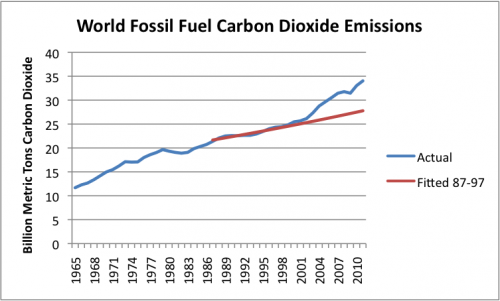
CO2 levels were only about 6% over pre-Industrial baselines at the time.  They are now about 35% and increasing.  The world is pumping more carbon dioxide into the atmosphere each year not only in increasing amounts but at an increasing rate.  Astonishing, but true.  From, as usual, the indispensable Gail Tverberg's blog, Our Finite World:


America's economists and national politicians, liberal and conservative alike, are arguing about ways to get the American consumer economy to grow again, to get people spending, to revive the American auto industry, to build the Keystone XL pipeline, to use Obama's "all of the above" energy policy including "clean coal," natural gas, oil, and, just to demonstrate his heart is in the right place, solar and wind power, too.  We're so proud of ourselves for reducing the amount of oil we import as we go after all of the domestic "tight" supplies of oil and natural gas, hammer and tong, or dredging up enormous quantities of, well, the Canadian province of Alberta in the mining of tar sands (bitumen). 

One of these days, however, we'll begin turning these trends around.  We're not certain when, but we realize AGW is a problem and we can't put it off forever.  Just as soon as the "recovery" is well under way and the unemployment rate is down we'll get right on it.  It would be a bad idea right now, but (we admit a little nervously) the disappearance of the Arctic sea ice in the summer, and the accelerating melting of most of the world's glaciers (which poses a threat to the essential water supplies of billions of the world's people) - yeah, have to admit: those do seem more like late-stage developments of global heating than the preliminary signs.  Those are the sorts of problems we should have been working to prevent 40 or 50 years ago, not using as a catalyst for planning action at some undetermined date in the remote future.


So I come back to the question: is it possible, given all this, that the world's elite academies of atmospheric science (MIT, Stanford, Scripps Oceanographic, Berkeley's alternative energy group at Lawrence Berkeley Lab), numerous European centers of study - that they actually know the die is cast?  I've said this before, but the most chilling comment I have ever heard came from Inez Fung, a leading climate science at Lawrence Berkeley, at a U.S. - China conference on climate change back in 2006 at Wheeler Auditorium.  Basically, Dr. Fung said that scientists who study climate change are "very, very worried."  They are "terrified" by the implications of what they're learning.

Guy McPherson, who writes the Nature Bats Last blog (indexed on the right), recently had this to say about climate change:


Let’s ignore the models for a moment and consider only the results of a single briefing to the United Nations Conference of the Parties in Copenhagen (COP15). Regulars in this space will recall COP15 as the climate-change meetings thrown under the bus by the Obama administration. A footnote on that long-forgotten briefing contains this statement:

“THE LONG-TERM SEA LEVEL THAT CORRESPONDS TO CURRENT CO2 CONCENTRATION IS ABOUT 23 METERS ABOVE TODAY’S LEVELS, AND THE TEMPERATURES WILL BE 6 DEGREES C OR MORE HIGHER. THESE ESTIMATES ARE BASED ON REAL LONG TERM CLIMATE RECORDS, NOT ON MODELS.”

In other words, Obama and others in his administration knew near-term extinction of humans was already guaranteed. Even before the dire feedbacks were reported by the scientific community, the Obama administration abandoned climate change as a significant issue because it knew we were done as early as 2009. Rather than shoulder the unenviable task of truth-teller, Obama did as his imperial higher-ups demanded: He lied about collapse, and he lied about climate change. And he still does.
 Kind of grabby, isn't it?  If you're playing along at home, 6 degrees C or more temperature increases and 80 feet rises in sea level, along with all of the other effects, are Game Over scenarios.

Climate change deniers tend to use a "conspiracy theory" argument to support their contention that the "liberal" scientific community is overplaying climate change as an issue in order to attract grant and research money, since the "alarmist" take on AGW is the "popular" one with the liberal media and so on and so forth.  (This is often the view among non-scientific global warming deniers.  The "scientific" deniers they cite to support their viewpoint very rarely actually deny AGW; on the contrary, such scientists [Freeman Dyson, Richard Linzen and others] admit that the atmosphere is warming and that humans are a principal cause, but claim the negative effects are overstated or that there are countervailing positive effects. This group, by the way, no longer includes Richard Muller, a Big Time Denier at Berkeley. http://www.sfgate.com/science/article/UC-climate-change-skeptic-changes-views-3748148.php  The Denier ranks are thinning; such apostacy! ).

Since I can theorize conspiratorially myself, I would posit a contrarian thesis: isn't it probable at this point that the real conspiracy of silence among the scientific community is manifested by the general absence of defeatism in their ranks?  See what I mean?  The argument that global warming is a made-up story by "liberal" scientists to attract funding is just getting kind of stupid at this point.  However, a "defeatist" attitude, if it became the general consensus (openly, I mean) among their ranks would lead to the same problem of de-funding (and loss of stature), and would have the awful permanence and irreversibility of being based on the truth, not a Bible Belt canard. 

Thus, it's better to talk about reducing carbon emissions 80% by 2050, or whatever.  It's better to be Al Gore and Laurie David and urge the world "to act now" to "avert" the worst consequences of climate change.  It's better if we all smile at each other and approve of each other's new Priuses - we're taking it seriously now!

This is what I'm trying to get at.  We don't like thinking any other way than  there has to be hope.  But (the largest "But" I've ever written):  Maybe there isn't any hope.  Maybe it's way, way too late.

Ye shall know the Truth, and the Truth shall set you free.  I hope more scientists break ranks and start laying it on the line if in fact we're past all "tipping points."  There are decisions to be made.  Should the present generation of child-bearing age who haven't had children procreate?  Would they be introducing their offspring right into the middle of the absolutely worst consequences of climate change as they reach their main years of life?

The facts are the facts, ma'am.  Carbon dioxide, methane, water vapor and the other greenhouse gases have a very long persistence in the atmosphere.  They are building up.  The thermal inertia of the ocean is beginning to yield up its latent heat to the atmosphere.  The great methane (a gas with perhaps 100 times the potency of CO2 as a greenhouse gas) blooms from the softening Alaskan and Siberian tundras are expanding exponentially.  China is opening a new coal-fired electrical plant every five days or so.  Does it make any difference what I, as an individual, do at this point?  Is an attempt at conservation or frugality simply a narcissistic expression of my projected self-importance (sort of like blogging)?  If I want a 409 horsepower vintage GTO, want to slam a CD into the player and crank up Ronnie & the Daytonas, should I just go the hell ahead and do it?

Wha-wha, uh wha uh wah uh wha!

February 23, 2013

Saturday Morning Essay: The Hall of Mirrors Economy

Once upon a time in a blog post far, far away, I made a prediction which was stunning in both its scope and later accuracy. I wrote that the stock market would fall at least 35% from its 2007 Dow high of 14,000.  I made this prediction long before the stock market started falling.  As it turned out, the Dow "over-corrected" and kept heading south from 9,000 or so.

My prediction was based mostly on a single data point which I had gleaned from the writings of Kevin Phillips, in books he published in 2004 and 2005.  Perusing this very intelligent man's writings, I was struck by the essential role which the Housing Bubble played in the maintenance of the "consumer economy" which gave the United States its illusion of prosperity.  Mr. Phillips informed us that between about 2000 and 2005 about half the apparent "income" fueling the consumer jamboree was actually money derived from re-fi, house sales, and equity lines of credit (LOC); in other words, the house as piggy bank.  Since it seemed to me that the Bubble could not be sustained (because it depended on financing tricks such as "teaser rates" and variable interest loans which would reset and bring reality crashing down on the borrowers), when it popped about half the money apparently in circulation would vanish.  Since consumerism is 70% of the American economy, this implied a 35% drop in the economy.  To the extent that the Dow reflected underlying economic fundamentals, it would show up there as a massive sell-off.

My ideas were not based on "conspiracy theories;" indeed, I was trying to find, to the limits of my ability, the underlying Reality of the U.S. economy.  Meanwhile, the Grand Poo-Bahs of the intellectual elite in America were doing their best to confuse the issue.  This effort was led by the New York Times and its Gaggle of Morons in the Op-Ed department.  Maureen "I Hate Men" Dowd, Tom "Globalization" Friedman, Paul "Just Print Money & We'll Be Fine" Krugman, David "Even If In the Middle Is Over the Cliff, That's Where I Want to Be" Brooks, Gail "Here's Another Fatuous Column" Collins, and their ace staff of reporters who provided the echo chamber for the Bush Administration's sale of the Iraq War.  As Bob Somerby, he of the felicitous turn of phrase and nice fall-away jumper, put it in The Daily Howler, "We are where we are because of these people."  The moral of the story is straightforward:  Just listen to varsity basketball players from the Mid-Peninsula League of the mid-1960's and you'll be fine.

Paul Krugman and his academic chum in the Princeton Economics Department, Ben Bernanke, failed to see the housing bubble until it was much too late.  Since Kevin Phillips is not one of their Economic Mandarins, they thought he could be safely ignored, even if Phillips was much smarter than both of them put together.  As the housing bubble burst, Ben Bernanke was assuring Congress in live testimony that it was not bursting.  Few men have been so utterly wrong about something so fundamental in such a public way.  His chagrin at his stupendously wrong call must have produced a determination in Bernanke that history could be reversed, as in a sci-fi movie, and he could re-engineer the housing bubble, the stock market bubble, and, for that matter, the Bubbles of Lawrence Welk and the Champagne Orchestra.

Cheered on by Krugman & the Morons, Bernanke began printing money and becoming a one-man enabler of profligate federal spending by buying up every Treasury bond he could find and scarfing up all of the country's shitty loans smooshed together in mortgage-backed securities (MBS).  Goddammit, he muttered, I'll show them.  Krugman provided the intellectual cover for this insanity by insisting that the ultra-low rates paid by the federal government had nothing to do with the Federal Reserve's role as the ultimate buyer of 75% of the Treasury issuance, or as establisher of the nation's short-term interest rates.  Nothing to do with the Fed's position now as the world's single largest holder, by far, of Treasury bonds.  And as for printing money, the U.S. economy is exactly like a baby-sitting co-op in Washington, D.C., so there's no problem.  Go ahead: google "Krugman and baby-sitting co-op" and see what happens.  I dare you.

Thus, Tom Friedman, perhaps the stupidest influential writer in the history of the Republic, gave us globalization, that Royal Road to Perdition on which we have traveled since about 1980.  And Krugman has given us the The Return of the Bubbles.  Bob Somerby:  nuthin but net

Fortunately, we have Gail Tverberg, writing at Our Finite World, to provide much needed doses of clarity and common sense.  In one stunning post (her latest), entitled "Twelve Reasons Globalization Is A Huge Problem,"  she dispenses with the illusions of globalism and money-printing in two simple paragraphs:

 At this point, high oil prices together with globalization have led to huge US deficit spending since 2008. This has occurred partly because a smaller portion of the population is working (and thus paying taxes), and partly because US spending for unemployment benefits and stimulus has risen. The result is a mismatch between government income and spending (Figure 11, below)...

Thanks to the mismatch described in the last paragraph, the federal deficit in recent years has been far greater than the balance of payment deficit. As a result, some other source of funding for the additional US debt has been needed, in addition to what is provided by the reserve currency arrangement. The Federal Reserve has been using Quantitative Easing to buy up federal debt since late 2008. This has provided a buyer for additional debt and also keeps US interest rates low (hoping to attract some investment back to the US, and keeping US debt payments affordable). The current situation is unsustainable, however. Continued overspending and printing money to pay debt is not a long-term solution to huge imbalances among countries and lack of cheap oil–situations that do not “go away” by themselves.
Krugman and Bernanke will never admit that a plain-spoken insurance actuary from the Midwest can run circles around them analytically, and so we'll continue crashing into walls in our Hall of Mirrors Economy, which will stagger along for a while yet (as long as the U.S. has the reserve currency and the rationale for buying our scrip in order to participate in the global oil market persists).  But, as Gail says, "it's not a long-term solution."  We don't have any long-term solutions.  Take it from the two-guard.  I've got a clear look at the hoop, and this one's money.


February 17, 2013

Three Economic Theories in Search of the Facts

(I think the blog post works better if you're playing the Talking Heads while you read.)

I remind myself periodically that "Economy" was the first and longest chapter of Walden.  Thoreau used the term in the broadest possible sense: the nature of the transaction between humans and Earth by which we sustain our survival.

Thoreau was a generalist; indeed, you might say he was the generalist's generalist.  He did it all - farming, building, foraging and maintaining his vital heat under rudimentary conditions in Massachusetts around 1840.  Modern Americans are not so lucky.  As a rule we pick out some narrow specialty by which to earn a living, then use the money received to buy everything that Thoreau garnered through physical effort in a direct, hands-on way from the environment.  Our existences are "mediated."  In a way we're all like household pets: completely dependent on the functioning of our "masters" running huge agri-business, bringing oil from Saudi Arabia, drilling for natural gas deep under the floor of the Gulf of Mexico, then piping it thousands of miles to the furnaces in our basements.

In recent years something seems to have gone wrong with the "organic society," the gizmo made of wheels, springs, sprockets and gears that keeps us all warm and fed.  For many people living in modern Western societies, including denizens of the United States, the system does not appear to be working.  The "specialized" jobs just aren't there.  When you get right down to it, that's the most important function of a modern economy.  It has to give people something they can do through which they can earn money so they can buy all the stuff they need in order to maintain their vital heat, and, if that doesn't take up all their time (which it usually does), to create a little "margin" so they can enjoy the experience of being alive.  (Thoreau reckoned it took him a few hours out of the 168 available weekly to do everything he needed to do to survive.  I leave it to you to judge the wisdom of the modern bargain with Planet Earth.)

As I have noted numerous times in recent weeks, the actual number of jobs in the United States has been stuck at around 132 million for well over a decade.  The employment rate of the working age population (ages 15 to 64) in the U.S. is down around 62%.  Despite this, we're told that the U-3 unemployment rate is 7.9%.  Such a percentage is generated by playing games with the numerator and denominator used to calculate it.  In turn, the games are motivated by political considerations: the desire of the parties in power (always the same two) to look good.  Common sense tells you that the population of the United States has not been stagnant for over a decade.  It grows at a rate slightly over 1% per year, or three million, so while the number of jobs has remained fixed, at least 30 million people have moved into the job pool during the same decade, roughly speaking.

There appear to be three major theories about why America has hit the economic wall.  The first is that a medium-sized investment bank, Lehman Brothers, failed in 2008, and this sent a "financial shock" through the system from which we just can't seem to recover.  This is the favorite, I think, of the academic economists, who like historical perspectives and "cyclicality."  I call this theory the "whistling past the graveyard" approach, since it implies this will all be over soon if we just wait it out.

The second theory concerns environmental/resource depletion factors, and in particular the high cost of the "master resource," petroleum, which is up around $100 per barrel.  This high cost finds its way into virtually everything: food production (fertilizers, transporting food to market); driving cars to work; international shipping; pharmaceuticals; and airline travel.  It represents a huge and hidden tax on everything we do.

The third theory is that America and other Western countries have simply "matured out" of their prime years of affluence.  How many more baubles (expensive cars, McMansions, flat-screen TVs) and unnecessary services (massages, tanning sessions, party planning) are we really planning to buy to give meaning to our lives now that the Baby Boomers (the ones with all the money) have reached the age where all of these things are more annoying than sources of diversion and pleasure?

For my money, I would reject the first theory out of hand as a piece of academic gobbledegook, the kind of thing that professors with very little experience of the real world would argue about in the faculty lounge at Princeton.  The second and third theories together, however, might be combined into one Grand Unified Theory of Economic Senescence which explains the crisis of the affluent society.  And indeed, we've really got a helluva problem on our hands now.

Having severed the natural relationship between Homo sapiens and Earth, we are now dependent, as noted, on the economic gizmo in order to stay alive.  The gizmo, however, is broken and cannot provide, under our capitalist system, the employment necessary for a very large chunk of the population to get by.  The "demand side" liberal economists (Paul Krugman, Robert Reich, Dean Baker) claim that the problem is "inadequate demand" from the population for goods and services.  Yet let me ask you this:  can you think of a single thing, anything, that you need or would simply like to have that you could not find, right now, by driving a few minutes?  What would that thing be?  Food?  An electronic device? A pair of jeans?  A tank of gasoline?  We have all those things in fantastic surplus.  You're probably not producing them and neither am I.  They're just there.  Who is supplying them?  Large monopolistic companies are providing them, that's who.  Large monopolistic companies that are doing everything they can to eliminate the employment of actual people through robots and other automation, who seek to become more and more "efficient" by getting rid of people with their incessant need for 'health care" and benefits and "workers' rights." 

The demand for the products and services of a few large monopolies (Wal-Mart, Costco, Home Depot, General Motors, Toyota, Standard Oil, BP, Shell, Dupont, Cargill, Monsanto, Archer Daniels Midland, Merck, U.S. Airways/American, United/Continental, Apple, Microsoft) is currently enough to keep them in business. They supply everything we need.  The "demand" for the vanished services and products of the Bubble Economy which existed in various forms between about 1992 and 2007 is gone, along with the money.  The Bubble years (dot.com, then the housing bubble) provided cash sources for sustaining all of the "discretionary" economic activities which proliferated when (a) cash existed for the commoners and (b) the cost of energy was cheap so that "discretionary cash" remained relatively plentiful.

Those conditions aren't here anymore. They aren't likely to return.  They were conditions which existed once in a lifetime.  Into the blue again, after the money's gone.

February 13, 2013

A few notes on the SOTU Address

After all, it's traditional to say something, and when George W. Bush was delivering these things, they were always good for a laugh.  It's hard to know how to react anymore when listening to the State of the Union Address.  Nothing the President actually says has any importance; the commentators appear to concede that as a matter of course.  It's all about "tone" and "drama" and "framing."  Congress is under no obligation to enact anything the President recommends, of course, but the President has a Constitutional duty to show up from time to time and tell Congress what he thinks they ought to do:

 "He shall from time to time give to Congress information of the State of the Union and recommend to their Consideration such measures as he shall judge necessary and expedient."  Article 2, Section 3.
Like so many things in our made-for-TV American lives, we've naturally turned these events into a once-a-year, highly-stylized affair, sort of like the Oscars.   There's even a Red Carpet: the President's entrance, with the choice positions near the aisle so you can press the Prez's flesh or  maybe score a bro-hug or exploding fist bump. I realize that times change, and it's unlikely that George Washington would have been handing out exploding fist bumps.  Nevertheless, you get the idea from the Constitution that the Framers were actually suggesting that the Executive coordinate with Congress in an effort to get things done, by periodically meeting with them (not necessarily once a year) and giving them his ideas. There's nothing in there about a "speech;" a speech is an empty ritual.  Yet this is so typical of our unserious times.  All surface, no substance.  You can't televise work sessions effectively, so we get a speech in response to Article 2, Section 3.

I look upon these things as a prime-time Reality version of watching a historical reenactment.  In the audience we have lots of ancient white men who have been in Congress forever, as sclerotic now as the institution they represent.  None of them has had a new idea in the past quarter century, which is why they are content with this performance in which the President urges them to do a lot of things they'll never do, such as expanding the reach of the federal government ever farther.  President Obama now wants Washington, D.C. to take over the country's nursery schools, I think I heard him say. 

The actual "state" of the union would appear to encompass negative trends and developments over the last year; so I would think on a fair reading of the Constitution.  However, a literal description of what's actually going on is not allowed, as contrary to the rules of modern politics.  The campaign never stops.  The President did not make any direct reference to the astonishing growth in the use of food stamps, for example.  Nor did he say directly that the actual number of non-farm American jobs, about 132 million, is just about exactly what it was in January, 2000, 13 years ago.  The labor participation rate (the percentage of working-age adults with employment) is stuck at about 62% and has been stuck there more or less forever.


This is my question:  why not simply say so in the State of the Union?  This graph is not from some Libertarian, bunker-dwelling, paranoid-schizophrenic website that rants and raves about the Bilderberg Group or the Protocols of the Elders of Zion.  It's from the U.S. Department of Labor.  Why not bring an easel up to the dais and plop this baby up there?  Wouldn't that at least be the beginning of wisdom?  The State of the Union:  "You know what, folks: it just doesn't seem to work for most of us anymore.  Dunno what's wrong, but the economy just doesn't seem to be happening. Maybe we should try doing something really, really different.  That's what I'm Recommending as Necessary and Expedient."

Instead, we get this kind of thing about gasoline usage:

"We have doubled the distance our cars will go on a gallon of gas and the amount of renewable energy we generate from sources like wind and solar, with tens of thousands of good, American jobs to show for it. We produce more natural gas than ever before, and nearly everyone’s energy bill is lower because of it. And over the last four years, our emissions of the dangerous carbon pollution that threatens our planet have actually fallen."

Yeah, they've fallen because we're too broke to fill up and drive anywhere.  Gail Tverberg's latest chart on the allocation of this "economizing" from her superb blog, Our Finite World:  
About 7% of the savings in petroleum usage results from our cars getting "twice" the mileage; another 25% (almost four times as much) results from a decrease in VMT, vehicle miles traveled.  Americans just aren't driving as much anymore, because they can't afford gasoline.

An even better idea: why doesn't the President just bring Gail Tverberg up on stage with him and hand her the pointer?  I know, I know, Article 2, Section 3 says "He." But we're bigger than that, aren't we? 

How about this?  Instead of extolling the wonders of increased mileage in autos, and how Americans are determined to save the planet by going broke and leaving their cars in the garage, why don't we build some fricking railroads?  How about suggesting that the able-bodied ride bikes?  Or walk?  You know: how about some ideas


February 12, 2013

Meanwhile, Back in the Biosphere

Writing about columnists at the New York Times (and I blame Bob Somerby and his superb line, "We are where we are because of these people" for the digression) is certainly amusing and diverting, but it's not really consistent with the Mission Statement of this blog.  Although there is no such Mission Statement.  If there were, however, the Mission would relate to the very title of the blog and to the analytical method and style of thinking of Henry David Thoreau, who anticipated most if not all of the problems that Industrial Civilization would face as the age of specialization advanced, as humans became cogs in an economic machine, and as we pushed the ecological limits of the world to the point of our own extinction.  I mean, it's all right there in the pages of Walden.

 What I find fascinating about my own years of life is that my span happened to overlap the transition from borderline sustainability of Homo sapiens as a primate (not Papal, the ape kind) to clear unsustainability.  I mean, it was bound to happen sooner or later, given the technological proclivities and aptitudes of this ape form which is, as Craig Dilworth wrote, Too Smart for Our Own Good.  If humans had the intelligence and rugged, natural "lifestyle" of chimpanzees or gorillas, for example, you might expect to find about 100 million of us roaming the surface of the Earth.  We would, at this level, be pushing the limits of the environment's ability to sustain our numbers, and natural cycles (droughts, diseases) would periodically cause a die-off of our numbers down to some equilibrium point.  Or we might, as the Norway rats did in the crowding experiment near the beginning of Professor Dilworth's book, utilize certain adaptive instincts to control our own numbers (some of which the Republican Right would find sacrilegious).

We're at this point because of the exponential growth function of population (as Paul Erlich tried to warn us) and the technological breakthroughs giving rise to what Dilworth calls the Vicious Circle Principle (VCP): faced with limits imposed by our burgeoning numbers, we devise breakthroughs (the Green Revolution in agriculture, for example) which allow us, temporarily, to go on multiplying and pushing the ecosphere to a new crisis point.

The last couple of books I've read on the subject of modern civilization at the crossroads were by Jeff Rubin, a Canadian economist:  Why Your World Is About to Get A Whole Lot Smaller and The Big Flatline.  Both are mainly about the limiting effects of expensive and increasingly scarce petroleum, a "master resource."  Petroleum is intimately connected, for example, to the ongoing success of the Green Revolution.  Oil shortages and a related problem, global warming,  are both growth-limiting factors as we move forward.  For example, despite a massive fall-off in petroleum usage in the United States over the last several years (a lot of it related to decreases in miles driven), the prices of West Texas Intermediate and Brent Crude oil remain stubbornly high, confounding the usual supply and demand analysis.  The growth of GDP in the American economy (and elsewhere) is inextricably related to the price of petroleum on the world market.  Simply put, the price is now too high to allow growth, and what appears to be "growth" since 2008 occurs only because the United States (a) borrows 40% of what the federal government spends, yet nonetheless (b) GDP includes government spending.  This is a way of saying that the American economy, net of borrowing from the future, has been contracting for the last 5 years.

This is what I don't see reflected in the analysis of "New York Times" columnists.  The presumption underlying the call for deficit spending, borrowing and printing money is that the American economy will revert to its "trend line."  This is necessary to make all of these monetary games work out, of course, because debt is an exponential function (Dmitry Orlov does a wonderful job with a parable on this very subject in his post today at cluborlov.com).  As we pile on debt with payable interest (even with the very low interest rates of the ZIRP environment), the accruing interest also generates interest and outruns any growth except growth which is no longer attainable, given resource and environmental constraints.  Stated another way, economists such as Paul Krugman (regardless of his beneficial motives) are arguing that historical "cycles" will once again assert themselves despite the underlying changed circumstances which make such reversion to a previous trend line impossible.

Meanwhile, the "globalized economy" has engendered a race by the developing nations (such as Brazil, Russia, Indian and China) to attain the level of (former) affluence enjoyed in America.  China, for example, has become the world's number one market for new automobiles.  It is bringing on-line a new coal-fired electrical generating plant about every five days, and yet its energy use per capita is only about one-tenth of the American usage.  I don't think their energy usage is ever going to match the American standard, because energy is a zero-sum game on a finite planet, and the climate implications will not allow it.  Even James Inhofe would admit he was wrong about the "hoax" of global warming before we reached that point.

So what will we actually do?  Probably react to events in a perpetual pattern of crisis-mode, is my guess.  Promise technological fixes to bail us out one more time, in the spirit of the Vicious Circle Principle.  I suppose we could sustain the world's population of 7 billion using solar and wind power (which are both forms of solar power) supplemented by the dregs of fossil fuels at levels safe (and available) to use.  But the question the "deep ecologists" ask is:  at what level could humans be sustained using only natural cycles?  That's the missing part.  Probably not at a level where Paul Krugman could appear on "This Week" every week and pronounce on the state of the "recovery."  Another "thought experiment" we might pose for ourselves is this: gorillas essentially survive on solar power.  Would planet Earth support 7 billion of them?  You might say no, because they're not as smart as we are.  Which takes you into a labyrinth you might call Vicious Circle Reasoning.

February 10, 2013

Mr. Krugman's Science, Part 5: the Reconciliation

While Mr. Krugman is certainly annoying and highly misleading (as Bob Somerby said about other New York Times columnists, "We are where we are because of these people."), I certainly bear no animosity toward Paul Krugman.  I actually think his approach is "right;" it's just that I don't think any of the reasons he advances are the true rationale for following his advice. 

We should keep the Potemkin village of the American economy going for as long as possible. Printing money, letting the Federal Reserve "buy" up the "debt" of the U.S. Treasury (the government agency which keeps its checking account at the Federal Reserve), and pumping hallucinated money into the stock and housing markets in an effort to reinflate the Bubbles.  The "transmission mechanism" the Fed uses to move money into the economy only indirectly and partially reaches the American commoners, and this is the reason that inflation, as measured by the Consumer Price Index, remains "muted."  Hyperinflation is the great fear of the central banker who begins playing games with a fiat currency, and Bernanke (a kind of financial mad scientist) believes that he has found a way to confine inflation where he wants it, in the stock and housing markets.  I believe he's dead wrong, and that there is an underlying financial "thermodynamics" based in the interlocking fiat currency system of the globalized economy which is far too complex for the central bank of one country, even the country with the largest economy and the site of the "reserve currency," to control indefinitely. 

Mr. Krugman's putative approach, that we should keep printing money and "borrowing" (largely from ourselves), and then balance the books "later" is the purest kind of moonshine.  Mr. Krugman says such things so that he can be regarded as one of the Very Serious Persons he spends his time lampooning.  You can't be taken seriously if you urge the party crowd in the main ball room of the Titanic to keep dancing and swilling champagne as the bow of the ship tips ominously downward; you have to advise the government to maintain the status quo "for now" until the "recovery" is complete.

That's where Mr. Krugman loses touch with reality. There isn't going to be any recovery to some mythical "trend line" derived by drawing a ruler through data points created by previous bubbles.  What Mr. Krugman apparently can't see is that the American economy has been sagging relentlessly (like a birthday balloon found two weeks later on the floor behind the couch) since about 1973, when we first began losing control over our domestic energy sources (meaning: oil), and subjected ourselves to the global economy (that monstrosity that Tom Friedman has always been so excited about, in his moronic way: "We are where we are because of these people...").  Now we're in a life and death struggle with the developed world (Europe, Japan, Canada, Australia) and the rapidly developing world of China, Russia, India, Brazil, South Korea, Southeast Asia, and they all want the same things we want: an opulent living standard just like America.  The world cannot support that, and we have placed our fate at the mercies of these competitors who intend to use every edge they can find to overtake us.

Mr. Bernanke is using his hole card, the reserve currency, and he's going all in, hallucinating money like a man possessed of strange visions.  And why the hell not?  Does he think there is actually a pot of gold at the end of this rainbow he's painting in the sky?  I doubt it (he's much smarter than Krugman).  But if we can derive a few more years, or whatever time, maintaining our Potemkin existence at something like its present level by means of these machinations, why shouldn't we?  As Mr. Krugman is fond of saying, the economy is "not a morality play."  Is this a somewhat sociopathic statement?  You can look at it that way; the point, however, is that we're going to get to that point of collapse one way or another, so why would we hurry it along with a premature act of self-annihilation?

If we suddenly withdraw 40% of the funding from the federal government, and stop goosing the stock and housing markets with hallucinated money from Bernanke's asshole corner computer,  we will bring on pandemonium.  This crazy wish to be all "tidy" and "balanced" is nuts.  Do what Krugman says,  "kick the can" down the road (his very words on Friday).  Mint that "trillion dollar coin."  Play any game you can think of to keep the party going.  You put on another stack of CDs and roll up the carpet.  I'll go out and buy a few more cases of Veuve Cliquot.

February 07, 2013

Mr. Krugman's Science, part 4

The text for today's sermon is taken from The Daily Howler, another blogspot...spot, this one ably manned by Bob Somerby, he of the clever phrase and the deadly outside jumpshot, a star of the Aragon Dons basketball team circa 1965.  I had the privilege of being on the court a couple of times against Bob, playing for crosstown rival San Mateo High School. As he was fearless in driving the lane, Bob does not shrink from taking on the mighty New York Times, that purveyor of Establishment memes, themes and nonsense, that First Amendment-powered organ that George W. Bush knew he could trust with the awful truth, for over a year, that the Bush/Cheney Administration was systematically violating the FISA law and the 4th Amendment in wiretapping American citizens without a warrant.  Or could plant bogus claims with Judith Miller, ace reporter/obfuscator, about weapons of mass destruction in Iraq.  Or could count on Thomas Friedman to do the dirty work of making an insane war look like an historical inevitability.  The New York Times has done so much to ruin the oversight function of the Fourth Estate, that shadow branch of government that Thomas Jefferson thought was more important than the other three.  As it was then, so shall it be now.  Writes Bob:

And so forth, and so on and more so. New York Times readers constantly fawn to the newspaper’s famous columnists, no matter how inane, bogus, dishonest or disrespectful the column in question may be. In this way, readers of our smartest newspaper have sleep-walked through the many years in which Times columnists have advanced the stupidest narratives of our age... We are where we are because of these people—because of this newspaper’s pseudo-journalists, because of its gullible readers.
Good stuff, Bob.  As nice in its own way as that fadeaway jumper back in the day.  To be fair in what I'm attributing to Mr. Somerby, I think Bob believes that Paul Krugman is a valuable exception to this general denunciation.  I can understand that.  I think it's a question of developing a feel for Mr. Krugman, if I can say that without too much presumption.  To become truly worn out by Mr. Krugman's nonstop, narcissistic self-promotion and intellectual flimflam is the work of years.  You have to watch Krugman truncate graphs, and cook statistics, and abstract from context, and you have to read his absolutely irreconcilable 180-degree changes in position depending upon whose ox he happens to be goring, and a writer of Bob Somerby's breadth (and frequency) may not have the time. Or he may genuinely believe that the obviously bad things about Krugman are more than balanced by the good professor's championing of the entitlements.  Be that as it may.

Lately Mr. Krugman has been having a field day with his neologisms.  I hasten to add that Mr. Krugman's coined phrases are sometimes a little worn around the edges, because he didn't actually make them up.  Take, for example, his use of the phrase Very Serious Person, a term of derision referring to members of the Beltway crowd who follow the herd and are wrong because they disagree with Mr. Krugman.  I'm pretty sure this is a lift from Glenn Greenwald, who coined the phrase, the acronym VSP, and gave the phrase its meaning.

Or "Confidence Fairy," a cutesie description which Krugman has run into the ground over the last year or so.  This term refers to the Deficit Scolds (another of his laboriously repeated descriptions), who focus too much on America's federal deficits and who do not understand (because they are not conversant with John Maynard Keynes) that the trillion dollar plus deficits we have been running since the latter part of the Bush Administration are not a problem.  Mr. Krugman repeats over and over that America does not have a fiscal problem.  The debt service, measured as a percentage of GDP, is manageable, inflation is low, and the future is so bright the present needs to wear sunglasses. 

As for the long run problems, Mr. Krugman (these days) seems to say one of two things: he quotes J.M. Keynes and his famous "in the long run we are all dead," or he says that America has "a big economy, we can handle whatever comes our way."  Thus, when a lesser light such as Laurence Kotlikoff over at Boston University begins talking about a net present value (NPV) of unfunded long-term liabilities for Social Security and Medicare, Mr. Krugman just yawns and probably thinks to himself, "What do you expect from a non-Ivy institution?" True, Professor Kotlikoff seems fairly certain that the NPV is currently $222 trillion, and under generally accepted accounting principles, this is the amount that should be booked by the Treasury as our current shortfall.  You might judge for yourself:


Mr. Krugman is not buying this sort of alarmist claptrap.  Indeed, he has recently been writing columns and blogs celebrating the end of the deficit problems.  Somewhere in there (you may have missed it; I'm pretty sure I did) we solved all of these funding difficulties.  I may have been distracted by the squadron of pigs flying out of my ass at that precise moment.

And yet, and yet:  in March, 2003, when George W. Bush was President, Mr. Krugman took a different approach.  What now seem quaintly mild deficits (on the order of $300 billion per year) had Mr. Krugman reaching for the smelling salts.  In a column called "A Fiscal Train Wreck," Mr. Krugman said this (and see if you can spot the slight difference in tone between Mr. K then and Mr. K now):

 That may sound alarmist: right now the deficit, while huge in absolute terms, is only 2 -- make that 3, O.K., maybe 4 -- percent of G.D.P. But that misses the point. ''Think of the federal government as a gigantic insurance company (with a sideline business in national defense and homeland security), which does its accounting on a cash basis, only counting premiums and payouts as they go in and out the door. An insurance company with cash accounting . . . is an accident waiting to happen.'' So says the Treasury under secretary Peter Fisher; his point is that because of the future liabilities of Social Security and Medicare, the true budget picture is much worse than the conventional deficit numbers suggest...  (my emphasis mischievously added).

How will the train wreck play itself out? Maybe a future administration will use butterfly ballots to disenfranchise retirees, making it possible to slash Social Security and Medicare. Or maybe a repentant Rush Limbaugh will lead the drive to raise taxes on the rich. But my prediction is that politicians will eventually be tempted to resolve the crisis the way irresponsible governments usually do: by printing money, both to pay current bills and to inflate away debt.

And as that temptation becomes obvious, interest rates will soar. It won't happen right away. With the economy stalling and the stock market plunging, short-term rates are probably headed down, not up, in the next few months, and mortgage rates may not have hit bottom yet. But unless we slide into Japanese-style deflation, there are much higher interest rates in our future.
How odd, huh?  Now, with an economy obviously much worse than the early years of the last decade, with the deficits much, much higher measured either as an absolute number or as a percentage of GDP, anyone who talks exactly as Mr. Krugman did in 2003 is a Deficit Scold,  a Very Serious Person or a believer in the Confidence Fairy.

Yet it is Mr. Krugman who is considered a genuine Very Serious Person, leaving aside the satirical edge for a moment.  When it was politically convenient to do so, Mr. Krugman folded up his Keynesian superstructure like a cheap lawn chair.  And now the good professor urges his government to do what irresponsible governments usually do: print money to pay current bills and to inflate away debt.

What can possibly account for this astounding flip-flop? I have my own General Theory. Mr. Krugman's column is about Mr. Krugman.  When George W. Bush was running deficits of around 3% GDP (which Krugman now says is essentially the "optimal size" and nothing to worry about), Dick Cheney was saying that "deficits don't matter." Reagan had proved that.  How can Paul Krugman possibly jump on that bandwagon? But now the Beltway consensus, the firm conviction of the Very Serious People, is that deficits, especially of the enormous size we currently face, most assuredly do matter.  How does one stake out an iconoclastic position in the face of such widespread common sense? How does one, in other words, make sure that attention is drawn to oneself, to remain the cynosure of all intellectual eyes?  By adopting Dick Cheney's position, of course.

This is why I admire Mr. Krugman's qualities as a showman, first and foremost. He knows that economics isn't a science, that it's an ass which will do what you want it to do, as Mr. Bumble said about law.  And if his 2003 predictions come true, and interest rates soar, and hyperinflation sets in, and the currency collapses, and we become a Banana Republic?  I assure you that Mr. Krugman will emerge, at least to his own nose, smelling like a rose, and will tell you, "I told you so."

February 06, 2013

Mr. Krugman's Science, Part 3

In a way, a traditional liberal like me must ask himself, why criticize Paul Krugman?  Mr. Krugman, after all, is the most ostentatiously liberal public intellectual in America.  His blog is entitled "The Conscience of a Liberal."  I don't know what that means, exactly, but it sounds deeply ethical and caring.  I guess.  Maybe just a touch sententious, actually.  Well, okay - a lot sententious, but this comes with the territory of his self-appointed role as guardian of the American welfare state. Someone has to protect it from the Grover Norquists of the world, doesn't someone?

Ay, there's the rub.  I think that's why American liberalism is beginning to break down into factionalism.  It used to be much clearer what you ought to believe as a liberal.  Sitting around dinner tables with my peeps as I traversed through adulthood, I already knew what every person at the table believed, and they knew what I believed.  We were all for the same Good Things, were we not?

Then one day we looked up from the miniscule portions of a California-cuisine dinner arrayed on a plate festooned with artistically arranged glazes of food coloring to notice that Planet Earth had been destroyed, and that we, as humans, had destroyed it. And when all was said and done, the main driving force behind this destruction was overpopulation and overuse of Earth's resources, both of which were potentiated by modern technology.  The great enemy of our viability, in other words, was the sheer size of our enterprise and the energy-using intensity of our economy.

In other words, Big Government Liberalism, which depends upon a centralization of power and distant control of our lives (with the voting populace reduced to voting based on Pavlovian reactions to media-created images), increasingly appeared as one of the manifestations of the Underlying Problem, along with globalization, monopolies, and giant concentrations of power in medicine, energy production and agribusiness. all of which are bound up in a synergistic and symbiotic combination.

Then we began to get sick of the whole thing.  So much for liberal unity of purpose.  The right wing, on the other hand, is fundamentally connected by a shared apocalyptic vision, that this life is essentially an audition for the Life That Counts, so who cares if the Earth is trashed?  What global warming?  Et cetera.  The siren call of religion is easy to understand: once you free yourself from the restraints of Reality, anything can be believed.  As the White Queen told Alice in Through the Looking Glass, she could "believe six impossible things before breakfast."

Mr. Krugman, for whatever relevance he may still have, is probably not aware that times have passed him and his Conscience by.  He seems, in general, to have a hard time staying current.  In recent months has has divulged that he was not aware until very recently that automation posed a threat to American labor, and before that he let out that he was ignorant of the connection between consumer spending in America before 2006 and the inflating housing bubble.  Other thinkers, such as Kevin Phillips, had written entire books on the subject: the American "consumer economy" was sustained by the process of cash-out refinancing, flipping houses, equity lines of credit and the like, and left only with their flatlining incomes, Americans could not keep this joke of an economy going.

You'll never convince Dr. K of that.  In a recent blog: 

"I know that this is a conclusion many people hate. They really, really want to believe that bad things must have good causes — that if you are suffering from high unemployment and low output, it must be because there is something deeply wrong, probably the fault of liberals. But what was deeply wrong with the US economy in late 2008 that wasn’t true of the US economy in late 2007? Recessions happen, and any halfway plausible story about how they happen is likely to suggest that non-fundamental government interventions, like printing money, can make things better."

As Dr. Evil said:  You just don't get it.   The same things are wrong with the American economy in 2013 as were wrong with the American economy in late 2007 and 2008.  "Recessions happen." For this you need a Ph.D?  Contrast this with Mr. Phillips and his analysis written back in 2006, before "Lehman Brothers" and the other great signifiers used by Monday Morning Quarterbacks such as Mr. Krugman: 

...the underlying Washington strategy… was less to give ordinary Americans direct sums than to create a low-interest-rate boom in real estate, thereby raising the percentage of American home ownership, ballooning the prices of homes, and allowing householders to take out some of that increase through low-cost refinancing. This triple play created new wealth to take the place of that destroyed in the 2000-2002 stock-market crash and simultaneously raised consumer confidence.
 Nothing similar had ever been engineered before. Instead of a recovery orchestrated by Congress and the White House and aimed at the middle- and bottom-income segments, this one was directed by an appointed central banker, a man whose principal responsibility was to the banking system. His relief, targeted on financial assets and real estate, was principally achieved by monetary stimulus. This in itself confirmed the massive realignment of preferences and priorities within the American system….
Likewise, huge and indisputable but almost never discussed, were the powerful political economics lurking behind the stimulus: the massive rate-cut-driven post-2000 bailout of the FIRE (finance, insurance, and real estate) sector, with its ever-climbing share of GDP and proximity to power. No longer would Washington concentrate stimulus on wages or public-works employment. The Fed's policies, however shrewd, were not rooted in an abstraction of the national interest but in pursuit of its statutory mandate to protect the U.S. banking and payments system, now inseparable from the broadly defined financial-services sector.
 The top-down central control of the American economy, guided by the Federal Reserve, is what Mr. Krugman explicitly advocates.  It is Krugman's firm belief that there is nothing standing in the way of recreating the exact conditions that prevailed in late 2007 other than our unwillingness to print the money necessary to "take up the slack" in the economy created by the bursting of the housing bubble (by reinflating that bubble and engineering a stock and bond bubble to go with it).  It is this unabashed pimping for a status quo that has come and gone, and that increasing numbers of people recognize is ecologically ruinous, that makes Mr. Krugman's polemics so unappealing, whether we're always aware of it or not.  He's rich and prominent, so the status quo works for him.  It weighs a little more heavily on the Consciences of other humans.

February 01, 2013

Mr. Krugman's Science, part 2

Paul Krugman is enormously proud of the "spectacular success" of Keynesian economics as far as its predictions concerning the aftermath of the Great Recession are concerned.  This spectacular success, which Mr. Krugman rushes on each occasion that he writes about it to share, is based upon certain fundamental tenets of the Holy Writ, the General Theory written by John Maynard Keynes during the Great Depression. 

Essentially, these predictions include:

1.  America is stuck in a "liquidity trap," a financial condition in which the Federal Reserve's control over short-term lending rates is ineffective, even after lowering rates practically to zero (zero interest rate policy, or ZIRP).  This is because everybody is broke and doesn't want to borrow money anyway.

2.  In such conditions of a depressed economy, the government can borrow freely at low rates and can print money with abandon without fear of (a) sparking inflation or (b) inciting the "bond vigilantes" to attack the sovereign debt-issuing function; that is, to cause an increase in the borrowing costs of the federal government.

3.  During such depressed times, it is a mistake for the government to engage in austerity; rather, this is the time for the federal government to step in and spend money so as to boost overall demand, which lags because of the broke-ass situation of the American Consumer (Homo consumeris, formerly known as "citizens").

Mr. Krugman has been proven right about everything (not to mention the work of the Great One whose theory he champions), and Mr. Krugman's many detractors and political opponents have been proven wrong.  While others, such as the misguided Bowles-Simpson Committee and the whole of the Republican Party, have urged fiscal restraint on budget cutting, Mr. Krugman believes that the $1 trillion budget deficits we are currently running, which force the government to borrow about 40% of everything it spends, are "too small."  He does not precisely quantify how far off we are in our deficits; we should go deeper in the hole, but Mr. Krugman does not offer precise guidance on how far down.

One must admit that the principles outlined above make some intuitive sense.  The federal government can issue the benchmark ten-year bond at a coupon rate of around 2%, below the rate of inflation; thus, in a way the money the Treasury borrows is essentially free, and can be added to the pile of existing public debt (currently around $11 trillion) while not greatly straining the federal budget's allocation to debt service.  Further, and although this is not a point that Mr. Krugman emphasizes, the Federal Reserve Bank itself actively participates in the Treasury bond market.  This is putting the matter rather modestly, in fact: under the current iteration of Quantitative Easing, the Fed will buy approximately 1/2 trillion more in bonds to add to its existing stash of about $1.4 trillion. Indeed, the Federal Reserve is the largest single holder of U.S. public debt in the world, and will leave the field in the dust over the next 12 months, as its holdings approach $2 trillion.

The Federal Reserve is not permitted, by law, to purchase Treasuries directly at auction.  This would "distort" the market, of course, since one buyer which can print its own money and doesn't care what the return is, would exercise an unfair advantage over other buyers.  However, this is probably a distinction without much difference, because the Fed's purchases on the secondary market are from the Primary Dealers, its own Klaque of Kool Kids who "make the market" in Treasuries at auctions and usually take down about half the issuance.  Since the Primary Dealers know that the Treasuries they purchase can be flipped to the Fed, they are similarly sanguine about their participation; that is, they can keep 'em if they want 'em, but if they don't, Uncle Ben will take them off their hands.

The Federal Reserve operates, thusly, as a sinkhole for U.S. Treasury debt: while the Fed is "credited" with interest payments from the Treasury, in reality this credit is remitted right back to the government, and thus the Treasury makes money on its own debt.  To make this wonderful situation even more perfect, the Fed simply conjured up the money to purchase its Treasuries out of thin air. Thus, the federal government is making money on its debt with money hallucinated out of nothing.

A mind more suspicious than mine or Mr. Krugman's - perhaps your mind, come to think of it - would perhaps at this juncture start wondering whether the interest rate situation, and the failure of the bond vigilantes to appear, might have more to do with this merry-go-round than what you might call "market fundamentals." That is, we're simply buying our own debt with money we create out of thin air.  That's the short form of the situation.  Other purchasers of federal debt, such as the Chinese government, buy Treasuries not so much for yield (which is nonexistent after taking into account inflation) but for currency stabilization purposes.  The Chinese buy Treasuries to boost the value of the dollar against the yuan for trade purposes, and to have some place to stash all those U.S. dollars they receive as the result of shipping stuff to the United States.

As I say, this is not something which Mr. Krugman spends a lot of time on, but it certainly seems worth thinking about as an alternative explanation to that expounded by the great John Maynard Keynes.

January 30, 2013

Mr. Krugman's Science, Part 1

Paul Krugman occupies a unique place within the intellectual punditry community, and I've often wondered how this came about.  For one thing, I suppose, not many academic economists (Mr. Krugman is a professor at Princeton, from whose stately halls the current Chairman of the Federal Reserve, Ben Bernanke, was emitted) write a regular column in one of the few remaining newspapers of actual national reach, in this case, the New York Times.  Which is to say, America's newspaper of record.  For another, there is the ubiquitous nature of his presence: he's a regular panelist on TV (ABC's "This Week"), he is interviewed frequently on talk shows (Morning Joe, CNBC, Charlie Rose, Bill Moyers), and he blogs perhaps more than any other prominent pundit in the history of the internet.  It appears that he blogs all day long, if you follow the date stamps on his relentless posting, hammering out his wooden, repetitive prose in which he engages in nonstop self-adulation and boasting about the peerlessly accurate nature of his economic predictions, along with vicious attacks on many other economists and political enemies, a cohort that seems to multiply at an alarming rate, as Mr. Krugman goes out of his way to write nasty things about people he's just been with on television, or shared a panel with at an academic conference, or wrote something which challenges one of his cherished Keynesian axioms.

It helps also that Mr. Krugman is for all the Right Things.  The Huffington Post, for example, the liberal riposte to the numerous right wing sites (the Drudge Report, Red State, Powerline) idolizes Mr. Krugman, republishing his columns and blogs and usually including a summary of "Krugman's Greatest Takedowns," a compilation of Mr. Krugman's attacks on arch-villains such as Paul Ryan, Mitt Romney and Chris Christie.  When you read such "classic" takedowns, you're struck by how lame they all are, how anemic in their thrust.  How dull.  Well, you think that way if you're like me.

What I admire is Mr. Krugman's conscious and deliberate construction of his persona as a showman and as the bete noire of the conservative side of politics.  That isn't easy to do if you're an economist, especially if you look rather ill-at-ease in your television appearances.  He won the Noble Prize for Economics (an award which was not part of the original Alfred Nobel will of 1895 but was endowed in 1968 by the Sveriges Riksbank, which funds the award) largely, I believe, because he used his column at the Times to denounce and attack the Bush Administration and the Iraq War from 2003 forward.  This played very well in Europe, of course, and raised Mr. Krugman's visibility markedly.  It appeared to me that the Nobel Committee had to rummage around in Mr. Krugman's back issues to find something that was academically interesting enough to justify the Prize, and came up with something (from 1988, I believe) about international trade.  Mr. Krugman discovered that if a country engaged in international trade establishes an industry (whether or not you might think such an industry is peculiarly suited to that nation's "natural" production), then other supportive industries will spring up around such an "anchoring" industry and give that nation a competitive advantage internationally.  This might strike you as perhaps one notch slightly above obvious common sense, but the Committee, having decided that this worthy American ought to receive the Prize for his outspoken resistance to the despised Bush Administration, needed to find something "original," and this is what they came up with.

I agreed with Paul Krugman's position on the Iraq War, and in those days he was very concerned about budget deficits caused by simultaneously (1) reducing the top marginal income tax rate on the plutocrats while (2) embarking on a large military buildup and invading two Muslim countries. Alas, his critique was no more effective in curtailing the massive American interventions in Afghanistan and Iraq than anyone else in this country; the electorate is virtually powerless to stop the relentless incursions of the American military into any country it chooses.  All such decisions are made in the Emerald City of Washington, D.C., far from any accountability, and when we elect a liberal naif, such as the genial Mr. Obama, to take on the entrenched power of the military-industrial complex, we see how rapidly such an out-of-his-depth personality gets co-opted and turned into another spokesman for the status quo.  Guantanamo remains open, the wars in the Muslim world proliferate and accelerate, Bin Laden is shot with no thought given to his capture, the Obama Administration cooperates in the making of a hagiographic movie about the efficacy of torture in the war on terror.  And moving past the MIC into the rest of our Corporatacracy, the Wall Street banks remain Too Big to Control (let alone dream of prosecuting), Big Pharma runs the medical care industry (and Obamacare), and the "changes" are in rhetoric and in "social issues" such as who can marry whom and who can stay in the country legally, and whether a drug-addled citizenry can be convinced not to shoot each other so much if we reduce the ammo clips from 30 to 10 bullets.

In such a political climate, maybe the smart players, like Krugman and Obama, learn the best way to play the game as a nominal liberal is to make all the right noises (from time to time) while remaining a power player and stalwart supporter of the Establishment.  That is, as a liberal who is for all the right things provided that nothing substantial gets changed in the way we do things now.

As I continue this musing, I will consider the Keynesian economics of Mr. Krugman, and describe how I play one of my favorite intellectual games:  Guess what Mr. Krugman's position will be on this!


January 24, 2013

What's a collapsarian gotta do to catch a break?

Frequent readers realize that one of my anchoring theses is that the Collapsarian community (Dmitry Orlov, James Kunstler, Richard Heinberg, and many, many others) use Peak Oil as a kind of deus ex machina to bring on a much-wished-for cessation of what you might call American business as usual. This business as usual is characterized by an auto-centric (I here refer to automobiles and the petroleum-powered internal combustion engine) society of sprawling suburbs, which encourage the ubiquitous (and seemingly self-replicating) pattern of strip malls, office parks, clogged freeways, urban congestion, pollution and global heating (I have firmly adopted James Lovelock's more dramatic phrasing).  The idea is that the inability of the world's oil fields to keep up with burgeoning demand, especially as China and India modernize and demand more and more of a relatively fixed quantity of available oil, will lead inexorably to wholesale changes in our "living arrangements" (as James Kunstler puts it).

I sympathize, of course.  What I wish is that we had, as Mr. Kunstler fondly wishes also, a vibrant network of high-quality trains as alternatives to the tedium of interstate highway driving, or to the awfulness of flying on cramped airplanes where all amenities have been eliminated in the name of security and economy.  Of course, this nostalgia for a nonexistent present (the French would have a good phrase for that) is a complete fantasy.  If we did have such a train network, the passengers would be my fellow Americans, jabbering, texting, screaming into their cell phones, occupying three seats each with their elephantine girth, and so forth.  It's nice to think about, but it's a dream.  If, as Cormac McCarthy said about Texas, that it's "No Country for Old Men," then America is not a good country in general for people of refined sensibilities.  I am afraid that's what Mr. Kunstler and many others are actually complaining about, and it's not even that subtle in the Clusterfuck Nation diatribes that James Kunstler writes on a weekly basis.  They're fun to read because they're so intemperate and scathing, but it's like scratching a bad rash.  It feels good while you're doing it, but it provides no lasting relief.  When you're done lambasting your fellow Americans, you look around and realize you're still here.

Still, Peak Oil offered so much promise.  Won't it cut into globalization, for example?  Well, it probably will.  The high cost of oil (which will remain stubbornly high because of the cost of extracting the remaining reserves and increasing international competition) tends to add significant costs to the transport of low-margin goods, such as cheap crap from China mass produced in their gulag of slave factories.  Meanwhile, there is no doubt that the general broke-ass condition of the American economy at present has significantly impacted what you might call "discretionary driving" in America.  The very worthwhile website maintained by the U.S. Energy Information Agency, for example, reports:

"U.S. gasoline consumption peaked in 2007 at 9.3 million bbl/d and fell by an average of 3.2% (300 thousand bbl/d) in 2008 due to the recession and high gasoline prices, which topped $4 per gallon in June and July 2008. Gasoline prices fell in late 2008 and remained below $3 per gallon through 2009 and 2010, but gasoline consumption remained flat, increasing by just 0.1% in 2009 and falling slightly in 2010. Regular-grade gasoline prices rose in early 2011, peaking at an average of $3.91 per gallon in May 2011, and for the year averaged $0.74 per gallon higher than the year before. In response to higher prices, households again cut back on highway travel, and gasoline consumption fell by 2.9% (260 thousand bbl/d) in 2011 from the year before."

It's a definite trend.  A little of this (but not much) is because of the move to more fuel efficient cars, such as hybrids. Essentially, this is an economic adaptation.  We're mostly stuck with gasoline-powered vehicles here in America (with our 240 million cars and trucks), so for the time being conservation is the only way out.  Yet this goes so much against the grain of American Exceptionalism, you know? 

The Collapsarians don't want to hear it, but my guess is that engineers will begin adapting to America's relative abundance of natural gas.  Natural gas is the bête noire
of the Peak Oil cassandras, of course.  They hate the stuff.  It's because America has so much of it.  It's the damned shale that's in the way of the dream.  It's loaded up with natural gas, and you can get to it with horizontal drilling and fracking the tight sedimentary deposits where it reposes.

The industry people say we have a 200-year supply of natural gas.  You can imagine how that one goes over with the Collapsarian community.  Yet the Peak Oil theorists seem reduced to arguing that the real supply, the readily accessible stuff that is economically feasible to extract, is more on the order of 20 to 30 years.  Still, a lot of these Collapsarians are late-stage Baby Boomers (such as Mr. Kunstler himself), and what good does it do one's anodyne fantasy of a return to the relative gentility of the 1950's to be told we can keep doing things the way we're doing them for another thirty years

You see the problem.  A 30 year time horizon does not work with modern America's attention span. 30 yeas might as well be forever.  Cars can run on natural gas; it's not that big an engineering hassle. Cars can also run on electricity, which can be generated with natural gas, or with solar and wind power, which is the project Israel (which is tired of buying oil from its burnoosed arch-enemies) is working on successfully.  That's what's going to happen, if I know my fellow Americans, and I must by now.  Qatar is in the process of demonstrating, by the way, that jet airplane fuel can be made from natural gas.  They're flying planes now using the stuff, and they're just as efficient (maybe more so) than jet fuel made from petroleum.

Just give it up, my Collapsarian friends, and make the most of it.  Americans will give up their cars when you pry their cold dead hands from the steering wheel.

January 19, 2013

Saturday Morning Essay: the flatlining economy, part 2

I think I only took one economics course at Berkeley.  The class met in the cavernous Wheeler Auditorium, so it must have been a survey course of some kind.  What little I remember is that the class was so boring that it induced a kind of physical pain to attend lectures or even to think about the subject matter.

I thought then, and think to this day, that economics is not in any sense a science (dismal or otherwise), but is rather a loosely-constructed discipline that looks at lots of numbers that are involved in economic activity.  Thus, economics considers such matters as the employment rate, productivity, GDP, the money supply (the various M measures), money velocity, rates of interest and so forth.  Its practitioners, of course, became jealous of the scientific stature of academics in real sciences (math, physics, chemistry, for example), and in the natural course of events economists began to promulgate rules and "laws" which governed their "science," and then divided themselves into various theoretical camps which savagely attack each other for perceived heresies of one kind or another.  Thus, we have "Keynesians" and "Austrians" and "Neoclassical Keynesians" of the Keynes-Hicks variety with IS-LM modeling of the economy, and "freshwater schools" (around the Great Lakes, such as the University of Chicago) and "saltwater schools" (as at Princeton and the Haas Business School at Berkeley). 

Economics cannot be science for one very simple reason: it fails the first and simplest of scientific tests.  One cannot reproduce the results of an experiment testing an hypothesis on a reliable basis.  Economic activity takes place in the real world, which presents millions of variables changing and mutating at all times, and many of these variables are psychological in nature (fear, greed, ignorance of outcomes).  In such a situation, a discipline such as economics can be little better than heuristic; it gives you a general idea about what's going on, but a slavish adherence to notional "laws" is just as likely to lead the economist to error as to enlightenment.  Worse, it tempts the academic economist to look at theories to explain what would be immediately apparent if he simply looked out the window.

Thus, this is yet another reason that I like Jeff Rubin's book, The Big Flatline.  He's not an academic economist; he is simply looking at the sky-high costs of fossil fuel energy (particularly the most important fuel, petroleum) and drawing a series of logical conclusions from this data point.  The United States, for example, has built an economy which is dedicated, consecrated to the principle that gasoline-powered cars shall not perish from the earth.  We have 2.7 million miles of paved roads in the U.S. and A. (as Borat says).  It kinda blows my mind when I think that if I walk to the end of my driveway, I come to an asphalt road on which I could drive a car from that point to Bangor, Maine, and the wheels would never touch anything but asphalt, and there would never be an interruption of any kind in the continuity of the roadway.  We have to have cars, in most places, to get around.  If it gets expensive to get around because of the high cost of petroleum, then every form of business begins to suffer.  All of the input costs of market items increase, at the same time that American "consumers" (we used to be "citizens" until we were reclassified by economists) are loath to spend money because of the increased costs of living brought about by higher energy costs.

The effect of high petroleum prices (the world marker, Brent Crude, remains consistently over $100 per barrel) has shown up in American gasoline usage, which has fallen precipitously over the last five years, as much as two million barrels per day.  The best news about this is that American carbon emissions are actually falling, year over year.  This is a triumph; this offers real hope.  The United States, as a matter of federal policy, has done essentially nothing about global warming (I prefer James Lovelock's terminology: global heating).  The Waxman-Markley bill to curb emissions has gotten precisely nowhere, yet the American recession has accomplished what the bill could not.  American carbon emissions now are better than the projections made by the Waxman-Markley legislation.

This is wonderful news.  America is headed in the right direction on energy usage.  True, we went broke in order to accomplish this milestone, but in the long run that will be okay.  Because there will be a long run this way, whereas the desperate attempts to "reflate" the economy and bring back the consumerist fiesta through money-printing and borrowing humongous sums of money under "Keynesian" theory simply leads back to the same fatal trajectory we were on before.  Naturally, the "liberal" economists (another telltale sign of the unscientific nature of their field of study - are there liberal and conservative mathematicians?) hide behind the crocodile tears of their professed concern for the Little Guy, the American commoner, and his unemployed, impoverished state.  But what they are urging is a return to the status quo ante, the one that is built upon an environmentally unsustainable premise. 

And now we see, thanks to the broader perspective of writers such as Jeff Rubin and Gail Tverberg, that it's economically unsustainable as well.  We can't afford to live like that anymore.  It's true that these writers share a hidden bias (one that James Kunstler and Dmitry Orlov also share): they don't want to live like that anymore.  It's a disgusting, ugly rat race.  Modern American aesthetic values (the Big Box stores, the strip malls, the cinema multiplexes, the 18-lane boulevards, the sprawling suburban ghettoes of Malvina Reynolds's "Little Boxes" and giant vinyl-sided McMansions, the crap imported from China, the billboards, the decaying store fronts once housing small businesses, the giant agribusiness farms producing monoculture non-food, the obese and diabetic populace, the reality TV shows, the chains of hotel, fast-food and franchised everything else) - it's all shit, and those left with any sensibility all know that.  The collapse of this pile of trash can't come soon enough for many people.  It's a kind of societal death wish, a death necessary to make way for something else.

The unaffordability of the present mode of living, brought on by the inability to afford the cost of powering it the way we have, is the quickest way out, and there's nothing that can be done about it.  We have to change.  Everything must become more efficient.  We have to conserve energy in all of its forms.  We have to develop the alternative energies of wind and solar, as Northern European countries are doing.  Houses have to become smaller and more energy efficient.  Mass transportation has to be developed, along with bike lanes.  Supply lines have to be greatly shortened to reduce the cost of transporting food and goods to market.  No more apples from Argentina during the winter.  No more everything from China. Local orchards, local farming, relocalized everything.

But first things first, and as Shakespeare almost said: the first thing we do is, we kill all the economists.