October 29, 2009

Blasphemy, pure & simple


I confess I didn't think that at first when I watched "Curb Your Enthusiasm" last Sunday night. Larry David's character (Larry David) is at the house of a midriff-baring young assistant, offering her the job back as his assistant on the David-Seinfeld reunion show. The assistant had taken umbrage and quit upon hearing Larry's complaint about her attire, revealing as it did one of those typically fatty High-Fructose-Corn-Syrup bellies that young women often display now in America. Anyway, Larry, who's apparently taking a drug like Flo-Max or something, needs to take a leak at the house. An earlier scene had already "established," through a comment by Jerry Seinfeld ("You have Seabiscuit in there with you?") that Larry is producing a prodigious flow when he goes. While he's using the john at the assistant's house, backsplash from the toilet hits a painting of Jesus on the wall just below Jesus's eye. Larry sees it, makes no effort to wipe it off, and hurries from the house. Q: Why didn't he just wipe it off? A: Because it would ruin the set-up of the joke.


The HFCS-Belly girl and her mother see the painting, mistake the stain for tears (of course) and decide to tour the country in a minivan and display the miracle. Images of Jesus on English muffins and French toast, on grilled cheese sandwiches, in snowflakes, in the pattern of syrup on sno-cones, on the walls of houses, etc., are regularly reported in the trash media and on e-Bay; we all know that, and that's what Larry was making fun of: the easy credulity of the belief-inclined, which does not include Larry David. It didn't have to be pee. It could have been water, but then that wouldn't have been funny. The Flo-Max connection was the predicate for the joke, which gives you an idea of how utterly wild David's imagination is, the crazy synthetic nature of his comedy. Suppose, he thinks, we've got a guy taking one of those prostate drugs. He can't control the flow, it's so enormous. It goes all over everything. What could it splash on? I've got it! It creates a crying Jesus, like all those plastic crying Jesuses that people rig up in their front yards using a concealed garden hose down in Florida.

That's how he got there. There has been a storm of protest. Father Donohue, whoever he is, is not amused at all. I guess he didn't laugh out loud (like I did). People are forgetting (or maybe remembering, and now they've had enough) that this is hardly the first time that Larry David has been down this road. In one of the first seasons (maybe the first, in fact), Larry arrives late to an immersion baptism in Northern California and rushes to break it up, thinking it's an attempted drowning. In a later season, Larry is anxious to nail a mezuzah to the doorway before his father (Shelley Berman) arrives, so Larry will look somewhat observant. He can't find a nail, so he lifts a crucifix nail, hanging by a cord around the neck of his sleeping father-in-law (this was about the time of "The Passion of the Christ"), and uses that. In the same episode, Larry, who has hired actors to stage a manger scene in his front yard in an act of contrition aimed at his Christian wife, winds up getting into a fist fight with Joseph.

Larry David has also made fun of Jewish kosher rituals such as burying plates which have been used for both dairy and meat, for example, and burial of his mother in the non-kosher part of the cemetery because she had a small tattoo (Larry is caught digging her up in the middle of the night). He hasn't spared Muslims (he tells the Muslim private eye he hires to determine Larry's parentage that he's not so sure they're as "peace-loving" as the PI claims).

David makes fun of all belief systems, all meaningless and irrational social habits and conventions, and practically everything else. Everything irritates him (he is told to "smile!" by a woman he does not know as he walks down a West L.A. sidewalk; he turns, glares, and yells: "Why don't you mind your own business? How 'bout that?"), and he makes every effort to simplify his life so it is completely devoid of ritual, cant and empty obligation. His money has made this a possibility. He likes people who make him laugh, and that's about it.

In other words, he's my hero.

Still, "blasphemy" is defined as "a contemptuous or profane act, utterance, or writing concerning God." (G_d, in Jewish usage; my American Heritage Dictionary is blasphemous, in Jewish contemplation, in the way it defines blasphemy.) Can one seriously argue that Larry David has not been contemptuous and profane concerning G_d? I'm not even going to try, and it's hardly a defense to say that he's contemptuous of everything, true as that might be.

October 27, 2009

Judge Antonio on Desegregation

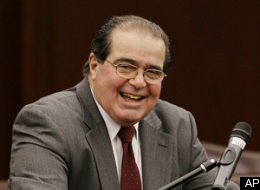
Speaking at a forum recently at the University of Arizona Law School, Justice Antonin Scalia (whom Bush called "Antonio") stated that he probably would have dissented in the landmark case of Brown vs. Board of Education and voted to maintain that stately Southern (and not just Southern, of course) institution known as "separate but equal." According to Antonio, if a state decides to segregate its schools along racial lines, that's well within their rights because the Constitution is "silent" on such a point. His expatiated on his reasoning as follows:

Using his "originalist'' philosophy, Scalia said he likely would have dissented from the historic 1954 Brown v. Board of Education decision that declared school segregation illegal and struck down the system of "separate but equal'' public schools. He said that decision, which overturned earlier precedent, was designed to provide an approach the majority liked better.


"I will stipulate that it will,'' Scalia said. But he said that doesn't make it right. "Kings can do some stuff, some good stuff, that a democratic society could never do,'' he continued.

"Hitler developed a wonderful automobile,'' Scalia said. "What does that prove?''

"The only thing you can be sure of is the Constitution will mean whatever the American people want it to mean today,'' Scalia said. "And that's not what a Constitution is for. The whole purpose of a constitution is to constrain the desires of the current society."


In the first place, the idea that Hitler developed the Volkswagen is somewhat apocryphal, but it's curious that's where Tony's mind went. I agree that whether or not Hitler designed a wonderful automobile seems pretty far removed from the question of whether black students in Kansas in 1954 (and later elsewhere, of course) should have been confined to all-black schools run by the state. I'm just not seeing how Scalia's Hitler point really relates to the argument he was making. The problem, of course, must be mine, because everyone knows how smart Judge Scalia is.


I'm pretty sure that Brown vs. Board of Education was based on the Equal Protection Clause of the 14th Amendment to the United States Constitution. Here's the text:

Section. 1. All persons born or naturalized in the United States and subject to the jurisdiction thereof, are citizens of the United States and of the State wherein they reside. No State shall make or enforce any law which shall abridge the privileges or immunities of citizens of the United States; nor shall any State deprive any person of life, liberty, or property, without due process of law; nor deny to any person within its jurisdiction the equal protection of the laws.


So here's the first question that comes to my mind under Tony's "originalist" approach: what does "due" mean in the due process clause? It doesn't actually say. I guess a circular approach is all that is left to us. Due process is the process of law that is due to an American citizen. The Sixth Amendment gives us some clues: j


In all criminal prosecutions, the accused shall enjoy the right to a speedy and public trial, by an impartial jury of the State and district wherein the crime shall have been committed, which district shall have been previously ascertained by law, and to be informed of the nature and cause of the accusation; to be confronted with the witnesses against him; to have compulsory process for obtaining witnesses in his favor, and to have the assistance of counsel for his defense.


Justice Tony adds an important caveat: not if you're a Muslim captured by the United States anywhere in the world.


Still, confining the issue to American criminal defendants, suppose the state of Texas decides to streamline its capital punishment process so that defendants, once convicted by a jury, are summarily executed by firing squad the same day. (The Third Reich used this approach, in the unlikely event there was a trial in the first place.) What Constitutional limit stops Texas from doing so? We all know Governor Perry (and George W. Bush, way back when) would prefer this expedited method. Antonio would have to let this one go, too, I'm afraid, just like segregation.


Judges not quite as smart as Scalia concluded back in 1954 that a state which divided up its schools along racial lines, with whites clearly in the majority and in better facilities, created a situation which was "inherently unequal," and one reason for this conclusion was the stigma of segregation itself. Tony went to a private Catholic high school in Manhattan, so it didn't matter all that much to him.


I doubt that the Founding Fathers, even the slave owners, really thought that the purpose of the Constitution was "to constrain the desires of the current society," if that meant that the desire of a society for equal protection should be defeated because we can't find the word "desegregation" in the document itself. It's possible that Enlightenment thinkers such as Thomas Jefferson were even smarter than Antonio, and did not imagine that the Constitution they created would be limited by intellectual gimmicks like "originalism." Indeed, they were smart enough to know they didn't know everything yet, which is why they used general words like "due process" and "equal protection," without attempting to enumerate the precise application of those words to every social situation. They were writing a guideline, not the Encyclopedia Brittanica.


October 26, 2009

Obama's golf game


Apparently, Barack hits the links on Sunday afternoons, often playing on military courses in the D.C. area. He's only been playing golf for about 15 years or so, and his handicap is around 24, which means on an average 72 par course, he shoots around 96, but often strays into the low 100's. In other words, he's not a very good golfer. He's good-natured about it, though, although he likes to "trash talk" on the course to get "into other players' heads."


I'm kind of thinking right now: gimme a frigging break.

Bush claimed that he gave up golf at some variable time (there were reports of Bush playing after his "decision") out of deference to the feelings of the families of soldiers in harm's way in Afghanistan and Iraq. More deference, perhaps, could have been shown by simply bringing the soldiers home from these pointless wars, but in the USA it's often true that "optics" are as good as something real, especially when you can get the Mainstream Media to go along with the gag. Barack, whose American soldiers in Iraq are now mainly sequestered out of the free-fire and free-exploding zones, perhaps does not feel that the same deference is necessary or particularly meaningful, and besides, since he was not a silver spoon kid like W, he didn't get a chance to grow up in country clubs. So he's "earned" his right to the vaguely Republican-looking pastime.

I don't really begrudge Obama's leisure-time choices. He needs to get away from the Oval Office and from whatever it is that he's doing there, and I'm starting to think that, as with Bush, the less he actually does, the better. His access to nice courses where other players are cordoned off while his pack of duffers and hackers shanks and pounds their way through is something he won't always have, like his weekend trips to Camp David, so the more taxpayer-subsidized golf he can get in now, the better for him. He can hone his game up till about January, 2013, at which point I strongly suspect he won't be the U.S. President anymore.

I see where the New York Times has picked up and stolen the painstaking work of Glenn Greenwald about Obama's complicity in the Bush-era atrocities committed against one Binyam Mohamed, a British citizen who was the victim of rendition and torture by the CIA and U.S. military. His torture went way, way beyond waterboarding; indeed, compared to the torture inflicted on Mr. Mohamed (such as slicing his scrotum with a scalpel), waterboarding seems like shooting a siphon down someone's baggy pants. The British security apparatus went along with the Bush demand that no record of Binyam's torture be made public, on pain of a loss of cooperation with the CIA regarding terrorist threats against Britain. And you're reading that right (it's reflected in the opinion of the British High Court): the U.S. told Great Britain that if they publicized the torture of Mohamed, the U.S. would keep secret actionable intelligence indicating the possibility of an attack on Britain. Britain's spy services yielded to the threat, and demanded that a court hearing Binyam's case redact the Famous Seven Paragraphs which detail the tortures inflicted upon him. The lower court went along with this; the High Court has now reversed this decision and is prepared to publish the opinion in full. Here's what the Times has to say:

Victims of the Bush administration’s “enhanced interrogation techniques,” including Mr. Mohamed, have already spoken in harrowing detail about their mistreatment. The objective is to avoid official confirmation of wrongdoing that might be used in lawsuits against government officials and contractors, and might help create a public clamor for prosecuting those responsible. President Obama calls that a distracting exercise in “looking back.” What it really is is justice.

The Obama Administration is pretty lathered up about this, and they are pressuring the British government to appeal this latest decision. In so doing, Obama is not only ratifying the violations of Geneva Conventions by the Bush Administration, and acting contrary to the requirements of the Convention Against Torture (which requires Obama to investigate and prosecute where appropriate any credible allegation of torture), but Obama is now becoming complicit in a direct effort to subvert the judiciary for political reasons.

All of which is to cover for Bush/Cheney war crimes.

I'm starting to think that Obama is a pretty weird bird. I just don't get it. He casually lies about lots and lots of things, and has so alienated his "progressive" base at this point that he must know that when 2012 rolls around, the money from the base won't be there. Why would anyone get excited about him?

That's the way it is. I never expected anything from Bush but the worst, and man did he deliver. I thought Obama would produce great things and chart a new course, go for the long ball, but he's content to chip and putt, I guess. We're pretty much on our own, while he flies off to Martha's Vineyard, buzzes up to New York in some fat cat's Gulfstream for "date night" in New York, speaks at two-grand-a-plate dinners with the banksters on Wall Street, and in general carries on like a guy completely out of touch with the people that actually elected him.

Whatever. Play through, Mr. Prez.


October 22, 2009

Nothing new under the financial sun


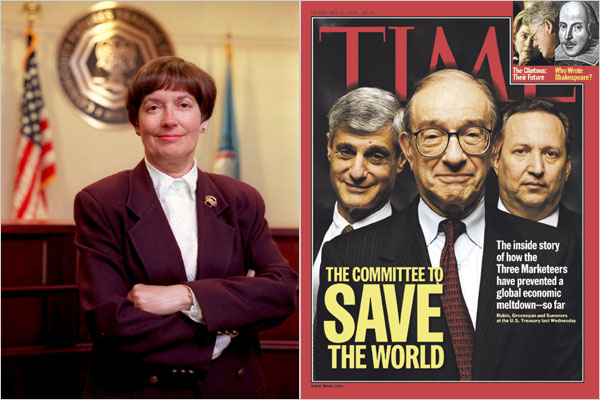
This week "Frontline" did an interesting report on Brooksley Born (left photo), probably someone you haven't heard of because her tenure in government was abruptly truncated when she failed to act like one of the boys. She was Clinton's original choice as head of the Commodities Future Trading Commission. A Stanford law graduate, a very seasoned securities litigator with Arnold & Porter in Washington, D.C., she took her rather obscure job seriously and immediately became concerned about the immense volume of unregulated derivatives traded over the counter with no federal oversight at all. So she proposed regulations to force this off-site gambling into the open, where it would be subject to normal capital requirements, disclosure and reporting.


She was aggressively opposed by Clinton's Three-Headed Monster of Deregulation: the misogynistic Larry Summers, the arrogant Robert Rubin (Sec. of Treasury) and the Ayn-addled Alan Greenspan, Chairman of the Fed. They didn't want any regulation at all, being market "fundamentalists." Greenspan went so far as to dispute the necessity of regulating securities fraud, arguing that the "market" (which had a kind of holy, talismanic meaning for him) would take care of it. They blocked Brooksley at every turn, showing up at Congressional hearings with her and kneecapping her ideas. Clinton, in the thrall of the go-go tech IPO craze and the booming market on Wall Street, sided with the Boyz, of course, since his weaselly cowardice where women were concerned (think Lani Guinier) made his decision easy. Clinton became a champion of financial deregulation (he signed the repeal of the Glass-Steagall Act, which is why you see securities dealers inside your local Bank of America), globalization and offshoring of American jobs. In a lot of ways, George W. Bush simply executed Clinton's plan for the destruction of the American middle class and ruination of the American economy. The hard work of making America vulnerable to grifters and banksters was well underway when Bush took charge in the Oval Office. With the financialization of the economy a done deal, Bush could concentrate on his true passion, war.

Anyway, after Born quit in frustration, the derivative business (credit default swaps, etc.) exploded into a business with a notional value greater than the combined GDP's of the nations of the world. It was a situation completely out of control. Various geniuses, such as those at Long-Term Capital Management, based their opaque investment schemes on the unregulated derivatives market, and made a killing in ways which they claimed were immune from failure. Then the Russian economy collapsed and LTCM, for reasons no one could completely understand (since no one really understood their business) went into free-fall, losing hundreds of millions of dollars every day. LTCM was so interconnected with the banks on Wall Street that the failure of the hedge fund threatened to bring the American economy down with it, which may sound familiar. So Robert Rubin organized a cartel of big banks to bail LTCM out and the crisis passed. Rubin's role as savior of Wall Street is remembered; his seminal role in thwarting regulation of the business that sank LTCM, less so.

The derivatives business went totally nuts under the malignant neglect of Bush&Cheney, reaching, by some estimates, a notional value of one quadrillion dollars. The collapse of AIG was directly attributable to its land office business in credit default swaps, side bets on the success or failure of securities such as mortgage-backed bonds. And, of course, there was no real oversight of the mortgage-backed security business itself, another multi-trillion dollar business in which all the big commercial and investment banks were deeply involved. When Bear Stearns failed in 2007, it started a domino collapse of the entire financial industry. This time the banks themselves could not save the system (so they said, since they were the ones who needed saving), so it was left to the federal government and the Federal Reserve, the lender of last resort, to bail everyone out.

It must be a little strange for President Obama to meet with his economic advisors, see Larry Summers sitting on the other side of the desk in the Oval Office, and realize this somewhat porcine and definitely self-satisfied guy is one of the principal architects of the problem we're in now. And yet he leans heavily on his advice; after all, Summers is really, really "smart." Obama tends to marginalize Paul Volcker, an occasional ex officio advisor, because Volcker has lately taken to calling for the nationalization of banks such as Citigroup, Bank of America and Wells Fargo, on the grounds that they're "zombie banks." (If for no other reason, I am grateful to the financial crisis for this colorful usage, lifted from the Afro-Caribbean voodoo tradition.) They're being propped up by bailouts and zero percent loans, and by the government's acquiescence in allowing them to count the hundreds of billions in cruddy loans on their books as if they had real value. Volcker thinks this is pointless, especially since they're not really lending, just hoarding. As Max Keiser has said, America needs a banking system, but it doesn't follow that we need exactly these banks run by these specific, well-connected individuals.

Well, despite such thinking, I do believe this is another instance where Obama is loath to fail in a unique and original way, and if all the Goldman Sachs alums and Goldman Sachs cronies around him tell him that we must save The Banks in the Club (the ones left after Goldman helped the government get rid of competitors like Merrill Lynch and Lehman Brothers), so be it. If the economy goes down for the count (if America becomes a failed state), he wants to make certain that he is following the corrupt consensus in Washington, D.C., and the de-regulating, Wall Street-pandering, bribe-accepting cadres supposedly representing us remain definitely in the ascendant in D.C. As a recent example, Obama raised $2 million for the Democrats on Wall Street just this past Tuesday night - how tough do you want to be with your Sugar Daddies?

Oil is now $82/barrel despite slumping demand and massive overstock. Makes a lot of sense, huh? It does when you see a Euro costs a buck fifty now. Bernanke is reaching the end of his capacity to stoke Treasury purchases by "quantitative easing." If we don't buy our own debt, who will? That will become a very interesting question, and one where the answer, I'm afraid, is going to be delivered during Barack's first term. He's going to be dealing with crises, seriatim, that will make LTCM seem like someone's overdraft at the local credit union.

October 21, 2009

Nonsensical Slogans as Official Policy


I've remarked a few times on a phenomenon which has become the norm in American politics over the last decade or so, namely, the Nonsensical Slogan as official policy. As a prime example, there was Bush/Cheney's deathless repetition of the real reason for the war in Iraq: "We're fighting them there so we don't have to fight them here." In my naivete, I was prone to thinking this moronic incantation only demonstrated that Bush & Cheney were foolish. How wrong can a person be? They were way ahead of me, in actuality, because the slogan worked.


Although the statement itself made no sense. Bush, in a press conference, admitted unequivocally that Saddam had "nothing" to do with 9/11. So - what was the basis for the insistence that we would fight Iraqis here if we did not fight them there? Have we ever fought Iraqis here? Have they ever tried to invade or attack us here? We've been in combat with Iraqis, in desultory fashion, on and off since 1991. In all that time, with all that provocation, did they ever attack us? Yet Bush & Cheney (and Rove), seasoned pols that they were and are, had a better reading of the American booboisie than I, I have to admit.

It's at least reassuring to read other writers once in a while who refuse to abandon common sense in the face of propaganda. Take, for example, Johann Hari, a fine writer who contributes on the HuffPost sometimes. He was analyzing the various rationales for continuing the American occupation of Afghanistan. The Nonsensical Slogan most often trotted out, by Bush originally and now by the Obama Administration, is that we cannot allow Afghanistan "to become a safe haven for terrorists planning attacks against the United States." At the surface, at least (that is, before you spend two or three tenths of a second thinking about it), this rationale seems more plausible than fighting them over there so we don't have to fight them here. Hari points out, however, as I've tried to do before, that this reasoning is equally lame.

He adds a few facts I hadn't thought of. Since 9/11, there have been two other headline terrorist attacks, the 3/11 attacks on the trains in Madrid, and the 7/7 attacks on British public transit. None of these attacks (including 9/11 on New York and D.C.) was actually "planned" in Afghanistan. As far as preparations for 9/11, most of those were done in Hamburg, Germany, and in South Florida. It is strictly and only the temporary residence of Osama bin Laden and a few top al-Qaeda henchmen in Afghanistan that provided cover for what was actually simply an acting out of American rage against a plausible foe. Except that Bush & Cheney completely blew it where bin Laden was concerned, so it's difficult to see now what in the hell it was about.

The other aspect which Hari talks about is what might be called the Whack-A-Mole problem. Supposing for a moment that terrorists need a "safe haven" to "plan attacks" (and in the three examples above, there is no evidence for this), why is it that Islamic terrorists would cooperate by all migrating to Afghanistan so we can annihilate them? That presents a contradiction in terms: if they're that stupid, what's the real problem anyway? If General Jim Jones is correct (no one has authoritatively contradicted him), there are currently about one hundred members of al-Qaeda left in Afghanistan. One shudders to think that if there were many more before, then like toothpaste being pushed from the tube, they are now all over the border in nuke-armed Pakistan. How helpful. But more to the point, what is it about Afghanistan that makes it uniquely suitable as a "terrorist base" as opposed to other Muslim states such as Yemen, Indonesia or Algeria, or, to refer to the actual home states of the actual 9/11 hijackers, Egypt and Saudi Arabia? The United States cannot actually invade, occupy and nation-build in every last country that might be used as a terrorist "base," and to repeat: why does a terrorist need a "base?" Timothy McVeigh used the United States as a base, and he accomplished what he was after.

I work on the assumption that President Obama is a pretty clear thinker and must see these easily-grasped points. It does not make sense to confer upon Afghanistan the unique status as "terrorist stronghold" simply because it was bin Laden's last-known forwarding address, following stints in Saudi Arabia and Sudan. Yet Obama repeats, over and over, that the Afghanistan War is a "war of necessity." Necessary for what, and to whom?

October 20, 2009

Nero's Hoedown


For those curious about the fate of the world, I recommend Dmitry Orlov's cluborlov.blogspot for the first of a three-part series on global temperature increase, and particularly the estimates on sea level rise. A business as usual approach to carbon emissions will result, according to the Hadley Centre in Britain, by the year 2055, in a 7.2 F temperature increase, with catastrophic implications for the two largest repositories of land-based fresh water, Greenland (10%) and Antarctica (90%). I suppose the usual divergence of opinion in this country remains: those who say there's no problem, like Sen. James Inhofe (R,-Hades), and those in the scientific community who claim there will be a 7.2 F global average temperature rise in the next 45 years if we don't take drastic action.


At least there's a clear choice. Meanwhile, the debate rages on how many troops to send to Afghanistan. President Obama seems captivated by the Friedman Gambit for the moment: if Karzai is corrupt (he is), then we have no one to "partner with." How can we commit the Sacred Blood of our Brave Young Men and Women, so the sanctimonious cackle of the Chickenhawks goes, without someone to partner with? We'd really love to sink into a quagmire, we really would, but not without someone to partner with. If Karzai were a little more like John Adams, and would stop wearing that Shriners' hat, we could get somewhere, like up to our necks in quicksand.

Glenn Greenwald dusts off a largely-forgotten report from 2004 by the Defense Science Policy Board (whoever they might be) which roundly criticized the approach to counter-terrorism of Bush/Cheney (although the report was put together during their reign) because fighting wars in Muslim countries just makes things worse. It uses fancier language than that, but that's what it says. They don't hate us "for our freedoms," as the silly shibboleth went, but because of our support of corrupt dictatorships in the Muslim world (Egypt, Saudi Arabia) and because we bomb them and invade them. Hey, don't look at me: Donald Rumsfeld commissioned the report of this group.

That's something I've wondered about. We're all concerned about instability in Pakistan now, but why did things get so sketchy there during the last 8 years? Any connection to what we're doing next door (and in Pakistan itself)? If the presence of American forces in the Muslim world is the problem, how does increasing the number of troops solve it?

Is there any connection between the two parts of this blog? Probably, but I'm not sure I've thought of it yet. I'm beginning to think that we cling to our wars in more or less the same way Great Britain hung on to its empire in the early part of the last century, before it finally had to release its grip on the "jewel in the Crown," India, after World War II. By demonstrating our military might, we conceal such inconvenient realities as our $12 trillion dollar national debt, half owed to foreigners; the projected increase in the debt by $9 trillion before 2020; the pathetic actuarial state of the entitlement programs; the skewing of 90% of the nation's wealth to about 1% of the population; the corruption of Congress; the destruction of the USA's manufacturing base in favor of a "financialized," paper-shuffling economy; 20% unemployment; and various other signs and portents. We're so systemically ill that we can barely rouse ourselves to pay attention to the next catastrophe, so we talk about some more wars to keep us "safe." In Copenhagen at the end of the year, when the nations of the Earth meet to draw up plans to deal with global warming, we should probably do the world a favor and just stay out of the way. Maybe rather than weighing in with a lot of ideas we won't follow through on (you can't get a meaningful climate change bill through this Congress), we should just vote "present."

October 15, 2009

Frontline's "Obama's War"


Pretty good show on PBS a couple of nights ago about the war in Afghanistan. An embedded reporting team moved around Helmand province in Afghanistan with Echo Company, a Marine outfit patrolling an area dominated by the Taliban. Spliced into the hour-long show were excerpts from speeches from David Petraeus and lots of think-tank talking heads. I came away with these thoughts:


1. Watching Petraeus's PowerPoint-aided speech to some think tank institute or other (one of those focusing on defense), I was struck by how similar in style and content a war speech is these days to the language of the business consultant. "Missions," "objectives," "modalities," "partnering with," etc. It's a real industry, war-making in this country, with a huge constituency. A lot of people in government and quasi-government would be out of work if we stopped fighting wars. A war is a business venture with purposes far removed from the putative reason for the conflict; for example, no one is very convincing that the Afghan War, now in its 9th year, is really about 9/11 anymore. When you think about it, how could it be? A certain obeisance is paid to this original rationale, but the main purpose of the war is the war itself, and all the careers and government contracts connected to it. This situation provides tremendous institutional momentum.

2. The show opens with a Marine commander giving his version of Henry V's St. Crispin's Day speech. It's not a very good speech. He tells the Marines that 50 years from now their grandchildren will ask them about what happened that summer in Afghanistan. With all due respect to the terrible danger the grunts face every day over there, I kind of doubt this. 50 years from now the Afghanistan War will be in the same category as the Panama invasion or the great conquest of Grenada. Anyway, given the awful, inarticulate nature of modern speech patterns in America, wouldn't it be better just to quote the Bard himself?

This story shall the good man teach his son;
And Crispin Crispian shall ne'er go by,
From this day to the ending of the world,
But we in it shall be remembered-
We few, we happy few, we band of brothers;
For he to-day that sheds his blood with me
Shall be my brother; be he ne'er so vile,
This day shall gentle his condition;
And gentlemen in England now-a-bed
Shall think themselves accurs'd they were not here,
And hold their manhoods cheap whiles any speaks
That fought with us upon Saint Crispin's day.

Clearly this is what the commander was going for, and it didn't work. I would say, however, that Henry V's decision to invade France was beset by a problem similar to the Afghan invasion: Henry's war didn't make any sense either, but with Shakespeare writing his material, it seemed more rational.

2. Everyone in Afghanistan, except the U.S. military, is interested primarily in one thing: the money you can make with opium poppies. The Taliban, Karzai's government and the native tribes are all up to their eyeballs in heroin production. Karzai's chief aide is a narco-dealer, for example, or is widely viewed as one by the populace. The U.S. military just looks the other way: they can't win hearts and minds by wiping out the lucrative poppy business, so they leave it alone.

3. Pakistan is a real mess. No doubt this is the real reason we're in Afghanistan - to keep an eye on the Muslims with the nukes. The ISI (Pakistan's security apparatus) is highly supportive of Afghanistan's Taliban, which means that a lot of the billions in aid we pay to Pakistan probably finds its way one way or another into the hands of our nominal enemy. The Pakistanis, by and large, seem to hate us, so the idea of a direct solution to our problem, simply garrisoning soldiers in Pakistan, is a non-starter, as the management consultants/generals might say. So we have to mess around with a war next door in order to keep our forces ready to...? Hard to say.

4. Karzai is hugely corrupt and probably plays the Taliban off against us and vice versa.

The grunts of Echo Company patrol the primitive villages of southern Afghanistan and get shot at, and blown up, by a largely unseen enemy who avoid direct confrontation. It really looks like such a war could go on forever. The Taliban aren't going to leave and the local, non-hostile population seems largely indifferent to their presence so long as they're allowed to grow opium poppies. Karzai rules Kabul, but beyond that it's all sort of the Wild West.

I suppose the only real question is whether our presence in Afghanistan helps or hinders stability in Pakistan. Those who want us out say it "destabilizes" Pakistan, those who say we "must win" claim our presence is necessary. McChrystal (who spends a lot of time on-air during the show) of course believes he needs a lot more troops in order to get the job done. I imagine he'll get most of them because Petraeus demonstrated in Iraq that a fractional increase in the number of American troops (the "surge") does something, and I don't think Obama wants to take a chance on varying from this template even if the two situations are not at all analogous. The war may fail, but Obama will want to fail in a way that is acceptable to the War Industry, and in America Surges 'R Us. If you go rogue and do something weird, like withdraw completely, you take a huge gamble. You change the "brand." In later reconstructions of your failure, the analysis will be simplified so that Fox News and the Republicans will yell that Obama had the compelling example of The Surge to guide him, but made some fancy argument that Iraq was not Afghanistan and tried something else. That doesn't play in America. Way too complicated.

October 13, 2009

Obama as our guide to oblivion


A preliminary note from the always entertaining/informative Dmitry Orlov:


I've said it here before: Obama is the new Gorbachev, the smiling face behind the crumbling imperial façade, the personable, non-threatening loser. Gorbachev got his Nobel Consolation Prize in October 1990; a little less than a year later the USSR was no more and he was unemployed.

In awarding him the Peace Prize, the Nobel committee actually did some good: by reaffirming his legitimacy as a leader, it helped to weaken the hand of the conservative forces within Russia, which later staged an unsuccessful coup in an effort to reclaim control of the dissolving empire.

Gorbachev certainly deserves credit for making sure that the USSR disintegrated with a whimper and not a bang. May Barak Obama be just as successful in completing the dissolution of the USA, quietly and without any undue bloodshed. Moving forward, I wish him a long and happy unemployment.

Now is that actually the case? Dmitry likes the analogy between the collapsing Russian state and what he sees as the same inevitable American fate; and I myself have conceded that if there is one polity that springs readily to mind when considering the ossified condition of American politics, it's the old Soviet Union. Congress and the White House are incapable of responding to real problems, and largely this is because of our own superannuated Politburo, which we call the U.S. Senate.

It's a pity that during the expansion of the U.S. westward, with the inclusion of all those new states beyond the original 13, that we simply didn't get rid of the Senate. It's profoundly undemocratic, since very small populations are vastly overrepresented. Those tiny electorates in South and North Dakota, Wyoming, Montana: they all have two Senators, just like California, yet California has a population twelve times the combined population of all those states (about 3 million for them; 36 million for the Golden State- by that logic, shouldn't Los Angeles have 8 Senators all of its own?). What's with the bicameral legislature? Nebraska doesn't have one, and who's got more corn than they do? The bicameral legislature is obviously a kind of vestigial artifact from the Houses of Lords & Commons, and why do we want to be reminded of that?

But the main problem with all those ancient pols in the Senate is that (a) they're a stationary target for lobbyists, and (b) they have that stupid 60-vote rule which they put in place so they would never have to do anything other than approve wars and pass unconstitutional legislation (Telecom immunity, Military Commissions Act, the Patriot Act, etc.). The Senate assures that lobbyists can use their money efficiently to buy votes. A little systems analysis allows the influence peddlers to figure out where the key committees are, how many votes they have to buy, and how to use the 60-vote rule to choke off anything they don't like. The Senate is the choke point for all meaningful reform in this country. Pretty obvious when you think about it. Why is the health care reform bill such a watered-down, soggy piece of nothing? Because it has to get through the lobbyist-infested Senate.

I don't know if Dmitry is right, but the Senate certainly doesn't hurt his case. The U.S. is in a depression and Congress really cannot do much about it because they are institutionally incapable of reordering American spending priorities. Look how much talk is still devoted to this Afghanistan question. 20% unemployment, $1.5 trillion deficits, the states going broke, and the Senate argues endlessly about whether in this 9th year of the Afghan war we should add 20 thousand or maybe 40 thousand more troops.

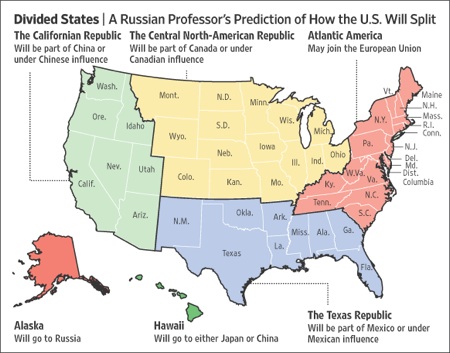
That's why it doesn't surprise me that the early rumblings about secession have come from large, cash-strapped (there's another kind?) states, such as Texas. You begin to wonder how to make ends meet locally, how to pay for schools, roads, state employees, and you realize that all those federal taxes your citizens pay go into the insatiable maw of the military-industrial complex, which exists not primarily to protect you but to enrich itself with your money, and you think....is there a simpler way to do this? Like just keeping the money here?

As the depression persists, more talk of that sort will surface. Orlov could be right that Obama might be the perfect president, with his fetishistic attachment to mediation and everyone getting along, to oversee the orderly breakup of the U.S. of A. Better him than Bush, that's for sure. Bush would have launched a preemptive strike against the first state that tried it. Not so Barry. It might be change he could believe in.

October 12, 2009

The Doppelganger Seizes Krugman's Keyboard


Nothwithstanding his Nobel Prize in Economics (and let's face it, the Nobel Committees in Oslo and Stockholm are getting pretty whimsical these days), sometimes I think the problem with Paul Krugman is that he's just not very smart. He's ambitious, obviously, since you can see him opinionating on the Op-Ed pages of the New York Times, on Real Time with Bill Maher, and on George Steph's snoozefest on Sunday mornings, where you can also listen to the Climate Change Deniers' Champion, George Will.


To account for my ambivalence about Krugman's true intelligence, I have invented the literary conceit of the Doppelganger, a mysterious (but still bearded) phantom who periodically takes over Krugman's spot at the Times and writes his column for him. I think the DG was keeping Krugman's seat warm over the weekend and wrote his column appearing today, in which Krugman (?) argues that the falling value of the dollar against international currencies is an unequivocally good thing. It's simple, according to Professor K: it makes American exports more attractive, and the reason the dollar is actually falling is because foreign banks have relaxed as they bask in the warm glow of the obvious economic recovery and have retreated from the safe haven of the dollar into their domestic currencies.

Meanwhile, back in the real world, Romania's government just collapsed because they're broke. California, which would be in the G-8 if it were a country (its economy is/was that large), is on budgetary life support, and if it crashes (it might) then the state which produces half the country's food (including all those exports) will come asunder.

I just figured out who's writing Krugman's columns! I don't why it never occurred to me before. It's Ben Bernanke. All the details fit. Faculty of Princeton's economics department? Check. Beard? Check. Refusal to confront reality? Check.

It's him alright. Look, Paul, Ben, Doppel, whoever you are: it's obvious to us why you're printing money (monetizing the debt, though you refuse to admit it), keeping interest rates at the "zero lower bound" (fancy Fed talk for not charging interest at all), and maintaining all the happy talk about the economic recovery. Politically speaking, it's just not possible anymore to face the truth. The Bubble-Built-On-Debt Economy is over, but the problem is that the bubbles in that economic champagne we were drinking have left us with a helluva hangover. To wit, to keep the party going during the Bush years, and to funnel the remaining notional wealth of the United States into the accounts of about four or five large investment banks on Wall Street who were well-connected in Washington, American consumers took on residential, commercial real estate and credit card debts they could not pay with existing incomes. They could not pay the present value (factoring in the interest increases built into such loans) of the loans even at the moment when the ink was still wet. The vaults of large banks (Bank of America, Wells Fargo, Citi, Wachovia, Washington Mutual, Indy Mac) became stuffed with these dodgy pooled mortgages, and hundreds of billions more were sold to fixed-income investors. The cream (the commissions) was skimmed at the front end by Goldman Sachs, Bear Stearns, JP Morgan Chase, et al., and they all got very rich.

Then sunrise came. The world at large is now looking askance at the epic scene of wreckage in America stretching from sea to shining sea, the hundreds of thousands of houses owned by banks representing the worthless collateral of all those failed loans. At the specter of America borrowing 40 cents of every dollar its government spends, yet that government is unable to stop itself from expensive foreign wars. At the Federal Reserve's hypertrophied balance sheet, heavy with all those toxic loans it traded for Treasuries during its "cash for trash" triage operations. And the world is saying: WTF?

There's the true story of the dollar's decline. The FDIC is broke and afraid to declare any more banks insolvent, although hundreds of banks are in that condition. The Treasury is holding huge auctions on practically a daily basis to raise cash to meet the inexorable needs of Congress for more dough to keep the game going.

This is all about improving our export position? I doubt that, just a little. The real purpose of zero interest loans and the Fed's ravenous appetite for all the crap on the books of the banking system is the hope, however faint, that the real estate bubble can be reinflated so that, voila!, all those loans become good again. That's the game, that's the prayer. It's the only way out, short of doing something politically impossible, such as telling the truth.

A weak dollar is very scary, because the ability to decide how much money we have (by virtue of our status as the printer of the world's fiat currency) is mostly what we have left. Krugman says the weak dollar is "good news." It is what's new, but I don't know how good it is.

October 08, 2009

Night terrors


Writing a late night note to a friend:


Dear [censored], sorry to have been so MIA. Haven't been able to blog much, or write email much either. Behind on various things, for some reason. It's [redacted] (see Obama style manual, re: CIA IG Torture Report). Here's my overall take: Barney Frank,
and Ben Bernank they're all in the tank for my bank,
and yours. And the reason is simple: we never did solve the basic problem. All those mortgage-backed securities are still sitting in vaults in various places, many now transferred to the Federal Reserve, which is carrying a gigantic balance sheet -- over $2 trillion, almost 3 times where it was 2 years ago. Schiff, Chris Martenson, others all come at the problem from different angles, but they end up at the same place. The housing bubble burst, and it meant a huge loss in equity across the board, trillions wiped from the national asset column, and made MBS fall drastically in value - how far down, we don't really know, because the Fed has done everything it can to conceal the true extent of the damage. It offloads billions in these derivatives from the banks and from Fannie and Freddie. It prints money to buy them from the banks, then the banks buy Treasuries. Then often the Fed turns around and buys the Treasuries back from the banks. Foreign investors are being bought off too, by buying their Agency debt (Fan/Fred) with printed money, which the foreign central banks (FCBs) use to buy Treasuries, thus enabling the Treasury/Fed to print more money based on the creation of debt. It is all a gigantic shell game purposely kept very confusing, circular and opaque in an effort to conceal the enormous scope of the problem. Since the banks were lending at about 10-1 versus reserves, their real losses out there in the vast expanses of exurban America, greatly exceed their actual capital. But the Fed is conspiring with the big banks to hide the true extent of the losses by never allowing a real market for MBS. As Martenson says, it's the sound of one hand clapping. If the Fed never allows us to see how much money has been lost, do the losses even exist? Meanwhile, Ron Paul and now this rising superstar Alan Grayson are all over Bernanke with this demand for an audit. This is a nightmare. Can you imagine what will crawl out from beneath the rocks if they do an audit? The true extent of the games being played? Barney Frank and others look like they're in on a conspiracy, it has, to the populist mind, the look of vast D.C.-Wall Street Cabal, but in truth they're just deathly afraid of the Mother of All Bank Runs. It would be the end of the economy, the dollar, the country. If the public finds out that BofA, Wells, Citi, Chase are all just Zombies, completely broke, and they find out that the FDIC is also broke (which it is, after 97 bank failures so far), panic will set in. And here comes commercial real estate to add to the problems of bad debt, along with the shadow inventory being held off the market by the banks in a desperate attempt to provide flotation devices for the underwater loans. It's completely, totally FUBAR. I personally think Bernanke has done an amazing job to hold this thing together with his three flashing shells. But is he just postponing the inevitable? Can you actually hold all this debt off the books forever and pretend it doesn't exist? I seriously doubt it. Really, really do. Guess I'll post this as a blog, too, huh?

October 05, 2009

Bowing down to the GDP & other graven images


So in some respects the worship at the altar of the almighty GDP is, indeed, like the South Sea Island cargo cults. The cults took different forms, but were based on the desire of indigenous South Sea Islanders for the material goods of Westerners with whom they came in contact. Sometimes the cultists would imitate the mannerisms and dress of the Westerners, a form of thinking which proceeded on the assumption that the cargo could be conjured through magic.


American economists cling to the precious Gross Domestic Product in the same way. Never mind the still-rising unemployment rate, the continuing decline in house prices, the millions of foreclosed homes, the severe cutback in discretionary spending among the citizenry. Bernanke declared the recession officially over because the GDP stopped going down, and that's what matters.

Alex Berenson wrote an interesting book called The Number a few years ago about corporate governance and the relentless focus on one "metric" to decide whether a corporation was succeeding or failing: its quarterly earnings report. Everything was based upon this one statistic, and if reality did not cooperate, it was manipulated till it did. Thus, the excesses of Enron style "mark to fantasy" accounting, which has gone on to infect the way the Federal Reserve and the U.S. Treasury allow banks to carry worthless mortgage-backed securities on their books at face value to avoid the inevitable markdown to insolvency. The last thing anyone wants is the truth, after all.

The GDP includes government spending as one its four tributaries. Such spending, of course, has gone through the roof, and about half of that is borrowed money. Nevertheless, the spending counts positively in the GDP. No one really talks about the mirage-like quality of this spending. Meanwhile, all the "real" indicators point in the same direction: ordinary Americans are cutting way back on "discretionary" spending. Railway goods traffic is down about 18%; General Motors sales (after the brief flurry of action with Cash for Clunkers, which disproportionately benefited Japan) are down 50%, year-over-year. Airline travel down, highway mileage down, even greenhouse gas emissions are down worldwide 2.6% over the last year, a pace which would meet the Copenhagen goals if it can be maintained.

American wealth, over the last forty years or so, has been based on the encouragement and proliferation of non-essential spending, or for paying way too much for basics (such as housing and health care). While we pay lip service to the "free market economy," what has really happened is that we have built a culture where the individual creates an identity based on consumer spending, and where the "need" for such spending is created in the first instance by the influences of advertising. So we are what we buy. The economy came to depend on this correlation, and it was always in danger of the kind of catastrophic event which has now transpired. Americans can let go of a tremendous amount of superfluous spending without hardship (provided their income remains the same), but the problem is that the economy (and the jobs within it) depend on such superfluous spending, thus contradicting the income condition. Put another way, we don't really need half of all the shit we buy, but if everyone pulls back from that wasteful 50%, the economy tanks and huge numbers of people don't have enough money for anything.

The legions of Americans who have been laid off from crap jobs and jobs which depended on "turnover" were the first casualties of this pull-back: the baristas, the "sales associates" at Target and K-Mart, the auto salesmen, the vast hordes of real estate agents. Take autos, for example. In truth there is no reason that a person needs a new car every three years or so. The "need" is a culturally-induced compulsion which serves the purposes of the manufacturers, not the consumers. A car can be repaired. It can be fully depreciated by driving it into the ground. This makes work for car mechanics instead of car salesmen, but it also means fewer line workers in the factories.

We're in a "square root shaped" recovery. The plunge along the y-axis is steep and unrelenting. The recovery, however, is only partial. The conditions for massive discretionary spending, on which the "consumer economy" came to depend, are gone. The housing bubble, inflated with cheap foreign loans, was used to sustain spending with re-fi and lines of credit when the actual wages of Americans could no longer keep pace. The bubble burst. Now we're dependent on actual earnings, and those were never enough to sustain the old GDP.

The economics profession keeps treating this downturn as if it were simply another cyclical event instead of a paradigm shift. Just keep priming the pump, they say, and consumer confidence will return and spending will be back to normal. Where will people get the money? They borrowed it before, and they can't do that anymore. Facing the inevitable would allow a more intelligent response (the encouragement of more "basic" human activities, for example, such as more small-scale farming and less party-planning), but that would require a supple and responsive political system. That would require, in other words, something which doesn't exist here anymore.


October 01, 2009

While my guitar gently weeps


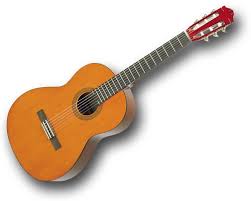
I bought the guitar I play most of the time these days at a music shop on Scott Street in San Francisco. It must have been in the mid 1970's, because I have pictures of me playing that axe around that time or a little later. It was a Japanese knock-off of a Spanish classical style, like a Ramirez, made with a Brazilian rosewood back, a German spruce top and an ebony fretboard. It cost about $250, and it came with a hard shell case of brown leather and plush orange lining. The guitar has mellowed with age, the tone actually improving, but it was always pretty good. A few years ago I thought about replacing it. To get a guitar made of similar wood (they're not actually supposed to use Brazilian rosewood anymore because of the rain forest problem), you need to spend at least a couple of grand, so I tried a few out at a well-stocked specialty store south of Market Street in SF. These didn't actually sound as good as mine, and the action (basically, the ease of playability) was no better. I found I needed to go as high as three grand to actually do better. After a while, I just forgot about it and went back to playing the same old guitar.


I have sheet music from my first purchases in the late 1960's, when I first started playing a lot of classical guitar (and learned how to read for the instrument). A particular favorite is a slim, tawny, corny-looking volume filled with the great masterpieces of the repertoire: Tarrega's Recuerdos de la Alhambra, Albeniz' Leyenda, Granados' Playera, Bach's Bouree from the Lute Suite in E Minor. Almost every tune in the book is a hit; just a few clunkers in the bunch. It cost $1.95, according to the cover. Cheaper than a Starbucks Venti. I know that I'll die while still trying to master all the music in that book.

Over the years I picked up a music stand and even one of those classical player's foot stools, so you can rest the guitar's curve on your left knee, where it belongs for classical stuff. Or bossa nova, or even Duke's Do Nothin' Till You Hear From Me. It was the Duke, in fact, who said the truth: there are only two kinds of music - good music and bad music. Anyway, that paraphernalia cost about $20, total. We're not at three hundred bucks yet, and we're spanning thirty years of playing.

You have to re-string a guitar regularly if you want it to sound good. You can buy a set of classical strings for six bucks, but I tend to go high end and buy Savarez Carte Rouge strings, which set me back about fifteen. That's every six months or so. You can change them more often, but I'm playing in my den, not Carnegie Hall.

I've made friends with that guitar, played weddings, parties and paid gigs, shown off, courted ladies, jammed with friends and family. Spent hours and hours, hundreds, probably thousands of hours, alone with it, just me and the guitar, working through the polyphony and counterpoint of ancient music, like the music in that buck ninety-five book.

I was thinking about all this while reading a book called Growth Fetish by Clive Hamilton, an Australian political theorist, think tanker, humanist, Big Picture Guy. The book's about the essential disconnection between the GDP "growth" of a country and the happiness or sense of well-being of its citizens. Beyond a threshold level of wealth (which the United States crossed decades ago), enough to assure basic prosperity to the citizenry, there's no correlation at all between GDP "expansion" and human happiness. Happiness arises from things in life other than material accumulations after the basics are taken care of. Human relationships, a sense of purpose in life, interesting things to do. America is the richest country but it isn't the happiest, not by a long shot. We lost our way in the fetishistic pursuit of material prosperity, and finally crashed the economy in the desperate quest for acquisition, taking on debts (both government and private) we can't repay, that depended on an insane expectation of exponential growth to sustain. Truth is, as measured by statistically accurate surveys, we were happier in America in the 1950's than we are now, when things were simpler and more egalitarian. That will probably come as no surprise to members of my generation. We remember.

That guitar teaches me the essential truth of Hamilton's thesis. For years at a time, in the pursuit of more complicated endeavors, I have neglected that guitar. I have been out in the world getting the money together to acquire other things. The guitar has sat in the closet, in the case, unloved, unused, with tarnished strings and a dusty sound board. Then I remember I still have it, still know how to play, and I bring it out, re-string it, polish it, and it leaps back to life, better than ever. Then I get in the habit of playing again, learning new stuff or, more likely, re-learning what I already know.

I suppose that if you amortize the cost of the whole guitar experience over the thirty years I've owned that precious instrument, the original price, the books, the stand, the stool, all the strings - it doesn't come to a thousand dollars. Maybe thirty bucks a year for all that enjoyment. 75% of what it costs to fill up the car with gas so I can go out and drive in traffic jams. Without a doubt, playing that guitar has given me more pleasure than anything else I can think of, and certainly more than anything else I can do alone. And as I keep getting older - hell, maybe even more than that.

September 28, 2009

So what's the deal with Iran?


My guess, frankly, is that Iran signed the Nuclear Non-Proliferation Treaty (NPT) in order to proliferate nuclear weapons. I think this idea is right even if I haven't seen it worded quite that way anywhere else (which, of course, is one of the reasons it appeals to me). But think about it: if Iran tried to build an enrichment plant outside the inspection regime of the IAEA and the comprehensive gaze of the ubiquitous Mohammed El-Baradei, Israel's Mossad and the CIA (acting on a tip from the Mossad) would figure it out very soon after they broke ground for the plant. Natanz would then have gone the way of Iraq's Osirak: "ka-boom!"


So the Iranians, referring to their well-thumbed copy of Poe's "The Purloined Letter," decided the best way to hide their program was to conduct it in plain view. I don't know if the Persians actually invented chess (or Parcheesi, for that matter), but they seem pretty good at reading between the lines of the NPT. Although they did not tell the IAEA about the second enrichment plant at Qum when they began construction, they claim technical compliance with the rule requiring notification to the IAEA at least 180 days before the introduction of uranium to the facility for enrichment. I've read the relevant parts of the NPT, and I can't find any provision that supports this "180-day" loophole. There is a reference to a 180-day period, but it refers to the period of compliance after a nation signs the NPT in the first place - you sign, then you've got six months to get your act together. Iran's argument has the familiar odor of an argument rather desperately concocted after other events - people found out - forced their hand. It seems more likely that Iran wanted to be far enough along in this underground facility so that it would withstand aerial bombardment, or even to finish it as an undisclosed backup to the Natanz facility which is a prominent feature of Israeli Air Force attack plans.

While it's true that the National Intelligence Estimate of a few years back concluded that Iran did not have a nuclear weapons program, it doesn't really matter because sifting uranium up to the 90+% level is the real "pacing element" in building a bomb. You get the shit, putting the bomb together is not so tough. If you don't have someone local, fly in a North Korean or maybe the Nuclear Amway Man himself, A.Q. Khan of Pakistan. He'll help set you up as an A-bomb franchise.

I know the counter-arguments: Iran is a signatory to the NPT, Israel, Pakistan, India and North Korea are not. Iran is simply exercising its rights to peaceful nuclear technology under Article IV of the Treaty. It all sounds good, but I take what I think of as the ultimate Realpolitik view. There is no margin of error for nuclear war. I keep going back to that University of Colorado study (I wonder if we can get Harvard or Yale to duplicate it, so people will take it seriously) which demonstrated that an exchange of about 40-50 Hiroshima sized A-bombs dropped on urban targets will destroy enough ozone in the Northern Hemisphere to make life pretty much unlivable up here. So the only countries I want to have nuclear weapons are the ones who won't use them unless they absolutely have to. I would put the USA, Russia, China, France, Great Britain, Israel and maybe India in this club. It's not really a question of being "fair" or legalistic. A legalistic approach which winds up destroying the human race is useless.

What really needs to happen is that the NPT regime simply gets rid of this "peaceful use" loophole, since civilian nuclear power is a bad idea anyway, and uranium, once it's enriched, is pretty indifferent to whether it's used to boil water in a reactor or destroy the world.

September 22, 2009

Confusion in the Ranks: Sheetless Klan Meetings


I've been noodling on various alternative names for the White People's Rallies, and Teabagesque meetings everywhere, and haven't hit on anything completely satisfactory. KooKoo Klan was a possibility; also Koo Klutz Klan. Not quite there, but that's the creative process for you: hit & miss.


Jimmy Carter thinks there is something "racist" in these attacks on Obama. Gee, ya think? Along with Jimmy's usual haul of annual UN humanitarian honors, I think he should be 2009's frontrunner for the Duh Award. I'm wondering: can Kenny Chesney update that awful song of his and call it "No Sheet, No Shoes, No Problems"?

Anyway, Frank Rich inspired Glenn Greenwald to write about the Glenn Beck Perplex, and specifically how this highly histrionic, lachrymose, unstable bundle of nerves manages to "lead" a movement when it's obvious Beck himself has no idea where he's going. You might say the Teabaggers and others marching under his banner cannot get their sheet together.

In the bad old days, between the Emancipation Proclamation and the Civil Rights Act, the angry white mobs had a tighter focus: anti-Negro, pro states' rights (which, in the manipulative hands of pols like George Wallace and Orval Faubus, were just the two sides of the same coin). Then as now, the reason these mobs tend to look melanin-deprived and basically confused is because they are drawn from the ranks of the white dispossessed. Economically anxious, debt-ridden, grievance-filled. Thus, they hold up signs that say, "I will protect the Constitution by any means necessary." So, in an unfair, slightly-too-sophisticated way, you might be tempted to ask: which part of the Constitution? Glenn Beck and others, operating at a level you might call superficial if that did not imply more depth than is actually there, have encouraged these mobs to think that "Obamacare" is unconstitutional because the federal government has no proper role in health care. Which is confusing, since Medicare is definitely a federal program, as are the Veteran's Administration hospital system and the Center for Disease Control. The issue was settled a long time ago by the Supreme Court through a generous interpretation of the Commerce Clause: the feds can basically do anything they want, such as tell a motel in Mississippi that they cannot discriminate in renting rooms, because, like it or not, they participate in "interstate commerce."

Or the tax thing, which our typical, well-fed protestor above is worked up about. The top federal marginal rate (35%) was brought down to its lowest level since Ronald Reagan under President George W. Bush. He did this at the behest of the plutocratic buddies who put him in office. Among other factors (such as the abandonment of anti-trust laws and the globalization agreements which encourage the shipping of American jobs out of the country), this shifting of the tax burden down has helped skew the wealth distribution to its present ridiculous imbalance. About two-thirds of the national net worth is controlled by 10% of the population; the bottom 40% own much less than 1%. I'm thinking (though I can't prove) that the political activist pictured above is not in the top 10%, and thus his enlistment in the anti-tax shock troops of Fox News is kind of, you know, nuts.

The Teabag Mobs or Sheetless Klan also encourage a "9/12" mentality, which means that they think we're on the verge of succumbing to the existential threat of an amorphous Islamic force. I suppose we could be; but this paranoiac approach to things doesn't jibe well with another Teabag hobby horse, the new-found concern about the National Debt. That's a legitimate worry, to say the least. So why have so many of the same Teabaggers, in the past, supported George W. Bush and his militaristic budget-busting, adding one-half trillion each year to the debt while in office? Why the support for "nation-building" in Iraq and Afghanistan when we're sinking in an ocean of red ink here at home? Or if they supported bank bailouts when Bush was doing it, why the protest over Obama doing the same thing?

You could call all the politics of the Teabaggers and the Koo Klutz Klans chaotic, but that makes it sound more coherent than it really is. The situation does call to mind one of the fundamental problems with democracy. As society gets more and more complicated, the intelligence and education necessary to grasp, even dimly, the precise way in which you're getting screwed increase beyond the level of the people doing the actual voting.

I read a long piece in the Boston Globe about Hyman Minsky, the iconoclastic economist, and prophet not honored in his time, who predicted the precise economic collapse the United States recently underwent in books and articles he was writing thirty and forty years ago. (Hyman even did a short stint as an Associate Professor at Berkeley in the early Sixties.) Minsky took a skeptical view of capitalism; he considered it inherently unstable (sort of like Glenn Beck, but different). He outlined three stages of capitalist development. In the first, borrowers and investors are pragmatic and conservative: they borrow only at a level where they can repay both the interest and the principal. I think of my parents' generation emerging from the Great Depression as representative of this paradigm. As the economy grows, and assets begin to inflate in value on a predictable basis, borrowers take on some risk: they borrow at a level where they can make the interest payments, but the principal is beyond them. Think Baby Boomers. This, of course, is the basic principle of leverage. This is Speculative Borrowing. At the third level, Minsky wrote, the borrowers throw caution to the wind and engage in "Ponzi borrowing," where they cannot reliably pay either the interest or the principal and depend entirely on inflation to make short-term profits. This exuberance (which was built up during the latter part of the Clinton years and into the Bush regime) lasts until some failure of a key component, maybe just one big company (Bear Stearns?) incites hysteria among over-extended, over-leveraged borrowers and investors and panic selling begins, bringing on rapid deflation and a deep recession/depression.

Minsky thought the government had an important role in mitigating the effects of Capitalist Bipolarity. When the bottom falls out, the government should institute a hiring program of the unemployed, enlisting them to work on roads, trails, railroads, clean-up, etc., in an effort to maintain a basic standard of living and to place a floor under the minimum wage. This was his "bubble-up" theory of recovery. In corporatist America, of course, we went the other way and decided to bail out a specific set of boards of directors and management teams at certain well-connected commercial and investment banks, to nationalize none of them, and to spend all of our money there. The Federal Reserve and Treasury are now tapped out.

Obama, out of fear of being called a Socialist, decided to follow the dubious lead of Bush and use a trickle-down approach to the problem. I was hoping, when GM failed, that Obama would try something audacious and nationalize the company, using its factory base and trained workers to build mass transit (high-speed and light rail). The U.S. paid enough to buy the companies outright based on their capitalization at the time. Instead, Obama "reassured" everyone that GM would stay in private hands; America's ownership would remain limited to holding a bad debt. I am now reconciled, or resigned, to the idea that Barack, unlike FDR (who used something like Minsky's idea in his Work Projects Administration and Civilian Conservation Corps), is simply not an audacious person. He tinkers a little (Cash for Clunkers, etc.) and that's it. If he fails, it will be failure based on tried-and-true modes of failure. It's what makes almost hilarious the cries from the mobs that he's a "revolutionary" or a "Marxist." I don't think Karl Marx would have recruited his economic team from Goldman Sachs and JP Morgan Chase.

You can see, of course, that the Sheetless are not going to hold signs up proclaiming their belief in the alternative approach of Hyman Minsky. For one thing, I suspect there are a lot of anti-Semites lurking in their midst, and the anti-Federal Reserve plank of their "platform" is not so far removed from suspicions about the Protocols of the Elders of Zion. The Teabag people are right that they've been had, and they're lashing out in all directions as a result. Whether what they're for or against has any chance of ameliorating their plight is similar to the probabilities involved in throwing darts at a spinning dart board. Maybe, maybe not. Does anyone represent them? Not really. Is Glenn Beck sincere in his belief in their multi-faceted "cause?" I doubt it. Is their situation going to get better? Uh-uh.

September 18, 2009

Obama Sets the Stage for Real Fascism?


Thanks to Eastern philosophy, I think I'm getting closer to sorting out my conflicted feelings about Barack Obama. I had fallen prey to the Western logical trap of "duality," of thinking in terms of opposing categories, so that to harbor suspicions about Obama's actual bona fides as a progressive or transformative leader placed me squarely in the yahoo camp of Birther Nation, Glenn Beck Crazies and other perplexing subgroups, with their mystifying, usually ungrammatical signs. (Why the hyphen between "Christian" and "Nation," for example?)


I realize it's not really like that. The Obese/Type II Diabetic March on Washington last weekend (which David Brooks found so inspiring, in his usual clueless way, because he saw some white people talking to black people), in which a large group of the White Dispossessed expressed their rage at Things in General, in its own paradoxical way shed light on the issue. I realize now. looking back over the last decade or so, that I was so shocked by the elevation of a genuine moron, George W. Bush, to the office of the Presidency that I made the mistake of believing that his election was some kind of aberration. Closer to the truth, it represented a trend line in the movement of a government responsive to the"general electorate" toward one which only uses the general electorate as a means of capturing power so that it can do what it sees as its real work, the maintenance of the status quo for the benefit of large multinational corporations. As is becoming increasingly obvious, this is the real constituency of the only two political parties viable in America.

Barack Obama is the head of one of these two political parties. Ignoring the trend line, the general populace (me included) fell for a spiel about "Change," seeing Obama as in some sense the avatar of Martin Luther King, Jr. or Robert Kennedy and wilfully discounting the modern reality that it's simply not politically possible anymore for a true Change Agent to survive in the political machinery essential to maneuvering toward the top. This obliviousness leaves us "shocked" that Obama turns out to be a kind of Bush in sheep's clothing. Obama is just as committed to fighting the "war on terror," choosing Afghanistan over Iraq (because Afghanistan is the "hip" war); he's just as bad and unconstitutional as Bush in denying habeas corpus rights to terror-war captives, creating a legal black hole in Bagram as opposed to the disfavored Guantanamo; worse than Bush in codifying a system of "preventive detention," a major break from a legal tradition begun with Magna Carta; just as craven where Wall Street is concerned; and a complete sell-out on his signature "health care" reform, where it is becoming obvious that he's only interested in the appearance of having passed something, regardless of whether it's actually ameliorative of the problems of the American Middle Class.

While all this is going on, Obama talks and talks and talks. On talk shows, in speeches, in press conferences. He preaches the gospel of bipartisanship while populist rage, in such forms as the 400 Pound/High Blood Glucose March exemplied, is stoked by Media Manipulators such as Glenn Beck, who may not realize (because of his own insanity) how dangerous the forces he's encouraging are.

One thing that is becoming self-evident is that it's highly doubtful the American people are going to fall for the "Progressive Change Agent" shtick again, so that the real danger, which we may see as early as 2010, is that the "progressives" may lapse back into their bitter apathy (which is their actual Comfort Zone, after all), while the Angry Whites (who, unlike the progressives, actually show up at demonstrations and "town halls") will mobilize and begin winning elections again based not on superior numbers but on superior motivation. I see that as the real danger posed by Obama's sell-out: a return of the disproportionate power of the White Religious Right who take to heart Woody Allen's famous dictum that just showing up is 90% of everything.

Meanwhile, the actual motivation of all these town halls and Teabaggers, "Obamacare," is pretty hard to figure out. It is an omnidirectional sort of rage and frustration which is "anti-government," secessionist, anti-immigrant and fearful of being completely marginalized economically. The people doing the demonstrating are actually the ones who would profit most from a radical transformation of health care in this country. In fact, I think health care is going to be the first Big Fail in our society: it's going to break down completely, because it's impossible to sustain the present system. It depends on the solvency of the Middle Class, and the Middle Class cannot afford what we have anymore. That is unique and unprecedented, although it never gets talked about in those terms. Most adverse social conditions in this country simply hit the poor and already marginalized, and then some "social program" (such as Medicaid or AFDC) is implemented to keep them from expiring altogether. The inability of Middle Class Americans to afford ordinary insurance premiums (which keeps adding to the ranks of the uninsured) is not ameliorated by such welfare programs, and yet there is nothing in the present proposals to do anything about this basic problem, because Obama is too timid (and probably beholden) to attack the problem at its root.

Meanwhile, the real estate market is not expected to recover to its 2006 prices until 2020 or so. Should be an interesting decade, in the sense of the Chinese curse.