Well, O knocked 'em dead over in Egypt and France, so much so that I've been thinking I should go through the archives here at the Pond and purge any negative reference to The One, the better to increase the favorable receipt of my resume at the White House in case I want a job in the West Wing. I've been thinking maybe I could be Special Assistant to the President in Charge of Funny Names. I've got a new one, by the way, a moniker for Max Baucus, the Senator from Aetna/Cigna/Blue Cross - Max Boughtman. Not bad, huh? To go with Mr. Mumbles (Harry Reid), La Diva (Nancy Pelosi), Lindsey "Is-My-Butt-Too-Big?" Graham, et alia.
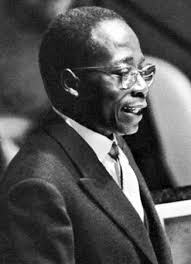
Barack's only serious failing is that he arrived kind of late in history. I think he means well, and he's a classy guy. It was good that America finally elected a minority, especially an African-American, to the nation's highest office, even if we waited until what may prove to be the waning days of the Empire. Naturally, a black man capable of election by the general population in this country is not going to be Street; you know, like Stokeley Carmichael, one of my favorites from the Civil Rights Movement. Man, that guy could bring it. Barack reminds me more of Leopold Senghor (pictured above), the poet, academic, and political leader of Senegalese liberation from colonialism. Cool, sophisticated, kinda French (where he was educated and where one of his wives was from - Normandy, in fact). Stokeley, on the other hand, was with the Student Nonviolent Coordinating Committee ("Snick"), got involved with the Black Panthers, and was altogether too hot for general acceptance.
It's probably true that Barack did not actually spend enough time in Washington's milieu before he became President. Realistically, maybe 4 years, and then he started running for President full-time. He had his eye on the prize. I think what he's coming up against is the basic reality of Washington, D.C. The business of the federal government, when you get right down to it, is the care and feeding of the military establishment, or in Eisenhower's phrase, the military-industrial complex. Here he is now submitting his own "supplemental" for the wars in Afghanistan and Iraq, to the tune of maybe $100 billion when all is said and done. The Republicans, faithful rubber-stampers when Bush was in office, will fight him on the bill because they've discovered a new, deep belief in fiscal prudence, so the ridiculous spectacle of the "anti-war" Nancy Pelosi marshalling her Demo charges to get "Barack's war budget" through the House will now entertain us.
If this sounds insane, it's because it is. The Republicans, of course, are not against the war, are not for fiscal prudence, and actually want to do everything they can to keep the money flowing to the Pentagon, to defense contractors and to their lobbyist friends. But they can safely fight Obama's war budget because the Democrats can't afford to have Barack defeated on the funding necessary to "wind down" the war in Iraq and rev up the war in Afghanistan, which he calls a war of necessity. Or did in Cairo, anyway. So the Democrats now have their war, but the main thing, probably, is that whichever party is in power, some war or other is going to be "necessary."
Wars are good for a major American industry, that industry being war itself. The United States is on a permanent war footing, and the MIC spending necessary to support it sops up most of what the federal government calls its discretionary budget. About half the money Congress "spends" each year, after all, is simply the in-and-out of the entitlement programs, which have their own dedicated tax systems and have been self-supporting. These programs are of no real interest to Congress. The discretionary half is where the action is, and about 64% of this goes to the MIC. So peacenik Senators like Barbara Boxer are nevertheless thrilled that the Pentagon is moving ahead with plans to build a redundant aircraft like the C-17, which is built, coincidentally, in California, and the equally useless and unnecessary B-22 is built in Georgia, so Saxby Chambliss will champion that one.
Useful programs like socialized medicine for the public at large do not have a constituency large enough to change this inertial force, so they're doomed to failure. This is the essential difference between the U.S. and countries such as France and Germany, which have broad social safety nets but without the concomitant burden of a huge military establishment. Trying to "Europeanize" the U.S. is doubtless beyond even the rhetorical skills of Barack Obama, and even Leopold or Stokeley would struggle with that one. Wars R Us. Constant war keeps all that military spending credible (it flagged under Clinton because he just didn't have anyone he could rationally engage in a large land war), it keeps army recruitments up in a time of general unemployment, it enables lots of medal ceremonies and promotions, gives a raison d'etre to West Point and Annapolis, to use a phrase Monsieur Senghor might have employed. Selling weapons remains one of our better export businesses, after all, and it doesn't have much company. So that in the same sense that New York is the financial capital of the U.S., and Los Angeles the movie industry's center, Washington is war headquarters central. It's what they do there, one way or another. We've been fighting wars so long no one can even remember why we're doing it anymore.
My guess is we'll keep it up till it breaks us, which, actually, might not be that far off.