June 02, 2009

North Korea Plans North American A-Bomb Test


June 2, 2009 (New York Times) - In a relentless approach to raising both the stakes and the visibility of his country's atomic bomb program, President Kim Jong-Il announced today that North Korea's next nuclear test would be conducted in mid-town Manhattan sometime "within the next couple of weeks."  Having successfully tested a 13-kiloton bomb at an underground site in North Korea recently, the Dear Leader stated that he was in no mood "to fok awound" and served notice that his country's nuclear ambitions would not be deterred by Western pressure or threats.


Nevertheless, top Administration officials were quick to respond.  "This is outrageous and unacceptable," said President Barack Obama in answer to a question from Katie Couric in a network TV interview last night.  "America has shown restraint so far and has agreed to talk without preconditions to North Korea about its nuclear program.  But exploding an A-bomb at the corner of 57th Street and 7th Avenue cannot but retard the progress of these talks. I condemn this decision to detonate a nuclear bomb in one of America's iconic cities, a melting pot and symbol of all that makes America great, in the strongest possible terms."

Vice President Joe Biden joined the President in criticizing the latest North Korean initiative. In an interview on "Hardball" with Chris Matthews, the garrulous VP laid it on the line in particularly candid terms:  "You know, I just don't get this guy, Chris.  I mean, what's in it for him?  He's got the poofy hair and he looks like he could use a little sun. The family name's Kim, for all I know he's the real deal, it's not personal. People talk about my hair, too, sure, but this is an A-bomb, for crying out loud, and he's setting it up to go off right in midtown.  I know that area, there are some good restaurants there, the Knicks play right down the street at the Garden, and hey I know what people are saying, the Knicks, will anyone even notice?  But that's neither here nor there, Chris, I mean for crying out loud, this is way, way, way over the line. I'm telling everybody I know not to go anywhere near New York till we get this thing sorted out.  I mean, come on.  An A-bomb?"

Secretary of Defense Robert Gates, in what is becoming characteristically frank and unguarded language, admitted that the U.S. had "taken its eye off the ball" in fighting the ghosts of the 9-11 hijackers by launching two wars against Muslim countries, neither one of which any hijacker ever visited or called home.  "I frankly believe we have misallocated American resources by overemphasizing the need to invade countries which use Arabic letters or have mosques or something," said a stern and obviously concerned Gates.  "We have managed to burn through enormous amounts of money, gotten lots of people killed, including tons of our guys, so they definitely look like real wars, so that part appeals to me. We just haven't been clear on why we're doing it, and that's probably because we're not sure. But while we've been occupied with that, Kim Jong-Il has gone ahead with this atomic bomb program, and now he's tested a big one underground, and he's testing missiles, and while we were surging in Aghanistan he went ahead and set up this nuclear blast in midtown Manhattan and I'm thinking there could be hell to pay if he succeeds with this one."

Press Secretary Robert Gibbs, at the White House press conference this morning, echoed the comments of other Administration officials.  "The President has a lot on his plate, and believe me we didn't plan to start our term in office with the worst recession since the Thirties, and now this, an A-blast on 57th Street, but President Obama has said many times that we're going to have to be able to deal with a number of crises all at once, whether that's the ideal way to do things or not.  So this Manhattan bomb is something that will get a lot of his attention, and he'll work with the Congress in a bipartisan way to come up with an appropriate response."

Harry Reid (D-Nev.), Senate Majority Leader, said that a focused response from the Senate was highly unlikely.  "We just don't have the 60 votes," he said.


June 01, 2009

Slouching toward the poor house


Maybe it's just the way things are now.  The fossilized approach to all problems, no matter how big, is all that's possible.  I read Michael Moore's take on the failure of General Motors, something he's followed since the early days of its decline (his "Roger & Me" being his first big movie hit), and I think he's right.  In part, of course, I think he's right because it's what Waldenswimmer said several months ago.  The auto factories owned by GM should be transformed into modern transportation factories building mass transit (light rail) and high speed rail locomotives and rolling stock, with some aspect of its ongoing car business used to build fuel-efficient hybrids and electric cars.  It's time to phase the internal combustion engine out, and put all those trained factory employees to work building technology with a future.


Michael cites the example of World War II as precedent: during the war, GM stopped building cars and converted to tanks, jeeps and machine guns, among other war-related manufacturing. GM did it fast, too, and did it successfully.  The United States government has invested enormous sums of money in attempts to resuscitate General Motors, more than the capital stock of the company is actually worth.  Why not use that stake to simply buy the corporation and its subsidiaries?  Why this idea that GM is going to "emerge" as profitable by tweaking its economic model?  Why, in other words, this pointless and very expensive magical thinking?

Well, for one thing, FDR isn't President.  The current crop of Democratic "leaders" just can't pull the trigger, and that includes Obama.  They keep thinking that thinking small will succeed, that an incrementalist approach to overwhelming problems will restore the U.S. economy from its present moribund state to a thriving, job-producing colossus. It won't.  The recession may "end," but the U.S. economy will nevertheless be stuck at a level of affluence about 40% lower than when the crisis began in July, 2007.  The only way out is to create jobs, and the only practical way to create jobs is to move to a completely different energy paradigm.  Obama keeps using the word "green" as kind of talisman; well, here's a chance to actually implement a "green" solution on a massive scale. 

FDR established Social Security by refusing to believe that the country had been reduced to a state where old folks could be forced to subsist on tins of cat food heated on gas rings.  Obama, faced with a similar crisis in healthcare which affects 50 million people, is stalled in his approach because the medical insurers and hospitals don't like his "public insurance" element, so the "negotiations" have broken down.  This is how blatant the control of business over government has become: if private industry says no, then we can't do it.  So forget single-payer, as Waldenswimmer also said a long time ago.  Blue Cross doesn't like it.  So the effect of all those uninsured Americans is that every year 18,000 Americans die unnecessarily, according to a study by the Institute of Medicine.  Six times as many people die every year as died in the 9-11 attacks, yet we've turned the world upside down to deal with those 19 hijackers who casually walked through our security systems and trained themselves to destroy us using our flight schools, but the expansion of Medicare to cover everyone cannot be done, because...a large group of insurers and hospitals are making more money the other way.  So, instead of actual medical care, let's put all the medical records online.  That should do it, and I'm sure there will never be a problem with hackers accessing the medical records of every living American and broadcasting them all over the world.  Meanwhile, it will look like we're doing something, and that's always the key.

As I said before, I've been reading this history by David Halberstam about the Korean War, particularly that first terrible winter of 1950-51, when the delusions of Gen. Douglas MacArthur led the Marines and Army into a terrifying trap in the far north of Korea.  Surrounded by 300,000 Chinese infantry which MacArthur said simply weren't there, the field leaders of the Marines trapped near the Chosin Reservoir and the Army farther west had to think for themselves.  The most creative, brave and resourceful of those leaders, such as General Paul Freeman of the Army and Gen. O.P. Smith of the Marines (picture above), figured a way out that avoided massacre.  Sometimes doing timid, half-hearted measures simply doesn't work.  FDR recognized that reality.  The current batch of corporate errand boys in Congress and the White House simply don't.  It's quite possible to incrementalize your way to the poor house.

May 31, 2009

La plus ça change, plus c'est la même chose


8:00 am, Oval Office, Monday, June 1:

Prez O enters through side door.  Robert Gibbs, Press Secretary and Rahm Emmanuel, Chief of Staff sit on sofa waiting. They rise to greet the President.  O bumps fists with both, slaps palms, then bumps elbows.  The two white guys, still getting familiar with routine, consume about 30 seconds of meeting with ritual.

O (sitting down):  What up, Bobby?
Gibbs:  General Motors is going under today.
O:  Bummer.  On my watch.  How does this play, Rahm?
Rahm:  We've positioned it well.  It's a penny stock now, everyone expected it.  Getting Soto nominated late last week was a stroke.  We've had 24/7 cycle on that one while the Republican nut jobs went nuclear on her, so no one will notice when a couple hundred thousand more guys are thrown out of work.
O:  Cool.  The timing worked.
Gibbs:  Sure did.  High five!
O:  We don't do that one anymore, Bobby.
Gibbs:  Right.  Yeah, it was Sonia from the jump, but holding off till you needed her played well. 90% of the questions have been about Sotomayor's racism.  Who gives a shit about General Motors or Kim's A-bomb?

(chuckles all around)

Rahm:  It's almost too easy sometimes.  I'm starting to see how even Bush could pull this off.
Gibbs:  Candy from a baby.
Rahm:  Weird, though.  Where we're taking on water is this date night thing, the trip to New York.
O:  I was worried about that.
Rahm:  It's not playing.
O:  I promised Michelle during the campaign.
Rahm:  Big whoop, is how Peoria sees that one. 
Gibbs:  I'll need my catcher's mask this morning.
O:  You know how many times Bush took that 747 to Crawford?  How much that cost?
Rahm:  Right.  It's a talking point.  
Gibbs:  Where we're vulnerable is we used to talk about "change."
O:  We saw an ethnic play, man.
Rahm:  Which is good.  Bush would have gone in for a remount of "My Fair Lady."
Gibbs:  The Gulfstream is better than Air Force One, but it's got that odor of Wall Street around it.
O:  Were we supposed to drive to New York?
Rahm:  Thing is, you're supposed to be big on global warming.
O:  And?
Gibbs:  It's discretionary flying.  Of kind of the most self-indulgent type.  Entourage, special trip instead of when you're going to the U.N. or something.
O:  Shit.  Where we were these comments on Friday?
Rahm:  Plus, you know - the country's kind of out of work.  Your man Geithner is fighting tooth and nail to defend the Wall Street exec lifestyle, and then you join in.
Gibbs:  The optics are off.
O:  One frigging date night...
Rahm:  We need a flak-catching strategy.
O:  I"m not giving a Rev Jeremiah speech.  Forget it.
Rahm:  Doesn't call for that.
Gibbs:  I'm going to get a lot of Q&A on the cost of this thing.
O:  What's the play on that?
Gibbs:  Better not to say. That's our line so far.
Rahm:  Of course, there's the transparency thing.
Gibbs:  They're starting to say we're transparent about being opaque.
O:  Do I apologize?
Gibbs:  That looks weak, especially because it will make it look like you're apologizing for fulfilling a promise.
O:  Well, hell...
Rahm:  It's a box canyon.  You'd be apologizing for poor judgment.
O:  The idea was the date night thing was good PR.  Where'd we go wrong?
Gibbs:  I think we got cross-ways on our images, that's all.  Self-indulgent power broker versus family man in love with his wife.  We played into a trap.
O:  Just soldier through, Bobby. Get on their case about not asking about the A-bomb.  Or GM.
Rahm:  That's the stuff, Barry.  You're getting the hang of this now.

(meeting concludes)


May 29, 2009

Who's Next?


"First we got the bomb,
but that was good,
'cause we love peace and brotherhood..."

Tom Lehrer, "Who's Next?"

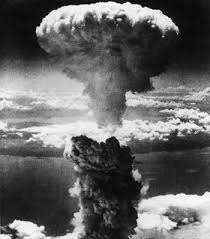
It appears that North Korea detonated a 13-kiloton atomic bomb not too long ago, burying it six miles deep in a huge cavern to disguise detectable details about the blast.  It was most likely an implosion device similar to the "Fat Man" design first tested at Alamogordo by the United States in the Trinity shot, July, 1945.  A Fat Man bomb was detonated over Nagasaki on August 9, 1945, with horrific results, as we know too well.  The kiloton yield of this bomb was similar to Nagasaki.

While many Western commentators are quick to analyze Kim Jong Ill's dogged determination to go nuclear as an effort to deter Western (and more specifically American) invasion, I have a feeling it's not as simple as all that.  That's a comforting analysis used by those who are somewhat over-ready to blame America for everything, and while there's always much to criticize about a country which is so influential and controversial, it seems more likely to me that Kim wants a bomb because he's nuts.  Arguing that he wants a bomb to "protect" his North Korean subjects is doubtless a contradiction in terms; if he actually cared about North Koreans, they would not live in a dirt-poor police state, subject to immediate internment (and probable death) in the Yodok Concentration Camp, which may rival Auschwitz in terms of sheer numbers killed at this point.  If one argues that Kim is simply being rational and self-defensive (as is argued often when talking about Ahmadinejad), then it reverses the argument and places the onus on the United States to behave rationally.

Yet, as noted, there's no particular reason to believe that Kim Jong Ill is rational at all.  He is hypothesized as rational in order to fit into the scheme of a predetermined argument, which is that all the United States has to do is behave itself and nothing bad will ever happen, at least where North Korea is concerned.  Rational motives and self-regard are imputed to Kim: he wouldn't be so foolish as to launch a preemptive strike against the West Coast of the United States because his own country would be vaporized in return.  He would, in other words, be committing suicide.  And as we know, no one ever commits suicide.  So we can rule out that danger.

Thus, irony aside, we can see that there's no comfort whatsoever in such simplistic analyses. Kim Jong Ill may be completely nuts and he may be building an atomic bomb so he can use it against another country.  His treatment of North Koreans strongly suggests that he is indifferent to
their fate.

So what do you do when a nut owns an atomic bomb?  We can't really say for sure what he'll do with it.  Those in possession of nuclear technology, such as A.Q. Khan of Pakistan, sometimes become promiscuous about sharing their secrets.  Khan was probably instrumental in the development of both North Korean and Iranian technology.  So what if Kim Jong Ill decides to sell a Fat Man to al-Qaeda?  Is that so far-fetched?  He always needs cash, and al-Qaeda has a lot of Arab (particularly Saudi) bankrollers.  We know that from the famous 28 redacted pages in the 9-11 investigation - Bush & Cheney's intervention to avoid Saudi embarrassment.

"A number of U.S. government officials complained to the Joint Inquiry about a lack of Saudi cooperation in terrorism investigations both before and after the September 11 attacks. [---redacted---]. A high level U.S. government officer cited greater Saudi cooperation when asked how the September 11 attacks might have been prevented. In May 2001, the U.S. government became aware that an individual in Saudi Arabia was in contact with a senior al-Qa'ida operative and was most likely aware of an upcoming al-Qa'ida operation." 
That part escaped redaction. If they let that part out, you can imagine how explosive the stuff was that they suppressed.  Still, Cheney, I must admit, has always focussed more than most on the danger of a nuclear explosion within the United States.  Now we can be assured that there is an anti-U.S. nut with a functioning atomic bomb.  It's doubtful it's ready for assembly atop one of those Taepodong missiles - that's very advanced stuff.  We began by dropping bombs out of B-29 bombers in 1945, a far more forgiving technology since the payload doesn't have to withstand all the G-forces involved in intercontinental ballistics.  But maybe one reason Kim buried his bomb so deep was to conceal the bomb's radioactive "signature:"  that particular array of radiation peculiar to specific designs.  That's just a hunch of mine.  If you were going to sell your bomb, that could have obvious advantages.  It might make it harder to trace the origins of the "device."  Would the United States vaporize North Korea on the suspicion it was Kim's bomb?

It's a horrifyingly fascinating subject because of the sui generis nature of nuclear weapons.  You can't fit them into the usual intellectual frameworks for discussing foreign policy. What we now know about even "limited" atomic bomb exchanges is that they will do so much damage to the Earth's ozone layer that it's folly to consider atomic warfare a "local" phenomenon.  If India and Pakistan exchange 30 or 40 atomic bombs detonated over cities, that may doom the Northern Hemisphere to unsustainability.

The subject has always perplexed me.  Nuclear weaponry is a subject so fraught with terror and existential implications that it's impossible to analyze it conventionally.  You have to invent a new kind of survival thinking in order to approach it intelligently, giving up the usual categories of "liberal" and "conservative" positions and becoming absolutely practical.  It's not a question of whether we "ought" to have the bomb and they shouldn't, or whether each "sovereign" who signs the Nonproliferation Treaty should be allowed to develop nuclear technology.  Those are nice, formal arguments which may win the debate for your team but do not alter the fundamental question.  A nut has the bomb; what are we going to do about it?

May 27, 2009

Men, Not Laws, Part 2


I mean, don't get me wrong. The most disappointing thing to me about Obama's adoption of Bushian Doctrine on Guantanamo, military commissions, "preventive detention," and escalation of the war in Afghanistan, state secrets (which he has actually expanded), and shielding from prosecution any violations of FISA or the Convention Against Torture, is that the most predictable result of such passivity and acquiescence has now come to pass.  Since Barack is a liberal hero, he has succeeded in educating the half of the country which resisted Bush's depradations against the Bill of Rights and lawless approach to governing that it was, after all, okay.  You can feel it in the air. Except for a few holdouts, such as the American Civil Liberties Union and Center for Constitutional Rights, promotion of the Bill of Rights is seen as part of a "leftist agenda."  The most dangerous thing about Obama's enthusiastic adoption of the Cheney doctrine of "preventive detention without trial and without charges" (which so clearly violates the 5th Amendment rights of "any person" (not just Americans) is that it now vests in people the final decision on whether someone is set free or imprisoned.  Not a set of laws.  Not a predictable system of procedures.  The say-so of a politician.


A long time ago I wrote about the real meaning of the Jose Padilla case.  I saw it as Cheney's experiment.  He was curious whether he could arrest an American on American soil and imprison him indefinitely without charges and detain him in an American brig without (a) a public outcry and (b) Congressional interference.  He succeeded on both counts.  That's the thing you have to concede to Dick: he thinks big.  It was a test case to determine whether the Democrats in the House and Senate were the pussies he thought they were.  I watched and listened for that impassioned speech, that convening of hearings by Harry Reid or Nancy Pelosi, which would spell out why the Padilla case was so outrageous and outside the bounds of ordinary American judicial procedure.  Never happened.

"9-11 changed everything."  So the self-protective solons in Congress were not going to do anything to make themselves look soft on terrorism.  Never mind that Padilla was never charged with the crime he was arrested for, the "dirty bomb" plot which Rumsfeld made up.  Instead, he was driven nuts through years of solitary confinement and abuse so that he could not effectively participate in his own defense in a conspiracy case he was sucked into down in Florida.

Could that happen to you or me?  Well, let's see.  If you're reading this, you're probably an American citizen, although it's probably worse for you if you're in America and you're not. Maybe you're on American soil right now.  And you haven't participated in a dirty bomb plot either.  Thus, so far, you're pretty much exactly where Jose Padilla was.  You're certain, however, that it won't happen to you and regard the suggestion that it might as paranoid.  You're probably right.

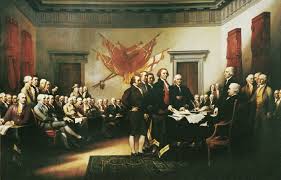
The Sons of Liberty in the late 18th Century in this country, however, didn't look at things that way.  One of their biggest gripes against King George III was his practice of "executive preventive detention" and abridgement of legal process.  It's right there in the Declaration of Independence, which hangs on my office wall:  "For depriving us in many cases of the benefits of trial by jury."  They weren't going to stand for that, because that's a tyrannical power, to declare the freedom or imprisonment of individuals on the basis of "executive decision."  And they included the 5th Amendment in the Bill of Rights:

No person shall be held to answer for a capital, or otherwise infamous crime, unless on presentment or indictment of a Grand Jury, except in cases arising in the land or naval forces, or in the Militia, when in actual service in time of War or public danger; nor shall any person be subject for the same offense to be twice put in jeopardy of life or limb; nor shall be compelled in any criminal case to be a witness against himself, nor be deprived of life, liberty, or property, without due process of law; nor shall private property be taken for public use, without just compensation.

I understand the counter-argument: the world is now too dangerous for Constitutional rights. It's better to abridge liberties in the case of the individual in order to ensure the safety of the larger citizenry.  It seems to me, however, that if we're going to do that, we should amend these charter documents.  There is no serious argument that Padilla, for example again, was held beyond the "48-hour" period of permissible detention before presenting charges against him.  He was held for years with no charges.  He was denied his right to counsel.  He was denied his right to a speedy trial, and he was deprived of his life and liberty, for years, without due process of law.  

What is vexing about Obama's decision to make the Padilla treatment standard procedure is that I'm almost certain George W. Bush was unaware that the Bill of Rights existed.  I'm sure he never read them.  Barack, on the other hand, studied them and taught them.  He's aware of what he's doing.  And what is it that he's doing?  I think he wants to be taken seriously as a guy who's just as tough as Dick Cheney.  I think that's the image he and his handlers are working on. And one has to admit that it looks mighty tough to do unconstitutional things to protect the country.

So I said yesterday that Barack's preventive detention scheme looked "silly" and inconsistent when you compared it to the fate of terrorist suspects who are actually tried and convicted and given determinate sentences and ultimately released, and someone asked me what I meant. So to spell it out: presumably there will be Guantanamo inmates who are tried and convicted, one way or another, and given sentences which they outlive.  This has already happened in the very few cases which have actually gone to trial in the 7 years Guantanamo has existed.  So these convicted terrorists will then be eligible for release into the wide, wide world.  At least I assume they will be.  So we then would have these two categories of terrorist detainees: the Category 5 detainees who have never been charged because they can't be convicted but are considered too "dangerous" to release; and terrorists who have actually been convicted, proved guilty, and are now eligible for release.

That seems completely crazy to me.  It's the sort of arbitrary, nonsensical thing that begins to happen when you start operating outside the rules because of "special circumstances."  This kind of lawless approach spreads like a contagion until the system is no longer reliable or fair. Thomas Jefferson and John Adams understood such things; I'm not sure there are many people around today who still do.

May 26, 2009

A nation of laws


I was probably as surprised as the next bleeding heart liberal that it would be Barack Obama, a Constitutional law professor, who would come up with the idea of formalizing our "perpetual preventive detention without charges or trial" policy for dealing with terrorist suspects.  I shouldn't say "suspects," actually; maybe "suspicious individuals" or "suspicious Muslims" would be closer to the mark.  In his recent speech, delivered ironically enough in front of a mural of the Constitution at the National Archives, Prez O outlined the 5 categories of individuals detained by the U.S. held at Guantanamo and elsewhere.  That actually would be a good movie title for Michael Bay or Ang Lee or one of those guys who concoct movies for teenage boys, mainly using an Apple computer instead of a camera.  "The Fifth Category."  That's not bad.  In fact, instead of writing this blog...


Anyway, the Fifth Category is defined as a bad guy who can't be tried for war crimes, or violations of U.S. law, either in a civilian court (U.S. federal district court) or a military commission (juris macropus rufus), because no conviction is obtainable. Thus, it follows that there's no sense in charging such a person with a crime.  What you might think follows from that is that you let the guy go, but not so fast.  If the Executive Branch concludes that such a person, while more or less immune from the legal process, is nevertheless "dangerous," then he's simply detained indefinitely.  For how long?  Well, the President hasn't really said, except to say that his version of the Great War on Terror (GWOT) should probably last at least another, oh, ten years.

This seems to imply that a Category 5 Detainee will be held until the GWOT is over.  However, as much as I respect President Obama's intellect, it seems to me he has made a fundamental error in logic here.  To declare the GWOT over, I suppose we have to be assured that no terrorists anywhere pose any threat to the United States whatsoever.  If we don't mean that, what could we mean?  The existence of even one Category 5 detainee (and let's face it, there are going to be a lot more than one), means that a corps of hardcore, dangerous terrorists remain alive.  If you let them out when the GWOT is declared over, then you've started the GWOT all over again. Suppose there were 19 Cat-5 Detainees.  Well, that's just the right number for another 9-11, isn't it?

So you can't let them out ever.  That's not fanciful, that's logic directly connected to the policy Obama announced.  So that leads to the next logical conclusion.  Why are we keeping dangerous Muslims alive in U.S. custody?  We can't try them, because we can't prove they've committed any crime, even in a rigged court room run by the Department of Defense and staffed with soldiers where hearsay is allowed and evidentiary rules are "relaxed" in favor of conviction (the Military Commission route).  We can't let them out because they're dangerous.  We can't set a release date because that is a contradiction in terms with the end of the GWOT.  

So wouldn't the most logical handling of dangerous detainees who can't be convicted in any forum simply be summary execution?  Isn't that what Pinochet did?  Hitler?  Stalin? Mao?  Of course that's what they did, because a dangerous dissident or troublemaker is most effectively put out of commission by killing him.  Then when the GWOT is finally over for good, no residual corps of terrorists remains in custody subject to release, except for the Supermax or military brig prisoners actually convicted with determinate sentences, but that's a logical problem which makes the whole idea of Category 5 a little silly and we don't want to do that.  We're being serious here.  Introducing all the logical inconsistencies in a piece of Right Wing pandering by the President is not my intention.

Or, alternatively, we could use the Due Process Clause of the Fifth Amendment to the United States Constitution, which really is more than just a backdrop for a pretty speech eviscerating civil liberties.  It's worked for a very long time.  Why not give it another shot?

May 25, 2009

Basic Rule of Hyperpartisan Politics


Carolyn Lochhead, a San Francisco Chronicle reporter, yesterday did her usual good work in laying out the essential nugatory facts about the national finances.  Her piece is here at http://www.sfgate.com/cgi-bin/article.cgi?f=/c/a/2009/05/24/MN2B17PDPL.DTL&hw=lochhead&sn=002&sc=718 .  What I like about her analyses is that she's already up to date on the essential vocabulary of Medicare, Social Security, GDP, national debt, et cetera, and so doesn't have to rediscover these facts each time she writes about our looming catastrophes.  For example, Ms. Lochhead appreciates that when a government official, say with the General Accounting Office, refers to the "Social Security Trust Fund," he means "nothing."  That is, Trust Fund = Zero.  This simplifies one's understanding. Similarly, she comprehends the distinction between the external national debt (owed to China & Japan) and the internal national debt (owed to the various "Trust Funds.") With respect to the second category, a "moral imperative" only will force us to honor this debt to ourselves, which is to say, the promises are not worth the paper on which they're written (and stored in that famous file cabinet in West Virginia).


Plus Ms. Lochhead can call on the estimable Alan Auerbach at Berkeley's Haas School of Business, another dismal realist and highly quotable academic pundit.  Alan points out that frightening things like the downgrade of U.S. debt to less than AAA (as has already happened to Great Britain) is one of those things "that don't happen until they happen."  Which is to say, they seem like bad dreams until you wake up and find they're  the surrounding reality.  Our national debt to GDP ratio would already ban us from membership in the European Union, so some inconceivable things have already happened. The Big Kahuna, of course, is the potential loss of the dollar's world reserve currency status.  Apres ca, le deluge.

The leading edge of Carolyn's article is President Obama's current budget, which borrows a buck for every buck it spends, which is to say that we've reached the point where half the federal budget is done on credit.  By humble analogy one senses immediately that a household budget done on the same basis is a bankrupt situation, but macroeconomics, we're assured, are not the same as such lowly analogies, so it's all good. Increasingly, it is the external national debt that is being increased, that is, real money owed to real creditors and not debt we can erase by passing legislation stating, for example, that Social Security is no more.  The national debt, probably by not later than 2020, will stand at $20 trillion, and probably 2/3 of that will be real external debt.  Thus, the real external debt will = current GDP.  We've come a long way, baby.

It's hard to say what, if anything, we can do about any of this.  I suspect nothing.  Which brings me to my Basic Rule of Hyperpartisan Politics.  We have two political parties who take turns running things in our country. When one party is in power, the other party lusts for power and will resort to anything, even treason and actively working for the deterioration of the American standard of living, in order to regain power. Sometimes this is said openly; the official spokesman for the Republican Party, for example, Rush Limbaugh, stated candidly that he hoped Barack Obama's economic recovery would fail.  That way the Republicans could ascend to the throne and resume cutting taxes, exacerbating the debt problem, and increasing the military budget, so the Soviet Union will fall.  Certain ruts, they can't get out of.

A party wishing to retain power cannot afford to take any action, therefore, which risks short-term reversals.  In our everyday lives, we probably recognize there are times when one must retrench, reeducate ourselves, sacrifice, in order to move forward again. This is part of the natural cycle of life.  But such rationality is impossible in American national politics.  For example, the rotten-to-the-core banking system, overloaded with bad debt built on reckless gambling (itself enabled by repeal of the Glass-Steagal Act), could have been taken into receivership by the United States, its creditors and stockholders wiped out and only its depositors protected under FDIC rules.  Then, over time, a solid banking system built on actual regulation and legitimate business could have been rebuilt.  So, instead of lending or "investing" about $12 trillion in federal funding (money which we obviously don't have), we would have used the regulatory and police power of the American government to achieve a different system.

But that would have taken time - probably a lot of time.  A great deal of economic and financial dislocation would have occurred, including among the all-important Big Rich/Campaign Donor Class, and with the attention span (and comprehension) of John Q. Public, the Republicans would have had a field day with such a "responsible" approach. You can multiply examples. Rather than lending money to General Motors, this bankrupt company could be allowed to go bankrupt.  Michigan would revert over decades to seasonal farming country.  The money thrown away could have been invested in mass transportation, such as railroads run on alternative energy, technologies with real futures, rather than "shovel ready" projects such as repaving freeways and building more roads under the Stimulus Package.

On and on.  Nothing can be done unless the short-term fallout can be controlled.  The theory is that the long-term consequences (such as bankrutpcy of the country) can be disguised or deferred, but losing power is something that happens NOW. Yet some problems simply cannot be rationally solved without a period of loss and retrenchment, because you can't always continue to invest and support obsolescence while creating innovation.  There simply isn't enough money or human capital to go around.

Thus, let's face it.  The country cannot be fundamentally changed. We've passed that Rubicon. That is why "healthcare reform" has already fallen apart.  To fix healthcare, you have to get rid of the for-profit basis of the system. The party which does that will lose the financial support of Big Healthcare (Pharma, Insurance, Hospitals), confuse and rattle the general public, and thus be out on its ear.  

Relax, in other words, and enjoy the ride.  Quell thy reformist tendencies and watch, with fascination, as Nature, which always bats last, steps into the box.

May 21, 2009

Distinctions without a difference


Admittedly there is a fine line between a skeptic and a crank, and one sometimes finds oneself crossing it unawares, especially if you're in the semi-regular habit of blooging (my portmanteau word for blogging and boogeying at the same time - I haven't checked to see if Maureen Dowd has stolen it).  For example, those who still spend most of their free time (and that's mostly what they must have) perusing the Warren Commission Report for evidence of the Mother of All Coverups probably belong in the Tin Foil Hat Brigade.  But the line is not always clear.  For example, did the CIA introduce crack cocaine into the United States as a result of the work it did for the Contras? What did make building #7 at the World Trade Center fall down on September 11, when no plane actually struck it?


You can't always tell what's really going on.  In the heyday of the Soviet Union, no sane, ordinary citizen of that country ever believed anything the government said; if it was published in Pravda, that was all the proof needed that it was an Official Lie.  The government could lie all the time because there was no effective competing party or group - the Commies controlled everything, the organs of government, the organs of the media.  If the citizenry didn't like them, it didn't matter.

I think some of these elements have taken root in the American system, and the germ of the idea, for me, resulted from reading Dmitry Orlov's writing on American politics.  He lived through the final years of the Soviet state and witnessed its collapse.  What he says about the U.S. is that we now have two Center-Right Parties which no longer have to respond to the actual needs of the citizenry.  There certainly are differences between the Democrats and Republicans and trivializing those differences is a mistake.  The problem is that the differences between the parties are not significant enough to make any real difference in the lives of ordinary Americans, and the ordinary citizen has no one else to vote for.  In effect, the so-called Two Party System has morphed into something akin to the PRC in Mexico during its long tenure of one-party rule, or similar to the Communist Party in the Soviet Union between 1917 and 1991.

Take one of my favorite examples, the Crime of the Century by which Congress stole the Social Security Trust Fund.  This was a $2.5 trillion heist.  There is no serious argument that anything else happened; in the early 1980's, Congress foresaw, or at least pretended to see, that the massive retirements of the Baby Boom generation starting just...about...now meant that the system would be insolvent unless FICA taxes were raised to create a trust fund of real money to make up for the short-fall in revenue caused by the retirements and the consequent drain on the system.  Congress took these large annual surpluses and spent them as part of general revenue, replacing the stolen money with Special Issue Treasury Notes, that is, IOUs.  This year the Social Security surplus is down to $3 billion; in better years, in the 1990s, it was closer to $200 billion.  So you don't need to be a swami to see that the inflows are about to become insufficient to pay the outflows, especially as we shed jobs at the rate of 500,000 per month and the Baby Boomers are now drawing on Social Security in increasing numbers.

If Barack Obama were really, really honest, in the old fashioned sense of that word (that is, a commitment to telling the real truth), he would stop with the civil liberties speeches for awhile and explain what happened to the trust fund in just the terms I used above.  Because that's what happned.  He would not talk about "reform" of Social Security (as Bush did before him), or means-testing or raising the cap on FICA taxes to bring in more money or reducing benefits.  He would lay it all out, the actual truth about what Democrats and Republicans did with the money, and then trace where the surpluses were spent, which was on defense.  He would then honestly discuss the excesses of the defense and security budgets, and the costs of fighting these constant wars of choice in Iraq and Afghanistan and elsewhere, and tell us that since that's where the money went, that's where he's going to get it back.  He would place the ultimate Sacred Cow on the altar of politics: the Defense Budget.

He won't do that.  He won't do it because, fundamentally, he's part of the system.  Calling foul on his co-conspirators in government, the operatives of the Democratic and Republican Parties, just isn't done.  It makes them all look bad.  So instead he will spend his time telling us why indefinite preventive detention (the hallmark of tyranny, according to Thomas Jefferson) is actually okay, and that it's better to conceal the truth and suppress photographs than to be honest about what we've done, because, again, it makes us all look bad.

And never a word about why the security of our retired senior citizens who depend on Social Security has been imperiled because of Congressional malfeasance and criminality, and never a word of explanation as to why we need to spend more on defense and security than the rest of the world (and all our "enemies" included) combined.  If there is actually a difference between that approach and the lies of Official Truth, I would be curious to know what it is and why the distinction matters.  I don't see it.  I don't see it in this "landmark" credit card bill the Senate is currently congratulating itself for, the elimination of a lot of dumb upticks in rates because of late payments, et cetera.  And yet Congress never addressed the actual means by which the banks fleece the naive and financially unsophisticated - the ridiculous, usurious rates charged by credit card companies in the first place.  25 to 30%?  Can Vito parked in the black car across the street cut you a better deal?  

Congress won't touch that because they don't work for you, and they don't work for you because they don't have to anymore. You want the batshit crazy Republicans or the corrupt Democrats?  Up to you, but don't say you didn't have a choice.

May 18, 2009

Land of Happy Motoring


This is kind of interesting - it's a graph, or Greendex, of public use of transportation by country.  Generally (in reading the graph), the more bluish a country's bar graph is, the more frequent is the use of public transportation. Russia ranks #1; the United States ranks last.

Of course, such graphs must be described and analyzed in a value-neutral way.  This graph does not, in my view, impugn Americans in any unique way for being energy hogs.  As you go down the list (to the Germans and French, say, who also don't score that well), you might well conclude that to the extent that a prosperous nation has a good highway or autobahn system, and can afford good autos, the less likely are its citizens to use public transportation. I've seen this myself in Germany - they have such great trains (I think the best in the world) - why do they drive so much?  But they do.  They prefer the convenience, the flexibility, and besides, trains are kind of expensive over there.

The United States, of course, is the apotheosis of the car culture.  Public transportation, except in some congested urban areas where cars are practically impossible to use (Manhattan, for example), Americans look upon as faintly distasteful, the result, perhaps, of bad choices in life.  In movies and popular songs, a bus ride is usually associated with either a period of bad luck ("Midnight Cowboy" or "The Trip to Bountiful") or a sense of being lost (Paul Simon's "America").  Bus stations are usually located in a part of the city where a respectable person wouldn't go for any other reason.  And since that's true, why go there for the bus?

So my view is that the most interesting thing about America is that, for the human species as a whole, we're always a leading indicator.  We're the fattest people on Earth, among the most poorly educated (versus other industrialized nations), the most sedentary, and the biggest energy hogs on the planet. In all these senses, I think we're the most "advanced."  We merely manifest or demonstrate what human beings tend to do and be when given the economic chance to be lazy.   We still own the best real estate in the world, a plenteous, resource-rich, varied, variegated sea-to-shining-sea Eden that many people the world over understandably covet.  We've treated this birthright like a toilet, of course, but that's another matter.  The point is that Americans, over the last 60 years or so, have simply done what any subset of uniquely blessed Homo sapiens would have done with the same advantages: we abused them.

That degenerative process actually underlies the "economic crisis" currently weighing Amurrica down.  While we glorify the Horatio Alger story, and praise the virtues of diligence and thrift, in truth all of that is actually a bummer.  Americans, for a brief period at least (about 20 years) figured out how to cannibalize the capital stock built diligently  up over generations by pledging it as collateral for debt.  We gave various names to this drift: "the Information Economy," the "Service Economy," etc., but what these euphemisms stood in for was the detrmination to get away from the grueling routine of manufacturing and farming jobs (which actually built the country) in favor of a kind of National Trust Fund Existence.

It actually worked for awhile, especially in those halcyon early days of the Bush Administration, about 2001 to 2005, where all regulatory oversight was dispensed with entirely (a process given a big boost by the Clinton Administration).  Lending and borrowing became the main industry in the country.  Alas, the laws of financial thermodynamics reasserted themselves in 2007 and the unwinding process began.  We're in the early stages of that.

As our fortunes sink, it will be interesting to see if our own bar graph above gets bluer.  Not out of virtue, of course, but because it may be the only way to get around.  In the end, that's the only reliable motivator of thrift and conservation - it must be thrust upon us.  It may soon be true that the only autos available for sale in the United States are foreign brands (although they may still be manufactured in the USA), and as the dollar sinks because of unsustainable federal trade and budget deficits, these autos will be out of reach for more and more former "trust fund babies."  

Cathy, I said, as we boarded a Greyhound in Pittsburgh,
Michigan seems like a dream to me now...


May 17, 2009

Let the Lone Star Republic Go in Peace


I was extremely disappointed by Keith Olbermann's uninformed, smarmy rant on his "Countdown" show the other night when he took Governor Rick Perry of Texas (maybe someday the "President" of Texas, or Generalissimo?) to task for mentioning again the possibility that Texas might secede from the Union.  His voice dripping with sarcasm, Olbermann "reminded" Perry of all the benefits of statehood his Republic would forfeit, and mentioned specifically such matters as federal aid, Social Security and the national defense.


Olbermann should have checked one key statistic before launching into his idiotic diatribe: according to the latest figures available (two years ago), Texas ranked 35th in the Union in return on investment (ROI) for federal taxes paid.  For every dollar that Texans send to Washington, they receive 94 cents in return.  (California's situation is much worse; there the figure is 78 cents).  This is a common misunderstanding about the "value" of statehood.  For most prosperous states, it's a net loss to be a member of the United States.  

I'm sure that Rick Perry is aware of this, even if Keith Ol'Blowhard is not.  Perry is simply doing the job he was elected to do: govern the people of Texas.  Their interests should be primary in his choice of policy, and it's become obvious to Perry (and to Sarah Palin's husband, to choose another loud and leading advocate for secession, this time for Alaska) that statehood simply comes at too high a price.  

For example, take a look at one of Olbermann's exhibits for the Union: loss of Social Security benefits.  In the first place, any prosperous state suddenly relieved of the duty of paying in FICA taxes to the federal government would free up enormous amounts of revenue for local use.  It has become a taxpaying fact of life that most Americans pay most of their federal taxes into this pay-as-you-go system; and since it's pay as you go, suddenly cutting off the federal payouts has no long-term effect other than allowing the citizens of a state (such as Texas) to escape the looming bankruptcy of the system and to replace it with something with a future.  The recent report from the Congressional Budget Office underscores how near-term that Social Security insolvency is.  Currently, the system produces only a $3 billion surplus above payouts, and while the forecast is that Social Security will not "go negative" until 2016, in fact this prediction is built on completely unrealistic economic guesswork.  Within a couple of years, at the present rate of unemployment, the system will be underwater.

So the "benefit" of the Social Security system is a mirage, the result of choices made by that vaunted federal legislative body (and Clown College), the U.S. Congress: they spent the 2.5+ trillion dollar surplus built up over a generation on high-tech toys for the military so we could fight unnecessary wars, replacing it with a file cabinet full of IOUs.  That's the sort of benefit you get from statehood: to see your tax payments go up in smoke.

Texas could field its own military - most of its citizens are armed to the teeth now.  With payroll taxes kept in Texas, Texas could easily devise its own solvent pension system and universal healthcare.  It's a big farming state so there will be no food shortages.

So as you're fond of saying to everyone else, Keith: STFU.  If Texas wants to leave the Union, let them.  It might, you know, start something.  Yugoslavia's breakup came about because Slovenia, a northern, European-style economy with close ties to neighboring Austria, wondered what the hell it was doing in a federation with a bunch of insane Southern Slavs and Muslims fighting endless religious pogroms and civil wars.  They announced they were leaving; essentially, the rest of Yugoslavia, too busy killing each other and never doing a damned day's work anyway, let them leave without firing a shot.

Texas: Don't Mess With It.  Perry is operating in the grand tradition of Stephen F. Austin, the Father of Texas, who lived just long enough to see the establishment of the First Republic in 1836, yet mercifully died before the tragedy of statehood in 1845.

May 11, 2009

Recycled Politics


I've been reading the last full book by David Halberstam, written before his recent, unfortunate death on the San Mateo Bridge in an auto accident.  A major loss to humanity and to the field of contemporary history.  This book is entitled The Coldest Winter, and it's about America during the earliest years of the Korean War, particularly 1950.  But one of the joys of reading Halberstam is that he believes in digressions and context, so that if he's discussing Douglas MacArthur he's sure to tell you the story of MacArthur's father, another general who not only fought in the Civil War but was the viceroy of the Phillipines following the Spanish-American War, in much the same way that Douglas MacArthur was viceroy of Japan following World War II.  Suffice it to say that Halberstam sides clearly with Harry Truman in the great controversy surrounding the decision to relieve MacArthur of his command of the Korean War, and that Halberstam agrees with the historians who believe MacArthur got a lot of American GIs unnecessarily killed in the north of Korea because of huge misjudgments about the intentions of the Chinese to intervene in the war.


Halberstam fills in context on the domestic front by describing the usual squabbling between Republicans and Democrats in the post-World War II years.  After the singular reign of FDR, the only president ever elected to four consecutive terms, the nation finally turned Rightward again in 1946.  The GOP picked up 50 seats in the House and 11 in the Senate.  It seems likely that the GOP would have won the presidency in 1948 if they had run Ike then instead of waiting four more years.  In that freshman class of 1946 the likes of Joseph McCarthy of Wisconsin came to town, and the Right wing criticism of Truman's liberalism reached a fever pitch, fueled by the long frustration of the GOP.  They had been kept out of power since 1932.

In those days the GOP was quite frankly the party of the well-to-do, the country club set, big business.  They believed in low taxation, hated all of FDR's social programs (which they called either "socialistic" or "Communistic" depending on mood and who was complaining), and favored big government spending only for defense.  Truman, on the other hand, worked hard to drastically reduce military spending in an effort to pay off the WW II debt.  The total national debt stood at $250 billion, a quaint number by today's humongous standards, but it was intolerable to the fiscally conservative Truman.

In other words, the political tango was danced much the same in 1950 as it is today.  The main difference is that the United States has lost most of its great middle class from the post-War era. The GOP, running out of fat cats to fill out their electorate, were forced during the Nixon years to employ the so-called Southern Strategy, in which they conned the Evangelicals and other non-pluocrats into voting Republican on the basis of "social issues" such as abortion, homosexuality and, most important of all, racism.  Prior to the "sell-out" of the Southern Democrats by Kennedy, Johnson and other turncoats who insisted on enforcing the 14th Amendment, even if it meant allowing black kids to go to school with white kids in Alabama, the Democrats could count on a solid South voting bloc.  Now the Deep South is actually the only remaining reliable stronghold of the quasi-theocratic Republican Party.  Even the uber-rich are probably evenly divided between Democrats and Republicans, since the wealthy own equal numbers of each in Congress.

One might call this "stability" through the generations, this pattern of recycled power traded back and forth between the Donkeys and the Elephants.  I'm more inclined to think of it as late-stage stagnation.  There is nothing in the Constitution, after all, which mandates or suggests that specific political parties must exist forever.  But they do in the U.S., and it's been these two parties for a long, long time, with no meaningful competition.  They never have any new ideas, and I think it's a direct result of this stagnation.  They have the same arguments, decade after decade, and they always use the same solutions.  Taxes go slightly up, then they go slightly down.  The defense budget goes slightly up, then slightly down.  We keep fighting wars of intervention, always on the same basic principle.  If we don't, whatever problem we're fighting will "spread."

The talk now is of the "death" of the Republican Party.  This won't happen.  The American people got tired of FDR's activism and internationalism and they voted in a bunch of isolationist, small government-big defense politicians.  The American people were appalled by the stupidity and incompetence of George W. Bush (they couldn't really believe they'd elected this clown) and they turned on the GOP with a vengeance.  But the American people will tire of the Democrats in turn, and then the other exhausted, ossified, no-idea party will be back running things again.

I think this is all a failure to adapt, of decadent processes which choke off real innovation and invention.  These parties limit their "initiative" and strategy to the preservation of power, which they pass back and forth on a fairly predictable schedule.  But it will take a generalized meltdown, not just an economic downturn, to get rid of them.  I think, however, they're quite capable of producing such an event, if not much else.


May 06, 2009

Land O' Prudes


Maureen Dowd in the New York Times wrote the political obituary of John Edwards today.  She didn't seem to regret it, really.  You might say she relished the opportunity, since scolding men for their wayward marital ways won her a Pulitzer Prize way back in the days when she was attacking Bill Clinton relentlessly for his shenanigans with Monica.  It's obviously a thing for Maureen, this all-too-common phenomenon of powerful men with a roving eye.  I suppose at some point she must have written about women who cheat, but if she has I missed the column.


Anyway, Maureen's elegy over John's political grave:  

John Edwards’s political career is over, and he’s being investigated by the feds about whether he used campaign funds to underwrite his affair. Nobody — except Rielle — has any interest in hearing from him again. Americans would have been relieved if the last we heard of him was that cringe-inducing “Nightline” interview last year, when he made the argument that he was a helpless narcissist and that he hit on Rielle when Elizabeth’s cancer was in remission.

Actually, Maureen should speak for herself and not all "Americans" and should not presume that "nobody" has any interest in hearing from John again.  I think that's a case of bluenose projection. Gary Hart survived his sexual escapades to become a kind of eminence grise of foreign policy matters, for example, so second acts are possible.  Bill Clinton is now widely revered as a political statesman by most Americans despite all the scolding he took from Maureen Dowd and the Republicans.

Still, there's no serious doubt that Dowd is right about Edwards's political career; as any kind of candidate for major office, he's through.  In that sense Maureen Dowd knows her America.

Recently, I was reading about Italy's Premier, the 72 year old Silvio Berlusconi,  and his marital difficulties.  Maria, his wife and 20 years his junior, has decided to seek a divorce in a very public way from Silvio because il cano antico has apparently become smitten with an 18 year old actress, on whom he dotes and lavishes gifts.  It's all like a cheesy Italian opera.  Maria might have known; after all, Silvio was 42 and she was 22 when he met Maria, an aspiring actress at the time.  And Silvio was married then, too, to the woman he left for Maria.  Silvio and Maria then carried on an affair for 10 years and had three children.  Then they got married.  And it was after all of that carrying on that Silvio was elected to Italy's highest office.

In recent memory we also have the case of Nicolaus Sarkozy of France, who was getting divorced so he could marry supermodel Carla Bruni virtually at the same time he was running for office.

So here's the question: why don't the Italians and French care?  Why are they able to make such a clear distinction between private "morality" (if that's even involved) and fitness for public office?  Asked another way, suppose it's all true about John Edwards.  Let's say that Rielle Hunter is the mother of John's baby and that they carried on an affair during his campaign, and that Rielle is a well-known party girl, as Maureen sniffs.  What is it about such a situation that would disqualify John Edwards as presidential timber?  And why is it only a disqualification in the United States but not in Western Europe?

I sometimes think that by imposing yet another artificial barrier to public office, the requirement that a person have a squeaky clean private life, that we're selecting for bloodless, epicene androids with dull personal histories and not much juice for life.  A complicated love life can be a pretty rich learning experience, after all; I would think that Silvio and Sarkozy probably know a helluva lot more about certain types of human motivation and passion than, say, Dick Cheney.  Just a guess.

Anyway, Maureen will be out of a job pretty soon, along with the rest of the print journalists, so maybe we shouldn't begrudge her the self-appointed role of Puritan Enforcer.  It's a gig, for now, and one of her reliable memes.  And no doubt her small-mindedness accurately reflects the attitude of her ever-dwindling readership.

May 05, 2009

Facing Other Unpleasant Facts


I've been reading a new collection of George Orwell essays entitled Facing Unpleasant Facts which includes a lot of Orwell's hoary best such as "Shooting an Elephant" and "Such, Such Were the Joys."  I quote Orwell on the masthead for this blog because the sentiment expressed there, which I applaud, actually did guide the way he wrote.  He was generally Socialist in his outlook but it was a practical kind of Socialism built upon his revulsion against capitalist exploitation in such industries as coal mining (thus his Road to Wigan Pier).  He obviously was no pie-in-the-sky idealist or pacifist; he was openly critical of Britain and France's appeasement of Hitler, and he personally fought in the Spanish Civil War.


The collection is prefaced with an introduction by George Packer of The New Yorker and there's a nice irony in that.  If there's a publication on Earth which typifies the kind of vague, on-one-hand-on-the-other-hand, excessively complex, under-edited type of prose which Orwell abhorred, I don't know what that magazine would be if not The New Yorker.  It's kind of amusing that Packer tries to rein it in a little in the intro and write a little more like Orwell: simple sentences, active verbs.  Orwell could write like that because his ideas were so powerful. He didn't let words get in the way of the clarity of his thinking.  Whereas in modern political writing, as one might find in the columns of the media stars at the New York Times and the Washington Post, the writers are so afraid of offending authority and thus spoiling "access," that no clear opinions dare be stated. Thus, the resort to "style" and the kind of mishmash which Orwell pilloried in "Politics and the English Language" [which Packer didn't dare include].

Orwell wasn't like that.  For example, in reflecting on the Spanish Civil War and why the elites in Great Britain and France simply left the Republican Army to its fate and its annihilating defeat at the hands of the Hitler-backed Franco forces, Orwell stated clearly that the reason was that the governments of Great Britain and France were pro-Fascist.  They liked what was going on. It suited their economic purposes to allow a Left-leaning government in Madrid to fall to the Fascist Franco. It was only when it became obvious that Hitler had designs against them that the Allies got serious about resisting Der Fuhrer.

It's interesting, to say the least, to mull over how Orwell would have written about the American invasions of Afghanistan and Iraq.  It's doubtful that Orwell would have seen the putative rationale, that "freedom was on the march," as in any sense genuine.  It seemed to be in America's economic interest to overthrow Saddam and install an America-friendly regime headed by Ahmed Chalabi.  That would ensure a favorable government overseeing our oil industry in Iraq.  Afghanistan presented a tempting target because of the oil pipeline that could be built across the country with the right government in place, such as one headed by the former Unocal consultant Hamad Karzai.  It would provide steady work for Halliburton, the oil field contractor.  It sounds good to throw in the stuff about the Taliban "harboring" bin Laden, but I doubt this kind of specious nonsense would have fooled George Orwell.  These wars served the purposes of the governing class.  They didn't turn out very well, but that's because the head guys in that governing class were pretty stupid.

One striking thing in one of the lesser-known essays: Orwell recommended keeping a diary or journal of one's ideas about politics and social matters.  That way you could track the development of your own thinking, watch it evolve, catch the errors in your understanding and logic.  I guess that's what a blog actually is, when you write about the stuff I usually write about.

May 03, 2009

Meanwhile, back in the troposphere


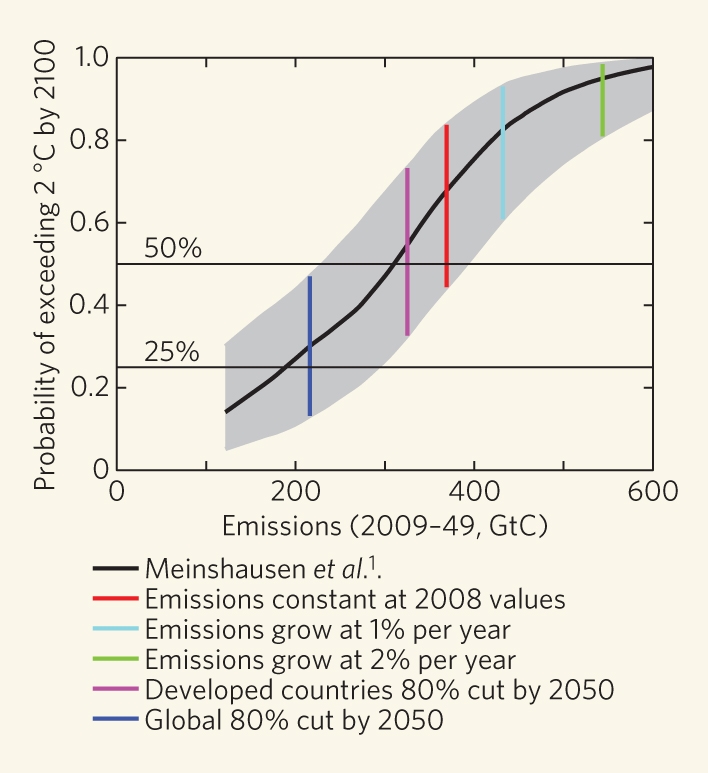
UPDATE:  I can't get the graph to size right. Blogger is not always the most adaptable graphic arts medium. So if you want to see the whole graph, the URL is http://www.realclimate.org/images/carbon_NV.jpg

The good people at RealClimate.org, a site everyone should consult periodically (link to the right) to see what the latest is on atmospheric science (as opposed to the pop-nonsense of uneducated pontificators such as George Will), have cited a couple of extremely elucidating studies in the current issue of Nature, from which the above graph of probabilities is taken.  Computer modeling of the climate continues to improve, and the bad news continues to pile up.  This is one of those situations in human history (perhaps unprecedented) when the doomsayers were simply not shrill enough. But everyone likes to appear "reasonable" at all times, I suppose, and not venture opinions beyond the available evidence.  The problem being, as pointed out by many, is that by the time conclusive proof arrives, the damage will be completely irreversible.

Actually, as the above graph demonstrates, the damage is already irreversible; it's now a question of whether we want to build on this catastrophe and take things all the way to nonviability.  Even if mankind were to cut CO2 emissions by 80% between now and 2050, there remains a possibility, projected as somewhere between 10% and 46% as I read the graph, that global average temperature will increase by more than 2 degrees C, which is about 3.6 F.  We've increased the average temperature so far due to AGW (anthrogenic global warming) by about .8C, or 1.44 F.  Thus, total warming of greater than 5 degrees F above preindustrial temperatures cannot be ruled out even with a "slam on the brakes" scenario, which, as you've probably noticed, is not exactly happening.

Business as usual is modeled as a 100% probability (virtually) that global warming will increase by more than 2 C.  Most of the projections based on business as usual lead to global warming of more than 5 C, or 8 F, which is a Game Over scenario.  

Since we have about 40 years to slam on the brakes to avert the worst of the possible outcomes (or minimize their likelihood), it would be good if Prez O and Steven Chu of the Dept. of Energy frankly admit that there just isn't time to reinstate the energy-profligate, consumer-oriented economy and that the upside of the recession is that it catalyzes a change that absolutely has to be made anyway.  

Then all that Barack has to do is explain to the Senate Gerontocracy what "global warming," "CO2," and the "atmosphere" are, and we're on our way.


May 01, 2009

Give Me That Old-Time...Waterboarding


First, I begin with a disclaimer: I am no grizzled war veteran, and I certainly have no desire to engage in the elaborate combat fantasies of chickenshits like George W. Bush and Dick Cheney, who did everything possible to stay out of harm's way when a war in which they firmly believed, the Vietnam conflict, was raging.  As in the case of, say, 99.9% of the American populace, and even 90% of uniformed cops, I have never fired a shot at a human being and I hope I live my whole life able to make that statement.  I've read a lot of World War II history, and it's my understanding that a majority of even combat troops never actually fired their weapons in an actual battle.


So I'm strictly using intuition and my imagination on this torture thing to create a hypothetical. I am imagining that I'm with a squad of American soldiers and for some reason we become trapped behind enemy lines during World War II.  We're in France, say.  Something like this actually happened to my uncle, who was a glider surveillance pilot in advance of D-Day. Anyway, we're disoriented, lost, and we come across a lone German soldier.  We capture him. What we want him to tell us is where the Germans are and the right way to move to get back to our own lines.  Under these circumstances, I don't think we're going to worry about the Geneva Conventions.  We need him to talk right away.  If it means pointing a revolver at his head, we'll do it.  Whatever it takes.  We'll also watch him closely to see if we can gauge whether he's telling the truth, because the truth is what we're after.  We're not going to rough him up just to rough him up.

I would not expect my buddies and me to be court martialed or tried as war criminals after the war is over.  I would not expect anyone ever to give it a condemning thought.  There were exigent circumstances and we did what any sane, self-regarding, even compassionate person would do.  I certainly would never think of "prosecuting" such soldiers for anything, so long as what they did was not gratuitous or sadistic just for the hell of it.  But that becomes an atrocity unrelated to the business at hand.

Let's imagine another scenario.  It's 2002 and George W. Bush, at the height of his Unitary powers, decides that Millicent S___, a Jefferson City, Missouri third grade teacher, a pale blonde woman about 28 years old, is an enemy combatant.  American patriots such as Charles Krauthammer, Samuel Alito of the Supreme Court, John Yoo of Cal's law school, Jay Bybee of the Ninth Circuit Court of Appeals, Rush Limbaugh, John Cornyn of Texas - they all think this is bold and great.  For some reason, Millicent is involved in international terrorism - so Bush says, and that's good enough for them.  She is captured, stripped, hooded, placed in an orange jumpsuit and shackled in the hold of a transport plane, then flown to Guantanamo.  She won't talk, however, other than to keep repeating there's been some terrible mistake.  Typical terrorist evasion, of course.  So she's stripped again, placed in a hypothermia cell where the temperature is kept at about 50 degrees, and left there with the lights on for about eleven days.  Occasionally she's brought out, shackled in a stress position, or a towel is placed around her neck so her head can be slammed against a wall repeatedly.  Then she's locked in a tiny box where she can't move, can't see, and can hardly breathe.  Still proclaiming her innocence, she's tied to a waterboard over and over and water is poured into her lungs.

Eventually she starts to talk.  Sort of delirious, she describes Afghanistan by saying it's a "mountainous area" and she wouldn't be surprised if bin Laden is still up there, and if there aren't more plots being hatched by a lot of the Arabs the interrogators have mentioned over and over during the last two weeks or whatever it's been.  She signs a confession and then is placed in a cage where she awaits...the end of the war on terror.

Well, we cracked Millie, at long last.  She was tough, she held out, but we got to her. 

"White evangelical Protestants were the religious group most likely to say torture is often or sometimes justified -- more than six in 10 supported it. People unaffiliated with any religious organization were least likely to back it. Only four in 10 of them did."


Pew Poll, April 30, 2009.

I would assume, therefore, that a majority of white evangelical Protestants in the United States would have no problem with our treatment of Millicent S____.  They would not see it as a sadistic fantasy from a pornographic magazine but as effective interrogation work.  Because, after all, this enthusiasm for torture must be based, in the final analysis, on principle and not on some retributive instinct or prejudice.  Note the similarities: Millicent was never tried and convicted of anything before her brutal treatment, exactly as in the case of the Arab detainees we have tortured.  All the rough stuff, the punishment, has preceded any form of judicial process in a court or tribunal.  No determination of evidence by an impartial judge has ever been made or sought.  We assume they're all guilty.  This was the logic of the Inquisition: we would not be burning your eyeballs out with a white hot poker if you were not an infidel, and if you say you're not an infidel, that only proves that you're a lying infidel entitled to even worse punishment, if we can think of something.

But the key word, the distinction, slipped into my comparison.  "Arab" detainees.  That's the real difference.  What is unthinkable for our demure ingenue from Jefferson City is okay if it's a Muslim Arab, because the profound racism of our white Evangelical population, that backbone of the modern Republican Party, provides for a clear distinction in the justice to which a white female American and an Arab Muslim are entitled.

It's an old story in American history.  It justified the internment of the Japanese, and only the Japanese, during World War II, although we were also at war with Germans and Italians.  Bush and Cheney knew it was okay to pick on Arabs because they could count on their party's base to look the other way.  These weren't Christians we were beating up; they were, to Bush/Cheney fans, untermenschen.  That's why, whenever I have blogged about this, I always specify that Bush and Cheney reserved the right to torture Arabs, or to deprive Arabs of habeas corpus, or to render Arabs to countries where torture was assured.

It's not a coincidence and it's not because all terrorists are Arabs.  It would have been unthinkable to waterboard Timothy McVeigh, or the Unabomber, or members of the Symbionese Liberation Army, or Bill Ayers and the Weathermen.  And here's the interesting part:  this prejudice has not gone unnoticed in the Muslim and Arab world.


This Week in Al-Obama©


I mean, I'd like to copyright that but Google would surely name me as a defendant in its "reverse class action" and declare itself the owner of Al-Obama© and that would be that.  So for the nonce, as the old-timey wordsmiths used to say, I'll declare it my own.


Other than the continuing Depression II and the near-term bankruptcy of Social Security, Medicare and the federal government, Al-Obama is holding up well, I think.  These are all problems which Barack indicated in his last press conference can be "handled."  I actually like his sunny optimism and can-do attitude.  Occasionally his answers betray an underlying grasp of the intractable nature of the problems he's dealing with, but this is in reality a good thing. For example, in Missouri (which he was careful to pronounce Missoura - he's a natural crowd pleaser), Barry copped to the coming insufficiency of current FICA payors to support the lazy-ass Baby Boomers who are beginning to retire in droves.  That small surplus paid in since the reforms (FICA tax hike) of the early 1980's created a delusional "trust fund" which Congress was quick to steal and spend on hi-tech weapon systems, replacing the looted cash with "government obligations," meaning T-bonds which the government promises to pay itself.  That is to say - Congress replaced the $2 plus trillion with nothing at all.  The trust fund does not exist.  It does not mean anything to use the term "trust fund" when there is no fund and there is no basis for trust.

What this means is that beginning in about 5 or 6 years, depending on how long the Depression lasts, the Social Security fund will go negative, and instead of a situation in which FICA receipts are a source of largesse for Congress to use in pleasing arms manufacturers in districts where races are tight, they will become the biggest of all drags - another debt.  Well, so what - Barack says it can be handled.  It can't, but that kind of thing doesn't matter anymore.

I did think that O did a better job both with his unscreened audience in Missoura and in his press conference of making the case that Bush left him the equivalent of a flaming bag of dog doo on the desk in the Oval Office.  Since the media-addled attention span of his subjects can't remember last week, let alone a year ago, this sort of proactive self-defense can't be used too often.  Just keep repeating that he inherited a government in financial ruin and an economy on life support, and blame it on Bush.  Otherwise, it won't be long before everyone begins arguing that the problems in Al-Obama© began on January 20, 2009.

A good case could actually be made that our descent accelerated in January, 1993, when Clinton took office.  Between 1993 and 2006, you won't necessarily be surprised to learn, the accumulation in wealth in the United States was allocated this way: 50% to the richest 1% of the populace, and 50% to the other 99%.  With money comes power, of course.  I do note that now that the Democrats are firmly in control of both Houses of Congress (although Harry Mumbles Reid claims, as always, that he just doesn't have the control he needs to do anything), they seem less inclined to pass laws of a populist nature.  Defeating the bankruptcy reform bill with its "cramdown" provision yesterday is a vivid case in point.  Suddenly, from the halls of the legislature, we hear cries about the "sanctity of contract" and the Contract Clause in the Constitution.  Article 1, Section 10 does forbid the "States" from passing laws which impair contractual obligations, but the clause has been interpreted loosely, like most things in the Constitution, to permit whatever the hell government needs to do in a specific situation, such as the 1934 Supreme Court case of Home Building & Loan Association v. Blaisdell 290 U.S. 398, which, during the Great Depression, allowed the courts to suspend foreclosures In fact, bankruptcy courts, in Chapter 11 cases, order "cramdowns" (reduction in the principal of a contractual obligation) all the time, every day, 24/7.  It's nothing new.  So when the Democratic Senators who work for Wall Street banks proclaim their devotion to the Contract Clause, it's completely bogus.

Bringing us back to the observations of Our Man From Russia, Dmitry Orlov, who has told us for years that the United States has two Center Right political parties, not a "right" and "left" party. The reduction of the "righter" of the two, the Republicans to a kind of freak sideshow has actually made it easier for the remaining viable party, the Democrats, to fill in the conservative vacuum, which they're anxious to do because that's where the money is.  So if ShittyGroup or BankstersofAmerica need work done by their Senators, they call on the Dems like Chris Dodd and Chuck Schumer, because the Republicans are frankly embarrassing to deal with at this point.  In yesterday's vote on the cramdown amendment, Schumer and Dodd could vote with the pro-little guy faction because they knew the amendment would lose, thanks to "liberal" Democrats like Nelson, Tester, Landrieu, Pryor and Our Newest Democrat, Arlen Specter of Pennsylvania.

It only makes sense that as money becomes increasingly vital to sustaining oneself in Congress that the conservative agenda of the donors with the most money (that upper crust 1%) would exert greater and greater control.  Political phenoms like Prez O are somewhat immune, since Obama can raise money directly from that large group called "American citizens," but he has to work with a thoroughly corrupt Congress, most of whom are about as charismatic as a bowl of oatmeal left out in the rain for a couple of weeks.

All things considered, I think Barack is about as good a President as we could possibly hope for in this country, which is why I favor a Constitutional Amendment changing our name to Al-Obama. He's conservative, really, he can't act boldly enough to actually deal with the dire problems we face, such as global warming and insolvency and mass unemployment, because the Washington Establishment would rather see a mass die-off in the United States than any reform which will negatively affect their Big Business paymasters.  But he's as good as it gets - rational, sane, adaptable, and doggone it - people really like him.

April 28, 2009

FAQ on Swine Flu


(Inspired by breathless reporting on CNN & other cable news outlets.)


Q:   Will everyone die?
A: Unfortunately, no.  The best we can currently hope for is massive social dislocation and panic, and maybe a few thousand deaths.  "A few thousand deaths" represent a rounding error unless they're caused by Arabs in hijacked airplanes.  Then the world must be changed completely to deal with the attack.  Even the Spanish flu of 1918 and the Plague of the Middle Ages failed to kill everyone, so this swine flu is likely to disappoint.  "Pandemic," however, is a cool word.

Q: Is swine flu a conservative or liberal issue?
A: Technically, it's a health issue, but we understand where you're coming from.  Efforts to deal with it through, say, medicine make it a liberal cause, because of the science involved.  However, it also has conservative bona fides in the sense that Mexican illegals can be blamed and hopefully shot by border vigilantes, particularly if the killings occur midday in time for the evening news cycle.  Swine flu may also be a sign of End Times in which case conservatives may argue against dealing with it at all based on the idea it's God's will. See, response to global warming.

Q: Why did pigs give it to us?
A: I'm surprised you have to ask.  Have you seen what we've done to them?  The average pig is smarter than the family dog and realizes he's being bred as a side dish for scrambled eggs. We're actually getting off pretty easy.

Q: How will we decide who gets Tamiflu and Relenza, the anti-viral drugs?
A: In the United States the life-saving drugs will be allocated based on how much money you have.  Poor people can use aspirin and Nyquil, if they can find a place to steal it.

Q: Why won't Republicans let us have a Secretary of Health & Human Services?  Wouldn't that be a good thing to have during a pandemic?
A: Probably, yes, but the idea of having a Cabinet-level person to direct an all-out effort to deal with the crisis must be balanced against Governor Sebelius's known preference for compliance with federal law in the form of Roe vs. Wade.  Understandably, this has upset Republicans who thought the Constitution was revoked in January, 2001.

Q: What's up with a virus that's part bird, part pig and part human?  Isn't that kind of freaky Frankenstein stuff?
A: We think so.  Also, an excellent metaphor for modern times.